Uncertainty about Hinkley nuclear project, despite UK govarnment’s approval
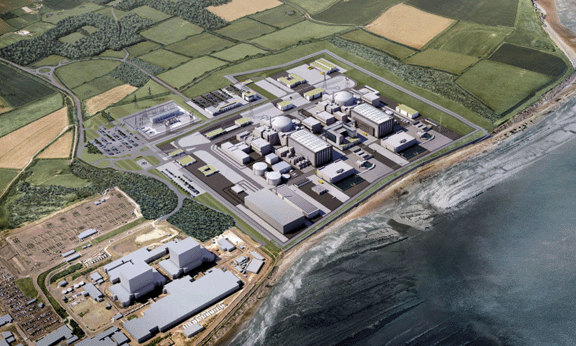 An amber light for China in UK nuclear power https://www.ft.com/content/40dbd3fa-7b2f-11e6-ae24-f193b105145e
Uncertainty about the £18bn Hinkley project survives a review After unexpectedly announcing a review at the end of July, the UK government has given the go-ahead for construction of the nuclear power station at Hinkley Point. This is the most important strategic decision since Theresa May became prime minister — one that has a bearing not only on the UK’s future competitiveness, but on its relations with China and France.
Regrettably, Mrs May has eschewed the chance to amend the commercial terms of the project, to be built at the gargantuan cost of £18bn by EDF, the French utility, with co-investment from the China National Nuclear Corporation (CNNC) and China Guangdong Nuclear Power. She has, though, announced a plan for new rules governing foreign investment in critical infrastructure. The impact of these on the nuclear programme is uncertain. If sufficiently stringent they could yet put the Hinkley project in doubt.
When it was first conceived a decade ago as part of plans to kick-start a nuclear “renaissance” as old coal-fired plants become obsolete, the Hinkley project was a more attractive proposition. Expected to be competitive with other power sources, it would also help Britain meet ever tougher emissions targets. A decade on — and at a time when the costs of wind power, solar energy and natural gas have all been falling — the price built into the deal is nearly four times higher. The French utility will receive more than double the present UK wholesale power price, indexed and guaranteed for 35 years. Questions therefore remain as to whether the project marries Britain’s energy needs with emission reduction targets in the most cost-effective way.
Mrs May ordered the review to assess concerns over the cost, the unproven technology involved and the role of Chinese investors in a plant that is due to meet about 7 per cent of domestic electricity demand. Her amendments all focus on national security. As part of a new, as yet unclear, legal framework for foreign investment in critical infrastructure, the government will in future hold a golden share in all nuclear power projects. Unexceptionally, this ensures that significant stakes cannot be sold without UK consent.
Of more concern potentially to Beijing is the additional security scrutiny to which the government plans to subject future nuclear projects. Again, the principle is sound from a UK perspective, but the details remain obscure.
China’s objective in putting £6bn into Hinkley Point was to be able to build its own reactors in the UK. During the “golden era” of Sino-UK relations proclaimed by the previous government of David Cameron when President Xi Jinping visited London last year, Beijing envisaged Hinkley as a springboard for its nuclear industry seeking other deals worldwide.
Both EDF and the Chinese have welcomed Mrs May’s decision to go ahead with the project. At least publicly, Beijing sees no obstacle towards its other planned investments with EDF. However, uncertainty over the long-delayed project has survived the review in important respects. Should additional regulatory scrutiny get in the way of Beijing’s other nuclear ambitions in the UK, notably a planned power plant at Bradwell, it could jeopardise the rationale for Chinese investment at Hinkley Point. EDF has warned that, without Chinese money, it may not proceed with the Hinkley scheme.
The last word on Hinkley may not have been written. Mrs May has addressed the concernsof security chiefs with a compromise that avoids an outright block. But she has deferred greater clarity on the extent to which she sees China playing a strategic role as an investor in the UK.
Hinkley nuclear station still might never happen
 Hinkley C nuclear go-ahead: May caves in to pressure from France and China, Ecologist Oliver Tickell 15th September 2016 It still might never happen
But despite today’s announcement there remains considerable uncertainty as to whether HPC will actually be built – among them legal challenges in the European Court to the unbelievably generous subsidy package for the project which appears to be incompatible with the EU’s ‘state aid’ regulations.
In addition both EDF and CGN, poised to take a 33.5% share in HPC, are unlikely to commit significant further capital to HPC until the Flamanville situation is resolved, and there is at least one working EPR to demonstrate that the design is constructable and operable – something that is still years away.
The highly risky (if potentially very profitable) project is also widely opposed within EDF as if it fails to ever generate power, or to operate reliably, it is likely to bankupt EDF. Also the company has yet to to line up the £16 billion (or more) it will need to finance its share of the project.
“This decision is unlikely to be the grand finale to this summer’s political soap opera”, said Greenpeace executive director John Sauven. “There are still huge outstanding financial, legal and technical obstacles that can’t be brushed under the carpet.
“There might be months or even years of wrangling over these issues. That’s why the Government should start supporting renewable power that can come online quickly for a competitive price.”
Richard Black, director of the Energy and Climate Intelligence Unit (ECIU), added:“Despite this being called a ‘final decision’ to build Hinkley C, other hurdles, including technical and legal challenges, may well lie ahead for the project.
“French trade unions don’t like it, nor do some of the likely candidates for the French Presidential Election next year, EDF’s finances are not the healthiest, and the French nuclear regulator is examining flaws in steel used for a similar reactor being built in France. So it may turn out not to be quite as ‘final’ as it looks now.
“Although China is reportedly happy with the new position, questions also remain over its main ambition – building its own nuclear reactors at Bradwell in Essex as a route into the Western market. The Chinese reactor hasn’t even begun the process of gaining UK safety approval, which usually takes four years, so negotiating a contract for Bradwell would fall to the next UK Government, not this one.
“And by then, electricity from other sources might look a whole lot cheaper than it does now.” http://www.theecologist.org/News/news_analysis/2988131/hinkley_c_nuclear_goahead_may_caves_in_to_pressure_from_france_and_china.html
New safeguards for Hinkley Point C nuclear power station “just window dressing”
Hinkley Point C nuclear power station gets government green light Labour and environmental groups say new safeguards for foreign investment are merely “window dressing”, Guardian, Rowena Mason, Simon Goodley, 16 Sept 16, Theresa May has been accused of backing down on security concerns about Chinese involvement in nuclear power after she gave the go-ahead to the £18bnHinkley Point C plant following a six-week review.
The government insisted the new plant in Somerset was only being approved with “significant new safeguards” to make sure China and other foreign investors could not own stakes in British nuclear plants without UK government approval.
However, Labour and environmental groups said the new security measures were merely “window dressing” and “hot air” that changed very little about the project, as the price remains the same and the new security powers already exist in law.
Under the proposals, EDF, the French firm building the plant with a £6bn investment from a Chinese state nuclear firm, will not be able to sell on its ownership without permission. For future projects, the UK government will own a “special share” that means it will have a veto over owners if there are national security concerns.
In a sign the new requirements do not appear to be overly stringent, both EDF and China General Nuclear said they were delighted by the approval, which they claimed will let them proceed with Hinkley and their wider plans for nuclear construction in the UK in future.
The Chinese are keen to proceed with a new plant at Bradwell in Essex in particular because it will be their own design built under the UK’s tough safety regulations, allowing the company to use it as a showcase to the rest of the world………
John Sauven, the Greenpeace executive director, also said the government’s review “appears to have been a lot of hot air”.
“The prime minister has baulked at the political embarrassment of irritating the French and offending the Chinese. Consequently, even if EDF manages to get the technology to work, the UK will pay the price by saddling themselves until 2060 with an out of date, flawed and expensive technology,” he said.
Clark, the business and energy secretary, said the new security restrictions were an improvement, claiming EDF would have been at liberty to sell its stake on without the revised contract.
His Department for Business, Energy and Industrial Strategy confirmed that this was the only new security requirement for Hinkley to proceed.
The controversial scheme in Somerset was approved six weeks after May unexpectedly placed the project under review, causing tensions with Beijing.
Following the review, the government is keeping a guaranteed price of £92.50 to EDF for every megawatt hour of electricity generated, despite concerns that is far higher than the market rate.
Chinese officials have previously given a series of veiled warnings that a decision by Britain to halt their investment in UK nuclear would be seen as a snub and would put at risk a supposed golden era of relations between the two countries.
The decision means Hinkley will be the first new nuclear reactor built in Britain in two decades……….https://www.theguardian.com/uk-news/2016/sep/15/hinkley-point-c-nuclear-power-station-gets-go-ahead
Why renewable energy is a better deal for Britain than Hinkley nuclear power
Nuclear power is risky and expensive; here’s a better idea https://www.theguardian.com/uk-news/2016/sep/15/nuclear-power-is-risky-and-expensive-heres-a-better-idea
It makes more sense to invest in renewables, efficiency and storage than spending billions on Hinkley Point C, Guardian, Damian Carrington, 15 Sept 16, In the 21st century, the UK will have to supply itself with power that is affordable, reliable and clean. But in almost every way, the proposed Hinkley Point C nuclear power station offers only expensive and risky solutions from the 20th century.
A nuclear power station is about as useful in solving the dilemma as a 20th-century nuclear weapon is in ending a 21st-century guerilla insurgency, because a ground-level energy revolution is taking place. The old regime of large, centralised power plants is being replaced a smart, efficient and widely distributed network, powered by increasing amounts of renewable energy.
If that sounds radical, it’s not – it’s just how the internet works to provide fast and reliable communications. If it sounds like a hippy dream, it’s not – New York State’s energy plan has embraced it in order to deliver 50% renewable electricity by 2030 and a 23% cut in energy use by buildings. In the UK, this government aims to improve the energy efficiency of just half the homes retrofitted by the last one.
If you think New York State is alone in its thinking – it’s not. Bodies including the government’s own National Infrastructure Commission(NIC), the National Grid and industry group Energy UK all point to a smart system that is more secure, cheaper and faster to build and they all use the same word: “revolution”, while the International Energy Agency talks of a rapid “transition”.
The momentum behind the revolution is straightforward: cost. While renewable energy and other energy technologies are plummeting in price, nuclear power continues its historical trend of getting ever more expensive. Even if the UK negotiates a sharp cut in the subsidies for Hinkley, it still could not be built before 2026 at the earliest. By then, a capacity crunch will have hit the UK as old power stations close.
Hinkley puts a lot of generation capacity in one plan , which is very risky given the financial, legal and technical obstacles it faces. EDF, the French company leading the project, is taking on considerable financial risk, with Martin Young, an energy analyst at investment bank RBC Capital Markets, saying the project “verges on insanity”.
Court challenges – including from EDF’s own trade unions – abound and the fiendishly complex project has been described by one nuclear engineer as unconstructable. Two attempts to build the same reactor in France and Finland are miles over budget and behind schedule.
In contrast, energy efficiency could deliver six Hinkleys’ worth of electricity by 2030, according to the government’s own research. Four Hinkleys’ worth could be saved by increasing the ability to store electricity and making the grid smarter, with the latter alone likely to save billpayers £8bn a year.
Capturing and storing carbon from fossil fuel plants is also vital, but has received scant attention from the government compared with Hinkley. It would halve the cost of beating global warming, according to government’s own official advisers, but in November ministers abruptly canned its plan. The government will not be able to get out of the Hinkley deal, however. Once signed, the deal with EDF contains a “poison pill” which could leave taxpayers with a £22bn bill if a future UK government shuts down the plant.
Closing down such a giant plant at short notice immediately puts the security of the nation’s electricity supply at risk. One back-up option recently favoured by the government is to deploy farms of diesel generators, which emit large volumes of carbon dioxide, ready to start up when needed.
Yet in a smart, distributed system, knocking out one wind turbine or solar panel is barely noticed by the grid.
The risk with Hinkley is that will it bring about the mutually assured destruction of both EDF and UK energy policy, with an expensive, hard-to-build reactor, in which the taxpayer will end up footing the bill.
World’s first large-scale tidal energy farm launched in Scotland

 All eyes on Scotland as world’s first large-scale tidal energy farm is launched on the Cromarty Firth, Thye National, SEPTEMBER 13TH, 2016 IT towers 49ft tall, weighs almost 200 tonnes and could mark the moment the tide turns for marine renewables, is is claimed.
The world’s first large-scale tidal energy farm was launched on Scotland’s coast yesterday.
The initial turbine for the MeyGen tidal stream project was unveiled at Nigg Energy Park on the Cromarty Firth, a former production centre for the oil and gas sector.
The massive structure, which will be installed in the Pentland Firth between Caithness and Orkney, has blades measuring 52 feet in diameter and developer Atlantis Resources eventually plans to add 268 others to create enough capacity to power 175,000 homes.
Maf Smith, deputy chief executive of industry body Renewables UK, hailed the development, saying: “New technology like this will be powering our nation for decades to come.”
Meanwhile, First Minister Nicola Sturgeon urged Westminster to honour a commitment to provide assurances for marine energy in its renewables support scheme or risk “irreparable damage” to the sector.
However, Tim Cornelius, chief executive of Edinburgh-based Atlantis Resources, said the launch was a “significant moment” for the green energy sector the world over…….http://www.thenational.scot/news/all-eyes-on-scotland-as-worlds-first-large-scale-tidal-energy-farm-is-launched-on-the-cromarty-firth.22312
Hinkley nuclear deal to be followed by an Essex nuclear deal with China?
 China to build nuclear reactor in Essex after Hinkley deal approved, Telegraph UK, Emily Gosden, energy editor 15 SEPTEMBER 2016
China is to begin developing a new nuclear power station in Essex after the Government heralded a new wave of UK reactors by approving the £18bn Hinkley Point plant in Somerset.
Chinese state nuclear firm CGN will fund one-third of Hinkley, which is led by French state energy giant EDF, in return for the chance to build its own design of reactor at Bradwell with EDF’s support………
The only change to the Hinkley deal is that the Government has taken powers to veto EDF selling its controlling stake in the project, leading critics to call Mrs May’s review “a lot of hot air”……..Both CGN and EDF made clear they did not regard the new safeguards as any obstacle to proceeding with the plans for a Chinese reactor at Bradwell.
Although ministers made no mention of Bradwell in their announcement, sources told the Telegraph that CGN had privately received Government assurance its plans, which were endorsed by the previous administration, were still welcome.
CGN said it was “delighted” by the Hinkley decision which would allow it to “move forward and deliver” Bradwell.
It is understood the firm hopes to begin the process of seeking UK safety approval for its Hualong One reactor design in the autumn. EDF has previously said such a plant could begin construction as early as 2022, subject to approval by UK regulators.
Mrs May’s joint chief of staff, Nick Timothy, has previously raised concerns that China could use its role in UK nuclear plants to “build weaknesses into computer systems which will allow them to shut down Britain’s energy production at will”………http://www.telegraph.co.uk/business/2016/09/15/china-to-build-nuclear-reactor-in-essex-after-hinkley-deal-appro/
Hinkley nuclear debacle should lead to a rethink of Britain’s nuclear programme
It’s astonishing. British governments have fiddled for a decade with the terms and structure of the Hinkley Point deal. The proposed agreement runs to thousands of pages, as you would expect with an £18bn contract to build the first new nuclear power station in the UK for a generation. Yet nobody seems to have considered what would happen if EDF, an over-indebted outfit over-reliant on the goodwill of current and future French politicians, ever wanted to sell Hinkley.
Theresa May’s review is a let-down on the central question of whether theHinkley Point C project should proceed; she should have binned the project because the technology was unproven and the financial terms a rip-off.
But she has addressed the question of future ownership. The UK government will be able to block EDF from selling its stake before and after construction. Similar powers will be secured in future by the UK government taking a special share in infrastructure projects deemed critical to the nation’s security.
This is welcome and overdue. Before the clause was inserted, it would have been possible, in theory, for EDF to sell its majority stake in Hinkley to its Chinese co-financiers, the state-backed CGN firm. Overnight, 7% of the UK’s energy supply could have been in the hands of a country with a long and dishonourable history of cyber espionage.
David Cameron and George Osborne, as they conducted their love-in with Beijing in recent years, ignored the worry in their desperation to find a new partner for EDF after Centrica, the owner of British Gas, dropped out of the Hinkley consortium in 2013. The energy select committee, shamefully, also danced around the subject of national security. May deserves some credit for addressing it.
The Brexit vote, incidentally, may have strengthened her hand. The EU tends to hate golden shares. Outside the club, it should be easier for the UK to adopt stronger protection over ownership of critical infrastructure. But the government is overstating matters when it says the UK’s policy will now fall into line with other big economies. The US imposes far stricter restrictions on foreign ownership of nuclear plants on its soil.
That is why, one assumes, the Chinese appear happy to accept May’s “significantnew safeguards”. For Beijing, the big prize has always been the chance to gain international recognition for Chinese technology by building a nuclear power station in Bradwell, Essex, to its own design. That prospect is still alive.
But let’s hope May’s brief probe of Hinkley heralds a deeper rethink on the UK’s entire nuclear programme. On cost and design, the adventure has lost touch with common sense.
First, cost. Hinkley, as everybody knows by now, is hideously expensive. If it were up and running today, EDF and CGN would be receiving annual revenues of £2.8bn, calculates Peter Atherton, of Cornwall Energy. But only £1.2bn would represent the market price of the electricity produced. The rest, £1.6bn, would be a top-up payment ultimately paid by the public.
The figure is large but, if it were a one-off, perhaps tolerable. The UK’s 27m households use about 40% of the country’s energy. Crunch the numbers and a theoretical “Hinkley subsidy” works out to about £24 per household a year at current prices.
The problem, of course, is that Hinkley in north Somerset is not a one-off. It will provide about 3,200MW of capacity. The government’s decarbonisation programme envisages up to 18,000MW of nuclear capacity by 2035. If Hinkley-style handouts are repeated, you’re talking serious money for consumers and a big hit to the competitiveness of UK industry.
That risk is real because of the second issue: the madness of a nuclear new-build programme in which all are invited to pitch. It’s not just China that wants to bring its kit – Japanese, South Korean and US firms are also on the ticket for new plants. The UK could end up building four different reactor designs from five different manufacturers. That is inherently more expensive than picking the best design, replicating it and harvesting economies of scale. The UK’s approach, argues Atherton, is “the equivalent of having the four new Trident nuclear subs built in different shipyards to different designs”.
It’s too late, it seems, to stop Hinkley. But May should order a rethink of the rest of the UK’s nuclear plan. It’s a badly designed mess that no other country would copy.
Hinkley nuclear and Brexit b- a bad deal for everyone concerned
How Hinkley delivers a bad deal for everyone http://blogs.reuters.com/breakingviews/2016/09/15/how-hinkley-delivers-a-bad-deal-for-everyone/ By John Foley
The economics of building Hinkley Point C for 18 billion pounds haven’t changed since last year, but they’re still not good. British energy users will effectively pay the difference between what operator EDF has been promised per megawatt hour, and the going market price. In September the UK government put that at 37 billion pounds over the contract’s 35-year life, or 15 billion pounds in today’s money.
It’s not much better for the French group. Should all go to plan, EDF could make a return on investment of around 9 percent a year, it says. But similar plants underway in France and Finland have run wildly over time and over budget.
Britain loses in another way too, because the new government is using Hinkley to launch a wide-ranging review of its authority to intervene in foreign takeovers of “critical infrastructure”. Over a decade ago, lawmakers deliberately took politics out of mergers. Interventions have been limited to matters of national security, media plurality and the stability of the financial system. The government now points out that other “major economies” have more stringent controls on foreign investment in infrastructure projects. That misses the point that Britain’s appeal has been that it is more open than places like France, China and the United States.
Why go ahead with such an unappealing project? The answer is Brexit. Voters’ decision to leave the European Union means Britain needs friends prepared to sign favourable trade deals. Scrapping Hinkley would poison the water for future talks with China, which is putting up a third of the cost of the project. Meanwhile, since almost half of Britain’s gas comes from continental Europe, developing more home-grown nuclear power may strengthen Britain’s hand ahead of negotiations over access to the single market.
Seen that way, going ahead with Hinkley may deliver a short-term benefit in the next couple of years, as Britain’s post-Brexit arrangements are hammered out. But the long-term disadvantages and financial costs will, like nuclear waste, contaminate the country for decades
Latest roundup on news on Britain’s planned Hinkley nuclear station
Bridget Woodman, Course Director, MSc Energy Policy, at the University of Exeter, says the Hinkley delay makes it possible to start debating the sorts of options being considered widely around the world, with measures to encourage more flexible, smaller-scale, renewable systems incorporating demand-side measures and new technologies such as storage. These are extraordinary times for energy policy in the UK.
After years of resigned acceptance that Hinkley would be built no matter how much of a basket case it was, even though few people argued that it makes sense, there is now a potential to have a real and considered debate about what sort of future electricity system we need. Now is the time to start considering the sorts of options being considered widely around the world, with measures to encourage more flexible, smaller-scale, renewable systems incorporating demand-side measures and new technologies such as storage. A system that is the absolute antithesis of what Hinkley Point C represents. Suddenly UK energy policy has become very exciting

 Hinkley Notes NuClear News No. 888 September 16 The Downing Street review of the proposed Hinkley Point C nuclear power station is coming to an end – and a decision will have to be made soon, probably before the end of September. The latest wave of public relations activity from EDF, the company that hopes to build the plant, shows how nervous the company is about the outcome. Given the range of doubts about the costs, the construction risks, the reactor technology and the involvement of the Chinese, that nervousness is well justified. (1)
Here are the news highlights from the last month.
It’s about the security stupid! The Times says the review centres on the security threat posed by allowing a Chinese company to invest in critical infrastructure in the UK. But officials are also puzzling over cost and value for money. Continue reading
Britain’s pro nuclear National Policy Statement on Energy is outdated and must be reviewed
In deciding when to review part of a national policy statement the Secretary of State must consider whether there has been a significant change in circumstances. If there has been a significant change in circumstances on which the policy regarding the need for new nuclear power stations was based; and if those changes were not anticipated at the time then the policy should be reviewed.
TASC concludes that the case for a review of EN-1 is unanswerable
 National Policy Statement on Energy NuClear News No 88 Sept 16 The government has a legal duty under section 6 of the 2008 Planning Act to review the National Policy Statement (NPS) on Energy, according to lawyers Leigh Day, because of dramatically changed circumstances over the last five years since the national policy statements enshrining the nuclear element were first published.
A report by Together Against Sizewell C (TASC) underlines the government’s duty to undertake a review and demonstrates why new nuclear has to be written out of the government’s energy policy.
The sections of the Overarching NPS on Energy (EN-1) which the TASC report says show the policy needs to be reviewed are section 3.5.1 to 3.5.11. Continue reading
Majority in Wales want electricity from renewable energy sources, not from proposed Wylfa nuclear station
Wylfa NucClear News No 88 September 16 A second consultation on the proposed nuclear power plant in Anglesey has been launched. Horizon Nuclear Power estimates Wylfa Newydd, which will include two reactors with a total capacity of 2,700MW, will take around nine years to build and have an operational life of 60 years. The consultation will run until 25th October. (1)
Nearly two-thirds of people in Wales want all of Wales’ electricity to come from renewable sources, a poll for the conservation organisation WWF has found. They also want the Welsh Government to invest more in improving the energy efficiency of homes. First Minister Carwyn Jones will publish his Programme for Government during the next few weeks and the focus is likely to be on how Wales adapts to Brexit. WWF is calling on the Government not to sideline investment in reducing emissions and tackling climate change. http://www.no2nuclearpower.org.uk/nuclearnews/NuClearNewsNo88.pdf
UK’s Hinkley nuclear deal teetering, but PM Theresa May claims good relations with China
 G20 summit: Theresa May says UK-China relations are about more than ‘Hinkley’ as deal teeters on edge The Prime Minister’s comments came as she prepared for a meeting with the Chinese premier at the end of the G20 summit Independent, Joe Watts Political Editor @JoeWatts_ Tuesday 6 September 2016 Theresa May has said the UK’s relations with China are “about more than Hinkley” as speculation mounted that the Prime Minister could pull back from the symbolically important £18bn nuclear scheme.
Ms May made the comments as she prepared for a meeting with Xi Jingpin, in which the Chinese President relieved a little pressure on her by saying he was willing to have “patience” in allowing her time to work out what she plans to do with the scheme his government has committed £6bn to.
The half-hour meeting that took place at the end of the G20 Summit in Hangzhou also saw Mr Xi say China would be “open” to bilateral trade arrangement.
It has already emerged that security around the planned nuclear power initiative at Hinkley is an issue officials are reviewing, and that at least one senior member of Mrs May’s team has serious reservations about the project.
Under the current deal which is yet to be signed, the Chinese would contribute funds towards building two reactors at Hinkley Point in a scheme led by French firm EDF, but it could then in turn lead to a further Chinese-designed power station at Bradwell in Essex.
The delay in finalising the agreement has threatened to overshadow Mrs May’s first major international summit, also her first visit to China. In Hangzhou, she and her team tried to move the story on UK/China relations off the Hinkley Point project and on to other areas. ……..http://www.independent.co.uk/news/uk/politics/g20-summit-theresa-may-uk-china-hinkley-point-xi-jingpin-edf-power-relations-are-about-more-than-a7227046.html
Energy chief says Hinkley Point is a deal out of date and too expensive
 Hinkley Point deal out of date and too expensive, says energy chief, Telegraph, UK, Emily Gosden, energy editor 3 SEPTEMBER 2016 The head of energy giant ScottishPower has waded into the row over Hinkley Point, insisting that the controversial subsidy deal for EDF’s proposed nuclear plant should be renegotiated because it is too expensive.
Keith Anderson, the firm’s chief corporate officer, said the deal, provisionally agreed by the Government in 2013 following lengthy negotiations, no longer made sense in the light of lower gas and offshore wind costs.
“It looks like a contract that was written five years ago on a business case that was probably pulled together 10 years ago. It looks out of line with what’s going on in the market now,” he said.
In an interview with Telegraph, Mr Anderson praised Theresa May’s “brave” decision to review the £18bn project and urged her to look at it in its entirety, not just her apparent concerns over Chinese state nuclear firms’ involvement.Becoming the latest high-profile figure to criticise the deal, Mr Anderson said that it now looked “expensive” and that gas and offshore wind offered faster, easier and cheaper ways of keeping the lights on and decarbonising, respectively.
“I can’t understand why anybody feels we need to sign a contract of that size and over that time period, at that price,” he said.
ScottishPower is seeking government support to develop both offshore wind and gas-fired power stations.
Its East Anglia offshore wind farm project last year won a subsidy contract at nearly £120 per MWh for 15 years. However, costs are falling rapidly, with ministers setting a cap of £105 per MWh on future contracts and a target of £85. EDF has insisted the deal is good value……http://www.telegraph.co.uk/business/2016/09/03/hinkley-point-deal-out-of-date-and-too-expensive-says-energy-chi/
Dangers of Sellafield nuclear site – a concern for nearby Isle of Man
 Isle of Man government ‘concerned’ about Sellafield safety, BBC News, 8 September 2016 Isle Of Man / Ellan Vannin The Manx government is “concerned” about the safety of the Sellafield nuclear site, a spokesman said.
On Monday, the BBC’s Panorama programme uncovered several safety concerns, from staffing levels to waste storage.
The Mannin Branch of the Celtic League has called on the Manx government to campaign for a full, independent inspection of the plant in Cumbria…….
The Isle of Man is located about 34 miles (55km) from the nuclear fuel reprocessing plant.
Due to its potential impact on the Manx fishing industry, the Manx government began monitoring radioactivity levels in the Irish Sea in 1989.
A government spokesman said: “Seafood fished in Manx waters can contain traces of radio-nuclides associated with effluent discharges from Sellafield to the Irish Sea, therefore these are monitored regularly to confirm that they remain well below maximum safe limits.”
The BBC investigation was prompted by a whistle-blower – a former senior manager who was worried by conditions at the plant…….http://www.bbc.com/news/world-europe-isle-of-man-37307763
Britain’s national disgrace: nuclear reprocessing at Sellafield
The National Audit Office (NAO) stated these tanks pose “significant risks to people and the
environment”. One official review published in The Lancet concluded that, at worst, an explosive release from the tanks could kill two million Britons and require the evacuation of an area reaching from Glasgow to Liverpool. These dangerous tanks have also been the subject of repeated complaints from Ireland and Norway who fear their countries could be contaminated if explosions or fires were to occur.
In short, the practice of reprocessing at Sellafield has been and remains a monumental national disgrace.
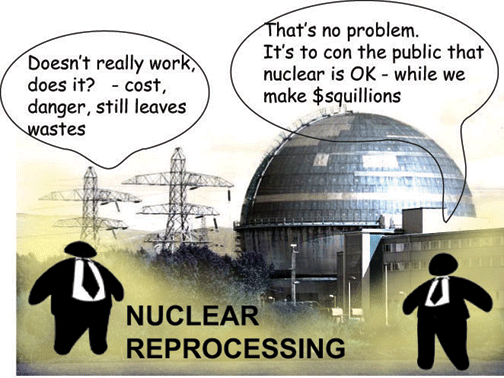
Especially serious are the ~20 large holding tanks at Sellafield containing thousands of litres of extremely radiotoxic fission products. Discussing these tanks, the previous management consortium Nuclear Management Partners stated in 2012:
“there is a mass of very hazardous [nuclear] waste onsite in storage conditions that are extraordinarily vulnerable, and in facilities that are well past their designated life.”
most of all, we should recognize that nuclear policies, in both weapons and energy, have poorly served the nation.
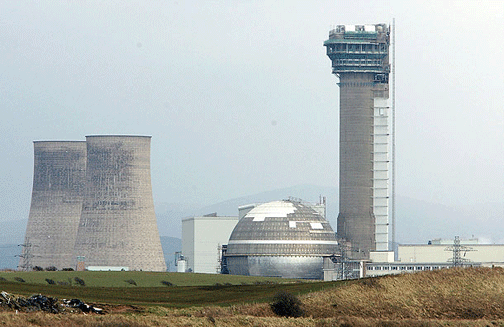 Sellafield exposed: the nonsense of nuclear fuel reprocessing http://www.theecologist.org/reviews/2988095/sellafield_exposed_the_nonsense_of_nuclear_fuel_reprocessing.html Ian Fairlie 6th September 2016 Last night’s BBC Panorama programme did a good job at lifting the lid on Britain’s ongoing nuclear disaster that is Sellafield, writes Ian Fairlie. But it failed to expose the full scandal of the UK’s ‘reprocessing’ of spent fuel into 50 tonnes of plutonium, enough to build 20,000 nuclear bombs – while leaving £100s of billions of maintenance and cleanup costs to future generations.
Many readers will have seen the interesting Panorama programme on the poor safety record at Sellafield broadcast on BBC1 last night.
The BBC press release stated this was a “special investigation into the shocking state of Britain’s most hazardous nuclear plant” – and it certainly was.
The most important of several whistleblower revelations was that the previous US managers had been shocked at the state of the plant when they took over its running in 2008.
Although the programme producers are to be congratulated for tackling the subject, it was only 30 minutes long and tells only a fragment of the whole sorry story.
This article tries to give more background information, and importantly, more analysis and explanation. The full story would require several books, and provide exceedingly painful reading.
What is reprocessing for? Continue reading
1 This Month





PLEASE OPPOSE HR 8255 AND S.3639 – bills would accelerate satellite deployment, with no environmental review or safeguards – https://ncstd5li.quorum.us/campaign/169331/
To see nuclear-related stories in greater depth and intensity – go to https://nuclearinformation.wordpress.com
-
Archives
- October 2026 (49)
- September 2026 (339)
- August 2026 (330)
- July 2026 (355)
- June 2026 (287)
- May 2026 (306)
- April 2026 (356)
- March 2026 (251)
- February 2026 (267)
- January 2026 (308)
- December 2025 (358)
- November 2025 (359)
-
Categories
- 1
- 1 NUCLEAR ISSUES
- business and costs
- climate change
- culture and arts
- ENERGY
- environment
- health
- history
- indigenous issues
- Legal
- marketing of nuclear
- media
- opposition to nuclear
- PERSONAL STORIES
- politics
- politics international
- Religion and ethics
- safety
- secrets,lies and civil liberties
- spinbuster
- technology
- Uranium
- wastes
- weapons and war
- Women
- 2 WORLD
- ACTION
- AFRICA
- Atrocities
- AUSTRALIA
- Christina's notes
- Christina's themes
- culture and arts
- Events
- Fuk 2022
- Fuk 2023
- Fukushima 2017
- Fukushima 2018
- fukushima 2019
- Fukushima 2020
- Fukushima 2021
- general
- global warming
- Humour (God we need it)
- Nuclear
- RARE EARTHS
- Reference
- resources – print
- Resources -audiovicual
- Weekly Newsletter
- World
- World Nuclear
- YouTube
-
RSS
Entries RSS
Comments RSS

