UK energy policy- economic and moral bankruptcy with nuclear and fracking
 Nuclear and fracking: the economic and moral bankruptcy of UK energy policy, Ecologist, Peter Strachan & Alex Russell, 27th September 2016 With its choice of Hinkley Point C – a £100 billion nuclear boondoggle – its enthusiastic support for expensive and environmentally harmful fracking, and its relentless attack on renewable energy, the UK government’s energy policy is both morally and economically bankrupt, write Peter Strachan & Alex Russell. It must urgently reconsider this folly and embrace the renewable energy transition
As Prime Minister Theresa May and EDF prepare to sign the Hinkley Point C contract, and Scotland sees the first shipment of fracking gas from the United States, it is perhaps timely to reflect on recent developments in UK energy policy.
Both new nuclear build and UK onshore shale gas and oil extraction fail key environmental, safety and economic tests.
The UK has recently committed to a nuclear renaissance, with Greg Clark, the Secretary of State for Business, Energy and Industrial Strategy (BEIS) at Westminster, describingthe “dawning of a new age of nuclear”.
But by commissioning French and Chinese companies to build the first UK nuclear power station in a generation, the Hinkley Point C deal has come in for almost universal condemnation.
Theresa May clearly buckled under economic pressure from China and has backed nuclear power as the panacea to combat the electricity crunch that we face. Her questionable decision means the UK is committed to a long-term very expensive project that comes with national security and many other concerns.
Empty promises
In 2007 the Chief Executive of EDF’s UK arm effectively cooked his own goose by claiming that Brits would be cooking their Christmas turkeys using nuclear power generated from Hinkley Point C by 2017. Now EDF are claiming that they won’t go over budget, when the new power plant is delivered some time in 2025.
If ongoing experience in France and Finland is anything to go by, and with apparently few financial penalties in place for late delivery, there are serious doubts that the project can be completed in the revised timescale and on budget.
Turning to the financials, the costs of the project are just enormous. Some have claimed that Hinkley Point C will end up being the most expensive physical object ever built. The project is a £100 billion boondoggle. The construction costs alone are in the region of £18-£25 billion. Then there are the subsidies that will amount to a conservative £1 billion plus per year, for at least 35 years.
The deal penned is inflation linked at more than twice the cost of current wholesale electricity prices. The plant will then operate for a further 30 years. It has a potential life span of around 65 years and it will continue to be a drain on public finances even after the initial lucrative contract has expired.
Then try to add into the calculus the unstated decommissioning and radioactive waste management costs, and it soon becomes apparent these super-burdensome costs and risks are incalculable.
If Sellafield in Cumbria, England, is used as a baseline, such costs are just eye watering. Indeed, bucket loads of money amounting to tens of billions of pounds have already been spent, trying to make safe the UK’s nuclear legacy. Based on the available evidence one can only conclude that cheap and clean nuclear power is a myth.
Fuel poverty for future generations
In terms of what Hinkley Point C will mean for household budgets, it is estimated that it will push up individual electricity bills by around £50 per annum. But this is just the start of such price rises as Hinkley Point C is the first of a number of new nuclear projects.
It is only around 3 GW of a 16 GW plus plan. Electricity bills will spiral out of control, as they did a few years ago when there were regular inflation busting price increases. The new nuclear age described by Greg Clark will surely set us on a path to fuel poverty for decades.
Even if households and business can afford such future hideous electricity bills, it might be 2030 before we see the plant operational – more than a decade later than was initially planned. Its promise to generate up to 7% of the UK’s electricity demand will be delivered around a decade too late to meet the 2020 electricity crunch that the UK faces…….
Glittering prizes or fracking folly?……..
Can we have more renewables please?
Most people don’t realise that renewables now supply around 25% of UK electricity and in Scotland it is over 50 per cent. Their market share has grown rapidly in recent years, trebling between 2010 and 2015.
Renewables now supply more electricity to the national grid than nuclear power and coal. They are very popular with the general public, cost-effective, and can be deployed very quickly, compared to the nuclear and shale options just outlined. They are also cleaner energy sources, and given all of these positives should surely be deployed to address the looming electricity crunch that threatens the UK.
But for the past two years the renewables industry has been under attack by the Conservative government. Changes to financial support mechanisms and the planning regime are now bringing onshore wind to a standstill. Solar support is being killed off. And while there is much rhetoric around offshore wind, it is actually progressing at a snail’s pace.
The direct effect of Conservative government policy changes has led to many thousands of green jobs being lost.
Another emerging and detrimental effect has been to undermine local community initiatives. In addition to supplying much needed electricity and investment in local assets such as community halls, churches and youth projects, community owned renewable projects encourage energy conservation, and have wider and important public education benefits.
If ever we needed some sign of reprieve for UK renewables, it is now.
A call to action
Westminster must get back on course and harness the heat of the sun, and the (gale) force of our wind, and the power of our waves and tides. It should fully embrace the energy transition from fossil fuels and nuclear power, to a renewable energy future.
Germany, Europe’s strongest economy, gets it and is making huge strides with their ‘Energiewende‘ strategy. The Scottish Parliament at Holyrood also gets it, and to pinch a phrase from former First Minster Alex Salmond, we have the potential to become the“Saudi Arabia of Renewables“.
The future of humanity depends on an all-encompassing global acceptance of the replacement of fossil fuels and nuclear power by renewables. If there is still a perception that British moral values lead where the world follows then its status is at best precarious.
Theresa May and Greg Clark must step up to the plate and nail the renewables flag to the top of UK energy policy. Nuclear power and fossil fuels have no economic or moral right to a long-term place in UK energy policy.
Peter Strachan is Professor of Energy Policy, Robert Gordon University. He tweets@ProfStrachan.
Professor Alex Russell is Chair of the Oil Industry Finance Association.
Authors’ note: The opinions expressed in this article are those of the authors and not those of the Robert Gordon University or Affiliates.
This article was orginally published on EnergyPost.eu. http://www.theecologist.org/News/news_analysis/2988167/nuclear_and_fracking_the_economic_and_moral_bankruptcy_of_uk_energy_policy.html
Professor Geraldine Thomas and nuclear scientific misconduct
 This is part of a very important article, in which Dr Baverstock thoroughly refutes the claims that Professor Geraldine Thomas’ made in a BBC interview, about Fukushima ionising radiation not being much to worry about. The BBC has since withdrawn her statements.
But that hasn’t stopped the South Australian government bringing Thomas out here to spin her stuff, in  support of Weatherill’s push for SA as the global nuclear waste dump.
Thomas’ comments in the video were insulting to the intelligence of the Japanese authorities and their advisors, and extremely ill-judged from a professional radiological point of view. The BBC was right to withdraw her comments as incorrect.
 ‘This was quite clearly scientific misconduct’ by Dr Keith Baverstock, Fissiononline 23 Sept 16 . I will take the BBC interview first. In this interview Thomas questions the whole basis of the Japanese response to the Fukushima accident in terms of its evacuation policy. Is one to imagine that those authorities and the Japanese scientific establishment are so stupid as not to recognise that there is no risk entailing living in those areas?
The internationally agreed public dose limit is 1 mSv per year in addition to approximately 2 mSv per year from natural background radiation. The single measurement made in that television interview indicate 2.8 microsieverts per hour, which is close to 25 mSv per year. That includes the natural background doses o at that point the dose rate is at least 20 times the public dose limit.
Surely Thomas can recognise that this must demand serious consideration by the appropriate authorities as to the safety of those who would live there? However, to determine the safety or otherwise of living there it would be necessary to do a comprehensive survey of the area. My guess is that five years after the deposition of the radioactivity there will be a high degree of variability in measurements: some may be less in the measurement made on the programme, but others more and perhaps considerably more. Furthermore, if one were looking at a situation, for example in the UK, one would have to ensure that the most exposed person could not receive more that 1 mSv per annum. Therefore promises arguments that being indoors for example would reduce the dose rate are not valid in the context of the radiological protection of the public in general.
Whether a special dispensation applies when determining the return of evacuees to their homes is a question that I believe needs to be discussed, because as far as I’m aware the current situation in Japan is unique. Furthermore, we are not talking about a total dose of 20 mSv for someone who returns to live in this village. In many such villages remedial measures to reduce the dose rate are being taken, but only for the main “living areas”. Straying beyond these areas could lead to much higher doses, and eating natural produce, mushrooms etc, to even higher doses.
In the light of these considerations, Thomas’ comments in the video were insulting to the intelligence of the Japanese authorities and their advisors, and extremely ill-judged from a professional radiological point of view. The BBC was right to withdraw her comments as incorrect if that is indeed what they did.
Watching the video I am inclined to believe that Thomas is being disingenuous when she says she made a numeric al error when calculating the dose from the interviewer’s measurement. She made no attempt to do any kind of calculation: the figure she cited was something she clearly had in mond at the outset: she was delivering propaganda for the nuclear industry
That in the context in which the interview took place and the way in which she was introduced to the audience, is clearly scientific misconduct. One must also say here that the ninterviewer must have been, for an experienced journalist, amazingly gullible to have allowed the interview to be broadcast……….. https://issuu.com/fission/docs/fissionline_44
Dr Keith Baverstock led the Radiation Programme at the World Health Organisation’s Regional Office for Europe from 1991 to 2003.
BBC and Science Media Centre (SMC UK) are pro nuclear spruikers
the BBC Science team’s involvement in a shocking display of bad science during the commemorations of the 2011 disaster in 2016 March this year. Even though there was outrage in the scientific community at the Fukushima video, it was some months before the BBC quietly took down the video.
the public that saw the biased Fukushima video were unaware of the wrong and dangerous information that was given.
There are many other articles out there that show the BBC defending Geraldine Thomas (BBC Expert) after the complaints came in and rebuffs for that on fissionline magazine and this was also added pressure that forced the BBC to take the Fukushima video down. (Ed note: Geraldine Thomas is currently in Australia, extolling the benefits of the nuclear industry, and downplaying the health effects of ionising radiation) )
Sellafield – Contempt of Parliament – BBC News missed 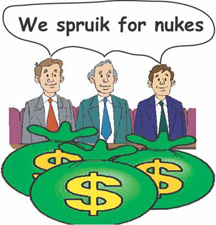 it. https://europeannewsweekly.wordpress.com/2016/09/19/sellafield-contempt-of-parliament-bbc-news-missed-it/by arclight2011part2 The nuclear industry supported press, in rebuffing the BBC Panorama teams claims of safety issues and lies to Parliament, we see some counters to the safety concerns but no response to the well documented evidence of the head of the Sellafield consortium lying to the Parliamentary committee and covering up the grave incident of plutonium release (and its cost) in November 2014.
Tony Price lies to Parliament (from Panorama Documentary) [on original]
The Spokesperson for Sellafield can be seen on the video acting a bit surprised at the questioning and revelations the Panorama reporter revealed. He just denied that any “spin” (ie lies) were said during the Parliamentary committee and that is the last word we have on this explosive revelation of criminality from the nuclear industry.
It is most surprising that the BBC News office did not pick this up as we see on the BBC web site they are fully aware of the issue of contempt of parliamentary procedure;
“….Examples of contempt include giving false evidence to a parliamentary committee, ….The Commons has the power to order anyone who has committed a contempt of Parliament to appear at the Bar of the House and to punish the offender…..”2008 BBC
Since that report was uncovered, the nuclear industry and their PR and government connections have swayed the public and eased their fears. The BBC and Science Media Centre (SMC UK) (Also called Sense About Science) was crucial to doing this and at the same time minimising the environmental and health impacts of the 2011 Fukushima disaster that had caused a huge drop in investor interest in nuclear projects.
So in the last 5 years the BBC has produced many supportive documentaries and educational materials favouring nuclear energy (Since the SMC UK started to receive large corporate funding) . In fact at the end of last year, the BBC science department was involved with promoting Sellafield and largely ignoring the many problems that existed there.
That was followed up by the BBC Science teams involvement in a shocking display of bad science during the commemorations of the 2011 disaster in 2016 March this year. Even though there was outrage in the scientific community at the Fukushima video, it was some months before the BBC quietly took down the video. Thereby, much of the public that saw the biased Fukushima video were unaware of the wrong and dangerous information that was given. Then just a couple of months ago a high profile visit to Sellafield by dignitaries was to underline the improvements and give Sellafield the all clear. Still other experts tried to combat the BBC and SMC UK PR management of all media regarding nuclear;
“The Ecologist, 12th August 2015 Dr David Lowry
Professor ‘Jim’ Al’Khalili’s ‘Inside Sellafield’ programme was a tour de force of pro-nuclear propaganda, writes David Lowry – understating the severity of accidents, concealing the role of the UK’s nuclear power stations in breeding military plutonium, and giving false reassurance over the unsolved problems of high level nuclear waste…”
The main thing for the BBC, government and nuclear industry was that the nuclear industry was still being perceived as above board and transparent. We saw a similar maneuver after the release of the Panorama Documentary on its You Tube site (Under BBC management orders?). The video was removed after just a few hours of being uploaded and after the link had been shared to an international social media audience. The video was put back up sometime later but after the interest had passed.
Although the media has largely ignored this story many experts have been commenting on the situation in Sellafield and there is a lot of well sourced data that bears the whistleblowers observations and claims (See source links below) . But it is the criminal manipulation of politicians during the Parliamentary committee process that demands our immediate attention. It undermines our Democracy.
Whilst discussing the issue of coverage, by the BBC, of the nuclear industry (with the exception of the excellent undercover investigative abilities of the BBC Panorama team) , I asked an experienced Science Media journalist and Author on how he viewed the BBC`s general coverage of nuclear matters over recent years and he had this to say;
“The BBC is guilty of a journalistic disgrace.” Karl Grossman, Professor of Journalism, State University of New York/College at Old Westbury, USA. [11th September 2016]
Meanwhile in the UK Paul Dorfman (Energy analyst spokesman for main stream UK media) said to me;
”Recent events reveal the ongoing national disgrace that is Sellafield, including the truly appalling state of the historic spent fuel ponds’….”
And Paul Dorfman was able to qualify his point through the excellent investigative work of the Panorama team. [11th September 2016]
In France an Energy systems engineer, well versed in La Hague (The French equivalent to Sellafield) and its impacts said this in response to a discussion on the Panorama revelations;
“….those plants, Sellafield and La Hague, would exterminate the whole world population in under 40 years, because there are tons of plutonium in Sellafield and tons in La Hague adding thousand times more than necessary to exterminate all animals through the world. The biggest aberration of history, the timing bomb for the global extinction, a potential aschimothusia .[“sacrifices” committed by force of a state ] …” Xavier Nast 11 September 2016
Marianne Birkby confirmed to me the ongoing “legacy” of dangerous safety practices at Sellafield;
“…The state of the Sellafield ponds is described by the BBC as an “historic legacy” but the “legacy” is ongoing with every reactor that continues to burn nuclear fuel whose waste is sent to Sellafield for reprocessing. . The now infamous photographs of the shocking state of the Sellafield ponds that were given to Radiation Free Lakeland by a brave whistleblower are not “historic.” Those shocking photographs are a graphic illustration of the continuing madness of nuclear power….” Marianne Birkby, Founder of Radiation Free Lakeland 11 September 2016
Sources for this article (Not already linked above)
The BBC Panorama You Tube documentary linkhttps://www.youtube.com/watch?v=JZ1i3HScYak
Dr Lowry http://drdavidlowry.blogspot.ie/2016/09/inside-sellafield-and-military.html?spref=tw
Dr Ian Fairlie response to the Panorama findings and historical summary on Sellafield here http://www.ianfairlie.org/news/bbc-panorama-programme-sellafield/
Critical scientific analysis of the BBC Science departments dangerous and insulting attempts of reporting on Fukushima (And the reason that the BBC had to take down the video, some months later. The comments on this video are enlightening and you can see both pro nuclear and anti nuclear people actually agreeing and making known their complaints to the BBC) – March 2016https://www.youtube.com/watch?v=qrgdAA5oiIA
Note from writer; There are many other articles out there that show the BBC defending Geraldine Thomas (BBC Expert) after the complaints came in and rebuffs for that on fissionline magazine and this was also added pressure that forced the BBC to take the Fukushima video down.. The whole story of BBC bias in Energy matters is too vast to cover here but I leave you with the above Key words and links (for the researcher) . The truth will out!! – Shaun McGee
180 mishaps in UK nuclear waste transport vehicles
 UK nuclear weapons convoys ‘have had 180 mishaps in 16 years’ Vehicles carrying nuclear weapons have had collisions, breakdowns and brake failures, disarmament campaign says, Guardian, Rob Evans, 21 Sept 16, Military convoys carrying nuclear weapons through Britain’s cities and towns have experienced 180 mishaps and incidents, including collisions, breakdowns and brake failures during the last 16 years, according to a report produced by a disarmament campaign.
The incidents catalogued in the report – based on official logs released under theFreedom of Information Act – include fuel leaks, overheated engines, clutch problems, and other mechanical faults in the convoys.
At other times, according to the report, the convoys went the wrong way, were diverted, and lost communications with commanders. The rate at which the incidents have occurred has risen in recent years, with 43 in the last three years.
In its report published on Wednesday, the International Campaign to Abolish Nuclear Weapons (Ican) warns that a serious accident involving the convoys could spread radioactivity over cities, contaminating communities and increasing cancer risks.
The convoys pass through cities and towns between Scotland and southern England. However, an opinion poll commissioned by Ican shows that nearly two-thirds of British adults did not know that the military transports nuclear warheads on British roads, prompting the campaigners to argue that members of the public have not given their consent to the dangers they pose.
Materials for nuclear weapons are driven through or flown over 122 local councils in the UK, including densely-populated areas such as Bristol, Birmingham, Cardiff, Edinburgh, Glasgow, Leeds, Liverpool, Sheffield, Manchester and Newcastle, according to Ministry of Defence data…….
The Ican report describes how nuclear warheads are carried in dark green, 44-tonne trucks between a bomb factory at Burghfield near Reading in Berkshire and a naval depot at Coulport on Loch Long near Glasgow, where they are loaded onto submarines.
The 900-mile round trips, usually spread over one or two days, are completed between two and six times a year, with the most recent onereported to have been completed this week.
According to Ican, the convoys – comprising up to 20 vehicles including police cars and a fire engine – use a variety of routes. One from Burghfield, where the warheads are assembled and maintained, goes along the M40, round Birmingham and past Preston on the M6, and then the M74 to Glasgow……..
Matt Hawkins, spokesman for Ican, said the report “painted a grim picture of the great risks posed by nuclear convoys”, adding that nuclear weapons “only add danger to our lives, exposing us all to the risk of radiation leaks or an attack by terrorists on one of these convoys”.
In 2003, following pressure from the Guardian, the MoD was forced to publish a list of accidents involving nuclear weapons between 1960 and 1991 after decades of secrecy. It showed that the weapons had been dropped, struck by other weapons and carried on a truck that slid down a hill and toppled over. https://www.theguardian.com/uk-news/2016/sep/21/uk-nuclear-weapons-convoys-have-had-180-mishaps-in-16-years
UK Liberal Democrats oppose Hinkley nuclear plan – ‘very poor value for money’
 Lib Dems vote to oppose Hinkley nuclear plant in emergency conference motion, Left Foot Forward,
Adam Barnett 19 September, 2016 Project is ‘very poor value for money’ and we should use renewable energy instead, say members Liberal Democrats voted to oppose a new nuclear power station at Hinkley Point C today in an emergency policy motion at party conference.
The party agreed this morning that the new £18 billion plant in Somerset was ‘very poor value for money’ for consumers and proposed renewable energy instead.
The motion also noted that similar nuclear plants in France and Finland are both ‘years behind schedule and significantly over budget’.
It concludes:
‘Conference believes that construction of a new nuclear station at Hinkley Point is both entirely dependent on public subsidy and represents very poor value for money for UK consumers, and that therefore it should be opposed.
Conference calls for a UK energy strategy resting on investments in energy efficiency, renewable energy, storage and interconnection with European grids, thereby providing energy security, an end to fuel poverty and the reduction of greenhouse gas emissions at the same time as creating jobs, exports and prosperity.’……..https://leftfootforward.org/2016/09/lib-dems-vote-to-oppose-hinkley-nuclear-plant-in-emergency-conference-motion/
China’s nuclear marketing plan gets a big boost from Theresa May’s decision to go ahead on Hinkley project
 British Project May Clear Way for China’s Nuclear Exports to the West VOA, Saibal Dasgupta, 20 Sept 16 BEIJING —
There’s a whole lot more in British Prime Minister Theresa May’s decision to allow a Chinese company to invest in the Hinkley Point C nuclear plant than mere business.
Chinese investment is limited to investing funds in the $24 billion project, which will use two French reactors supplied by Electricity de France. But the project could clear the way for Chinese involvement in a more crucial project at Bradwell, east England, which would allow China to export its nuclear technology to the Western world, analysts say.
China General Nuclear Corporation, the investor in Hinkley Point, already has signed a pre-feasibility agreement for the Bradwell project……..
Only a few developing countries like Pakistan are using Chinese reactors. These countries are not known to have the kind of strict regulatory control seen in the West.
The Bradwell B project could be a game changer. Getting regulatory approval in Britain for its reactors is crucial for China because it can open the doors for Chinese nuclear exports to the West……..
But there’s many a slip between May’s lip and China’s cup of hope. Britain already is in the midst of fierce debate with critics voicing concern about security issues. Critics question a provision in the contract that provides for a fixed electricity rate for 35 years at a time when energy prices are falling, and are expected to be much lower in the future……..
For Beijing, British approval for the Hinkley Point project is a major image booster, analysts say. Chinese business is seen in the West as an acquirer of property and trader of low-tech, unbranded goods, they point out…….http://www.voanews.com/a/british-project-china-nuclear-exports-west/3517485.html
Scotttish politicians slam the danger, secrecy, of hazardous air transport of nuclear wastes
 There’s no safe way to move nuclear waste’: Scottish Politicians slam nuke flight that needed armed cop convoy http://www.dailyrecord.co.uk/news/scottish-news/gun-cop-8859315, 18 SEP 2016 BY JIM LAWSON Green MP John Finnie and Caithness MP Paul Monaghan among those to voice concerns about flying nuclear waste to the US. THE first flight believed to be carrying British nuclear waste to America took off from Wick Airport amid tight security yesterday.
Scots politicians and anti-nuclear campaigners have slammed the deal, brokered by David Cameron and Barack Obama, to move the waste.
 The airport was closed from early morning as armed police patrolled the perimeter.
Twenty miles away in Thurso, more armed officers escorted a lorry from the
Dounreay nuclear plant through the town. It was carrying two heavily reinforced containers.
At 11.40am, a police convoy brought the containers on to the runway.
A US Air Force transport plane landed 10 minutes later and loading began almost immediately. The plane took off two-and-a-half hours later.
The plan to transport highly enriched uranium from Dounreay to the US emerged late last year.
Dounreay bosses won’t confirm or deny the scheme, but Cameron revealed after talks with Obama earlier this year that uranium from the plant would be moved to South Carolina.
Other types of uranium will be sent to Europe in exchange and used to make medical isotopes. But Dr Richard Dixon, director of Friends of the Earth, said: “There is no truly safe way to move this waste.”
 Caithness MP Paul Monaghan said the deal was “morally reprehensible” and Green MP John Finnie said people would be stunned that nuclear waste was being transported by plane.
Nuclear expert John Large said: “The risk in transport by air is the fuel being engulfed in fire, the packages breaking down and the fuel igniting.”
The runways at Wick have been extended at a cost of £18million to take the US planes, and Highland Council have published an order allowing local roads to be closed for five hours at a time until March 2018.
 Police refused to comment on yesterday’s operation for security reasons.The first flight believed to
be carrying British nuclear waste to America took off from Wick Airport amid tight security yesterday.
Scots politicians and anti-nuclear campaigners have slammed the deal, brokered by David Cameron and Barack Obama, to move the waste.
The airport was closed from early morning as armed police patrolled the perimeter.
Twenty miles away in Thurso, more armed officers escorted a lorry from the Dounreay nuclear plant through the town. It was carrying two heavily reinforced containers.
At 11.40am, a police convoy brought the containers on to the runway.
A US Air Force transport plane landed 10 minutes later and loading began almost immediately. The plane took off two-and-a-half hours later.
The plan to transport highly enriched uranium from Dounreay to the US emerged late last year.
 Dounreay bosses won’t confirm or deny the scheme, but Cameron revealed after talks with Obama earlier this year that uranium from the plant would be moved to South Carolina.
Other types of uranium will be sent to Europe in exchange and used to make medical isotopes. But Dr Richard Dixon, director of Friends of the Earth, said: “There is no truly safe way to move this waste.”
The runways at Wick have been extended at a cost of £18million to take the US planes, and Highland Council have published an order allowing local roads to be closed for five hours at a time until March 2018.
Police refused to comment on yesterday’s operation for security reasons.
Britain’s nuclear gamble will cost every UK family an extra £1,000
 The £18bn Hinkley gamble: Nuclear deal will cost every UK family an extra £1,000 as May signs off on the plans to protect Britain’s national security
- Prime Minister approved plans after restricting influence of Chinese state
- Britain will guarantee EDF £92.50 per megawatt hour, up on current market price of £38.91
- Tory MP Zac Goldsmith said the plant would generate ‘most expensive energy in the history of energy generation’
By JASON GROVES DEPUTY POLITICAL EDITOR FOR THE DAILY MAIL, 16 Sept 16
Electricity bill-payers will be forced to make up the difference once the plant in Somerset comes on stream in the 2020s.
The National Audit Office has warned these subsidies will add almost £30billion to electricity bills over the project’s lifetime. That is an extra £30 for the average annual bill over 35 years – totalling more than £1,000 per household.
Last night Tory MP Zac Goldsmith said by the end of the project ‘this new power plant will have generated the most expensive energy in the history of energy generation’.
And former Tory chancellor Lord Lawson said every independent energy expert believed the Hinkley project was a ‘thoroughly lousy deal’. He said EDF was ‘hopelessly behind schedule’ on similar plants in France and Finland and called on ministers to pull the plug if it encountered similar problems here……..
Last year, the French nuclear safety authority found weaknesses in the steel used to construct the pressure vessel at the heart of the reactor. These faults could mean that either the plant would have to operate at a much-reduced capacity, or the reactor would have to be rebuilt – or worse abandoned.
In extremis, if the vessel fails critics fear it could lead to a catastrophic nuclear accident on the scale of the Chernobyl disaster.
It is the same reactor design EDF plans to use for Hinkley, a so-called European Pressurized Reactor (EPR). This is similar to the Sizewell nuclear power station on the Suffolk coast, but on a larger scale and with extra safety features.
However, the British government has agreed to pay EDF much, much more for the electricity the Hinkley version would produce than the French government has for the electricity from Flamanville.
Controversially, the Cameron government guaranteed EDF a fixed price of £92.50 per megawatt hour over a period of 35 years, whereas EDF will charge the French government only €64 (£54) per megawatt hour for the electricity it hopes to produce in Normandy……….. http://www.dailymail.co.uk/news/article-3791895/The-18bn-Hinkley-gamble-nuclear-deal-cost-UK-family-extra-1-000-signs-plans-protect-Britain-s-national-security.html
At least 4 years before UK’s Bradwell nuclear plan could be approved
China must wait four years for decision on Bradwell nuclear plant
After Hinkley Point C go-ahead, Essex reactor would be even more significant for China – and more controversial for UK, Guardian, Graham Ruddick and Tom Phillips, 17 Sept 16 China faces at least a four-year wait to find out whether its plans to build a nuclear power station in Essex will be approved.
If it got the go-ahead, Britain would be relying heavily on Chinese investment for its future energy supply after the government approved the construction of an £18bn nuclear power station at Hinkley Point in Somerset, which will be 33% owned by China General Nuclear (CGN).
Theresa May pushed through the Hinkley Point C project despiteopposition from MPs and the public over its cost and the involvement of China. However, the project in Bradwell, Essex, is even more controversial because it would be majority owned and designed by China………
Under the deal, CGN agreed to invest £6bn inHinkley Point C in return for leading its own power plant project at Bradwell.
The Bradwell plant is considered vital by the state-owned company because it would be the first Chinese nuclear reactor to be built in a developed country and an opportunity to promote China’s technological expertise.
CGN plans formally to submit its plan for a nuclear reactor at Bradwell within weeks. However, it would take at least four years for the Office of Nuclear Regulation (ONR) to assess the proposals and possibly approve them. This means that despite the government having approved Hinkley Point C, the shape of Britain’s future energy supply will remain unresolved for some time……..
The process for the Chinese company would be the same as for other new reactors and would take around four years, as long as the group met the timetable for submissions and provided sufficient detail…….
CGN would own two-thirds of the Bradwell B project, with the French energy company EDF owning the rest. This is the reverse of Hinkley Point C, which is two-thirds owned by EDF and of a French design…….
Johnny Hon, a Sino-British entrepreneur and vice-president of the 48 Group Club, which promotes trade links between the countries, said: “Although the news is most welcome from China’s perspective, their most anticipated deal is the third potential reactor in Bradwell in Essex – whose details are yet to be confirmed.
“This reactor would be the first in a developed country to use Chinese technology and [would] be a breakthrough in establishing China as a global leader in nuclear power.”…….
General Electric, the US industrial giant, has confirmed it is in line to receive $1.9bn (£1.5bn) by building steam turbines and generators for the power plant. https://www.theguardian.com/uk-news/2016/sep/16/china-must-wait-four-years-for-decision-on-bradwell-nuclear-plant
Climate Change Think Tank sets out 10 serious mistakes in Hinkley nuclear decision
 HINKLEY GREEN LIGHT A MASSIVE STRATEGIC MISTAKE, SAYS CLIMATE CHANGE
 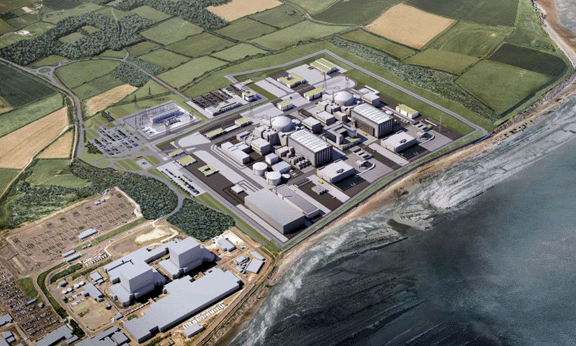 THINK TANK http://tomburke.co.uk/2016/09/15/hinkley-green-light-a-massive-strategic-mistake-says-climate-change-think-tank/ September 15, 2016 by tomburke Following reports today that the Government is about to give the green light to the Hinkley Point C nuclear power station, E3G, a leading climate change think tank said it would be a hugely expensive strategic mistake, using expensive 20th century technology that would soon be obsolete.
E3G Chairman, Tom Burke said: “It is a 20th Century solution to 21st Century problems. Bigger is no longer better. There are faster, cheaper, cleaner and smarter ways to deliver affordable, secure, low carbon electricity to Britain’s consumers.
Nothing about this deal is good for Britain’s hardworking families. They will pay the bill for decades but the jobs will go abroad. It is bad for consumers, bad for the climate and bad for the country.
The Prime Minister is missing a real opportunity to set Britain on course to a more productive and secure future. Instead she has committed us to an expensive and anachronistic energy policy that will leave Britain further behind in a rapidly changing world.”
- E3G sets out below ten reasons why this is a bad deal for British consumers and documents the range of cheaper, smarter, options for low carbon energy security that are better value for money.
HINKLEY POINT : The 10 Mistakes
The Investor Agreement that Greg Clark will sign with EDF is an irrevocable index-linked ‘take or pay’ contract to purchase 35 years’ worth of electricity from EDF at more than twice the current wholesale price. This will cost British consumers £37 billion in subsidy, four times that originally forecast[1]
- This deal binds future governments as well as the current Government. It will prevent Britain’s consumers buying cheaper electricity if it would displace that from EDF.
- It means Britain’s electricity consumers will pay more than £1 billion/year in subsidy to EDF for 35 years.
- The business case for this Agreement has never been subject to informed public scrutiny. The arguments for HPC and the rest of the nuclear programme have never been stress tested.
- The National Audit Office has already raised doubts that it represents value for money in the light of developments, including significant reductions in electricity demand forecasts, since it was first proposed[2].
- The National Infrastructure Commission has identified a package of other measures that could provide affordable, secure, low carbon electricity at lower cost.
- The National Grid has cut its forecast of the need for new centralised generation capacity in Britain by more than 50%, announcing its estimate of growth for decentralised generation was 50 times too low[3]
- EDF’s unions will argue in the French Courts that delaying a Hinkley decision until 2018 would allow for a design review to be completed that would reduce the subsidy needed from £92.50/MWh to £75/MWh[4].
- State Aids clearance for the UK subsidy is under challenge by the Austrian Government and others in the European Court. A further State Aids challenge is likely to the French Government’s re-financing of EDF. If either is successful the deal will fall.
- Hinkley will not produce electricity until 2030. There are cheaper, faster, cleaner and more reliable options available to deliver affordable, secure, low cost electricity to British consumers. These include:
- energy efficiency has reduced electricity demand by 25TWh ( 7% – the same as Hinkley will produce ) since 2010. A McKinsey report for the Government estimates that by 2030 demand could be reduced by a further 23% while reducing consumers bills;
- the National Infrastructure Commission reports that additional interconnectors could supply 2-3 Hinkleys by 2025;
- another National Infrastructure Commission report proposed investment in storage and smart grids that would provide the equivalent of 4 Hinkleys by 2030 and save £8 billion.
- Dong Energy, the world’s largest wind energy company, could replace all Hinkley’s electricity sooner and at lower cost. Offshore wind costs are continuing to fall.
- electricity from solar power is now also cheaper than Hinkley, having fallen by half in the last five years. From almost no solar panels in the UK, a third of a Hinkley has been added since 2010. Half of that was delivered in just 18 month.
- E3G is an independent global think tank, working to accelerate the transition to a low-carbon economy. E3G specializes in climate diplomacy, climate risk, energy policy and climate finance.
- In 2016, E3G was ranked the number one environmental think tank in the UK by the Go To Think Tank Index, second in Europe and sixth in the World.
Hinkley nuclear plant vulnerable to becoming a “stranded asset”
A Nuclear Lesson For Big Oil (And Vice Versa), Bloombeg Gadfly, 16 Sept 16 By Liam Denning It is a reasonable bet that the $24 billion Hinkley Point C nuclear power project in the U.K., due online in 2025, will neither be ready by 2025 nor cost just $24 billion. Indeed, it’s so reasonable that, as fellow Gadfly Chris Bryant lays out here, the stock market appears to be making that very same bet.
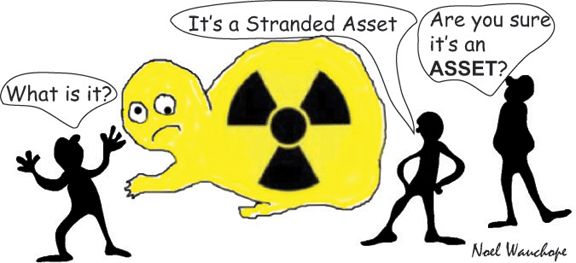
Leave aside the also reasonable conspiracy theories about London buttering up Paris and Beijing by approving the project and focus on the ostensible reason for doing it: maintaining security of energy supply……….
The oil and gas industry’s experience reveals one more insidious risk facing the nuclear project.
There’s a reason EDF demanded the U.K. government guarantee an electricity price for Hinkley Point’s output atdouble the current wholesale price. Financing a $24 billion project that won’t produce a cent of revenue for a decade is really tough — especially in an industry carrying as muchhistorical baggage on busted budgets and timescales as nuclear power does. Subsidies and guarantees help bridge the risk gap………
mega-projects can prove vulnerable not despite their scale but because of it. They might extract savings on, say, procurement, but their inherent complexity makes it hard to apply lessons from previous examples to gain efficiency. ……..
And once a company is several years into building a new power plant or LNG terminal, the compulsion to complete it is enormous, due to the already huge sunk costs (and need to save face), even if budgets and schedules have been blown through or — as was the case with fracking — another technology has disrupted the market……..
With energy technology in such flux right now, ranging from renewable power to batteries to energy efficiency, is there a high risk that a giant plant a decade or more away from completion becomes stranded? You bet…..……
In Hinkley Point’s case, of course, any future U.K. government wouldn’t dare try to wriggle out of those high, guaranteed power prices for fear of enraging the French. Because that’s never happened. https://www.bloomberg.com/gadfly/articles/2016-09-16/hinkley-point-nuclear-power-project-s-lesson-for-big-oil
Theresa May, under pressure from France and China caves in on Hinkley C nuclear go-ahead

The UK’s energy department, BEIS, today announced the go-ahead for the controversial Hinkley Point C (HPC) nuclear power plant in Somerset.
Only weeks ago Theresa May’s government delayed the signing of the deal with EDF to confirm its subsidy package which is likely to cost UK energy users anywhere from £30 billion to over £100 billion for 35 years after it opens.
The surprise move was widely welcomed due to a broad range of concerns about the HPC project, including:
- its very high cost, more than double the current wholesale power price and far more than the current cost of even high-cost renewable power from offshore wind;
- security concerns over China’s involvement in core UK infrastructure;
- the lack of any single example of a working EPR reactor anywhere in the world;
- the severe delays, cost overuns and technical problems at all EPR construction sites;
- and the low value of HPC’s contribution to UK energy supply in the new decentralised ‘smart grid’ era.
Pre-announcement spin indicated that the HPC deal would be subject to a number of“significant conditions” that would address these problems. But in the event energy secretary Greg Clarke is giving the go-ahead for HPC to almost precisely the same deal that was on the table before.
Ther only difference to be found in the energy department announcement is that arrangements have been put in place to allow the Government to “prevent the sale of EDF’s controlling stake prior to the completion of construction, without the prior notification and agreement of ministers.”
In particular the price remains unchanged……….
And as far as China is concerned, the UK is desperate to reach a trade deal with what is now by some measures the world’s largest economy and a major exporter to the UK. In particular the UK is seeking tariff-free access to the fast-gowing Chinese economy for UK manufactures, and the powerful financial services industry.
We can be sure that both countries leaders and ministers put the frighteners onto Theresa May and her entourage at the recent G20 summit to go ahead with HPC – and that she succumbed to that pressure at enormous cost to the UK, failing to win even the smallest concession on price.http://www.theecologist.org/News/news_analysis/2988131/hinkley_c_nuclear_goahead_may_caves_in_to_pressure_from_france_and_china.html
Britain’s Tories stand to gain financially from Hinkley nuclear decision: what a conflict of interest!!
When you have EDF granted access to the heart of government, former ministers now acting as lobbyists for the nuclear industry, and top-level Conservatives with their fingers in Hinkley’s financial pies, what’s best for the UK goes out of the window.

Hinkley: where Tories’ private bank balances are going nuclear, The Canary SEPTEMBER 15TH, 2016“……….a quietly released report by Greenpeace shows that the deal was probably always
going to go ahead.
EDF: in bed with the UK governmentAnalysis done by Greenpeace found that ten advisers and civil servants who worked at the former Department for Energy and Climate Change (DECC) in the last five years had links to EDF. One was recently employed by the DECC and was also a manager at the Office for Nuclear Regulation, the regulator for the nuclear industry. This was before they became a licensing officer for EDF.
An EDF Strategy Manager had a 13-month secondment to the DECC commercial team while working for auditors KPMG. As Greenpeace notes, the DECC commercial team “played a crucial role in deciding to press ahead with the Hinkley project”. It was this team which had oversight on who invested in Hinkley Point C. Additionally, a communications officer for EDF was previously the Senior Ministerial Visits Manager at DECC until early 2016. And a policy adviser and analyst for the now-defunct department had previously done the same job at EDF.
This is on top of the fact that former Liberal Democrat Energy Secretary, Ed Davey, now works as a lobbyist for MHP Communications – where EDF just happens to be a client. As Martin Williams describes in his book Parliament Ltd: A journey to the dark heart of British politics:
When he lost his seat in 2015, he [Davey] went off to join MHP Communications. He had connections with the firm already: MHP acted as lobbyists for EDF Energy, who Davey “had dealings with as a minister”… When MHP’s Chief Executive announced Davey’s appointment he was able to speak candidly about the benefits of employing a former energy minister. “Ed’s unique insight into the energy sector will be particularly valuable to the companies that we work with in that sector. His knowledge of the top-level workings of Britain’s political system will also prove immensely useful to a range of our clients and to MHP itself”. http://www.thecanary.co/2016/09/15/hinkley-tories-private-bank-balances-going-nuclear/
It was Davey who was responsible for the initial agreement between the government and EDF. But the links to EDF Energy and the Tory government run deeper than the Greenpeace analysis. And go right to the top of the Conservative Party.
Tories: in bed with EDF
Sir Richard Lambert heads EDF’s Stakeholder Advisory Panel. It gives EDF “strategic advice and direction”. Knighted under David Cameron, he’s a non-executive director of the Foreign and Commonwealth Office, acting as lead advisor to the Foreign Secretary. He was in this role under Philip Hammond, who appears to have been crucial in getting the Hinkley deal pushed through. Lambert said of the Hinkley deal:
Tory peer Lord Patten of Barnes is the former governor of Hong Kong and a former Conservative Party Chairman. But currently, he too sits on EDF Energy’s Stakeholder Advisory Panel. On 9 September, Patten co-authored an open letter to the Financial Times (FT), calling on May to “press ahead with Hinkley Point”.
Also on the EDF panel is Sir Simon Robertson. Another Tory peer, who is a party donor to the tune of £765,000, he was knighted in 2010, just after the Tories came to office. Robertson was also Deputy Chairman of HSBC until April 2016. In 2014, HSBC arranged the financial backing for EDF to carry out the project at Hinkley. Robertson also signed the letter in the FT. He is also a long-standing member of the Tory “Leader’s Group“. This “club” costs £50,000 a year to be a member of and gives access to the likes of May and Hammond at exclusive private dinners.
Hinkley: benefitting everyone, except the public
And in another twist of ‘fate’, it would seem the Prime Minister may well benefit from Hinkley Point C going ahead. May’s husband, Philip, works for investment company Capital Group. It, in turn, has a nearly 10% stake in French company Schneider Electric, which has been awarded a contract at Hinkley.
It would seem that the Tories’ push for the Hinkley project is not driven so much by “energy security”, but more by vested interests.
When you have EDF granted access to the heart of government, former ministers now acting as lobbyists for the nuclear industry, and top-level Conservatives with their fingers in Hinkley’s financial pies, what’s best for the UK goes out of the window. Meanwhile, the cost to every household is around £25 per year extra on the energy bill.
Business Secretary Greg Clark said the deal strikes the “right balance between foreign investment and national interest”. But the only “interests” being served, judging by who’s involved, are those of Tory bank balances.
Get Involved!
– Sign the petition against Hinkley Point C.
– Write to your MP to oppose the development.
– Find out when a protest is taking place.
Hinkley nuclear decision- .Great for France, China – but what about UK? The Brexit effect
Hinkley C nuclear go-ahead: May caves in to pressure from France and China, Ecologist Oliver Tickell 15th September 2016 “………Great for France, China – but what about us? The Brexit effect
Mrs May is known to have come under strong pressure from both French and Chinese governments to give HPC the go-ahead. Both governments have strong interests in seeing the project going ahead.
In the French case, the EPR reactor has cost EDF and Areva – both companies controlled and mostly owned by the French state – uncountable billions of euros. Four EPRs are under construction, in France, Finland and China. All are running very late and billions of euros over budget, while the French reactor at Flamanville may never open due to a faulty reactor vessel.
That means that HPC represents France’s last chance to present the EPR as a viable reactor for the lucrative nuclear export market, re-establish credibility, and regain value for its so far utterly failed investment in the EPR.
The deal also offers EDF a very high return on investment of over 10% based on the expected construction cost of €24 billion, making it (and UK energy consumers) a valuable ‘cash cow’ for the highly indebted company for many decades to come.
China is also intent on capturing its share of the global export market for nuclear power and HPC is its ‘way in’ to it. As part of the deal, Chinese nuclear company CGN is to get preferential treatment to build a new nuclear power station at Bradwell in Essex to its new, untested ‘Hualong’ reactor design that it intends to promote to international buyers.
So, plenty of good reasons for China and France to want to progress the deal. But what’s in it for the UK? Answer: Brexit. By sucking up to France, the government hopes to win over France as an ally in negotiating a better deal for the UK in Brexit negotiations……….http://www.theecologist.org/News/news_analysis/2988131/hinkley_c_nuclear_goahead_may_caves_in_to_pressure_from_france_and_china.html
Uncertainty about Hinkley nuclear project, despite UK govarnment’s approval
An amber light for China in UK nuclear power https://www.ft.com/content/40dbd3fa-7b2f-11e6-ae24-f193b105145e
Uncertainty about the £18bn Hinkley project survives a review After unexpectedly announcing a review at the end of July, the UK government has given the go-ahead for construction of the nuclear power station at Hinkley Point. This is the most important strategic decision since Theresa May became prime minister — one that has a bearing not only on the UK’s future competitiveness, but on its relations with China and France.
Regrettably, Mrs May has eschewed the chance to amend the commercial terms of the project, to be built at the gargantuan cost of £18bn by EDF, the French utility, with co-investment from the China National Nuclear Corporation (CNNC) and China Guangdong Nuclear Power. She has, though, announced a plan for new rules governing foreign investment in critical infrastructure. The impact of these on the nuclear programme is uncertain. If sufficiently stringent they could yet put the Hinkley project in doubt.
When it was first conceived a decade ago as part of plans to kick-start a nuclear “renaissance” as old coal-fired plants become obsolete, the Hinkley project was a more attractive proposition. Expected to be competitive with other power sources, it would also help Britain meet ever tougher emissions targets. A decade on — and at a time when the costs of wind power, solar energy and natural gas have all been falling — the price built into the deal is nearly four times higher. The French utility will receive more than double the present UK wholesale power price, indexed and guaranteed for 35 years. Questions therefore remain as to whether the project marries Britain’s energy needs with emission reduction targets in the most cost-effective way.
Mrs May ordered the review to assess concerns over the cost, the unproven technology involved and the role of Chinese investors in a plant that is due to meet about 7 per cent of domestic electricity demand. Her amendments all focus on national security. As part of a new, as yet unclear, legal framework for foreign investment in critical infrastructure, the government will in future hold a golden share in all nuclear power projects. Unexceptionally, this ensures that significant stakes cannot be sold without UK consent.
Of more concern potentially to Beijing is the additional security scrutiny to which the government plans to subject future nuclear projects. Again, the principle is sound from a UK perspective, but the details remain obscure.
China’s objective in putting £6bn into Hinkley Point was to be able to build its own reactors in the UK. During the “golden era” of Sino-UK relations proclaimed by the previous government of David Cameron when President Xi Jinping visited London last year, Beijing envisaged Hinkley as a springboard for its nuclear industry seeking other deals worldwide.
Both EDF and the Chinese have welcomed Mrs May’s decision to go ahead with the project. At least publicly, Beijing sees no obstacle towards its other planned investments with EDF. However, uncertainty over the long-delayed project has survived the review in important respects. Should additional regulatory scrutiny get in the way of Beijing’s other nuclear ambitions in the UK, notably a planned power plant at Bradwell, it could jeopardise the rationale for Chinese investment at Hinkley Point. EDF has warned that, without Chinese money, it may not proceed with the Hinkley scheme.
The last word on Hinkley may not have been written. Mrs May has addressed the concernsof security chiefs with a compromise that avoids an outright block. But she has deferred greater clarity on the extent to which she sees China playing a strategic role as an investor in the UK.
1 This Month





PLEASE OPPOSE HR 8255 AND S.3639 – bills would accelerate satellite deployment, with no environmental review or safeguards – https://ncstd5li.quorum.us/campaign/169331/
To see nuclear-related stories in greater depth and intensity – go to https://nuclearinformation.wordpress.com
-
Archives
- October 2026 (40)
- September 2026 (339)
- August 2026 (330)
- July 2026 (355)
- June 2026 (287)
- May 2026 (306)
- April 2026 (356)
- March 2026 (251)
- February 2026 (267)
- January 2026 (308)
- December 2025 (358)
- November 2025 (359)
-
Categories
- 1
- 1 NUCLEAR ISSUES
- business and costs
- climate change
- culture and arts
- ENERGY
- environment
- health
- history
- indigenous issues
- Legal
- marketing of nuclear
- media
- opposition to nuclear
- PERSONAL STORIES
- politics
- politics international
- Religion and ethics
- safety
- secrets,lies and civil liberties
- spinbuster
- technology
- Uranium
- wastes
- weapons and war
- Women
- 2 WORLD
- ACTION
- AFRICA
- Atrocities
- AUSTRALIA
- Christina's notes
- Christina's themes
- culture and arts
- Events
- Fuk 2022
- Fuk 2023
- Fukushima 2017
- Fukushima 2018
- fukushima 2019
- Fukushima 2020
- Fukushima 2021
- general
- global warming
- Humour (God we need it)
- Nuclear
- RARE EARTHS
- Reference
- resources – print
- Resources -audiovicual
- Weekly Newsletter
- World
- World Nuclear
- YouTube
-
RSS
Entries RSS
Comments RSS

