Dalton Nuclear Institute recognised as “world-leading” nuclear education in Prime Minister’s Innovation Nation speech
The recognition reinforces
Manchester’s position as a global centre of nuclear expertise, spanning
research and innovation, skills development and policy engagement.
Manchester has been recognised at the highest level for its strength in
nuclear research and innovation. Dalton combines research excellence with
the skills and talent development needed to support the UK’s future
nuclear ambitions. Its expertise helps connect academic research with
industry, government and policy, supporting real-world impact. The
recognition strengthens Manchester’s global reputation as a centre for
nuclear expertise.
Manchester University 9th Oct 2026, https://www.manchester.ac.uk/about/news/dalton-nuclear-institute-world-leading-recognition/
Fears of delay grow over removal of Fife nuclear submarine reactor

A FIFE councillor and anti-nuclear campaigners are demanding answers over plans to remove the most radioactive part of a decommissioned nuclear
submarine from Rosyth Dockyard. Councillor Brian Goodall says Babcock and
the Ministry of Defence urgently need to clarify when a reactor pressure
vessel, a highly radioactive component from a decommissioned submarine,
will be removed from Rosyth. It’s something that UK defence minister Luke
Pollard said should be done by the end of 2026, adding that his
department “remains committed” to the deadline. The issue in question
refers to the dismantling of the retired Royal Navy nuclear-powered
submarine HMS Swiftsure. It’s part of the UK’s Submarine Dismantling
Project, which should be completed by October 2028.
The National 10th Oct 2026 A FIFE councillor and anti-nuclear campaigners are demanding answers over
plans to remove the most radioactive part of a decommissioned nuclear
submarine from Rosyth Dockyard. Councillor Brian Goodall says Babcock and
the Ministry of Defence urgently need to clarify when a reactor pressure
vessel, a highly radioactive component from a decommissioned submarine,
will be removed from Rosyth. It’s something that UK defence minister Luke
Pollard said should be done by the end of 2026, adding that his
department “remains committed” to the deadline. The issue in question
refers to the dismantling of the retired Royal Navy nuclear-powered
submarine HMS Swiftsure. It’s part of the UK’s Submarine Dismantling
Project, which should be completed by October 2028.
The National 10th Oct 2026 A FIFE councillor and anti-nuclear campaigners are demanding answers over plans to remove the most radioactive part of a decommissioned nuclear from Rosyth Dockyard.
Councillor Brian Goodall says Babcock and
the Ministry of Defence urgently need to clarify when a reactor pressure
vessel, a highly radioactive component from a decommissioned submarine,
will be removed from Rosyth. It’s something that UK defence minister Luke
Pollard said should be done by the end of 2026, adding that his
department “remains committed” to the deadline. The issue in question
refers to the dismantling of the retired Royal Navy nuclear-powered
submarine HMS Swiftsure. It’s part of the UK’s Submarine Dismantling
Project, which should be completed by October 2028.
The National 10th Oct 2026, https://www.thenational.scot/news/26623369.fears-delay-grow-removal-fife-nuclear-submarine-reactor/
New nuclear ‘would make Scotland a target for Putin’, says Scots Labour MP.
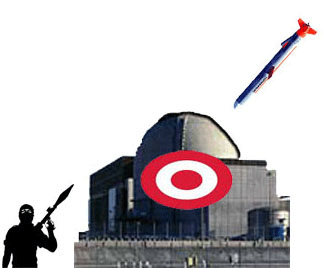
Brian Leishman said hosting small reactors north of the border “would
make communities a target”. Building new nuclear would “make Scotland a
target for Putin”, a Scottish Labour MP has said. Mr Leishman will say in
a Westminster Hall debate once the House of Commons returns from recess:
“Politicians from nearly every party say that the UK will likely be at
war with Russia by 2030.
“If the war hawks are correct, then why would it
make sense for various areas to become targets for Putin? “Nuclear power
plants or the other policy pushed by the nuclear energy lobby – hundreds
of small reactor sites in locations up and down the UK – would make
communities a target.” The UK government has said that Torness in East
Lothian, Hunterston in Ayrshire, and Dounreay in Caithness could host small
nuclear reactors. But the SNP has effectively banned it, saying it would
rather focus on renewables which is much cheaper to build.
Scotsman 10th Oct 2026, https://www.scotsman.com/news/politics/new-nuclear-would-make-scotland-a-target-for-putin-says-scots-labour-mp-9274732
How safe are Britain’s military bases from hostile states?
The UK’s most sensitive sites are increasingly vulnerable to rapidly evolving weapons and surveillance systems and in some cases only have police protection
Armed only with explosives and machineguns, it was the SAS who pioneered
hit-and-run raids on Axis airbases across the North African desert during
the Second World War. Striking planes while they were parked on poorly
guarded airstrips was a stroke of genius that forced the Nazis to overhaul
their defences as daring squads of British operatives destroyed hundreds of
German and Italian aircraft before they could take to the skies. Drones,
advanced missiles, “grey zone” operations and militant activism are now
prompting a similarly urgent transformation of how British bases are
protected. From the Cotswolds to the Middle East, our most sensitive sites
are increasingly vulnerable to the rapidly evolving weapons and
surveillance systems used by hostile states.
Times 9th Oct 2026, https://www.thetimes.com/uk/defence/article/how-safe-britain-military-bases-hostile-states-ccj980mjk
Will there ever be a new nuclear power station at Bradwell?

4. Speculation
With large ‘mega-reactors’ seemingly out of the picture, a prevailing misconception is that so-called Small Modular Reactors (SMRs) might be built at Bradwell. SMRs are anything but small! Typical proposals would take up more space than the closed Bradwell does and introduce yet more toxic waste. And no design that the UK Government has considered has ever been built and tested. No company or developer has indicated it is considering the Bradwell site, although other closed sites in England have been mooted.
6 October 2026 https://www.banng.info/news/regional-life/new-nuclear-at-bradwell-ever/
Peter Banks, BANNG Co-ordinator, answers this question for the October 2026 edition of Regional Life magazine
Several factors come into play when attempting to answer that big question.
1. Current State of Play
The withdrawal of the Chinese General Nuclear Company (CGN) indicated that the Bradwell site is highly unlikely to be further considered for large ‘mega-reactors’ like the Hualong One Reactor design.
2. Political Implications
In existing (albeit awaiting updates) UK Government documentation, the Bradwell site is still listed as “potentially suitable” for nuclear development. With frequent changes in ministers and proposed regulatory changes, it is unclear whether this will change, especially as the onus has shifted to potential developers to choose a “suitable site” themselves. BANNG continues to maintain that the site is wholly unsuitable for any type of nuclear power station and its long-term legacy of dangerous radioactive wastes.
3.Legacy
There are areas of the former power station that give cause for concern. The two highly visible buildings covered in shiny cladding house the reactor containment vessels with the graphite moderator blocks still inside. These will remain too dangerous to decommission for another 100 years from now. Also Bradwell Intermediate Level Waste (ILW), along with inbound ILW from Dungeness and Sizewell A, is housed in a relatively new (built 2013-14) Intermediate Storage Facility (ISF). Further, when demolition of the storage pond building started, it was found it was too radioactive and another shell was built around it. Any new nuclear power station next door would vastly add to the dangerous legacy.
4. Speculation
With large ‘mega-reactors’ seemingly out of the picture, a prevailing misconception is that so-called Small Modular Reactors (SMRs) might be built at Bradwell. SMRs are anything but small! Typical proposals would take up more space than the closed Bradwell does and introduce yet more toxic waste. And no design that the UK Government has considered has ever been built and tested. No company or developer has indicated it is considering the Bradwell site, although other closed sites in England have been mooted.
5. Probability
At the time of writing, no developers have proposed building any sort of nuclear power plant at Bradwell. In addition to BANNG’s resolute stance that the site is not suitable, regulators may also be reluctant to recognise it as meeting the criteria to be “potentially suitable”.
To conclude, the chances of building a new nuclear power station at Bradwell are minimal. The answer to the question must be NO.
Ministry of Defence under pressure on Trident balloon accident

Local people filmed a large balloon meant to provide last-ditch communications in a nuclear war deflating and crashing. But the Ministry of Defence won’t say anything about it
Rob Edwards, October 06 2026,
https://www.theferret.scot/trident-balloon-accident/
The Ministry of Defence is being urged to “come clean” about an accident that reportedly destroyed the UK’s emergency nuclear war communications balloon, after The Ferret discovered that key information has been taken offline.
Byline Times reported that the helium balloon, codenamed Sunflower and kept in Scotland, crashed to the ground after deflating during a test over Yorkshire on 4 September.
The balloon is designed to lift a 1,500-metre radio antenna enabling the UK government to order Trident submarines to launch a nuclear strike after Britain has been attacked.
Both the Ministry of Defence (MoD) and the army have refused to make any comment at all, encouraging speculation that the balloon could have been downed by a Russian drone.
At the same time, one of the main pieces of evidence about the balloon’s history and purpose appears to have been removed from a military website after it was highlighted in Byline Times.
Byline Times reported that the helium balloon, codenamed Sunflower and kept in Scotland, crashed to the ground after deflating during a test over Yorkshire on 4 September.
The balloon is designed to lift a 1,500-metre radio antenna enabling the UK government to order Trident submarines to launch a nuclear strike after Britain has been attacked.
Both the Ministry of Defence (MoD) and the army have refused to make any comment at all, encouraging speculation that the balloon could have been downed by a Russian drone.
At the same time, one of the main pieces of evidence about the balloon’s history and purpose appears to have been removed from a military website after it was highlighted in Byline Times.
Known as the low frequency fall back (LFFB), the balloon has been kept in an army warehouse on a Dundee industrial estate, next to the city’s Eastern Cemetery. Vehicles to transport it are believed to be housed in a hardened aircraft shelter at the army and airforce base at Leuchars in Fife.
Every autumn, it has travelled with a police convoy to and from a former airfield at Topcliffe, near Thirsk in Yorkshire, to be tested. It was videoed by a Facebook group called Fife Jammer Locations going through Cupar in Fife on 29 August and 12 September.
Unfortunately, as Byline Times reported, during its latest test on 4 September the balloon was filmed by another Facebook group, North Yorkshire Weather Updates, partially deflated and spinning on its tether. Footage shows it rapidly ascended, was blown 12 miles east and finally fell into a farmer’s field near Ampleforth…………………………………………………………………………….
The Bylines Times story on 8 September was written by the veteran investigative journalist, Duncan Campbell. Along with researcher, Mike Kenner, he is writing a book on UK nuclear war planning with the provisional title ‘The Decoy Game’, updating his revelatory 1983 book, War Plan UK.
Dave Cullen, a UK nuclear weapons expert from the BASIC nuclear think tank in London, stressed the “vital importance” of communication with Trident submarines in a crisis.
He said: “If this backup communications system relies on a single balloon, the public deserves to know what happened in this incident. Given the details that have already been published, the ongoing silence from the MoD seems to serve little purpose, other than saving them further embarrassment.”
Rob Forsyth, a Royal Navy nuclear submarine commander in the 1970s who now campaigns against Trident, described the balloon as an absurd “Heath Robinson” contraption. It was “so Dad’s Army as to be unbelievable”, he said, referring to the comedy which made fun of the home guard in the Second World War.
“The MoD is understandably reluctant to reveal why this happened but, by saying absolutely nothing, it leaves conspiracy theorists a clear field,” he told The Ferret. “Some explanation as to what happened and reassurance that the vulnerability of a strategically vital communication link is being addressed is needed.”
“It is completely unacceptable that they are refusing to answer questions” – Gillian Mackay MSP, Scottish Greens co-leader
The Scottish Greens called on the MoD to “come clean” and explain what happened. “These are very concerning allegations that have been uncovered, and the MoD should be more transparent,” said the party’s co-leader, Gillian Mackay MSP.
“It is completely unacceptable that they are refusing to answer questions and refusing to give any details on what was behind this when there is video footage that will rightly be concerning people across the country.”
The SNP defence spokesperson, Dave Doogan MP, described the UK nuclear weapons programme as a “costly charade” which was fooling nobody. “Even advocates for nuclear weapon systems should be dismayed to see such vanity and extravagance undone by a balloon on the end of a string,” he said.
A Ministry of Defence spokesperson told The Ferret: “We’re not commenting on this.” A spokesperson for the army added: “We will not be commenting.”
Training campus expansion to support Sizewell C project

The expansion of a construction and engineering training campus in Suffolk
has been backed to train up to 3,000 people over five years. Phase two of
the Lound Civil Campus at East Coast College will provide training linked
to the Sizewell C nuclear power station and other Nationally Significant
Infrastructure Projects, according to East Suffolk Council.
The project
received £2.1m from the Asset Skills Enhancement and Capability Fund,
which is managed by Suffolk County Council, East Suffolk Council and the
client Sizewell C Ltd. The expanded campus is designed to provide training
for “up to 3,000” new entrants, career changers and existing workers
seeking additional construction and engineering skills, East Suffolk
Council said. Courses will focus on civil engineering and construction
trades, with the college working alongside regional employers to identify
workforce requirements.
Construction News 6th Oct 2026,
https://www.constructionnews.co.uk/skills/training-campus-expansion-to-support-sizewell-c-project-06-10-2026/
Plans to reduce armed Civil Nuclear Constabulary escorts

“I think it’s a bad idea, it really is. The reason you’ve got to guard this stuff in the first place is because of how dangerous it is.
“Anyone who gets hold of this material can use it for anything they want, they can use it for a dirty bomb, they can use it for a poisoning device.
“That’s why you need to have a strong deterrence force around the material in transit.”
7th October, By Gareth Cavanagh
NUCLEAR industry plans to reduce armed police escorts for some movements of radioactive material have raised concerns about security.
Removing “mandatory Civil Nuclear Constabulary (CNC) armed escorts where they do not provide a proportionate security benefit,” is the proposal from Nuclear Transport Solutions, in response to a Government review.
Proposals for reducing unnecessary armed escorts were included in a collective NDA (Nuclear Decommissioning Authority) Group response to the review.
The Government’s Nuclear Regulatory Taskforce Review called for an end to the regulatory red tape that it believes is frustrating progress in the nuclear industry.
Sellafield Limited and Nuclear Waste Services had its own ideas in response to the review but NTS wants risk-based security requirements for certain nuclear material movements.
Rail movements of hazardous waste occur regularly to and from Sellafield site near Seascale.
Reprocessed waste is also returned to overseas customers by sea from Barrow Docks, after being taken there from Sellafield by train.
NTS says the change could reduce the cost and complexity of transport while maintaining safety and security.
It’s response estimates cost
savings of 10 to 20 per cent, if security controls were optimised rather than removed.
It also predicts time savings of four to eight weeks from the planning process.
However, concerns have been expressed about the possible effect of reducing armed protection during transport.
CNC carries out armed escorts for NTS movements of hazardous material.
It also guards the gates of Sellafield and has a police headquarters on the site.
Matt Okuhara, who served with the force from 2006 to 2012 has criticised the proposal in The i Paper.
He said: “I think it’s a bad idea, it really is. The reason you’ve got to guard this stuff in the first place is because of how dangerous it is.
“Anyone who gets hold of this material can use it for anything they want, they can use it for a dirty bomb, they can use it for a poisoning device.
“That’s why you need to have a strong deterrence force around the material in transit.”
A spokesperson for the NDA Group said the proposed changes would not remove the need for security arrangements.
Instead, NTS would be able to choose measures according to the circumstances of each shipment, while meeting regulatory requirements……………………………………………..
NDA bosses say some transport arrangements remain prescribed by the regulator, meaning some shipments must use armed police escorts even where routes and materials are considered lower risk. https://www.whitehavennews.co.uk/news/26611260.plans-reduce-armed-civil-nuclear-constabulary-escorts/
The normalising of nuclear

6 October 2026 Noel Wauchope, https://theaimn.net/the-normalising-of-nuclear/
The facts on the nuclear industry’s effects on health and environment are now seen through a blur of discussion on climate change, and costs, and connection with military power, and it all seems too hard to grasp. When the UK’s Green Party decides to go sorta kinder pro-nuclear, well, nuclear power and nuclear weapons are beginning to look sort of OK and normal.
We are in a strange period of time, in which things previously agreed on, are now up for doubts and denial. Just as an example, in Australia, free infant vaccinations supplied by the government have pretty much been for many decades considered mandatory (although not legally mandatory). Now infant vaccination rates are falling. This fall reflects a loss of trust in health authorities. Most Australian children still do receive the full schedule of vaccines, but there’s a lessening of understanding of the reasons behind the programme. That’s combined with misinformation about vaccination as the cause of autism, among other false claims.
That’s just one very important example of the atmosphere of doubt and distrust that is becoming more prevalent in society at large, and Australia is not immune from this “fog of disbelief” about public health.
The vaccination issue is particularly misunderstood and dangerous, because that programme depends on “herd immunity.” A century ago, Australian families were all too likely to lose several of their many children to infectious diseases. In any old country cemetery in Victoria, you will find a whole lot of graves of infants, who died 100 years ago, many from the same families. Over the 20th Century a universal programme of infant vaccination revolutionised that, and survival rates for children rocketed up.
Well, I certainly have strayed away from my main theme – which is the growing acceptance of the nuclear industry as probably OK. I do think that social media, with its briefness and lack of fact-checking has contributed to the blurring of information, and the growing distrust of genuine experts.
What is happening in the UK, under a Labour government, is a definite case of the blurring of information about the nuclear industry. This started in 2006, with Tony Blair reversing Labour’s opposition to new nuclear, and it steadily moved on to Keir Starmer’s enthusiasm for it in 2025. Now the UK Labour government has a seemingly more moderate and “leftish” Prime Minister, with a more nuanced approach to things nuclear. Their latest effort is acting on the report of the Nuclear Regulatory Taskforce Review, which recommends a “radical reset” of the UK’s nuclear regulatory framework to streamline approvals, reduce costs, and support safe, rapid delivery of civil and defence nuclear projects. So, the The UK’s Environment Agency is moving towards treating nuclear energy more like other industries by implementing a Nuclear Transformation Programme. It is an almost imperceptible change.
But it is such a telling change. No other industry has this extraordinary feature – that it involves the highly toxic fuels of uranium and plutonium, that its very essence is in splitting the atom to release ionising radiation As there has not been a nuclear disaster since 2011, it seems to be accepted by the powers that be that there will never be another one. At the same time, today’s warfare of drones and missiles raises a scary idea that a weapon might strike a nuclear facility. No other industry has this unique vulnerability that a great spread of toxic radiation would result from such a hit.
The dangerous effects of ionising radiation have been recognised since 1896, and confirmed more recently in several scientific studies, such as cancer mortality after low dose exposure to ionising radiation in workers in France, the United Kingdom, and the United States (INWORKS): cohort study. And we all think it’s fine, we don’t think twice, as the radiographer darts out of the room when we have an X-ray.
So the nuclear industry is not like other industries. It has always had exceptional regulations to deal with this unique danger. Now the USA under Trump is denying the danger, and trashing the safety regulations. You might expect a British Labour government to have a more principled approach to health and safety. But, under the pressures of propaganda, of industry lobbying, of determination to stay in power, this process of normalisation of nuclear is underway in the UK.
Who can we turn to, to speak truth to power? Not the UK Greens. They have just voted to end the party’s opposition to nuclear power, dropping a commitment to phase out the technology in a major shift in its energy policy. Matthew Pearce, The Guardian, has explained this – “The Green MP Carla Denyer said the decision recognised there was a role for nuclear while the country moved towards an electricity system based primarily on renewables.” The article quotes Professor Andrew Stirling, who commented that “the motion was “completely irrational”. “Why would a party that pioneered concerns about nuclear power that have been so broadly vindicated by history, choose now to shift its position?”
One does wonder how long it will be, before something happens. We have been extraordinarily lucky in that the big accidents have been relatively few, and not in recent years. Unfortunately, while people are shocked and concerned about big dramatic accidents, the slow insidious spread of “low level” ionising radiation just goes on, unnoticed. It’s “normal”.
I for one am quite saddened at the UK Greens’ decision. You wonder who is left – anyone in politics, in power, in the media, who is not so hell-bent to hang on to their job, that they might stick their head above the parapet and say NO to nuclear.
Flying Scared: The Evacuation of US Bombers from RAF Fairford

From the aggressively pro-American terrain of the Australian Strategic Policy Institute, Malcom Davis claimed to have identified the crucial lesson: “that in an age of drone warfare, it is no longer sufficient to assume that aircraft parked in the open are invulnerable to attack.”
7 October 2026Dr Binoy Kampmark, https://theaimn.net/flying-scared-the-evacuation-of-us-bombers-from-raf-fairford/
The evacuation of a dozen B-1B bombers of the US Air Force from the RAF Fairford in Gloucestershire is another instalment in the latest rippling of the Iran war that began as a pre-emptive, illegal assault by the US and Israel on the Islamic Republic in late February. This, arguably, came in two parts, the first scripted with the detention and arrest of five men on September 27 in the vicinity of the base on suspicion of committing offences under the Explosives Act and suspicion of preparation of a terrorist act. (Another was arrested on October 1.) All were British nationals based in London and speedily released on police bail. At the time, Assistant Commissioner Laurence Taylor, head of Counter Terrorism Policing (CTP), floated the suggestion that “this may be activity committed by proxies, or individuals either knowingly or unknowingly, working on behalf of a foreign state.” The dust had barely settled before the finger pointing at Iran began. The men in question, according to the police, remained under investigation, with their release “subject to stringent conditions on their movement and contact with others.”
On October 4, the Pentagon announced that “all bombers that were deployed to RAF Fairford have been re-deployed to their home stations in the United States.” The department, wishing to blunt the significance of this hasty decision, added that the US military bomber force of B-1s, B-2s, and B-52s remained “ready to deliver precious global strike capabilities – including through operations that launch and recover from the continental United States.”
Two days later, Counter Terrorism Policing announced that a further arrest had been made of a dual UK-Iranian man regarding “activity that took place close to RAF Fairford.” The arrest was made “on suspicion of terrorist acts under Section 5 of the Terrorism Act 2006.” The Senior National Coordinator for CTP, Vicki Evans, reiterated the line that this remained “a live investigation and our specialist teams continue to pursue multiple lines of enquiry into the circumstances surrounding events near RAF Fairford.”
When asked about whether the movement of the bombers was linked to the September 27 incident, US Secretary of State Marco Rubio proved platitudinous and undetailed. “It’s not unusual to see movement of assets to different parts of the world based on exercises, redeployments, people changing out and new people coming in, new planes coming in and old planes going out.” This front of airy meaninglessness did not take long to vanish. The US Vice President JD Vance added salt to the otherwise dull mix in stating that the bombers had exited the base out of an “abundance of caution.” It was felt that Iran was doing what it had “done for 49 years… which is to engage in acts of terrorism against the US and against a lot of other people.”
President Donald Trump, tongue ever loosened, also told reporters when asked if the bomber redeployment had arisen from any “specific threat” did not hesitate: “Yeah, I think we can say that. They didn’t fly out by accident.” What followed was the usual combination of adulterated facts and twisted tales. There had been “some threats. And rather than tempting the enemy, we’ll capture the enemy and beat the enemy. But why should we leave them there? So we moved them around a little bit. Not very far.” Never one to accept the premise that the US security establishment might err on occasion, the president reiterated the familiar, if long fossilized line: Washington “actually knows the people that made the threat.”
This dramatic decision to move the bombers from a base that hosts the US Air Force’s 501st Combat Support Wing, an important component in the illegal war against Iran, is very much the opposite of what was initially done when a farmer noted the presence of three white vans and a “large group of hooded and masked men” who then attempted to alert the Ministry of Defence police at the airbase. When no response was forthcoming, she made a 999 call to police at 01:36 BST. Within 10 minutes “the village was full of armed police.” She ruminated on the effect of the call: “I believe that my 999 call foiled whatever plans they had.” She was also “absolutely staggered that it was left to me, as a member of the public, to see and report this.” The UK Defence Secretary, Wes Streeting, despite thanking the farmer for her call, suggested she only had “a partial picture” of what was unfolding, while Trump, claimed that the men were placed under surveillance “for a long time, and we got them.”
The swift relocation of such costly, vulnerable military hardware in the face of a threat that would, if inflicted, have cost a fraction of any budget, is also a startling reminder of the turns in modern warfare. The Ukrainians demonstrated with formidable efficacy in Operation Spider’s Web how its drones could strike Russian nuclear-capable bombers, allegedly crippling a third of its capacity. Taking place in June last year, it involved the use of 117 modestly priced drones that had been smuggled into Russia via lorries by unwitting drivers. The strikes, taking place across five different time zones with the assistance of the commercial autopilot software ArduPilot and the use of artificial intelligence for targeting purposes, led to an estimated bill amounting to US$7 billion. Some 41 planes were damaged or destroyed.
Operation Spider’s Web drew swooning praise from the cognoscenti. Katja Bego of Chatham House thought it “offered a glimpse into the future of warfare, transformed by access to cheap, widely available technology such as small drones, in which anything, anywhere can become a target.” This, she went on to say, raised “urgent questions” about NATO’s own preparations in the face of such an attack.
Before mighty odds and expensive machinery, new methods of war are proving resourceful, daring and devastating. One palpable absurdity of the Iran War has been the eye-popping costs accruing from the use of heavy weaponry in offence and anti-ballistic missiles such as the THAAD system in defence. This has drained the US inventory, sending Washington’s allies into fits of concern. On a relatively meagre budget, labouring in the face of superior odds and numbers, Tehran has caused mayhem with its drone and missile strikes across the Gulf region. In the case of RAF Fairford, the Iranians, whatever the speculation, did not even need to launch a single drone for an expensive fleet of bombers to be relocated to the continental US.
Despite no official confirmation that Tehran was actually involved, the commentary circuit has been clogged by assessments of a victory for the Islamic Republic. “I think it is hard to conclude anything other than that this will be seen as a success by Iran,” suggests former UK first national security advisor, Lord Peter Ricketts. “Whether it was the intention or whether it’s the inadvertent outcome, it is certainly the outcome that they have now forced the US into a public bring-back of their forces from one of their allies.”
From the aggressively pro-American terrain of the Australian Strategic Policy Institute, Malcom Davis claimed to have identified the crucial lesson: “that in an age of drone warfare, it is no longer sufficient to assume that aircraft parked in the open are invulnerable to attack.” The US needed “to invest in hardening bases, including developing new hardened aircraft shelters for forward deployed aircraft.” Another, surely cheaper solution would be to refrain from launching criminally foolish wars in the Middle East, or anywhere else, for that matter.
The war against Iran was meant to conclude in a popular insurrection against the theocrats in Tehran and the blooming of various flowers in the Orangerie of democracy. There was no insurrection and certainly no flowering. Instead, the successor regime to those slayed continues to resist with steeliness and wage its battle in the fields of briefings, psychology and economics. So far, it is winning.
Windscale nuclear disaster at Sellafield 69 years ago today
10th October, By Ewan Wishart, https://www.whitehavennews.co.uk/news/26623785.windscale-nuclear-disaster-sellafield-69-years-ago-today/
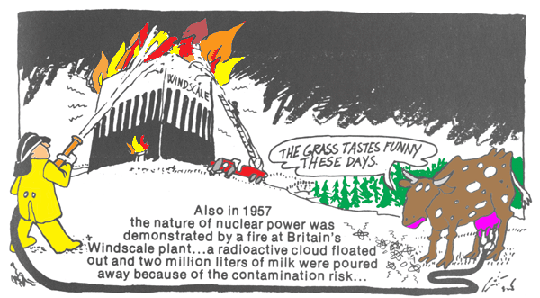
TODAY, 69 years ago, a fire broke out on the Cumbrian coast which would become the worst nuclear accident in British history.
On October 10, 1957, workers at Windscale, the site now known as Sellafield, discovered that Pile No. 1, one of two reactors built as part of Britain’s post-war nuclear weapons programme, was on fire.
The reactors had been producing plutonium for Britain’s atomic weapons programme, with the Number One Pile having become operational in 1950.
On October 10, 1957, workers at Windscale, the site now known as Sellafield, discovered that Pile No. 1, one of two reactors built as part of Britain’s post-war nuclear weapons programme, was on fire.
The reactors had been producing plutonium for Britain’s atomic weapons programme, with the Number One Pile having become operational in 1950 10 operators realised something was seriously wrong.
Increasing the airflow in an attempt to cool the reactor instead helped fan the flames, while radioactive material began escaping through its chimney.
Workers eventually saw fuel channels glowing red inside the reactor and battled to bring the unprecedented fire under control.
Former Windscale worker David Staton, who later recalled his role in the emergency to the News & Star, was just 27 when he was summoned to the scene with the message: “Come at once. Pile One is on fire.”
Attempts using carbon dioxide and water were unsuccessful before the shutdown fans were switched off, starving the blaze of oxygen and allowing the water to extinguish it, Mr Staton recalled.
The consequences extended far beyond the site.
Radioactive fallout spread across Britain and Europe, while the distribution of milk from around 200 square miles of surrounding countryside was stopped because of contamination by radioactive iodine. No evacuation of the surrounding population took place.
The accident was subsequently rated Level 5 on the seven-point International Nuclear Event Scale and remains the UK’s most serious nuclear accident.
The disaster also became entwined with the secrecy of Britain’s Cold War nuclear programme.
The government under Harold Macmillan heavily censored information surrounding the accident, with concerns that disclosure could damage Britain’s nuclear relationship with the United States. The inquiry into the accident was not released in full until 1988.
The contemporary reaction in West Cumbria can still be traced through the Whitehaven News archives.
A week after the disaster, on October 17, 1957, the paper reported that local people would take a long time to regard the atomic plants with the same “complacency” they had before the fire.
The archive also records monitoring vans travelling through the area testing vegetation and air, while farmers were woken during the night and instructed not to sell, drink or feed contaminated milk to their animals.
Later scientific
research has complicated estimates of the disaster’s health impact. Historical estimates based on the radiation released suggested there could have been around 190 additional cancers, about 100 fatal, but subsequent epidemiological studies have not found the predicted increase.
Almost seven decades later, the Windscale Fire remains one of the defining events in the history of Britain’s nuclear industry.
Tory plan to cut Scotland’s powers poses a question they cannot dodge.

Andrew Bowie – the shadow energy secretary – who has made crystal clear
what a General Election win for his party would mean: fewer powers for
Scotland.
“We will legislate to ensure that Scotland can host new nuclear
power generation,” Bowie said. The message is this: should the Tories
re-enter No 10, the devolution of planning powers to the Scottish
Government will be stripped back. Bowie did not shy away from this, telling
party faithful at the Tory conference:
“If John Swinney and SNP ministers
want to have a fight over any plans that would deliver thousands of jobs
and protect energy security, then I say bring it on.” The SNP responded
with their own challenge. “Tory politicians proposing to force nuclear
power plants on Scotland should tell us who among them wants one of these
extortionate, wasteful, and unnecessary nuclear plants built in their
constituency,” SNP MSP Laura Mitchell said.
The National 5th Oct 2026,
https://www.thenational.scot/news/26609474.tory-plan-cut-scotlands-powers-poses-question-cannot-dodge/
Tories pledge ‘Britannia Shield’ to protect UK from drone attacks.
Aplanned network of radar, command and control systems and interceptor
missiles would strengthen defences against aerial threats. The
Conservatives have pledged to build a £10bn integrated air-defence system
to protect the UK from missile and drone attacks if they win the next
general election. The proposed system, dubbed “Britannia Shield”, would
involve an improved network of radar, command and control systems, and
interceptor missiles to protect critical national infrastructure and
military bases from aerial threats.
FT 5th Oct 2026,
https://www.ft.com/content/f30a1afc-2aa8-4cdd-a6e8-b18523298456
Scotland could get large nuclear reactor under Tories, says shadow energy secretary
Conservatives vow to change the law to override SNP ban on new nuclear
The Scotsman, By Andrew J Quinn, Westminster Correspondent, 5th Oct 2026,
cotland could get a large nuclear reactor under the Tories, the shadow energy secretary has said.
Andrew Bowie told the Conservative Party Conference that “no part of Britain will be off limits” when building a third large-scale reactor in the UK.
The Aberdeenshire West and Kincardine MP vowed to change the law to override the SNP’s ban on new nuclear.
He told the conference in Birmingham: “We will need a third large-scale reactor. We will build that reactor, and no part of Britain will be off limits, including Scotland.
“We will legislate to get it done. No more Mr Nice Guy. No more devolve and forget.
“Energy is a reserved power of the sovereign Parliament of our United Kingdom, and I am fed up with the SNP playing games with devolved planning policy to block our nuclear renewal.
“So we will legislate to ensure new nuclear can and will be built in Scotland, and if the Nationalists want to stop us from delivering thousands of jobs, economic growth, and energy security for Britain, I’ve one thing to say: bring it on.”
The UK government wants to build small nuclear reactors in Scotland. But the SNP, which holds control over planning, has so far blocked it.
Torness in East Lothian, Hunterston in Ayrshire, and Dounreay in Caithness have all been cited as potential sites.
But the prospect of a new large nuclear reactor north of the Border has not been seriously considered before.
Hinkley C in Suffolk and Sizewell C in Somerset are two large nuclear power stations which are being built in the UK.
Torness is Scotland’s last remaining active nuclear power plant. The facility is scheduled to close by 2030.
Hunterston A in North Ayrshire shut down in 1990, while Hunterston B shut down in 2022.
Mr Bowie said: “We once led the world in nuclear power, and we can do so again, ensuring that Britain will always have reliable, plentiful electricity. Cheap energy drove the industrial revolution. Abundant nuclear power will drive Britain’s renewal.
“We will supercharge the rollout of new nuclear in Britain. We will deliver at pace and go further. Where there’s a block, we will break it down. Where there’s red tape in the way we will cut it full steam ahead.
“We’ll invest in small modular, advanced modular reactors and open this country to the newest and most exciting technology in the world.
“But to ensure stability and reliability, we need further large-scale reactors, a gigawatt-scale reactor, standing along Hinkley and Sizewell.
“Now, when I was nuclear minister, I was delighted and proud to be able to announce existing new developments that would create jobs and boost Britain’s energy security across the country, from Wales to the southwest, Hartlepool to East Anglia………………………………….. https://www.scotsman.com/news/politics/scotland-could-get-large-nuclear-reactor-under-tories-says-shadow-energy-secretary-9266799
Labour Government will not override Holyrood to bring in new nuclear, says UK energy minister
Labour Government will not override Holyrood to bring in new nuclear, says
UK energy minister. Michael Shanks said that “ripping up the Scotland Act
to force through new nuclear isn’t the right approach”. The Labour
Government will not override Holyrood to bring in new nuclear reactors, a
UK energy minister has said.
Scotsman 6th Oct 2026, https://www.scotsman.com/news/politics/labour-government-will-not-override-holyrood-to-bring-in-new-nuclear-says-uk-energy-minister-9268139
1 This Month
23-25 October – on Zoom – World BEYOND War’s annual global conferenc


Shut down the radiation-damaged Heysham nuclear reactors now
To see nuclear-related stories in greater depth and intensity – go to https://nuclearinformation.wordpress.com

Say No to NASA’s Reckless Nuclear Reactor on the Moon
Say No to NASA’s Reckless Nuclear Reactor on the Moon

-
Archives
- October 2026 (247)
- September 2026 (339)
- August 2026 (330)
- July 2026 (355)
- June 2026 (287)
- May 2026 (306)
- April 2026 (356)
- March 2026 (251)
- February 2026 (267)
- January 2026 (308)
- December 2025 (358)
- November 2025 (359)
-
Categories
- 1
- 1 NUCLEAR ISSUES
- business and costs
- climate change
- culture and arts
- ENERGY
- environment
- health
- history
- indigenous issues
- Legal
- marketing of nuclear
- media
- opposition to nuclear
- PERSONAL STORIES
- politics
- politics international
- Religion and ethics
- safety
- secrets,lies and civil liberties
- spinbuster
- technology
- Uranium
- wastes
- weapons and war
- Women
- 2 WORLD
- ACTION
- AFRICA
- Atrocities
- AUSTRALIA
- Christina's notes
- Christina's themes
- culture and arts
- Events
- Fuk 2022
- Fuk 2023
- Fukushima 2017
- Fukushima 2018
- fukushima 2019
- Fukushima 2020
- Fukushima 2021
- general
- global warming
- Humour (God we need it)
- Nuclear
- RARE EARTHS
- Reference
- resources – print
- Resources -audiovicual
- Weekly Newsletter
- World
- World Nuclear
- YouTube
-
RSS
Entries RSS
Comments RSS

