The nuclear industry has co-opted academia in Cumbria
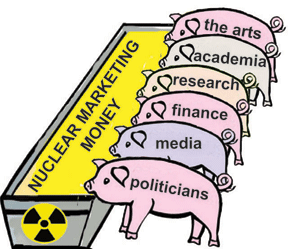
In Cumbria 21st June 2018, More needs to be done to ensure communities not only see but feel the benefits of investment in Cumbria’s nuclear sector, industry figures have been told. Rick Wylie, the Samuel Lindow Academic Director for the University of Central Lancashire (UCLan) based at Westlakes Science and Technology Park, laid down the challenge at the third warm-up arm-up event to September’s Cumbria Nuclear Conference, hosted by Carlisle MP John Stevenson.
Mr Wylie stressed the important work the nuclear industry had already done to support communities and the aspirations of young people and adults, by supporting projects such as the new Whitehaven Academy and Well Whitehaven. But, in a speech at Castle Green Hotel in Kendal on Thursday night, he said: “Nuclear investment needs to have wider public value. It is not just about money, it is about ensuring people not just see but feel the benefits of it.
The prolonged closure of nuclear reactor 3 at Hunterston B in North Ayrshire, UK
 Hunterston B NO2NuclearPower 22 June 18 THE prolonged closure of reactor 3 at Hunterston B in North Ayrshire is the beginning of the end for seven nuclear power stations in Scotland and England. The reactor is scheduled to stay offline until 17th November according to EDF’s website, but experts doubt whether it will ever restart, and argue that proliferating cracks in other elderly reactors across the country will shorten their expected lives and lead to premature shutdowns. EDF Energy, however, insist that it will be able to reopen the reactor.
Independent nuclear engineer John Large says extending the life of troubled reactors like the one at Hunterston is “gambling with public safety”. He says the new cracks signal the “death knell” for Hunterston reactor three. “This means that reactor four is doomed to the same fate, followed by similar plants at Hinkley Point and Hartlepool, thereafter progressively followed by other advanced gas-cooled reactors”.
EDF says it has found a total of 39 “keyway root cracks” in the reactor and they are “happening at a slightly higher rate than modelled”. The integrity of the thousands of graphite blocks that make up the reactor core is vital to nuclear safety. They ensure that the reactor can be cooled and safely shut down in an emergency. Large argues that EDF’s decision to keep reactor three closed until the end of the year was prompted by the UK Government’s safety watchdog, the Office for Nuclear Regulation (ONR). “ONR’s doubts about the reactor safety have not been satisfied by this most recent inspection,” he said. “It may simply be a way of saving face and fobbing off the announcement that the plant is to be permanently shut down.”
Large also highlighted the uncertainties in tracking cracks, which are mostly modelled rather than measured. “There is little that EDF can do to physically resolve this problem,” he said.
Rita Holmes, a local resident who chairs the Hunterston site stakeholder group, argued it would be very difficult for the public to have confidence in the safety of reactor three. “It has had its day and should be allowed to bow out gracefully,” she said. (1) “The local communities are unhappy that the reactor has any cracks, and certainly not happy that one with a growing number of cracks could be allowed to continue generation.”
If the graphite blocks fail and become misshapen, nuclear fuel could get stuck overheat, melt down and leak radioactivity in a major accident. Cracks could also prevent control rods from being inserted causing the nuclear fuel to overheat, potentially resulting in a nuclear accident. An ONR spokesperson said: “Before we grant permission to EDF to restart reactor three we will require that an adequate safety case justifying further operation.”. John Large said “The core at Hunterston may now be in such a poor structural state that its collapse during a relatively modest earthquake could result in a nuclear fuel meltdown and significant radioactive release.”
EDF says “We have prepared well for this; we have a £100 million graphite research programme.”” Professor Paul Bowen, a metallurgist from the University of Birmingham who advises the ONR, thought that the body was likely to insist on more frequent inspections rather than reactor closure. “I’m absolutely confident that the regulator will take a very conservative position,” he said. (2)
“The thing which will close (these reactors) down in the end will be the cost of ensuring safety. It is possible to make a safety case for a significant amount of cracked bricks but it takes time and costs money,” said Barry Marsden, professor of nuclear graphite technology at the University of Manchester. (3)
Local communities should be given a say in the future of Hunterston, according to Green MSP Ross Greer. He says the lack of public consultation has been unacceptable, while highlighting that European law says all ageing nuclear power stations should have an environmental impact assessment. He said: “This is obviously of major safety and economic concern to the local community. Last year I published a report urging the Scottish Government to review safety conditions at the site following earlier reports of cracks and the repeated granting of lifetime extensions to the plant. The local community currently has no say in decisions to extend a plant’s lifetime as an Environmental Impact Assessment with a public consultation is not required. The government must reconsider its position on the need for an Environmental Impact Assessment to accompany decisions on the granting of lifetime extensions to ageing nuclear power stations and commit to a renewed transition plan for North Ayrshire which will prevent the community being left behind, as so many others have been, by the closure of aging power stations.” (4)
A Committee of the Aarhus has just published a report which says the Netherlands “failed to comply” with Aarhus Convention by refusing to organise a public consultation on the 20 year lifetime extension of an old nuclear plant at Borssele. This has important implications for Torness which is due to submit its next Periodic Safety Review to the Office for Nuclear Regulation in January 2019.
(5) Experts estimate the 40% cut in the power station’s output – it normally supplies enough electricity for 1.8m homes – will cost the French state-owned firm £100m-120m in lost revenue. That is small compared with the impact of temporary safety closures at EDF’s French plants, which led profits to fall 16% last year, but it is still a blow the company could do without as it ramps up construction of the £20bn Hinkley Point C nuclear power station in Somerset. (6)
As things currently stand the UK’s remaining 8.9 GW of nuclear capacity will close over a 12-year period, starting in 2023. However, rather than wondering if the AGRs could be given further life extensions, questions should now be asked about the supply implications if some, or all, of the AGRs are unable to operate as envisaged, says Anthony Froggatt of Chatham House. With Brexit raising questions about the financing and schedules for some interconnections, government policies slowing down the deployment of onshore renewables despite their tumbling costs, and the existing plans for the closure of the remaining coal stations, urgent consideration must be given to ensure supply, energy efficiency and flexibility from now on.
Onshore and offshore renewables need to be at the heart of the future system. This would be good for the environment and competitiveness, as the last few years have seen a remarkable change in economics of renewable energy and it is now recognized that by 2020 electricity from renewables will be ‘within the fossil fuel-fired cost range, with most at the lower end or undercutting fossil fuels’ and are already significantly lower than the current prices offered for nuclear new build. (7 http://www.no2nuclearpower.org.uk/wp/wp-content/uploads/2018/06/SafeEnergyNo78.pdf
Continued delays and overspending at the Sellafield nuclear waste clean-up site
Herald 20th June 2018 , Decommissioning the nuclear site at Sellafield faces continued delays and an overspend of up to £913 million, according to an official report. The National Audit Office (NAO) said the Nuclear Decommissioning Authority (NDA) had improved its performance in delivering major projects at the site in Cumbria. But work is still predicted to be late and to cost more than originally expected, said the spending watchdog. The NDA’s nine major projects were expected to cost an additional 60% of their budget at the design stage in 2015, but this has been reduced to 29%, said the NAO. While this was a substantial improvement, it was still a forecast overspend of
£913 million.
The NAO reported that three projects were cancelled when £586 million had already been spent on them after the NDA said it had
found a better way of delivering the work. It said Sellafield Limited has achieved £470 million in efficiency savings, but added that neither the NDA nor the company knows their make-up and admit that a proportion does not represent genuine efficiency savings.
“The strategic decisions the NDA takes around prioritising activity at Sellafield could be profoundly changed and improved by a better, more evidence-based assessment of these constraints. “The NAO has found that the role of the NDA is unclear and this could put at risk the progress we are now seeing at Sellafield,” the report said. “The Department for Business, Energy & Industrial Strategy’s
governance of the NDA is complex and not working as well as it should to support improvements at Sellafield.
http://www.heraldscotland.com/news/16301638.Watchdog_warns_of_delays_and___900m_overspend_in_Sellafield_decommissioning/
‘Vague assurances’ to Ireland on post-Brexit nuclear safety ‘not worth much’
‘Vague assurances’ on post-Brexit nuclear safety ‘not worth much’
Fianna Fáil expresses concerns about Britain’s capacity to maintain standards, Brian Hutton
Julian Assange’s 6 years of confinement in Ecuadorian Embassy in London
2,192 Days of Confinement: Assange’s 6 Years in Ecuadorian Embassy in Numbers, https://sputniknews.com/europe/201806191065516777-assange-6-years-embassy-london/
June 19 marks six years since the founder of WikiLeaks entered the building of the Ecuadorian Embassy in London. He hasn’t stepped foot outside it since.
Julian Assange has been residing at the Ecuadorian Embassy in London since 2012, where he sought refuge while facing sexual assault allegations in Sweden.
981 days have passed since the Metropolitan police removed dedicated 24/7 guards from outside the Ecuadorian Embassy on October 12, 2015.
“Like all public services, MPS resources are finite. With so many different criminal, and other, threats to the city it protects, the current deployment of officers is no longer believed proportionate,” a statement by the Met police said.
865 days since the UN Working Group on Arbitrary Detention (WGAD) ruled in a majority decision that Assange was being detained inside the Ecuadorian Embassy in London arbitrarily and was allowed to leave.
READ MORE: UN Ruling on Assange’s Illegal Detention Explained
396 days since the allegations were dropped by Swedish prosecutors, but the Wikileaks founder would still get arrested if he left the embassy’s premises — by the UK police — for failing to surrender to the court in 2012.
158 days since Assange was granted Ecuadorian citizenship and subsequently the UK was asked to recognize the whistleblower as a diplomatic agent. Had the British agreed — it would have given Assange immunity to finally leave the embassy.
However, the UK refused the request, meaning he remains confined to the Ecuadorian Embassy, which has been found “dangerous physically and mentally” and “a clear infringement of his human right to healthcare.”
83 days since the whistleblower’s access to the Internet was cut off “in order to prevent any potential harm.”
“The government of Ecuador has suspended the systems that allows Julian Assange to communicate with the world outside of the Ecuadorian Embassy in London… The measure was adopted due to Assange not complying with a written promise which he made with the government in late 2017, whereby he was obliged not to send messages which entailed interference in relation to other states,” the government of Ecuador said in a statement.
Julian Assange fears extradition to the United States to be prosecuted for espionage after his website leaked classified US data.
UK govt providing $billions for Wylfa nuclear power project, but Hitachi still scrambling for more money from Japan and USA

Nikkei Asian Review 16th June 2018 , Hitachi continues to search for ways to share the burdens of building a British nuclear power plant and now is sounding out the Development Bank of Japan and several Japanese power companies about taking stakes in the
project, a high hurdle as many are still struggling with the heavy financial fallout from the 2011 meltdown at Fukushima.
The cost projection for the project on the Welsh island of Anglesey has ballooned to 3 trillion yen ($27.1 billion). To keep it commercially viable, the British government pledged on June 4 to arrange the entire 2 trillion yen in necessary loans, twice its original offer. In addition, 900 billion yen is to be invested in the Hitachi subsidiary responsible for developing and building the plant, with 300 billion yen coming from a consortium of Japanese companies and the Japanese government.
The DBJ is considering an investment as a government-affiliated financial institution. Chubu Electric Power, Tokyo Electric Power Co. Holdings, Kansai Electric Power, Chugoku Electric Power and Hokuriku Electric Power are some of the utilities being approached
about taking small stakes in the project, as well as Japan Atomic Power. Hitachi is also asking the utilities for technical support.
Japan Atomic Power already plans to support such aspects as operation and maintenance of the U.K. plant with U.S. energy provider Exelon. Tepco and Chubu Electric both operate in Japan boiling water reactors, the same type that will bebbuilt on Anglesey. But winning participation from these companies will not be an easy task. Tepco must raise 16 trillion yen of the 22 trillion yen needed to decommission the Fukushima Dai-ichi nuclear plant and compensate victims of the meltdown. The company has said it will improve profitability to do so, but such efforts are still in the preliminary stages.
https://asia.nikkei.com/Business/Business-Deals/Hitachi-seeks-Japanese-partners-in-building-27bn-UK-nuclear-plant
Nuclear Industry Association still struggling with inconvenient truth that Brexit is bad for their industry
 Industry body welcomes progress on international nuclear agreement as Brexit looms http://www.timesandstar.co.uk/news/business/Industry-body-welcomes-progress-on-international-nuclear-agreement-as-Brexit-looms-31636156-0808-499c-bb14-5cb07e604c04-ds
But the Nuclear Industry Association says there remains a lot to do to secure Britain’s nuclear sector before it leaves Euratom.
Progress on a voluntary agreement that will continue to allow officials to keep tabs on and inspect UK civil nuclear facilities including Sellafield post-Brexit, has been welcomed by an industry group.
The International Atomic Energy Agency’s (IAEA) board of directors has approved the UK Voluntary Offer Agreement, which if ratified as expected later this summer, will see the UK continue to share information on its civil nuclear facilities and allow inspections by IAEA officials.
The IAEA works to ensure the peaceful use of nuclear energy and has safeguards in place with nuclear weapons states such as the UK. At present the sharing of information and inspections go through the European Commission and its agency Euratom.
The UK is set to leave Euratom in March 2019 at the same time it exits the European Union.
The Nuclear Industry Association (NIA) has been pushing the Government to secure agreements with bodies including the IAEA, to ensure current agreements do not break down post-Brexit.
The NIA’s chief executive Tom Greatrex welcomed the IAEA’s approval of a replacement agreement as a “step in the process towards creating a domestic regime to replace current Euratom functions”.
He said: “It is the first in a series of international agreements which need to be negotiated, agreed and ratified with a number of third countries, and the practical arrangements relating to the UK’s safeguarding regime need to be finalised – including recruitment, training, systems and equipment.
“There has been significant progress over the last few months, but there remains a lot left to do.
“Industry continues to work with government to assist in this process, but it remains of critical importance that the government finalise negotiations on a transitional framework for the UK before it leaves the EU and Euratom in March 2019, to minimise the risk of future arrangements not being ready at the time the UK ceases to be part of Euratom.”
Concerns has also been expressed in Cumbria over the UK’s exist from Euratom.
Barrow and Furness MP, John Woodcock has been a long-standing critic of the move, which he says has potential to hurt the industry in the county.
Prime Minister Teresa May said she is keen to retain some links with Euratom post-Brexit.
In a speech last month Mrs May said she would “willingly” make a financial contribution to allow Britain’s to “fully associate” itself with Euratom’s R&D programme and Horizon Europe research and innovation programme – the successor to Horizon 2020.
15th June Forum to discuss nuclear weapons travelling on A34 UK

http://www.oxfordmail.co.uk/news/16292903.Forum_to_discuss_nuclear_weapons_travelling_on_A34/
A FORUM to discuss nuclear transportation and how councils can deliver low carbon energy instead will be held in Oxford today.
The Nuclear Free Local Authorities organisation will hold its summer seminar on nuclear transports – as nuclear weapons currently travel up and down the A34 – nuclear transparency and promoting low carbon energy.
The local government voice on nuclear issues wants authorities to adopt anti-nuclear policies and encourage them to be part of a mixed energy supply over the next 40 years.
The city council’s NFLA representative, John Tanner, said: “I am thrilled that Nuclear Free Local Authorities are meeting in Oxford to discuss nuclear safety and local energy scheme.
“Lots of people don’t know that nuclear weapons regularly travel up and down the A34.”
He added: “It’s also important to remember that green energy, produced locally, can be a lot more economical than large-scale nuclear power.”
The forum will take place at Oxford Town Hall from 10.30am to 1pm.
Centrica wants to sell its nuclear industry stake, but it’s hard to attract buyers
Centrica aims to sell UK nuclear stake by end of 2020 , Nasdaq, By Susanna Twidale, LONDON, June 14 (Reuters) – Centrica plans to sell its 20 percent stake in eight British power plants by the end of 2020, but has yet to start marketing the assets, the company’s CEO said on Thursday
France’s EDF owns the other 80 percent of the nuclear plants ……….
Analyst have said it could be difficult to attract buyers for the nuclear assets, with large financials shying away from nuclear investment and half of the plants expected to close in 2024.
Last week Britain said it would consider investing in a new plant to be built by Japanese company Hitachi in northern Wales, with private investors reluctant to take on the huge costs of new nuclear power infrastructure. https://www.nasdaq.com/article/centrica-aims-to-sell-uk-nuclear-stake-by-end-of-2020-20180614-00256
Fears in Isle of Man community over dangers of new Wylfa nuclear power station
Fears over new atomic plant Isle of Man Today, 14 June 18 The new secretary of the Mannin branch of the Celtic League is calling on the Manx government to oppose plans for a new nuclear power station on Anglesey.
Wylfa nuclear plant, located just 35 miles from the southern coast of the Isle of Man, closed in 2015 after more than 40 years of service.
Now the Westminster government has announced that public money will be invested into a multi-billion pound replacement…….
Allen Moore, who was appointed branch secretary of Celtic League Mannin last month and is also the organisation’s environmental officer, believes the Manx government should oppose the project.
He said: ’Opposition to the nuclear policies of the UK and French governments remains a core concern of the Celtic League. Those governments have built many of their nuclear power stations in or close to Celtic countries, and none more so than around the Irish Sea. It is to be hoped that the Manx Government does express concerns to the UK about the new Wylfa power station development. The MHKs were elected to represent us, after all.’
Mr Moore said we need to look after the environment to ensure that we survive, both here in the Isle of
Man and worldwide.
He explained: ’I was four months old at the time of the Windscale fire. If that had been even worse we wouldn’t have survived in the Isle of Man.
’At best, we would have had to be evacuated, and now the UK might be talking about the Windscale Generation as well as the Windrush Generation.
’There is a perception in some quarters that nuclear power produces clean energy and doesn’t cost much once the power station is built.
’However, as is being seen with the older generation nuclear power stations, decommissioning these plants is hugely expensive, including finding a safe way of disposing of and securing the radioactive material. What are we leaving future generations?’
The Manx government’s declared policy is to seek the complete closure of the Sellafield nuclear reprocessing plant and to oppose the operation of any nuclear facility which is the source of radioactive pollution.
The government laboratory conducts independent monitoring of environmental radioactivity levels in the Isle of Man.
Reports suggest estimated construction costs for Wylfa have risen from £10bn to as much as £20bn. The UK govt may cover a large proportion of that funding. http://www.iomtoday.co.im/article.cfm?id=41170&headline=Fears%20over%20new%20atomic%20plant§ionIs=NEWS&searchyear=2018
British nuclear industry threatened by exit from EU, without the Euratom safeguards
Brexit without trade deal is ‘worst-case scenario’ for nuclear industry, Utility Week 12 June 18
David Blackman
Withdrawing from the EU without a trade deal would be the “worst-case scenario” for the nuclear industry, Tom Greatrex has warned.
The Nuclear Industry Association chief executive told a conference in London, organised by Chinese atomic energy company Ocean Energy last week, that the Brexit transition period would be “crucial” to the sector, which depended in turn on whether the UK is able to strike a trade deal with the EU.
“No deal is the worst-case scenario for our industry because of the specific nature of the Euratom treaty,” he said, referring to the EU-wide framework for safeguarding nuclear materials and labour.
Greatrex also raised alarm bells over the impact of Brexit on the industry despite the steps taken by colleges in Somerset to train local people to work in the Hinkley Point C plant.
…….Labour peer Lord Hanworth echoed Greatrex’s concerns about the industry’s skilled labour pipeline, citing as a particular worry the government’s failure to make a decision so far on Rolls Royce’s bid to develop a small modular reactor programme.
Rolls Royce could “no longer sustain” the project in the face of “considerable uncertainty”, he said: “If they have to walk away from the project, Britain will lose part of its nuclear engineering competence. “
The peer also highlighted concerns expressed by Hinkley Point C’s developer EDF about the shortage of steel fixers and concrete pourers.
Nuclear warning over Brexit as advisers fear for Scottish sites’ safety
John Boothman, June 10 2018, The Sunday Times Scotland’s ability to safeguard nuclear sites will be compromised by Brexit, say government advisers who are concerned that EU oversight of inspections and monitoring of atomic facilities will be lost.
An expert group led by Professor Anne Glover, president of the Royal Society of Edinburgh, said Westminster will need to establish a system of policing the country’s nuclear power plants, which include Torness in East Lothian and Hunterston B in North Ayrshire, when the UK is forced to leave Euratom, the European nuclear regulator.
The UK’s Office for Nuclear Regulation (ONR) must take on extra duties after the UK leaves the EU, including the “safeguards” regime required under international rules to prevent misuse of fissile materials, the panel said.
The group believes the move could…(subscribers only) https://www.thetimes.co.uk/article/nuclear-warning-over-brexit-as-advisers-fear-for-scottish-sites-safety-fxskdprdp
As nations pull out of nuclear power, Britain is isolated in putting tax-payer funds into new nuclear construction

 Britain’s nuclear U-turn puts us in a very lonely club, https://www.theguardian.com/commentisfree/2018/jun/08/government-nuclear-dream-north-wales-climate-change Fred Pearce Pumping £5bn into a new plant in north Wales as a way to fight climate change is a solution at odds with the rest of the world
For once, ministers have put their money where their mouth is – into taking another stab at nuclear power. This week the business secretary, Greg Clark, announced plans to pump £5bn into a new nuclear power station at Wylfa in north Wales. It was a reversal of a longstanding Conservative policy not to underwrite nuclear construction. So why the sudden enthusiasm? And what does Clark know that the rest of the world does not?
For almost everywhere else, governments and corporations are pulling the plug on nuclear. Even in a world fearful of climate change, in which nations have promised to wean themselves off fossil fuels by the mid-century, almost no one wants to touch nuclear.
Germany will be nuclear-free by 2022. France – once Europe’s great nuclear advocates – is backtracking. President Macron is committed to cutting nuclear’s contribution to grid power from the 75% to 50%. Seven years after the Fukushima accident, all but a handful of Japan’s 54 nuclear power plants remain closed.
US utilities are shutting reactors fast too, even those with years of their operating licences yet to run. In America’s deregulated energy markets, nuclear cannot compete. Last week President Trump called for the utilities to suspend closures, citing national energy security. He may resort to the law to get his way, but even Trump is not demanding new reactors.
Meanwhile, the state-sponsored nuclear enthusiasm of China, recently the world’s premier builder, has dimmed. Beijing has issued no new construction approvals for over two years. Only Russia keeps up the momentum – which puts Britain in an embarrassing club.
Britain hasn’t completed a new nuclear power station for 23 years. …… renewable sources like solar and wind are both now cheaper, and are becoming cheaper still, while nuclear costs only rise.
Some who call themselves “eco-modernists” argue that nuclear and renewables would make a great mix: nuclear could fill in when the sun goes down and the winds drop. But there is a problem. Any effective stand-in for fickle renewables needs to be available at the flick of a switch. Hydropower or natural gas can do the job, but not nuclear. Its forte is to deliver constant baseload power
If nuclear ticked enough other boxes, it might still have a role to play in keeping the lights on. But it has always been a bad neighbour and troublesome citizen. Some of our fears about radiation may be exaggerated, but they are real fears nonetheless. And nuclear power’s links to nuclear weapons are not just about shared technology – at least not while Britain remains home to the world’s largest stockpile of plutonium.
We are sitting on 130 tonnes of a human-made element that lies at the heart of most nuclear weapons. The stockpile is at a warehouse at Sellafield in Cumbria, in defiance of warnings from scientists at the Royal Society a decade ago that in its present form it poses a major security risk, whether diverted for weapons or breached by terrorists.
The plutonium was manufactured over decades from used power-station reactor fuel. Britain wanted to be at the forefront of a new global industry using plutonium to fuel new designs of reactors. But production continues even though there is no sign of a world market for plutonium. And neither the new Hinkley Point reactor under construction in Somerset, nor the proposed plant at Wylfa, will burn the stuff.
The government seems determined to pursue a nuclear dream, even though it has palpably failed to come to terms with the toxic legacy of the country’s nuclear past.
Next to the site of the planned Wylfa plant sits the shell of an old nuclear power station. It was shut in 2015, but is not scheduled for demolition for almost another century, in 2105. It is one of 11 former plants that sit abandoned around our coastlines, from Dungeness in Kent to Trawsfynydd in Snowdonia, and Sizewell in Suffolk to Hunterston in south-west Scotland.
They are currently being put into what the industry terms “care and maintenance” – mothballed while their radioactivity decays, and until the government’s Nuclear Decommissioning Authority can find somewhere to put their remains.
On present form, that day may never come. Britain is today no nearer agreeing a final resting place for its most dangerous and long-lasting radioactive wastes than it was back in 1976, when the royal commission on environmental pollution said we should build no more nuclear power plants until that problem was resolved. Absurdly, the most recent plan has been to bury the waste in tunnels to be dug beneath the Lake District national park.
Nuclear power today is a largely friendless industry: uneconomic without heavy government support, uninsurable, stuck with a military heritage from hell, overtaken by cleaner competitors, beset by waste problems that no one has resolved, and always vulnerable to public panic after the Chernobyl or Fukushima accidents.
Some believe it may have a future when the waste problems are resolved and if radical new reactor designs emerge. That may be so. But the truth is that in the 60 years since the bomb-makers first promised us “atoms for peace”, nuclear power has gone from a sunrise to a sunset industry. Only the British government seems not to realise it.
Fred Pearce is the author of Fallout: A Journey Through the Nuclear Age, From the Atom Bomb to Radioactive Waste
“Temporary” – or rather STRANDED, nuclear wastes for Sellafield, as Britain has no idea what to do with its radioactive trash
 Sellafield to store nuclear waste on site for up to 100 years
Waste will be stored in a facility until there is a long-term disposal solution NWE Mail, UK, By Jenny Barwise, 8 June 2018
Sellafield is seeking permission to store extra nuclear waste in a specialised facility on the site for up to 100 years.
An application has been lodged with the county council to built two extra plant rooms in the existing Self Shielded Box Storage (SSBS) facility. The facility itself was granted permission three years ago and completed earlier this year. It is designed solely for the interim storage of boxes of waste from the Magnox storage pond which ceased operations 25 years ago.
The waste would be stored in the facility as an interim measure until a long term disposal solution – such as a geological waste facility which the Government is currently consulting on – was created. ……..
“This year we completed the construction of a new store which will hold hundreds of self-shielded boxes – these are specially built 30-tonne metal containers which safely hold radioactive waste and provide the necessary shielding from the waste inside them.”…….
As well as creating the extra plant rooms, the security fence needs to be raised by four-metres.
The application has been lodged with the county council as it is the authority which deals with minerals and waste matters, but Copeland Council has been consulted on the plans.
At a meeting earlier this week, Copeland planning officer Heather Morrison said: “In the absence of any long-term disposal options being available for this material, interim storage solutions are required.”…..years http://www.nwemail.co.uk/home/Sellafield-to-store-nuclear-waste-on-site-for-up-to-100-years-fdf84498-08c3-418e-a5f1-f86c0e1aafa2-ds
Old, unproven, unreliable nuclear technology planned for Britain’s Wylfa nuclear power station
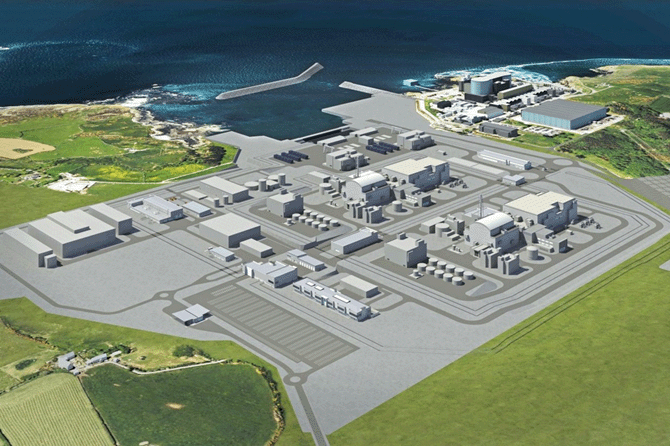 Unearthed 5th June 2018 Hitachi is seeking billions of pounds from the British government to help build a new nuclear power plant at Anglesey in Wales – but experts say the technology being used is far from proven.
Last week Hitachi-rival Toshiba confirmed that they are pulling out of a major nuclear power project in the USA which planned to use a similar reactor type to the one planned for Wylfa. Toshiba said in a press release that the South Texas
Project had “ceased to be financially viable” due to prevailing economic conditions.
The announcement leaves the UK as one of the last countries looking to build this technology, called the Advanced Boiling
Water Reactor (ABWR). Steve Thomas, Professor of Energy Policy at the University of Greenwich, said that while there are some small differences between the European reactor led by Hitachi and the abandoned US reactor
from Toshiba, the “perception that this is proven technology is not supported by the facts”.
Although there are four similar reactors that have been built in Japan, plans for construction elsewhere have seen a
series of failures. And because of the long lead-in times for developing and building nuclear reactors, power plants built today may have been designed decades ago, Thomas said
“The technology that has been built already is actually 30 year old technology, which has been updated twice
over. So the plants that are operating do not really represent what we would build, and also the performance of the plants in terms of their reliability has actually been very poor.”
https://unearthed.greenpeace.org/2018/06/05/wylfa-hitachi-nuclear-reactor-type-awbr/
1 This Month





PLEASE OPPOSE HR 8255 AND S.3639 – bills would accelerate satellite deployment, with no environmental review or safeguards – https://ncstd5li.quorum.us/campaign/169331/
To see nuclear-related stories in greater depth and intensity – go to https://nuclearinformation.wordpress.com
-
Archives
- October 2026 (19)
- September 2026 (339)
- August 2026 (330)
- July 2026 (355)
- June 2026 (287)
- May 2026 (306)
- April 2026 (356)
- March 2026 (251)
- February 2026 (267)
- January 2026 (308)
- December 2025 (358)
- November 2025 (359)
-
Categories
- 1
- 1 NUCLEAR ISSUES
- business and costs
- climate change
- culture and arts
- ENERGY
- environment
- health
- history
- indigenous issues
- Legal
- marketing of nuclear
- media
- opposition to nuclear
- PERSONAL STORIES
- politics
- politics international
- Religion and ethics
- safety
- secrets,lies and civil liberties
- spinbuster
- technology
- Uranium
- wastes
- weapons and war
- Women
- 2 WORLD
- ACTION
- AFRICA
- Atrocities
- AUSTRALIA
- Christina's notes
- Christina's themes
- culture and arts
- Events
- Fuk 2022
- Fuk 2023
- Fukushima 2017
- Fukushima 2018
- fukushima 2019
- Fukushima 2020
- Fukushima 2021
- general
- global warming
- Humour (God we need it)
- Nuclear
- RARE EARTHS
- Reference
- resources – print
- Resources -audiovicual
- Weekly Newsletter
- World
- World Nuclear
- YouTube
-
RSS
Entries RSS
Comments RSS

