UK’s nuclear power bigwigs want “community engagement”, but exclude critics of Sizewell nuclear project
Ipswich Star 28th June 2018 , Sizewell C boss under fire for meeting Suffolk business leaders – but not
campaign groups. EDF Energy chief executive Simone Rossi is addressing
Suffolk Chamber of Commerce members at their annual general meeting in
Ipswich on Friday, June 29.
But Theberton and Eastbridge Action Group on
Sizewell (TEAGS), Minsmere Levels Stakeholder Group (MLSG) and the B1122
Action Group said he should show his commitment to community engagement and
meet with them too. “Despite being in post for eight months and speaking
about Sizewell regularly to the national media, Simone Rossi appears
surprisingly reluctant to visit us,” said Paul Collins of TEAGS and MLSG.
“If EDF really wants to show its commitment to engagement, Simone Rossi
will make it a priority to come and meet the community that is on the
frontline of Sizewell C and D and that will suffer a cumulative and
disproportionate impact during construction. He owes it to the people of
east Suffolk to come and hear our concerns face to face and ensure that EDF
meets its stated obligations before the next round of consultation.”
http://www.ipswichstar.co.uk/news/sizewell-c-edf-suffolk-teags-leiston-suffolk-chamber-of-commerce-1-5583182
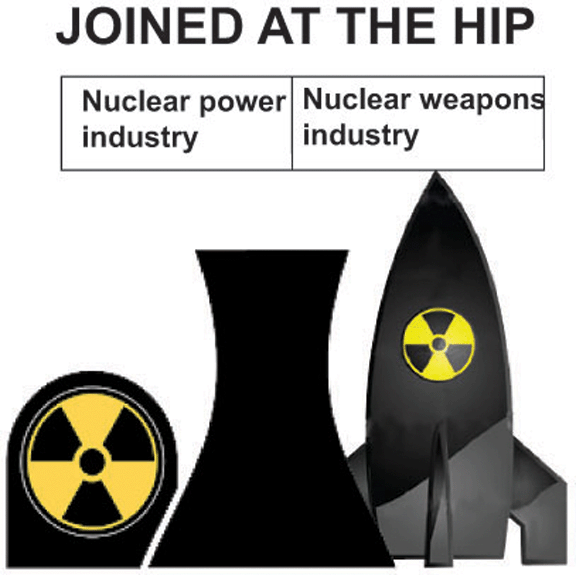
The nuclear weapons connection: Why Hinkley Point C nuclear station gets go-ahead, and Tidal Lagoon energy doesn’t
 David Lowry’s Blog 27th June 2018 , The question asked in the Guardian leader: “Hinkley Point C got the
go-ahead despite its cost. So why not Swansea Bay?” has a number of
credible answers.
Firstly, you cannot warheads for nuclear weapons of mass
destruction form any by-products of a tidal lagoon as you can from Hinkley
C’s plutonium.
Indeed, when Hinkley A was being developed in the late the
Ministry of Defence issued clear statement on: “the production of
plutonium suitable for weapons in the new [nuclear ] power stations
programme as an insurance against future defence needs…” (17 June 1958)
http://drdavidlowry.blogspot.com/2018/06/you-cannot-fuel-nuclear-proliferation.html
UK govt launches pro nuclear campaign, pushes for women in the nuclear industry
 UK government unveils £200m nuclear sector deal, The Engineer, Business secretary Greg Clark launches deal including commitment to new technology development and increased role for women in the nuclear industry ……. Details of the deal include up to £44m funding to develop advanced modular reactors, a commitment to reduce the cost of nuclear new build by 30 per cent by 2030, and to cut the cost of decommissioning old sites by 20 per cen% in the same period. There will be a new review into ways of accelerating the cleanup of old sites. Clark also signalled an increased commitment to fusion energy research, with the establishment of a national fusion technology centre at Culham in Oxfordshire, the site of the Joint European Torus (JET) fusion experiment and the home of Tokomak Technologies, which is developing fusion reactors based on the spherical tokomak principle. This fusion centre will be supported by £86m funding from the government.
“The UK is the home of civil nuclear technology and with this investment in innovation and our commitment to increasing diversity in an already highly-skilled workforce, I want to ensure we remain the world leader,” Clark said.
The NSD was announced at Trawsfynydd in Snowdonia, the site of a decommissioned nuclear reactor (the only one in the UK not on the coast) and a mooted site for the first small modular reactor project. “This site reflects both the past of our nuclear industry and an exciting future as the potential site for the new generation of small reactors, placing Wales at the centre of a UK arc of the nuclear industry,” said Alan Cairns, secretary of state for Wales.
The advanced modular reactor project will see eight designs go forward to detailed commercial and technical visibility studies. This phase 1, £4m has been allocated, and three or four of the designs will then go forward to a second phase for further development, with a possible £40m of further funding subject to a value for money approval from the Treasury. Up to £5m will be made available to regulators to support this, and up to £7m will fund capability and capacity to assess and licence small and novel reactor designs…..https://www.theengineer.co.uk/nuclear-industry-sector-deal/
UK’s Tidal Lagoon energy project – would be costly to build, but very cheap for 120 years thereafter
 Times 28th June 2018 , Professor Chris Binnie: Greg Clark says that the Swansea tidal
lagoon was rejected as it is three times as expensive as Hinkley C, but his
calculations are suspect. The tidal lagoon would be expensive to build, but
once built it could go on for 120 years with minimal refurbishment cost.
And letter Prof Roger Kemp: The government’s rejection of the Swansea tidal
lagoon is extremely disappointing. Greg Clark says that wind energy is
cheaper, bu t it’s a false comparison: we can predict the tides years in
advance but it is difficult to look more than a week ahead with wind.
https://www.thetimes.co.uk/edition/comment/adhd-and-the-rise-in-the-use-of-medication-d2bjsnc6f
Theresa May’s UK govt rejects renewables, promotes nuclear – and cancels promising tidal energy project
 Bloomberg 27th June 2018 The U.K. government earmarked 200 million pounds ($262 million) to smooth
the way for the next nuclear power plants just two days after rejected the
case for an experimental project that would generate power from the tides.
The Department for Business, Energy and Industrial Strategy said its
Nuclear Sector Deal will fund technology and skills needed to maintain the
industry that the government is backing to be part of its future energy
mix. About 56 million pounds will go to help eight vendors of modular
reactors carry out technical studies.
The decision puts further distance
between Prime Minister Theresa May’s administration and the possibility
of government support for cutting-edge renewable technologies. May’s
government has scaled back subsidies for wind and solar, halted onshore
wind farms and declined to back Tidal Lagoon Power Ltd.’s proposal for a
1.3 billion pound project to demonstrate its technology.
https://www.bloomberg.com/news/articles/2018-06-27/u-k-earmarks-262-million-to-bolster-its-nuclear-power-industry
Chemical spill at the Sellafield nuclear plant
Whitehaven News 26th June 2018 , Firefighters were called to deal with a chemical spill at the Sellafield
nuclear plant. Cumbria Fire and Rescue Service was called to the spillage,
which involved about 25 litres of nitric acid, at 3.13pm yesterday. The
service sent three crews, who joined two Sellafield fire service engines
already at the scene. Two CFRS and two Sellafield firefighters wearing
gas-tight suits and breathing apparatus applied sodium bicarbonate to
neutralise the acid. They were at the scene for about two hours. A
Sellafield spokesman said the spill did not involve any radioactive
chemicals, the material stayed within a bund designed to contain spillages
and the incident posed no risk or harm to anybody.
http://www.whitehavennews.co.uk/news/firefighters-called-to-Sellafield-4731973a-e10d-480c-8b3f-222c18dfc449-ds
UK govt cancels promising Swansea Tidal Lagoon scheme, as it promotes dodgy Wylfa nuclear power plan
Guardian 27th June 2018 Letter Gideon Amos: When I and my fellow planning inspectors spent the best
part of a year examining and reporting on both the principle and the detail
of the project in Swansea, it was clear that this pathfinder project had
important environmental, cultural and regeneration benefits.
Vitally, itwould provide baseload generation capacity to complement our welcome but
increasing reliance on wind energy. In addition, while being “first of a
kind” presents big investment and consenting headaches for a promoter, the
potentially infinite lifespan of the generating station means these early
upfront costs need to be discounted over a much longer timeframe than other
projects.
Failing to weigh these benefits and costs in the Treasury
economist’s balance sheet is a major mistake and one that misses a massive
opportunity to put the planet back at the centre of our nation’s future.
NFLA 27th June 2018 The Nuclear Free Local Authorities (NFLA) is hugely disappointed in the
decision announced on Monday by UK Business and Energy Secretary Greg Clark
to cancel potential financial support for the Swansea Tidal Lagoon scheme.
This is a retrograde step for a nascent and exciting technology, and
compares negatively with the billions being offered to prop up new nuclear
reactor schemes like Wylfa B.
http://www.nuclearpolicy.info/news/cancellation-support-swansea-tidal-lagoon-scheme-error-uk-energy-industrial-strategy-policy/
Ireland’s concerns on nuclear safety after Brexit and UK’s withdrawal from the Euratom Treaty
 Irish Times 25th June 2018 , Cllr Mark Dearey, Cllr John Trainor, Co-Chairmen, Nuclear-Free Local
Authorities All-Ireland Forum: … on nuclear safety after
the UK leaves the Euratom arrangements, it is clear that Minister for the
Environment Denis Naughten must do more than simply accept cosy platitudes
from his UK counterpart. While the Border issue is a pivotal part of the
negotiations of Brexit, the parallel decision to leave the Euratom Treaty
arrangements is still of real importance.
The treaty oversees all external safety and security checks at UK nuclear sites, particularly Sellafield, as
well as monitoring the UK’s duties in not proliferating nuclear materials
that could be converted into a nuclear weapons programme.
In our view, the UK government needs to grow up on the issue of the jurisdiction of the
European Court of Justice on matters of nuclear safety. The UK government
has compromised all over the place on Brexit, and by refusing to do so on
this subject, it is putting all of our safety at risk on a point of
political expediency.
As The Irish Times has correctly noted, the transfer
of these duties to the domestic nuclear regulator is not without risk, and
there is real concern that there may not be enough inspectors recruited in
sufficient time and that key and complicated IT systems to verify such work
are put in place by March 2019.
Last month the Oireachtas Joint Planning
Committee heard of detailed concerns over the UK’s approach to assessing
the transboundary impacts of plans to develop new nuclear plants like
Hinkley Point and Wylfa.
Any accident from an existing or new nuclear plant
could have devastating health, economic and social impacts on Ireland, so
it is important not just to receive assurances, but to properly audit them
and to be satisfied that a new nuclear safety regime remains fit for
purpose.
Ireland is extensively doing that with other impacts of Brexit on
the country, and in our view, this should be a core part of that detailed
discussion. We also want to know how both governments will prioritise
nuclear safety and energy policy in a post-Brexit world, where we see a
real lack of forward thinking in addressing the energy needs of both the UK
and Ireland.
https://www.irishtimes.com/opinion/letters/brexit-and-nuclear-safety-treaty-1.3541656
With climate change, it’s unwise for UK to build Hinkley Point C, as sea levels are rising
 Weatherwatch: the nuclear option and rising levels of anxiety Danger of coastal flooding might make sensible people think twice about building houses in vulnerable places, let alone nuclear power stations, Guardian, https://www.theguardian.com/news/2018/jun/22/weatherwatch-the-nuclear-option-and-rising-levels-of-anxiety Paul Brown,
Back in 2012 a document obtained under the Freedom of Information Act showed that the Environment Agency was warning that 12 out of the UK’s 19 nuclear sites were in danger of coastal flooding and erosion because of climate change. Among them was Hinkley Point in Somerset, one of the eight proposed sites for new nuclear power stations around the coasts.That was before the increasing volume of melting of the Greenland ice capwas properly understood and when most experts thought there was no net melting in the Antarctic.
Melting ice sheets are hastening sea level rise, satellite data confirms
Satellite measurements released earlier this month and other recent observations of how warmer seas are eroding ice shelves and glaciers have removed uncertainty.
Estimates of sea level rise in the next 50 years have gone up from less than 30cm to more than a metre, well within the lifespan of the nuclear stations the UK government has planned.
The extra coastal erosion and threat of storm surges that this increase in sea level will bring to our shores might make sensible people think twice about siting any buildings in vulnerable places, let alone nuclear power stations.
So far, however, the government has yet to respond and is pressing ahead with its plans.
Scrap Trident or risk a “nuclear annihilation abyss”- former nuclear sub commander warns UK govt
 Former nuclear sub commander pleads with Government to scrap Trident or risk a “nuclear annihilation abyss”, Sunday Herald, Rob Edwards, 24 June 18
How the British government struck such a terrible deal as Hinkley Point C nuclear power project

 Hinkley Point: the ‘dreadful deal’ behind the world’s most expensive power plant Building Britain’s first new nuclear reactor since 1995 will cost twice as much as the 2012 Olympics – and by the time it is finished, nuclear power could be a thing of the past. How could the government strike such a bad deal? Guardian, By Holly Watt, 21 Dec 17, Hinkley Point, on the Somerset coast, is the biggest building site in Europe. ……
the irony of Hinkley Point C is that by the time it eventually starts working, it may have become obsolete. Nuclear power is facing existential problems around the world, as the cost of renewable energies fall and their popularity grows. “The maths doesn’t work,” says Tom Burke, former environmental policy adviser to BP and visiting professor at both Imperial and University Colleges. “Nuclear simply doesn’t make sense any more.”
The story of Hinkley Point C is that of a chain of decisions, taken by dozens of people over almost four decades, which might have made sense in isolation, but today result in an almost unfathomable scramble of policies and ambitions. Promises have been made and broken, policies have been adopted then dropped then adopted again. The one thing that has been consistent is the projected cost, which has rocketed ever upwards. But if so many people have come to believe that Hinkley Point C is fundamentally flawed, the question remains: how did we get to this point, where billions of pounds have been sunk into a project that seems less and less appealing with every year that passes?
……… By the end of 2003, all government policy indicated that Hinkley Point C would never be built, and there was no prospect of any other new nuclear power plants. It seemed certain that nuclear had no future in Britain – which is why, when the government performed a volte-face three years later, so many onlookers were astonished. “Without any obvious change in the world, by 2006, the position in government had been completely reversed,” MacKerron told me. “Nuclear power had become extremely beneficial, important and not uneconomic.”
One thing that had happened in the intervening years was a PR blitz by the nuclear industry, which had deployed scores of lobbyists, including former politicians such as the former energy minister Brian Wilson, to push the idea of a “nuclear renaissance” in the UK. Between 2003 and 2006, says Andrew Stirling, professor of science and technology policy at Sussex University, “Britain saw the beginnings of a massive pro-nuclear lobbying and PR campaign that continues to this day.”
Through the media and advertising campaigns, key messages were hammered home. Renewables were intermittent and unreliable. Overseas gas imports were politically vulnerable. “Green” nuclear was the only plausible way to hit carbon dioxide reduction targets. Keith Parker, who was then chief executive of the Nuclear Industry Association (NIA), told the New Statesman that the 2005 election became a particular focus for swaying opinions. “It gave us a good chance to raise the profile of nuclear power,” he said. In the months leading up to the election, a series of talks was organised at exclusive venues such as the Army & Navy Club on Pall Mall and St Stephen’s Club in Queen Anne’s Gate. Industry leaders and experts came together to explain the benefits of nuclear to politicians and energy journalists. The NIA (which is now chaired by John Hutton) took on the role of managing the influential all-party parliamentary group – an informal grouping of politicians – on nuclear energy.
In July 2006, the government U-turn arrived in the form of a new policy paper, The Energy Challenge, which declared that new nuclear power stations would be necessary to help Britain reduce its carbon emissions and to ensure an uninterrupted, affordable supply of energy well into the future.
Greenpeace launched a legal challenge, claiming that the consultation process behind the government’s recommendation had been totally inadequate. The judge presiding over the case agreed, and in February 2007 ruled that the process had been “misleading”, “very seriously flawed” and “procedurally unfair”. Blair accepted the ruling, but stated that “this won’t affect the policy at all”.
Andrew Stirling believes that there was a crucial, largely unspoken, reason for the government’s rediscovered passion for nuclear: without a civil nuclear industry, a nation cannot sustain military nuclear capabilities. In other words, no new nuclear power plants would spell the end of Trident. “The only countries in the world that are currently looking at large-scale civil power newbuild programmes are countries that have nuclear submarines, or have an expressed aim of acquiring them,” Stirling told me.
In May 2007, the government published a paper titled “Meeting the energy challenge: a White Paper on energy”, which reaffirmed its enthusiasm for nuclear and declared that there had been “significant changes in the economics of nuclear power”. In contrast to the late 1980s, the government claimed it was now being approached by “some energy companies expressing a strong interest in investing in new nuclear power stations”.
When Gordon Brown took over from Blair in June 2007, the shift to nuclear proceeded apace. As it happened, the new prime minister’s brother, Andrew, was then the communications director for EDF, though a spokesman for Gordon Brown told me that at no point while he was prime minister “did he ever discuss energy policy with Andrew Brown”.
In January 2008, the announcement came. A new generation of nuclear power stations in the UK was given formal backing by the government. “It was one of the most exciting days in my ministerial life,” says Hutton. “Ministers do lots of important things all the time, but there are probably those moments in your ministerial career when you sit back and think: ‘Actually, this is going to have an intergenerational effect. This is going to affect the country 50, 60, 70 years after I’ve gone.’”
The development at the top of the list was Hinkley Point C……….
With no real plan B after the private sector had lost interest in Hinkley Point, the government suddenly found itself in a weak negotiating position. “They perhaps didn’t foresee that only one developer, EDF, was prepared to go ahead,” said MacKerron. “So by definition, they were a bit over a barrel.”
In September 2008, British Energy was sold to EDF. After months of long and difficult negotiations between EDF and a team of civil servants representing the UK’s interests in British Energy, and an earlier failed bid, the French company paid £12.5bn to take over eight UK nuclear power plants. It also announced its plan to develop four new power stations.
These days, EDF looks like an unlikely white knight. The market value of the company has collapsed, from more than €150bn (£132bn) in 2008 to roughly €30bn (£26bn) today, and the French nuclear industry is facing an existential crisis.
…….. The financial deal that EDF struck with the British in October 2013 to fund the project – which, in Magnin’s words, amounts to the British taxpayer funding France’s energy needs – remains one of the most controversial elements of the Hinkley deal.
Given its commitment to building Hinkley Point C, the government had no choice but to make EDF an offer that was too good to resist. It offered to guarantee EDF a fixed price for each unit of energy produced at Hinkley for its first 35 years of operation. In 2012, the guaranteed price – known as the “strike price” – was set at £92.50 per megawatt hour (MWh), which would then rise with inflation. (One MWh is roughly equivalent to the electricity used by around 330 homes in one hour.)
This means that if the wholesale price of electricity across the country falls below £92.50, EDF will receive an extra payment from the consumer as a “top-up” to fill the gap. This will be added to electricity bills around the country – even if you aren’t receiving electricity from Hinkley Point C, you will still be making a payment to EDF. ……..
In short, instead of using taxpayers’ money to fund a state subsidy for EDF, the government negotiated a deal whereby the electricity consumer foots the bill. Given that almost every taxpayer in the UK is an electricity consumer, the distinction is largely academic. …….
The deal looks particularly bad when compared with the current cost of renewable energy. As Hinkley’s pricetag keeps rising, the cost of energy keeps falling. And, as a recent report from the public accounts committee pointed out, although energy costs are falling, this just drives up the top-up payment to EDF. “No one was protecting the interests of energy consumers in doing the deal,” the report noted.
In December 2013, the European commission decided that the payments to EDF were so big that they could distort the electricity price across the whole of Europe, and launched an investigation into the deal. The resulting document, published in 2014, can be read as a 33,000-word attempt by the EU to save the UK from its own poor negotiating.
The commission raised several issues………
In 2012, as it was preparing to negotiate the strike price with EDF, the government hired the consultancy firm LeighFisher to assess construction costs for Hinkley. The higher the cost estimated by LeighFisher, the higher the strike price for EDF.
However, as the National Audit Office pointed out in June 2017, LeighFisher is owned by Jacobs Engineering Group. And at the same time that LeighFisher was assessing Hinkley Point construction costs, Jacobs was working for EDF, with some of its staff seconded to the French company. The National Audit Office points out that Jacobs staff were having “input” into LeighFisher’s cost verification exercise.
In short, a division of a company employed by EDF was advising the UK government how much to pay EDF.
……. Hinkley Point C will be the third nuclear reactor to be built on this site. These days, its oldest brother, Hinkley Point A, which began operating in 1965 and was decommissioned in 2000, is dilapidated, with large holes gaping in its blue walls. Hinkley Point B, which began operating in 1976 and is scheduled to be decommissioned in 2023, stands 300 metres to its right – an anonymous grey hulk, disappearing against the sky, as steam from its huge chimneys floods into the clouds………
“My grandchildren will be paying for this,” Allan Jeffery from Stop Hinkley told me, as we walked around the outer boundary of the site earlier this year.
The government estimates that the Hinkley top-up payments will cost consumers around £30bn over the course of the 35-year contract. One of the few figures on a comparable scale is the Brexit divorce bill.
The story of Hinkley point contains another echo of – or perhaps a warning for – the Brexit negotiations. With Hinkley, even though the UK’s position got steadily worse, at no point did the government seriously try to force the terms of the deal. It simply couldn’t, because it had backed itself into a corner.
……. The stakes of the Hinkley deal were also high for both China and France, and neither country gave an inch. When it came to the crunch, the UK’s negotiators had to take the deal they were offered. “The issue now is that nobody has a good exit strategy,” says Prof Steve Thomas. “I think everyone wants out. But there are penalties to pay now, and there is the humiliation of 10 wasted years.”……..https://www.theguardian.com/news/2017/dec/21/hinkley-point-c-dreadful-deal-behind-worlds-most-expensive-power-plant
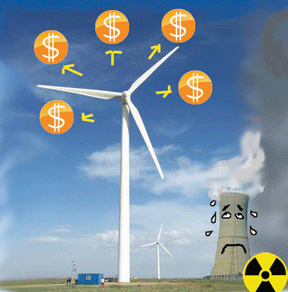
Britain’s wind energy programmes have proved to be cheaper and better climate policy, as against nuclear
 Dave Toke’s Blog 22nd June 2018, The Climate Change Act has been celebrating its 10th anniversary, but there
is surprisingly little to celebrate in the earlier advice of the Committee on Climate Change (CCC). The CCC is the body created to advise the Government on the achievement of the carbon reduction commitments (80 per cent of 1990 levels by 2050).
You would expect the advice of the CCC to speed the Government’s low carbon programme, but in the crucial aspect of
electricity supply policy it has (in the past) actually damaged it! Looking back on its past, it looks like the Committee gave completely the wrong advice to the Government, advice which, alas, they still seem to be following now. In particular, in the ‘Renewable Energy Review’ issued in 2011 (which I criticised at the time), the CCC, urged the Government to cut
back the targets for offshore wind and instead focus on nuclear power.
They told the Government not to be put off by the Fukushima disaster that had happened earlier that year. According to the Times Report on May 9th 2011 ”The Committee on Climate Change says heavy reliance on offshore wind could result in unacceptable increases in fuel bills.’ David Kennedy, the then Chief Executive of CCC said that ‘Nuclear looks like it will be the lowest cost for the next decade or two’. Indeed the Review stated that nuclear power was currently ‘the most cost effective of the low carbon technologies’.That conclusion, given the cost of onshore wind, was highly challengable at the time, especially as given the existing record of nuclear power plant that had been built in the UK and the roll-out of
onshore wind.
Whereas the deployment of renewable energy has soared ahead, despite the best efforts of many in the Conservatives to block it, nuclear power plans set out in 2010 have proved to be fantasy. And, of course, offshore wind costs have tumbled rapidly making the CCC’s earlier pronouncements looking especially silly.
http://realfeed-intariffs.blogspot.com/2018/06/how-committee-on-climate-change-gave.html
Scotland’s Youth Peace Academy running 3 day programme to train activists
 The National 22nd June 2018 , A FULLY funded three-day training programme is giving young people the
chance to become top activists on nuclear disarmament. The Youth Peace
Academy is inviting 18 to 30-years-olds residing in Scotland to take part
in a packed training programme. Participants will learn about nuclear
weapons, lobbying, writing press releases, fundraising tools and more.
Peace Education Scotland’s Flavia Tudoreanu helped come up with the idea
after attending a similar event in Berlin. She said: “We thought it would
be really good to bring to Scotland.
http://www.thenational.scot/news/16306981.Young_Scots_offered_training_in_anti-nuclear_activism/
Nuclear decommissioning in the UK
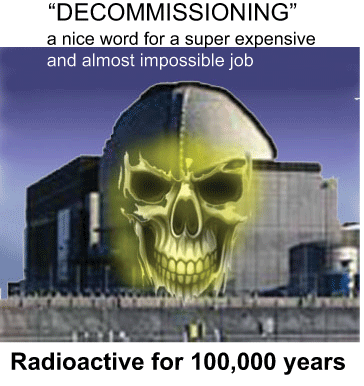 Decommissioning NO2Nuclear Power. Safe Energy Journal 78 The UK government has launched a consultation on the future regulation of nuclear sites in the final stages of decommissioning and clean-up. The Department for Business, Energy and Industrial Strategy (BEIS) said the consultation seeks to enable a “more flexible approach that can optimise waste management, thereby realising environmental benefits and reducing costs”.
Of the 36 nuclear sites located across England, Wales and Scotland, the Nuclear Decommissioning Authority (NDA) is responsible for the decommissioning and clean-up of 17. Other sites to be decommissioned in the future include the operational nuclear power stations owned by EDF Energy, and other nuclear sites in the nuclear fuel cycle, reprocessing, waste management, pharmaceutical and research sectors.
In the UK, the Nuclear Installations Act 1965 (NIA65) provides the legal framework for nuclear safety and nuclear third-party liability and sets out a system of regulatory control based on a robust licensing process administered by the Office for Nuclear Regulation (ONR). Under this regime, a site operator is required to have a licence to use a site for specified activities such as the operation of nuclear power stations. In addition to the nuclear site licensing regime, the NIA65 requires that financial provision is in place to meet claims in the event of a nuclear incident, as required under international law on nuclear third-party liability.
The consultation proposals include changing the NIA65 to allow licensees to exit the licensing regime once the site has reached internationally agreed standards and nuclear safety and security matters have been fully resolved. After the licence has been ended, the site would be regulated by the relevant environment agency and the Health and Safety Executive, in the same way that non-nuclear industrial sites undergoing clean-up for radioactive or other contamination are regulated.
Proposals for further clean-up would be assessed by the relevant environment agency under the Radioactive Substances Regulations. BEIS said this process would enable the site operator to work with the community to establish the “most appropriate” end-state for the site and would result in improved waste management and other environmental benefits.
BEIS proposes to implement two recent decisions by the OECD Steering Committee for Nuclear Energy concerning the exclusion of certain sites from the nuclear third-party regime when the main nuclear hazards have been removed and the risks to the public are small. It also proposes to tighten the licence surrender process to require a licensee to apply to ONR to surrender the licence, and to strengthen requirements for ONR to consult with HSE when the licence is surrendered or varied. (1)
The Government says the main reasons for change are:
- nuclear third party liability currently continues beyond the point at which it is no longer required. The UK has not yet implemented the decisions of the OECD Steering Committee for Nuclear Energy concerning the exclusion of certain sites from the nuclear liability regime;
- site operators wishing to exit the NIA65 licensing regime are required to clean-up the site in a way that does not allow them to balance the overall safety and environmental risks and this may result in unnecessary costs; and
- · disposal facilities for radioactive waste located on nuclear licensed sites remain subject to nuclear licensing. Such sites are also regulated by the environment agencies. This is considered dual regulation which is unnecessary after nuclear safety matters have been resolved.
The UK Government Department for Business, Energy and Industrial Strategy (BEIS) published a discussion paper on the regulation of nuclear sites in the final stages of decommissioning and cleanup in November 2016. The NFLA responded here:
This response concluded that:
There is a danger that what is being proposed will simply be seen as turning nuclear sites into nuclear dumps as a way of saving money.
The concept of “optimisation” which is decided by the operator and regulators making value judgements needs to be replaced with the concept of the Best Practicable Environmental Option which uses a systematic consultative and decision making procedure.
Any part of a nuclear site upon which it is proposed to allow unrestricted use must be able to show that doses to members of the public will be of the order of 0.01mSv or less per year. Using a risk factor in conjunction with probability of receiving a dose is too flexible and unacceptable.
Any waste left on-site much be concentrated and contained in a monitorable, retrievable store.
Former nuclear operators should remain liable for any future unexpected events and should also be liable to pay for any regulatory effort in perpetuity.
These earlier proposals appear to allow for the unrestricted use of sites which may have nuclear waste buried and which could be capable of administering doses of up to 20mSv/yr if human intrusion occurs.
The HSE Criterion for De-Licensing Nuclear Sites (2005) says the Basic Safety Standards Directive (Euratom 96/29) allows member states to exempt a practice where appropriate and without further consideration if doses to members of the public are of the order of 0.01mSv or less per year. HSE is of the view that this dose limit broadly equates to a risk of 10-6 ‘as well as being consistent with other legislation and international advice relating to the radiological protection of the public. The environment agencies Guidance on Requirements for Authorisation (GRA) on Near Surface Disposal Facilities for Solid Radioactive Waste (Near Surface GRA) says that a risk level of 10-6 per year is equivalent to a calculated dose of around 0.02mSv/yr, where the probability of receiving the dose is one.
The consultation is open until 3rd July, and is available here:
https://www.gov.uk/government/consultations/the-regulation-of-nuclear-sites-in-the-final-stagesof-decommissioning-and-clean-up http://www.no2nuclearpower.org.uk/wp/wp-content/uploads/2018/06/SafeEnergyNo78.pdf
UK’s Nuclear Decommissioning Authority (NDA) to spend billions stabilising plutonium canisters
 Power Technology 21st June 2018 , NDA to spend billions stabilising plutonium canisters. The National Audit Office (NAO) has released a report detailing the unstable condition of highly dangerous plutonium canisters at the Sellafield nuclear plant, said to be “decaying faster than anticipated”.
The report, titled ‘Progress with reducing risk at Sellafield’ warns that if these canisters were to leak it would prove an “intolerable risk” – a label defined by the Nuclear Decommissioning Authority (NDA) as a situation where reducing the risk “becomes the overriding factor”, taking precedence over matters of cost and requiring immediate action.
The NDA has refused to comment on the number of canisters affected, though it has said it is only a “small proportion” of their total number. The UK houses 40% of global civil plutonium, the majority of which is stored at the Sellafield site in Cumbria, itself overseen by the NDA. The substance is a by-product of nuclear fuel reprocessing and the site’s abundant stock has led the NDA to label Sellafield its most hazardous facility.
The new report shows Sellafield, which opened in 2012, to have ‘unsuitable’ containers for storing plutonium. The NAO has proposed the canisters be repackaged through the store retreatment plant (SRP) facility, though until this facility is ready the NDA is recommended to place the more unstable canisters in extra layers of packaging. In response to these measures, the NDA has announced its decision to pledge a further £1bn on these packaging canisters, and £1.5bn on building a new facility to house the plutonium.
https://www.power-technology.com/news/nda-spend-billions-stabilising-plutonium-canisters/
1 This Month





PLEASE OPPOSE HR 8255 AND S.3639 – bills would accelerate satellite deployment, with no environmental review or safeguards – https://ncstd5li.quorum.us/campaign/169331/
To see nuclear-related stories in greater depth and intensity – go to https://nuclearinformation.wordpress.com
-
Archives
- October 2026 (19)
- September 2026 (339)
- August 2026 (330)
- July 2026 (355)
- June 2026 (287)
- May 2026 (306)
- April 2026 (356)
- March 2026 (251)
- February 2026 (267)
- January 2026 (308)
- December 2025 (358)
- November 2025 (359)
-
Categories
- 1
- 1 NUCLEAR ISSUES
- business and costs
- climate change
- culture and arts
- ENERGY
- environment
- health
- history
- indigenous issues
- Legal
- marketing of nuclear
- media
- opposition to nuclear
- PERSONAL STORIES
- politics
- politics international
- Religion and ethics
- safety
- secrets,lies and civil liberties
- spinbuster
- technology
- Uranium
- wastes
- weapons and war
- Women
- 2 WORLD
- ACTION
- AFRICA
- Atrocities
- AUSTRALIA
- Christina's notes
- Christina's themes
- culture and arts
- Events
- Fuk 2022
- Fuk 2023
- Fukushima 2017
- Fukushima 2018
- fukushima 2019
- Fukushima 2020
- Fukushima 2021
- general
- global warming
- Humour (God we need it)
- Nuclear
- RARE EARTHS
- Reference
- resources – print
- Resources -audiovicual
- Weekly Newsletter
- World
- World Nuclear
- YouTube
-
RSS
Entries RSS
Comments RSS

