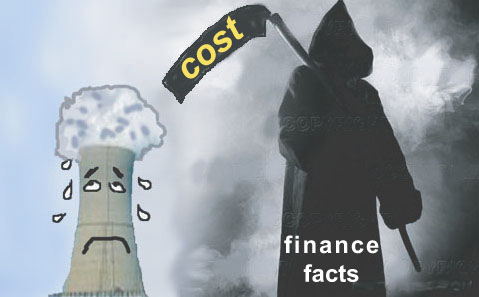
Ever multiplying financial costs for building new nuclear reactors are hitting UK, and other countries, too
 Nikkei Asian Review 6th June 2018 Britain’s move to finance much of a Hitachi nuclear power plant underscores
how such projects have grown too costly for the private sector to bear
alone, raising further questions about a key component of Japan’s ambitious
plans to export infrastructure worldwide.
The threat of electricity shortages spurred by factors including aging power plants drove London’s
pledge to loan a full 2 trillion yen ($18.2 billion) for the Japanese
industrial group’s plan to build two nuclear reactors in Wales, a project
slated to cost over 3 trillion yen.
The Wylfa saga illustrates how the expense of building nuclear power plants has become a deterrent to their
construction. Estimates for the Wales reactors have roughly doubled from
the initial outlook, owing to snowballing costs for safety and other
provisions. apart from Hitachi’s U.K. project, most of Japan’s overseas
nuclear efforts face an uncertain future at best.
Plans for new reactors are stalling around the world as countries get caught between the need for
energy security and the risks associated with nuclear energy. A Mitsubishi
Heavy Industries plan to build four reactors in Turkey’s Black Sea coastal
city of Sinop has doubled in cost to around 5 trillion yen, owing mainly to
additional precautions against earthquakes. Now the project “will not turn
a profit unless the Turkish government more than doubles the price at which
it buys electricity,” said a source affiliated with Mitsubishi Heavy.
Trading house Itochu has pulled out of the business alliance behind the
project. Toshiba’s former nuclear unit Westinghouse Electric, which was
building four reactors in the U.S., filed for bankruptcHitachi still faces
other hurdles on the Wylfa project. Lining up investors is proving
difficult on the Japanese side.
The U.K. government likely will drive a
hard bargain on power purchase prices, having drawn criticism for agreeing
to pay far above market rates for electricity from Hinkley Point C, a
nuclear power plant being built by France’s EDF and state-owned China
General Nuclear Power Group. Clarifying liability for accidents will be
another issue.
https://asia.nikkei.com/Business/Business-Trends/Hitachi-s-UK-nuclear-project-shows-heavy-risks-for-private-sector
Caroline Lucas: Backing Wylfa Nuclear Power Station Is The Wrong Move At The Wrong Time
Huffington Post 5th June 2018, Behind its shiny green veneer, this government has overseen
the funding stream for clean energy fall to its lowest levels in a decade.
The context for this public payout for new nuclear is an energy market
that’s making it blindingly obvious that renewables are the future. Solar
and wind are now the cheapest forms of new electricity generation, and new
technology means that power from the sun, sea and wind, balanced with
batteries and interconnection, are able to be the backbone of British
energy in the future.
Onshore wind – which the Government has all but
banned – could have a strike price a whopping £37.50 lower than Wylfa’s.
The frequent retort to those of us who oppose nuclear is centred on the
need for ‘baseload’ power – but such arguments are increasingly weak.
We know that battery technology is coming on leaps and bounds – and even
the ex-head of National Grid, Steve Holliday, has said that “the idea of
large power stations for baseload is outdated”, and noted that “from a
consumer’s point of view, the solar on the rooftop is going to be the
baseload”.
But it’s not just the government’s skewed financial
priorities that make Wylfa the wrong move at the wrong time. At the heart
of the problems with nuclear energy is the stark fact that there is still
no solution to the nuclear waste problem.
https://www.huffingtonpost.co.uk/entry/wylfa_uk_5b164eafe4b093ac33a17a41
UK govt’s new funding of nuclear projects contrasts with its lack of support for renewable project in Wales
NFLA 5th June 2018 , The Nuclear Free Local Authorities (NFLA) is very disappointed, but not at
all surprised, with the announcement by UK Energy Minister Greg Barker to
offer £5 billion of taxpayer money to assist with the funding of the Wylfa
B new nuclear reactor in Anglesey.
Whilst going against years of previous
government policy, it also compares unfavourably with the expected lack of
Government support of an exciting new renewable energy project in Wales –
the proposed development of the Swansea tidal lagoon scheme, and future
projects planned in Cardiff Bay and off the north Wales coast.
At present this scheme looks to be on a life support machine, though the Government
delayed the expected announcement to ditch the project and the thousands of
jobs that could be created.
http://www.nuclearpolicy.info/news/wylfa-b-swansea-bay-tidal-lagoon-developing-low-carbon-energy-solutions/
UK government has not revealed the terms of its nuclear deal with Hitachi
 Stake in nuclear plant would be dramatic change of policy for UK, Government has not revealed terms of sensitive deal with Hitachi over Wylfa, Ft.com, 5 June 18, NICK BUTLER
Last Monday, the board of Hitachi met in Tokyo to consider the future of their proposed new nuclear power plant at Wylfa in north Wales. The Japanese company decided neither to approve nor to drop the plan but to continue the negotiations with the UK government.
As Toshiaki Higashihara, Hitachi’s chief executive, said after the meeting: “No decision has been taken.”
They were right to pause because the deal on the table was weak and inadequate as protection against the risks involved in a project of such scale. Wylfa is set to cost at least £20bn — and, given the record of new nuclear construction, that figure can only rise.
As reported by the Japanese press, at that stage the deal appeared to involve simply a UK government “guarantee” to cover the construction phase of the project, which is when the risks are highest.
But, within days, authoritative reports in the FT and elsewhere indicated that Britain had gone further and decided to make a direct investment of public money into the project.
This would be a dramatic change of policy with many implications.
First, it would mark the reversal of 40 years of a privatisation of the energy sector begun by Margaret Thatcher and Nigel Lawson. Suddenly, the state is back in business and the arguments against other proposed nationalisations, for instance of the railways or energy retailers, are undermined.
Second, taking a direct stake in one energy supplier opens up issues of competition policy. Will the government take shareholdings in other new nuclear projects including Hinkley Point C ? If nuclear, why not offshore wind or gas-fired power stations?
Then there is the question of the use of resources. There appears to be almost no extra money for anything from the National Health Service to defence and security. But suddenly several billion pounds have been found for a single nuclear power station……..
A direct shareholding will almost certainly be challenged in the courts on the grounds of competition policy and European state-aid rules. Britain is likely to be subject to EU rules at least until the end of the Brexit transition period.
And it must face scrutiny in parliament, where it will be weighed against other potential uses of the money.
Examination of this deal is likely to force a strategic review of energy policy, which would include just how much nuclear power is really needed — a question that has not been answered since 2013. In those five years, much has changed and there is a good case for a fundamental and open reappraisal.
As the Japanese will have discovered, the UK government is weak and nothing in British politics is certain. The deal is not yet done. https://www.ft.com/content/7ba55ce6-63f3-11e8-90c2-9563a0613e56
British Conservative govt overturns its previous opposition to socialising the nuclear power industry
UK takes £5bn stake in Welsh nuclear power station in policy U-turn, Ministers reach initial agreement with Japanese firm Hitachi over new Wylfa plant, Guardian, Adam Vaughan, 3 June 18,
The UK will take a £5bn-plus stake in a new nuclear power station in Wales in a striking reversal of decades-long government policy ruling out direct investment in nuclear projects.
Ministers said they had reached an initial agreement with the Japanese conglomerate Hitachi to back the Wylfa plant but emphasised that no final decision had yet been made and negotiations were just beginning.
The business secretary, Greg Clark, announcing the Wylfa agreement in the Commons, said: “For this project the government will be considering direct investment alongside Hitachi and Japanese government agencies.”…..
the use of billions of pounds of taxpayer money will be highly controversial at a time when there is pressure to increase NHS funding and alternatives such as solar and wind power are falling in cost. ……..
Caroline Lucas, the co-leader of the Green party, said: “Taking a stake in this nuclear monstrosity would see taxpayers locked into the project and paying out for a form of electricity generation that’s not fit for the future.”
Greenpeace attacked what it called a “bailout” of the project and accused Clark of being coy about what Hitachi had been offered.
UK now setting up an agreement that will replace the nuclear safeguards lost in leaving Euratom
 U.K. Reaches Draft Deal to Ensure Nuclear Supply After Brexit, Bloomberg , By Jonathan Tirone,
The U.K. reached an accord with international inspectors that will help keep the flow of nuclear materials going after the country leaves the European Union.
The International Atomic Energy Agency’s board of governors could approve the U.K.’s draft safeguards this week in Vienna, according to a statement. The IAEA deal will “replace existing agreements” between the U.K. and European Atomic Energy Community, or Euratom, that are needed for the import and export of fuel used in nuclear power plants.
Euratom’s main function is to safeguard nuclear fuel, making sure it isn’t diverted to make weapons. The U.K. will lose that service from Euratom once it departs the EU. ……https://www.bloomberg.com/news/articles/2018-06-04/u-k-reaches-draft-deal-to-ensure-nuclear-supply-after-brexit
Britain’s Tories have done a complete U turn about subsidising nuclear power – the reason why
Dave Toke’s Blog 4th June 2018 , For the sake of artificially massaging down the price paid for electricity
from the proposed Wylfa nuclear plant the Government is about to commit the
country to pay for billions of pounds of almost inevitable construction
cost overruns.
In doing so the Tories will be junking their opposition to
doing such a thing. In 2010 The Conservative Party election manifesto
stated that: ‘we agree with the nuclear industry that taxpayer and
consumer subsidies should not and will not be provided – in particular
there must be no public underwriting of construction cost overruns’
There was a very good reason for this manifesto commitment. None of the nuclear
power plant currently operating in the UK were constructed according to
their original cost estimates. They were built during the time when
electricity was nationalised, and so the costs were spread around all
consumers and there was limited transparency about the economics of
building nuclear plants.
The Tories decided that there should be no more
wastage of public money on nuclear plant which soaked the public purse.
They wanted competition in electricity generation. Nick Butler in the
Financial Times has made some perceptive comments on this peculiar deal. He
is one of the few who has done some serious thinking about how it can
possibly be the case that the Wylfa project will be sold on a ‘cheaper’
price than Hinkley C despite the fact that the projected cost of building
Wylfa is actually higher than Hinkley
The remarkable thing is that despite
this effort at price fakery, the price agreed will still be a lot higher
than that available for installing large amounts of onshore wind offshore
wind and solar power.
http://realfeed-intariffs.blogspot.com/2018/06/wylfa-how-tories-are-deliberately.html
UK Tax-payer to cop huge payments for Wylfa nuclear power project, and costs may still balloon further
 Times 3rd June 2018 ,Ministers will this week reverse decades of opposition to investing taxpayer money in nuclear energy by agreeing to bankroll a £15bn-plus power station in Wales. The government will commit to taking a direct stake in the Wylfa plant on Anglesey, planned by the Japanese industrial giant Hitachi, after more than two years of negotiations.
It is understood the government will also provide the vast bulk of the £9bn debt. State equity will slash the cost of borrowing, but leave the taxpayer exposed if costs balloon or the project overruns. It has, though, helped ministers to
negotiate a strike price — a guaranteed payment for the plant’s electricity — of about £77.50 per megawatt hour. The government was determined to achieve a cheaper price than the £92.50 agreed with EDF, which is building the £20bn Hinkley Point power station in Somerset.
It is understood that this week’s heads of terms agreement with Hitachi will refer to “lessons learnt” from Hinkley. That deal was criticised by the National Audit Office for driving up the cost by piling too much risk on EDF. The deal this week has had to overcome opposition from the Treasury and will be a coup for the business secretary Greg Clark, who sees nuclear power as a key pillar of the government’s industrial strategy. Hitachi is believed to be considering increasing the number of reactors at Wylfa from two to four, with a strike price of less than £70, and to be planning a plant in Gloucestershire. Wylfa’s three shareholders — the UK and Japanese governments and Hitachi — will pump in about £6bn of equity on top of the £9bn debt provided largely by UK taxpayers.
https://www.thetimes.co.uk/article/taxpayer-bankrolls-15bn-nuclear-plant-at-wylfa-in-wales-0p7dnxfhq
Chinese firm Ocean Nuclear, links to former UK Prime Minister, on a fund-raising roadshow in London


 City AM 1st June 2018 Energy investment firm Ocean Nuclear today announced the launch of a $5bn (£3.8bn) nuclear energy industry fundraising roadshow in London. The Chinese company has negotiated nuclear infrastructure projects in more than
20 countries and will use 144 meetings at the roadshow to raise money for the programmes.
Ocean Nuclear has backing from firms including Silk Road Energy, which aims to raise $80m, and has been backed by the Belt and Road initiative, which has links to former Prime Minister David Cameron.
http://www.cityam.com/286792/chinese-firm-launches-5bn-london-nuclear-energy-industry
Taxpayer bankrolls £15bn nuclear plant at Wylfa in Wales
John Collingridge The Sunday Times The government will commit to taking a direct stake in the Wylfa plant on Anglesey, planned by the Japanese industrial giant Hitachi, after more than two years of negotiations.
It is understood the government will also provide the vast bulk of the £9bn debt. State equity will slash the cost of borrowing, but leave the taxpayer exposed if costs balloon or the project overruns.
It has, though, helped ministers to negotiate a strike price — a guaranteed payment for the plant’s electricity — of about £77.50 per megawatt hour. The government was determined to achieve a cheaper price than the £92.50 agreed…… (subscribers only) https://www.thetimes.co.uk/article/taxpayer-bankrolls-15bn-nuclear-plant-at-wylfa-in-wales-0p7dnxfhq
UK Environment Agency (EA) will let Atomic Weapons Establishment’s (AWE) release more radioactive isotopes into the air
 NIS 31st May 2018 The Environment Agency (EA) have announced that they are planning to
approve the Atomic Weapons Establishment’s (AWE) application to to
increase the quantity of volatile beta emitters that AWE Aldermaston is
permitted to release into the environment.
Beta emitters are radioactive elements that produce beta radiation. Volatile is a chemistry term which
refers to a substance that tends to vaporise and become a gas. AWE’s
application for the increase to the limit was announced in late January,
and there was a consultation on the application which ended in February.
The Environment Agency have now released a draft decision which approves
the proposed increase to the limit. Under their current license AWE are
allowed to release 4.4 megabecquerels (MBq) of volatile beta emitters into
the air as gas every year. The draft decision allows them to increase the
limit to 100 MBq a year, an increase of 22 times, or 2200%. A becquerel is
a measure of the quantity of radioactive material. One bequerel is the
quantity of material where radioactive decay will occur once every second.
A megabecquerel means one million becquerels of material. The EA is running
a consultation on the draft decision, which closes on the 6th June.
https://www.nuclearinfo.org/article/awe-aldermaston/environment-agency-plans-approve-2000-increase-awe-discharge-limit
UK wind power – much cheaper than planned Wylfa nuclear power plant
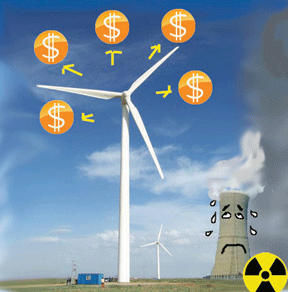 ‘Cheap’ power at Wylfa nuclear plant blown away by wind, The Times, Emily Gosden, Energy Editor, 2 June 18 The electricity generated by the Wylfa nuclear plant could be about a fifth
cheaper than Hinkley Point’s but is likely to be much more expensive than
power from the latest offshore wind farms. It is understood that a figure
of close to £75 per megawatt-hour is under discussion as the “strike
price” that Hitachi, the Japanese conglomerate developing the Anglesey
plant, would be guaranteed by the government for the electricity it
produces. The difference between the guaranteed price and the wholesale
price — currently £50 per MWh — would be paid for by consumers through
levies on their energy bills.
Ministers are preparing to announce next week
the outline of a deal to fund the proposed Wylfa plant, which could cost in
excess of £15 billion. The twin-reactor plant could generate 2.9 gigawatts
of electricity, enough to power five million homes. It is due to start
generating in the mid 2020s. The government plans to invest directly in
Wylfa, as well as to offer extensive guarantee loans for the project. These
measures are designed to cut the cost of the project and so lower the price
that consumers will have to cover.
Critics of nuclear power are likely to
draw unfavourable comparisons with offshore wind. Two projects in UK waters
were awarded guarantees prices of £57.50 per MWh last year. Some onshore
wind and solar projects are being built without any subsidy.
https://www.thetimes.co.uk/article/cheap-power-at-nuclear-plant-blown-away-by-wind-3bzc2h5qm
British government used pilots like ‘GUINEA PIGS’ during Cold War nuclear experiments
 MoD used British pilots like ‘GUINEA PIGS’ during Cold War nuclear experiments https://www.express.co.uk/news/uk/967466/cold-war-nuclear-experiments-MoD-radiation-RAF
THE Ministry of Defence (MoD) used British nuclear test pilots like “guinea pigs” during the Cold War, deliberately exposing them to radiation, it has been claimed By ALICE SCARSI, May 31, 2018
The shocking allegation was made by the widow of a pilot who obtained secret documents suggesting her husband took part in a life-threatening experiment.
Shirley Denson, 83, said the documentation shows her husband, Flight Lieutenant Eric Denson, was ordered to fly through the cloud of a thermonuclear explosion at Christmas Island in the Pacific.
The test exposed him to so much radiation he was left with unbearable headaches which eventually brought him to kill himself to make the pain stop, she added.
And the experiment may have affected two of the couple’s four daughters, as Mrs Denson claimed they were born with abnormalities.
The widow, who was handed the papers by the MoD while conducting research about her husband’s service, described the situation “wicked” and “evil”.
“It makes me furious to think it was done on purpose, that my Eric mattered so little to them.”
The documents revealed Fl Lt Denson had flown his Canberra B6 bomber into the mushroom cloud of a 2.8 megaton nuclear explosion on April 28 1958, with X-ray badges on the seat to measure radiation, the Mirror reported.
During the flight, the pilot would have been exposed to 65 years’ worth of normal background radiation during the six-minute flight.
British Nuclear Test Veterans’ Association chairman Alan Owen said: “This is the first time in all our years of campaigning we have ever found evidence this strong.
“Our members always believed they were guinea pigs and this appears to prove some of them were, at best, collateral damage in horrifying experiments.
“We need to know everything – now.”
The MoD denied Fl Lt Denson was purposely exposed to radiation.
The allegations caused outrage among politicians, who urged the MoD to answer the claim.
Deputy Labour leader Tom Watson described the documents as “shocking”, and said the Defence Secretary should issue an unqualified apology to Mrs Denson in the Commons.
He said: “This is a shocking document the MoD cannot wriggle out of.
“We need answers about what experiments were conducted, and how many of the 22,000 nuke vets were involved in them.”
Shadow defence secretary Nia Griffiths said the papers brought to light “deeply worrying revelations” and called for them to be investigated by the MoD.
And Shadow Health Secretary Jonathan Ashworth added: “This is an absolute scandal.”
A spokesman for the MoD rejected the claims saying: “It is not true to say these men were subject to an experiment to look at the effects of radiation.
“The British nuclear testing programme contributed towards keeping our country secure during the Cold War and regular health checks were conducted throughout.
“The National Radiological Protection Board has carried out three studies of nuclear test veterans and found no valid evidence to link this programme to ill health.”
And he exclusively revealed to Express.co.uk: “According to the information available in the Operational Record Books for the squadron, Fl Lt Denson did not fly the same aircraft in the week after his sampling sortie.
“The ‘experiments’ referred to were to determine the best possible arrangement on the body of dosemeters (devices that measure radiation) so that these mens’ exposure could be measured as accurately as possible.”
Hitachi ‘won’t pay’ for nuclear accidents at proposed Wylfa plant on Anglesey
Times 30th May 2018 Hitachi ‘won’t pay’ for nuclear accidents at proposed Wylfa plant on Anglesey. Hitachi could seek to absolve itself of financial responsibility for any accidents at its proposed new nuclear power station in north Wales.
The Japanese conglomerate has decided to continue with work developing the planned Wylfa plant on Anglesey after progress in financing talks with the government, which Hitachi is already relying on for a package of loan guarantees, subsidies and potential direct investment to make the project viable.
However, the company wants further concessions to reduce its risks, the Japanese newspaper Nikkei reported. Reports in several Japanese media outlets have claimed that the Wylfa plant could cost as much as three trillion yen, or almost £21 billion — making it even more expensive than Hinkley Point C.
EDF decided to build Hinkley Point only thanks to a 35-year subsidy contract from the government, which locks consumers into paying a fixed price for the power it generates and has been criticised for its high cost.
The Nikkei reported that some of Hitachi’s directors also wanted “safeguards that reduce or eliminate Hitachi’s financial
responsibility for accidents at the plant”. Nuclear operators are already obliged to take out insurance to cover their liabilities in case of an accident. If they are unable to secure insurance from the market, the government is obliged to step in and provide it instead. It is unclear what alternative arrangement or safeguards Hitachi might be seeking.
https://www.thetimes.co.uk/edition/business/hitachi-wont-pay-for-nuclear-accidents-at-proposed-wylfa-plant-on-anglesey-gtm28q0k3
British scientists distressed at loss of funding as Britain leaves the nuclear safety agency Euratom
Nature 29th May 2018 , Prime Minister Theresa May conceded on 21 May that a post-Brexit Britain
was willing to pay to “fully associate” with Euratom, Europe’s nuclear agency. The details of the arrangement, similar to many that surround the controversial exit of the United Kingdom from the European Union, still have to be ironed out.
And among those watching the negotiations with mounting concern are scientists at the Joint European Torus (JET) near Oxford, UK, who currently benefit greatly from Britain’s membership of the agency. The hundreds of researchers at JET receive annual funding of around €60 million (US$70 million), because Britain is part of Euratom. As it stands, that funding will cease at the end of this year.
https://www.nature.com/articles/d41586-018-05283-x
1 This Month





PLEASE OPPOSE HR 8255 AND S.3639 – bills would accelerate satellite deployment, with no environmental review or safeguards – https://ncstd5li.quorum.us/campaign/169331/
To see nuclear-related stories in greater depth and intensity – go to https://nuclearinformation.wordpress.com
-
Archives
- October 2026 (19)
- September 2026 (339)
- August 2026 (330)
- July 2026 (355)
- June 2026 (287)
- May 2026 (306)
- April 2026 (356)
- March 2026 (251)
- February 2026 (267)
- January 2026 (308)
- December 2025 (358)
- November 2025 (359)
-
Categories
- 1
- 1 NUCLEAR ISSUES
- business and costs
- climate change
- culture and arts
- ENERGY
- environment
- health
- history
- indigenous issues
- Legal
- marketing of nuclear
- media
- opposition to nuclear
- PERSONAL STORIES
- politics
- politics international
- Religion and ethics
- safety
- secrets,lies and civil liberties
- spinbuster
- technology
- Uranium
- wastes
- weapons and war
- Women
- 2 WORLD
- ACTION
- AFRICA
- Atrocities
- AUSTRALIA
- Christina's notes
- Christina's themes
- culture and arts
- Events
- Fuk 2022
- Fuk 2023
- Fukushima 2017
- Fukushima 2018
- fukushima 2019
- Fukushima 2020
- Fukushima 2021
- general
- global warming
- Humour (God we need it)
- Nuclear
- RARE EARTHS
- Reference
- resources – print
- Resources -audiovicual
- Weekly Newsletter
- World
- World Nuclear
- YouTube
-
RSS
Entries RSS
Comments RSS

