EDF Energy extends Hunterston B-7 UK nuclear outage until Dec. 1 LONDON (Reuters) 8 Oct 18– EDF Energy has extended an outage at its Hunterston B-7 nuclear reactor in Britain until Dec. 18, it said on Monday.
The reactor, which can produce enough electricity to power more than 800,000 homes, has been offline since March when cracks were found in its core during a routine inspection.
Morning Star 6th Oct 2018, Alan Simpson: If there are seminal moments in politics, Jeremy Corbyn’s speech at the 2018 Labour conference will go down as one of them.
This was when the planet took centre stage. From the Kerala floods to the Saddleworth moorland fires and from California to Scandinavia, 2018 has been a roller coaster of extreme weather events.
This is the shape of things to come, but it took Corbyn to make “one-planet economics” the centrepiece of tomorrow’s politics. This couldn’t have come at a better moment. The Conservatives are tearing themselves apart, with their crazies loving every moment. We need a better plan.
It was into this maelstrom that Corbyn pitched his leader’s speech — a bold vision, promising that
Labour’s “programme of investment and transformation, to achieve a 60
per cent reduction in emissions by 2030, will create over 400,000 skilled
jobs.” Pretty unequivocal stuff. But that is just the start. Shadow
chancellor John McDonnell was no less uncompromising. The next government
will have to deliver carbon reductions of 15 per cent per year. To do so,
Britain will need a much more circular economics — not one that makes do
with less but one that certainly wastes and pollutes less.
And as Corbyn stressed, it is in “green jobs” that tomorrow’s transformative
economics will be rooted. For most people, a more circular economy would
deliver real improvements in their quality of life — from the air we
breathe, the food we eat, the homes we live in to the jobs and skills the
country needs.
This will come not just in the accelerated shift into
renewable energy but in using less energy in the first place. Tackling the
scandal of “cold homes” will save lives as well as cutting carbon.
Clean transport systems offer the same opportunities. These are a world
away from the triple absurdity of the GMB trade union sharing a platform
with the Taxpayers Alliance at the Tory Party conference in support of
fracking.
Wired 8th Oct 2018 Seventy years of British nuclear history lie behind these concrete, stone
and aluminium walls. Since opening in February 2017, Nucleus, the UK
Nuclear Decommissioning Authority’s (NDA) Nuclear and Caithness Archive,
near Wick, Scotland, has been gathering thousands of records, images and
plans about the UK’s civil nuclear industry.
More documents are being transferred from 17 archives across the UK, as the NDA plans to house them
all in this single purpose-built location. The archive contains documents
dating back to the 1950s, and some are classified as Top Secret. Records
are kept in triplicate: a copy on paper, a microfilm and a PDF version, to
reduce wear on the originals. https://www.wired.co.uk/article/nucleus-archive-uk-nuclear
Public Enquiry 6th Oct 2018 Dr Keith Barnham goes through some of the terminal problems at the Hinkley
C nuclear power station site
– ‘Radioactive mud’ test have been for gamma radiation, not alpha which shows up plutonium
– Economics of nuclear no longer viable
– Bridgwater Bay tidal lagoon would produce an equivalent amount of electricity
– France and China are not building any more nuclear power but have industries which are looking to expand anywhere guillible enough to take them
– Tory government have put the brakes on renewable energy to artificially prop up the dying nuclear industry
– this is a project the nuclear industry want, but nobody else does. Activists call for halt to ‘nuclear mud’ dumping off Wales. Campaigners say sediment has not been tested properly and may do ‘irreversible harm’ Among those backing
the objectors is the Emeritus Prof Keith Barnham, a distinguished research fellow in the physics department at Imperial College London, who argues it is possible that large amounts of uranium and dangerous levels of plutonium could have reached the mud when cooling water from the decommissioned Hinkley Point A was discharged. https://www.youtube.com/watch?v=fL5mnD6HrzA&feature=youtu.be
What does the UK’s nuclear future look like?,By Chris MasonPolitical correspondent, BBC News, 5 October 2018
Six months out from Brexit, how are those involved with the UK’s nuclear sector viewing the prospect?
The area around the Sellafield nuclear plant in Cumbria is the heartland of the UK’s nuclear industry…….. The word that sums up what everyone told us is “uncertainty”, but a particular kind of uncertainty, grounded in the history of this industry.
Months after Calder Hall opened, the Euratom Treaty established the European Atomic Energy Community. The UK did not formally join straight away but did have a relationship with it.
Euratom oversees nuclear research, sets the rules on where nuclear material is and how it is moved around. It knows, for instance, exactly how much spent uranium is in a storage pond at Sellafield.
But the government has decided leaving the European Union means leaving Euratom, and that is likely to mean potentially huge changes to the way nuclear businesses operate.
Mr Coughlan fears losing out on nuclear decommissioning orders from elsewhere in Europe, especially from Germany and Sweden.
“Once we are out, and no longer part of Euratom, it means we will not be able to participate in those markets,” he says. “The negotiations have been pretty disastrous for the UK,” says Sue Ferns, deputy general secretary of the Prospect trade union, who adds that current “uncertainty” over Brexit negotiations is damaging.
It’s that word again.
So, given such concern, why is the UK leaving Euratom?
After all, former government adviser Dominic Cummings, a leading advocate of Brexit, has described ministers as “morons” for advocating withdrawal from the organisation.
The House of Lords also tried to force the government to keep the UK in Euratom.
The crux of the government’s opposition is the way Euratom itself is overseen by the European Court of Justice (ECJ). The prime minister insists this cannot happen – the UK cannot be subject to the decisions of a foreign court.
The government argues a central driving motivation for Leave voters was the desire to, as the slogan put it, “take back control”, meaning there can be no role for the ECJ.
Instead, ministers say, they will reach alternative arrangements with the EU, and have speeded up arriving at nuclear co-operation agreements with other countries worldwide.
But what do those who work for Euratom have to say about this big change?
Dame Sue Ion, who chairs Euratom’s Science and Technology Committee, says the UK has a lot of world-class expertise and creating new post-Brexit arrangements has meant a huge extra burden of unnecessary work.
She feels that ministers must “keep their foot on the gas pedal” to ensure international nuclear co-operation agreements after Brexit are as broad-based as possible.
The government has set out its plans for the nuclear sector in the event of no deal with the EU. A law has already been passed so that the Office for Nuclear Regulation in the UK, which already exists, could oversee “domestic safeguards” instead of Euratom. New agreements have also been signed with the International Atomic Energy Agency to replace the existing agreements between it, Euratom and the UK.
A week or so earlier, a pro-nuclear lobby group, New Nuclear Watch Institute, which masquerades as a think tank, issued a tendentiously inaccurate 34 page report, arguing that new nuclear is essential to meet carbon emission reduction targets. It was reported in The Guardian
In response I wrote this unpublished letter, below, correcting certain factual mistakes:
Here we go again! Your energy editor’s on line article (“Abandoning nuclear power plans ‘would push up carbon emissions,” 26 Sept) reports lobby group the New Nuclear Watch Institute as claiming nuclear power is both low carbon and its alternatives “ will raise the cost of electricity.
All the robust evidence demonstrates the opposite in both cases. Just over a year ago you published a letter from me challenging the low or even zero carbon claims of nuclear ( “Beware nuclear industry’s fake news on being emissions free,”17 Sept 2017;www.theguardian.com/environment/2017/sep/17/beware-nuclear-industrys-fake-news-on-being-emissions-free)
In my letter from a year ago, I pointed out I had challenged this nuclear low carbon myth in your columns 12 years earlier. (“There is nothing green about Blair’s nuclear dream, “ 20 October 2005<https://www.theguardian.com/politics/2005/oct/20/greenpolitics.world.
I said in my letter a year ago “It is about time this dangerous falsehood was confined to the dustbin of history.”
Sadly it seems, like Freddy, it seems it is going to be resurrected each mellow autumn!
Here are some of the more egregiously challengeable extracts from the report……..
Independent 5th Oct 2018, The UK capital is increasingly vulnerable as a result of sea level rises
and will have to use its main flood defence, the Thames Barrier, more
frequently.
London is among the cities identified as being at risk of major
flooding, according to a new report. Sea levels are expected to rise by
over 40cm unless global warming is limited to 1.5C above pre-industrial
levels, the more ambitious target set by the Paris climate agreement.
An analysis released by Christian Aid as nations meet in Korea to finalise a
major UN climate change report concerning the 1.5C target looks at some of
the coastal cities most at risk. Climate change could act as a “threat
multiplier” to existing problems such as sinking ground and subsidence,
water extraction and bad planning.
Radiation Free Lakeland 3rd Oct 2018 , Nuclear mud isn’t the only waste. The industry is getting rid of waste by
sending it to landfill, ‘recycling’ – new routes are being found to
dump as much waste as possible.
The planned incinerator at Carlisle does not give any indication where the waste would be coming from. Radiation
Free Lakeland have written a letter of objection. The door is wide open to
a tsunami of radioactive waste being incinerated.
The private operators and even the regulators can get away with saying ‘ what dont be ridiculous
there is NO RADIOACTIVE WASTE planned for the new incinerator’. They said
this to us about radioactive wastes being dumped at Lillyhall. This is
because the waste that used to be classified as radioactive is now
classified as “exempt” for “free release” so by the magic touch of
a magic pen it is no longer radioactive. https://mariannewildart.wordpress.com/2018/10/03/how-to-get-shot-of-nuclear-wastes/
Welsh leaders urged to halt ‘nuclear mud’ dumping off Cardiff, Sediment from Hinkley Point C construction site is being disposed of at Cardiff Grounds, Guardian, Steven Morris @stevenmorris20– 2 Oct 2018 Pressure is increasing on the Labour-led Welsh government to halt the dumping of “nuclear mud” in the sea close to Cardiff after a campaign by an eclectic group of scientists, surfers and a pop star.
A motion calling on the government to suspend the licence allowing mud excavated from the construction site of the Hinkley Point C nuclear power station in Somerset to be disposed of just off the Welsh capital is to be debated next week in the national assembly for Wales.
The development prompted Cian Ciarán, the keyboard player from Super Furry Animals, to discontinue an attempt on Tuesday to obtain a court injunction to stop the dumping.
There is growing concern and anger that 300,000 tonnes of sediment from the Hinkley Point C site is being disposed of at the Cardiff Grounds sandbank.
Campaigners claim the mud has not been tested properly and could contain particles that may pose a health risk. They have described the sediment as “nuclear mud” and nicknamed the sea off Cardiff “Geiger Bay”, a play on Tiger Bay, the old slang name for the city’s docklands. One of their main concerns is that the sediment could be washed ashore in a storm.
Welcoming the assembly debate, Ciarán said: “This Labour government has taken the Welsh people for granted and has risked the health of the nation. For me the core message of the campaign remains unchanged: the absence of evidence is not the evidence of absence and therefore the precautionary principle should dictate a rethink. We will continue to seek the answers the Welsh public deserve.”
He called for the Welsh government’s patrol vessel, FPV Rhodri Morgan, to monitor the dumping that is taking place. “It is a duty for every Welsh assembly member to do right by its people and hold to account the government that granted the licence,” he said.
Hinkley Point builder feels heat for French reactor failings. EDF has been
rebuked by French safety regulators for failings in the construction of a
prototype reactor in Normandy. Flamanville has been beset by problems and
delays that critics say cast doubt on EDF’s ability to deliver power from
the British plant by 2025, as promised.
The Autorité de Sûreté Nucléaire, the French nuclear regulator, said yesterday that EDF may need
to carry out more repairs than had been estimated initially on faulty
weldings at the French reactor and ordered it to carry out a wider review
of the quality of materials in the project. The watchdog said that it
believed the company had “failed to properly oversee certain activities” at
Flamanville and had failed in its handling of the welding problems when
they were discovered, taking a year and a half to inform the regulator.
Times 4th Oct 2018 , Flamanville originally was due to start up in 2012, but it has been delayed
repeatedly. This summer, EDF said that the start date had slipped again to
early 2020 as it needed to repair “quality deficiencies” in the welding in
part of the plant that carries steam to the turbines.
The costs of the project are estimated at €10.9 billion, more than three times its
original budget. The company has blamed the welding issues on a contractor
that had signed off on the work despite the failings. It said in July that
it needed to redo 53 weldings at Flamanville, but was confident that a
further ten were fit for service.
However, the watchdog said it was not certain that this was the case and that EDF should “start preparing for
possible repair work on the weldings”. It said that the company had
informed it only early last year, despite identifying the issue in July
2015.
This year the British nuclear regulator raised concerns about poor
quality control checks on EDF’s supply chain for Hinkley Point C and said
that improvements had to be made. Kate Blagojevic, head of energy and
climate at Greenpeace, said: “The French nuclear regulator has given a
pretty damning verdict on EDF’s attempt to build the new nuclear power
station at Flamanville . . . Nothing in the latest statement from the
French nuclear regulator could possibly inspire confidence that Hinkley
will be built on time or budget.” https://www.thetimes.co.uk/article/b8a10964-c745-11e8-a4a5-a34bea2c1d04
Huffington Post 1st Oct 2018 A Cardiff court will play host to a group of activists on Tuesday, as they
fight for an injunction to stop 300,000 tonnes of “nuclear mud” from a
Somerset power station being disposed of just outside Cardiff.
The unusual dispute centres on the “Hinkley Point C” building site, where energy
supplier EDF are currently in the process of constructing two new nuclear
reactors. In order to drill the six shafts needed for the reactors, EDF is
clearing 300,000 tonnes of mud and sediment – and planning to dispose of it
just off the Welsh coast, on the Cardiff Grounds sandbank.
The prospect of that amount of waste being ditched a mile and a half away hasn’t exactly
excited locals or environmental campaigners, but there’s another factor
causing added concern. For decades, Hinkley Point has been a nuclear power
hub, with its first station – “A” – operating for 35 years before
closing in 2000. Hinkley Point B was opened in 1976 and is still
functioning today.
The presence of these two plants has led to concerns
over whether the mud there is radioactive and when the plans were
announced, various online petitions calling for the Welsh Assembly to look
into the matter were launched online, gathering a total of 100,000
signatures by mid-September. Keyboard player Cian Ciarán has become
something of a spokesperson for the campaign. His worries – shared by his
fellow campaigners – are centred on the validity of the tests carried out.
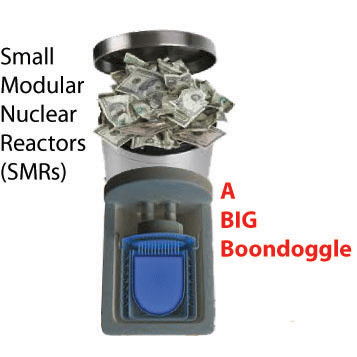
Energy firms demand billions from UK taxpayer for mini reactors Ministers under pressure to fund new generation of small-scale nuclear power stations,Guardian, Adam Vaughan Energy correspondent @adamvaughan_uk, 1 Oct 2018 Backers of mini nuclear power stations have asked for billions of pounds of taxpayers’ money to build their first UK projects, according to an official document.
Advocates for small modular reactors (SMRs) argue they are more affordable and less risky than conventional large-scale nuclear plants, and therefore able to compete with the falling costs of windfarms and solar power.
But the nuclear industry’s claims that the mini plants would be a cheap option for producing low-carbon power appear to be undermined by the significant sums it has been asking of ministers.
Some firms have been calling for as much as £3.6bn to fund construction costs, according to a government-commissioned report, released under freedom of information rules. Companies also wanted up to £480m of public money to help steer their reactor designs through the regulatory approval process, which is a cost usually paid by nuclear companies.
Ten companies hoping to build the plants requested direct government funding, according to the briefing paper by the Expert Finance Working Group on Small Reactors. While the report named the companies involved in the mini nuclear projects, it did not specify who was asking for
David Lowry, a nuclear policy consultant who obtained the document, said: “SMRs are either old, discredited designs repackaged when companies see governments prepared to throw taxpayers’ subsidies to support them, or are exotic new technologies, with decades of research needed before they reach commercial maturity.”
The working group that drafted the report, and was appointed by the Department for Business, Energy and Industrial Strategy (BEIS), urged the government in August to put in place a framework to help bring the smaller plants to market.
The government has already offered £44m of funding for research and development of one group of SMRs, which typically have a capacity of less than a tenth of the Hinkley Point C nuclear plant being built in Somerset, or enough power for 600,000 homes.
Mini nuclear power stations are unlikely to supply clean energy to Britain’s homes and businesses any time soon. Of more than 30 British, US and Chinese companies that have expressed an interest in building one in the UK, the majority told the working group that their power stations would be ready to deployed in the 2030s.
The companies include UK firms such as Rolls-Royce, Sheffield Forgemasters and Atkins, along with China’s CNNC, US companies NuScale and Westinghouse, and France’s EDF Energy.
The working group found the firms’ cost estimates “varied significantly”, to the degree that some of the companies clearly had a “lack of understanding” of how British nuclear regulation works.
It also noted that some of the companies proposed using “non-standard fuels” rather than the conventional uranium used by today’s nuclear plants, which “may add cost to business models” because of new facilities to produce and later manage the spent fuel.
The firms told the group that the four main barriers they faced were finding and confirming sites, the cost of regulatory approval for their designs, a lack of state funding and unclear policy.
On 24 September, shadow chancellor John McDonnell confirmed that a Labour government would keep the UK’s nuclear arsenal. He said, however, that as prime minister Jeremy Corbyn would only use it in consultation with the cabinet, parliament, and the “wider community”.
Right-wing attacks
In spite of the comments, the right-wing media attacked McDonnell’s statement as too soft. The Sun, for example, said that McDonnell “sparked ridicule” for suggesting that a Corbyn-led government would only launch a nuclear strike after “ask[ing] for the British public’s permission”.
A favourite weapon
Indeed, Corbyn’s former opposition to renewing the UK’s nuclear arsenal, known as Trident, has been one of the right’s favourite weapons with which to attack him. Some right-wing media outlets have called him “loony left” for his life-long commitment to nuclear disarmament.
And some from the Blairite wing of his own party have also piled on the abuse. In 2015, then Labour MP John Woodcock, for instance, called Corbyn’s position on Trident “childish” and “dangerously naïve”.
Expert view
But a scarcely viewed video on YouTube shows that the anti-Trident position is actually supported by one of the world’s leading experts on nuclear weapons. In a 2016 interview on Al-Jazeera with Mehdi Hasan, former UN weapons inspector Hans Blix backed Corbyn’s call to scrap Trident.
Asked by Hasan whether he supports the scrapping of Trident, he replied:
Yes, I think it’s a tremendous cost, and I do not see that it really, perceptively adds to British security
Blix is a Swedish diplomat and served as minister of foreign affairs in the Ola Ullsten administration in the 1970s. He became famous for his role as a senior UN weapons inspector in the run-up to the invasion of Iraq. He has also served as head of the International Atomic Energy Agency.
“Sentimental status-seeking”
And for Blix, it’s apparently the pro-Trident people who are being childish and naïve. He said that holding on to Trident is “more a question of sentimental status-seeking”. He added that the UK will keep its permanent seat at the UN Security Council regardless of whether it holds on to nuclear weapons. Interestingly, Blix also says that he does not “see any enthusiasm in Washington for Trident, either.”
The hard-hitting video makes nonsense of the right’s endless fear-mongering, and provides a welcome antidote to the attacks on the Labour leadership.
Fortunately, shadow peace minister Fabian Hamilton is reportedly drawing up a nuclear disarmament proposal for the shadow cabinet’s consideration. And it would be well served to heed Blix’s advice.
Plans for a new nuclear power station in Cumbria are on the verge of collapsing after the Toshiba-owned company – NuGen – laid off 60% of its workforce and embarked on a final effort to sell the project. Toshiba was due to sell the NuGen consortium to South Korean state-owned firm Kecpo in early 2018, as the Japanese firm exits international nuclear projects and looks to recoup some of the £400m it has spent on the Moorside plant.
But Kepco has been delaying a final decision, due in part to the UK government signalling a new approach to financing nuclear power stations. That has forced NuGen to cut 60 of its 100-strong workforce after a six-week consultation with staff. (1)
Unions said the project’s problems showed the need for the government to take a stake in Moorside. Justin Bowden, the GMB national secretary, said: “The looming collapse of this vital energy project has been depressingly predictable for months.” The GMB wants the NDA to be scrapped as it currently exists and a Nuclear Development Agency created to make sure Moorside and the accompanying creation of thousands of new jobs and apprenticeships, goes ahead. (2) The skeleton NuGen team is now focused on clinching a deal with Kepco by the end of the year before Toshiba writes the unit off entirely at the end of March 2019. Success will hinge on whether Kepco buys into a new financing approach for nuclear power plants that the government is exploring, known as the regulated asset base (RAB) model. Officials think it could deliver the government’s nuclear ambitions more cheaply for consumers than alternatives.
The RAB approach involves a regulator – in the case of nuclear power stations most likely to be Ofgem – setting a fixed sum for the costs of the scheme, and a fixed return for the project’s backers. Those returns would be funded by energy bill payers. But the model is likely to be ditched if Jeremy Corbyn comes to power. Alan Whitehead, the shadow energy minister, said: “Using customers’ bills to make a bet that construction of such large and complex projects will not overrun in terms of cost or time is a reckless act.” (3)
The Chief Executive of NuGen said he will “fight tooth and nail” to salvage the £15 billion Moorside nuclear power station in an impassioned speech to industry leaders gathered in Cumbria. He says he is fully behind using the RAB model. (4)
The FT reported that Toshiba had entered talks with Canadian asset manager Brookfield over the potential sale of NuGen. Brookfield bought Westinghouse from Toshiba for $4.6bn in January after the US nuclear business filed for Chapter 11 bankruptcy protection in 2017. (5) But the claims were later rubbished by Toshiba. It added that it was still considering the sale of NuGen to Kepco. (6)
Later NuGen admitted that there are no firm plans to save Moorside. (7)
Workington Labour MP, Sue Hayman, co-chair of the All Party Parliamentary Group on Nuclear Energy, wrote to the Secretary of State for Business, Greg Clark MP, at the end of July, when NuGen announced it was consulting on job losses, calling on him to guarantee Government support for the project and 20,000 future Cumbrian jobs. Mr Clark said in June that he “will consider direct Government investment” in the proposed Wylfa nuclear power station in Wales, but he has refused to make any similar commitment to Cumbria. In a response to Sue’s letter, energy minister Richard Harrington MP said: “The Secretary of State and I understand the potential importance of the Moorside project to the local area. However (…) the proposed sale of NuGen is principally a commercial matter for Toshiba and it would not be appropriate for me to comment on those ongoing negotiations.” Sue Hayman said: “This Tory government could not care less about the Cumbrian economy, the Moorside project, or the 20,000 future jobs it will bring.” (8)
but he has refused to make any similar commitment to Cumbria. In a response to Sue’s letter, energy minister Richard Harrington MP said: “The Secretary of State and I understand the potential importance of the Moorside project to the local area. However (…) the proposed sale of NuGen is principally a commercial matter for Toshiba and it would not be appropriate for me to comment on those ongoing negotiations.” Sue Hayman said: “This Tory government could not care less about the Cumbrian economy, the Moorside project, or the 20,000 future jobs it will bring.” (8) http://www.no2nuclearpower.org.uk/wp/wp-content/uploads/2018/09/NuClearNewsNo111.pdf
Dave Toke’s Blog 27th Sept 2018 Labour’s low cost and practical proposals for expansion of onshore and offshore wind, solar power, energy conservation and increases in renewable heat are the surest sign yet that they are the competent choice for Government.
Their proposals need some elaboration in places and some work on detail, but seem to be in a different dimension compared to the Tory Government who seem increasingly certain to be heading for self-destruction on the anvil of Brexit.
Rebecca Long-Bailey is aiming for 85 per cent of electricity to come from low carbon power by 2030. This is an easily
achievable target, and will be done at low cost if simultaneously Labour cancels the disaster-in-waiting project at Wylfa, and some way can be found to avoid Hinkley C being built.


 Months after Calder Hall opened, the Euratom Treaty established the European Atomic Energy Community. The UK did not formally join straight away but did have a relationship with it.