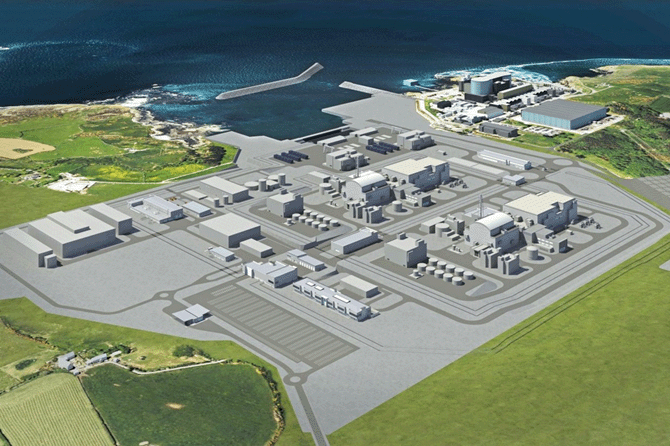
Bradwell Update, NuClear News October 18
China’s leading nuclear energy company CGN says it would consider pulling back from control of the Bradwell nuclear plant to appease political sensitivities.
Under a 2016 agreement, CGN would have a 66.5% stake in Bradwell and EDF would have the remainder when it starts generating electricity in the late 2020s or ealry 2030s. However, CGN’s chief executive Zheng Dongshan told the Financial Times (FT) CGN would be willing to consider “not being the majority operator. We understand the political and local sensitivities”. (1)
Should the Bradwell project proceed, it would be the first Hualong HPR1000-type reactor. The Office for Nuclear Regulation is currently assessing the reactor design but a final decision on the Generioc Design Assessment is expected to take at least three years. (2)
BANNG’s Andy Blowers says the project may be doomed anyway as the site is totally unsuitable and is widely opposed by communities all around the Blackwater Estuary. The Chinese withdrawal, should it come, would reflect widespread concerns about the security issues surrounding their investment into a highly sensitive part of the UK’s national infrastructure. Recent manoeuvres off the disputed, Chinese-built, artificial islands in the South China Sea have increased tensions in the area and provoked warnings of Chinese investment withdrawal from the UK. It is possible that the Bradwell project could be an early victim of deteriorating relations between the two countries. In any event the project was already looking doubtful. It is facing considerable challenges in delivering vast quantities of cooling water by pipeline and the need to avoid polluting the Marine Conservation Zone which gives protection to the Colchester Native Oyster and other marine life. Most of the site is vulnerable to flooding and it will be a heroic feat to demonstrate that highly radioactive spent fuel can be safely and securely stored on the site until the end of the next century. (3)
The Blackwater, Crouch, Roach and Colne Estuaries were designated as a Marine Conservation Zone in 2013. As part of the designation native oysters have been legally protected indeed there is the Essex Native Oyster Restoration Initiative to further the aims of the MCZ designation. The MCZ designation is a major change in the site status since Bradwell was selected in 2011 as a potential site for power generation by the Government. Despite the new MCZ status CGN and EDF Energy still confirm their belief that Bradwell is a good site for nuclear development. If you take into account this and all the other environmental protections that run along the proposed site you would have thought it would be the last place to build a nuclear power station! http://www.no2nuclearpower.org.uk/wp/wp-content/uploads/2018/09/NuClearNewsNo111.pdf
September 29, 2018
Posted by Christina Macpherson |
politics, UK |
Leave a comment

After wrangling over Georgia nuclear plant, cost concerns remain, By Matt Kempner and Anastaciah Ondieki – The Atlanta Journal-Constitution , September 28, 2018
Not many people can name the plant that their electricity comes from. But in Jefferson, at a gathering sponsored by Jackson EMC, plenty of customers were familiar with the trials and tribulations of expanding Plant Vogtle.
Among the people who gather annually for chicken dinners, gospel music and raffle drawings put on by the electric cooperative, there are worries about the mounting headaches 130 miles away.
Plant Vogtle — the only nuclear power plant under construction in the United States — keeps ending up in the news because of its ever escalating pricetag. And those soaring costs are likely to end up in the monthly bills of customers of Jackson EMC and most other Georgia utilities, which are on the hook to pay for the project.
“I don’t understand why they can’t figure out what it’s going to cost,” said Mike Mize, a retired phone company worker who lives in Commerce and gets power from Jackson EMC. “I want them to hurry up and finish the thing and quit spending money on it.”
But high-stakes events this week suggest that costs will only go higher.
Co-owners of the plant voted Wednesday to continue its expansion, but did little to address the fundamentals of the Vogtle’s troubles.
The owners ditched a proposal for a firm cost cap on the now $27-billion-plus project and avoided addressing calls by state lawmakers to refrain from passing new cost increases along to customers. Meanwhile, electric membership cooperatives and city utilities around the state lost some of their say over whether the project continues in the future.
Georgia Power blasted the idea of a firm cost cap, but agreed to take on a greater share of costs in the event of certain big overruns. The size of the risk shift was limited — if there are $2.1 billion in cost increases, the company would face an extra $180 million penalty, “peanuts in this context,” said one critic.
Georgia Power, the state’s largest utility, was given carte blanche to drop out of the project at its sole discretion.
Morgan Stanley analysts predict a “very good chance” that Vogtle costs could jump more than another $2.1 billion.
“We think there is a significant level of uncertainty around the budget and see a very high likelihood of continued cost overruns,” the analysts wrote.
Add that to the existing pile. Nine years into construction, the Vogtle expansion is billions of dollars over budget, years behind schedule and at least four years away from completion.
Cost projections and assurances from Georgia Power have been consistently wrong.
Then a bankruptcy filing last year by the project’s main contractor, Westinghouse Electric, eliminated a contract that had buffered Vogtle owners from many extra costs. But the costs still continue to rise.
When Georgia Power recently announced $2.3 billion in new increases, it automatically triggered a vote by the co-owners on whether to stick with the project.
Georgia Power, the Municipal Electric Authority of Georgia and Dalton Utilities all gave approval. But Oglethorpe Power, which represents electric membership corporations throughout the state, insisted on a cost cap. It also asked that shareholders of Georgia Power’s parent, Southern Company, eventually cover additional cost increases. (Another Southern subsidiary is overseeing the construction.)
Bitter disagreements among the project’s co-owners bubbled out into the public. It kicked off brinkmanship negotiations over whether and how the project would continue.
The core issue is one that has haunted Vogtle for years: Who should shoulder its ever-ballooning costs?
“We never signed up for a project where we would just be a blank checkbook for Southern Company or anybody else in this project,” said Gary Miller, the chief executive of GreyStone Power Corporation, which serves portions of Fulton, Cobb, Douglas and other counties. “We never said, ‘Build it no matter what the cost.’ ”………
There’s been intense political pressure to continue the work. If the project were to be canceled, its costs likely would end up in customer bills without any energy generation to show for it. Some Jackson EMC members consider that wasteful; others want to stop the bleed. …….https://www.myajc.com/business/after-wrangling-over-georgia-nuclear-plant-cost-concerns-remain/9iGHX9Ugo7QPkli9LoqGbM/
September 29, 2018
Posted by Christina Macpherson |
business and costs, UK |
Leave a comment
 Wylfa no2nuclearpower, 7 Sept 18
Plans to clear a site to build a new £12bn nuclear power station have been approved despite strong opposition. Horizon Nuclear Power will now start the 15-month process to clear an area measuring just over a square mile (740 acres) to build the new Wylfa Newydd B reactor.
But Greenpeace has taken legal action arguing work should not start until Wylfa B is given the official go-ahead.
Anglesey council unanimously approved the plans in a meeting on Wednesday. Horizon does not have the Development Consent Order (DCO) for the nuclear plant, a process that could take at least 18 months for the planning inspectorate to decide upon. But planning officials said giving it prior permission would speed up the construction process. Ahead of the council’s planning meeting, Greenpeace solicitors launched a legal challenge against the officials’ recommendation. The campaigners said the council’s report had “mistakenly relied upon the government’s Nuclear Energy National Policy Statement as a key justification for their support for Horizon’s plan to clear the site”…..
http://www.no2nuclearpower.org.uk/news/wylfa-7-9-18/
September 29, 2018
Posted by Christina Macpherson |
Legal, UK |
Leave a comment
 NuClear News, October 18 Sizewell C – a figment of the imagination
 In an interview with The Times in April EDF Energy’s UK chief executive, Simone Rossi, said that rapid progress was needed on the development of Hinkley Point C because promised cost savings would not materialise if there was a significant delay between work on the two. (1)
EDF does not need to strike a deal on Sizewell with the government this year, but Mr Rossi wants to be confident that it will be possible to reach an agreement. “This is the year where we need to understand whether this whole thing is really feasible or not,” he told The Times. “If we were to conclude that maybe it’s not feasible, then at that point maybe we say we are not in a position to continue the project.” EDF is pushing for a Regulated Asset Base (RAB) model.
The GMB has been urging a go ahead for Sizewell C because it faces an uncertain future, after the tion in National Infrastructure Commission (NIC) pushed for a reduction in the government’s plans for new nuclear power stations. (2)
September 29, 2018
Posted by Christina Macpherson |
politics, UK |
Leave a comment
Radiation Free Lakeland 25th Sept 2018 The rain returned several weeks ago and our gardens and fields have
returned to their usual shades of green. However, United Utilities still
finds it necessary to take full-page advertisements urging us all “to use
a little less water,” to spend less time in the shower, to turn off the
tap when brushing teeth etc. These are, of course in themselves, laudable
actions, but it also seems reasonable to ask ‘Where has all the water
gone? ‘ and, subsequently, to speculate that a big part of the answer
lies in the enormous quantities of water being extracted from Cumbria’s
rivers and lakes to cool and service the many serious hazards that remain
at the Sellafield nuclear site, including Building 30.
https://mariannewildart.wordpress.com/2018/09/25/nuclear-costing-the-earth-rivers-and-sea/
September 28, 2018
Posted by Christina Macpherson |
UK, water |
Leave a comment
Solar Power Portal 26th Sept 2018 A Labour government would look to treble the UK’s current solar capacity
and create more than 400,000 green jobs by 2030. Those were the key facts
from this week’s Labour Party conference which comprised speeches from
some of the opposition party’s central figures. Yesterday the party’s
shadow business, energy and industrial energy secretary Rebecca Long-Bailey
said that Labour had been working with an “expert team” of energy
professionals, engineers and academics to assess how the country could meet
such a target. A near trebling of the UK’s solar capacity would equate to
around 39GW of operational solar in the UK, enough, according to
Long-Bailey, to power seven million homes. Leonie Greene, director of
advocacy at the Solar Trade Association, stressed that expanding wind and
solar capacity should be an economically-driven decision that crosses party
political lines. “The government estimates that around £180 billion
needs to be invested in the electricity sector alone to 2030, so enabling
the lowest cost technologies which do not need public subsidy and which do
not contribute to climate change – namely solar and onshore wind – would be
very good news for consumers.”
https://www.solarpowerportal.co.uk/news/corbyns_labour_government_would_treble_uk_solar_capacity_create_400000_gree
September 28, 2018
Posted by Christina Macpherson |
politics, renewable, UK |
Leave a comment

 Sunday Times 23rd Sept 2018 , Aldermaston, The consortium that runs Britain’s nuclear weapons factory paid itself
£70m of dividends last year despite huge delays and cost overruns on a key
project. AWE Management paid the dividends to its shareholders — the
giants Serco, Jacobs and Lockheed Martin — which have a long-term
contract to run the Atomic Weapons Establishment (AWE).
AWE, which develops and builds the nuclear warheads that arm the navy’s Trident submarine
fleet, came under fire from the government’s spending watchdog in May.
The National Audit Office said an upgrade to AWE’s warhead assembly
facility in Berkshire was six years late and costs had spiralled from
£734m in 2011 to £1.8bn.
AWE has also been at loggerheads with the
nuclear safety watchdog, which, in July, prosecuted the company over an
incident last year in which an electrician was injured. At a court hearing
last week, AWE admitted failing to ensure the safety of its staff. It is
due to be sentenced in November.
https://www.thetimes.co.uk/edition/business/navy-nuke-maker-awe-pays-70m-dividend-lvthpcwkj
September 26, 2018
Posted by Christina Macpherson |
business and costs, UK, weapons and war |
Leave a comment
The National 23rd Sept 2018 ,SUNSHINE and a rainbow reflected the positive vibes at the Nae Nukes
Anywhere’ peaceful protest march from the peace camp in Faslane
yesterday, led by Scottish makar Jackie Kay. More 600 people from around
the world and of all ages gathered at Trident’s military base at the
gates of HMNB Clyde to urge governments around the world to ban nuclear
weapons.
http://www.thenational.scot/news/16897005.more-than-600-anti-nuclear-campaigners-stage-peace-walk-at-faslane/
September 26, 2018
Posted by Christina Macpherson |
opposition to nuclear, UK |
Leave a comment
The Hill, BY BRETT SAMUELS – 09/23/18 British Prime Minister Theresa May said Iran is holding up its end of the nuclear pact that the U.S. withdrew from earlier this year.
“We believe that that should stay in place, and others involved in putting that deal together believe that it should stay in place,” May said in an interview aired Sunday on CBS’s “Face the Nation.”……..
Tensions between the U.S. and Iran have been heightened in the months since the Trump administration withdrew from the Obama-era Iran nuclear deal, which offered Tehran sanctions relief in exchange for abandoning its nuclear program. Trump had decried the pact as the “worst deal ever.”
The U.S. has since reimposed some of the sanctions lifted in the deal, potentially crippling the Iranian economy.
Other signatories of the 2015 agreement — including the United Kingdom, France, Germany, the European Union, Russia and Iran — have pledged to remain committed to the deal.
The U.S. has suggested countries that continue to do business with Iran, such as the United Kingdom, could face sanctions. https://thehill.com/homenews/sunday-talk-shows/407978-theresa-may-iran-continues-to-uphold-commitment-to-nuclear-pact
September 26, 2018
Posted by Christina Macpherson |
Iran, politics international, UK |
Leave a comment

 N2NP 19th Sept 2018 A court in Paris has ordered French utility EDF to
  release a risk analysis
report to the group’s works council (CEE) concerning its Hinkley Point C
nuclear project. The appeals court in Paris said the firm must communicate
the report within a month and must consult the CEE regarding the project
within two months.
In 2016, EDF refused to release all documents required
by the council for it to be able to issue its advice on the project,
triggering CEE’s legal action. The CEE say EDF failure to give elected
representatives of the staff objective, precise and complete information on
the technical and financial issues raised by the Hinkley project meant they
had not been able “to give a reasoned opinion on this project“.
Commenting on the news, Steve Thomas Emeritus Professor of Energy Policy at
Greenwich University and author of ‘Time to Cancel Hinkley?’ said:
“Some senior EDF management and some EDF trade unions have long been
concerned about EDF’s participation in the Hinkley Point C project.
The 3-year old report the EDF Central Works Council (CCE) has won access to
will show that EDF is well aware of these risks. The continuing delays and
cost overruns (more than 3 times over budget and 8 years late) at
Hinkley’s reference plant, Flamanville, significantly worse than when the
report was written, illustrate graphically the scale of the risk.
The Works Council see Hinkley as a financially risky project that will divert EDF’s
scarce finances away from the strategically more important task of
upgrading and life-extending EDF’s fleet of 58 reactors, many of which
are at or near the end of the 40-year design life.”
Stop Hinkley spokesperson, Roy Pumfrey says: “Even the long standing nuclear advocate,
former International Energy Agency boss, Nobuaki Tanaka, says nuclear power
can’t compete with renewables. He says it’s ‘ridiculously
expensive’ and ‘utterly uncompetitive’ Electricity consumers would
almost certainly still be able to make savings if the project were halted
now and the south-west were given the chance to develop sustainable energy
industries. Full construction start is still a year or more away so not too
late to stop it.”
http://www.no2nuclearpower.org.uk/news/campaign-update/paris-court-ruling-on-hinkley-point-c-risks/
September 21, 2018
Posted by Christina Macpherson |
business and costs, France, Legal, UK |
Leave a comment
‘Ticking time bomb!’ UK warning as nuclear bases ‘NOT FIT for purpose’https://www.express.co.uk/news/uk/1020963/uk-nuclear-submarines-ministry-of-defence-MoD
THE INFRASTRUCTURE for supporting the Royal Navy’s fleet of nuclear submarines is no longer “fit for purpose”, MPs have warned. Sep 21, 2018 The Commons Public Accounts Committee said past decisions to delay maintenance at the Ministry of Defence’s (MoD) 13 nuclear sites around the UK had created a “ticking time bomb”.
The warning came after the National Audit Office disclosed earlier this year that the MoD’s “Nuclear Enterprise” programme was facing a £2.9 billion “affordability gap”.
The committee chair Meg Hillier said that with the MoD already facing “challenges” over the delivery of its new aircraft carriers and a potential £20 billion shortfall in its equipment programme, there were “serious questions” over its ability to meet its national security commitments.
Over the next 10 years, the MoD is expected to spend £51 billion on the Nuclear Enterprise – maintaining and replacing the submarine fleet, including the Vanguard submarines which carry the UK’s Trident nuclear deterrent…..
he MoD had deferred work on dismantling old submarines which had been taken out of service on “affordability grounds” and there was now a backlog of 20 vessels waiting to be disposed of, including nine which still contained nuclear fuel.
To date, the UK has never completely disposed of an old nuclear submarine and while work has begun on the first, it is not due to be finished until the mid-2020s.
The committee said work on de-fuelling the next submarine was due to begin around the same time, and that the disposals programme was expected to last “at least a couple of decades”.
Ms Hillier said: “I am particularly concerned that the infrastructure available to support the Nuclear Enterprise is not fit for purpose.
“The MoD admits that while it has previously put off dismantling submarines on grounds of cost, this is no longer acceptable on grounds of safety and reputation. The MoD needs to get on top of this quickly.”
September 21, 2018
Posted by Christina Macpherson |
safety, UK, weapons and war |
Leave a comment
 NuGen chief vows to “fight tooth and nail” to salvage Moorside nuclear power project, News and Star , 21 Sept 18, Tom Samson makes impassioned pledge at the second Cumbria Nuclear Conference
 The boss of NuGen has vowed to “fight tooth and nail” to salvage the £15 billion Moorside nuclear power station in an impassioned speech to industry leaders gathered in Cumbria.
Tom Samson, chief executive of the company set to develop the plant in West Cumbria, also told around 150 delegates at the second Cumbria Nuclear Conference at Carlisle Racecourse on Friday, that he was fully behind using the Regulated Asset Base (RAB) model to fund the “transformational” project.
In his first public address since NuGen made more than 70 staff redundant because of delays to a deal between current owners Toshiba and prospective buyers Kepco, he warned that the threat of winding up the company was “very real”.
With Toshiba’s exit from NuGen definite, Mr Samson stressed it was crunch time for a project that has the potential to create thousands of jobs in Cumbria and generate around seven per cent of the UK’s energy needs.
“My commitment to Cumbria is that I will fight tooth and nail to find a solution, and indeed a sustainable solution, we can depend upon with real determination to avoid a wind up of NuGen,” he said at the conference, hosted by Carlisle MP John Stevenson. “The deal with Kepco may still come to fruition, but we cannot just wait for them to make a decision. It is essential that this project (Moorside) goes ahead and we therefore have to consider alternative ways forward.”
Kepco is understood to have a deal for NuGen on the table but will not sign on the dotted line until it has undertaken a study in to the risks and profitability of applying RAB model to finance Moorside, which allows government regulators to ensure stable returns and finance through government support.
Delays to the deal led Toshiba to strip Kepco of “preferred bidder” status in August. Toshiba is now understood to be in talks with a number of other investors including Brookfield Asset Management, which bought Westinghouse from Toshiba at the beginning of the year for $4.6 billion.
But Mr Samson expressed his support for deploying the RAB model to finance NuGen, although he was keen to stress no firm decisions had been made on whether it would be used.
“I am convinced that the model which is now being proposed by the Government could provide NuGen with a viable path forward which puts NuGen in control of its own future,” he said……….
A recent report from the NIC recommended delivering just one more nuclear power station after Hinkley Point C – namely the Horizon Nuclear Power project at Wylfa Newydd – before pausing for around 10 years to gather evidence on how competitive renewable energy and battery storage projects are in comparison.
Mr Samson said NuGen was “deeply shocked” at the suggestion, which could further damage efforts to progress Moorside, and accused the NIC of failing to recognise the complexity of new nuclear projects and their vital contribution to providing a stable source of energy……….
The event – organised by John Stevenson MP to encourage greater collaboration in the nuclear sector – was sponsored by WYG, UCLan, NuGen and the Centre of Nuclear Excellence. http://www.newsandstar.co.uk/news/business/NuGen-chief-vows-to-fight-tooth-and-nail-to-salvage-Moorside-nuclear-power-project-df430793-5e25-42dc-b1ea-ff67886b4f06-ds
September 21, 2018
Posted by Christina Macpherson |
business and costs, UK |
Leave a comment
Whitehaven News 20th Sept 2018 , The Nuclear Decommissioning Authority has joined forces with the Japan
Atomic Energy Agency to share expertise in nuclear decommissioning and
radioactive waste management. The NDA – which is responsible for cleaning
up and decommissioning 17 sites in the UK including Sellafield in Cumbria
– has signed an agreement that will see skills, knowledge, research,
information and technology exchanged with the JAEA, Japan’s research and
development institute for nuclear energy.
JAEA’s work includes undertaking research and development work to support the decommissioning
and environmental restoration of TEPCO’s stricken Fukushima Daiichi
Nuclear Power station. It is also aiding the decommissioning of the Monju
fast breeder reactor and the Tokai Reprocessing Plant.
http://www.whitehavennews.co.uk/news/business/NDA-joins-forces-with-Japan-Atomic-Energy-Agency-98721037-4777-4322-a8fc-22b18d0c979e-ds
September 21, 2018
Posted by Christina Macpherson |
Japan, UK, wastes |
Leave a comment
 The National 20th Sept 2018 ,PEACE campaigners are urging Scots to force the hand of the country’s biggest institutions in a war against nuclear weapons as a bombshell report
is launched. With data drawn from annual results, official statements and
freedom of information reports, the paper reveals the extent to which major
Scottish bodies help fund the making of nuclear weapons.
Billed as a way to help “eliminate” the big-money devices, the document has been produced by
the Scottish Campaign for Nuclear Disarmament (CND) in conjunction with
similar organisations. It calls on bank customers, students and pension
holders to press major institutions into divesting their funds from
companies involved in the manufacture of nuclear weapons.
These include Royal Bank of Scotland and the Scottish Local Government Pension Scheme
(SLGPS), the largest fund of its kind in the country. It also claims that
success could help sink Trident, arguing: “If we can persuade Scottish
financial institutions to divest from nuclear weapons producers, this will
incentivise those companies to end their involvement with Trident and other
nuclear weapons programmes.”
http://www.thenational.scot/news/16889880.scots-urged-to-put-pressure-on-institutions-funding-nuclear-arms/
September 21, 2018
Posted by Christina Macpherson |
business and costs, UK, weapons and war |
Leave a comment
Independent 21st Sept 2018 Government delayed scrapping potentially unsafe nuclear submarines in bid
to cut costs, MPs told. Influential Commons committee tells Ministry of
Defence to put a stop to postponements after expert admits possible ‘safety
issue’. The government has delayed scrapping potentially unsafe nuclear
submarines because of concerns over costs, a new report from an influential
committee of MPs has revealed. 20 disused submarines are currently awaiting
disposal, according to the Ministry of Defence (MoD), including nine that
still contain nuclear fuel. But despite admitting to potential safety
risks, the government will only begin dismantling the next vessel in the
mid-2020s, while the total work needed to scrap the entire 20 submarines
will not be completed until at least 2045.
https://www.independent.co.uk/news/uk/politics/trident-uk-nuclear-submarines-government-cuts-pac-ministry-defence-a8547856.html
September 21, 2018
Posted by Christina Macpherson |
UK, wastes, weapons and war |
Leave a comment