Sizewell C nuclear project: community has lost faith in the integrity of EDF
 East Anglian Daily Times (not on web) 3rd April 2020, John Rea Price: Community has lost faith in the integrity of EDF. East Anglian Daily Times (not on web) 3rd April 2020, John Rea Price: Community has lost faith in the integrity of EDF.So EDF has generously agreed to defer their application for planning consent “by a few weeks”, actually for just a month the website of the Planning Inspectorate suggests.
Mr Cadoux Hudson of EDF goes on to promise that more
time would be given for people to register as participants in the public examination. What he didn’t say is that this will be an extremely formal and legalistic process with very little opportunity for genuine engagement by members of the community and is thus a meaningless concession. He goes on to say that over eight years of public consultation EDF has tried hard to be transparent. He doesn’t seem to appreciate that the community has experienced its efforts as truculent and dismissive.
Despite repeated demands at each of the four stage of public consultation it has, in particular, failed to provide any evidence of substance and quality on the probable cumulative environmental impact of its development on this
uniquely sensitive landscape and coastline. The consequence has been that communities that were not in principle opposed to Sizewell C have become its bitterest opponents. Such is the loss of any faith in the integrity of EDF that many now believe that it will exploit the opportunity of this grave national crisis to drive its application forward as aggressively as possible.
It will thus seek to minimise the depth of scrutiny that its very
complex proposals demand at a time when statutory agencies, county, district and parish councils, conservation bodies and community groups have the least capacity to undertake this. https://www.eadt.co.uk/news |
|
Sam and the Plant Next Door – growing up by the nuclear power plant
Sam, 11, is always being told not to worry about the nuclear power plant rising next door, but for him there is lots to think about. Hinkley Point C will be Britain’s largest nuclear plant, and it’s only two miles away. Most of his classmates expect to work at the plant but Sam is determined to escape that fate.
His dream is to protect the surrounding marine life he identifies with. Like the fish, he feels unappreciated by the adults. Sam thinks the only way to reach his dream is to leave his friends behind and to go to a private school. But when he’s offered a place, his parents can’t afford the fees. As a last resort, they turn to the power company for funding, which forces Sam to decide what kind of person he wants to be. Drifting between Sam’s daily life and his dreams, a film about holding on and letting go, along the tricky passage from childhood innocence to grown-up life https://www.youtube.com/watch?v=VMhYngrEgZU&feature=youtu.be
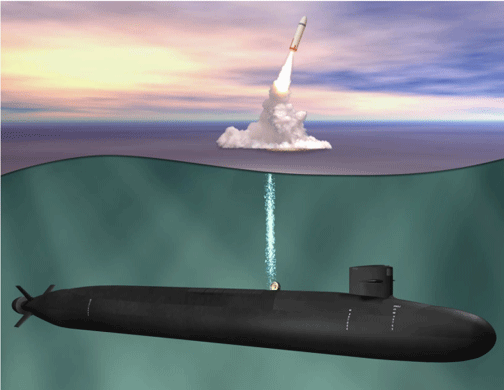
Expert opinion recommends furloughing Britain’s Trident nuclear weapons
|
Nuclear weapons law expert suggests furloughing Trident https://www.irishlegal.com/article/nuclear-weapons-law-expert-suggests-furloughing-trident 3 April 2020 A legal expert on nuclear weapons has joined calls for the UK government to rethink keeping Trident submarines at sea during the coronavirus pandemic.Professor Nick Grief of Kent Law School is among a group of signatories to a letter questioning whether the cost of keeping the nuclear weapons system on “continuous at sea deterrent patrol” is justifiable during the COVID-19 outbreak.
Other signatories to the letter, circulated to parliamentarians across the UK, include three former Royal Navy commanders, SNP Westminster leader Ian Blackford, academics and peace campaigners. The signatories have said they hope the letter will encourage politicians and the wider public to begin to question the morality and the feasibility of nuclear weaponry. It states: “The increasing cost of coronavirus will require decades to recover. Meanwhile, the UK’s Trident nuclear weapon system remains on continuous at sea deterrent patrol costing some £2 billion a year and using scarce military assets to protect the on-patrol submarine.” The letter also raises concerns about “the morale of the submarine crew on patrol” during the pandemic, as well as “their own state of health and exposure to the virus”. It concludes: “In these circumstances, and lacking any foreseeable threat of a ‘bolt from the blue’ nuclear weapon attack on the UK, is it appropriate for the government to continue spending billions of pounds on continuous at sea deterrent, as well as building new nuclear warheads and the submarines to carry them?” |
|
UK ‘s new nuclear projects further delayed
|
Nuclear project planning hit by delays, Construction News, 02 APR 2020 BY MILES ROWLAND DECISIONS ON FUTURE NUCLEAR BUILDS HAVE BEEN PUSHED BACK AT THREE POTENTIAL NEW SITES DUE TO THE CORONAVIRUS CRISIS.The planning process for Wylfa Newydd, Sizewell C and Bradwell B have all been delayed by periods ranging from weeks to months.
A decision on Horizon Nuclear’s application for a development consent order (DCO) for Wylfa Newydd – the shelved nuclear project in Anglesey, North Wales – has been pushed back by six months by the government, from 31 March to 30 September. This is the second such delay for the decision, the original deadline for which was 23 October last year. While the project was put on hold over funding issues, Horizon, a subsidiary of Hitachi, had been hopeful the project could restart following the decision and the approval of a new funding model. A statement from the Planning Inspectorate said: “The secretary of state has concluded that an additional period of time is required in order to complete his consideration in respect of environmental effects and other issues which were outstanding following the examination.”…… Decisions on future nuclear builds have been pushed back at three potential new sites due to the coronavirus crisis. The planning process for Wylfa Newydd, Sizewell C and Bradwell B have all been delayed by periods ranging from weeks to months. A decision on Horizon Nuclear’s application for a development consent order (DCO) for Wylfa Newydd – the shelved nuclear project in Anglesey, North Wales – has been pushed back by six months by the government, from 31 March to 30 September. This is the second such delay for the decision, the original deadline for which was 23 October last year. While the project was put on hold over funding issues, Horizon, a subsidiary of Hitachi, had been hopeful the project could restart following the decision and the approval of a new funding model. A statement from the Planning Inspectorate said: “The secretary of state has concluded that an additional period of time is required in order to complete his consideration in respect of environmental effects and other issues which were outstanding following the examination.”……. EDF and Horizon Nuclear have also been awaiting a decision from the government on whether the regulated asset base model could be used to fund nuclear projects, following a consultation in October. The model requires developers to spend less upfront and instead raise cash through consumer bills. A spokesman for the Department for Business, Energy and Industrial Strategy said a decision would be made “in due course”. Meanwhile, the public consultation for Bradwell B in Essex, which began last month, is to be extended by five weeks. The project is introducing new ways for the community to participate in the consultation online and on the phone, as well as allowing people to book 20-minute discussions with nuclear experts to answer questions throughout April. Ground-surveying works are continuing on site at Bradwell B, and the project is awaiting a decision from the Office for Nuclear Regulation and the Environment Agency on its design for the UK HPR1000 – a third-generation pressurised water reactor.
Last week EDF announced it was cutting its workforce on Hinkley Point C by more than half, and implemented a range of measures to encourage social distancing after criticism that its actions there had been insufficient. A spokesman declined to state whether this could cause delays to the project. It is due to be completed in either 2025 or 2026. https://www.constructionnews.co.uk/civils/nuclear-project-planning-hit-by-delays-02-04-2020/ |
|
Doctors warn on coronavirus danger for Julian Assange, imprisoned without conviction, in a coronavirus incubator
 ASSANGE EXTRADITION: Doctors Warning on Assange in a Covid-19 Breeding Ground, Consortium News,April 1, 2020 • In a prison cited for failing to curb infections, Doctors4Assange warn that Julian Assange is at high risk of contracting the deadly coronavirus. According to a report Wednesday in The Daily Maverick, imprisoned WikiLeaks publisher Julian Assange is one of only two prisoners of 797 inmates in Belmarsh Prison who are being held for skipping bail. The majority are violent criminals, including 20 percent for murder and 16 inmates on terrorism offenses. The facility was also repeatedly criticized by prison inspectors for a lapse in preventing infections to inmates. Following Judge Vanessa Baraitser’s decision to deny Assange bail last week, Doctors4 Assange released the following statement:
Doctors4Assange Statement on Assange
Bail Hearing over Coronavirus Risk, March 27, 2020 Doctors4Assange strongly condemns last Wednesday’s decision by UK District Judge Vanessa Baraitser to deny bail to Julian Assange. Despite our prior unequivocal statement[1] that Mr Assange is at increased risk of serious illness and death were he to contract coronavirus, and the evidence of medical experts, Baraitser dismissed the risk, citing UK guidelines for prisons in responding to the global pandemic: “I have no reason not to trust this advice as both evidence-based and reliable and appropriate.”[2]
Notably, however, Baraitser did not address the increased risk to Mr Assange relative to the general UK prison population, let alone prisoners at HMP Belmarsh where Assange is incarcerated. Nor did she address the rapidly emerging medical and legal consensus that vulnerable and low-risk prisoners should be released, immediately.
As the court heard, Mr Assange is at increased risk of contracting and dying from the novel disease coronavirus (COVID-19), a development which has led the World Health Organization to declare a public health emergency of international concern[3] and a global pandemic.[4] The reasons for Mr Assange’s increased risk include his ongoing psychological torture, his history of medical neglect and fragile health, and chronic lung disease.
Edward Fitzgerald, QC, representing Mr Assange, said, “These [medical] experts consider that he is particularly at risk of developing coronavirus and, if he does, that it develops into very severe complications for him… If he does develop critical symptoms it would be very doubtful that Belmarsh would be able to cope with his condition.”[5]
Baraitser’s casual dismissal of Mr Assange’s dire situation in the face of the COVID-19 emergency stood in stark contrast not only to the expert medical evidence, but the proceedings themselves. The hearing took place on the third day of the UK’s coronavirus lock-down. Of the two counsels representing Mr Assange, Edward Fitzgerald QC wore a facemask and Mark Summers QC participated via audiolink. US attorneys joined the proceedings by phone.
Mr Assange himself appeared by videolink, which was terminated after around an hour, rendering him unable to follow the remainder of his own hearing, including the defence summation and the District Judge’s ruling. Mr Assange’s supporters attending in person observed social distancing measures. Overall only 15 people were in attendance, including judge, counsel, and observers……..
Adding their legal voices to these medical and human rights authorities, the day after Mr Assange’s bail hearing, three professors in law and criminology recommended “granting bail to unsentenced prisoners to stop the spread of coronavirus”.[12]
Julian Assange is just such an unsentenced prisoner with significant health vulnerability. He is being held on remand, with no custodial sentence or UK charge in place, let alone conviction.
Doctors4Assange are additionally concerned that keeping Assange in Belmarsh not only increases his risk of contracting coronavirus, it will increase his isolation and his inability to prepare his defence for his upcoming extradition hearing, in violation of his human right to prepare a defence…… https://consortiumnews.com/2020/04/01/assange-extradition-doctors-warning-on-assange-in-a-covid-19-breeding-ground/
EDF workers at Hinkley Point C nuclear site are a major health risk to local residents

 accommodation around Hinkley Point are a major health risk to residents and should be moved out to purpose-built campuses which have strict health precautions, local councillors urged this week.
workforce by half to around 2,000 in the coming days in an attempt to limit
the spread of the coronavirus, it was claimed that while residents were in
lockdown, HPC construction workers could “come and go as they wish”.
“People are very scared and concerned,” said Cllr Chris Morgan,
chairman of Stogursey Parish Council and the area’s councillor on
Somerset West and Taunton Council. “What is happening is a recipe for
disaster.”
Hinkley workforce, “you have still got a very large group of people doing
what everyone else has been told not to do. “We have a large multiple
occupation building (HMO) in the middle of the village, another in Castle
Street, one in Burton and many rented rooms, all full of people going to
work, coming back, using the shops, all mixing together.
particularly in Stogursey parish, is that we still have contractors who
quite rightly go home at the weekends, some to the Covid 19 hotspots of
South Wales and the West Midlands, and then return to the middle of our
local community, totally untested, before they return to the site.
measures can be taken, but at the moment it seems that the only real
control over the situation would be to shut the site down, which I don’t
think will happen because it is a critical national infrastructure
project.” https://www.wsfp.co.uk/article.cfm?id=123896&headline=Health%20fears%20over%20Hinkley%20workers
EDF, French company building Hinkley Point power station, shifts workers’ costs to UK govt
Coronavirus: EDF to furlough Hinkley Point workers after reducing site numbers, Edward Thicknesse CITY A.M. 29 Mar 20, Hundreds of workers at EDF’s Hinkley Point C nuclear plant are being furloughed after the firm decided to cut the number of workers on site by more than half.
In an attempt to cut costs, the Telegraph reported that many of the site’s workers are being moved onto the government’s employee retention scheme, which guarantees them 80 per cent of their wages.
In an attempt to cut costs, the Telegraph reported that many of the site’s workers are being moved onto the government’s employee retention scheme, which guarantees them 80 per cent of their wages.
Although some of the 2,000 or so workers moved off the nuclear site in Somerset will continue to work in back office roles, the requirement to pay the majority will now shift to the government.
Those initially set to be moved onto the Treasury scheme are contractors working on the site, not EDF employees.
The French firm said: “Hinkley Point C has reduced the number of workers on its site to enable safe working. The project has not asked for any additional Government support and the majority of workers will remain in employment”.
It is understood that contractors are furloughing 500 or so employees, with the intention to bring them back onto payroll as soon as possible.
EDF has not issued a statement on whether it expects the coronavirus pandemic to impact the project’s timeline. …..
EDF’s decision to reduce its workforce came after the government came under pressure to suspend all non-essential construction work over safety concerns.
Politicians of all stripes, from London mayor Sadiq Khan to Tory ex-minister Iain Duncan Smith hit out against the government’s decision not to pause all such work for the duration of the crisis. https://www.cityam.com/coronavirus-edf-to-furlough-hinkley-point-workers-after-reducing-site-numbers/
Government under pressure to suspend non-essential construction work (such as building nuclear plants)
“The judgment we have made is that in work, in many instances, the 2m rule can be applied,” he said.
However critics say public health should be prioritised over the economy during the coronavirus outbreak.
Former Tory cabinet minister Iain Duncan Smith joined those calling for a temporary suspension of work. He told the BBC: “I think the balance is where we should delete some of those construction workers from going to work and focus only on the emergency requirements.”
The confusion over who is able to work came after Prime Minister Boris Johnson’s announced a nationwide lockdown in a televised address on Monday night.
The PM said people should only leave their homes to shop for basic goods, fulfil medical needs, to exercise and to travel to work when “absolutely necessary”. However the types of work considered necessary has not yet been made clear….. https://www.cityam.com/government-under-pressure-to-suspend-non-essential-construction-work/
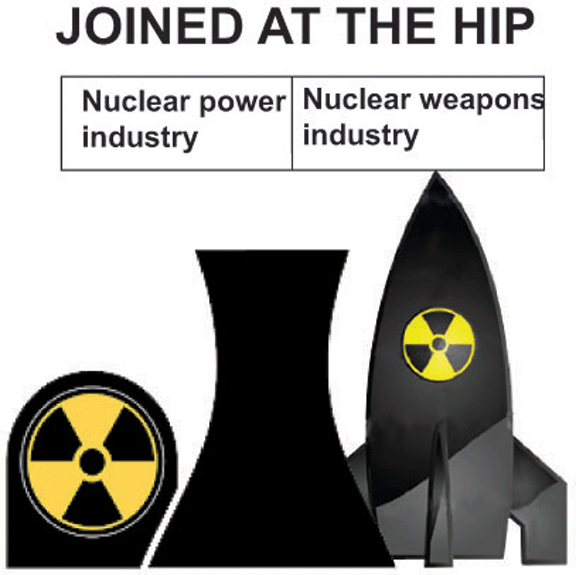
British small nuclear reactors to help Turkey to get nuclear weapons?
 Fears over nuclear Turkey after Rolls Royce reactor deal, Morning Star,
 MARCH 25, 2020 ENGINEERING firm Rolls-Royce has struck a deal with Turkey for the production of nuclear mini-reactors, sparking fears that the British company and its international consortium partners are helping pave the way for Ankara to develop a nuclear bomb…..
the plans have raised fears that Turkey’s authoritarian President Recep Tayyip Erdogan could use the development as a step towards the country becoming a nuclear-armed power.
As previously reported in the Morning Star, Turkey’s secret nuclear programme includes plans to acquire weapons of mass destruction (WMDs), including nuclear missiles.
Writing in a pro-government newspaper in 2017, Mr Karaman said: “We need to consider producing these weapons, rather than purchasing them, without losing any time and with no regard to words of hindrance from the West.”
There are already some 70 US-owned nuclear warheads said to be based at Incirlik airbase near the southern of Adana.
In previous deals with Russia and a Japanese-French consortium, the door was left open for the development of nuclear weapons after Turkey rejected offers to include the provision of uranium and the return of the spent fuel rods used in the reactors.
The development has parallels with the Indian missile capability developed after the testing of plutonium produced in the Canadian-supplied Cirus reactor, which first raised the issue that nuclear technology supplied for peaceful purposes could be diverted to weapons production. https://morningstaronline.co.uk/article/b/fears-over-nuclear-turkey-after-rolls-royce-reactor-deal
Hinkley nuclear construction work continues, while rest of UK is in lockdown
UK and Fench govts consider nuclear construction as “essential”, so can remain open
The Government has deemed the jobs at Hinkley Point C nuclear power station near Bridgwater to be essential and French energy giant EDF says that it is “a project of critical national importance”.
The number of construction workers will now be reduced by more than half to around 2,000 to mitigate the coronavirus risk and bosses have pledged to reduce staffing levels further as the project progresses.
But critics and opponents have rounded on the decision to carry on and have called on the Government to halt proceedings.
This is putting lives at risk right across Somerset and the whole of the country. Why hasn’t the Prime Minister ordered them to stay at home – is he just pandering to the nuclear lobby? While the rest of the country is in lockdown, EDF fails to acknowledge that if someone has developed a fever, they have been incubating and spreading the virus for days beforehand.
Workers have been photographed close to each other in the canteen and sitting shoulder to shoulder on the buses which transport them to and from the site.
This is at odds with Government advice to socially distance.
They need to put something else in place. They need to consider their workers. If there is an outbreak at Hinkley Point then it would be uncontrollable. Our NHS system here in the South West is quite small compared to big cities.
Sellafield nuclear facility cuts back drastically on staff working onsite

 In Cumbria 22nd March 2020, Sellafield is telling the vast majority of its workers to stay away from its main site and satellite offices and to work from home. Mark Neate,
director of environment, safety and security with Sellafield Ltd, has told
employees: “We will minimise attendance at all of our sites and wherever
possible everyone should continue (or start) working from home.
https://www.in-cumbria.com/news/18325910.sellafield-workforce-told-stay-home/
Why using hydrogen to supply heating would be a terrible choice
energy. Even if the hydrogen was sourced from renewable energy (and not much of it will be) the result would be a grandiose waste of renewable energy. This is because using hydrogen from renewable energy to heat buildings is around four times less energy efficient compared to using heat pumps (using renewable electricity) to supply heating in buildings.
enough to 100 per cent. Second, such a programme will provide support for a continued fossil fuel industry. A third reason is that using ‘blue’ hydrogen, in as much as it succeeds in paving the way for supply of renewable hydrogen, will lock in a huge wastage of renewable energy
compared to using this renewable energy much more efficiently.http://realfeed-intariffs.blogspot.com/2020/03/why-using-hydrogen-to-supply-heating.html
Hinkley nuclear worker concerned at coronavirus risks at the site
station but has seen no changes.
https://www.somersetlive.co.uk/news/somerset-news/worker-fears-spread-coronavirus-hinkley-3967724
Seabrook Nuclear plant operating with limited staff
Nuclear plant operating with limited staff Gloucester Daily Times, By Jack Shea Staff Writer, 22 Mar 20
- SEABROOK, N.H. — Amid the ongoing coronavirus pandemic, the company that owns the Seabrook, New Hampshire, nuclear power plant is continuing to operate the facility with only essential personnel, while the Nuclear Regulatory Commission is doing most of its work to monitor the plant remotely.
In a statement Friday afternoon, Lindsay Robertson, spokesperson for NextEra Energy, which owns the Seabrook nuclear plant, said the company has implemented its “pandemic plan,” and is following its procedures for ensuring continuity of service……..
According to Diane Screnci, spokesperson for the NRC, the commission is continuing oversight of the Seabrook plant and other facilities licensed by the commission, although much of the work is being done over the phone.
Screnci said the NRC’s resident inspectors are onsite at a reduced frequency, and are able to do their jobs remotely……
The C-10 Foundation monitors the safety of the Seabrook nuclear power plant because six Massachusetts communities — Amesbury, Merrimac, Salisbury, Newburyport, Newbury and West Newbury — are within a 10-mile radius of the plant and are considered part of the New Hampshire plant’s emergency planning zone. https://www.gloucestertimes.com/news/local_news/nuclear-plant-operating-with-limited-staff/article_b477e508-1332-5eb5-8592-3d9426ab897d.html
1 This Month




PLEASE OPPOSE HR 8255 AND S.3639 – bills would accelerate satellite deployment, with no environmental review or safeguards – https://ncstd5li.quorum.us/campaign/169331/
To see nuclear-related stories in greater depth and intensity – go to https://nuclearinformation.wordpress.com
-
Archives
- September 2026 (339)
- August 2026 (330)
- July 2026 (355)
- June 2026 (287)
- May 2026 (306)
- April 2026 (356)
- March 2026 (251)
- February 2026 (267)
- January 2026 (308)
- December 2025 (358)
- November 2025 (359)
- October 2025 (375)
-
Categories
- 1
- 1 NUCLEAR ISSUES
- business and costs
- climate change
- culture and arts
- ENERGY
- environment
- health
- history
- indigenous issues
- Legal
- marketing of nuclear
- media
- opposition to nuclear
- PERSONAL STORIES
- politics
- politics international
- Religion and ethics
- safety
- secrets,lies and civil liberties
- spinbuster
- technology
- Uranium
- wastes
- weapons and war
- Women
- 2 WORLD
- ACTION
- AFRICA
- Atrocities
- AUSTRALIA
- Christina's notes
- Christina's themes
- culture and arts
- Events
- Fuk 2022
- Fuk 2023
- Fukushima 2017
- Fukushima 2018
- fukushima 2019
- Fukushima 2020
- Fukushima 2021
- general
- global warming
- Humour (God we need it)
- Nuclear
- RARE EARTHS
- Reference
- resources – print
- Resources -audiovicual
- Weekly Newsletter
- World
- World Nuclear
- YouTube
-
RSS
Entries RSS
Comments RSS

