Under cover of Coronavirus constraints, EDF could speed application for £14 billion Sizewell nuclear reactor build, without pubic consultation
East Anglian Daily Times 27 April 2020 Suffolk MP has joined growing concern that EDF Energy will submit its planning application for the Sizewell C nuclear power station during the coronavirus crisis.
Already 54 town and parish councils, along with campaign groups, have voiced their frustration at the possibility – amid concerns that it would be “intolerable and unfair” to add extra anxiety
to people at this time. Now Central Suffolk and North Ipswich MP, Dr Dan Poulter has written to Government ministers saying the Covid-19 restrictions would inhibit full and proper consideration of the application and it would “not be appropriate” yet.
EDF has already delayed its submission of a Development Consent Order (DCO) for the £14 billion twin reactor for a month but there are worries it could submit the documents in
May. Dr Poulter has been contacted by a large number of residents who have
a number of concerns in regards to the DCO. He is concerned there would be
pressure on council officers dealing with Covid-19 to respond to issues and
questions raised by the submission and opportunities for public
consultation curtailed as public meetings are not permitted.
https://www.eadt.co.uk/news/mp-dan-poulter-sizewell-c-letter-to-ministers-1-6624715
UK govt again to try “astronomically expensive” plutonium reprocessing nuclear reactors
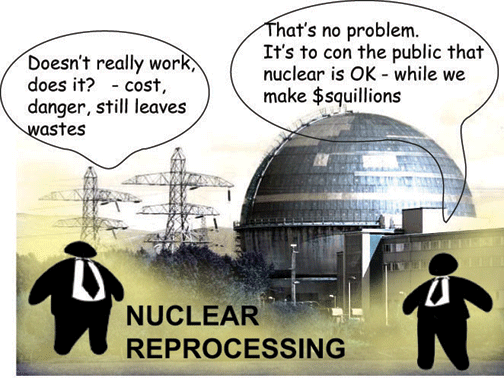 Westminster relaunches plutonium reactors despite ‘disastrous’ experience, The National, 26 April, 20 By Rob Edwards This article was brought to you by The Ferret.
THE UK Government is trying to resurrect plutonium-powered reactors despite abandoning a multi-billion bid to make them work in Scotland.
Documents released by the UK Office for Nuclear Regulation (ONR) under freedom of information law reveal that fast reactors, which can burn and breed plutonium, are among “advanced nuclear technologies” being backed by UK ministers.
Two experimental fast reactors were built and tested at a cost of £4 billion over four decades at Dounreay in Caithness. But the programme was closed in 1994 as uneconomic after a series of accidents and leaks.
Now ONR has been funded by the Department for Business, Energy and Industrial Strategy (BEIS) in London to boost its capacity to regulate new designs of fast reactors, along with other advanced nuclear technologies.
Campaigners have condemned the moves to rehabilitate plutonium as a nuclear fuel as “astronomically expensive”, “disastrous” and “mind-boggling”. They point out that it can be made into nuclear bombs and is highly toxic – and the UK has 140 tonnes of it…….
ONR released 23 documents about advanced nuclear technologies in response to a freedom of information request by Dr David Lowry, a London-based research fellow at the US Institute for Resource and Security Studies. They include redacted minutes and notes of meetings from 2019 discussing fast reactors, and are being published by The Ferret.
One note of a meeting in November 2019 shows that ONR attempted to access a huge database on fast reactors maintained by the UK Government’s National Nuclear Laboratory (NNL) in Warrington, Cheshire…..
Two companies have so far won funding under this heading to help develop fast reactors that can burn plutonium. The US power company, Westinghouse, is proposing lead-cooled fast reactors, while another US company called Advanced Reactor Concepts wants to build sodium-cooled fast reactors.
In November 2019 BEIS also announced an £18 million grant to a consortium led by reactor manufacturer, Rolls Royce, to develop a “small modular reactor designed and manufactured in the UK capable of producing cost effective electricity”.
According to Dr Lowry, fast reactors would require building a plutonium fuel fabrication plant. Such plants are “astronomically expensive” and have proved “technical and financial disasters” in the past, he said.
“Any such fabrication plant would be an inevitable target for terrorists wanting to create spectacular iconic disruption of such a high profile plutonium plant, with devastating human health and environmental hazards.”
Lowry was originally told by ONR that it held no documents on advanced nuclear technologies. As well as redacting the 23 documents that have now been released, the nuclear safety regulator is withholding a further 13 documents as commercially confidential – a claim that Lowry dismissed as “fatuous nonsense”.
THE veteran nuclear critic and respected author, Walt Patterson, argued that no fast reactor programme in the world had worked since the 1950s. Even if it did, it would take “centuries” to burn the UK’s 140 tonne plutonium stockpile, and create more radioactive waste with nowhere to go, he said.
“Extraordinary – they never learn do they? I remain perpetually gobsmacked at the lobbying power of the nuclear obsessives,” he told The Ferret. “The mind continue to boggle.”
The Edinburgh-based nuclear consultant, Pete Roche, suggested that renewable energy was the cheapest and most sustainable solution to climate change. “The UK Government seems to be planning some kind of low carbon dystopia with nuclear reactors getting smaller, some of which at least will be fuelled by plutonium,” he said.
“The idea of weapons-useable plutonium fuel being transported on our roads should send shivers down the spine of security experts and emergency planners.”
Another nuclear expert and critic, Dr Ian Fairlie, described BEIS’s renewed interest in fast reactors as problematic. “Experience with them over many years in the US, Russia, France and the UK has shown them to be disastrous and a waste of taxpayers’ money,” he said.
This is not the view taken by the UK Nuclear Industry Association, which brings together nuclear companies. It wants to see the UK’s plutonium being used in reactors rather than disposed of as waste……
“The Scottish Government remains opposed to new nuclear power plants in Scotland,” a spokesperson told The Ferret. “The Scottish Government believes our long term energy needs can be met without the need for new nuclear capacity.”
The UK Department for Business, Energy and Industrial Strategy did not respond to repeated requests to comment. https://www.thenational.scot/news/18405852.westminster-relaunches-plutonium-reactors-despite-disastrous-experience/
The end of reprocessing spent nuclear fuel has left an expensive UK plutonium stockpile with no peaceful use
 UK plutonium stockpile is a costly headache, https://climatenewsnetwork.net/uk-plutonium-stockpile-is-a-costly-headache/ April 23rd, 2020, by Paul Brown, The end of reprocessing spent nuclear fuel has left an expensive UK plutonium stockpile with no peaceful use UK plutonium stockpile is a costly headache, https://climatenewsnetwork.net/uk-plutonium-stockpile-is-a-costly-headache/ April 23rd, 2020, by Paul Brown, The end of reprocessing spent nuclear fuel has left an expensive UK plutonium stockpile with no peaceful use
LONDON, 23 April, 2020 − For 70 years Britain has been dissolving spent nuclear fuel in acid, separating the plutonium and uranium it contains and stockpiling the plutonium in the hope of finding some peaceful use for it, to no avail: all it has to show today is a UK plutonium stockpile. To comply with its international obligations not to discharge any more liquid radioactive waste into the Irish Sea, the United Kingdom government agreed more than 20 years ago under the Ospar Convention on the protection of the north-east Atlantic to shut its nuclear fuel reprocessing works at Sellafield in northwestern England at the end of this year. As well as 139 tonnes of plutonium, which has to be both carefully stored to prevent a nuclear chain reaction and protected by armed guards as well, to avoid terrorist attack, there are thousands of tonnes of depleted uranium at Sellafield. The reprocessing plant shut down prematurely as a result of a Covid-19 outbreak among its employees, and most of the 11,500 workers there have been sent home, leaving a skeleton staff to keep the site safe. Whether the plant will be restarted after the epidemic is unknown. Fewer than half Sellafield’s workers are involved in reprocessing. Most are engaged in cleaning up after decades of nuclear energy generation and related experiments. There are 200 buildings at the massive site, many of them disused. It costs British taxpayers around £2.3 billion (US$2.8bn) a year to run Sellafield and keep it safe. Solution needed soon While the British government has been reluctant to make any decision on what to do about its stockpiled plutonium and uranium, the Bulletin of the Atomic Scientists has expressed alarm about the danger it poses. “The United Kingdom has to find a solution for its plutonium stockpile, and quickly,” its report says. The scientists point out that there is enough plutonium to make hundreds of thousands of nuclear weapons, and that it is a permanent proliferation risk. The annual cost of £73m to keep the plutonium safe is dwarfed by the much larger cost of trying to make safe the whole site with its thousands of tonnes of nuclear waste. The Bulletin reports that the original reason for the reprocessing works was to produce plutonium for nuclear weapons. The UK supplied the US at times, as well as producing its own weapons. A 2014 agreement between the British and US governments gives an outline of the nuclear links which then existed between them.
For decades there were also plans to use plutonium in fast breeder reactors and to blend it with uranium to make Mixed Oxide Fuel (MOX) . This was a time when governments believed that the world’s supply of uranium would run out and that re-using it with plutonium would be a way of generating large amounts of electricity, as a way to avoid burning fossil fuels and as part of the solution to climate change. MOX was one possible fuel. Using recycled plutonium in fast breeder reactors was another possibility. And a third option was new-style reactors that burned plutonium, theoretically possible but never built. But uranium did not run out, and MOX did not prove economic. It and the new reactors proved so technically difficult they were abandoned. Despite these setbacks, successive British governments have continued reprocessing, always refusing to class plutonium as a waste, while still exploring ways of using it in some kind of new reactor. This is likely to remain the official position even after reprocessing ends in December. The UK’s Nuclear Decommissioning Authority, the agency that runs Sellafield, faced by this indecision, continues to store the plutonium behind three barbed-wire barricades, guarded by the only armed civilian police force in the country. Here to stay? One of the tricky political problems is that 23 tonnes of the plutonium is owned by Japan, which sent its spent fuel to be reprocessed at Sellafield but is unable to use the recycled material, which cannot be returned to Japan in its current state because of nuclear proliferation concerns. Despite these setbacks, successive British governments have continued reprocessing, always refusing to class plutonium as a waste, while still exploring ways of using it in some kind of new reactor. This is likely to remain the official position even after reprocessing ends in December. The UK’s Nuclear Decommissioning Authority, the agency that runs Sellafield, faced by this indecision, continues to store the plutonium behind three barbed-wire barricades, guarded by the only armed civilian police force in the country. Here to stay? One of the tricky political problems is that 23 tonnes of the plutonium is owned by Japan, which sent its spent fuel to be reprocessed at Sellafield but is unable to use the recycled material, which cannot be returned to Japan in its current state because of nuclear proliferation concerns. |
|
Wind or solar technologies will provide UK with 100% energy, in a predominantly electric future
 Chartist 18th April 2020, Dave Toke: As offshore wind technology fully blooms as its own distinctmass industrial technology producing power at low prices, and as the prospect of floating wind turbines comes closer, the potential for the technology threatens to eclipse everything else – at least in countries with a large waterline, such as the UK.
another story. The story here is that on its own, the offshore wind available could generate over five times the anticipated total energy requirements for the UK in a ‘net zero carbon’ scenario – that is, based upon the Committee on Climate Change estimate that a mainly electric economy supplied from low carbon sources would require 645TWh of power generation in 2050. Wind power could do this as the cheapest electricity source available – apart from solar power of course, with which the competition will probably be intense in the future.
https://www.chartist.org.uk/offshore-wind-the-force-is-with-you/
UK’s plutonium problem as it shuts down its last nuclear reprocessing facility

burial. https://thebulletin.org/2020/04/britain-has-139-tons-of-plutonium-thats-a-real-problem/
For UK’s new Labour leader, climate action and Green New Deal will be key goals
Business Green 14th April 2020, Newly appointed Labour leader Sir Keir Starmer completed his front bench
team late last week, handing key green positions to a raft of experienced
MPs. Starmer is widely expected to make climate action and Labour’s Green
New Deal a key plank in the Opposition’s offer to the public – a fact
underlined by the handing of specific green briefs to senior MPs. But it
remains to be seen if he retains the unprecedented levels of low carbon
infrastructure funding pledges and nationalisation programmes proposed
under Corbyn’s leadership.
https://www.businessgreen.com/news/4013864/labour-completes-green-shadow-ministerial-lin
Environmental rules governing radioactive waste, fish farming, recycling and other sectors are being weakened due to Covid 19
 Radioactive Waste Regulations – Scotland

The Ferret 12th April 2020, More than 5,000 business sites across Scotland are going to escape
judgement on their environmental breaches in 2020 because of the coronavirus pandemic. Environmental rules governing radioactive waste, fish farming, recycling and other sectors are also being relaxed by the Scottish
Environment Protection Agency (Sepa) to help companies cope with Covid-19.
The Faslane nuclear base and nuclear power plants have been given the green light to break safety limits on radioactive waste. Sepa has relaxed environmental rules for specific sectors, notably the military and civil
nuclear industry. A “temporary regulatory position statement” posted on its website offered radioactive waste exemptions to the Faslane navel base on the Clyde, as well as nuclear plants at Hunterston in North Ayrshire,
Torness in East Lothian and Dounreay in Caithness.
“During a significant outbreak of Covid-19 the ability of operators to run their operations may be compromised by a lack of available staff,” the statement said. “We expect operators to be ensuring that the impacts of Covid-19 on the environment are minimised. We recognise, however, that in some cases operators may be unable to comply for reasons beyond their control.” It added: “Any failure by the operator to comply with the conditions of their authorisation will not be treated as a non-compliance”. This only applied “where non-compliance with authorisation conditions is unavoidable and a direct result of emergency resulting from Covid-19 outbreak and will not lead to significant environmental harm,” Sepa said.
The Scottish Campaign for Nuclear Disarmament warned that more dangerous radioactivity could be discharged into the environment. “It is outrageous to suggest that the pandemic is a reason for relaxation of the regulatory
requirements,” said campaign chair, Lynn Jamieson. “Willingness to tolerate possible breaches of regulations by civil or military nuclear facilities demonstrates shocking inadequacy on the part of the Scottish Environment Protection Agency. Whose environment are they in place to protect?”
The nuclear-free group of local authorities also expressed concern. “These new rules from Sepa seem to allow further leeway on nuclear sites over the handling of radioactive waste,” said the group’s vice convenor in Scotland, Renfrewshire SNP councillor Audrey Doig. “Sepa should be very wary of relaxing rules and find ways of continuing to
regulate the industry in the robust, safe and secure way the public expects.”
https://theferret.scot/pollution-checks-coronavirus-crisis-sepa/
The National 12th April 2020
https://www.thenational.scot/news/18374483.polluters-given-free-pass-coronavirus-crisis/
David Lowry: Covid-19 spread shows up vulnerability at heart of nuclear programmes


programmes, with resilience of UK critical national infrastructures undermined. The coronavirus’ effects act as threat multiplier, as David Lowry explains.
regulatory oversight to continue effectively across the UK? And, if this situation arose, what executive regulatory decision would be required if all operating nuclear facilities could no longer be simultaneously regulated to a legal standard?
plans should they fall below these levels, to enable them to remain in control of activities that could impact on nuclear safety under all foreseeable circumstances throughout the life cycle of the facility. In addition, licensees need minimum staffing levels to comply with their on-site and off-site emergency plans.
https://energytransition.org/2020/04/corona-crisis-hits-nuclear-sector/
With coronavirus problem, Hinkley Point C nuclear project should be paused

until the Covid-19 public health emergency is under full control. This repeated call comes from the NGOs and NFLA following intensive lobbying of the UK Government, the Office for Nuclear Regulation (ONR) and the Somerset local authorities responsible for the Hinkley Point C site by many of these groups, including the local Stop Hinkley group.
There have been improved efforts as well to enforce social distancing, though it remains to be seen if earlier poor practice in this area on and around the site could lead to increased infection rates in North Somerset and areas where the workforce originate from, such as South Wales and the Bristol area.https://www.nuclearpolicy.info/news/joint-statement-concerned-anti-nuclear-ngos-uk-ireland-nuclear-free-local-authorities-ongoing-construction-work-hinkley-point/
Sellafield nuclear construction stalled – paus in construction extended to April 27
|
I
 n Cumbria 9th April 2020, Sellafield has announced it is extending the pause of construction work n Cumbria 9th April 2020, Sellafield has announced it is extending the pause of construction workacross its nuclear site. Initially the firm has announced it would halt construction work until April 8. But now it has been extended to April 27.
A company spokesman said: “Our pause on construction work has been extended
while we continue to identify the key work that needs to continue and which of our key workers and supply chain are needed on site. “The pause includes all construction work currently being undertaken by the Projects Delivery Directorate and most other project work on-site, with some key exceptions where stopping work could impact on nuclear safety. https://www.in-cumbria.com/news/18369742.sellafield-extends-pause-work/ |
|
Microbes in nuclear fuel ponds slow down the decommissioning process
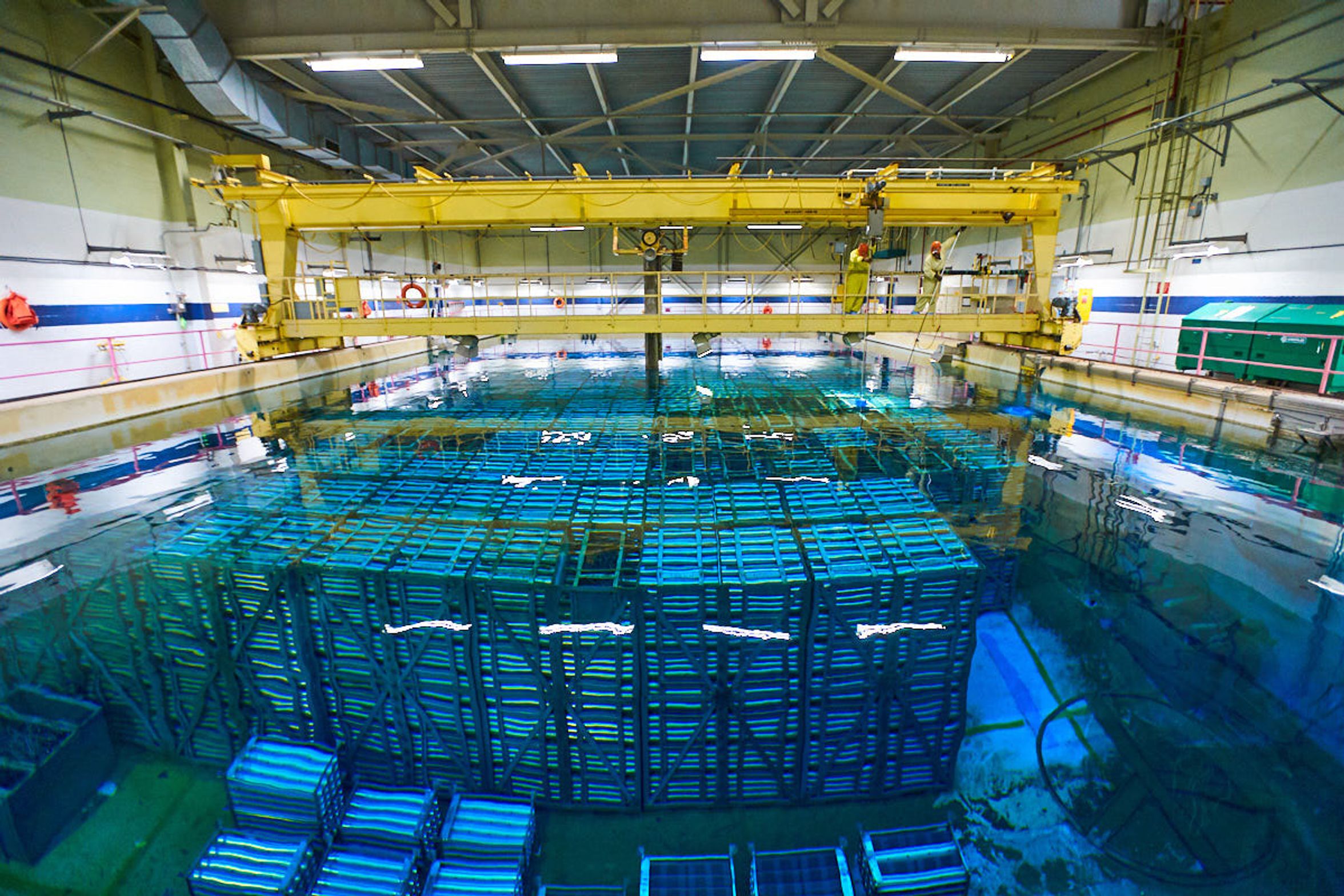 Manchester University 8th April 2020,Two new research papers from The University of Manchester, working with colleagues at Sellafield Limited and the National Nuclear Laboratory show that microbes can actively colonise some of the most intensively radioactive waste storage sites in Europe. When nuclear facilities such as
Sellafield were designed and built more than 50 years ago, it was sensible to assume that the conditions in the pond would prevent microbial life from taking hold, but now new research shows that this is not the case. The growth of microbial life in nuclear facilities can cause uncertainty or problems. Understanding how microbial life can inhabit environments such as
fuel storage ponds is vital to progress nuclear decommissioning work such as at Sellafield. Microbes are a group of organisms that, including bacteria and algae, are known to inhabit a wide range of habitats on Earth. Improvements in detection technology in recent years has allowed microorganisms to be detected in environments previously thought to be inhospitable to life. It is now becoming clear that some microorganisms are capable of withstanding surprisingly high doses of radiation, at levels significantly greater than seen in natural environments. Power Technology 8th April 2020, University of Manchester researchers have discovered microbial life can
Geomicromicrobiologists studied microbes that can cause summer blooms in
nuclear fuel storage ponds, slowing down the decommissioning process of retired nuclear plants. Summer blooms reduce visibility and disrupt fuel retrieval. University of Manchester microbiology professor Jonathan Lloyd
said: “Our research focused on Sellafield’s First Generation Magnox Storage Pond (FGMSP), which is a legacy pond that has both significant levels of radioactivity in conjunction with a highly alkaline pH (11.4), equivalent to domestic bleach. “The ultimate aim of this work was to identify the microbes that can tolerate such an inhospitable environment, understand how they tolerate high radiation levels, and help site operators control their growth. “The growth of the microorganisms in the FGMSP inhibits the operations in the pond, which is currently a priority for decommissioning. “ |
|
|
Nuclear Free Local Authorities (NFLA) call for more stringent safety measures, and the closure of EDF’s old nuclear reactors
|
Ardrossan Herald 8th April 2020, Six safety incidents have been reported at Hunterston including concerns about the nuclear plant’s cooling systems, fuelling machine and cracks in the reactors’ graphite core. The UK government’s safety watchdog, the Office for Nuclear Regulation, said that Hunterston had “failed to adequately account for” radioactive materials last October. The Scottish Environment Protection Agency (SEPA) also disclosed that unauthorised radioactive “debris” was found in a supposedly empty fuel flask that had been returned to Hunterston from the Sellafield site. The Nuclear Free Local Authorities (NFLA) are calling for North Ayrshire Council to take more stringent measures regarding the plant and for EDF to close down old reactors. NFLA Scotland Convenor, Councillor Feargal Dalton said: “These
incidents confirm in our view that these aging reactors would be better being closed and the workers transferred into the long-term process of decommissioning Hunterston B.” |
|
Call to stop construction at Hinkley C nuclear project, due to coronavirus risk
Allan Jeffrey of Stop Hinkley talks to the Extinction Rebellion Radio Show. Rebel Radio 7th April 2020
https://www.mixcloud.com/XR_RebelRadio/rebel-despatches-hinkley-point-07042020/
BBC Points West 8th April 2020, Bus drivers carrying workers to Hinkley Point C construction site are
worried their lives are being put at risk. Every day a fleet of vehicles drops of and picks up hundreds of staff. The bus company says its putting in screens to protect the drivers, but work hasn’t been complete yet.
Bus drivers are calling for construction to stop. For the safety of everybody it makes more sense to close the site down. They are showing no regard for human life and potentially putting everyone in a situation where people
could die. Drivers are expressing their concern on social media and sending pictures which seems to show lack of social distancing. There are concerns too about the movement of workers who come from outside the area.
https://www.bbc.co.uk/iplayer/episode/m000h59p/points-west-late-news-08042020
More delay in planning application for UK’s Wylfa Newydd nuclear project

Wylfa Newydd planning decision delayed again, NEI, 6 April 2020 A planning decision over the Wylfa Newydd nuclear power plant in Anglesey has been deferred, the UK Government has confirmed.
The Wylfa Newydd project, which envisaged the construction of two UK advanced boiling water reactors (ABWRs), was suspended in January 2019 after Hitachi, failed to reach a funding deal with the UK government. However, the government had been expected to grant a Development Consent Order to construct the £12 billion power station on 31 March…… The Secretary of State (Alok Sharma) has decided to re-set the statutory deadline for this application to 30 September 2020….'”
…..EDF Energy announced last month that it was delaying submission of its planning application for Sizewell C by a “few weeks” due to the coronavirus crisis. Construction work at Hinkley Point C has also been scaled back. https://www.neimagazine.com/news/newswylfa-newydd-planning-decision-delayed-again-7859280
EDF’s hypocrisy -Hinkley C nuclear construction continued, despite pandemic, as “essential” work
Bridgwater Mercury 4th April 2020 Roy Pumfrey: WHILE EDF has gone halfway by reducing the number of workers on the Hinkley C (HPC) site, the company seems reluctant to shut HPC down completely (‘HPC construction continues’, Mercury, March 24) due to the Coronavirus pandemic.
An EDF statement talked about reducing worker numbers ‘further as work already in progress is completed’, but was not specific about which work was so critical that it couldn’t be terminated now and how much longer it would carry on.
This is in stark contrast to the situation at Flamanville in France (HPC’s sister station) where EDF has stopped all but essential tasks. EDF hides behind the fig leaf of HPC being ‘a project of critical national importance’.
This is simply no longer justified. If it was okay to stop work for three weeks
over Christmas and the New Year, it must be done now when the stakes are
much higher than a holiday. At the same time, EDF promised to take more
effective measures on social distancing. Photographs of workers grouped in
bus queues and using the canteen but clearly less than 2m apart show that
this is all but impossible.
https://www.bridgwatermercury.co.uk/news/18351121.letter-shut-hinkley-c-now/
1 This Month




PLEASE OPPOSE HR 8255 AND S.3639 – bills would accelerate satellite deployment, with no environmental review or safeguards – https://ncstd5li.quorum.us/campaign/169331/
To see nuclear-related stories in greater depth and intensity – go to https://nuclearinformation.wordpress.com
-
Archives
- September 2026 (339)
- August 2026 (330)
- July 2026 (355)
- June 2026 (287)
- May 2026 (306)
- April 2026 (356)
- March 2026 (251)
- February 2026 (267)
- January 2026 (308)
- December 2025 (358)
- November 2025 (359)
- October 2025 (375)
-
Categories
- 1
- 1 NUCLEAR ISSUES
- business and costs
- climate change
- culture and arts
- ENERGY
- environment
- health
- history
- indigenous issues
- Legal
- marketing of nuclear
- media
- opposition to nuclear
- PERSONAL STORIES
- politics
- politics international
- Religion and ethics
- safety
- secrets,lies and civil liberties
- spinbuster
- technology
- Uranium
- wastes
- weapons and war
- Women
- 2 WORLD
- ACTION
- AFRICA
- Atrocities
- AUSTRALIA
- Christina's notes
- Christina's themes
- culture and arts
- Events
- Fuk 2022
- Fuk 2023
- Fukushima 2017
- Fukushima 2018
- fukushima 2019
- Fukushima 2020
- Fukushima 2021
- general
- global warming
- Humour (God we need it)
- Nuclear
- RARE EARTHS
- Reference
- resources – print
- Resources -audiovicual
- Weekly Newsletter
- World
- World Nuclear
- YouTube
-
RSS
Entries RSS
Comments RSS

