Britain’s Trident nuclear submarine base is in the grip of a Coronavirus scare
 Coronavirus crisis at UK’s nuclear submarine base as twenty staff show COVID-19 symptoms and are forced into isolation Daily Mail, Coronavirus crisis at UK’s nuclear submarine base as twenty staff show COVID-19 symptoms and are forced into isolation Daily Mail,
By JAKE WALLIS SIMONS ASSOCIATE GLOBAL EDITOR FOR MAILONLINE 20 March 2020 Britain’s Trident nuclear submarine base is in the grip of a Coronavirus scare, MailOnline can reveal. Her Majesty’s Naval Base Clyde, the home of the UK nuclear deterrent in Scotland, has nearly 20 possible cases of infection so far. Servicemen and women reporting Covid-19 symptoms have been isolated in sealed rooms with ‘no entry’ signs taped to the doors. The number of possible victims is currently in the ‘low teens’, a source said, and preparations are underway for a major outbreak. The top floor of the Linton Block, one of 17 accommodation buildings at the facility, has been converted into a makeshift quarantine unit and sealed off. A medical team equipped with masks and yellow biohazard bags was seen at work on the base last week. A Ministry of Defence source insisted that Britain’s nuclear deterrent remains fully operational and that there is no possibility of a national security emergency. So far nobody has tested positive on the base, he added, though he acknowledged that testing has not been carried out in every case, in line with Government guidelines. Staff have complained at being ‘left in the dark’, saying they have not been informed about the virus risk at the facility. ‘Nobody knows what is going on and it’s making people frightened,’ one told MailOnline on condition of anonymity. ‘We have not had a single communication to tell us what is happening, and every day more rooms are sealed off. ‘Everyone here is expected to put our lives on the line for the Navy. We just want the Navy to level with us and tell us what the risk is.’ A Ministry of Defence source said that the jigsaw of different private firms and Navy units that operate the base has made it difficult to communicate news about the virus effectively to all staff. The source said: ‘The base is endeavouring to ensure all personnel are aware of the situation and the measures being taken to safeguard personnel.’ HMNB Clyde, commonly known throughout the Navy as ‘Faslane’, is home to 3,000 service personnel, 800 of their families and 4,000 civilian workers, mainly from the engineering firm Babcock International. The Linton Block, where the quarantine facility is being set up, is opposite the ‘Supermess’, one of the base’s major leisure hubs. In addition to separate bars for officers and sailors, there are restaurants, cafes and shops, with a bowling alley, ski slope, swimming pool and gym nearby. All of these are now seen as a ‘petri dish for the virus’, according to personnel serving at the site, and most are being closed down as the top brass prepares for the worst. The sports schedules, which include circuit training and team events such as football, rugby and boxing, have been cancelled, and the swimming pool has been shut in an effort to combat the spread of the disease………https://www.dailymail.co.uk/news/article-8131755/Coronavirus-crisis-UKs-nuclear-submarine-base.html |
|
1,000 staff at Sellafield nuclear facility self-isolating amid pandemic
 Coronavirus: 1,000 Sellafield staff self-isolating amid pandemic https://www.bbc.com/news/uk-england-cumbria-51951984 Coronavirus: 1,000 Sellafield staff self-isolating amid pandemic https://www.bbc.com/news/uk-england-cumbria-51951984
18 March 2020
About 1,000 employees at the Sellafield nuclear site in Cumbria are self-isolating amid the coronavirus outbreak. The firm earlier said it was carrying out a controlled shutdown of the Magnox plant, ahead of any absences. The plant in Seascale reprocesses spent fuel and Sellafield Ltd said it was scaling back operations so staff could concentrate on critical processes. The thousand staff represents about 8% of the whole workforce. They are either showing symptoms, have close family who have symptoms, or are having to distance themselves because they have an underlying health condition. On closing the reprocessing site, Sellafield said: “As a proactive measure, to retain the reprocessing stream in a sustainable state for the future, we are moving to a controlled shutdown of the Magnox reprocessing plant over the next few days. “This approach will enable the best opportunity for an effective restart when circumstances permit. With safety in mind, similar measures may be necessary elsewhere across the business.” |
|
The Blackwater Against New Nuclear Group (BANNG) protests the lack of full information on nuclear plans
BANNG 19th March 2020, In the wake of the coronavirus epidemic, Bradwell B has cancelled two-thirds of the exhibitions it had planned as part of its public
consultation on its proposals for a new nuclear power station. But, the
company is still calling for feedback on its plans to be given at any time
up to 27th May 2020.
The Blackwater Against New Nuclear Group (BANNG) has protested that the partial consultation will be only partially informed and
consequently feedback will be unrepresentative of the views of the whole of
the Blackwater communities. Prof. Andy Blowers, Chair of BANNG has written
to the Chinese company developing the proposals urging that the
consultation be terminated altogether. The exhibitions that did take place
were well attended, engaging in robust discussion where citizens were able
to question the plans and make clear in face-to-face exchanges with company
staff their concerns about the imposition of a massive nuclear complex on
the Dengie peninsula. The meetings at Maldon and Bradwell Village were well
attended, informative and occasionally emotional.
https://www.banng.info/news/banng-press-release-19th-march-2020/
Sellafield nuclear waste site to close due to coronavirus
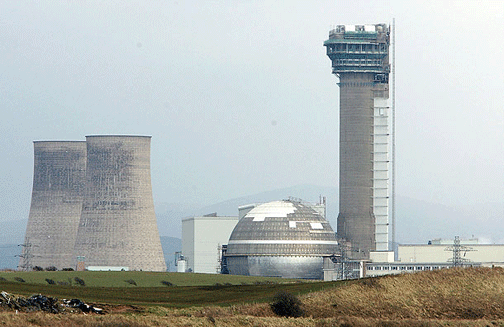 Sellafield nuclear waste site to close due to coronavirus, Magnox reprocessing plant will begin controlled shutdown after 8% of staff self-isolate,Guardian Jillian Ambrose Energy correspondentThu 19 Mar 2020 Britain’s nuclear waste site will shut its reprocessing plant at Sellafield after more than 8% of its staff began self-isolating to prevent the spread of the coronavirus.
The controlled shutdown of the Magnox plant in Cumbria will begin in the next few days after an outbreak of the Covid-19 virus within Sellafield’s 11,500 staff.
The company told employees on Tuesday evening that it would “scale back some operations” to “make best use of available people”.
Sellafield revealed last weekend that a staff member had tested positive for coronavirus, and on Monday it confirmed that another employee with suspected Covid-19 had begun self-isolation.
The number of Sellafield employees self-isolating has quickly climbed to about 1,000.
A Sellafield spokesman said the number in self-isolation included people with symptoms of the virus as well as those with underlying health conditions who undertaking social distancing……..
The Magnox plant is to close permanently this year. It began reprocessing waste from Britain’s first nuclear reactors in 1964 to separate the uranium and plutonium, which can still be reused from the spent radioactive waste. https://www.theguardian.com/business/2020/mar/18/sellafield-nuclear-waste-plant-close-coronavirus-staff
EDF reassures UK that during coronavirus epidemic, nuclear operations will continue
|
EDF Energy says plans in place to maintain operations at UK nuclear plants https://uk.finance.yahoo.com/news/edf-energy-says-plans-place-144424093.html?guccounter=1&guce_referrer=aHR0cHM6Ly9uZXdzLmdvb2dsZS5jb20v&guce_referrer_sig=AQAAABq2naeyyQ9ohtcPQW2Ho9e2-qDfI6XSbDwfZUneTxi4VhdT3GWx-zWbqg0MCFS2ArOO-cBI7xrEXbGJxc_Z4MEQGCMb8xZYz9GdF6dLu3azUPUvN5EB4x2GgyUSjwZkX1E93xGECuqxS4HnxqOETaVwytGf9KBTZIzT3QuaBP-R Reuters18 March 2020 By Nina ChestneyLONDON (Reuters) – EDF Energy has plans in place to maintain operations at its nuclear power plants in Britain during the coronavirus outbreak, it told Reuters on Tuesday.
The company operates all 15 nuclear reactors in Britain. Currently eight of those, with a combined capacity of around 4.2 gigawatts – almost half of the country’s total nuclear power capacity – are offline for planned or unplanned outages. “We have comprehensive plans in place to maintain operations at all of our power stations and planned generation is not affected at any of our sites,” said a spokeswoman, declining to specify what the measures were. On Monday, EDF Energy’s parent company EDF <EDF.PA> said it would reduce staff at its Flamanville nuclear power plant in northern France due to coronavirus infections in the Cotentin region. The plant has been offline for maintenance. Britain’s Office for Nuclear Regulation (ONR) said all UK sites have minimum staffing levels, and contingency plans should they fall below these levels, to enable them to stay in control of activities that could affect nuclear safety under all foreseeable circumstances. The ONR, which is in charge of overseeing nuclear safety, said its staff have been directed to work at home. “A number of inspectors will continue to travel to sites where required, but we will endeavour to carry out as much of our business as possible via phone, email and Skype,” it said. “These measures will not have a severe impact on our regulation of the nuclear industry.” (Reporting by Nina Chestney; Editing by Pravin Char and Jan Harvey) |
|
UK’s nuclear regulated asset base (RAB) financing passes all financial risks to electricity customers
 Times 15th March 2020 David Lowry: I read with incredulity the claims of Horizon nuclear chief Duncan Hawthorne that his company, which is really a Japanese shell company with no products, could build nuclear plants offering power at half the currently projected cost from the Hinkley Point C plant being built.
Fukushima Daiichi reactors in Japan on March 11, 2011 — costs $250bn
(£200bn) and rising — suggests Horizon has not learnt the full lessons
of that. The regulated asset base (RAB) financing mechanism Horizon
advocates transfers all financial investment risk to electricity customers
before a single unit is delivered to a home, allowing the foreign nuclear
company to build plants without having to pay attention to keeping costs
under control. This is an extraordinarily one-sided proposal. Surely even
this nuclear-friendly government cannot fall for it.
Nuclear waste transport disrupted by measures to stall coronavirus
GNS 13th March 2020, The return transport of vitrified waste from the reprocessing plant in Sellafield to the interim storage facility in Biblis planned for this spring is suspended. As the police authorities responsible for accompanying and carrying out the transport have stated, the police operation is currently not responsible with regard to the current “spread of corona” and therefore cannot be carried out in spring as planned. The companies and institutions involved in the repatriation will agree on a new deadline for the repatriation in due course.
Bradwell BNuclear power plant consultations cancelled amid coronavirus fears
Nuclear power plant consultations cancelled amid coronavirus fears, East Anglian Daily Times, 13 Mar 20, Public consultations for the proposed Bradwell B power plant in Essex have been cancelled amid growing coronavirus uncertainty.
Project partners EDF and China General Nuclear (CGN) took the decision to cancel the stage one events in the interest of public safety.
In total, 10 of the events will no longer take place, including exhibitions in Brightlingsea, Great Barrow and South Woodham Ferrers.
A spokesman for the project said: ‘The Bradwell B project has been closely monitoring the rapidly changing situation relating to Covid-19 and listening both to advice from Public Health England and to the concerns of the public, our staff and other stakeholders……
Those who wish to have their say on the plans can still do so until May 27, with consultation documents still available online and at various libraries and council offices in the county. ……
So far, 590 people have been diagnosed with the virus – including six in Essex.
Those who wish to obtain hard copies of the documents or have questions about the proposals can contact developers on 01621 451451 or by email here. https://www.eadt.co.uk/news/bradwell-b-events-cancelled-amid-coronavirus-fears-1-6559799
The lies about nuclear waste dumping in Scotland – from U.S. nuclear submarines
We were lied to in the past about dumping of nuclear waste https://www.thenational.scot/politics/18295704.lied-past-dumping-nuclear-waste/
By Iain Ramsay, Greenock & Inverclyde 11 Mar 20, QUITE a few years back, when I was a local SNP candidate here in Inverclyde, the local small boat owners and fishermen’s association approached me with their worries and problems, which resulted in me taking up the cudgels on their behalf.One of their spokesmen, who had a prawn fishing boat, was the late Brian Penny, who explained the problem and gave me the astounding fact that all the sea life had died in the Holy Loch.
The obvious cause of this was the USA nuclear submarine base of Polaris submarines, which must be discharging or dumping nuclear waste into the loch. With the help of the Greenock Telegraph we made a complaint to the far-off powers in Westminster who (according to them) sent a naval investigation team and took samples of sand, and water from the Loch, and assuring all concerned, that there was no need for any worry, as their tests had shown that the Loch was clean and no contamination was found.
 So who was to be believed, our local men who worked the river, or the boffins from the Anglo/Brit Navy? It was their expert word against our on-the-spot working fishermen. The result was that, as usual, nothing happened, until long after the USA navy left, the commander of the Holy Loch base retired and confessed to dumping tons of radio active waste into the loch.
Along with this admission was his statement that the base would have been illegal in America, as such nuclear bases have got to be more than 20 miles from the nearest town.This Holy Loch base was bang in the middle of the river Clyde, and only two miles from Greenock, the second-largest town in Scotland.
This confession by this former USA commander made the Royal Navy tests a total lie. No such tests were made. Proof of the pudding resulted in a permanently based dredger, working for well over a year on the very spot where the American commander’s mother ship was moored. I hope since that panic clean-up, sea life may have made a comeback, although some types of nuclear waste are a danger for a hundred years or more. I hope the USA were back charged for this long and hazardous clean-up, or did we taxpayers foot that bill also?
This doesn’t end the story of contamination, and if anything is only the beginning of a long line of attacks on our fragile environment. The English-flag-flying Royal Navy have taken over where the Yankees left off. Just across the river we have a nuclear submarine base, which not only admits to discharging radioactive waste from Faslane into the Gairloch but announces that this will increase by 50% when the new nuclear subs arrive.
The fact is, the only enemy attack we have to thole right now is from this highly dangerous Cobalt-60 and Tritium cocktail, a GIFT from the Royal Navy. However if you look up GIFT in a German dictionary, it means poison or venom. There are no contingency plans for our children’s health, when only less than two miles away we have a unique seawater swimming pool in Gourock which will eventually filter this contamination through, to be shared by all.
No, to Mr Donald Doull, the base commander, don’t install that new pipeline which will spew out this dangerous filth into our beloved Clyde. Rather fill your navy tankers with the effluent, and sail it down to the River Thames, when opposite the Westminster Parliament discharge this contaminated water into the river. Let’s see how long the Londoners would tolerate such muck spreading on their patch. You will find the English are not as gullible as to accept your stupid comment that this waste is of an acceptable radioactive level. Acceptable by whom, may I ask?
Groups question the viability of the three coastal sites for UK’s new nuclear plants
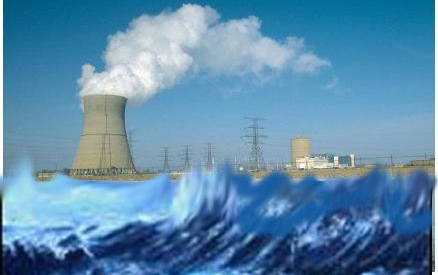 Hinkley, Sizewell and Bradwell, Stop Hinkley 10th March 2020, A meeting between representatives of groups opposing new nuclear development, the Office for Nuclear Regulation (ONR) the independent nuclear safety regulator, and the Environment Agency discussed how the ONR regulates against external hazards.
2018. According to minutes of meetings held by ONR’s group of climate
change experts, projections of sea level rise for the year 2100 contain
“considerable uncertainty” and ” small changes to UK storm systems can
alter the height of storm surges significantly”. Crucially, sea level has a
huge effect on the severity of storm surges. An increase in sea level of
one metre could mean that a storm of a severity currently expected only
once every thousand years is likely to occur once every decade. The meeting
took place in Bridgwater on 28th January 2020. Stop Hinkley was joined by
Together Against Sizewell C (TASC) and Blackwater Against New Nuclear Group
(BANNG). The groups are questioning the viability of the three coastal
sites which are all vulnerable to the impacts of flooding, storm surges and
coastal processes which will inevitably intensify in coming years.
Government advisers warn Britain against costly new nuclear reactors
 Times 7th March 2020, Net Zero Report. Plans for nuclear plants in Britain face fresh uncertainty after government advisers warned against backing costly new reactors. The nuclear industry wants the government to commit to a funding system to back the construction of reactors, including EDF’s proposed Sizewell plant in Suffolk.
However, the National Infrastructure Commission, set up in 2015 to provide impartial advice to the government, reiterated concerns in a report about backing more nuclear plants. It noted that there had been cost reductions in renewable power technologies such as wind and solar over the past ten years, but “costs of building and running nuclear power stations have not
fallen consistently, even in countries that have built fleets of similar reactors”. Given the potential for other non-intermittent technologies to complement renewables, it said that this “weakened the case for committing to a new fleet of nuclear power stations”.
https://www.thetimes.co.uk/article/advisers-raise-doubts-over-new-nuclear-plants-8hd85cr6d
Worker at Hinkley Point nuclear station has now developed coronavirus COVID-19
Nuclear and other toxic wastes dumped in Beaufort’s Dyke, which lies between Scotland and Northern Ireland
The National 4th March 2020, FOR decades, Scotland has been used by the Ministry of Defence to dump
everything from nuclear waste to unwanted munitions. For example,
Beaufort’s Dyke, which lies between Scotland and Northern Ireland, is
packed with laboratory waste, chemical munitions and artillery rockets. The
decision by the MoD to use it as a dumping ground has effectively ruled out
any possibilty of using that crossing for a Scotland to Northern Ireland
bridge (if ever such a thing was viable in the first place).
https://www.thenational.scot/news/18280377.uk-used-scotland-nuclear-dumping-ground-decades/
We can now see the full horror of nuclear plans for Bradwell B
|
BANNG 4th March 2020, Bradwell B to use Cooling Towers. At last we can see the full horror of what is proposed for Bradwell B! The pre-application for planning permission public consultation documents have just been published by the Chinese developer.
TV 4th March 2020, People in Bradwell-on-Sea in Essex will get to have their say on plans for a new nuclear power station from today. A 12 week public consultation is starting on proposals for Bradwell B – a twin reactor on the same site as a power station which stopped operating in 2002. The consultation will include fifteen exhibition events across Essex which will give local residents the chance to review the proposals. |
|
Protesters call for Capenhurst Urenco nuclear plant to be closed down
|
Protesters call for Capenhurst nuclear plant to be closed down https://www.cheshire-live.co.uk/news/chester-cheshire-news/protesters-call-capenhurst-nuclear-plant-17873816 Demonstration held as Urenco celebrated its 50th birthday By
David HolmesChief reporter 6 MAR 2020
Urenco’s nuclear plant at Capenhurst this week celebrated 50 years since the government-owned international company was founded . But outside protesters lamented the damage to human health and the environment caused by disasters like Chernobyl in Ukraine and Fukushima in Japan. Close Capenhurst campaigners argued the sector was unsafe from uranium mining to nuclear power production and the transportation and storage of highly radioactive waste.
Concerns have been raised about the Urenco plant itself which enriches uranium for use as fuel in nuclear reactors with the depleted uranium – a low level radioactive and toxic byproduct of the process – stored on site. Marianne Birkby, an anti-nuclear campaigner from Cumbria, speaking at the small demonstration outside the plant, said: “The start of the nuclear fuel cycle is here and where it ends up is Sellafield in Cumbria and every day, virtually, there’s nuclear waste transported on the roads, rail, sea and nobody wants the waste. “It’s all very well for Urenco to say ‘enriching the future’ and how fantastic it all is but nobody wants nuclear waste at the end of the day. And nuclear waste is the product of nuclear power.” Japanese campaigner Kaori Mikata-Pralat read out a statement on behalf of a group pursuing legal action against the Tokyo Electric Power Company over the 2011 Fukushima disaster when a tsunami swamped the plant leading to the release of radioactive contamination. Explaining that Fukushima had alerted her to the dangers, she told CheshireLive: “I wasn’t quite aware of the scale of the problem of this nuclear industry.” She has met victims of nuclear accidents, adding: “What they want is this tragedy should not be repeated any where in the world. Fukushima people suffered a lot.” Kaori said the ocean had also been poisoned. Even nuclear power stations functioning normally affected the eco-system as sea and river water was used to cool the reactors with the hot water put back, harming fish and plant life. Pointing at the sun, fellow protester Philip Gilligan said: “That nuclear power station up there is supplying the energy. It’s the only nuclear power station we want. So the energy coming to earth could easily be used with zero carbon output and zero nuclear. The problem is we need a bomb. And it’s hidden in statements like ‘energy as cheap as water’ which was current when Sellafield went critical in the ‘70s.” Urenco highlights the alleged green credentials of nuclear because there are no CO2 emissions during energy generation but the protesters claim the carbon footprint is ‘enormous’ after taking into account uranium mining, transport and the manufacture of thousands of tons of concrete for the installations. But what of the job losses if plants like Capenhurst, which employs 550 people, were closed? The campaigners argue the Government should reskill the workforce to produce renewable technology like solar panels. |
1 This Month




PLEASE OPPOSE HR 8255 AND S.3639 – bills would accelerate satellite deployment, with no environmental review or safeguards – https://ncstd5li.quorum.us/campaign/169331/
To see nuclear-related stories in greater depth and intensity – go to https://nuclearinformation.wordpress.com
-
Archives
- September 2026 (339)
- August 2026 (330)
- July 2026 (355)
- June 2026 (287)
- May 2026 (306)
- April 2026 (356)
- March 2026 (251)
- February 2026 (267)
- January 2026 (308)
- December 2025 (358)
- November 2025 (359)
- October 2025 (375)
-
Categories
- 1
- 1 NUCLEAR ISSUES
- business and costs
- climate change
- culture and arts
- ENERGY
- environment
- health
- history
- indigenous issues
- Legal
- marketing of nuclear
- media
- opposition to nuclear
- PERSONAL STORIES
- politics
- politics international
- Religion and ethics
- safety
- secrets,lies and civil liberties
- spinbuster
- technology
- Uranium
- wastes
- weapons and war
- Women
- 2 WORLD
- ACTION
- AFRICA
- Atrocities
- AUSTRALIA
- Christina's notes
- Christina's themes
- culture and arts
- Events
- Fuk 2022
- Fuk 2023
- Fukushima 2017
- Fukushima 2018
- fukushima 2019
- Fukushima 2020
- Fukushima 2021
- general
- global warming
- Humour (God we need it)
- Nuclear
- RARE EARTHS
- Reference
- resources – print
- Resources -audiovicual
- Weekly Newsletter
- World
- World Nuclear
- YouTube
-
RSS
Entries RSS
Comments RSS

