Share price plummets because of Uranium One’s risky deal with Russia
Uranium One shares dive as Russia deal questioned Reuters, Jun 9, 2010 Shares tumble 11 pct one day after Russian deal State-owned ARMZ to take controlling stake in company* Analysts cite rising risk, wonder about approval.By Cameron FrenchTORONTO, – Uranium One (UUU.TO) shares deepened their slide on Wednesday, a day after the company agreed to sell a controlling stake to Russia‘s state-owned nuclear company, with some analysts cutting share-price targets and questioning whether the deal will be approved….. Uranium prices have been in decline since hitting a record high in 2007, and were at $40.75 a pound this week… UPDATE 1-Uranium One shares dive as Russia deal questioned | Reuters
Australian uranium mine to come under Russian control
Moscow moves on global uranium mines The Australian June 10, RUSSIA has moved to boost its holdings in global uranium mines, with state-owned Rosatom agreeing to take a controlling stake in Canada’s Uranium One……If the deal goes ahead, it will put the Honeymoon uranium project in South Australia, scheduled to come into production at the end of the year, under the control of the Russian government…… Uranium One has sold its recently acquired 3 per cent stake in Australia’s Paladin Resources,…….Uranium One owns 51 per cent of Honeymoon Well mine, which means it will come under Rosatom’s control.Honeymoon Well, 75km northwest of Broken Hill, is expected to cost $138m to develop.The other 49 per cent is owned by Japan’s Mitsui…. Moscow moves on global uranium mines | The Australian

Russia’s nuclear agency Rosatom involved in Iran, France, Australia
Russia and Iran would jointly run Iran’s first nuclear power plant that Rosatom plans to launch in August. Iran agreed to establish a joint venture with Rosatom to operate the plant because the country doesn’t have enough experience in maintaining such facilities, he said.In other news, Rosatom signed an agreement with the French Atomic Energy Commission to expand cooperation on reprocessing, decommissioning and isotopes technology.
In what could further extend Rosatom’s international reach, the State Duma is scheduled to ratify an accord between Russia and Australia on peaceful nuclear cooperation on Wednesday. Continue reading
Russia did not use nuclear explosions to fix oil leaks
all these Soviet nuclear blasts were on land and did not involve oil. Eventually, both superpowers gave up trying to use nukes for peaceful purposes, and one of the reasons was the environmental hazards.

Just Because Someone Else Did It, Doesn’t Mean It’ll Work As the New York Times pointed out, the whole idea came from something the Russians tried back in the 1960s to stop a natural gas fire. Historian and nuclear non-proliferation expert David E. Hoffman tears down the idea that “if it worked for them it’ll work for us”: But didn’t the Soviet Union once use nukes for this? Not exactly. Continue reading
Uranium mining and polonium: remember Litvinenko
Roxby’s radioactive risk, The Independent Weekly. HENDRIK GOUT04 Jun, 2010 “…….Litvinenko was a high-ranking Soviet intelligence operative who turned against the KGB over a range of political assassinations he said had been carried out by the spy agency.He was then murdered, almost certainly by a former KGB colleague acting – so Litvinenko alleged before he died – on the implicit orders of Russian President Vladimir Putin.

The murder weapon was polonium-210, a radioactive metalloid and one of the most toxic elements known to science – a quarter of a million times more toxic than cyanide. A particle weighing less than one-hundredth of one microgram (about the weight of a single scale on a butterfly’s wing) is a lethal dose. Continue reading
Terrorists seeking nuclear materials in Russia
 Terrorists still trying to access nuclear materials in Russia and former-Soviet republics: Russia by : RIA Novosti , June 02 2010 PoliJAM, Terrorists have not given up their attempts to access nuclear materials in Russia and former-Soviet republics, the head of the Russian Federal Security Service said on Wednesday.
“We have information that terrorists are continuing their attempts to access nuclear materials, as well as biological and chemical components,” Alexander Bortnikov said at a news conference after a meeting of the heads of security services from the member states of the Commonwealth of Independent States (CIS). Breaking News, Politics, US and World News, and Entertainment – The PoliJAM Times
Short term approach to nuclear wastes masks reality of the problem
as the world’s nuclear military powers are discovering the costs continue after the submarines and power stations have been decommissioned from active service. The equipment and reactors cannot easily or cheaply be dismantled and will remain radioactive for hundreds of years
Nuclear and radioactive waste disposal – by Patrick Boniface – Helium, 30 May 2010, Nuclear waste is dangerously toxic, its environmental impact if released would be devastating, as was witnessed during both the Chernobyl explosion, the American Three Mile Island scare and the Windscale fire of 1957.In these cases radioactive material was released into the atmosphere. With the Windscale fire some 15,000 terabequerels (TBq) of radioactive material (notably Iodine-131) were released (3).
A report compiled by Crick & Linsley in 1983 estimated that 260 people would eventually die from dieases, such as thyroid cancers, related to the release of the material during the fire, (4).
Other aspects that environmentalist’s voice concerns over include the storage of spent nuclear fuels, from commercial nuclear reactors and increasingly from redundant nuclear warships such as submarines.
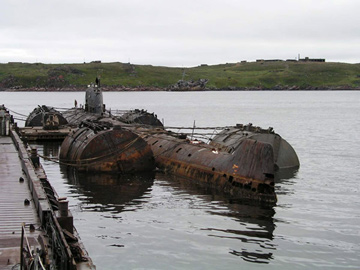
In particular in the former Soviet Union around the submarine base of Arkangel in Northern Russia there are around sixty nuclear submarines that are rotting away but still with large amounts of nuclear material contained within their hulls.
The Russian economy is unable to afford the costs of de-commissioning these submarines. The cost of decommissioning is between $100-300 million per submarine (5). Continue reading
Pressure on Russia and China to reveal nuclear weapons stockpile numbers
Britain Discloses Size of Nuclear Stockpile: Who’s Next? » FAS Strategic Security Blog, By Hans M. Kristensen, 26 May 2010, “….. Who’s Next? Three of the five original nuclear weapon states have now disclosed the sizes of their military stockpiles of nuclear warheads. The pressure is increasing on the other nuclear weapon states to follow the good example.The size of the Russian stockpile is unknown but Norris and I estimate Russia possesses 12,000 nuclear warheads, of which 4,600 might be operational. A Russian official recently told Reuters that Russia after ratification of the New START agreement “will likewise be able to consider disclosing the total number of Russia’s deployed strategic delivery vehicles and the warheads they can carry.” That would not be disclosing the size of the stockpile, but still be progress.China’s stockpile is even more opaque, although Norris and I estimate it at approximately 240 warheads
Britain Discloses Size of Nuclear Stockpile: Who’s Next? » FAS Strategic Security Blog
Russia not transparent on its nuclear weapons
Russian Nuclear Weapons Account Falls Short » FAS Strategic Security Blog, By Hans M. Kristensen, 11 May 2010, A brochure handed out by the Russian government at the ongoing nuclear Non-Proliferation Treaty Review Conference in New York appears to misrepresent the size of the Russian nuclear arsenal. Continue reading
The Russian idea for fixing oil leaks- nuclear bomb the oil well!
Should we drop a nuclear bomb on the leaky oil well? Washington Examiner, By: Mark Hemingway, 05/04/10 Apparently that’s what the Russians have done in similar circumstances:Komsomoloskaya Pravda, the best-selling Russian daily, reports that in Soviet times such leaks were plugged with controlled nuclear blasts underground. Continue reading

Russia – a nuclear security danger!
Russia: A Nuclear Security Leader? Partnership for a Secure America , by Volha Charnysh |26 April 2010, Considered the Pandora’s box of nuclear security issues for decades, Russia is now being recast as a nuclear security leader……. However, Russia’s active and at times reckless pursuit of nuclear business contradicts its claim to nuclear security leadership and could weaken the commitments made at the Summit. Continue reading
Impact of radioactive waste on remote communities in Russia
Russian atomic waste endangers the people and environment of far north, EnerPub – Energy Publisher, April 25, 2010by Paul A. Goble The dying off of the numerically small peoples of the Russian north, already taking place because of economic development and climate change, is being accelerated by the mishandling of nuclear materials at power stations and military bases in that region and especially by the lack of secure storage facilities for nuclear wastes there. Continue reading
Russia accused of involvement in smuggling of enriched uranium
Saakashvili accuses Russia of supplying enriched uranium to Caucasus, News.Az 23 April 2010, President of Georgia Mikheil Saakashvili accused Russia “of creating unstableness”.According to RBK, in the opinion of the Georgian leader, the unstableness enables the smugglers to deliver the highly enriched uranium to the Caucasus………..The Georgian leader underlined that Russia should be responsible for maintaining control of the nuclear weapon distribution in these territories so long as “it has occupied them”. In his opinion, the incidents with the highly enriched uranium threaten Georgia’s safety.
News.Az – Saakashvili accuses Russia of supplying enriched uranium to Caucasus
Closure of Russia’s last plutonium nuclear reactor
Russia shuts down last plutonium reactor ABC News (Australian Broadcasting Corporation) 16 April 2010, Russia has shut down its last weapons-grade plutonium reactor, in line with a pledge made at a nuclear security summit in Washington this week, officials said. Continue reading

Russia doesn’t count depleted uranium as ‘nuclear wastes’
The Russian state-media report adds the uranium isn’t considered waste material because it can be reprocessed. Depleted uranium, however, has severe health consequences from long-term exposure.
Greenpeace irked by Russia’s uranium, ST. PETERSBURG, Russia, April 14 (UPI) –– A ship from the environmental group Greenpeace arrived Wednesday in St. Petersburg, Russia, to protest nuclear fuel waste shipments from France. Continue reading
1 This Month
29 Jan. Thursday 7-8 p.m. Webinar – World’s Largest Nuclear Station in Port Hope, ON?
To see nuclear-related stories in greater depth and intensity – go to https://nuclearinformation.wordpress.com/


31st January – Challenging the War Machine – a DECLASSIFIED UK SUMMIT


Website of the Week
Now until to February 10, 2026 Radioactive waste storage in France: the debate is finally open! How to participate?
-
Archives
- January 2026 (288)
- December 2025 (358)
- November 2025 (359)
- October 2025 (376)
- September 2025 (258)
- August 2025 (319)
- July 2025 (230)
- June 2025 (348)
- May 2025 (261)
- April 2025 (305)
- March 2025 (319)
- February 2025 (234)
-
Categories
- 1
- 1 NUCLEAR ISSUES
- business and costs
- climate change
- culture and arts
- ENERGY
- environment
- health
- history
- indigenous issues
- Legal
- marketing of nuclear
- media
- opposition to nuclear
- PERSONAL STORIES
- politics
- politics international
- Religion and ethics
- safety
- secrets,lies and civil liberties
- spinbuster
- technology
- Uranium
- wastes
- weapons and war
- Women
- 2 WORLD
- ACTION
- AFRICA
- Atrocities
- AUSTRALIA
- Christina's notes
- Christina's themes
- culture and arts
- Events
- Fuk 2022
- Fuk 2023
- Fukushima 2017
- Fukushima 2018
- fukushima 2019
- Fukushima 2020
- Fukushima 2021
- general
- global warming
- Humour (God we need it)
- Nuclear
- RARE EARTHS
- Reference
- resources – print
- Resources -audiovicual
- Weekly Newsletter
- World
- World Nuclear
- YouTube
-
RSS
Entries RSS
Comments RSS
 nuclear-news