Kiriyenko, Russia’s top nuclear man, pushing for nuclear commerce
Russian environmentalists, however, fear that the 123 agreement will open the way for the United States to transfer its nuclear waste to Russia for reprocessing — a task that green groups say Russia is ill equipped for.
Russians Eye Bottom Line As Americans Hail Non-Proliferation Achievement The Moscow Times, 11 Jan 2011, ………while the Americans claimed a victory for Obama’s pledge to reduce proliferation, the Russian side seemed coldly focused on the bottom line. ………Russia’s atomic energy agency has vigorously promoted the idea of a global “nuclear renaissance” as a way to meet growing energy demand and reduce dependence on fossil fuels. The company will soon have representatives posted at Russian embassies to help cultivate its foreign market. Rosatom chief Sergei Kiriyenko told Medvedev that Rosatom expects to land orders to build 30 more generating units abroad in addition to contracts it has already signed. Continue reading
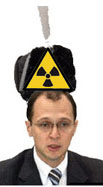
What the new Nuclear Arms Reduction Treaty says
What’s Inside the New Nuke Arms Treaty , Wired.com, By Spencer Ackerman

- December 21, 2010 Back from the brink of annihilation, the Obama administration’s treaty with Russia on reducing nuclear weapons is looking like it’ll pass the Senate after all, possibly as early as Wednesday. The only thing that everyone’s overlooked in the past several months’ political theater over the treaty is what it actually does — and doesn’t do. So we’re here to help. Continue reading
Russia wants to defeat India’s Nuclear Liability Law
India’s nuclear liability legislation, passed in August, caps the operator’s liability atRs 1,500 crore ($331 million) and also gives it the right to seek damages from suppliers, if there is an accident.
Ahead of prez visit, Russia seeks clarity on N-liability Hindustan Times
New Delhi, December 18, 2010Ahead of President Dmitry Medvedev’s visit that begins on Monday, the Russian ambassador on Friday said the country was still awaiting an explanation on how India’s nuclear liability legislation would work. Continue reading
Russia manipulating to avoid India’s Nuclear Liability Law
Russia’s concern over liability law may delay new Kudankulam pacts, The Hindu Priscilla Jebaraj, 4 Dec 10, Decision not taken to accept liability: Atomstroyexport MOSCOW: Russian reservations about the implications of India’s nuclear liability law may be delaying the contracts for two nuclear power reactors to be built in Kudankulam, in the Tirunelveli district of Tamil Nadu. Continue reading
Russia’s warning on nuclear missiles and START Treaty
The Kremlin warnings come amid uncertainty over the United States Senate’s ratification of New START (Strategic Arms Reduction Treaty),……
The pact would reduce how many strategic warheads the US and Russia could hold and set up a system so each could inspect and verify the other’s arsenal.
Putin warns against being shut out of missile shield TODAYonline Dec 03, 2010 MOSCOW – Russian Prime Minister Vladimir Putin has warned that his country would deploy nuclear weapons and “strike forces” if it were shut out of a Western missile shield. Continue reading
Russia ramps up nuclear weapons in Europe
True totals of Russian tactical nuclear weapons is a tightly-held secret, but the Federation of American Scientists estimated last year that Moscow has nearly 5,400 of them, with about 2,000 deployed.
Russia Moves Tactical Nukes Closer to NATO. Gulp. Wired.com, By Spencer Ackerman November 30, 2010
While the U.S. and Russia have been publicly crowing about their awesome new friendship for the past two years, Moscow’s been moving small, ground-based nuclear weapons closer to the borders of Washington’s easternmost NATO allies. Continue reading
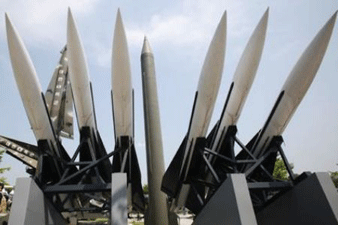

Russia planning nuclear powered space engines and nuclear plants on Mars
The Russian space agency also expressed its willingness to design a space-based nuclear power station, which can be deployed on the Mars or the moon for 10-15 years.
Russia To Start Developing Nuclear Space Engines | AHN, 23 Nov 10, Moscow, Russian Federation (AHN) – Russia is considering developing nuclear-powered space engines. Continue reading
Russia cutting back on nuclear safety expenditure
now under threat as funds for nuclear safety co-operation have been omitted from expenditure earmarked for local regional purposes.
Cash Cut Threatens Finnish-Russian Radiation Safety Co-operation YLE Uutiset22 Nov 10, Co-operation on nuclear safety between Finland and Russia could grind to a halt due to a lack of cash. Continue reading
Radioactive poisoining of Mayak, in rural Russia
Mayak means irradiated milk, and a river 1,000 times as radioactive as normal. Genetic defects in people 25 times and cancer incidence four times the Russian average……..
Dumping nuclear waste on defenceless Russians, de.indymedia.org |Presenter Sonia Seymour Mikich: “……….The CASTOR protests of Gorleben ( ………german-nuke-waste-transportation) have shown yet again how nuclear waste has entrapped us. There’s no final repository anywhere. There are no disposal suggestions that would be suitable for a million years – that’s how long the fuel rods radiate. Continue reading
3 new ballistic missile tests by Russia
Russian military test-fires 3 ballistic missiles Google hosted news, 29 Oct 10, MOSCOW (AP) — Russia’s military on Thursday successfully test-fired three intercontinental ballistic missiles in one day during training of its strategic forces. The Defense Ministry said the Bryansk nuclear submarine of the navy’s Northern Fleet on Thursday launched a Sineva missile from the Barents Sea at a range on the Kamchatka Peninsula.Another nuclear sub, the Georgy Pobedonosets of the Pacific Fleet, test fired an RSM-50 from the Sea of Okhotsk at a testing range in the northwestern Arkhangelsk region…… The Associated Press: Russian military test-fires 3 ballistic missiles
Western countries funding multi $billion cleanup of Russia’s arctic nuclear wastes
Although Russian authorities pledged transparency about the region’s nuclear issues, foreign journalists are denied access to a number of sites.
Russian Arctic’s ‘nuclear dump’ gets a facelift By Pierre-Henry Deshayes , Google hosted news, (AFP) –18 Oct 10, MURMANSK, Russia — An electronic sign along a busy street posts the outside temperature, the wind strength — and the radioactivity level.Welcome to Russia’s Kola Peninsula, a region that still bears the scars of its dubious past as the Soviet Union’s “nuclear dump”. Continue reading
Russia boosting nuclear sales – will take back radioactive wastes
Russia Seeks to Build Europe’s Nuclear Plants – NYTimes.com, Rosatom, the Russian state-owned nuclear company, is competing with Westinghouse and Areva of France to build new reactors at the Temelin station in the Czech Republic.By ANDREW E. KRAMER October 11, 2010 MOSCOW — The Russian nuclear industry has profited handsomely from building reactors in developing countries, including India, China and Iran. Now it is testing the prospect of becoming a major supplier to the European Union, too…….. Continue reading
Disposing of dead nuclear reactors – problem not yet solved
The problem of disposing of this kind of reactors is ripe everywhere, not only in Russia..this branch of the nuclear industry is least developed technically, technologically and marketingwise,..Apart from Russia, this kind of reactor is used in a number of European countries
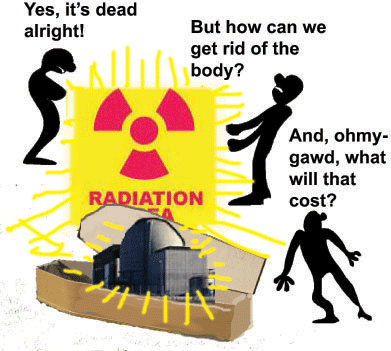
Russia to retire uranium-graphite reactors Voice of Russia, Oleg Nekhai , Sep 30, 2010 Russian nuclear scientists intend to shut down uranium-graphite reactors on a mass scale. Continue reading
Russian nuclear powered ice-breaker in the Arctic
Russians go nuclear in bid to crack pole The Australian September 20, 2010 THE Arctic icecap faces a new threat from Russian plans to build the world’s largest icebreakerThe new ship will be capable of smashing its way across the polar region even in winter.The nuclear-powered vessel would create shipping lanes across the Arctic Ocean while helping energy companies exploit the region’s gas and oil reserves.
The proposal coincides with reports last week that the Arctic icecap had shrunk to 4.66 million sq km, the third-lowest recorded since 1979. Its average winter thickness at the North Pole has also halved, to about 2.4m, since 1976.……Russians go nuclear in bid to crack pole | The Australian
Moscow facing up to its nuclear radiation mess
Radiation scare for Moscow parks The Moscow News, – Evgeniya Chaykovskaya – 13 Sept 10, Levels of radiation on Moscow’s streets have reached a level so high that the authorities are about to spend 4.7 billion roubles to get rid of it.The $153 million clean-up will run from 2011-2013 amid reports of no fewer than 18 dangerous radioactive objects within the capital.
And they can be found in heavily built-up areas like Kuzminki, Continue reading
1 This Month



26 September – International Day for the Total Elimination of Nuclear Weapons


PLEASE OPPOSE HR 8255 AND S.3639 – bills would accelerate satellite deployment, with no environmental review or safeguards – https://ncstd5li.quorum.us/campaign/169331/
To see nuclear-related stories in greater depth and intensity – go to https://nuclearinformation.wordpress.com
-
Archives
- September 2026 (245)
- August 2026 (330)
- July 2026 (355)
- June 2026 (287)
- May 2026 (306)
- April 2026 (356)
- March 2026 (251)
- February 2026 (267)
- January 2026 (308)
- December 2025 (358)
- November 2025 (359)
- October 2025 (375)
-
Categories
- 1
- 1 NUCLEAR ISSUES
- business and costs
- climate change
- culture and arts
- ENERGY
- environment
- health
- history
- indigenous issues
- Legal
- marketing of nuclear
- media
- opposition to nuclear
- PERSONAL STORIES
- politics
- politics international
- Religion and ethics
- safety
- secrets,lies and civil liberties
- spinbuster
- technology
- Uranium
- wastes
- weapons and war
- Women
- 2 WORLD
- ACTION
- AFRICA
- Atrocities
- AUSTRALIA
- Christina's notes
- Christina's themes
- culture and arts
- Events
- Fuk 2022
- Fuk 2023
- Fukushima 2017
- Fukushima 2018
- fukushima 2019
- Fukushima 2020
- Fukushima 2021
- general
- global warming
- Humour (God we need it)
- Nuclear
- RARE EARTHS
- Reference
- resources – print
- Resources -audiovicual
- Weekly Newsletter
- World
- World Nuclear
- YouTube
-
RSS
Entries RSS
Comments RSS
 nuclear-news