Samantha Smith – a 10 year old who acted to reduce nuclear weapons
 Your voice matters in reducing nuclear
  weapons https://www.thestar.com/opinion/contributors/2019/07/31/your-voice-matters-in-reducing-nuclear-weapons.html
New research: 2017 radioactive cloud traced to an unacknowledged nuclear accident in southern Russia

Mysterious Radiation Cloud Over Europe Traced to Secret Russian Nuclear Accident https://www.livescience.com/66050-radiation-cloud-secret-russian-nuclear-accident.html By | July 29, 2019 A vast cloud of nuclear radiation that spreadover continental Europe in 2017 has been traced to an unacknowledged nuclear accident in southern Russia, according to an international team of scientists.
The experts say the cloud of radiation detected over Europe in late September 2017 could only have been caused by a nuclear fuel-reprocessing accident at the Mayak Production Association, a nuclear facility in the Chelyabinsk region of the Ural Mountains in Russia, sometime between noon on Sept. 26 and noon on Sept. 27.
Russia confirmed that a cloud of nuclear radiation was detected over the Urals at the time, but the country never acknowledged any responsibility for a radiation leak, nor has it ever admitted that a nuclear accident took place at Mayak in 2017. [Top 10 Greatest Explosions Ever]
The lead author of the new research, nuclear chemist Georg Steinhauser of Leibniz University in Hanover, Germany, said that more than 1,300 atmospheric measurements from around the world showed that between 250 and 400 terabecquerels of radioactive ruthenium-106 had been released during that time.
Ruthenium-106 is a radioactive isotope of ruthenium, meaning that it has a different number of neutrons in its nucleus than the naturally occurring element has. The isotope can be produced as a byproduct during nuclear fission of uranium-235 atoms.
Although the resulting cloud of nuclear radiation was diluted enough that it caused no harm to people beneath it, the total radioactivity was between 30 and 100 times the level of radiation released after the Fukushima accident in Japan in 2011, Steinhauser told Live Science.
The research was published today (July 29) in the journal Proceedings of the National Academy of Sciences.
Ruthenium release
The cloud of radiation in September 2017 was detected in central and eastern Europe, Asia, the Arabian Peninsula and even the Caribbean.
Only radioactive ruthenium-106 — a byproduct of nuclear fission, with a half-life of 374 days — was detected in the cloud — Steinhauser said.
During the reprocessing of nuclear fuel — when radioactive plutonium and uranium are separated from spent nuclear fuel from nuclear power reactors — ruthenium-106 is typically separated out and placed into long-term storage with other radioactive waste byproducts, he said.
That meant that any massive release of ruthenium could only come from an accident during nuclear fuel reprocessing; and the Mayak facility was one of only a few places in the world that carries out that sort of reprocessing, he said.
Advanced meteorological studies made as part of this new research showed that the radiation cloud could only have come from the Mayak facility in Russia. “They have done a very thorough analysis and they have pinned down Mayak — there is no doubt about it,” he said.
The accident came a little more than 60 years since a nuclear accident at Mayak in 1957 caused one of the largest releases of radiation in the region’s history, second only to the 1986 explosion and fire at the Chernobyl nuclear power plant, which is now in the Ukraine. [Chernobyl Nuclear Disaster 25 Years Later (Infographic)]
In the 1957 accident, known as the Kyshtym disaster after a nearby town, a tank of liquid nuclear waste at the Mayak facility exploded, spreading radioactive particles over the site and causing a radioactive plume of smoke that stretched for hundreds of miles.
Nuclear accident
The study showed that the 2017 accident at Mayak was unlikely to have been caused by a relatively simple release of radioactive gas, Steinhauser said. Rather, a fire, or even an explosion, might have exposed workers at the plant to harmful levels of radiation, he added.
Russia has not acknowledged that any accident occurred at the Mayak facility, maybe because plutonium is made there for thermonuclear weapons. However, Russia had established a commission to investigate the radioactive cloud, Steinhauser said.
The Russian commission ruled that there was not enough evidence to determine if a nuclear accident was responsible for the cloud. But Steinhauser and his team hope it may look again at this decision in the light of the new research.
“They came to the conclusion that they need more data,” he said. “And so we feel like, okay, now you can have all of our data — but we would like to see yours as well.”
Any information from Russia about an accident at the Mayak facility would help scientists refine their research, instead of having to rely only on measurements of radioactivity from around the world, Steinhauser said.
The international team of scientists involved are keenly interested in learning more about its causes. “When everybody else is concerned, we are almost cheering for joy, because we have something to measure,” he said. “But it is our responsibility to learn from this accident. This is not about blaming Russia, but it is about learning our lessons,” he said.
The often forgotten nuclear disaster in Russia’s Ural Mountains
River of radiation: Life in the area of the world’s 3rd-worst nuclear disaster Rt.com 28 Jul, 2019 Before Fukushima and Chernobyl, the worst-ever nuclear disaster was a massive leak from a plant in the eastern Urals. RT went to see how people live in areas affected by the fallout from the USSR’s risky rush to the nuclear bomb.
Chernobyl and Fukushima are the two names that are most likely to come to mind when one thinks about nuclear disaster, and rightfully so. People in the US will likely recall the Three Mile Island accident, while Britons may say the “Windscale fire.”
The name “Kyshtym” will probably mean nothing to the wider public, despite it belonging to the third-worst nuclear accident in history. An RT Russian correspondent traveled to the area to speak with locals, some of whom personally witnessed the 1957 disaster, to find out what living in such a place feels like.
Bomb at any cost
Kyshtym is the name of a small town in what is now Chelyabinsk Region in Russia, located in an area dotted by dozens of small lakes. A 15-minute car ride east will bring you to another town called Ozyorsk. Six decades ago, you wouldn’t find it on any publicly available map because it hosted a crucial element of the Soviet Union’s nascent nuclear weapons program, the Mayak plant.
The Soviet leadership considered building up a stockpile of weapons-grade plutonium to be a high priority, while environmental and safety concerns came as an afterthought. Some of the less-dangerous radioactive waste from Mayak was simply dumped into the Techa River, while the more-dangerous materials were stored in massive underground tanks.
The sealed steel containers, reinforced with meter-thick concrete outer walls, were considered strong enough to withstand pretty much anything. In September 1957 this assumption was proven wrong, when one of the tanks exploded with an estimated power of 70-100 tons of TNT. This happened due to an unrepaired cooling system, which allowed radioactive waste to build heat and partially dry up, forming a layer of explosives, an investigation later found. An accidental spark was then enough to blow off the 160-ton lid of the tank, damage nearby waste storages, and shatter every window pane within a 3km radius.
A plume of radioactive waste was ejected high into the air. Some 90 percent of the material fell right back, contaminating the area and adding to the pollution in the Techa River, but some was atomized and traveled northeast with the wind. A 300km long, 10km wide stretch of land running through three Russian regions is what’s left by the fallout. The worst-affected part of it was designated a natural reserve a few years after the disaster.
Cover up
The disaster was covered up in the Soviet media, which reported that the strange lights in the night sky – actually a glow caused by ionization from radioactive waste – was a rare event related to the aurora. The locals knew something was wrong, of course, due to the evacuation of two dozen nearby villages and the large-scale decontamination work that was to be carried out over the next several years.
Later, the military came to get radiation readings in it. Afterwards, soldiers demolished the banya and took away not only the house but even the layer of soil on which it was built.
Officially, the scale of the disaster remained a state secret until the late 1980s.
Poisoned river
The Techa River remains contaminated now, long after Mayak stopped dumping waste in it. The radiation is relatively low, however: standing next to it is no worse than traveling on an airplane. Thousands of people cross it every day via a bridge road that connects Chelyabinsk and Ekaterinburg – the two nearest provincial capitals.
The only inhabited village down the river is called Brodokalmak and is about 85km downstream from Ozyorsk, and 50km away from the bridge crossing …….
Ghost village
Halfway between the bridge and Brodokalmak is another village, Muslyumovo. It was inhabited until about a decade ago, when Rostatom, the Russian nuclear monopoly, offered to relocate its 2,500 residents. Now it’s a ghost village………
Triple exposure
Another place that had a close brush with Mayak’s waste is Metlino, a town about 25 minutes east from Ozyorsk. Some residents were unfortunate enough to have been exposed to radiation three times in their lives, according to Lyudmila Krestinina, who heads a lab at a local radiation research medical center.
First, they lived on the Techa River when it was used to dump waste. Then the disaster happened, and the cloud went past, close enough for some fallout but not close enough for it to become a major risk. The third time happened in 1967.
“There was drought and the Karachay bog, where waste was dumped from the Mayak, caught fire. The wind brought radioactive smoke over Metlino,” she said. “Now the contamination level has decreased several times, but it’s still higher than background radiation.”
The bog used to be a lake in the early days of Mayak, which started to dry up in the 1960s. The 1967 incident prompted major landscaping work to cover its shallow parts with earth and provide greater water supply. This solution was ultimately deemed unfeasible, so the rest of the lake was covered as well. The work ended just four years ago. ……. https://www.rt.com/russia/465243-kyshtym-nuclear-disaster-mayak/
Fears about a Soviet-era nuclear waste site, on the planned route for a Moscow expressway.
|
Radiation fears cloud plans for Moscow expressway Protesters say construction risks disturbing dangerous particles at nuclear waste site , Ft.com,Nastassia Astrasheuskaya in Moscow 26 July 19, A plan to build a new Moscow road adjacent to a Soviet-era nuclear waste site has put city planners on a collision course with activists and residents who fear the spread of radiation in the Russian capital. Moscow officials deny there is any risk from building the so-called Southeast Chord — a 34km expressway designed to alleviate growing congestion in the city of more than 12m people. The motorway would run past the Moscow Polymetal Plant and its radioactive waste disposal site — dating back to the 1930s — where dangerous volumes of radium, thorium and uranium were stored. Opponents of the plan say they want to stop “Chernobyl repeating in Moscow” and warn that construction risks releasing buried particles into the air and waterways. They fear these will be picked up on vehicles using the road and dispersed across the city. “Of course this is not on the Chernobyl scale, but it can undoubtedly lead to additional health problems,” said Konstantin Fomin of Greenpeace Russia. Hundreds of people took to the streets this week to protest against the road plan. The public outcry comes amid a series of protests in Moscow this month against the decision not to allow opposition figures to contest upcoming local elections, and follows mass rallies that helped free a Russian journalist in June who had been detained on fabricated charges. …….People in Belarus, Ukraine and south-west Russia continue to suffer the effects of the 1986 Chernobyl nuclear plant explosion, which has contaminated large territories and resulted in significant growth in thyroid gland cancer rates. Some 30 per cent of Russians believe a catastrophe similar to Chernobyl could reoccur, according to a recent Levada poll. ……… Rosatom, Russia’s state nuclear corporation, which controls the plant, declined to comment. In a letter to Greenpeace published by the organisation, Rosatom admitted some areas of the plant contained radioactive waste and said the Moscow government had not co-ordinated the road construction areas with the plant. “We are being ignored. They are planning to build the motorway anyway. Why can they let such a catastrophe take place and no one is doing anything about it?” wrote Lucy Pickalova, a resident of the area, on her Facebook page. https://www.ft.com/content/771f7ec8-aebf-11e9-8030-530adfa879c2 |
|
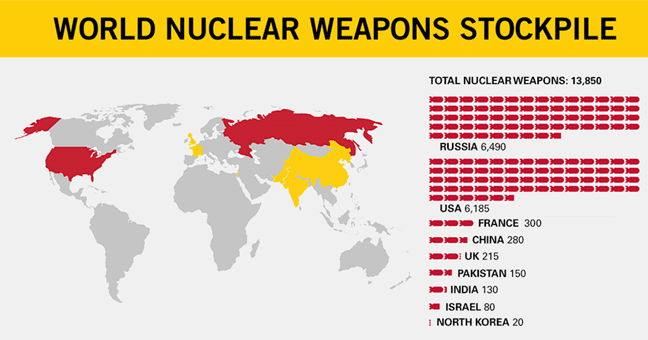
World security needs nuclear New Start agreement – USA-Russia, not a distraction about China
|
Nobody wins a nuclear war — especially not two nuclear behemoths. https://thehill.com/opinion/international/453576-nobody-wins-a-nuclear-war-especially-not-two-nuclear-behemoths BY DANIEL R. DEPETRIS,— 07/17/19 U.S. and Russian officials met this week in Geneva for what one hopes will be new strategic arms reduction talks. Trump administration officials are cautiously optimistic the discussions could lead to a more substantive negotiation about capping — and perhaps even decreasing — the number of nuclear weapons both countries have in their stockpiles. This matters for U.S. and global security because these two nations possess more than 90 percent of all nuclear weapons. President Trump, however, wants to go further than a simple extension of the 2010 The New Strategic Arms Reduction Treaty (START) agreement or a new bilateral treaty with the Russians. Instead, he is prodding China to join a trivariate arrangement. But in prefacing or linking an extension of New START to a fresh accord that includes the Chinese, the administration is increasing the possibility of ending up with neither. For one, pushing Beijing to into a three-way deal is like pushing on a locked door. The Chinese have shown no interest in a three-way deal, in large measure because their nuclear arsenal is a fraction (roughly 2 percent) of the globe’s entire inventory. At roughly 290 warheads, Beijing’s nuclear weapons program is minuscule when compared to the thousands of combined warheads Washington and Moscow have stockpiled. Indeed, China stockpile is less than 1/20th the size of the United States and about 1/22th the size of Russia’s. To expect the Chinese to participate in a new arms control negotiation with two nuclear superpowers when the numbers are so steadily stacked against them is a fool’s errand. Beijing’s no-first use nuclear policy, in place since its first ever nuclear explosive test in 1964, was recently reaffirmed just last year. An offensive nuclear strike is not something U.S. officials in Washington have to worry about. To focus on a U.S.-Russia-China nuclear agreement at the expense of keeping an already existing New START accord alive is the wrong priority. New START, signed in April 2010, was a win-win, pragmatic arms control agreement for both sides. The pact cut the U.S. and Russian stockpiles byaround one-third; capped the amount of nuclear warheads on deployed intercontinental ballistic missiles at 1,550; limited the number of deployed and non-deployed ICBM launchers to 800; and allowed each country to verify compliance with the treaty, including on-site inspections, information exchanges and advanced notices. Unlike the Intermediate Range Nuclear Forces Treaty, inspectors have verified Moscow’s compliance with the letter of the deal. For two countries that possess a combined 12,675 nuclear weapons, New START is a critical enforcing mechanism for nuclear parity and a stable balance of power. It is now the only functional arms control accord preventing the U.S. and Russia from entering another costly, risky arms race. The deal expires in February 2021 but could be extended for another five years if both Presidents Trump and Putin agree to do so. Putin has already expressed his interest. Trump, someone who considers himself a transactional pragmatist, shouldn’t waste any more time before doing the same. An extension of New START, however, is not only important for strategic stability between the two nuclear superpowers (without New START, there is nothing stopping either the United States or Russia from building and deploying more and better nuclear warheads). but also valuable for stabilizing the entire U.S.-Russia relationship in desperate need of improvement. For this reason, a constructive relationship with Moscow is unquestionably a good thing for U.S. security. Extending New START is a no-brainer and indeed could very well be an opportunity to mend relations. It’s not hyperbole to describe U.S.-Russia relations as being at their lowest since the land-based missile build-up in Europe in the early 1980s. From Syria and Ukraine to NATO and cybersecurity, Washington and Moscow are often on opposite sides of the issue. Even though both nations share some interests, including arms control and countering terrorism, Washington has become the epicenter of anti-Russia sentiment, where condemning Putin and advocating for sanctions is sport. Good politics, however, doesn’t necessarily correspond with good statecraft or foreign policy. Talking with adversaries, rivals, or competitors is a critically important component of effective foreign policy. We must engage with the world as it is, not as we wish it to be. Simply ignoring the Russians, pretending they don’t exist, or believing that using the stick unreservedly against Moscow will force it to cry uncle and change its policies to our liking makes conflict between nuclear superpowers more likely. Giving New START another five years of life is perhaps the only issue Washington and Moscow can agree on in today’s political climate. It’s perhaps the most important reason the U.S. and Russia must find a way to co-exist. Ensuring New START survives should be pursued aggressively for the sake of U.S. and global security Nobody wins a nuclear war — especially especially not two nuclear behemoths with thousands of warheads apiece. Daniel R. DePetris is a fellow at Defense Priorities, a foreign policy think tank focused on promoting security, stability and peace. |
|
|
For the second time in a week, take-down of Russian nuclear reactors, due to malfunction
|
Second Russian Nuclear Plant Taken Down After Malfunction, July 18, 2019 https://www.themoscowtimes.com/2019/07/18/second-russian-nuclear-plant-taken-down-after-malfunction-a66464 Three units have been unplugged at a nuclear power plant in Russia after a short circuit, less than a week after another nuclear plant unit was briefly taken down in the country over an unspecified malfunction. Russia operates 10 nuclear power plants, including the four-reactor Kalinin plant 350 kilometers northwest of Moscow, according to the London-based World Nuclear Association. Second Russian Nuclear Plant Taken Down After Malfunction Kalinin’s first, second and fourth reactors were taken offline, Russia’s state-run TASS news agency reported, citing emergency services in the town of Udomlya on Thursday. The Tver region branch of Russia’s Emergency Situations Ministry told the agency the three reactors were taken down due to a short-circuit. “The radiation level at the station and surrounding territory remains without change and is in line with normal background levels,” said Rosenergoatom, a subsidiary of state nuclear corporation Rosatom, in a statement. Last Friday, a nuclear power plant reactor in Beloyarsk was knocked out, triggered by a safety mechanism. It resumed operations on Tuesday. |
|
Uncertainty over safety of Russia’s floating nuclear power plants
|
Floating Nuclear Power Plants: Solution or Nightmare?, Homeland Security, By Dr. Brian Blodgett, Faculty Member, Homeland Security, American Military University,18 Jul 19, Russia continues to project its power north of the Arctic Circle with the launch of the Akademik Lomonosov, a floating barge with two 35-megawatt nuclear reactors. Icebreakers will tow the Akademik Lomonosov along the Northern Sea Route, from Murmansk to Pevek.
Once the Akademik Lomonosov arrives at Pevek, the Russians will decommission the 48-megawatt, Bilibino land-based nuclear power plant that entered operation in 1974. Currently, this reactor generates most of the electricity for Russia’s autonomous, mineral-rich Chukotka region in the far northern area of Siberia. The Akademik Lomonosov will be over 4,200 miles from Moscow but less than 1,250 miles upwind of Anchorage, Alaska. Floating Nuclear Power Plants Have Been Used BeforeThe concept of floating nuclear power plants is not new. …. Use of Akademik Lomonosov Causing Environmental ConcernsEnvironmentalists are worried about the radioactive steam that the Akademik Lomonosov’s reactors will produce. The radioactivity could have adverse effects on the local populace. Additionally, there is a concern about an earthquake-triggered tsunami destroying the Akademik Lomonosov.Such a tsunami would cause a release of radioactive material and fuel into not only the air but also the water, impacting marine life. Russia Not Worried about Nuclear Disasters with the Akademik LomonosovRussia dismisses environmental concerns since it has over 50 years of experience in safeguarding nuclear-powered Arctic icebreakers…… Recently, there have been revelations that the Soviet nuclear submarine K-278 Komsomolets that sunk over 30 years ago is now releasing radiation levels 800,000 times higher than expected. As a result, there is a concern of what would occur if the Akademik Lomonosov was to sink into the Arctic waters that enter the Pacific near Alaska and then flow down our western coast. Additionally, the recent fire on the unnamed Russian AS-12 submarine that occurred on July 1, resulting in the death of 14 crewmembers, reminds the world how dangerous nuclear power can be. According to a comment reportedly made by a high-ranking military official at their funeral, the servicemen averted a “planetary catastrophe” before they died……… 2011 Japanese Nuclear Accident Serving as Disaster Model…….. A meltdown occurring on the Akademik Lomonosov or any future sister nuclear floating platforms could be much worse for the local population and the environment. While the remoteness of Pevek will complicate crucial security procedures, such as the routine disposal of nuclear fuel to rescue operations, it will also limit the spread of deadly radiation.But with Rosatom avidly seeking future countries as partners in spreading nuclear power to areas with electrical needs, such as New Jersey considered doing in the 1960s, only time will provide us with proof that floating nuclear power plants are a potential solution to energy needs.https://inhomelandsecurity.com/floating-nuclear-power-plants-solution-or-nightmare/ |
|
Moscow’s Polymetals Plant’s slag heap – an intractable radioactive hazard=- could become Moscow’s Chernobyl?
 Will a Road Through a Nuclear Dumping Ground Result in ‘Moscow’s Chernobyl’? https://www.themoscowtimes.com/2019/07/16/will-a-road-through-a-nuclear-dumping-ground-result-in-moscow-chernobyl-a66404
Activists warn that construction will release radioactive dust into the air and the Moscow River. By Evan Gershkovich, July 16, 2019
When Yelena Ageyeva moved to the Moskvorechye-Saburovo neighborhood in southeastern Moscow in 1987, she was aware that there was a radioactive site across the railroad tracks from her apartment building.
“They calmed us down by saying that it was all buried under soil and so we had nothing to worry about,” said the 59-year-old pensioner on a recent evening at the commuter rail station adjacent to the site. “We lived in peace all these years.”
The site, the Moscow Polymetals Plant’s slag heap, contains tens of thousands of tons of radioactive waste left over after the extraction of thorium and uranium from ore. The factory ceased production of metals in 1996 for “environmental reasons,” according to its website — it now produces weapons and military equipment — and the dump is now a hill half a kilometer wide sloping down to the banks of the Moscow River.
City officials had been considering a full-scale clean-up for years, but never rubber-stamped a plan due to the risky location of the site near a source of water for Moscow’s southern suburbs.
Now residents of nearby neighborhoods say new plans for an eight-lane highway across the southern band of the city that will pass next to the site have eclipsed environmental and health concerns. They warn that the construction will unleash the buried radioactive materials into the river at the bottom of the hill and the air that the city’s 12 million residents will breathe.
A legacy of a rushed Soviet effort to begin nuclear research as the race to build an atomic bomb gained steam in the 1930s, the hill is one of many contaminated sites across Russia — some of which are smack bang in the middle of the country’s capital and most populated city, where research first began at the Kurchatov Institute.
Just 13 kilometers from the Kremlin and steps from Kolomenskoye Park, a popular spot for Muscovites to ski in winter and picnic in summer, the Moskvorechye-Saburovo hill is the most contaminated of the bunch, according to Radon, a government agency tasked with locating and clearing radioactive waste.
“Operations in such an environment are a serious engineering challenge — one incautious step, and radioactive soil gets into the river,” said Alexander Barinov, Radon’s chief engineer for Moscow, when asked about the site in a 2006 interview.
“Full decontamination by removing all of the radioactive waste is simply impossible,” he added, noting that Radon every year conducts “a kind of therapy” to ensure the site’s safety — in short, dumping dirt on top of the waste to keep it buried after topsoil runoff each spring.
“The alternative is to assign this territory a special status and impose restrictions on its use, but the city authorities keep postponing this decision.”
More than a decade later, the authorities have apparently postponed that decision indefinitely. According to activists and local politicians, city officials are pretending the problem doesn’t exist at all.
“I believe the authorities know full well the risks,” said Pavel Tarasov, a Communist Party municipal deputy representing the Lefortovo neighborhood. “But it’s a lot easier to steal state budget funds allocated to construction than to clean up radioactive waste.”
Officials last fall started to push ahead with plans to build the new highway. In November, they began holding public hearings in neighborhoods through which the road will pass, including those around the radioactive site. Activists say officials didn’t mention that the hill holds radioactive waste during those hearings.
“We’ve been well aware that there was radioactive waste here for a long time,” said Andrei Ozharovsky, a specialist with the radioactive waste safety program of the country-wide Social-Ecological Union non-profit organization, during a recent tour of the site.
Ozharovsky, who in 1989 graduated from the National Research Nuclear University, located within walking distance of the plant, said he studied under a professor who used to be its former director and would mention the waste left there in lectures.
That information was not exclusive to nuclear scientists. In 2011, the popular state-run Rossia 1 television channel toured the site. “The radiation there exceeds the permissible level by tens of times,” a broadcaster said on air.
With the information out in the open, it wasn’t long until activists began to raise concerns on social media after the public hearings began last year. As anxiety swelled, local residents and municipal deputies demanded that the authorities conduct a safety test. In April, specialists from Radon and the Emergency Situations Ministry measured a rate two hundred times higher than the norm.
In the weeks since, officials have attempted to placate concerns by noting that construction won’t actually touch the radioactive parts of the site but just pass nearby — 50 meters away, to be exact. In a statement released Thursday, Radon called the reactions by local public figures “extremely emotional.”
A day earlier, Greenpeace Russia had released a statement demanding that construction be halted.
“Once trucks start driving near the site, the topsoil will slide and the radioactive dust will be released,” said Rashid Alimov, the director of the organization’s energy program, noting that the April examination didn’t dig deep enough to determine the danger level of the waste beneath.
“If radioactive dust gets into people’s lungs, it can increase the likelihood of cancer,” he added.
That worry has hit close to home for Katya Maximova, 32, who lives across the river from the site. When the Chernobyl reactor exploded in 1986, the year before she was born, her aunt lived in Ponyri, a village in Russia’s southern Kursk region about 500 kilometers away. The aunt believes the tragedy killed off almost everyone in the village over the next decade.
“Pretty much everyone got cancer within the next five to 10 years,” Maximova said.
Maximova, who has been a driving force behind the social media campaign to raise awareness about the Polymetals Plant hill, criticized the authorities for withholding information from the public and not attempting to understand the full picture in the first place.
“We’re not specialists so it’s hard to know what’s true,” she said. “We’re not against the authorities or against the construction. What we want is a full-scale examination first.”
A public hearing at the State Duma is scheduled for Wednesday morning, but Maximova said construction of the highway has already started on her side of the river.
“We have a long history of tragedies due to negligence,” she said, noting Chernobyl and last year’s fire at the Winter Cherry Mall in the Siberian city of Kemerovo that killed more than 60 people, many of them children. “These are preventable tragedies.”
Maximova has recruited others to help with the social campaign, including her friend Ruslana Lugovaya. Thinking about what could happen frightens Lugovaya, so she is allaying her fears by focusing on the work, with a dab of dark humor.
“Why go visit Chernobyl when we have our own Chernobyl right here in Moscow?” she said.
U.S., Russia to discuss nuclear arms limits in Geneva on Wednesday –officials
U.S., Russia to discuss nuclear arms limits in Geneva on Wednesday –officials https://news.yahoo.com/u-russia-discuss-nuclear-arms-185425751.html
WASHINGTON, July 15 (Reuters) – Representatives from the United States and Russia are set to meet in Geneva on Wednesday to explore the idea of a new accord limiting nuclear arms that could eventually include China, U.S. senior administration officials said on Monday.
U.S. President Donald Trump has said that he would like to see a new type of arms control deal with Russia and China to cover all types of nuclear weapons, a topic that he has discussed individually with Russian President Vladimir Putin and Chinese President Xi Jinping.
China is not currently a party to nuclear arms pacts between the United States and Russia.
The U.S. delegation will be led by U.S. Deputy Secretary of State John Sullivan and will include Tim Morrison, a top aide at the White House National Security Council, as well as representatives from the Pentagon, the Joint Chiefs of Staff, and the National Security Agency, said the U.S. officials, who spoke to reporters on condition on anonymity.
Russia’s deputy foreign minister, Sergei Ryabkov, will lead the Russian delegation, the U.S. officials said.
“We actually feel that – touch wood – we’ve actually got to a point where we can try to start this again,” one of the officials said, listing off a long series of incidents that have soured relations between the United States and Russia during the past year.
“I say touch wood because we’re always just one incident away from unfortunately things getting derailed,” the official said. (Reporting by Roberta Rampton Editing by Marguerita Choy)
Russia’s new Nuclear-Powered Aircraft Carrier? Just all talk?
But the Kremlin for years has celebrated scale models of future flattops, all without spending any money to actually design or build the vessels.The longer the Russian navy waits, the less likely it is that a new carrier directly will replace Kuznetsov when the aging, unreliable ship finally decommissions.
A defense-industry source said the Kremlin had begun a technical assignment for a future nuclear-powered carrier under program name Project 11430E Lamantin, TASS reported in July 2019.
But the Russian navy’s own commander-in-chief, Nikolai Yevmenov, told reporters there was no firm deadline for funding or construction. “There will be, of course, a nuclear-powered aircraft carrier but not in the short-term perspective,” Yevmenov said.
……..Russia’s entire annual military budget rarely exceeds $70 billion. Only a small fraction of that typically pays for ships.
The high cost of a replacement vessel perhaps explains why the Kremlin is determined to keep Kuznetsov in service as long as possible. The Russian navy plans to dry-dock Kuznetsov starting in 2020 and conduct extensive repairs on the 1980s-vintage vessel………https://nationalinterest.org/blog/buzz/russian-navy-get-nuclear-powered-aircraft-carrier-answer-nyet-67022

Planetary catastrophe – was not likely from the Russian nuclear submarine accident
Russian Navy Claims Sailors Prevented ‘Planetary Catastrophe’
Was the damaged submarine’s reactor in danger of causing a nuclear accident? https://www.popularmechanics.com/military/navy-ships/a28340271/submarine-nuclear-reactor-accident/ By Kyle Mizokami, Jul 10, 2019 A senior Russian Navy official said that accident on the nuclear-powered submarine Losharik was nearly a “planetary catastrophe,” were it not for the fourteen sailors killed in the incident. The submarine, widely believed to be a spy sub capable of operating on the deep ocean floor, was damaged in an accident on July 1st. The Kremlin denied there was risk of such a “catastrophe.”
An aid to the head of the Russian Navy, Sergei Pavlov, stated at a funeral for the sailors lost in the accident, “With their lives, they saved the lives of their colleagues, saved the vessel and prevented a planetary catastrophe.” Pavlov reportedly did not elaborate.
The Kremlin denied that the reactor had been at risk, stating that it had been “totally sealed off” and there were no problems with it. Radiation monitoring stations in Norway relatively near where the incident took place have not reported any spikes in radioactivity.
The accident, according to Russian Defense Minister Sergei Shoigu, started in the sub’s battery compartment and spread. This suggests a fire that was the result of a buildup of hydrogen gasses inside the ship. Submarines, even nuclear ones, carry banks of batteries to provide a temporary source of power, and hydrogen is produced as a byproduct of the battery charging process. If the gas reaches a critical level of concentration, a spark onboard the ship could set off a fire.
According to Shoigu, the crew battled the fire for an hour and a half. Although the automatic fire extinguishers kicked in, they proved insufficient. The surviving crew managed to initiate an emergency blow procedure and the ship surfaced off the coast of the Kola Peninsula, where the remaining crew members were rescued.
Losharik, named after a cartoon horse made of interconnected juggling balls, got its name because the interior of the ship is made of seven interconnected steel or titanium spheres. The spheres give the ship its deep diving capability, with the sub reportedly capable of reaching depths of at least 1,000 meters (3,280 feet).
It is not clear where Losharik’s 5 megawatt nuclear reactor resides, but the ship is only 230 feet long with all personnel, propulsion systems, and mission equipment inside the seven spheres. The fire could not have been far from the reactor, but if the reactor and batteries resided in different spheres they could have been closed off from one another. Shoigu seems to be stating that was the case.
Even if the fire did reach the reactor it seems unlikely that the ejection of radioactive materials could cause a “planetary catastrophe” on the scale of the 1986 Chernobyl accident. Losharik’s reactor generated just five megawatts, the RBMK reactor at Chernobyl was much more powerful and used much more nuclear material to generate up to 3,200 megawatts.
Russia’s grandiose nuclear ambitions – expressed in its floating nuclear plant for the Arctic
Russian floating nuclear plant prepares for towing into Arctic seas, Plant to support 50,000-person Chukotka region with power for oil and gas industries Katie Toth · CBC News Jul 10, 2019 Russia’s controversial nuclear barge is ready to travel through the Arctic seas — and observers across the globe are watching.
Greenpeace has called it a “floating Chornobyl.”
But the Akademik Lomonosov, which will dock in the Eastern Siberian town of Pevek, also provides a small glimpse into Russia’s northern ambitions and the role of nuclear power in achieving them.
Russia’s atomic energy agency, the Rosatom State Atomiс Energy Corporation (ROSATOM), has said in news releases that the future floating nuclear power plant will be a key piece of infrastructure as it develops its Arctic shipping route.
Meanwhile, the agency has started work on a fleet of nuclear-powered icebreakers to keep that route open. Its latest three ships can cut through three metres of ice, and each can produce 350 megawatts of power.
It’s a lot more difficult to counter a catastrophe there than anywhere else on the globe.– Jan Haverkamp, Greenpeace
Rebecca Pincus, an assistant professor with the U.S. Naval War College, says Russia’s vision for itself as a global superpower in the 21st century hinges on the far North.
Russia’s grand strategy for the century is centred on developing Arctic resources,” Pincus said. “That economic engine [is] … integral to Russia relaunching its place in the world.”
According to statements by ROSATOM, the plant will supply the 50,000-person Chukotka region with power and it will support “key industries” in this oil-and-gas rich region.
‘It’s a classical Russian solution’
The choice to build a floating nuclear power station is “a fabulous little encapsulation of all the challenges Russia faces in developing its Arctic zone,” Pincus said. “Floating a nuclear power plant to a tiny little city in the Russian Arctic is colossally challenging, colossally expensive … it’s a classical Russian solution.”
………. Jan Haverkamp, a nuclear energy expert with Greenpeace, says his organization is right to be worried. The Lomonosov will be docking in one of the most remote places in the world.
The Lomonosov, prior to a paint job. Greenpeace is concerned about the plant and its isolated location, saying that it would be difficult to counter a catastophe in the remote region. (ROSATOM)
“It’s a lot more difficult to counter a catastrophe there than anywhere else on the globe,” he said.
Haverkamp is also concerned about the power being used to extract fossil fuels.
“Climate change is a given.… Opening up new fossil projects at the moment, when the world needs to be fossil-free in 2050, does not seem to make very much sense.”
Meanwhile, ROSATOM says this barge is only a small piece of a new future for floating nuclear power. It’s building a second generation of the floating nuclear units, and it’s in talks with several countries looking to buy nuclear barges of their own.
Emails to ROSATOM’s media contact were not returned before publication.
The barge will start getting towed to Pevek in August. https://www.cbc.ca/news/canada/north/russia-floating-nuclear-plant-1.5206448
Tax-payer funding absolutely critical to Russia’s nuclear industry
 State support pivotal to Russia’s nuclear sector, says report, WNN 12 July 2019
Russia’s nuclear power industry consists of 89 enterprises that are owned by the state-run joint stock company Atomic Energy Power Corporation (AEPC), or Atomenergoprom, its Russian name.
Since commissioning its first, five-megawatt, nuclear power plant, in Obninsk in 1954, Russia has been one of the world’s leading countries in nuclear power generation, S&P says, and the country plays an important role in all parts of the nuclear cycle, from mining to construction.
The report – What Makes Russia’s Nuclear Sector Competitive – says state support includes capacity-supply agreements, ad hoc equity contributions from the government, and low nuclear liabilities that accrue only after 2011……….
“We expect domestic nuclear capacity to increase only moderately because electricity demand in Russia is stagnating, given only modest GDP growth, a significant potential for energy savings, and the government’s intention to avoid raising electricity prices through additional increases in capacity payments,” the report says.
The key risks, according to S&P, concern international projects: tighter requirements for new builds, which are likely to mean potential delays – “as seen with” the Hanhikivi project in Finland; and, nuclear phase-out policies in Western Europe that “could weigh on exports in the longer run”.
“That said, we believe exports of fuel and enrichment services should be resilient in the next several years because Russia mostly exports to nuclear-supportive countries under long-term contracts,” the report says.
“Meanwhile, treatment of nuclear waste or decommissioning services could increase in importance,” it adds.
AEPC has “solid” profitability and financial metrics compared with international and local peers, S&P says, which provides “financial capacity” for new nuclear power construction, domestically and abroad.
Although Russia is involved in a “record number” of international nuclear power construction projects, the prime contractor is AEPC’s unrated sister entity Atomstroyexport, and AEPC is only directly involved in two projects, Hanhikivi in Finland (34%) and Akkuyu in Turkey (96%), the report notes.
AEPC covers all stages of the civil nuclear cycle, from uranium extraction (about 13% of global production) through enrichment and fuel fabrication (about 36% and 17% global market shares) to electricity generation in Russia. It is the sole operator of nuclear plants with 29.1 GW, or 12% of Russia’s total installed capacity, and 18% of the country’s electricity production, at ten plants and 35 units in operation. http://www.world-nuclear-news.org/Articles/S-P-report-on-Russia
THIS SUNKEN NUCLEAR SUB IS LEAKING RADIATION INTO THE OCEAN
|
THIS SUNKEN NUCLEAR SUB IS LEAKING RADIATION INTO THE OCEAN, https://futurism.com/the-byte/sunken-nuclear-sub-leaking-radiation _KRISTIN HOUSER__10 Jul19
Sunken Measures A team of Russian and Norwegian scientists just made a grim, timely discovery. Just one week after a nuclear-powered Russian submarine caught fire, killing 14 sailors, researchers sent a remote submarine to collect samples around the sunken wreckage of another nuclear sub, which caught fire in 1989 leading to the deaths of 42 crew members. The preliminary results of their investigation indicate that radiation levels in the water near the sunken Soviet sub’s ventilation duct are up to 800,000 times higherthan expected in sea water — suggesting we may be dealing with the repercussions of the recent disasterfor decades to come. This isn’t the first time researchers have detected higher than normal radiation levels around the wreckage of K-278 Komsomolets, which sunk about 260 miles off the Norwegian coast and is now about a mile beneath the ocean’s surface. “We took water samples from inside this particular duct because the Russians had documented leaks here both in the 1990s and more recently in 2007,” expedition leader Hilde Elise Heldal said in a press release. “So we weren’t surprised to find high levels here.” While the current levels are higher than normal, according to Heldal, they aren’t high enough to threaten Norwegian fish or seafood — so for now, the team plans to thoroughly study its collected samples and continue to monitor to wreckage for signs that the radiation is getting worse. |
|
1 This Month

of the week – Shut Down Drone Warfare!


Tell the Ukrainian Government to Drop Prosecution of Peace Activist Yurii Sheliazhenko

Petition to revoke the licensing of the Near Surface Nuclear Disposal Facility (NSDF) at Chalk River. https://www.ourcommons.ca/petitions/en/Petition/Details?Petition=e-7247
To see nuclear-related stories in greater depth and intensity – go to https://nuclearinformation.wordpress.com
-
Archives
- April 2026 (91)
- March 2026 (251)
- February 2026 (268)
- January 2026 (308)
- December 2025 (358)
- November 2025 (359)
- October 2025 (376)
- September 2025 (257)
- August 2025 (319)
- July 2025 (230)
- June 2025 (348)
- May 2025 (261)
-
Categories
- 1
- 1 NUCLEAR ISSUES
- business and costs
- climate change
- culture and arts
- ENERGY
- environment
- health
- history
- indigenous issues
- Legal
- marketing of nuclear
- media
- opposition to nuclear
- PERSONAL STORIES
- politics
- politics international
- Religion and ethics
- safety
- secrets,lies and civil liberties
- spinbuster
- technology
- Uranium
- wastes
- weapons and war
- Women
- 2 WORLD
- ACTION
- AFRICA
- Atrocities
- AUSTRALIA
- Christina's notes
- Christina's themes
- culture and arts
- Events
- Fuk 2022
- Fuk 2023
- Fukushima 2017
- Fukushima 2018
- fukushima 2019
- Fukushima 2020
- Fukushima 2021
- general
- global warming
- Humour (God we need it)
- Nuclear
- RARE EARTHS
- Reference
- resources – print
- Resources -audiovicual
- Weekly Newsletter
- World
- World Nuclear
- YouTube
-
RSS
Entries RSS
Comments RSS
 nuclear-news