A spokesperson for the Kremlin was blasé about the Nyonoksa explosion, stating that “accidents happen.” Yes, they do, but nuclear-powered cruise missile programs don’t just happen. They represent dangerous and unnecessary choices to goose a nation’s theoretical military supremacy, incentivizing other nations to follow suit, risks be damned. The arms control regimes that once moderated U.S. and Russian decisions are already crumbling, and another big one—the New Strategic Arms Reduction Treaty, or New START—may expire in 2021. What exactly transpired in the White Sea on August 8 may remain fuzzy, but what is becoming increasingly clear is the risk to life associated with a new generation of nuclear arms proliferation between the U.S. and Russia. With ultranationalist leaders and weapon fetishists in control of Washington and Moscow, buttressed by military yes-men and mercenary defense contractors, there’s little to stand in the way of a new, irrationally exuberant buildup of bizarre new nuclear forces.
Burevestnik, SKYFALL nuclear weapons – “of course, it’s a dick-measuring contest,”
 next superpower arms race will be even more foolish than the last one. New Republic , By August 22, 2019, The United States and Russia are entering a new arms race, and the costs aren’t just monetary. On August 8, Russian civilians around the remote village of Nyonoksa found themselves downwind of a military nuclear propulsion experiment gone wrong in the White Sea, just outside the Arctic Circle. According to the Russian ministry of defense, a liquid propellant rocket engine had gone awry and exploded.
The exact sort of weapon Russia may have been testing is unknown, but the balance of evidence points to a probable culprit: the Burevestnik nuclear-powered cruise missile. Nuclear nonproliferation expert Jeffrey Lewis and his team of researchers out in Monterey, California, have done much of the work in compiling this evidence, which includes the presence of a nuclear fuel carrier ship that was known to have been involved in recovery efforts after a previous failed test of the missile. Known in NATO countries as the SSC-X-9 SKYFALL, the Burevestnik’s atomic propulsion is said by Russian state media to give the missile “almost unlimited range, non-predictable trajectory and high air defense penetration capacity.”……..
In the end, much of what may be driving investment and research on this weapon—beyond Putin’s chest-thumping—may be the sprawling and influential Russian defense bureaucracy. (Overspending on exotic military systems is not an exceptionally American trait.)
That’s the shaky strategic logic behind it. But the common-sense logic, as the radioactive Nyonoksa explosion shows, is even less kind. If a nuclear-powered cruise missile sounds exotic and a little dangerous, that’s because it is. Missiles go boom—usually intentionally, but often enough not—and whatever nuclear power source they might be using onboard wouldn’t be immune.
There’s still little consensus among American experts about how exactly the Burevestnik might leverage nuclear power for propulsion. If you thought nuclear fission weapons were complex, nuclear rocket propulsion is more arcane and mysterious still. In the 1950s and 1960s, U.S. scientists drafted fanciful plans to give missiles nuclear engines, on the assumption that they’d be able to fly longer and farther than any weapon yet conceived. But the Americans eventually gave up; the technical challenges and environmental risks weren’t worth it. The Russians haven’t given up just yet, but they may someday…..
For the Russian leadership, a weapon like Burevestnik is a prestige project, a way to set Moscow apart from its competition……
Of course, Donald Trump couldn’t stomach another head of state flaunting his fancy rocket. The president tweeted on August 12 that the United States has “similar, though more advanced, technology.” As nuclear chemist Cheryl Rofer observed, this was a rare tweet by Trump’s standards: one that criticized Russia. “And of course, it’s a dick-measuring contest,” Rofer added. (Trump’s done this before, chiding North Korean dictator Kim Jong Un on Twitter over the size of his “nuclear button.”) To the extent he grasps the salient issues, it’s likely the president has already asked Pentagon officials why the United States doesn’t have a nuclear-propelled cruise missile of its own.
Russia Tells Nuclear Watchdog: Radiation From Blast Is ‘None of Your Business’
|
Russia Tells Nuclear Watchdog: Radiation From Blast Is ‘None of Your Business’ Daily Beast , Barbie Latza Nadeau, Correspondent-At-Large 08.20.19 Russia has told the Vienna-based Comprehensive Nuclear-Test-Ban Treaty Organization that the nuclear-reactor explosion at a White Sea missile test site in early August is none of their business.
The news came as two additional Russian monitoring stations designed to warn about nuclear radiation threats have gone silent after the mysterious Aug. 8 blast at the site this month, according to The Wall Street Journal. Four monitoring stations are now down, which is alarming experts who suspect Russia is attempting to cover up what really happened and keep details about the weapon being tested under wraps. ….. HTTPS://WWW.THEDAILYBEAST.COM/DONALD-TRUMP-DEFENDS-TRADE-WAR-WITH-CHINA-I-AM-THE-CHOSEN-ONE
|
|
Absolutely no need for Russia and the US to be adversaries and enemies
I visited Russia’s nuclear city and don’t want to relive the Cold War
Commentary: One era of nuclear brinksmanship was enough for CNET’s Stephen Shankland, who visited the Russian nuclear weapons center of Sarov just after the first Cold War ended. CNET, BY STEPHEN SHANKLAND
AUGUST 18, 2019 I spent more than five years as a reporter in Los Alamos, New Mexico, birthplace of the atomic bomb, home to a major national laboratory, and the 18,000-person town where I grew up. I covered everything from President Bill Clinton visiting the lab to mostly harmless radioactive cat poop triggering radiation alarms at the county landfill. But the story that made the biggest impression on me took place thousands of miles away, in Russia.
In May 1995, I was part of a seven-person civilian delegation that traveled to Los Alamos sister city Sarov, about 230 miles east of Moscow. It’s the home of the institute where Russia developed its first atomic bomb. Our visit was timed to coincide with a 50th anniversary celebration of the end of the Great Patriotic War, aka World War II, which for the Russians ended when the Germans capitulated in May 1945.
I’m remembering it now because I’ve recently interviewed Siegfried Hecker, former director of Los Alamos National Laboratory and a key leader of the US-Russian lab collaboration that led to my trip.
Back when US-Russian relations were thawing
During the time of my trip, relations between Russia and the US were warming, but now they’re cooling once again. That troubles Hecker — even though he spent much of his career designing the nuclear weapons the US aimed at the then-USSR.
It troubles me, as well. I grew up during the Cold War, and I’m not eager to introduce my children to concepts like nuclear winter and megadeath. And even as treaties between the US and Russia fizzle out and the two countries rev up another arms race, worries are piling up about the nuclear weapons capabilities of Iran and North Korea, too.
But Hecker stresses the similarities between the US and Russia — “They’re so much like us,” he says……
Hecker has a lot more of those connections. He’s friends with plenty of Russians and sees their cultural values as very similar to ours. And he’s keeping his communication links alive even though the US-Russia lab-to-lab collaboration project he helped begin is now all but dead. He’ll take his 57th trip to Russia in November.
The two countries can move past sticking points like NATO’s eastward expansion and Russia’s military action in the Crimea and eastern Ukraine, Hecker says. Today’s nationalistic fervor might make it hard to defrost the relationship, but seeing the world from the other side’s perspective will help, he says.

Russia Testing Nuclear-Powered Mega-Torpedo Near Where Deadly Explosion Occurred

Russia Testing Nuclear-Powered Mega-Torpedo Near Where Deadly Explosion Occurred https://www.forbes.com/sites/hisutton/2019/08/17/russia-testing-nuclear-powered-mega-torpedo-near-where-deadly-explosion-occurred/#7f3e00632d7fH I Sutton, Aerospace & DefenseI cover the changing world of underwater warfare. Details are still emerging of the explosion of a nuclear-powered engine that killed at least seven people in northern Russia last week. Conflicting reports, rumors and speculation center around whether the engine was for a nuclear-powered cruise missile, codenamed Skyfall by NATO, or some other weapon-related reactor. One of the possible weapons in the frame is the Poseidon mega-torpedo. This new weapon is described as an Intercontinental Nuclear-Powered Nuclear-Armed Autonomous Torpedo by the U.S. government
Radiation from a missile explosion has not spread beyond Russia
no radiation from the recent incident appears to have reached Europe. The Norwegian Radiation Protection Authority says it has detected nothing unusual yet, and the UK’s radiation monitoring network, RIMNET, told New Scientist it has had no reports of other countries recording increases in radiation levels.
“Lack of detection by Norway and Finland so far makes us assume only trace concentrations may reach Europe,” says Rashid Alimov at Greenpeace Russia. Modelling by Ivan Kovalyets at the National Academy of Sciences of Ukraine suggests only small concentrations might reach into Ukraine. https://www.newscientist.com/article/2213200-no-sign-radiation-from-a-missile-explosion-has-spread-beyond-russia/
Russia’s ‘flying Chernobyl’ – mystery new nuclear weapon
Russia’s mysterious ‘new’ nuclear weapon a ‘flying Chernobyl’, https://www.smh.com.au/world/europe/russia-s-mysterious-new-nuclear-weapons-a-flying-chernobyl-20190816-p52ho5.html, By Gregg Herken, August 16, 2019 Washington: Last week, Vladimir Putin’s government cryptically announced that there had been an explosion at a missile test centre in remote northern Russia that involved the release of radioactive materials. Initially, two people were said to have been killed; the death toll was subsequently raised to seven. A nearby village was ordered evacuated, then the villagers were told to stay put.
US analysts think the accident involved the prototype of a nuclear-powered cruise missile that the Russians call Burevestnik, or Petrel, but is known in the West by its NATO designation, Skyfall. Putin has called it “a fundamentally new type of weapon” – an “invincible missile” with virtually unlimited range, easily able to evade US defences.
When Skyfall was first announced, early last year, some Western military analysts started hyperventilating. “That’s a technological breakthrough and a gigantic achievement,” claimed one. “These weapons are definitely new, absolutely new.”
But in fact, these “new” missiles are a throwback to the early days of the Cold War. And back then, it was the United States that developed a nuclear-powered cruise missile, in the early 1960s.
“Project Pluto” was part of a Pentagon program known as Supersonic Low Altitude Missile, a clunky name almost certainly designed to yield its catchier acronym, SLAM. The missile was cancelled in 1964, never having taken flight. Nuclear-powered cruise missiles were not a good idea then, and they are not a good idea now.
That’s not to say that such weapons are not impressive, in a way.
SLAM envisioned a locomotive-sized missile flying at three times the speed of sound near treetop level, tossing out hydrogen bombs along the way and spewing radiation in its wake. (In 1990, when I worked at the National Air and Space Museum, I researched the history of the project for an article in Air and Space magazine.)
There was a reason Pluto’s inventors, at the Livermore nuclear weapons laboratory in California, dubbed it “the weapon from Hell.” The noise level on the ground when Pluto went by was expected to be 150 decibels. (The Saturn V moon rocket, by comparison, produced 200 decibels at full thrust.)
The shock wave alone might have been lethal. And since Pluto’s nuclear ramjet engine ran at 2500 degrees Fahrenheit (1371 degrees), portions of the missile would have been red-hot — literally “frying chickens in the barnyard” on the way to its targets.
Indeed, SLAM operated on the same principle as the errant low-flying B-52 bomber in Dr Strangelove. As Major Kong observed to his crew, “they might harpoon us, but they dang sure ain’t going to spot us on no radar screen.”
An alternate idea was to tie Pluto to a tether at the Nevada Test Site. (“That would have been some tether,” dryly observed another scientist at the lab.) Finally, what do you do with a highly radioactive missile once it’s been tested? Dumping it in the ocean was the solution offered back then. And it is probably Putin’s preferred solution now.
Ultimately, in the United States, cooler heads prevailed. Six weeks after the successful static test of Livermore’s nuclear engine in Nevada in July 1964, the Pentagon pulled the plug on Pluto.
Intercontinental-range ballistic missiles promised to destroy targets in the Soviet Union well before Pluto got to them, with equal certainty and a lot fewer associated risks. SLAM, its critics said, stood for “slow, low and messy.”
But Pluto, it seems, has risen again, this time in a Russian incarnation – a nuclear-powered Frankenstein, a flying Chernobyl.
Putin’s Skyfall cruise missile also has a seagoing sibling: a giant nuclear-powered torpedo, dubbed Poseidon, designed to destroy US port cities with a multi-megaton blast.
Poseidon bears a striking resemblance to the idea that Russia’s Nobel Prize-winning physicist, Andrei Sakharov, came up with in the early 1960s. When Sakharov told a Soviet admiral of his proposal, however, the latter was “shocked and disgusted by the idea of merciless mass slaughter.”
Feeling “utterly abashed,” the physicist abandoned the concept and never raised it again. “I’m no longer worried that someone may pick up on the idea,” Sakharov wrote in his memoirs, published in 1990. “It doesn’t fit in with current military doctrines, and it would be foolish to spend the extravagant sums required.”
If so, Putin’s ploy is reminiscent of Soviet Premier Nikita Khrushchev’s hollow Cold War boast that the USSR was turning out ICBMs “like sausages.” (As Khrushchev’s son, Sergei, later observed, his father wasn’t exactly lying: The Soviets weren’t making sausages then, either.)
Of course, flying nuclear reactors and giant nuclear-armed undersea drones could do a lot of damage to cities if they really existed and were ever used. But the real danger of Putin’s Potemkin arsenal is that it will – as Khrushchev’s boast did decades ago – spark a US overreaction and lead to pressure to revive ideas like Livermore’s Pluto and Sakharov’s Poseidon: forgotten relics of Cold War 1.0 that are best left dead and buried.
Russian doctors kept in the dark about patients being nuclear accident victims
Russian Doctors Say They Weren’t Warned Patients Were Nuclear Accident Victims
One doctor was reportedly later found to have a radioactive isotope in their muscle tissue. https://www.themoscowtimes.com/2019/08/16/exclusive-russian-doctors-say-they-werent-warned-patients-were-nuclear-accident-victims-a66896
Russia’s fast nuclear reactor project is postponed
Rosenergoatom is expected to receive about RUB280 billion (USD4 billion) less in state funding for the construction of new nuclear reactors in Russia owing to the postponement of its fast neutron reactor programme, Russian newspaper Kommersant reported last week, citing anonymous sources. Rosenergoatom is the nuclear power plant operator subsidiary of Russian state nuclear corporation Rosatom.
Rosatom’s investment plan received preliminary approval during a meeting in the Russian Energy Ministry on 2 August, according to the article, with funding out to 2035 to total RUB880 billion and not the RUB1.16 trillion Rosatom had allocated for the two new VVER-1200 units under construction for the Kursk II project, units 3 and 4 for the Leningrad II project and a BN-1200 fast reactor at Beloyarsk. Commissioning of the BN-1200 has been postponed to 2036, the article said, from the previous target of 2027.
Financing to pay for the new units will be paid back over 20 years, with an average rate of return on investment of 10.5% per year, the article said. Rosatom is prepared to consider a lower rate of return, it added.
Russia’s new investment cycle for its electricity sector will also take into account modernisation work at thermal power plants, the construction of remote energy facilities and the development of renewable energy sources. The funds must however be “distributed among market participants so that wholesale energy market prices do not rise above inflation”, the article said. The reduction in funding reflects “the restriction on tariff growth by inflation”, it added, and thus the launch of the BN-1200 will “most likely be postponed to 2036 in order to reduce energy market spending”……. http://www.world-nuclear-news.org/Articles/Rosatom-postpones-fast-reactor-project-report-say
Russian Region Orders Gas Masks After Deadly Nuclear Blast
Confusion and secrecy following Russian explosion, backflip on evacuation of village
Key points:
- Medics who treated victims of an accident have been sent to Moscow for medical examination
- Russia’s state weather service said radiation levels spiked in Severodvinsk by up to 16 times
- Many Russians spoke angrily on social media of misleading reports reminiscent of Chernobyl
The explosion took place on Thursday at a naval weapons range on the coast of the White Sea in northern Russia.
State nuclear agency Rosatom said the accident occurred during a rocket test on a sea platform.
The rocket’s fuel caught fire after the test, causing it to detonate, it said in a statement carried by Russian news agencies.
Two days later, after a spike in radiation levels was reported, Rosatom conceded the accident involved nuclear materials.
On Tuesday (local time), the Russian military ordered residents of the small village of Nyonoksa to temporarily evacuate, citing unspecified activities at the nearby navy testing range.
But a few hours later, it said the planned activities were cancelled and told the villagers they could go back to their homes, said Ksenia Yudina, a spokeswoman for the Severodvinsk regional administration.
Local media in Severodvinsk said Nyonoksa residents regularly received similar temporary evacuation orders, usually timed to tests at the range.
Russia’s state weather service said radiation levels spiked in the Russian city of Severodvinsk, about 30 kilometres west of Nyonoksa, by up to 16 times following the explosion.
Emergency officials issued a warning to all workers to stay indoors and close the windows, while spooked residents rushed to buy iodide, which can help limit the damage from exposure to radiation.
‘People need reliable information’
Many Russians spoke angrily on social media of misleading reports reminiscent of the lethal delays in acknowledging the Chernobyl accident three decades ago.
US experts said they suspected the cause was a botched test of a nuclear-powered cruise missile commissioned by President Vladimir Putin.
Boris L Vishnevsky, a member of the St. Petersburg City Council, told the New York Times that dozens of people had called asking for clarification about radiation risks.
“People need reliable information,” Mr Vishnevsky told the Times.
“And if the authorities think there is no danger, and nothing needs to be done, let them announce this formally so people don’t worry.”
The five scientists that died in the explosion were buried Monday in the closed city of Sarov — which houses a nuclear research facility and is surrounded by fences patrolled by the military.
While hailing the deceased as the “pride of the atomic sector”, Rosatom head Alexei Likhachev pledged to continue developing new weapons. “The best tribute to them will be our continued work on new models of weapons, which will definitely be carried out to the end,” Mr Likhachev was quoted as saying by RIA news agency.
Medics who treated victims sent to Moscow
Medics who treated the victims of an accident were sent to Moscow for medical examination, TASS news agency cited an unnamed medical source as saying on Tuesday.
The medics sent to Moscow have signed an agreement promising not to divulge information about the incident, TASS cited the source as saying.
US President Donald Trump said on Twitter on Monday the United States was “learning much” from the explosion and the United States had “similar, though more advanced, technology”.
He said Russians were worried about the air quality around the facility and far beyond, a situation he described as “Not good!”
But when asked about his comments on Tuesday, the Kremlin said it, not the United States, was out in front when it came to developing new nuclear weapons.
“Our president has repeatedly said that Russian engineering in this sector significantly outstrips the level that other countries have managed to reach for the moment, and it is fairly unique,” Kremlin spokesman Dmitry Peskov said.Mr Putin used his state-of-the nation speech in 2018 to unveil what he described as a raft of invincible new nuclear weapons, including a nuclear-powered cruise missile, an underwater nuclear-powered drone, and a laser weapon.
Tensions between Moscow and Washington over arms control have been exacerbated by the demise this month of a landmark nuclear treaty.
USA abandoned the Nuclear-Powered Missile long ago due to its extreme danger. It seems that Russia just tried it again.
Why the U.S. Abandoned Nuclear-Powered Missiles More Than 50 Years Ago
President Donald Trump says the U.S. has a missile like the one that killed seven in the Russian arctic. That’s untrue, because the U.S. abandoned the idea decades ago.
Aug 13, 2019 Last week’s mysterious nuclear accident in Russia became even more mysterious as the government admitted that a small nuclear reactor had exploded, killing seven people.
Evidence is piling up that the incident is somehow related to Russia’s development of a nuclear-powered cruise missile, and President Donald Trump took to Twitter to state that the U.S. has a similar system. One problem: the U.S. looked into nuclear-powered cruise missiles more than half a century ago before rejecting them as impractical.
Last week’s mysterious nuclear accident in Russia became even more mysterious as the government admitted that a small nuclear reactor had exploded, killing seven people.
Evidence is piling up that the incident is somehow related to Russia’s development of a nuclear-powered cruise missile, and President Donald Trump took to Twitter to state that the U.S. has a similar system. One problem: the U.S. looked into nuclear-powered cruise missiles more than half a century ago before rejecting them as impractical.
Earlier reports of the August 8th incident stated that two individuals from Russia’s Defense Ministry were killed and six badly injured. Russia’s nuclear energy agency, has since admitted five of its employees were also killed in the explosion, with another three receiving injuries and burns. According to the Guardian, Rosatom said it was working on a number of experimental technologies, including “miniaturised sources of energy using [fissile] materials,” though a spokesperson did not explain how such research was related to the explosion.
After the incident, Greenpeace accused the Russian government of a coverup, using its own data to claim that radiation levels in the nearby city of Severodvinsk briefly spiked up to twenty times normal levels. The levels were not serious enough to warrant public health warnings.
A consensus is emerging that the nuclear accident is in some way related to Russia’s development of the Burevestnik (“Storm Petrel”) nuclear-powered cruise missile, known by NATO as the SSC-X-9 Skyfall. One advantage of a nuclear-powered missile would be a nearly unlimited range, allowing the missile to fly much longer than conventionally powered cruise missiles. This would allow the missile to fly around U.S. air defenses, skirting entire continents if necessary.
The United States tried to develop a nuclear-powered cruise missile in the 1950s and 1960s but abandoned the project as impractical. The weapon was known as Supersonic Low Altitude Missile, or SLAM, and it would have been the most dangerous nuclear weapon ever made.
SLAM, also known unofficially known as “The Big Stick,” was designed as a low-flying cruise missile. A rocket booster would launch SLAM into the air and boost it to speeds where its nuclear-powered ramjet engine would kick in. Once activated, the engine would give SLAM a top speed of Mach 3.5. The YouTube channel Curious Droid has a great mini-history on this doomsday weapon:
The missile would fly unusually low for a missile of its time, just 1,000 feet, to avoid enemy radars. The supersonic shockwave was projected to leave a trail of devastation, flattening forests, buildings, and killing anyone in the missile’s flight path.
SLAM, despite being advertised as a missile, was actually more like an unmanned bomber. Instead of a single warhead, it carried up to 26 hydrogen bombs, each hundreds of times more powerful than the bombs dropped on Hiroshima and Nagasaki. SLAM could fly a predetermined route over an enemy country or even continent, ejecting H-bombs on targets below. Once out of bombs SLAM would fly one last mission, running into a final target that would shower the target zone with lethal radioactivity.
SLAM was never built because it was too dangerous to even test. The dangerous levels of radioactivity unleashed by the nuclear engine was a big plus in some apocalyptic wartime scenario, but it couldn’t even be tested in the skies over the U.S. SLAM was also overtaken by intercontinental ballistic missile development, which could deliver a thermonuclear warhead against a target in Russia in half an hour.
Whatever Russia was really testing last week in the arctic, it’s likely something that should’ve remained an unused relic of the Cold War. https://www.popularmechanics.com/military/research/a28690053/russia-nuclear-powered-missile-skyfall/
‘Dirty bomb’: Mystery Russian ‘superweapon’ kills five
An on-board reactor would give an engine almost unlimited range. In the case of a guided cruise missile, it could circle the world before receiving orders to attack from out of the blue.
But they’re not easy to control.
They operate at extremely high temperatures. They use explosive fuels, such as liquid hydrogen. And any accident could have devastating, long-lasting effects.
|
‘Dirty bomb’: Mystery Russian ‘superweapon’ kills five https://www.news.com.au/technology/innovation/military/dirty-bomb-mystery-russian-superweapon-kills-five/news-story/c3f85442bc12c6fea43cc4cf67df392e 13 Aug 19It was an explosion, played down by Russian officials — until they were forced to admit five people were dead and many more are at risk.
Jamie Seidel When an experimental missile exploded at a secret Russian base, things were immediately odd. Children from the nearby city of Severodvinsk were sent home from school. Its 185,000 residents were told to stay indoors. Doses of Iodine were distributed. All shipping was barred from the area for at least 30 days. What could cause such a reaction? How could a relatively small explosion cause such confusion? Russia’s nuclear energy agency Rosatom eventually stepped forward: It explained that a missile testing an “isotope power source for a liquid-fuelled rocket engine” had misfired. Rosatom conceded the accident on Thursday night had killed five, and three were being treated for burns. Russian officials said elite scientists Alexey Vyushin, Yevgeny Koratayev, Vyacheslave Lipshev, Sergey Pichugin and Vladislav Yanovsky — were killed during tests on a liquid propulsion system Little else is officially known. But military analysts have been speculating. Was it some sort of “dirty bomb”, with a radioactive warhead? Could it have been a failed launch from a nuclear-powered submarine? Suspicion has also fallen on one of President Vladimir Putin’s vaunted new “superweapons”. STORMY PETREL The idea of using a nuclear-reactor powered ramjet isn’t new It appears to have been thought up by Nazi rocket scientists during the dying days of World War II. With the fall of Berlin, these experts were divided up between the United States and the Soviet Union. Both nations embarked upon experimental nuclear-powered missile projects in the 1950s. It was quickly recognised the radiation-spewing technology was far too perilous to be practical. But a boisterous President Putin revealed what he called the 9M730 Burevestnik (Petrel) early last year as one of six new “superweapons”. NATO calls it the SSC-X-9 “Skyfall”. “Since its range is unlimited, it can manoeuvre as long as you want. No one in the world has anything like that,” Mr Putin boasted. “It may appear some day, but by that time we will develop something new.” The accompanying presentation showed the missile weaving its way between radar stations in the mid-Atlantic, passing around South America’s Cape Horn and worming its way up towards Hawaii. Mr Putin said the missile was successfully tested in late 2017 and was “invincible against all existing and prospective missile defence and counter-air defence systems”. “I want to tell all those who have fuelled the arms race over the last 15 years, sought to win unilateral advantages over Russia, introduced unlawful sanctions aimed to contain our country’s development: Aall that you wanted to impede with your policies have already happened,” Mr Putin declared. “You have failed to contain Russia.” But things don’t appear to be going to plan. EXPLOSIVE POTENTIAL Nuclear propulsion is promising — but also problematic. Continue reading |
Russia says small nuclear reactor blew up in deadly accident
|
August 13, 2019 The failed missile test that ended in an explosion killing five scientists last week on Russia’s White Sea involved a small nuclear reactor, according to a top official at the institute where they worked.
The institute is working on small-scale power sources that use “radioactive materials, including fissile and radioisotope materials” for the Defence Ministry and civilian uses, Vyacheslav Soloviev, scientific director of the institute, said in a video shown by local TV.
The men, who will be buried on Monday, were national heroes and the “elite of the Russian Federal Nuclear Centre,” institute Director Valentin Kostyukov said in the video, which was also posted on an official website in Sarov, a high-security city devoted to nuclear research less than 400 kilometers east of Moscow.
The blast occurred on August 8 during a test of a missile that used “isotope power sources” on an offshore platform in the Arkhangelsk region, close to the Arctic Circle, Russia’s state nuclear company Rosatom said over the weekend. The Defence Ministry initially reported two were killed in the accident, which it said involved testing of a liquid-fuelled missile engine. The ministry didn’t mention the nuclear element.
Rosatom declined to comment on the incident on Monday and a spokeswoman for the Sarov institute couldn’t immediately be reached.
Russian media have speculated that the weapon being tested was the SSC-X-9 Skyfall, known in Russia as the Burevestnik, a nuclear-powered cruise missile that President Vladimir Putin introduced to the world in a brief animated segment during his state-of-the-nation address last year.
The incident comes after a series of massive explosions earlier last week at a Siberian military depot killed one and injured 13, as well as forcing the evacuation of 16,500 people from their homes. Russia’s navy has suffered numerous high-profile accidents over the years. In July, 14 sailors died in a fire aboard a nuclear-powered submarine in the Barents Sea in an incident on which officials initially refused to comment. A top naval official later said the men gave their lives preventing a “planetary catastrophe.”
Russia’s worst post-Soviet naval disaster also occurred in the Barents Sea, when 118 crew died on the Kursk nuclear submarine that sank in after an explosion in August 2000. https://www.theage.com.au/world/asia/russia-says-small-nuclear-reactor-blew-up-in-deadly-accident-20190813-p52gfm.html
|
|


Putin’s silence on mysterious radiation accident
 Russia nuclear leak: Mysterious footage of hazmat officials escalates radiation panic https://www.express.co.uk/news/world/1164125/Russia-nuclear-leak-radiation-Putin-iodine-hazmat
CHILLING footage from Russia has intensified fears of a nuclear radiation accident after ambulances were spotted lined with protective chemical sheets and hospitals workers were seen wearing hazmat suits.
Rostam added that the explosion took place during the testing of an “isotope power source”.
The official said five of its employees had died as a result of the accident and three more were being treated for burns.
However, the extent of the incident and threat of radiation has not been disclosed, amid growing global concern.
The Archangelsk naval base has been placed under emergency lockdown for a month, with the nearby White Sea also closed to commercial shipping.
A sudden radiation spike detected in the region following the explosion prompted the initial speculation that the incident was related to a nuclear missile test.
The radiation level was recorded as 20 times higher than the normal level in the nearby city of Severodvinsk.
This has been reinforced by chilling footage filmed in the aftermath of the incident.
One video showed hospital workers wearing hazmat suits while they loaded the injured into an ambulance. Another terrifying video revealed a security escort of ambulances transporting the injured to Moscow.
In this footage, one of the ambulance is clearly coated in a chemical protection film.
A defence ministry source said that the worker’s clothes had been burned as soon as they were hospitalised with suspected radiation. Experts have linked the incident to the testing of the new nuclear-powered cruise missile Burevestnik mentioned during a speech by Vladimir Putin last year.
Local people have reportedly been urged to take precautions against radiation, with children from local kindergartens taken indoors after the blast.
There has also been a rush to buy iodine in Russia’s far north.
Russian expert Dr Mark Galeotti said the incident was “clearly a bigger issue than the Russians are letting on”.
He told the BBC: “Despite what the Kremlin have said, there must have been some sort of radiation leak – and they want people to not just stay out of harm’s way, but also don’t want people coming to the site with Geiger Counters.”
Five people were killed following Russian rocket explosion
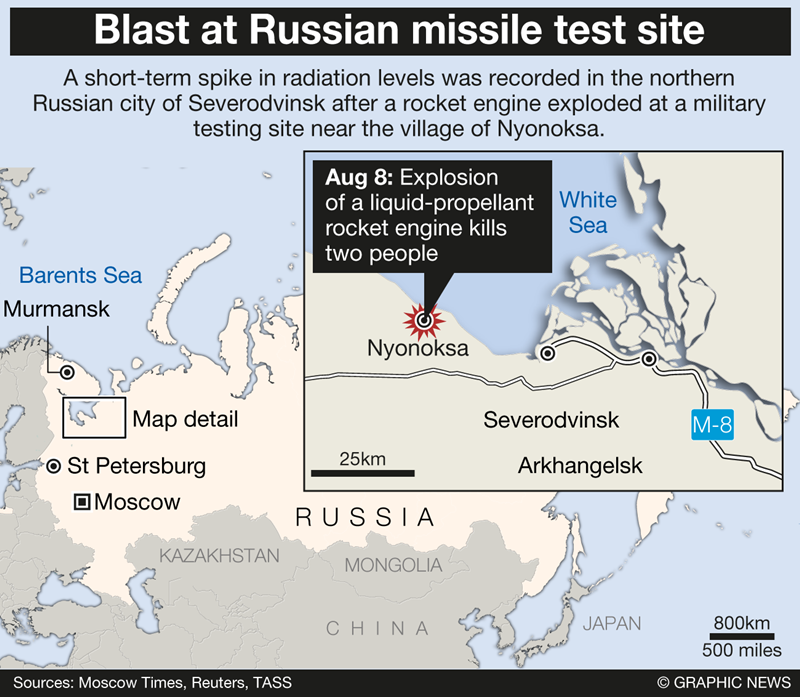
Russia explosion: Five confirmed dead in rocket blast, BBC 10 Aug 19, Five people were killed and three injured following a rocket explosion on a naval test range in Russia on Thursday, state nuclear company Rosatom confirmed.
Rostacom said the accident occurred during tests on a liquid propellant rocket engine.
The three injured staff members suffered serious burns in the accident.
Authorities had previously said that two people died and six were injured in the blast at the site in Nyonoksa.
The company told Russian media that its engineering and technical team had been working on the “isotope power source” for the propulsion system.
The Nyonoksa site carries out tests for virtually every missile system used by the Russian navy, including sea-launched intercontinental ballistic missiles, cruise missiles and anti-aircraft missiles.
Authorities in Severodvink, 47km (29 miles) east of Nyonska said that radiation levels shortly after the blast were higher than normal for about 40 minutes but returned to normal……..
Ammunition dump blaze
It is the second accident involving Russia’s military this week.
On Monday, one person was killed and eight others were injured in a blaze at an ammunition dump in Siberia.
Flying munitions damaged a school and a kindergarten in the area. More than 9,500 people were evacuated.https://www.bbc.com/news/world-europe-49301438
1 This Month

To see nuclear-related stories in greater depth and intensity – go to https://nuclearinformation.wordpress.com
-
Archives
- September 2026 (184)
- August 2026 (330)
- July 2026 (355)
- June 2026 (287)
- May 2026 (306)
- April 2026 (356)
- March 2026 (251)
- February 2026 (267)
- January 2026 (308)
- December 2025 (358)
- November 2025 (359)
- October 2025 (375)
-
Categories
- 1
- 1 NUCLEAR ISSUES
- business and costs
- climate change
- culture and arts
- ENERGY
- environment
- health
- history
- indigenous issues
- Legal
- marketing of nuclear
- media
- opposition to nuclear
- PERSONAL STORIES
- politics
- politics international
- Religion and ethics
- safety
- secrets,lies and civil liberties
- spinbuster
- technology
- Uranium
- wastes
- weapons and war
- Women
- 2 WORLD
- ACTION
- AFRICA
- Atrocities
- AUSTRALIA
- Christina's notes
- Christina's themes
- culture and arts
- Events
- Fuk 2022
- Fuk 2023
- Fukushima 2017
- Fukushima 2018
- fukushima 2019
- Fukushima 2020
- Fukushima 2021
- general
- global warming
- Humour (God we need it)
- Nuclear
- RARE EARTHS
- Reference
- resources – print
- Resources -audiovicual
- Weekly Newsletter
- World
- World Nuclear
- YouTube
-
RSS
Entries RSS
Comments RSS
 nuclear-news