USA, EU not honouring nuclear deal – says Iran official
Iran Official Accuses US, EU of Not Honoring Nuclear Deal By MARIA DANILOVA, abc news, ASSOCIATED PRESS WASHINGTON — Apr 15, 2016, A top Iranian official on Friday accused the U.S. and the European Union of failing to honor last year’s nuclear deal by keeping Iran locked out of the international financial system.
The White House insisted Washington is committed to fulfilling its part of the accord and said Tehran wants concessions that weren’t part of the deal.
The historic accord took effect in January and envisions Iran curtailing its nuclear program in exchange for billions of dollars in sanctions relief.
The head of Iran’s central bank, Valiollah Seif, said in a speech Friday that Iran’s counterparts have not lived up to their commitments and that “almost nothing” has been done as part of the deal.
“In general, we are not able to use our frozen funds abroad,” Seif said at the Council on Foreign Relations through a translator. Seif was in Washington to attend the spring meetings of the International Monetary Fund and the World Bank. “They (Iran’s partners) have not honored their obligations.”
He urged Washington to do more to encourage international banks to do business with Iran and ease Iran’s access to U.S. financial institutions. Otherwise, he said, the deal “breaks up on its own terms.” He did not elaborate……http://abcnews.go.com/Politics/wireStory/iran-official-accuses-us-eu-honoring-nuclear-deal-38426758
Russia marketing nuclear power stations to Laos: Russia will build and operate them
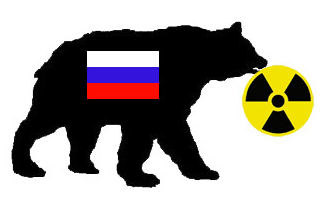 Russia and Laos plan nuclear cooperation, World Nuclear News, 15 April 2016
A memorandum of cooperation in the field of nuclear energy for peaceful purposes has been signed by Russian state nuclear corporation Rosatom and the ministry of energy and mines of Laos……
In August 2015, it was reported that Rosatom and Laos were in negotiations to set up the Southeast Asian country’s first nuclear power plant. The talks concerned Russia building two 1000 MWe nuclear power reactors in Laos on a build-operate-transfer basis. http://www.world-nuclear-news.org/NP-Russia-and-Laos-plan-nuclear-cooperation-1504164.html
According to German intelligence, terrorist Salah Abdeslam did not have German nuclear files
German intelligence agency disputes reports Salah Abdeslam had German nuclear files http://www.theguardian.com/world/2016/apr/14/paris-attacks-suspect-salah-abdeslam-had-german-nuclear-files
Spokeman for domestic intelligence agency says its head did not brief MPs on files found in Paris attacks suspect’s flat Guardian, Reuters in Berlin. Germany’s domestic intelligence agency has denied reports that Salah Abdeslam, a prime suspect in the Paris attacks, possessed documents about a nuclear research centre in Germany.
Newspapers in the Redaktions Netzwerk Deutschland (RND) media group said on Thursday that documents were found relating to the Juelich centre near the Belgium-Germany border, which is used for the storage of atomic waste.
The centre said in a statement that there was no indication of any danger and that Juelich was in contact with security authorities and nuclear supervisors.
The RND newspapers cited sources within the parliamentary control committee, whose meetings are confidential, as saying that Hans-Georg Maaßen, the head of the domestic intelligence agency (BfV), told the nine-person committee at the end of March that Abdeslam had the documents.
It said he had disclosed to the committee, which monitors the work of German security agencies, that printouts of articles from the internet and photos of the Juelich chairman, Wolfgang Marquardt, had been found in Abdeslam’s apartment in the Molenbeek area of Brussels.
The BfV on Thursday denied Maaßen had briefed the committee. “This is not right,” a spokeswoman said. “We have no information about this. Our president Maaßen never talked to any members of parliament.”
Two committee members also told Reuters that they had not been informed about the matter.
RND earlier reported that several members of the Bundestag and a terrorism expert at the BfV said they knew of this information and that Maaßen had confidentially informed them.
Abdeslam, born and raised in Belgium to Moroccan-born parents, was arrested on 18 March in Brussels. Four days later, suicide bombers killed 32 people in Brussels airport and on a rush-hour metro train.
Concerns that Islamic extremists are turning their attention to potential weak spots in the nuclear industry have risen since the attacks.
German nuclear centre a target for Paris terrorist?
Paris terrorist was eyeing German nuclear centre http://www.thelocal.de/20160414/paris-attacks-ringleader-had-records-of-german-nuclear-plant 4 Apr 2016 Salah Abdeslam, a key figure in the Paris attacks last November, was gathering information on a nuclear energy research centre in Germany, new evidence seen by German media revealed on Thursday.
- Swedish police hold terror suspect wanted in Germany (13 Apr 16)
- Munich police release suspects after terror probe (08 Apr 16)
- ’11 terror plots foiled in Germany since 2000′ (29 Mar 16)
Salah Abdeslam had documents at his apartment about a nuclear research centre at Jülich in North Rhine-Westphalia, raising concerns for authorities about what he many have been planning on German soil.
The documents included articles printed out from online sources about the research facility, as well as photos of the centre’s head, Wolfgang Marquardt, newspapers under the publishing group Redaktionsnetzwerk Deutschland (RND) reported, citing members of a parliamentary panel.
Abdeslam is currently being held in a Belgian prison, waiting to be deported to France, where he will face trial for terrorism offences in connection with the November 13th Paris attacks that left 130 dead.
The most recent documents were reportedly found inside of Abdeslam’s apartment where the French national was arrested last month in the Molenbeek district of Brussels.
Just days later, three bombs went off in Brussels in a coordinated terror attack that killed 32 people.
German domestic intelligence (Verfassungsschutz) President German Hans-Georg Maaßen reportedly informed several members of a Bundestag (German Parliament) security committee last month about the findings.
But according to RND, the Chancellery and the Interior Ministry declared that they did not have any information about the documents.
Similar information about the Brussels terrorists monitoring a Belgian nuclear scientist several weeks ago fueled speculation that they could have been planning to somehow get radioactive material for a dirty bomb, perhaps by blackmailing the researcher. They reportedly spied on the researcher, including filming him at his home for hours.
Immediately after the Brussels attacks, a Belgian nuclear power plant was evacuated of all non-essential personnel. Officials were also concerned when it emerged that two former Belgian nuclear power plant workers had gone to Syria to fight with Isis, one of whom was killed.
German nuclear power plants are extensively protected against the possibility of any interferences or other actions by an outside person, including terror attacks, according to the German Environment Ministry.
But according to environmental NGO BUND, the reactors are not sufficiently safe enough against air attacks.
EDF in America going for wind power, abandoning nuclear
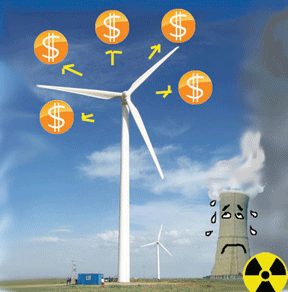 EDF shows that wind makes better sense than nuclear,Ecologist Chris Goodall April 2016 EDF in the UK may be propelled by its disastrous nuclear ambitions, writes Chris Goodall. But across the Atlantic it’s another story: the company is the US’s biggest wind developer, and selling its power, profitably, for under 40% of the price it has been promised for Hinkley C, including federal tax credits…….
Within the same company, they do things very differently on the other side of the Atlantic; there EDF focuses wholeheartedly on wind and has no nuclear under development.
It has just proudly announced that it has become the largest wind developer in North America with a portfolio in 2015 of over 1 gigawatt of newly constructed wind farms.
If it continues at the current rate, it will be generating more electricity from wind by 2025 than would be provided by Hinkley Point C. The numbers are as follows. Hinkley will generate about 25 terawatt hours a year. EDF’s 2015 annual portfolio of new wind projects will provide about 3 terawatt hours a year at average US utilisation factors.
If it continues to develop new wind projects at the rate of 1 gigawatt a year, it will be generating well over 30 terawatt hours a year from wind by the end of 2025. 2025 is when EDF says Hinkley will be finished.
What about the capital cost of wind versus nuclear? The latest US estimates suggest a figure of about $1,700 per kilowatt of capacity. That means EDF’s projects completed in 2015 cost about $1.8bn. Over ten years, that rate of installation will mean a total cost of around $18bn or about £13bn. Wind is therefore at least 30% cheaper to construct.
And it is much cheaper to operate. The most important project it completed in 2015, the 250 MW farm at Roosevelt in New Mexico, has sold its electricity for the next 20 years to a utility for $23.39 a megawatt hour, less than 20% of the price agreed for Hinkley of £92.50/MWh.
Note that the Roosevelt price is somewhat subsidised by Federal tax credits but even without this benefit the cost of wind would be less than 40% of the price of UK nuclear. Wind saves consumers money when compared to the nuclear alternative.
It’s simple really: renewables are a better and more secure investment
EDF finances many of its US wind projects on the back of power purchase agreements with major companies such as Microsoft, Procter and Gamble and Google. They commit to buy the electricity produced at a fixed price, not the inflation adjusted figure that the UK will pay for Hinkley. The EDF press release said:
“Corporate America is increasingly turning to renewable energy to power its business operations, based both on consumer preferences and because renewable energy simply makes economic sense.”
We never hear this line from EDF in the UK.
EDF cannot guarantee the wind will blow or the sun shine. Unlike in Britain, its US business is also investing heavily in energy storage. The US company has announced 100MW of battery systems in the US because “Energy storage is an attractive, cost-effective addition to intermittent energy generation projects.” However there’s no mention of batteries on EDF’s UK web site.
For sensible reasons large international companies often pursue varied market strategies in different countries. EDF in the US has decided to back wind while the UK has gone for nuclear.
But even a quick look shows that the energy and financial returns to the US strategy seem far clearer and better for the company, and its customers, than the tactics of the UK business. http://www.theecologist.org/blogs_and_comments/commentators/2987489/edf_shows_that_wind_makes_better_sense_than_nuclear.html
Widespread support for Church of England’s stand against Exxon Mobil
Church of England takes on energy giant ExxonMobil http://www.christiantoday.com/article/church.of.england.takes.on.energy.giant.exxonmobil/83931.htm Mark Woods CHRISTIAN TODAY CONTRIBUTING EDITOR 13 April 2016 The Church Commissioners have won widespread support for a move to put pressure on energy giant ExxonMobil to disclose the impact of climate change policy on its business.
The Church Commissioners manage a fund of around £6.7 billion, whose revenues are used to support the Church of England. The Commissioners co-filed a shareholder motion with the New York State Comptroller Thomas DiNapoli. It asks Exxon to disclose the effect on its business if measures to restrict global warming to two degrees are successful.
More than 30 institutional investors have so far said they will vote for the motion.
Exxon’s competitors Shell and BP have already agreed to disclose how much they will be impacted by efforts to lower greenhouse gas emissions. They were targeted by similar shareholder proposals co-filed in 2015 by the Church Commissioners and other investors. Exxon had attempted to have the resolution struck down by the Securities and Exchange Commission but its request was denied last month.
Church Commissioners spokesman Edward Mason said: “We are delighted with the scale of support this resolution has received so far. The resolution is part of a much wider trend following the Paris Agreement for investors to ask companies to improve disclosure on how they are positioned for the risks and opportunities posed by climate change.”
Exxon has funded groups spreading information denying human-induced climate change and lobbying politicians against climate change legislation. While it pledged to cease doing so in 2007, a Guardian report last July claimed it was continuing the practice.
It has a long history of rejecting shareholder motions on climate change and of rejecting the scientific consensus.
When Exxon challenged the most recent shareholder motion, DiNapoli said: “ExxonMobil risks becoming an outlier among its peers who have publicly supported reining in climate change.
“As investors, we need to know how ExxonMobil’s bottom line will be impacted by the global effort to reduce emissions and what the company plans to do about it.”
Exxon is also under under pressure from a coalition of 17 US attorneys general, Attorneys General United for Clean Power (AGUCP), who have banded together to enforce climate change laws. New York attorney general Eric Schneiderman announced at a press conference on March 29 that the coalition was working to find “creative ways to enforce laws being flouted by the fossil fuel industry and their allies in their shortsighted efforts to put profits above the interests of the American people and the integrity of our financial markets”.
Schneiderman referred to a “relentless assault from well-funded, highly aggressive and morally vacant forces that are trying to block every step by the federal government to take meaningful action” to fight climate change.
The initiative by the attorneys general was criticised by some religious conservatives, however.
Jeffrey Riley, professor of ethics at New Orleans Baptist Theological Seminary, told Baptist Press: “Few deny that the climate is changing – it always has. The debate is on the cause. In spite of the public rhetoric that declares scientific consensus, the debate is still out. Public and political rhetoric on this issue is neither truth nor an argument for truth. Christians who hold that we are stewards of the earth ought to be interested in truth, and for that reason should not support any action that stifles legitimate scientific and economic debate.”
Fake safety check at German nuclear facility
Nuclear staff feigned safety check just before SZ.de newspaper
magazine [Google translation]
The Ministry of Environment of Baden-Württemberg has the operator now prohibited, the affected reactor Philippsburg 2 to go back. From Michael Bauchmüller , Berlin 14 Apr 16
The power company EnBW has uncovered a serious vulnerability in one of its nuclear power plants. As the company announced on Wednesday, an employee of an external service faked last December a security check, without having performed it. The Ministry of Environment in Stuttgart said on Wednesday the re-start of the reactor……..http://www.sueddeutsche.de/politik/vom-netz-genommen-akw-mitarbeiter-taeuschte-sicherheitspruefung-nur-vor-1.2948941
Operating licence for Olkiluoto 3 nuclear reactor applied for by TVO
Finland’s TVO applies for delayed Olkiluoto nuclear plant licence http://uk.reuters.com/article/finland-nuclearpower-idUKL5N17H192 Apr 14, 2016
Finnish utility Teollisuuden Voima (TVO) has applied for an operating licence for its much-delayed Olkiluoto 3 nuclear reactor, saying it is on track to start production in late 2018.
“This is a significant milestone. The project is moving from installations to tests,” project manager Jouni Silvennoinen said in a statement on Thursday.
It was originally due to start operation in 2009, and TVO has traded blame for the delay with the plant’s supplier consortium Areva-Siemens , with both demanding billions of euros from each other in an ongoing arbitration at the International Chamber of Commerce. (Reporting by Jussi Rosendahl; Editing by Alexander Smith)
Luxembourg would pay France to shut down all too near nuclear power station
 Luxembourg offers France money to close nuclear plant http://en.rfi.fr/france/20160412-luxembourg-offers-france-money-close-nuclear-plant By RFI Luxembourg offered on Monday to chip in financing to close an ageing French nuclear power plant near its border, saying the tiny nation could be obliterated if the station malfunctioned.
During a press conference with his French counterpart Manuel Valls, Luxembourg’s Prime Minister Xavier Bettel said a problem at the Cattenom plant could “wipe the duchy off the map”.
“The Cattenom site scares us, there’s no point in hiding it,” he said of the plant that has been in operation since the mid-1980s. “Our greatest wish is that Cattenom close.”
Luxembourg “would be prepared to make a financial commitment to a project, which would have to be cross-border… at Cattenom that is not nuclear in nature.”
Valls — who was on a one-day visit to the nation of about 500,000 — said France has pledged to cut its reliance on nuclear energy from more than 75 percent to 50 percent by shutting 24 reactors by 2025.
“Message received,” he added.
Fessenheim houses two 900-megawatt reactors and has been running since 1977. Due to its age activists have long called for it to be permanently closed.
French President Francois Hollande has pledged to shut down the Fessenheim plant by the end of his five-year term in 2017.
Russia Rejects N.Korea’s Claim to Status of Nuclear Power – Lavrov
“We, as well as China, reject North Korea’s nuclear-missile ambitions,” Lavrov stressed
In Europe, nuclear industry needs EUR 450 billion to survive

 Nuclear needs up to EUR 450 billion to survive http://one-europe.info/nuclear-needs-up-to-eur-450-billion-to-survive, 10 Apr 16, A new report published by the European Commission reveals the current state and future plans for European energy and has led to strong reactions from key stakeholders. If the European Union wants to keep nuclear energy alive until 2050 it will need to find up to EUR 450 billion in investments, according to a new report published by the European Commission.
There are 129 nuclear power reactors in operation in 14 Member States, with a total capacity of 120 gigawatts and an average age of close to 30 years. It is estimated that more than 50 of those reactors are to be shut down by 2025.
“If no new power plants are built, in 2040 we will not have any kind of nuclear energy in Europe,”claimed European sources.
Maintaining a nuclear generation capacity of between 95 and 105 gigawatts would require between EUR 350 and 450 billion in new plants to replace most of the existing nuclear power capacity, according to the report, the first one released since the nuclear disaster in Fukushima.
Moreover European nuclear operators estimated that EUR 253 billion will be needed for nuclear decommissioning and radioactive waste management until 2050.
The European Commission believes that nuclear energy is expected to remain an important component of the EU’s energy mix through 2050.
The total estimated investments in the nuclear fuel cycle between 2015 and 2050 are projected to be between EUR 650 and 760 billion.
Nuclear risks
The Greens at the European Parliament criticized the EU Commission for choosing a high risk strategy of extending reactor lifetime up to 60 years, instead of thinking of alternatives.
“This paper shows that the EU Commission’s thinking is still influenced by nuclear supporters in key positions. The paper is a bizarre mixture of illusion and propaganda. It is alarming that the Commission sees the greatest potential for the future of the nuclear sector via the extension of reactor lifetimes by up to 60 years. This approach is grossly irresponsible for such a high risk technology,” stated Greens/EFA co-president Rebecca Harms.
The Greens energy spokesperson, Claude Turmes, said that the EU Commission is simply ignoring the reality that nuclear power can no longer compete with renewable energy.
“The Commission acknowledges that billions of Euro required for decommissioning nuclear plants and dealing with nuclear waste are missing but makes no proposals for how this gap should be addressed. The only answer given is to prolong the lifetime of nuclear reactors. This is at odds with the EU treaties and the principle that those responsible for such costs should foot the bill, ” Turmes said.
EC report on nuclear energy http://ec.europa.eu/transparency/regdoc/rep/1/2016/EN/1-2016-177-EN-F1-1.PDF
Greens alternative study www.greens-efa.eu/pinc-2016-15348.html
UK vulnerable to cyberattack if planned nuclear deal with China goes ahead
 How Chinese nuclear deal leaves UK vulnerable to CATASTROPHIC cyber attack GEORGE Osborne has been warned that granting the Chinese a large stake in Britain’s nuclear energy infrastructure poses a “substantive” threat to UK national security. Sunday Express, By TOM BATCHELOR Apr 10, 2016 Beijing is planning to invest in two major nuclear power plant projects in a multi-billion pound contract that would give them access to Britain’s strategic energy network.
No formal agreement between China and the UK has yet been signed, but energy experts have spoken out about the potential for “catastrophe” if the Chinese are given the green light to invest.
Security concerns centre on access to IT systems, with analysts warning the UK would be left vulnerable if relations continue sour to China over the coming years.
Britain’s friendship with the communist state was strained recently over the Tata steel crisis with China putting a highly punitive tax on the metal produced in south Wales to further damage the UK industry.
But experts say a nuclear power deal would put the UK at the mercy of Beijing.
Dr Paul Dorfman, an advisor to the British Government on nuclear security and a senior research fellow at UCL’s Energy Institute, said: “You don’t want to let the Chinese into complex, strategic, national energy infrastructure and you certainly don’t want them anywhere near nuclear.
“There are some real security issues here.”
Fears have been raised about “backdoors” in IT technology that could be exploited by the Chinese government or rogue hackers.
Malicious IT breaches could allow data to be extracted or inserted into complex computer systems, allowing Beijing to circumvent British control of a nuclear plant and shut it down.
GCHQ will be on standby to protect the UK from the threat of a cyber attack if the Chinese are allowed to build at Hinkley Point in Somerset and Bradwell in Essex…….. https://www.express.co.uk/news/uk/658755/Chinese-nuclear-deal-leaves-UK-vulnerable-to-catastrophic-cyber-attack-on-power-plants
Safety of Spain’s nuclear reactors is questioned by European Commission
European Commission concerned over Spain’s nuclear power stations http://www.theolivepress.es/spain-news/2016/04/10/european-commission-concerned-over-spains-nuclear-power-stations/
Issues surrounding the safety of older reactors were raised by climate and energy commissioner Miguel Cañete
CONCERNS over Spain’s nuclear power stations have been aired by the European Commission.
Issues surrounding the safety of older reactors were raised by climate and energy commissioner Miguel Cañete who claims there is a ‘lack of transparency’ when addressing safety issues at Spanish sites.
Cañete’s allegations were sparked after his request for information about a nuclear-waste storage facility in Bilbao was ignored.
“The Commission expects to receive this information under Article 41 of the Euratom treaty, which governs investment projects in this field,” said Arias Cañete. “To date, we haven’t received any communication referring to the possibility of installing a nuclear waste storage facility at the plant.”
Cañete added that Spain had ‘described various measures ensuring transparency’ in its 2014 report on the Nuclear Safety Directive but had failed to live up to its promises.
France is dangerously ill-prepared to deal with a nuclear accident – report
France is ‘not prepared for a nuclear accident’, report says http://www.thelocal.fr/20160407/france- unprepared-for-nuclear-accident
 , according to a worrying new report, that the Swiss and Germans will want to read with interest.
- France’s oldest nuclear plant ‘to close this year’ (06 Mar 16)
- Germany demands France shut old nuclear plant (04 Mar 16)
- Swiss sue French over ‘dangerous’ nuclear plant (03 Mar 16)
That’s the conclusion of a new report by France’s ANCCLI commission that reports on the state of the country’s nuclear facilities.
“France is not ready to face a serious nuclear accident,” warned the commission’s president Jean-Claude Delalonde. “Even though a national response plan was made public in February 2014, nothing has been put in place,” he said.
The report comes after both Switzerland and Germany have expressed concerns about the safety of some of France’s 19 nuclear power stations, with authorities in Geneva even launching legal action.
According to Delalonde’s association the French government has not learned the lessons from previous disasters like Chernobyl that was presented as a “Soviet” accident.
The Fukushima disaster in Japan prompted the French to improve certain safety measures around nuclear reactors but ANCCLI want more.
They want the “emergency zone” around nuclear power stations, where measures are put in place in the event of accident, extended from the current 10km radius to 80 km.
The fact this hasn’t been done already creates a dangerous situation for Europe, the report says.
For example France distributes iodine tablets, which protect against the potentially cancer-causing effects of radioactivity, to those living within the 10km radius of a nuclear reactor, but in Belgium the same measure is taken within a 20km radius.
After Fukushima, the radius was extended to between 20km and 50km in Switzerland. The entire state of Luxembourg is part of an emergency zone even though there are no nuclear power stations on its territory. It’s due to the fact the Cattenom reactor in France is close to the border.
The duchy has previously forwarded to the European Commission a study commissioned by Germany’s Greens party, which according to Luxembourg “listed the Cattenom plant’s security problems”.
ANCCLI wants French authorities to work out a plan and carryout “digital simulations” for how Iodine tablets would be distributed to the whole of France before a radioactive cloud passes and also how the population would be evacuated in the event of a disaster.
The extent of the problems France would face in the event of a disaster are made clear by the fact more than 1.25 million people live within 30km of the Bugey power plant near Switzerland and over one million live around the Fessenheim power station – the oldest in the country.
Delalonde points out that India’s contingency plans are far more developed than they are in France.
“They anticipate the amount of food that will be needed, the number of emergency beds needed, blankets and even how many saris would be needed,” he said.”This power plant is very old, too old to still be in operation,” said a spokesman for Germany’s Environment and Nuclear Safety Minister Barbara Hendricks.
Meanwhile, the Swiss canton of Geneva on Wednesday filed a complaint against French nuclear plant Bugey located in the neighbouring French region of Ain, claiming that it “deliberately puts in danger the life of others and pollutes the waters”.
Russi, france, USA, all vying to market nuclear reactors to China
Rosatom hopes to plug into nuclear industry By Lyu Chang (China Daily) 2016-04-08 Rosatom, the Russian State Atomic Energy Corp, is seeking to hit big in China’s nuclear industry with the opening of a regional center headquartered in Beijing on Thursday,according to a senior official of the company.
“We are looking to expand our business in China, a market with huge potential for growth inthe nuclear industry, and the activities of regional center are designed to help strengthen ourcooperation with the country,” said Alexander Merten, president of Rosatom InternationalNetwork……..
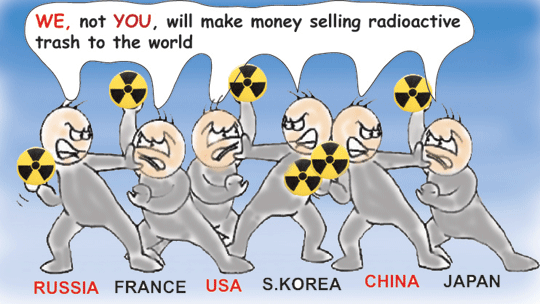
China’s nuclear industry is on the fast track to become one of the world’s largest, with plans tohave completed 58 gigawatts of installed capacity with another 30 gW under construction bythe end of 2020.
But Rosatom will face fierce competition from companies such as the US WestinghouseElectric and France’s nuclear giant Areva with rival third-generation nuclear designs such asAP1000 and EPR1000, both of which aim to expand its presence in the Chinese market…….https://mail.google.com/mail/u/0/#inbox?compose=153f5049f5598818
1 This Month




Shut down the radiation-damaged Heysham nuclear reactors now
To see nuclear-related stories in greater depth and intensity – go to https://nuclearinformation.wordpress.com

Say No to NASA’s Reckless Nuclear Reactor on the Moon
Say No to NASA’s Reckless Nuclear Reactor on the Moon
-
Archives
- October 2026 (302)
- September 2026 (339)
- August 2026 (330)
- July 2026 (355)
- June 2026 (287)
- May 2026 (306)
- April 2026 (356)
- March 2026 (251)
- February 2026 (267)
- January 2026 (308)
- December 2025 (358)
- November 2025 (359)
-
Categories
- 1
- 1 NUCLEAR ISSUES
- business and costs
- climate change
- culture and arts
- ENERGY
- environment
- health
- history
- indigenous issues
- Legal
- marketing of nuclear
- media
- opposition to nuclear
- PERSONAL STORIES
- politics
- politics international
- Religion and ethics
- safety
- secrets,lies and civil liberties
- spinbuster
- technology
- Uranium
- wastes
- weapons and war
- Women
- 2 WORLD
- ACTION
- AFRICA
- Atrocities
- AUSTRALIA
- Christina's notes
- Christina's themes
- culture and arts
- Events
- Fuk 2022
- Fuk 2023
- Fukushima 2017
- Fukushima 2018
- fukushima 2019
- Fukushima 2020
- Fukushima 2021
- general
- global warming
- Humour (God we need it)
- Nuclear
- RARE EARTHS
- Reference
- resources – print
- Resources -audiovicual
- Weekly Newsletter
- World
- World Nuclear
- YouTube
-
RSS
Entries RSS
Comments RSS

