EU and Iran co-operating on nuclear safety
EU-Iran cooperate on nuclear safety World Nuclear News, 22 April 2016 The European Commission and Iran are to launch their first nuclear safety cooperation project under a joint statement issued during an EU delegation’s visit to Tehran. ……According to the statement, the EC and the AEOI are to cooperate “in fulfillment of measures set out in the Joint Comprehensive Plan of Action” – the agreement signed in July 2015 by Iran and the E3/EU+3 (China, France, Germany, Russia, the UK and the USA – also referred to as the P5+1 – plus the European Union) under which Iran agreed to limit its uranium enrichment activities, eliminate its stockpile of medium-enriched uranium and limit its stockpile of low enriched uranium over the next 15 years………http://www.world-nuclear-news.org/NP-EU-Iran-cooperate-on-nuclear-safety-2204168.html
Russian nuclear corporation Rosatom to “educate” South Africans on benefits of nuclear power

 ROSATOM TO GROW PUBLIC AWARENESS ON NUCLEAR ENERGY, Eyewitness News, The Russian atomic energy company faces strong resistance from environmental lobbyists in SA. Rahima Essop 21 Apr 16 CAPE TOWN – Rosatom says it has to ‘gradually grow public awareness and acceptance’ about nuclear energy as the Russian atomic energy company faces strong resistance from environmental lobbyists and opposition politicians in South Africa.
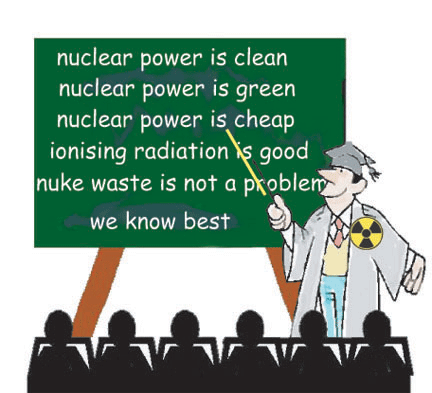
Two organisations have challenged the legality of government’s proposed 9,600 MW nuclear build programme in court before Energy Minister Tina Joemat-Pettersson calls for quotes for the tender.
Rosatom is said to be on the inside track for the contract.
The Democratic Alliance (DA), meanwhile, is pushing for the project to be abandoned on the basis that it’s unaffordable and shrouded in secrecy.
Rosatom has billed nuclear as a cheap source of energy and a job-creating solution for the country.
The company, which is building 34 reactors across the globe, is hoping to influence South African perceptions about nuclear…….Rosatom has sponsored a press trip to Hungary. http://ewn.co.za/2016/04/21/Rosatom-to-gradually-grow-public-awareness-on-nuclear-energy
Belgian nuclear safety in question, after repeated reactor shutdowns
Renewed shutdowns cast doubt on Belgian nuclear safety, DW, 21.04.2016 Martin Kuebler, Brussels
Belgium’s nuclear authority has said its power plants are safe after calls by Germany to shut down two aging reactors. But critics say details are lacking – and point to a conflict of interest. Martin Kuebler reports.
With doubts about the safety of Belgium’s nuclear reactors rife among neighboring countries, and the threat of attacks on its nuclear sites still a valid concern, the news that one of the country’s disputed reactors had once again shut down unexpectedly on Thursday wasn’t encouraging.
Late in the afternoon, utilities operator Engie Electrabel announced that the 34-year-old Doel 3 reactor near the city of Antwerp, close to the border with the Netherlands, had automatically shut down following a standard test – “normal procedure if there is an anomaly,” according to a plant spokesperson. The Belga news agency said the outage was expected to last for 24 hours.
Earlier in the day, Engie also said the Doel 1 reactor – shut down since April 13 for maintenance work scheduled to last several days – would now remain offline until May 31 “for additional analyses” and “operational maintenance.” Doel 1 and 2, in operation since the mid-1970s, were set to be taken out of service in 2015 after 40 years, until parliament decided to extend their lifespans by another decade.
The shutdowns are just the latest for Belgium’s seven aging reactors, which in the last two years have gone offline around 10 times for various technical problems or minor emergencies like fires – four incidents this year alone.
On Wednesday, German Environment Minister Barbara Hendricks called on the Belgian government to shut down Doel 3 and Tihange 2, located near the eastern city of Liège, for an indefinite period to guarantee safety “until further research can be undertaken.”
Her request came after a meeting between representatives of the German Environment Ministry, an independent German Reactor Safety Commission (RSK) and Belgium’s Federal Agency for Nuclear Control (FANC) in early April, in which Germany expressed its concern over tiny cracks in the pressure vessels of the two reactors discovered in 2012.
Hendricks pointed out that RSK had failed to confirm that the reactors were safe, and called for further tests to show that Belgium “takes the concerns of its German neighbors seriously.” The Tihange nuclear power station is located about 60 kilometers (37 miles) from the German border, and the decision to restart Tihange 2 in December sparked great concern in the nearby city of Aachen.
Belgium’s Energy and Environment Minister Marie-Christine Marghem was unavailable for comment on Thursday………. http://www.dw.com/en/renewed-shutdowns-cast-doubt-on-belgian-nuclear-safety/a-19206484
NATO concerned at danger of ISIS nuclear attack on Britain or Europe


 EU and Nato say there is ‘a justified concern’ of ISIS carrying out a chemical or nuclear attack in Britain or Europe
- ISIS ‘plans nuclear and chemical attacks on Britain and EU’, say NATO
- Terrorists are trying to obtain nuclear weapons, security chiefs warns
- ISIS is also ‘trying to implant bombs in humans and hack driver less cars’
- See more news on the ISIS threat at www.dailymail.co.uk/isis
By SARA MALM and ALLAN HALL FOR MAILONLINE, 20 April 2016 ISIS terrorists are planning nuclear and chemical attacks on Britain and Europe, international security chiefs have warned.
Both Nato and the EU say there are ‘justified concerns’ that ISIS jihadists are working on obtaining chemical, biological, radioactive and nuclear materials to carry out attacks on the EU.
Speaking at the Security and Counter Terror Expo in London this week, senior counter terrorism officials warned of ISIS’s plans to carry out chemical attacks. ‘With CBRN [chemical, biological, radioactive and nuclear materials], there is a justified concern.’ Jorge Berto Silva, deputy head of counter terrorism for the European Commission said according to The Telegraph.
Dr Jamie Shea, deputy assistant secretary general for emerging security threats at Nato, told the annual Security and Counter Terror Expo: ‘We know terrorists are trying to acquire these substances.’………http://www.dailymail.co.uk/news/article-3547840/EU-Nato-say-justified-concern-ISIS-carrying-chemical-nuclear-attack-Britain-Europe.html
France’s nuclear corporation EDF warned on legal action over the Hinkley nuclear project debacle

 Pressure rises on EDF board over Hinkley Point nuclear plant, FT.com, 19 Apr 16, Michael Stothard in Paris A group of managers at French utility EDF have sent a letter to its board of directors warning they could all face legal action if the company pushes ahead with its contentious Hinkley Point C nuclear project in the UK.
The letter, dated April 19 and seen by the Financial Times, said that if a board decision in favour of Hinkley Point led to the “destruction of the value” at EDF its directors could be held personally responsible……….
French president François Hollande is also meeting ministers at the Élysée Palace on Wednesday to discuss financing options for Hinkley Point. The French state has an 85 per cent stake in EDF.
The letter by the group of EDF managers highlights the internal battle that has raged within the company over Hinkley Point, with chief financial officer Thomas Piquemal resigning last month because of concerns that the UK project could threaten the company’s future…….
Two other nuclear projects in France and Finland using the same reactor technology proposed for Hinkley Point are both severely delayed and billions over budget…….. http://www.ft.com/intl/cms/s/0/d6d16bd0-0628-11e6-9b51-0fb5e65703ce.html#axzz46IzsG72i
EDF’s minority shareholders want French govt to be forced to buy them out.
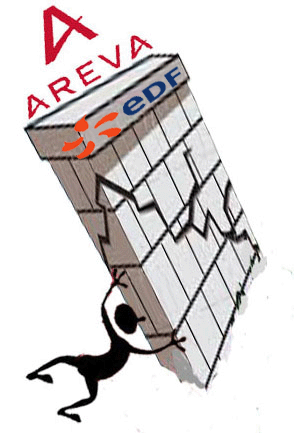
 EDF staff investors demands France buys out minorities in nuclear dispute
Staff shareholder group says state abuses majority
* Minorities say EDF used as government policy tool
* EAS fears Hinkley Point will crimp future dividends (Adds detail on dividend, EDF no comment)
Reuters By Geert De Clercq PARIS, April 19 An EDF employee shareholders group has asked the AMF market regulator to force the French state to buy out the utility’s minority shareholders, in a dispute over its plans to build nuclear plants in Britain.
In a letter to the AMF, seen by Reuters on Tuesday, EDF Actionnariat Salarie (EAS) asks the market regulator to consider requiring the state to launch a so-called public withdrawal bid.
EAS alleges that the government is abusing its position as a majority shareholder by forcing EDF to go ahead with building nuclear plants in Britain, which EAS says is too risky for EDF and will prevent it from paying dividends in coming years……..
HINKLEY POINT CONSEQUENCES
EAS argues that in pushing EDF’s 18 billion pound (22.8 billion euros) project to build two reactors at Hinkley Point, in Britain, the government defends the interests of the country’s nuclear industry rather than those of EDF, at the expense of its minority shareholders…….
Hinkley Point is crucial for the survival of reactor builder Areva and France’s many smaller nuclear companies, in an industry that employs about 200,000 people. With three quarters of its power generated by nuclear, France needs no more reactors, and export prospects are limited after the 2011 Fukushima disaster.
“While the state only owns 85 percent of EDF’s capital, it behaves as if it is the sole proprietor and uses the company as a lever for its industrial policy,” EAS said.
It also said the UK project will prevent EDF from paying a dividend for at least seven years……..
On Wednesday, the government will discuss EDF’s finances ahead of an EDF board meeting on Friday. Sources close to the company said the board will review financing options but will not decide on Hinkley Point. (1 euro = 0.7906 pounds) (Editing by Alexander Smith) http://www.reuters.com/article/edf-nuclear-shareholders-idUSL5N17M5CN
Cancer toll in Serbia, from NATO’s use of depleted uranium weapons

 Depleted uranium used by NATO during bombing of Serbia takes its toll http://inserbia.info/today/2016/03/depleted-uranium-used-by-nato-during-bombing-of-serbia-takes-its-toll/ By InSerbia with agencies -Mar 29, 2016 BELGRADE – The use of depleted uranium during NATO bombing of Serbia has caused long-term damage to Serbia and the Serbian people. Because every year we have an increase in the number of cancer cases by 25 percent over the previous year. Figures in the case of patients in Kosovska Mitrovica support this fact, as in 2011 here were registered 185 of them, the following year, 225 and in 2013 – 250. Therefore, the gloomy forecasts, imposed back in 2002, that the use of depleted uranium during the aggression of Western military alliance against FRY will cause an epidemic of malignant diseases, turned out to be accurate, said dr. Nebojsa Srbljak for Serbian daily “Vecernje Novosti”.
Dr Srbljak, a cardiologist at the ZTC in Kosovska Mitrovica and founder of the NGO “Angel of Mercy” which deals with data on the number of patients with malignancy in Kosovo, explained for the daily that “those who used the depleted uranium had to know what consequences it causes”. He said that the study of his organization, which cover the period of two years before and two years after the bombing, clearly shows that the number of patients with malignant diseases is caused by radioactivity, and not stress and other bad life habits.
“Let us remember the example of Italy which has revealed that their soldiers, who stayed in Kosovo, were irradiated and that the increased number of hematological diseases is a direct consequence of the use of depleted uranium ammunition,” said dr. Srbljak. “Italian KFOR soldiers were deployed where the most of the ammunition with depleted uranium was used, in Pec, Djakovica, in Kosare. Their families, as far as I know, have received compensation.”
Dr. Srbljak urges the authorities that our country formally request compensation, not only for material damage but also because of the increase in the number of patients with malignant diseases. The cardiologist claims that someone was trying to minimize the information he and his team published back in 2002 that the number of patients with malignant diseases was increased by almost 200 percent compared to the period before the bombing.
“It became clear that we are right when our neighbors Albanians started to go to Belgrade for a treatment. Because, and that is obvious, they have confidence in the expertise of Serbian doctors. I therefore think that our proposal, to open a branch of Oncology Institute in Belgrade here in (Kosovska) Mitrovica could finally be realized.”
UK energy secretary admits energy supply would be OK even if Hinkley nuclear cancelled or delayed
Minister admits lights would stay on even if Hinkley nuclear plant is delayed Guardian, Damian Carrington, 19 Apr 16 UK energy secretary admits for the first time that any delays or cancellations to new nuclear reactors would not compromise national energy supply. The UK’s energy secretary has admitted for the first time that the lights would stay on if new nuclear reactors at Hinkley were cancelled or delayed.
Amber Rudd has previously said that “energy security has to be the number one priority” and that new gas and nuclear power would be “central to our energy-secure future”.
But in a letter released on Tuesday in reply to MPs on the energy and climate change select committee, which asked what contingency plans were in place if Hinkley is delayed or cancelled, she said: “While we have every confidence the deal will go ahead, we have arrangements in place to ensure that any potential delay or cancellation to the project does not pose a risk to security of supply for the UK. I am clear that keeping the lights on is non-negotiable.”
She also said that delays to the troubled plant could risk the UK missing its targets to cut carbon emissions, and that alternatives could cost more but would not represent a “significant increase” in cost in the short term.
The final decision by French-state owned company EDF to go ahead with Hinkley has been repeatedly delayed and the billion of pounds of state subsidies and the feasibility of the giant project have been widely criticised. Last week one of the UK’s major investors, Legal and General, called Hinkley “a total waste of money”………
A report from the government’s National Infrastructure Commission in March found that “smart power – principally built around three innovations, interconnection, storage, and demand flexibility – could save consumers up to £8bn a year by 2030, help the UK meet its 2050 carbon targets, and secure the UK’s energy supply for generations.”
Angus MacNeil, chair of the energy and climate change committee, said: “[Rudd’s] letter shows the government has had to finally concede the need for a Plan B on Hinkley, although the detail is sketchy. New capacity must be brought online in a way that is compatible with our decarbonisation targets. That means limiting the role of fossil fuels and maximising the use of smarter low carbon options to meet demand.”……..
ohn Sauven, Greenpeace’s UK director said: “There is absolutely no reason that the UK could not meet our decarbonisation targets if the government dropped Hinkley and gave renewable energy businesses a fraction of political and financial support that nuclear and fossil fuel companies enjoy.” http://www.theguardian.com/environment/2016/apr/19/minister-admits-lights-would-stay-on-even-if-hinkley-nuclear-plant-is-delayed
Clean water for 10 million people, due to London’s new floating solar farm
World’s Largest Floating Solar Farm to Provide 10 Million People with Clean Water, Luminary Daily, By Gary Joshua Garrison / 20 March 2016 The solar farm will span 57,500 square meters (or about eight soccer stadiums) of the Queen Elizabeth II reservoir and will consist of 23,000 solar panels, covering about a tenth of the reservoir. It is slated to be completed by the end of March.

Utility company Thames Water runs the reservoir, while Lightsource Renewable Energy — a private solar energy company based in London — is responsible for the funding and operation of the revolutionary farm.
“This will be the biggest floating solar farm in the world for a time — others are under construction,” Angus Berry, energy manager for Thames Water, told The Guardian. “We are leading the way, but we hope that others will follow, in the UK and abroad.”………
Similar floating solar farms are under construction, or have already been completed, both in England and around the world. Recently, a 45,500 square meter solar farm opened in Greater Manchester, England and water company United Utilities, also in Manchester, is currently constructing a similar project that will have about half the capacity of the Thames Water project. In Japan, solar company Kyocera is in the process of building an 180,000 square meter floating solar farm (see featured image at the top) that is set to be completed in 2018.
For their dedication to providing clean, renewable energy, for their innovation, and for helping to lead the charge in the energy revolution we are happy to name the folks at Lightsource and Thames Water our Luminaries of the Week. http://luminarydaily.com/worlds-largest-floating-solar-farm-to-provide-10-million-people-with-clean-water/
Solar city makes more 4 times more electricity than it consumes
 Revolutionary: Germany Builds A Solar City That Produces Four Times More Energy Than It Consumes http://thelogicalindian.com/environment/germanys-revolutionary-solar-city-that-produces-four-times-more-energy-than-it-consumes/ – Abhishek Mittal 14 Apr 16, We have known cities to be great power-guzzlers, having a huge appetite for consuming electricity to power its homes and buildings. To generate electricity for such cities through renewable sources like solar becomes a difficult task given the vast amount of area required to place the solar panels. But a city in the heart of Germany has achieved something more incredible. It not only has made itself self-sufficient in energy, but in fact has become a net producer of energy – all thanks to a localized approach for adopting solar power.

The Solar cities of Germany:
The Sonnenschiff and Solarsiedlung cities located in Freiburg, Germany are modern, planned habitations that were worked upon with solar power in mind. Literally meaning Solar Ship and Solar Village, the Sonnenschiff and Solarsiedlung cities were specifically designed and built to be solar cities, balancing size, accessibility, green space, and solar exposure. Each of the fifty-two homes along with some commercial buildings is fitted with large rooftop solar panels that double-up as sun shades. The panels are perfectly aligned to point in the right direction of the sun, and the buildings follow the Passivhaus standards of green building technology.
The cities have been designed by architect Rolf Disch. Together with the latest photovoltaic technology for the panels that make them highly efficient, and use of phase-change materials and vacuum insulation for the walls of the buildings that provide optimum thermal performance, the cities are able to generate four times the power which they consume.
Solar Vs Nuclear:
The success of solar as an alternative to the polluting coal-fired power is not limited to these twin-cities. The entire area of Freiburg has been leading the country into a solar revolution since a long time. It was once on the crossroads of choosing between solar and nuclear as the preferred alternative source. Infact a nuclear power plant had already begun construction near Freiburg in early 1970s, amid protests from students and farmers who saw nuclear as a dangerous and polluting source of energy.
A major change in mindset of the local population came when an engineer Dieter Seifried started an institute to research into alternative forms of energy and popularized solar as a safe, reliable and efficient source. Seifried said regarding nuclear power in an interview to CBC news, “you will see first that it is not clean at all, second that it is expensive and third that we have a lot of unsolved problems like where do we deposit the waste.” Gradually more and more residents started to install rooftop solar panels on their houses and ditched the conventional power from grid. In 2000, Germany tabled a clean energy bill that forced power-companies to pay a set fee called a feed-in tariff to anybody providing power to the grid. This gave an impetus to the efforts of Seifried and others, and today, 30% of Germany’s electricity comes from renewable sources, mainly wind and solar. The nuclear plant being built in Freiburg was shut down soon after the protests, and after the unfortunate Fukushima meltdown in Japan in 2011, Germany has committed to phase out all 17 of its nuclear reactors by 2022.
The examples of Freiburg and the solar cities show how people themselves can own up the process of transitioning from conventional methods of energy generation to cleaner alternatives. The role of government in incentivizing renewable energy and providing access to technology is also very important. The Logical Indian gives a big thumbs-up to the residents of Freiburg for kickstarting the solar revolution in their country, and hopes that similar initiatives are taken up by people across the world.
Ukraine – insecure, corrupt, – on Chernobyl anniversary – the nuclear danger
For security reasons, Australia has suspended uranium sales to Russia. It seems extraordinary that Australia should now enter into a deal with even more unsafe and unstable Ukraine, in its present war and political crisis.
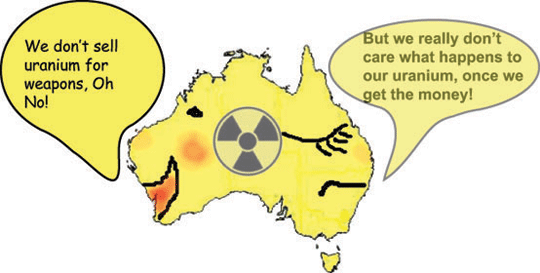
 Four big reasons not to sell uranium to Ukraine https://independentaustralia.net/environment/environment-display/fourbig-reasons-not-to-sell-uranium-to-ukraine,8895 Noel Wauchope 18 April 2016 As the 30th anniversary of the Chernobyl disaster approaches, Noel Wauchope outlines just a few compelling reasons why the Coalition Government’s uranium deal with Ukraine may have further disastrous consequences.
WHAT AMAZINGLY insensitive timing! As the anniversary of the Chernobyl nuclear catastrophe approaches, Australia makes a deal (at the Nuclear Security Summit) to sell uranium to Ukraine.
This is such a bad idea for so many reasons — it’s hard to know which to pick first!
Economics: simply because uranium exporting is not really economically worthwhile.
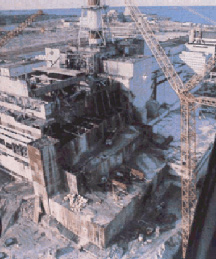 Chernobyl’s plight: because Ukraine’s Chernobyl radioactive disaster is continuing. (We supplied uranium for that other catastrophe — Fukushima.)
Insecurity: Ukraine’s dangerous nuclear industry due to civil war, ageing reactors, risks of smuggling and terrorism.
Political crisis: Ukraine’s notoriously corrupt and unstable political regime.
Let’s check those four reasons.
Economics
The global uranium industry is in a declining state. Price reporting companies describe repeated low and falling uranium prices. Australia’s uranium industry now accounts for 0.2 per cent of national export revenue — and that’s not counting profits that go overseas, due to the high degree of foreign ownership of companies mining uranium in Australia.
Chernobyl’s plight
The 30th anniversary of Ukraine’s Chernobyl nuclear accident is on 26 April 2016. Ukraine is still suffering from, and struggling with, the legacy of that radioactive catastrophe. The conservativeWorld Health Organisation (WHO) estimates the radiation caused deaths at 4,000 — based on itsreport ‘Health Effects of the Chernobyl Accident and Special Health Care Programmes’. The 2016 TORCH (The Other Report on Chernobyl) Report amplifies this discussion (summary here) but all sources agree that no conclusive figure can be given.
The legacy of the accident includes the struggle to contain the radioactivity of the shattered reactor.
Insecurity
This issue of nuclear security is another irony in this uranium sales deal. Julie Bishop and Ukraine President used the meeting of the Nuclear Security Summit in New York to discuss the sale. The focus of the Summit was the need to protect radioactive materials from dangerous zones, and from the risk of terrorists obtaining them.
You couldn’t pick a more dangerous zone than Ukraine
Ukraine’s Zaporizhia nuclear facility is Europe’s largest and is only 200 kilometres from the conflict zone in eastern Ukraine. Already there have been sabotage events that affected its nuclear programme.
All of these events have led to an additional emergency shutdown of the electrical network of two units at thermal power plants – the Dnieper and Uglegorskaya – and the emergency unloading by 500 MW of nuclear power plants in Ukraine. This includes Zaporozhskaya NPP and the South Ukrainian NPP. I want to stress that such emergency unloading of a nuclear plant – it is very dangerous. ~ Senior Ukrainian energy official Yuriy Katich.
Some commentators have described nuclear plants in the region as pre-deployed nuclear targets and there have already been armed incursions during the recent conflict period.
Bankwatch recently listed 10 reasons why Ukraine’s nuclear power stations are a security danger for Europe. These include Ukraine’s ageing reactors – some already having exceeded their planned lifespan – and restrictions on the nuclear regulator’s ability to inspect reactors. Bankwatch regards Ukraine as a huge financial risk to Europe:
The European Commission, the European Parliament, and EU governments – particularly in neighouring countries that could be affected by the Ukrainian government’s reckless nuclear adventure – need to demand Ukraine complies with its international obligations, especially when EU public money is involved.
Petro Poroshenko’s Government is responding to Bankwatch’s criticism with a lawsuit against Bankwatch’s member group National Ecological Centre of Ukraine (NECU), in an attempt to silence criticism and avoid public scrutiny. Organisations in five European countries have joined in a campaign for transparency about Ukraine’s nuclear programme.
Even Ukraine’s own Progress Report to the Nuclear Security Summit admits some safety problems, listing over 1400 sources of ionising radiation that are not under regulatory control.
Ukraine now has a messy and competitive nuclear power system, in which Western companiesAREVA and Westinghouse compete in marketing and upgrading nuclear reactors and lobby to sell nuclear fuel. But Russia actually controls the fuel supply, providing nuclear fuel to 13 out of Ukraine’s 15 reactors.
Ukraine is just next door to Moldova, the heart of a 2014 nuclear smuggling gang. With Ukraine’s secretive nuclear arrangements, and inadequate regulatory system, the possibility of theft of radioactive materials is a real one in Ukraine.
Political crisis
Oligarchs are reported to control 70 per cent of the state’s economy. The country has been described as a “cleptocracy” —with so much intrigue amongst corrupt politicians and oligarchs that it’s called “Ukraine’s Deep State”.
President Petro Poroshenko himself is a very successful businessman, whose business assets have increased over the past year. Before the last election, Poroshenko pledged to sell his company Roshen but now refuses to do so. He also owns a major TV channel. His private assets are larger than those of any other European leader. Poroshenko is currently involved in a real estate scandal.
Along with lawmaker and business partner Ihor Kononenko, Poroshenko is co-owner of the International Investment Bank. Kononenko is accused of being involved in a laundering scheme that moves money from Ukrprominvest (a group founded by Kononenko and Poroshenko) to the British Virgin Islands through offshore companies Intraco Management Ltd and Ernion. Economy Minister Aivaras Abromavicius, who worked to expose political corruption, resigned in disgust on 3 February, saying:
“Neither me nor my team have any desire to serve as a cover-up for the covert corruption, or become puppets for those who, very much like the “old” government, are trying to exercise control over the flow of public funds”.
Aivaras claimed that Prime Minister Mr Yatsenyuk and Mr Poroshenko were blocking reforms aimed at tackling corruption. Ukraine Prime Minister Arseniy Yatsenyuk resigned suddenly on 11 April, under pressure from Poroshenko, who has replaced him with close associate, Volodymyr Groysman. Several reformers from Ukraine’s previous government are departing after declining to serve under Mr Groysman.
The West is watching the Ukrainian regime carefully. The IMF has been providing a $17.5 billion support scheme to cash-strapped Ukraine but has put it on hold, due to the corruption and instability of the regime.
Early this month, the Netherlands held a referendum regarding a potential Ukraine-EU treaty on closer political and economic ties. A whopping 61 per cent (2.509 million people) voted against Ukraine’s association with the EU. European nations, as well as many Ukrainians share in loss of confidence in the government, following this referendum as well as revelations of scandals in the Prosecutor General’s Office.
All this concern came to a head with the revelations of the Panama Papers, in which President Poroshenko figures largely. Unlike Iceland’s President, Poroshenko has no intention of resigning. The West has been very quiet about the allegations against him — presumably they support anyone who is opposed to Russia’s Putin.
Poroshenko claims that his financial arrangements have all been legal. But not everyone agrees with that. Igor Lutsenko, a member of Verkhovna Rada, Supreme Council of Ukraine, outlines how Poroshenko violated Ukrainian law in setting up the British Virgin Islands firm.
For security reasons, Australia has suspended uranium sales to Russia. It seems extraordinary that Australia should now enter into a deal with even more unsafe and unstable Ukraine, in its present war and political crisis.
No doubt the federal parliament’s influential Joint Standing Committee on Treaties (JSCOT) will examine the planned deal, that Julie Bishop signed up to in New York with Ukrainian Energy and Coal Industry Minister Volodymyr Demchyshyn.
JSCOT recently warned against the agreement to sell uranium to India but its recommendations were ignored by the Coalition Government. Here’s hoping that there will be scrutiny on the Ukrainian agreement and that the government will pay attention.
France’s nuclear corporation faces massive costs for decommissioning nuclear reactors
Nuclear reactor clean-up weighs on EDF, FT.com, 19 Apr 16, Michael Stothard in Paris French utility faces questions about whether it has set aside enough to decommission power plants
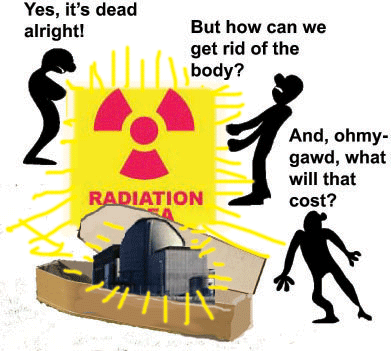 In 1997 French utility EDF started to dismantle its first nuclear power plant, a 30-year-old heavy water reactor in Brennilis, north-western France. It was expected to cost €250m.
The bill is now set to be at least half as much again, and the decommissioning is still not done. In fact, there has never been a full dismantling of a reactor in France, the only European country to get three-quarters of its electricity from nuclear power.
EDF, the operator of all 58 of France’s reactors, is preparing to build a new £18bn plant at Hinkley Point in the UK that some at the Paris-based company have warned is too dangerous given its stretched balance sheet. EDF’s other big reactor project, at Flamanville in France, is already six years behind schedule and €7.2bn over budget.
Hinkley and Flamanville have focused attention on another looming challenge for EDF: has the company set aside enough money to cover the huge cost of dismantling and cleaning up its existing nuclear power stations in France?
Unlike the UK, where the state has assumed much of the financial risk of taking apart nuclear reactors, in France it all falls on EDF, which has established a €23bn special fund for this purpose.
The €23bn — much of it invested in equities and bonds — has been set aside to cover what EDF estimates will be the €54bn cost of decommissioning the 58 reactors and safely storing their radioactive waste. This includes €23bn for dismantling the power stations, and €26bn for managing spent fuel………..
EDF faces several major investments. As well as the £18bn Hinkley Point project, EDF is involved in bailing out reactor designer Areva by buying a controlling stake in its reactor business for €2.5bn. It is also extending the life of France’s existing nuclear power stations until 2025, at a cost of €55bn.
And it is not just the decommissioning of the 58 reactors that is of concern. The estimated cost of storing radioactive waste — potentially for thousands of years — has been steadily rising………..http://www.ft.com/cms/s/0/c82ae2c4-0582-11e6-9b51-0fb5e65703ce.html#axzz46IzsG72i
Nuclear Ruins Still Toxic Even After 30 Years – Chernobyl
Chernobyl Aftertaste: Nuclear Ruins Still Toxic Even After 30 Years, Nature World News. 19 Apr 16 Thirty years after what many has considered their worst nightmare, the effects of the Chernobyl explosion still live on. Many may have escaped from death but most of those who have been affected by the incident are still carrying the upshot of the trauma……..
He observed the higher amount of homocysteine, an amino acid linked to heart disease on 80 percent of teenagers. Serious hormonal level changes were also found in 45 percent of the children. Premature death is larger in the places near the explosion site which clearly shows the long-time toxic effect of Chernobyl on human health……..http://www.natureworldnews.com/articles/20961/20160419/chernobyl-aftertaste-nuclear-ruins-still-toxic-even-after-30-years.htm
Chernobyl’s nuclear nightmare – a timeline
Chernobyl: Timeline of a nuclear nightmare http://www.wtsp.com/news/nation-now/chernobyl-timeline-of-a-nuclear-nightmare/138536883 Kim Hjelmgaard and USA TODAY , April 17, 2016

Timeline of a disaster
February 1986:
Ukraine’s Minister of Power and Electrification Vitali Sklyarov tells Soviet Life magazine that the odds of a meltdown at Chernobyl’s nuclear power plant are “one in 10,000 years.”
April 25, 1986:
The plant’s operators prepare to conduct a special test to see how an emergency water cooling system would fare in the event of a complete loss of power.
April 26, 1986:
The test begins at 1:23.04 a.m.
Fifty-six seconds later, pressure builds in the reactor No. 4 in the form of steam. This causes an explosion that lifts a 1,000-ton lid that covers volatile fuel elements. Radiation is immediately released into the air.
As oxygen pours into the reactor, a graphite fire begins. A chemical reaction causes a second explosion, and burning debris lands on the roof of reactor No. 3.
Meanwhile, the engineer responsible for the night shift, Alexander Akinhov, does not yet think the reactor’s core is damaged. “The reactor is OK, we have no problems,” he says. Akinhov subsequently dies from radiation illness.
Thirty separate fires develop. An alarm goes off at a local fire station.
At 1.45 a.m. firefighters arrive. They know nothing about radiation and aren’t wearing any protective clothing. Driver Grigory Khmel later recalls: “We saw graphite lying everywhere. I kicked a bit of it. Another fireman picked up a piece and said ‘hot.’ Neither of us had any idea of radiation. My colleagues Kolya, Pravik and others all went up the ladder of the reactor. I never saw them again.”
At 3:12 a.m. an alarm goes off at an army base deep in the Soviet Union. The general in charge decides to send troops. They arrive in Ukraine’s capital of Kiev at 2 p.m.
At 5 a.m. reactor No. 3 is shut down. Reactors No. 1 and 2 are stopped about 24 hours later.
April 27, 1986:
As more emergency response teams arrive, evacuations begin in a radius of 6 miles around the plant. April 28, 1986:
The Soviet Union publicly admits for the first time that an accident happened but gives few details.
An alarm goes off at a Swedish nuclear plant after the soles of shoes worn by a nuclear safety engineer there test positive for radioactivity. The radiation is traced to Chernobyl.
May 1, 1986:
May Day parades to celebrate workers go ahead as planned in Kiev and Belarus’ capital Minsk despite huge amounts of radiation continuing to be released. Wind, and radioactive clouds, blow back toward Kiev after initially drifting northwest toward Europe. Authorities believe that by holding these celebrations they will prevent panic.
May 14, 1986:
Soviet leader Mikhail Gorbachev talks about the accident live on television. He subsequently mobilizes hundreds of thousands of people, including military reservists from all parts of the Soviet Union, to help in the cleanup.
They become known as “liquidators.” Many will become ill and die from radiation-related diseases.
Gorbachev, in a 2006 memoir, says Chernobyl “was perhaps the real cause of the collapse of the Soviet Union.”
France committed to investing in Hinkley nuclear plant, even if it bankrupts EDF
 French ‘committed’ to investing in Hinkley C nuclear plant Plymouth Herald April 17, 2016 By Kate Langston The French government is “completely committed” to building the Westcountry’s new nuclear power plant at Hinkley, the country’s ministers have confirmed.
In an interview with the BBC, the French economy minister Emmanuel Macron stressed the £18 billion project is “very important” to the French state, which owns 85% of energy firm EDF.He added that backers still need to finalise some “technical and industrial” aspects of the Hinkley C deal, but should be in a position to sign in a “week or more”.
The assurances from Mr Macron come less than a week after he sparked fresh fears for the Somerset-based development by announcing he had “not yet made a decision” about the investment.
They also follow the publication of a letter from the main union representing EDF workers stating the firm is “on the edge of bankruptcy”, and should not be risking billions of pounds in the UK……..
The original date for the generator to come online has been pushed back from 20203 to 2025, and the estimated cost has soared from £16 billion to between £18 and £24.5 billion…….
Mr Macron told journalists that Hinkley is “important for [France’s] commitment to nuclear energy”. “We back Hinkley Point project, it’s very important for France, it’s very important for the nuclear sector and EDF,” he said.
“Now we have to finalise the work, and especially the technical and industrial work, very closely with EDF, with the British government, to be in a situation to sign in the coming week or more.”
The EDF board was due to meet to make a final decision on its investment in Hinkley in January, but this was postponed and is now expected to take place in May.
But John Sauven, director of environmental pressure group Greenpeace which is opposed to the new plant, has accused Mr Macron of saying one thing to a UK audience “and another to the French”.
“He has made it abundantly clear in French that no decision has been made,” he told the BBC. “The reasons are clear: the costs are rising, the problems are mounting, and the opposition in France is growing.
“The alternatives are looking increasingly attractive no matter which language you speak.”……….http://www.plymouthherald.co.uk/French-committed-investing-Hinkley-C-nuclear/story-29126276-detail/story.html
1 This Month




Shut down the radiation-damaged Heysham nuclear reactors now
To see nuclear-related stories in greater depth and intensity – go to https://nuclearinformation.wordpress.com

Say No to NASA’s Reckless Nuclear Reactor on the Moon
Say No to NASA’s Reckless Nuclear Reactor on the Moon
-
Archives
- October 2026 (302)
- September 2026 (339)
- August 2026 (330)
- July 2026 (355)
- June 2026 (287)
- May 2026 (306)
- April 2026 (356)
- March 2026 (251)
- February 2026 (267)
- January 2026 (308)
- December 2025 (358)
- November 2025 (359)
-
Categories
- 1
- 1 NUCLEAR ISSUES
- business and costs
- climate change
- culture and arts
- ENERGY
- environment
- health
- history
- indigenous issues
- Legal
- marketing of nuclear
- media
- opposition to nuclear
- PERSONAL STORIES
- politics
- politics international
- Religion and ethics
- safety
- secrets,lies and civil liberties
- spinbuster
- technology
- Uranium
- wastes
- weapons and war
- Women
- 2 WORLD
- ACTION
- AFRICA
- Atrocities
- AUSTRALIA
- Christina's notes
- Christina's themes
- culture and arts
- Events
- Fuk 2022
- Fuk 2023
- Fukushima 2017
- Fukushima 2018
- fukushima 2019
- Fukushima 2020
- Fukushima 2021
- general
- global warming
- Humour (God we need it)
- Nuclear
- RARE EARTHS
- Reference
- resources – print
- Resources -audiovicual
- Weekly Newsletter
- World
- World Nuclear
- YouTube
-
RSS
Entries RSS
Comments RSS

