Brexit vote- the finish for Hinkley nuclear power plan?
 Brexit vote is ‘final nail in the coffin’ for £18billion Hinkley Point nuclear power station plans, says energy expert
Brexit vote could spell end for long-delayed Hinkley power station project
Energy expert Dr Paul Dorfman voiced concerns about £18billion scheme
He said French-owned EDF ‘extremely unlikely’ to invest in current climate
Dorfman said there were too many political uncertainties for the company
By STEPHANIE LINNING and SAM TONKIN FOR MAILONLINE, 29 June 2016 The UK’s Brexit vote is the ‘final nail in the coffin’ for an £18billion project to build a new power station at Hinkley Point, a leading energy expert says.
Dr Paul Dorfman, an Honorary Senior Research Fellow at the Energy Institute, University College London, said EDF, a majority French-owned company, is ‘extremely unlikely’ to invest given the current economic climate.
The long-delayed project was due to have Hinkley Point power station producing 7 per cent of the UK’s electricity by 2017. But, if built, the earliest date it could now start doing so is 2025.
Even that looks a remote possibility according to Dr Dorfman, who told MailOnline Brexit was ‘the final nail in the coffin’ for Hinkley Point.
He said: ‘It gives everybody the chance to slip out without losing any more face.
‘How is France going to invest in the UK if the UK is no longer part of the union?
‘Not only that but the French nuclear industry has huge financial problems and unions are screaming that they don’t want it [Hinkley Point].’
Dr Dorfman, a member of the European Nuclear Energy Forum, also believes the knock-on effect would see plans for a third reactor at Sizewell power station in Suffolk ditched too.
‘If Hinkley fails, which it will do, then Sizewell will go the same way.’ he said. ‘That will have serious implications for the UK energy industry.’……..http://www.dailymail.co.uk/news/article-3663424/Nuclear-power-station-likely-18billion-casualty-Brexit-vote-says-government-advisor.html
Hinkley nuclear power plan, and the costs of its radioactive wastes
Russia’s spurious nuclear marketing deals
 Experts say some deals Rosatom boasts about are not contracts, just a “memorandum of understanding” or “framework agreement.” Many of these are with countries that will not be ready for nuclear for years, if not decades, such as Algeria, Argentina, Bolivia and Nigeria.
whether any new plants ever get built, Rosatom is likely to keep signing new deals around the globe.
“Rosatom likes to sign MOUs everywhere, they like one every few months, for the photo opportunity,”
Rosatom’s Global Nuclear Ambition Cramped by Kremlin Politics, Fortune by Reuters JUNE 26, 2016 The problem is that Russia wants to parlay Rosatom’s success into political leverage.
The $100 billion overseas order book of Russia’s nuclear power plant builder Rosatom—bigger than all its Western competitors combined—makes it look like the giant in its field.
But if the company—formed in 2007 from the Russian Atomic Energy Ministry and tasked with turning nuclear power into a major export industry—is ever to reach its potential as a global industrial giant, it will have to shed Russia’s reputation for using energy policy as a means to political ends.
Deal after deal has collapsed in Europe, where individual countries and the European Union as a whole consider it a priority to reduce dependency on Russian energy, and relations have deteriorated over Moscow’s intervention in Ukraine.
A project in fast-growing, energy-hungry Turkey—possibly the ideal market on paper—has been stalled because of a collapse in relations between the two countries supporting opposite sides in the Syrian civil war.
And an array of deals announced in poorer developing countries like Egypt, Jordan and Bangladesh seem unlikely to reach fruition any time soon because of the countries’ lack of experience with nuclear power, shortage of capital and grids that are unsuitable.
“Rosatom is pretty good at announcing $100 billion euros of orders in 25 countries, but not an awful lot of these are firm contracts, they are just bits of paper,” said Steve Kidd at East Cliff Consulting. Continue reading
Brexit might help UK to develop nuclear projects

 5 ways Brexit would transform European energy, Politico, Sara Stefanini , 24 June 16 Central and Eastern Europeans would lose a powerful ally, while nuclear and renewable investors would face an uncertain world.
A British vote to leave the European Union would force broad changes to the bloc’s energy policy, weakening its climate policy and removing a crucial Central European energy ally — but it could also give London far more freedom to pursue nuclear projects.
The U.K. is often an energy outlier in the EU, advocating nuclear power and shale gas sources shunned by others. And it tends to build alliances broadly aimed at keeping interference from Brussels to a minimum.
But both sides have a lot to lose.
A Brexit could undercut long-term climate policies in Brussels and London, and the EU would lose the U.K.’s pro-free market voice, which has historically helped tone down some more statist schemes coming from European capitals.
Here are the five ways that a Brexit would impact Europe’s energy and climate forecast:…….
4. The freedom to subsidize — maybe
One area the European Commission tries to avoid is state aid, particularly for energy projects.
But even when the Commission gives a green light, there’s the danger that another EU country might try to interfere. That’s what happened with Hinkley Point. Brussels approved a state aid plan in 2014, but Austria, backed by Luxembourg,challenged the decision in the European Court of Justice eight months later…….
Environmental advocates worry it would give the U.K. room to continue rolling back support for renewables in favor of other fuels.
“One of the reasons why the government has had to have a more sensible policy on these issues is because state aid disciplines have stopped it from throwing money at gas-powered stations and fracking and nuclear,” said Nick Mabey, chief executive of the environmental analysis group E3G……..http://www.politico.eu/article/uk-brexit-renewable-energy-hinkley-nuclear-interconnectors-gas-climate-emissions-paris/
Exit from the European Union could make it easier for Britain to develop nuclear power
A British vote to leave the European Union would force broad changes to the bloc’s energy policy, weakening its climate policy and removing a crucial Central European energy ally — but it could also give London far more freedom to pursue nuclear projects.
The U.K. is often an energy outlier in the EU, advocating nuclear power and shale gas sources shunned by others. And it tends to build alliances broadly aimed at keeping interference from Brussels to a minimum.
But both sides have a lot to lose.
A Brexit could undercut long-term climate policies in Brussels and London, and the EU would lose the U.K.’s pro-free market voice, which has historically helped tone down some more statist schemes coming from European capitals.
Here are the five ways that a Brexit would impact Europe’s energy and climate forecast:…….
 4. The freedom to subsidize — maybe
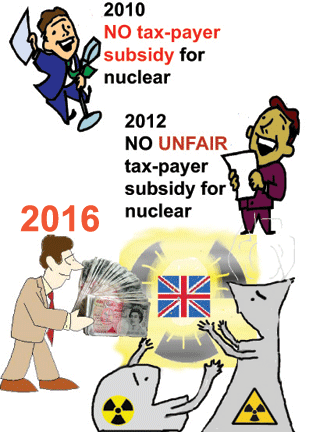
One area the European Commission tries to avoid is state aid, particularly for energy projects.
But even when the Commission gives a green light, there’s the danger that another EU country might try to interfere. That’s what happened with Hinkley Point. Brussels approved a state aid plan in 2014, but Austria, backed by Luxembourg,challenged the decision in the European Court of Justice eight months later…….
Environmental advocates worry it would give the U.K. room to continue rolling back support for renewables in favor of other fuels.
“One of the reasons why the government has had to have a more sensible policy on these issues is because state aid disciplines have stopped it from throwing money at gas-powered stations and fracking and nuclear,” said Nick Mabey, chief executive of the environmental analysis group E3G……..http://www.politico.eu/article/uk-brexit-renewable-energy-hinkley-nuclear-interconnectors-gas-climate-emissions-paris/
Senior EDF managers want Hinkley nuclear project to be postponed
EDF Managers Tell UK MPs That Hinkley Point C Should Be Postponed http://www.nucnet.org/all-the-news/2016/06/20/edf-managers-tell-uk-mps-that-hinkley-point-c-should-be-postponed
Plans & Construction 20 Jun (NucNet): Senior managers at EDF have told British MPs that a final investment decision (FID) on the planned Hinkley Point C nuclear project should be delayed until problems including the reactor design and “multi-billion litigation” over the Olkiluoto-3 project in Finland have been resolved.
The letter from EDF managers to the UK parliament’s energy and climate change committee is a setback for the proposed £18bn (€23bn, $26bn) nuclear station in Somerset, England. The station is a flagship of the government’s energy policy and is intended to provide seven percent of Britain’s electricity from about 2025.
In April, the state-controlled French company said it was delaying the FID until September while it consulted with trade unions.
A letter dated 13 June and addressed to Angus MacNeil, the chairman of the committee, from the Fédération Nationale des Cadres Supérieurs de l’Énergie (FNCS) union, “advises to delay the FID until better upfront industrial visibility is evidenced”.
Outstanding problems highlighted by in the letter include:
– Areva NP, the designer of the European pressurised water reactor (EPR) planned for Hinkley Point, “is currently facing a difficult situation”.
– The French nuclear safety authority (ASN) may not approve operation of the Flamanville-3 EPR under construction in northwest France due to various anomalies with the reactor vessel bottom and the reactor vessel head.
– There may be “identical flaws” in an Areva EPR being built at Taishan-1 in China.
– Litigation between Areva and the Finnish energy group TVO over delays to the Olkiluoto-3 EPR remain unsettled.
– An EDF offer to purchase Areva expired on 31 March, leaving “governance uncertainties upon the implementation of the Hinkley Point C project”.
The letter says that on 25 May, ASN declared at an annual hearing in the French parliament that financial and economic challenges that both EDF and Areva are facing would be “time consuming”. The necessary reorganisations “would need long delays before a proper recovery happens” and ASN would prioritise regulatory oversight of the existing fleet rather than any new project.
According to the letter, ASN is concerned that while EDF is dedicating its efforts to new nuclear projects, the financing of safety improvements for the normal operation of the French nuclear fleet could be delayed or even given up.
The letter says “heavy evidence” still needs to be brought prior to further commitments, in order to make those commitments “gain robustness and reliability”.
On 7 June, three French workers unions sent a letter to energy minister Ségolène Royale asking for clarification about the “orientation” of the French nuclear industry.
Vincent de Rivaz, the chief executive officer of EDF’s UK subsidiary EDF Energy told MPs last month that he could not give a definite time for when the company will make the FID.
Mr de Rivaz was called to reappear before the committee after indicating at an appearance in March that the FID could be taken by early May. The committee asked him to explain why that had not happened.
The letter is online: http://bit.ly/1Uc8N0F
Russia’s massive nuclear-powered icebreaker to seek oil reserves in Arctic
Arktika is just one icebreaker in a class known as Project 22220. The other two — Sibir, which was laid down in May 2015, and Ural — are also planned. If completed, Sibir will reportedly have the propulsion power of 110 MW, almost twice as powerful as Arktika. Both ships are part of a $1.2 billion contract that Baltic Shipyards signed in 2014 with Rosatom State Nuclear Energy Corp.
Why would Russia need nuclear-powered icebreakers in the first place? Obviously, for defense. Icebreakers can clear a path for military ships, allowing for increased mobility and range for the Russian naval fleet.
The nuclear power door is only just still open in Sweden
 Sweden’s deal leaves door to nuclear power open, but only just, Reuters STOCKHOLM, JUNE 23 | BY DANIEL DICKSON AND NERIJUS ADOMAITIS Sweden has agreed to cut taxes on nuclear power generators and allow for the construction of new reactors but policymakers have yet to work out how that fits with a commitment to using 100 percent renewable energy……..
Spokeswomen for the Energy Minister Ibrahim Baylan and for the Green Party, a junior member of the ruling coalition……….the target is formulated as electricity production… that means all production in Sweden is renewable,” Lise Nordin, Green Party energy policy spokeswoman and member of the parliament, told Reuters.
While the agreement allows power generators “in theory” to build new reactors, in reality they would be too costly, she added.
“The probability that new nuclear power will be built is zero,” Nordin said……..http://uk.reuters.com/article/sweden-nuclearpower-idUKL8N19E2VM
NUCLEAR-capable ballistic missiles for Russia – placed in Europe
Russia to deploy NUCLEAR-capable ballistic missiles in the heart of EUROPE, Express, UK 23 June 16 RUSSIA plans to station advanced nuclear-capable missiles deep inside Europe – putting vast swathes of the continent in the crosshairs of Moscow’s short-range ballistic missile programme. By TOM BATCHELOR, Jun 23, 2016 Kremlin insiders say the Russian enclave of Kaliningrad – on the Baltic Sea wedged between Poland and Lithuania – will host the Iskander missile – dubbed the Stone by Nato.
Crimea, which was annexed from the Ukraine in 2014, could also host a second Iskander missile base, Russian defence sources claim.
Russia has been accused of blatant acts of aggression in eastern Europe and the Baltics, with land grabs, military exercises and close fly-bys of its fighter jets.
The move is in defiance of a US-backed Nato missile shield that was erected in Romania last month, with a second planned for Poland in 2018.
With a range of roughly 300 miles, the Iskander missile could hit targets as far away as eastern Germany, the entire Baltic region and Poland, as well as parts of Sweden.
But experts say the targets it will cover can be struck by longer-range Russian missiles anyway.
Relations between Russia and the West have plunged to their lowest point since the Cold War in recent months.
Both sides have ramped up their defence spending, missile programmes and defensive shields as Europe enters what many observers believe is a new Cold War…….http://www.express.co.uk/news/world/682701/Russia-station-Iskander-nuclear-missiles-Kaliningrad-Cold-War-tensions
Nestle’s new deal for powering its UK and Ireland operations with wind energy
 NEW RENEWABLE POWER SOURCE FOR NESTLE UK AND IRELAND OPERATIONS LONDON, The Climate Group, 22 June 16 Nestlé has signed a new deal to power around half of its UK and Ireland operations with wind from the Scottish Highlands.
An initial 15 year Power Partnership Agreement with Community Wind Power will see a brand new nine turbine wind farm open up in Dumfries and Galloway in the first half of 2017. It will produce approximately 125GWh of power per annum, meeting around 50% of Nestlés electricity demand in the UK and Ireland – equivalent to 30,000 homes.
Earlier this year, Nestlé UK & Ireland announced that all its grid supplied-electricity would come from renewable sources, in a deal with EDF Energy. This currently accounts for all of Nestlés electricity use in the UK and Ireland.
As a member of RE100, Nestlé is committed to transitioning its electricity use to 100% renewable electricity not just in the UK, but across its global operations. The latest available data shows that in 2015, 8.4% of Nestlés total electricity consumption was being sourced from renewable power. Today’s development is another positive step towards its global goal.
Dame Fiona Kendrick, Chairman & CEO of Nestlé UK & Ireland, said: “This is a newly commissioned wind farm, generating new energy, creating capacity that didn’t previously exist and capable of providing half of our electricity needs. It’s a proud moment for us and means we have reached another key milestone in our efforts to become a sustainable business.”…….http://www.theclimategroup.org/what-we-do/news-and-blogs/new-renewable-power-source-for-nestl-uk-and-ireland-operations/?platform=hootsuite
Germany criticises NATO’s warmongering policy towards Russia
Germany slams NATO ‘warmongering’ on Russia Berlin , Yahoo News, 18 June 16 (AFP) – German Foreign Minister Frank-Walter Steinmeier has criticised NATO for having a bellicose policy towards Russia, describing it as “warmongering”, the German daily Bild reported.
Steinmeier pointed to the deployment of NATO troops near borders with Russia in the military alliance’s Baltic and east European member states.
“What we should avoid today is inflaming the situation by warmongering and stomping boots,” Steinmeier told Bild in an interview to be published Sunday. “Anyone who thinks you can increase security in the alliance with symbolic parades of tanks near the eastern borders, is mistaken,” Germany’s top diplomat added.
NATO had announced on Monday that it would deploy four battalions to Estonia, Latvia, Lithuania and Poland to counter a more assertive Russia, ahead of a landmark summit in Warsaw next month…….https://www.yahoo.com/news/germany-slams-nato-warmongering-russia-115515814.html
Spanish village scarred by American air crash, with 4 hydrogen nuclear bombs on board
Even Without Detonation, 4 Hydrogen Bombs From ’66 Scar Spanish Village NYT, By RAPHAEL MINDER JUNE 20, 2016 PALOMARES, Spain — José Manuel González Navarro, a mechanic, headed out of this seaside village on his motorbike one morning 50 years ago when he heard explosions overhead and looked up to see a ball of fire in the sky. Debris started to shower down, some “falling very slowly, like if a giant tree was shedding shiny metal leaves,” he recalled in an interview.
“I was just thinking about what objects might prove useful,” he said. “I liked fishing, and those parachute straps, thin but very solid, were clearly perfect to be turned into a weight belt for diving.”
Like many in Palomares, Mr. González Navarro, now 71, figured he had witnessed a military air crash. But he was unaware that a United States Air Force bomber and a refueling jet collided, accidentally sending four hydrogen bombs hurtling toward Palomares. Although no warheads detonated, two of the bombs shattered, spreading plutonium over the village.
Whereas American service members are complaining that the hurried cleanup effort carried out by the military jeopardized their health, many in Palomares lament the damage the accident has done to their community.
“Living in a radioactive site that nobody really has wanted to clean has brought us a lot of bad publicity and has been something hanging over our head like a sword of Damocles,” said Juan José Pérez Celdrán, a former mayor of Palomares. For years after the crash, local tomatoes, lettuce and watermelons did not carry any Palomares label because of the stigma associated with the place.
And the cleanup effort continues half a century later.
In 1966, American troops removed about 5,000 barrels of contaminated soil after the accident and called the cleanup complete. But about a decade ago, the Spanish authorities found elevated levels of plutonium over 99 acres. Some of the areas of elevated radioactivity almost touched private homes, as well as fields and greenhouses. Scientists from Ciemat, the Spanish nuclear agency, fenced off the most hazardous sections and began pressuring the United States to remove about 65,000 cubic yards of radioactive soil — far more than was removed right after the accident……..http://www.nytimes.com/2016/06/21/world/europe/spain-palomares-hydrogen-bombs.html?_r=1
US plane with hydrogen bomb crashed in Spain: cleanup workers sick from plutonium exposure

 Decades Later, Sickness Among Airmen After a Hydrogen Bomb Accident, NYT, by DAVE PHILIPPSJUNE 19, 2016Alarms sounded on United States Air Force bases in Spain and officers began packing all the low-ranking troops they could grab onto buses for a secret mission. There were cooks, grocery clerks and even musicians from the Air Force band.
It was a late winter night in 1966 and a fully loaded B-52 bomber on a Cold War nuclear patrol had collided with a refueling jet high over the Spanish coast, freeing four hydrogen bombs that went tumbling toward a farming village called Palomares, a patchwork of small fields and tile-roofed white houses in an out-of-the-way corner of Spain’s rugged southern coast that had changed little since Roman times.
 It was one of the biggest nuclear accidents in history, and the United States wanted it cleaned up quickly and quietly. But if the men getting onto buses were told anything about the Air Force’s plan for them to clean up spilled radioactive material, it was usually, “Don’t worry.”
“There was no talk about radiation or plutonium or anything else,” said Frank B. Thompson, a then 22-year-old trombone player who spent days searching contaminated fields without protective equipment or even a change of clothes. “They told us it was safe, and we were dumb enough, I guess, to believe them.”
Mr. Thompson, 72, now has cancer in his liver, a lung and a kidney. He pays $2,200 a month for treatment that would be free at a Veterans Affairs hospital if the Air Force recognized him as a victim of radiation. But for 50 years, the Air Force has maintained that there was no harmful radiation at the crash site. It says the danger of contamination was minimal and strict safety measures ensured that all of the 1,600 troops who cleaned it up were protected.
Interviews with dozens of men like Mr. Thompson and details from never before published declassified documents tell a different story. Radiation near the bombs was so high it sent the military’s monitoring equipment off the scales. Troops spent months shoveling toxic dust, wearing little more protection than cotton fatigues. And when tests taken during the cleanup suggested men had alarmingly high plutonium contamination, the Air Force threw out the results, calling them “clearly unrealistic.”
In the decades since, the Air Force has purposefully kept radiation test results out of the men’s medical files and resisted calls to retest them, even when the calls came from one of the Air Force’s own studies.
Many men say they are suffering with the crippling effects of plutonium poisoning. Of 40 veterans who helped with the cleanup who The New York Times identified, 21 had cancer. Nine had died from it. It is impossible to connect individual cancers to a single exposure to radiation. And no formal mortality study has ever been done to determine whether there is an elevated incidence of disease. The only evidence the men have to rely on are anecdotes of friends they watched wither away.
“John Young, dead of cancer … Dudley Easton, cancer … Furmanksi, cancer,” said Larry L. Slone, 76, in an interview, laboring through tremors caused by a neurological disorder.
At the crash site, Mr. Slone, a military police officer at the time, said he was given a plastic bag and told to pick up radioactive fragments with his bare hands. “A couple times they checked me with a Geiger counter and it went clear off the scale,” he said. “But they never took my name, never followed up with me.”
Monitoring of the village in Spain has also been haphazard, declassified documents show. The United States promised to pay for a public health program to monitor the long-term effects of radiation there, but for decades provided little funding. Until the 1980s, Spanish scientists often relied on broken and outdated equipment, and lacked the resources to follow up on potential ramifications, including leukemia deaths in children. Today, several fenced-off areas are still contaminated, and the long-term health effect on villagers is poorly understood.
Many of the Americans who cleaned up after the bombs are trying to get full health care coverage and disability compensation from the Department of Veterans Affairs. But the department relies on Air Force records, and since the Air Force records say no one was harmed in Palomares, the agency rejects claims again and again.
The Air Force also denies any harm was done to 500 other veterans who cleaned up a nearly identical crash in Thule, Greenland, in 1968. Those veterans tried to sue the Defense Department in 1995, but the case was dismissed because federal law shields the military from negligence claims by troops. All of the named plaintiffs have since died of cancer…….
“First they denied I was even there, then they denied there was any radiation,” said Ronald R. Howell, 71, who recently had a brain tumor removed. “I submit a claim, and they deny. I submit appeal, and they deny. Now I’m all out of appeals.” He sighed, then continued. “Pretty soon, we’ll all be dead and they will have succeeded at covering this whole thing up.”……
The Pentagon focused on finding the bomb lost in the ocean and largely ignored the danger of loose plutonium, the Air Force personnel at the site said. Troops traipsed needlessly through highly contaminated tomato fields with no safety gear. http://www.nytimes.com/2016/06/20/us/decades-later-sickness-among-airmen-after-a-hydrogen-bomb-accident.html
Call for Britain to have Russia build UK’s new nuclear stations
 UK government needs a nuclear plan B, says Tim Yeo, Guardian, Terry Macalister, 19 June 16, “…….. Tim Yeo, a former chair of the energy and climate change committee, said the government should also consider whether the Russian state operator, Rosatom, or the British state could build new atomic plants.
The Hinkley project in Somerset has been hit by a series of delays, with its developer, EDF, recently postponing a final investment decision until September.
Yeo said continuing opposition from EDF unions to spending huge sums of money in Britain and political uncertainty ahead of the French elections next spring could hold up the project further……..
Yeo said the Russian political situation made it harder for the UK government, but Russian nuclear sources have previously said Rosatom would like to talk.
In 2014, a senior Decc officialconfirmed that there had been serious contact between the two sides……
The pro-nuclear campaigner said the total cost of any new reactor to energy billpayers could be reduced if the British government became directly involved, as some City analysts have claimed…….https://www.theguardian.com/uk-news/2016/jun/19/uk-government-should-have-a-nuclear-plan-b-tim-yeo-hinkley-point-bradwell-scheme
America fails to monitor health of Spanish community affected by hydrogen bomb accident
Decades Later, Sickness Among Airmen After a Hydrogen Bomb Accident, NYT, by DAVE PHILIPPS JUNE 19, 2016 “……….Spain’s Monitoring
The United States promised to pay for long-term monitoring of health in the village, but for decades it provided only about 15 percent of funding, with Spain paying the rest, according to a declassified Department of Energy summary. Broken air-monitoring stations went unfixed and equipment was often old and unreliable. In the early 1970s, an Atomic Energy Commission scientist noted, the Spanish field monitoring team consisted of a lone graduate student.
Reports of two children dying of leukemia during that time went uninvestigated. The lead Spanish scientist monitoring the population told American counterparts in a 1976 memo that, in light of the leukemia cases, Palomares needed “some kind of medical surveillance of the population to keep watch for diseases or deaths.” None was created.
In the late 1990s, after years of pressure from Spain, the United States agreed to increase funding. New surveys of the village found extensive contamination that had gone undetected, including some areas where radiation was 20 times the permissible level for inhabited areas. In 2004, Spain quietly fenced off the most contaminated land near the bomb craters.
Since then, Spain has urged the United States to finish cleaning the site.
Because of the uneven monitoring, the effect on public health is far from clear. A small mortality study in 2005 found cancer rates had gone up in the village compared with similar villages in the region, but the author, Pedro Antonio Martínez Pinilla, an epidemiologist, cautioned that the results could be because of random error, and urged more study.
At that time, a United States Department of Energy scientist, Terry Hamilton, proposed another study, noting problems in Spain’s monitoring techniques. “It was clear the uptake of plutonium was poorly understood,” he said in an interview. The department did not approve his proposal…..
About a fifth of the plutonium spread in 1966 is still estimated to contaminate the area. After years of pressure, the United States agreed in 2015 to clean up the remaining plutonium, but there is no approved plan or timetable…….http://www.nytimes.com/2016/06/20/us/decades-later-sickness-among-airmen-after-a-hydrogen-bomb-accident.html
1 This Month




Shut down the radiation-damaged Heysham nuclear reactors now
To see nuclear-related stories in greater depth and intensity – go to https://nuclearinformation.wordpress.com

Say No to NASA’s Reckless Nuclear Reactor on the Moon
Say No to NASA’s Reckless Nuclear Reactor on the Moon
-
Archives
- October 2026 (301)
- September 2026 (339)
- August 2026 (330)
- July 2026 (355)
- June 2026 (287)
- May 2026 (306)
- April 2026 (356)
- March 2026 (251)
- February 2026 (267)
- January 2026 (308)
- December 2025 (358)
- November 2025 (359)
-
Categories
- 1
- 1 NUCLEAR ISSUES
- business and costs
- climate change
- culture and arts
- ENERGY
- environment
- health
- history
- indigenous issues
- Legal
- marketing of nuclear
- media
- opposition to nuclear
- PERSONAL STORIES
- politics
- politics international
- Religion and ethics
- safety
- secrets,lies and civil liberties
- spinbuster
- technology
- Uranium
- wastes
- weapons and war
- Women
- 2 WORLD
- ACTION
- AFRICA
- Atrocities
- AUSTRALIA
- Christina's notes
- Christina's themes
- culture and arts
- Events
- Fuk 2022
- Fuk 2023
- Fukushima 2017
- Fukushima 2018
- fukushima 2019
- Fukushima 2020
- Fukushima 2021
- general
- global warming
- Humour (God we need it)
- Nuclear
- RARE EARTHS
- Reference
- resources – print
- Resources -audiovicual
- Weekly Newsletter
- World
- World Nuclear
- YouTube
-
RSS
Entries RSS
Comments RSS

