Kiev’s new nuclear project puts Europe at risk

 ‘Threat of 2nd Chernobyl’: Kiev’s new nuclear project puts Europe at risk, Greens warn
The Ukrainian Greens Association, a non-profit environmentalist organization, listed the risks in a statement released on Monday.
“We are deeply concerned about plans to build a spent nuclear fuel storage in the upper reaches of the Dnepr River close to densely populated places,” the statement said, citing a speech made by the association’s spokeswoman, Anna Rak, at the first Nuclear Energy Policy Forum in Brussels on June 30.
Rak also emphasized that the government plans “to secretly fast-track the construction of a surface dry, spent nuclear fuel storage system… close to the Dnepr river,” ignoring basic safety standards and “creating the threat of a second Chernobyl.”
Ukraine’s Greens stressed that the decision to build the facility just 70 kilometers away from the Ukrainian capital of Kiev, in Chernobyl’s exclusion zone, was taken “without a proper environmental impact assessment and public consultation with the [local] residents.”
They also warned that the contractor for the project, Holtec International, actually lacks sufficient experience while the technology it plans to use in construction has never been tested or tried in any other country.
The association added that the procedure of choosing the contractor was “neither transparent nor open,” warning that Ukraine may once again become a subject to “unpredictable and dangerous nuclear experiments,” apparently referring to the Chernobyl nuclear disaster.
The organization demanded that Ukrainian authorities “ensure that the project complies with all international rules and standards before the construction is launched” and emphasized that the residents of the Kiev region have “an unconditional right” to get all relevant information about the project and to take part in the discussion concerning its construction.
The Ukrainian Greens Association also urged the European Commission, the European Parliament and international environmental bodies to carry out an “independent environmental assessment of the project.”……..https://www.rt.com/news/349590-nuclear-fuel-ukraine-eu/
Brexit uncertainty adding to anxiety of former supporters of UK’s Hinkley nuclear project

 Hinkley Point C critics try to derail it amid Brexit vote turmoil
Board of EDF, energy project’s key backer, is at risk of fracturing as ex-supporters worry about uncertainty of British government, Guardian, Terry Macalister, 2 July 16 Britain’s flagship energy project, Hinkley Point C, is hanging by a thread as critics inside key backer EDF use the political turmoil from the Brexit vote to try to derailthe already delayed £18bn scheme.
Jean Bernard Levy, the EDF group chief executive, and the French and British governments, have in recent days insisted they are as committed as ever to a positive final investment decision being taken as soon as possible.
But well-placed sources in Paris have told the Guardian that the already divided EDF board, which must make that decision, is in danger of fracturing further as former supporters of the project worry about Brexit.
“The situation for Levy was already very delicate,” said one source. “But it has become a lot more difficult because there is so little certainty around the British government,” they added. “No one could know today which way a vote [of the board on Hinkley] would go.”
Those arguing against the project say it is impossible to make any decisions when it is unclear who will be the future prime minister, chancellor of the exchequer and energy and climate change secretary.
Highly critical EDF unions in France, which have six representatives on the main board, are pressing waiverers among the five independent board members who have previously supported Levy to change their minds…….https://www.theguardian.com/uk-news/2016/jul/01/hinkley-point-c-critics-try-to-derail-it-amid-brexit-vote-turmoil?CMP=share_btn_tw
Struggling nuclear company EDF now looking for a nuclear shut-down business
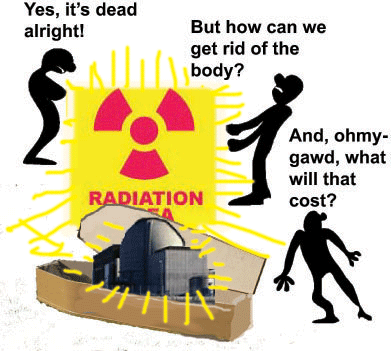 France’s EDF sets sights on $200 bln nuclear decommissioning market By Bate Felix and Benjamin Mallet PARIS, July 4 (Reuters) – EDF aims to snare a sizeable share of the global nuclear decommissioning market, worth an estimated 200 billion euros ($222 billion) over the next 15 years, by virtue of experience gained in dismantling its old reactors.
The French state-controlled utility is in the process of dismantling nine reactors and has 58 others in operation, supplying France with about 75 percent of its energy needs.
Worldwide, 110 reactors have been halted and will need to be safely dismantled, EDF executives said, adding that the company has a team of 800 experts in the complex process.
“Nuclear decommissioning is a very important market with opportunities for the international and local nuclear sector,” Dominique Miniere, executive director for EDF’s nuclear and thermal plants, told journalists in Paris……
Based on the completed decommissioning of reactors in the United States, EDF estimates that it will cost about 400 million euros to dismantle a 900 megawatt pressurised water reactor — a process that could take up to 15 years.
The company’s first dismantling of a nuclear reactor in France — the Chooz A reactor that ceased operating in 1991 — is expected to be completed in 2022. ($1 = 0.8974 euros) (Editing by David Goodman) http://af.reuters.com/article/energyOilNews/idAFL8N19Q3N4
Delay £18bn building of Hinkley nuclear station – EDF workers’ committee
 EDF workers’ committee expected to demand that nuclear power plant at Hinkley Point in Somerset is delayed http://www.thisismoney.co.uk/money/markets/article-3672592/EDF-workers-committee-expected-demand-nuclear-power-plant-Hinkley-Point-Somerset-delayed.html By CITY & FINANCE REPORTER FOR THE DAILY MAIL, 4 July 2016 EDF’S workers’ committee is expected to demand today that a nuclear power plant at Hinkley, Somerset, is delayed.
The energy firm has yet to make a decision on how to raise £18bn of funds needed for the power station, and has put off deciding until September to allow time to consult the unions.
The unions are obliged to deliver their opinion today on whether Hinkley should go ahead. But three of them issued a statement last week to say that Britain’s vote to leave the European Union added new elements of uncertainty.
It follows a legal action launched earlier this month in French courts by EDF’s Works Council, who asked for the project to be put off.
It is feared that if the unions do not support the project it could further delay Hinkley, which was due to be completed in 2017 but is currently expected to be finished by 2025.
Complications in who pays for costs of Germany’s nuclear phase-out
Who pays for Germany’s nuclear phase-out?,DW Hilke Fischer 1 July 16 Germany’s decision a few years ago to phase out nuclear power was an abrupt move. But it still remains unclear who foots the bill for shutting down the nation’s nuclear plants, as utilities seek damages from the state. Months after a Tsunami resulted in a nuclear disaster at the Fukushima Daiichi plant in Japan, Germany’s coalition government, led by Chancellor Angela Merkel, decided to phase out nuclear power in the country.
Immediately after Fukushima, eight of 17 functioning nuclear plants were shut down, and the government’s decision established a timeline of taking the remaining plants offline by 2022.
Five years later, it’s gradually becoming clear how much this hasty exit could cost. Feeling dispossessed by the move, major utilities have filed a raft of lawsuits claiming damage payments from the government amounting to around 20 billion euros ($22.3 billion).
An eagerly awaited ruling
Complying with the government’s nuclear moratorium, Germany’s biggest energy provider Eon had to shut down its power plants Isar 1 and Unterweser. The company has therefore sued both the federal government as well as the state governments of Bavaria and Lower Saxony, seeking damage payments to the tune of around 380 million euros. The state court of Hanover is expected to deliver its ruling on the case on Monday, July 4………..
the energy companies take issue not only with the moratorium. They – RWE, Eon and Vattenfall – have also lodged numerous cases at the constitutional court in Karlsruhe against the government’s entire policy mandating an accelerated exit from nuclear power……..
State responsible for disposal costs?
Lodging cases before the constitutional court is a pressure tactic, said Green Party politician Oliver Krischer in March. “It’s to obtain concessions over the financing of nuclear waste disposal,” he remarked, pointing to the nuclear commission the government had set up to advise it on how to allocate the costs of storage and disposal of nuclear waste as well as the decommissioning of the power stations.
At the end of April, the commission presented its recommendations: The companies have to bear the costs of decommissioning the nuclear power plants. Furthermore, Eon, RWE, Vattenfall and EnBW are to pay 23.3 billion euros into a fund to manage the storage and disposal of nuclear waste.
In return, the state is to take on all the residual financial risks associated with radioactive waste management. A number of scientists and economists argue that the costs would be much higher than the 23.3 billion euros, and that the taxpayers would be on the hook for those cost overruns.
Germany’s parliament is expected to vote on the recommendations after the summer break, and should it approve them, they would come into force at the end of the year. http://www.dw.com/en/who-pays-for-germanys-nuclear-phase-out/a-19372796
Brexit – the ‘coup de grace’ for Britain’s new nuclear?
Brexit curse hits nuclear power, new London runway, Ecologist, Paul Brown 29th June 2016 Following the vote to leave the EU, the UK’s energy and climate change policy faces major challenges, writes Paul Brown, with new nuclear power and a third London runway at Heathrow runway looking like the first casualties. …..Plans for four giant nuclear reactors to be built in Englandby the French are almost certain to be scrapped because opposition among trade unions in France has hardened since last week’s vote……. time is rolling by and Électricité de France (EDF) is due to make a ‘final investment decision’ in September to build two 1,650 MW nuclear reactors at Hinkley Point in southwest England. They were expected to be followed by two more to the east of London.
Time for the ‘coup de grace’
The Hinkley decision, already postponed repeatedly, has been in doubt for months because of the parlous financial state of EDF and the increasing opposition of a group of French trade unions, whose members fear that the building of nuclear power stations in the UK would divert much-needed investment away from home.
There are also question marks about whether the nuclear design is viable at all, since construction delays and cost over-runs have dogged the prototypes, and none is yet producing electricity.
The backlash against the British decision to leave the EU will not affect the decision, according to the immediate reaction from EDF and the French government, but the chances of the scheme being given the go-ahead in September now seem remote.
Mycle Schneider, an independent nuclear and energy industry analyst based in Paris, says that the Brexit vote would hand EDF “the perfect occasion to pull the plug on Hinkley Point without losing face”. He believes that the Brexit vote represents a “disaster” for EDF’s plan, and that a decision to press ahead with Hinkley Point is unimaginable at the moment……
Can’t pay, won’t pay?
Until the Brexit vote, the UK government was committed to building 10 new nuclear power stations as part of its ‘low carbon’ plan for the energy sector. The programme always seemed improbable, given the state of the nuclear industry worldwide, but getting private investors to support such a policy now seems even less likely.
One of the unlooked-for side-effects of the decision is to take the UK outside theEuratom Treaty that safeguards nuclear materials from misuse. Since the UK has the largest stock of plutonium in the world, and a large trade in nuclear materials with Europe, the US and Japan, this creates serious problems over who now regulates the industry. http://www.theecologist.org/News/news_round_up/2987861/brexit_curse_hits_nuclear_power_new_london_runway.htm
Brexit could result in Britain’s unilateral nuclear disarmament.
Nuclear Brexit Bulletin of the Atomic Scientists , 30 June 16, HUGH GUSTERSON Hugh Gusterson is a professor of anthropology and international affairs at George Washington University. His expertise is in nuclear culture, international security, and more
For those who favor disarmament, this would be good. For those who hoped Britain’s departure from the European Union would restore its glory on the world stage, it presumably would not…..
Insofar as pundits have speculated about the international security implications of Brexit, they have pointed out that British diplomats will be so focused on renegotiating trade agreements with the rest of the world that they will devote fewer resources to the turmoil in the Middle East and simmering tension with Russia, and that Britain will therefore be a less reliable ally for the United States. (This partly explains why Russian President Vladimir Putin greeted Brexit with a grin.) They assume, though, that Britain will remain strongly committed to NATO.
One problem with this assumption is that the UK may no longer exist as a country within a few years. It looks likely that, if Brexit proceeds, Scotland will withdraw from the United Kingdom, and there is a possibility that Northern Ireland will follow suit……
In the Brexit referendum, every single district in Scotland voted to remain in the EU, and a decisive majority of Scots—62 percent—voted to stay. It now looks as if the only way they can remain in the EU is to secede from the United Kingdom and apply for EU membership as a separate nation. A poll taken after the Brexit vote found that 59 percent of Scots say they would now vote for independence from Great Britain. Nicola Sturgeon, the shrewd and charismatic leader of the Scottish National Party, has stated her interest in moving toward a second referendum on Scottish independence.
For 30 years, the Scottish National Party said that an independent Scotland would stay out of NATO. It narrowly reversed that position in 2012, but it remains adamantly opposed to the stationing of any nuclear weapons in Scotland. That could be a problem since all of Britain’s nuclear weapons are stationed in Scotland. …..
A British parliamentary report in 2012, written in response to increasing concerns that Scotland might secede from the United Kingdom, concluded that finding a suitable base to replace Faslane and Coulport would be “highly problematic, very expensive, and fraught with political difficulties.” For one thing, it would take 10 to 20 years to construct a new base. And according to a 2014 study, doing so would cost English taxpayers about £3 billion (or some $4 billion at today’s exchange rate, almost certainly an underestimate)—on top of the £20 billion it will already cost to replace the four decaying nuclear submarines. This money will be particularly hard to find if British GDP declines sharply, as predicted, following disengagement from the European single market.
That is assuming a suitable new site could even be found, but the three sites that have been discussed in the media all have significant problems……..
It is becoming evident that, in addition to all the negative consequences of Brexit opponents warned about, there will be additional unforeseen and unintended consequences that will only become clear over time. In a supreme irony, one of those consequences may be that the English nationalist vote strips Britain of its status as a nuclear power. http://thebulletin.org/nuclear-brexit9620
Scrapping Trident won’t destroy tens of thousands of jobs
 Ignore pro-nuclear spin: CND says scrapping Trident won’t destroy tens of thousands of jobs https://www.rt.com/uk/349024-trident-jobs-cnd-replacement/30 Jun, 2016 Any threat to jobs resulting from a decision to scrap Britain’s Trident nuclear weapons system must be seen in its actual context and not through the prism of pro-nuclear spin, the Campaign for Nuclear Disarmament (CND) claims in a new report.
Released on Thursday, “Trident and jobs: The employment implications of cancelling Trident replacement” picks apart the myth that scrapping the nuclear weapons would wipe out tens of thousands of jobs.
The government claims that “the current system and its replacement provide civilian jobs, some of them highly-skilled and well paid, many in deprived areas where alternative employment of the same quality is scarce,” said CND.
CND argues that the current figure of around 30,000 usually given for the number of jobs dependent on the current and proposed deterrents is overestimated, and that armed forces personnel and others must be subtracted from that sum in order to reach a true figure.
Those workers, the group says, would be reallocated to other parts of the military or set to work decommissioning the subs if the program was scrapped.
CND say the actual figure is closer to 11,000 and that Trident itself cannot justify the money required to continue funding it given that it is not self-sustaining, incredibly costly, and effectively useless.
Instead, they argue that “a host of industries are in need of investment, from wind and wave power, to nuclear decommissioning, to aerospace technology to marine industries and others.”
British industry as a whole “faces chronic skills shortages which public sector-led investment can address,” the group adds.
“The money saved by not replacing Trident would provide the finances for this program. This would amount to an industrial strategy for Britain with the existing workforce and regions at its core.”
At a cost of £205 billion, CND posit that replacing Trident cannot be justified on its own terms, and other uses for the money and the workers must be found.
Moldova hesitant – for now, resisting China’s nuclear marketing
 Will China Bring Nuclear Power to Moldova?, Eurasia Net 30 June 16 China appears willing to help Moldova become a nuclear power. But for now officials in Chi?in?u seem hesitant to go all-in on atomic energy.
Chinese representatives from the state-run National Nuclear Power Company (NNPC) were in Moldova in mid-May for talks aimed at identifying opportunities to boost “bilateral cooperation in the energy sector,” according to an official statement. Chinese and Moldovan officials agreed to complete a feasibility study on “launching new projects for producing electricity in Moldova” by the end of 2016……
For now, the Moldovan government seems more interested in renewable energy. ……
Târ?u said that he advised against a nuclear power plant because of the environmental risks, plus Moldova’s lack of water resources, facilities for storing radioactive waste, and “qualified and experienced staff in this field.”
Another risk also exists: an Associated Press report in late 2015 indicated that Moldova could be atrafficking hub for nuclear materials. Criminal groups with supposed Russian ties allegedly have used the country four times since 2010 to try and pass radioactive materials to anti-Western customers (including a Moldovan undercover agent posing as a representative of the Islamic State terror organization). None of the attempts succeeded……..
energy expert Târ?u does not believe that a nuclear power plant will be built in Moldova. Thirteen years ago, Moldova also considered the possibility of a French-built nuclear power plant, but the discussions resulted in nothing . http://www.valuewalk.com/2016/06/china-nuclear-plant-moldova/
Russia’s nuclear marketing: the ambitions and the reality
 Russia’s nuclear energy expansion – a geopolitical footprint?, New Eastern Europe
 News, , 28 June 2016 “…….As the low oil and gas prices globally have squeezed Russia’s fossil fuel export revenues, an integral part of the country’s income, the nuclear industry has been looking for a worldwide expansion. Rosatom, Russia’s state-owned nuclear champion, has in the recent years set an ambitious course to deliver Russian nuclear power generating technology to both traditional partner countries as well as to new “developing“ economies…….
Nuclear ambitions
Over the past decade state-owned nuclear corporation Rosatom and its network of subsidiaries have made direct or indirect commitments to build nuclear power plants in a number of countries around the world. As stated by a Rosatom official in a recent interview, Russia has signed intergovernmental agreements for the possible construction of 36 nuclear reactors overseas and is holding “active and consistent” tendering negotiations about 21 others. It is apparent that Russia seems to be looking away from Europe and its traditional markets in search of new business opportunities for its nuclear industry.
During the Russia – ASEAN (Association of Southeast Asian Nations) summit held on 19 and 20 May in Sochi, Russia’s president Vladimir Putin said his country is ready to provide a Generation III nuclear reactor technology to countries in Southeast Asia. Another Rosatom official called forAfrica to invest in nuclear energy during an annual energy forum in Johannesburg in February 2016.
The reality
The overall expansion agenda seems really impressive, but in fact only some of the projects are in an active construction phase – such as those in Belarus, China, Finland, India, and Slovakia. The projects in Egypt, Hungary, Iran and Vietnam are also likely to get the go-ahead in the near future. As for the rest, the picture has not been so rosy.
Turkey’s Akkuyu project is becoming increasingly bogged down after the relationship between Moscow and Ankara embittered last November. Ukraine has denounced an agreement with Russia on the construction of two units at the Khmelnitsky site as the two countries have become increasingly hostile due to the looming Donbas and Crimea crises. China appears to have taken over the project for the expansion of the Atucha plant in Argentina. And nuclear development on the African continent (except for South Africa and Egypt) is nowhere closer to reality in the near future.
Looking back at Europe, both Finland’s Hanhikivi and Hungary’s Paks 2 nuclear new build projects have come under scrutiny of the authorities. In the Finnish case, the main condition set by Helsinki to allow the project was for 60 per cent of the ownership of Fennovoima, the company building Hanhikivi, to be held by investors from the EU. This meant Rosatom could only be a minority owner with its 34 per cent. As with Hungary, the European Commission (EC) has launched two procedures against the government in Budapest looking into the legality of the state aid and public procurement conditions around the Paks 2 project. The EC has expressed its doubts on whether the deal with Russia fully meets EU regulations and has been concluded on market terms. The EC said it would assess if a private investor would have financed the project on similar terms or whether Hungary’s investment constitutes state aid.
Economics and geopolitics
From an economic point of view, nuclear projects are specific with their high upfront capital costs. This fact often creates major hurdles for countries or companies looking to build nuclear capacities………
Apart from the initial investment, which is undoubtedly good business for Rosatom, even more attractive is the possibility for nuclear fuel supplies the Russian-designed reactors will be using over their operational lifetime. As this is on average 30-50 years, it is a brilliant opportunity for continued revenue over a very long period of time. ……
Forced to play by the common rules, Russia has to accommodate to open competition on EU terms. Therefore, it is looking for an ambitious expansion of its nuclear exports around the world, striving to “conquer” market shares as a first mover, while major nuclear industries in Europe and Japan are plagued by shrinking business opportunities, financial problems, and negative public opinions. The real contenders to Russia’s nuclear expansion in the short and medium term will become China and the US. It only remains to be seen where the business ends and geopolitics begins. http://www.neweasterneurope.eu/articles-and-commentary/2040-russia-s-nuclear-energy-expansion-a-geopolitical-footprint
Brexit vote- the finish for Hinkley nuclear power plan?
Brexit vote is ‘final nail in the coffin’ for £18billion Hinkley Point nuclear power station plans, says energy expert
Brexit vote could spell end for long-delayed Hinkley power station project
Energy expert Dr Paul Dorfman voiced concerns about £18billion scheme
He said French-owned EDF ‘extremely unlikely’ to invest in current climate
Dorfman said there were too many political uncertainties for the company
By STEPHANIE LINNING and SAM TONKIN FOR MAILONLINE, 29 June 2016 The UK’s Brexit vote is the ‘final nail in the coffin’ for an £18billion project to build a new power station at Hinkley Point, a leading energy expert says.
Dr Paul Dorfman, an Honorary Senior Research Fellow at the Energy Institute, University College London, said EDF, a majority French-owned company, is ‘extremely unlikely’ to invest given the current economic climate.
The long-delayed project was due to have Hinkley Point power station producing 7 per cent of the UK’s electricity by 2017. But, if built, the earliest date it could now start doing so is 2025.
Even that looks a remote possibility according to Dr Dorfman, who told MailOnline Brexit was ‘the final nail in the coffin’ for Hinkley Point.
He said: ‘It gives everybody the chance to slip out without losing any more face.
‘How is France going to invest in the UK if the UK is no longer part of the union?
‘Not only that but the French nuclear industry has huge financial problems and unions are screaming that they don’t want it [Hinkley Point].’
Dr Dorfman, a member of the European Nuclear Energy Forum, also believes the knock-on effect would see plans for a third reactor at Sizewell power station in Suffolk ditched too.
‘If Hinkley fails, which it will do, then Sizewell will go the same way.’ he said. ‘That will have serious implications for the UK energy industry.’……..http://www.dailymail.co.uk/news/article-3663424/Nuclear-power-station-likely-18billion-casualty-Brexit-vote-says-government-advisor.html
Hinkley nuclear power plan, and the costs of its radioactive wastes
Russia’s spurious nuclear marketing deals
Experts say some deals Rosatom boasts about are not contracts, just a “memorandum of understanding” or “framework agreement.” Many of these are with countries that will not be ready for nuclear for years, if not decades, such as Algeria, Argentina, Bolivia and Nigeria.
whether any new plants ever get built, Rosatom is likely to keep signing new deals around the globe.
“Rosatom likes to sign MOUs everywhere, they like one every few months, for the photo opportunity,”
Rosatom’s Global Nuclear Ambition Cramped by Kremlin Politics, Fortune by Reuters JUNE 26, 2016 The problem is that Russia wants to parlay Rosatom’s success into political leverage.
The $100 billion overseas order book of Russia’s nuclear power plant builder Rosatom—bigger than all its Western competitors combined—makes it look like the giant in its field.
But if the company—formed in 2007 from the Russian Atomic Energy Ministry and tasked with turning nuclear power into a major export industry—is ever to reach its potential as a global industrial giant, it will have to shed Russia’s reputation for using energy policy as a means to political ends.
Deal after deal has collapsed in Europe, where individual countries and the European Union as a whole consider it a priority to reduce dependency on Russian energy, and relations have deteriorated over Moscow’s intervention in Ukraine.
A project in fast-growing, energy-hungry Turkey—possibly the ideal market on paper—has been stalled because of a collapse in relations between the two countries supporting opposite sides in the Syrian civil war.
And an array of deals announced in poorer developing countries like Egypt, Jordan and Bangladesh seem unlikely to reach fruition any time soon because of the countries’ lack of experience with nuclear power, shortage of capital and grids that are unsuitable.
“Rosatom is pretty good at announcing $100 billion euros of orders in 25 countries, but not an awful lot of these are firm contracts, they are just bits of paper,” said Steve Kidd at East Cliff Consulting. Continue reading
Brexit might help UK to develop nuclear projects
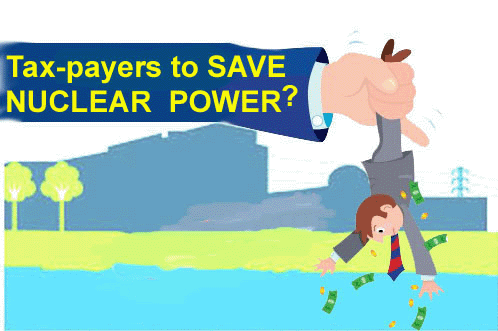 5 ways Brexit would transform European energy, Politico, Sara Stefanini , 24 June 16 Central and Eastern Europeans would lose a powerful ally, while nuclear and renewable investors would face an uncertain world.
A British vote to leave the European Union would force broad changes to the bloc’s energy policy, weakening its climate policy and removing a crucial Central European energy ally — but it could also give London far more freedom to pursue nuclear projects.
The U.K. is often an energy outlier in the EU, advocating nuclear power and shale gas sources shunned by others. And it tends to build alliances broadly aimed at keeping interference from Brussels to a minimum.
But both sides have a lot to lose.
A Brexit could undercut long-term climate policies in Brussels and London, and the EU would lose the U.K.’s pro-free market voice, which has historically helped tone down some more statist schemes coming from European capitals.
Here are the five ways that a Brexit would impact Europe’s energy and climate forecast:…….
4. The freedom to subsidize — maybe
One area the European Commission tries to avoid is state aid, particularly for energy projects.
But even when the Commission gives a green light, there’s the danger that another EU country might try to interfere. That’s what happened with Hinkley Point. Brussels approved a state aid plan in 2014, but Austria, backed by Luxembourg,challenged the decision in the European Court of Justice eight months later…….
Environmental advocates worry it would give the U.K. room to continue rolling back support for renewables in favor of other fuels.
“One of the reasons why the government has had to have a more sensible policy on these issues is because state aid disciplines have stopped it from throwing money at gas-powered stations and fracking and nuclear,” said Nick Mabey, chief executive of the environmental analysis group E3G……..http://www.politico.eu/article/uk-brexit-renewable-energy-hinkley-nuclear-interconnectors-gas-climate-emissions-paris/
Exit from the European Union could make it easier for Britain to develop nuclear power
A British vote to leave the European Union would force broad changes to the bloc’s energy policy, weakening its climate policy and removing a crucial Central European energy ally — but it could also give London far more freedom to pursue nuclear projects.
The U.K. is often an energy outlier in the EU, advocating nuclear power and shale gas sources shunned by others. And it tends to build alliances broadly aimed at keeping interference from Brussels to a minimum.
But both sides have a lot to lose.
A Brexit could undercut long-term climate policies in Brussels and London, and the EU would lose the U.K.’s pro-free market voice, which has historically helped tone down some more statist schemes coming from European capitals.
Here are the five ways that a Brexit would impact Europe’s energy and climate forecast:…….
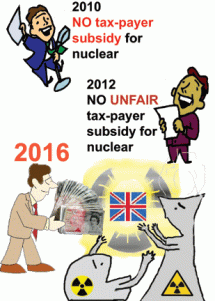 4. The freedom to subsidize — maybe
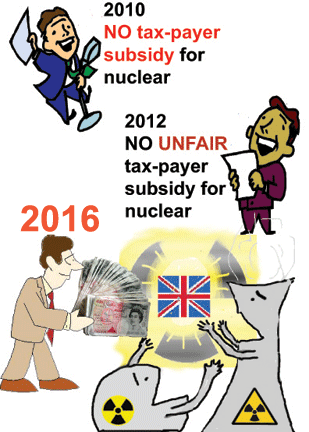
One area the European Commission tries to avoid is state aid, particularly for energy projects.
But even when the Commission gives a green light, there’s the danger that another EU country might try to interfere. That’s what happened with Hinkley Point. Brussels approved a state aid plan in 2014, but Austria, backed by Luxembourg,challenged the decision in the European Court of Justice eight months later…….
Environmental advocates worry it would give the U.K. room to continue rolling back support for renewables in favor of other fuels.
“One of the reasons why the government has had to have a more sensible policy on these issues is because state aid disciplines have stopped it from throwing money at gas-powered stations and fracking and nuclear,” said Nick Mabey, chief executive of the environmental analysis group E3G……..http://www.politico.eu/article/uk-brexit-renewable-energy-hinkley-nuclear-interconnectors-gas-climate-emissions-paris/
1 This Month




Shut down the radiation-damaged Heysham nuclear reactors now
To see nuclear-related stories in greater depth and intensity – go to https://nuclearinformation.wordpress.com

Say No to NASA’s Reckless Nuclear Reactor on the Moon
Say No to NASA’s Reckless Nuclear Reactor on the Moon
-
Archives
- October 2026 (289)
- September 2026 (339)
- August 2026 (330)
- July 2026 (355)
- June 2026 (287)
- May 2026 (306)
- April 2026 (356)
- March 2026 (251)
- February 2026 (267)
- January 2026 (308)
- December 2025 (358)
- November 2025 (359)
-
Categories
- 1
- 1 NUCLEAR ISSUES
- business and costs
- climate change
- culture and arts
- ENERGY
- environment
- health
- history
- indigenous issues
- Legal
- marketing of nuclear
- media
- opposition to nuclear
- PERSONAL STORIES
- politics
- politics international
- Religion and ethics
- safety
- secrets,lies and civil liberties
- spinbuster
- technology
- Uranium
- wastes
- weapons and war
- Women
- 2 WORLD
- ACTION
- AFRICA
- Atrocities
- AUSTRALIA
- Christina's notes
- Christina's themes
- culture and arts
- Events
- Fuk 2022
- Fuk 2023
- Fukushima 2017
- Fukushima 2018
- fukushima 2019
- Fukushima 2020
- Fukushima 2021
- general
- global warming
- Humour (God we need it)
- Nuclear
- RARE EARTHS
- Reference
- resources – print
- Resources -audiovicual
- Weekly Newsletter
- World
- World Nuclear
- YouTube
-
RSS
Entries RSS
Comments RSS

