At the end of the Hinkley nuclear power story – massive radioactive clean-up costs
 Hinkley Point C developers face £7.2bn cleanup bill at end of nuclear plant’s life
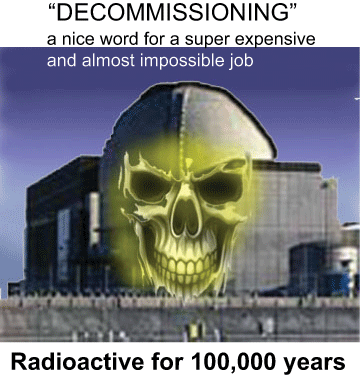
French and Chinese developers will be the first nuclear operators in the UK that will have to pay to decommission the site, Guardian, Adam Vaughan, 30 Sept 16 , The French and Chinese companies that are to build the £18bn Hinkley Point C nuclear power station will have to pay up to £7.2bn to dismantle and clean it up.
Documents published yesterday reveal for the first time how much the developers, EDF and China General Nuclear Power Group (CGN), will have to pay to decommission the plant, beginning in 2083.
The new reactors in Somerset will be unique in British nuclear history, as they are the first for which the operator will have to pay to make good the site afterwards.
“Waste transfer contracts signed today mean that, for the first time in the UK, the full costs of decommissioning and waste management associated with the new power station are set aside during generation and are included in the price of the electricity,” EDF said in a statement.
Decommissioning costs ate up around half the budget for the now-disbanded department of energy and climate change, after the liabilities for cleaning up old nuclear plants were effectively nationalised in 2004 and 2005 when two companies faced financial problems.
The Hinkley Point C decommissioning costs are estimated at £5.9bn to £7.2bn, with the dismantling of the plant expected to begin in 2083. The government, EDF and CGN anticipate the winding up of the new reactors will continue well into the 22nd century. The plant is expected to be fully decommissioned “from 2138” when the final spent fuel is disposed of.
Experts said the cost estimate was likely to be on the low side. “The reality in terms of decommissioning is that it always costs more than people say,” said Dr Paul Dorfman, of the Energy Institute at University College London.
He claimed that the precedent of the government taking ownership of the liabilities of British Nuclear Fuels Limited and British Energy more than a decade ago showed that the government would be forced to shoulder the costs if Hinkley’s developers had a shortfall.
The body charged with dismantling 17 of Britain’s old nuclear power plants puts the cost of cleanup at £117bn over 100 years in its latest annual report, more than twice the cost estimated a decade ago. A large proportion of the cost is due to the complexity of Sellafield……..https://www.theguardian.com/environment/2016/sep/30/hinkley-point-c-developers-face-72bn-cleanup-bill-at-end-of-nuclear-plants-life?CMP=twt_a-environment_b-gdneco&utm_content=buffer99004&utm_medium=social&utm_source=twitter.com&utm_campaign=buffer
India and Pakistan both looking to an alliance with Russia
Nuclear War: Pakistan, China, Russia Vs India, America Nuclear Warheads USA Morning News 1 Oct 16 “……… Nuclear Warhead Assessment
So if it comes down to an all-out nuclear war between the US-India on one side and China-Russia-Pakistan on the other, here is an assessment of which side is likely to have an upper hand in the war:
- It has been estimated that China, India, and Pakistan all possess ballistic missile, cruise missile, and sea-based nuclear weapons.
- Even though China, Russia, and the U.S. possess nuclear weaponry, according to the NPT, they have been banned from building and maintaining such weapons in perpetuity.
- China has 260 approximate warheads, Russia has roughly 7300 and Pakistan has 120.
- The USA is lagging slightly behind Russia with 7100 warheads and India currently has 110.
Hence, with Russia currently ahead than all the rest in the nuclear race, both India and Pakistan are looking to Russia to build an alliance with. http://www.morningnewsusa.com/nuclear-war-pakistan-china-russia-vs-india-america-nuclear-warheads-23109179.html
UK government admits the costs of Hinkley nuclear deal – gas would be cheaper

 Hinkley Point nuclear deal signed as Government admits gas would be cheaper, Telegraph, energy editor 29 SEPTEMBER 2016
The Hinkley Point C nuclear plant will saddle UK consumers with higher energy bills than building gas power stations, the Government has admitted, as it signed a legally-binding contract to subsidise the £18bn project.
An official assessment claimed the Franco-Chinese project to build Britain’s first nuclear plant in a generation represented “value for money”, despite being more expensive than gas, because it would help meet climate change targets.
A series of deals signed between the Government, France’s EDF and China’s state nuclear firm CGN at a ceremony in London marked the final go-ahead for the Somerset power plant and also fired the formal starting gun on Chinese efforts to build their own reactor in Essex………
Under a deal first agreed in 2013 Hinkley will be paid a fixed price of £92.50/MWh for the power it produces for 35 years, funded through levies on energy bills. The National Audit Office has said it could cost up to £30bn in subsidies.
Among hundreds of pages of documents issued on Thursday afternoon – some heavily redacted – ministers faced a series of questions over a cursory three-page assessment concluding that the deal would add £12 to energy bills in 2030 but was “value for money”.
The assessment said Hinkley was “cost-competitive to other options for delivering power” despite its own assessment that the “comparable cost” of new gas in the 2020s could be as low as £45/MWh, solar as low as £65/MWh and onshore wind as low as £49/MWh.
If Hinkley was delayed by three years and gas plants built instead then by 2030 the UK would be £3.2bn better off and energy bills would be “£6 cheaper per year”, it concluded……..
John Sauven, executive director of Greenpeace, accused the Government of obfuscation and providing “no evidence anywhere in the documents to back up their assumptions”.
“The numbers speak for themselves. In the unlikely event Hinkley is working sometime in the second half of the next decade, renewable energy will be much cheaper, yet British consumers will still be forced to pay over the odds for nuclear power,” he said.
Another document underlined the lasting impact the decision will have on UK energy policy for more than a century to come, forecasting that the spent fuel for the plant would not be disposed of until the year 2138.
EDF Energy said Hinkley would “kickstart Britain’s nuclear revival” and that it had “been shown to offer consumers value for money”.
The Government said the signing of the deal marked “a significant step forward for a new era of nuclear power in the UK”. http://www.telegraph.co.uk/business/2016/09/29/hinkley-point-nuclear-plant-gets-final-go-ahead-as-government-si/
Low-key ceremony for final signing of Hinkley nuclear power project
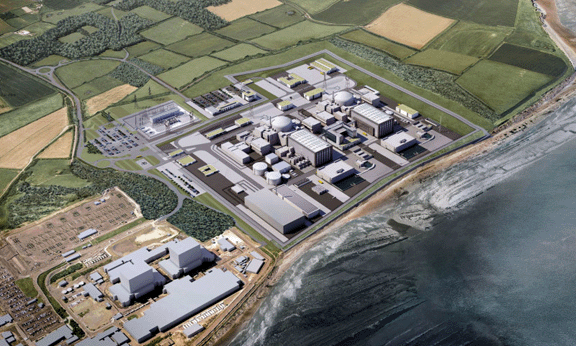 Hinkley Point: ministers sign go-ahead for nuclear power plant Representatives of British, Chinese and French governments attend ceremony giving final authorisation for power station, Guardian, Rowena Mason, 30 Sept 16, The UK has signed its £18bn contract with France and China to build the Hinkley Point C nuclear power station, giving the final go-ahead for construction at the site in Somerset.
The deal was finalised at a low-key ceremony in London, just two months afterTheresa May alarmed her French and Chinese counterparts by putting the entire project under review. EDF, the French nuclear contractor, and its Chinese partners had to cancel their previous plans for a signing ceremony at the last minute when the review was announced in July.
The project finally got approval this month, after Greg Clark, the business secretary, announced there would be some new restrictions on future investments in critical infrastructure if there were national security concerns.
Clark attended the signing ceremony on behalf of the UK, alongside Jean-Bernard Lévy, the chairman of EDF, and He Yu, chair of China General Nuclear…….
Greenpeace said it was “no wonder the UK government has opted for a ‘champagne-free’ signing ceremony away from public view”.
The environmental group said: “With a stroke of the pen ministers are signing away billions of pounds of billpayers’ money to a project they know is plagued by legal, financial and technical problems. In the unlikely event Hinkley is working some time in the second half of the next decade, renewable energy will be much cheaper, yet British consumers will still be forced to pay over the odds for nuclear power. It’ll be like being locked into an expensive fixed-rate mortgage as interest rates plummet.”…….https://www.theguardian.com/uk-news/2016/sep/29/hinkley-point-ministers-sign-go-ahead-for-nuclear-power-plant
Media is hyping Small Modular Nuclear Reactors , but doubts about them remain
 All over the media, on matters nuclear, I see these glowing reports on the great future just about to take off – for Small Modular (Nuclear) Reactors (SMRs) . Note that they leave out the word “Nuclear” – knowing that it’s not very popular with us all – the great unwashed.
The arguments are many – from the need for huge amounts of energy (though that’s dubious), to the false claim that SMNRs solve the radioactive trash problem, to the claim that they’ll fix climate change.
But my favourite nuclear lobby argument is the one where they either say directly, or more often imply – that big nuclear reactors are bad, so therefor Small ones must be good.

Anyway, the mainstream media knows where the money is, in reporting. Even The Guardian wrote up a lovely PR for Small Nukes – but I noticed that they sneaked in a few concerns about them:
“…….The first small modular nuclear reactors (SMRs) could be operating in the UK by 2030 with the right government support, according to a new report from theEnergy Technologies Institute (ETI).
The analysis, released today by the government and industry-backed energy research body, examined the steps needed to support the first SMR in the UK and concluded a credible schedule for implementation can be set out – as long as a policy framework is developed to reduce risks for SMR developers and increase investor confidence.
Setting out a timeline of key steps that will be required to deliver SMR deployment, the ETI said the UK should clarify and raise awareness of regulatory standards and expectations in the next five years and set out a clear statement of intent in relation to SMR development in the UK by 2024, with the aim to achieve at least one final investment decision by 2025………
While advocates of SMRs maintain they can safely bring down the cost of nuclear power and help to support an increasingly decentralised grid, critics argue there is still little evidence the technology will bring down costs where larger reactors have consistently failed to do so and fear they will come with inherent safety risks, which other low carbon sources of power could avoid….. quoted in The Guardian, 29 Sept
The 100 billion pound bill for decommissioning Europe’s old nuclear power stations
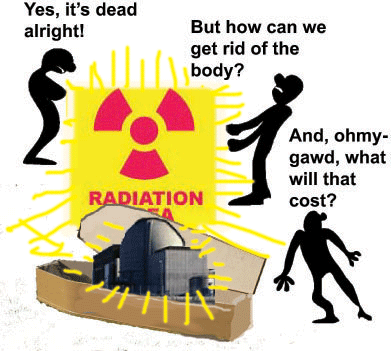 Standard and Poor’s: dismantling Europe’s old nuclear power plants will run up a hundred billion pound bill for EDF EON RWE and others
Nuclear liabilities of the largest eight nuclear plant operators in Europe totaled €100bn at the end of last year, representing around 22 per cent of their aggregate debt, according to credit rating agency Standard & Poor’s.
Operators are legally responsible for decommissioning nuclear power plants, a process which can take several decades to implement, meaning the associated costs are high. Europe’s main nuclear operators include France’s EDF, Germany’s E.ON and RWE. They are legally responsible for decommissioning nuclear power plants, a process which can take several decades to implement, meaning the associated costs are high.
While the analysis by S&P treats nuclear liabilities as debt-like obligations, it recognises that several features differentiate them from traditional debt. But given the size of the liabilities against a company’s debt, they can impact a company’s credit metrics, and their credit rating.
The report noted that a company’s nuclear provisions are difficult to quantify, as well as cross compare, because accounting methods vary between different countries.
It also foresees many operational challenges ahead, including a reality check on costs and execution capabilities.
At last – Hinkley nuclear a new money spinner for troubled company AREVA
 Areva says awarded 5 billion euros worth of Hinkley Point contracts http://af.reuters.com/article/energyOilNews/idAFL8N1C55YB PARIS, Sept 29 (Reuters) – French nuclear group Areva said on Thursday it has won contracts worth over 5 billion euros ($5.61 billion) to provide various services at Britain’s $24 billion Hinkley Point nuclear project.
The deal to build Britain’s first new nuclear power station in decades at Hinkley Point was signed behind closed doors in London earlier on Thursday in a private ceremony.
Areva said the subcontracts include among others, a long-term fuel supply agreement, and the delivery of the two nuclear steam supply systems, from design and supply to commissioning.
The company will also provide material for the fuel fabrication, producing uranium and providing conversion and enrichment services at Hinkley Point.
It said the activities will start in early 2020. ($1 = 0.8917 euros) (Reporting by Bate Felix; editing by John Irish)
Ukraine joining the renewable energy revolution
Solar on the steppe: Ukraine embraces renewables revolution Former Soviet nation bids for independence from Russian fossil fuels. Nature Quirin Schiermeier 28 September 2016 Wind and solar power are wallflowers in oil- and gas-rich Russia. Not so in neighbouring Ukraine. With fears about Russian hegemony at a peak, the former Soviet republic is ready to join the renewables revolution.
“Energy independence has become a matter of national security for Ukraine,” says Sergiy Savchuk, head of the state agency on energy efficiency and energy saving in Kiev. “That’s why renewable-energy development is now a priority issue for the Ukrainian government.”
In July, Ukrainian environment minister Ostap Semerak unveiled plans to build a large solar power plant and a biogas facility in the wasteland around the former Chernobyl reactor.
The announcement came just two weeks after parliament reopened the state-owned exclusion zone around the shuttered nuclear site to development for business and science.
The Chernobyl energy project will cost around US$1.1 billion, a sum that means substantial foreign investment is required. It is part of Ukraine’s broader ambition to step up renewable-energy capacity. According to the National Renewable Energy Action Plan adopted in 2014, the government aims to almost triple capacity for electricity production, transport and heating by 2020 — from its current level of around 9.3 gigawatts to more than 26 gigawatts. Renewables would then supply about 11% of all energy consumed in Ukraine……..
Ukraine has significant untapped renewable-energy potential, finds a 2015 report by the International Renewable Energy Agency (IRENA) in Abu Dhabi, United Arab Emirates — enough to support the 2014 plan. The largest country to lie entirely within Europe (Turkey and Russia are mostly in Asia), it gets more sunshine than Germany, where photo-voltaic solar power now exceeds 40 gigawatts.
Ukraine also has good grid infrastructure, including high-voltage transmission lines between Chernobyl and Kiev, says Dolf Gielen, director of IRENA’s Innovation and Technology Center in Bonn, Germany…… http://www.nature.com/news/solar-on-the-steppe-ukraine-embraces-renewables-revolution-1.20690
Finland utility taking legal action against nuclear company AREVA
 Finnish utility Teollisuuden Voima (TVO) said today that it has started legal action against the same company which is supplying two nuclear reactors to Hinkley Point C. City A.M. Jessica Morris, 29 Sep 16
It’s taking Areva to court over delays at Olkiluoto 3 nuclear reactor in Finland. The project, which was supposed to showcase EDF and its engineering partner Areva’s EPR technology, has been plagued by disputes, budget overuns and delays
A TVO spokesman told Reuters that it had not received assurances from plant supplier Areva that the Olkiluoto project would have the necessary resources to be ready to begin power production by 2018 as planned.
“We have asked for this several times but have not received the necessary assurances,” said Pasi Tuohimaa, spokesman for TVO, adding that the case was filed in a French commercial court…….http://www.cityam.com/250284/finnish-firm-takes-hinkley-point-c-nuclear-reactor-maker
Dutch climate plan includes shutdown of new coal-fired plants
 Ambitious Dutch climate plan includes shutdown of new coal-fired plants, CBC radio AS It Happaens 29 Sep 16 The Netherlands has voted to adopt some of Europe’s most drastic measures to cut carbon emissions.
In a close vote last week, the Dutch parliament pledged a 55 per cent cut in cut C02 by 2030. That would include a shutdown of the country’s five remaining coal power plants, including three that opened just last year.
“Even if it feels a bit weird to close down literally brand new coal-fired power plants, all alternative measures are far more expensive.”– Stientje van Veldhoven, Dutch politician
Stientje van Veldhoven, a Dutch politician with the Democrats 66 party, spoke to As It Happens host Carol Off. Van Veldhoven was in Paris last year during negotiations for an international deal on goals to mitigate climate change. She voted to support the plan……..http://www.cbc.ca/radio/asithappens/as-it-happens-wednesday-edition-1.3782437/ambitious-dutch-climate-plan-includes-shutdown-of-new-coal-fired-plants-1.3782537
UK may be forced to leave Euratom treaty on nuclear energy, due to Brexit
Brexit ‘could trigger’ UK departure from nuclear energy treaty https://www.theguardian.com/environment/2016/sep/27/brexit-could-trigger-uk-departure-from-nuclear-energy-treaty
The UK’s withdrawal from the EU could also force it to exit the Euratom treaty on nuclear energy, ENDS has learned, Guardian, José Rojo for ENDS, part of the Guardian Environment Network. The UK’s withdrawal from the EU could also force it to exit the Euratom Treaty on nuclear energy, ENDS has learned.
The Euratom Treaty, which applies to all EU member states, seeks to promote nuclear safety standards, investment and research within the bloc. Although it is governed by EU institutions, it has retained a separate legal identity since its adoption in 1957.
Brian Curtis, a member of the European Economic and Social Committee (EESC), told ENDS that his Committee had recently consulted the European Commission on whether Brexit would automatically lead to a UK exit of Euratom.
Curtis said the Commission had responded affirmatively, arguing that the Treaty of the European Union (TEU) applies to the Euratom Treaty under article 106 of the latter agreement. This would mean, it said, that the reference to ‘Union’ inTEU’s article 50 – which needs to be invoked by member states wishing to quit the bloc – would apply not only to the EU itself but to Euratom membership as well.
According to EESC, a Euratom withdrawal by the UK – which recently approved the controversial £18bn Hinkley C project – could have major strategic implications for the EU nuclear sector. “But anticipating specific outcomes at this stage is problematic,” the Committee added.
The Commission itself would not comment on the exchange, which took place as the EESC examined the EU’s latest nuclear plan.
The draft Nuclear Indicative Programme (PINC), which was unveiled in April, is the first to be published by the Commission since the Fukushima-Daiichi nuclear disaster in 2011.
The EESC is required by the Euratom Treaty to give its opinion on such plans before they are finalised. It released its opinion on the latest PINC last week, after adopting it at a plenary vote.
The document praises the Commission for its analysis of investment needs during the entire nuclear fuel cycle and its emphasis on funding for nuclear decommissioning.
However, the Committee adds that the 2016 PINC is half the length of thepreceding plan from 2007 and fails to address key issues faced by EU nuclear energy.
These, it says, include the competitiveness of nuclear amid changes to construction and capital costs, its investment needs in the context of the EU’s Energy Union goals and the speed at which new technologies may be rolled out.
EESC’s opinion was published two weeks ahead of a meeting of the European Nuclear Energy Forum, which will be attended by EU member states and European institutions in Bratislava on 3-4 October.
Both Russia and America Prepare for Nuclear War? (and this is ‘good for business’)
Dangerous Crossroads: Both Russia and America Prepare for Nuclear War? http://www.globalresearch.ca/dangerous-crossroads-both-russia-and-america-prepare-for-nuclear-war/5548074 By Prof Michel Chossudovsky Global Research, September 27, 2016 Barely acknowledged by the Western media. both Russia and America are “rearming” their nuclear weapons systems. While the US is committed to a multibillion dollar modernization project, Russia is largely involved in a “cost-effective” restructuring process which consists in decommissioning parts of its land-based ICBM arsenal (Topol) and replacing it with the more advanced Yars RS-24 system, developed in 2007.
Rest assured, the B61-12 is a “mini-nuke” with an explosive capacity of up to four Hiroshima bombs. It is categorized as a “defensive” (peace-making) weapon for use in the conventional war theater. According to scientists on contract to the Pentagon, the B61-11 and 12 (bunker buster bombs with nuclear warheads) are “harmless to civilians because the explosion is underground”.
The nuclear triad modernization project is at the expense of US tax payers. It requires the redirection of federal revenues from the financing of “civilian” expenditure categories (including health, education, infrastructure etc) to the “war economy”. It’s all for a good cause: “peace and security”.
 War is “Good for Business”
The multibillion dollar project is a financial bonanza for America’s major defense contractors including Boeing, Lockheed Martin and Northrop Grumman, which are also firm supporters of Hillary Clinton’s stance regarding a possible first strike nuclear attack against Russia, China, Iran and North Korea.
Reported by Defense News, US Secretary of Defense Ash Carter on September 26 called for the “need to modernize all three legs of the nuclear triad.” The project would require a major boost in defense expenditure.
Underscoring today’s “volatile security environment”, the multibillion dollar project is required, according to Carter, in view of threats largely emanating from Russia, China as well as North Korea:
Carter’s comments came during a visit to Minot Air Force Base in North Dakota, … Under the fiscal year 2017 budget request, Carter said, the department pledged $19 billion to the nuclear enterprise, part of $108 billion planned over the next five years. The department has also spent around $10 billion over the last two years, the secretary said in prepared comments. The “nuclear triad” references the three arms of the US strategic posture — land-based ICBMs, airborne weapons carried by bombers, and submarine-launched atomic missiles. All of those programs are entering an age where they need to be modernized.
Pentagon estimates have pegged the cost of modernizing the triad and all its accompanying requirements at the range of $350 to $450 billion over the next 10 years, with a large chunk of costs hitting in the mid-2020s, just as competing major modernization projects for both the Air Force and Navy come due.
Critics of both America’s nuclear strategy and Pentagon spending have attempted to find ways to change the modernization plan, perhaps by cancelling one leg of the triad entirely.But Carter made it clear in his speech that he feels such plans would put America at risk at a time when Russia, China and North Korea, among others, are looking to modernize their arsenals. (Defense News, September 26, 2016)
Carter casually dismissed the dangers of a no-win global war, which could evolve towards a “nuclear holocaust”, Ironically ”… He also hit at critics of the nuclear program — which include former Secretary of Defense William Perry, [who ironically is] widely seen as a mentor for Carter — who argue that investing further into nuclear weapons will increase the risk of atomic catastrophe in the future. (Defense News, September 26, 2016)
Carter expressed his concern regarding Russia’s alleged “nuclear saber-rattling”.
Russia’s ICBM System
Were Carter’s timely statements in response to Russia redeployment and restructuring of its ICBM system on its Western frontier, which were announced on September 20?
Last week, the Russian news agency Tass confirmed that “The westernmost strategic missile force division in the Tver region will soon begin to be rearmed with the missile system Yars.”
It will be a sixth strategic missile division where the newest mobile ground-based missile complexes will replace the intercontinental ballistic missile Topol,” the press-service of the Strategic Missile Force quotes its commander Sergey Karakayev as saying.
According to the official, this year regiments in the Irktusk and Yoshkar-Ola divisions began to be rearmed. The re-armament of the Novosibirsk and Tagil divisions is nearing completion. Earlier, the Teikovo division was fully rearmed.
The final decision to rearm the strategic missile division in the Tver Region will be made after a command staff exercise there. The press-service said the exercises will be devoted to maneuvering along combat patrol routes.
In the near future the ICBM RS-24 Yars, alongside the previously commissioned monoblock warhead ballistic missile RS-12M2 Topol-M, will constitute the backbone of Russia’s strategic missile force.
The Yars ICBM RS-24 was developed in 2007 in response to the US Missile Shield. It is nothing new in Russia’s military arsenal. It is a high performance system equipped with thermonuclear capabilities.
What this report suggests is the restructuring of Russia’s strategic missile force and the replacement of the Topol system (which Moscow considers obsolete) with the Yars ICBM RS-24.
UK energy policy- economic and moral bankruptcy with nuclear and fracking
Nuclear and fracking: the economic and moral bankruptcy of UK energy policy, Ecologist, Peter Strachan & Alex Russell, 27th September 2016 With its choice of Hinkley Point C – a £100 billion nuclear boondoggle – its enthusiastic support for expensive and environmentally harmful fracking, and its relentless attack on renewable energy, the UK government’s energy policy is both morally and economically bankrupt, write Peter Strachan & Alex Russell. It must urgently reconsider this folly and embrace the renewable energy transition
As Prime Minister Theresa May and EDF prepare to sign the Hinkley Point C contract, and Scotland sees the first shipment of fracking gas from the United States, it is perhaps timely to reflect on recent developments in UK energy policy.
Both new nuclear build and UK onshore shale gas and oil extraction fail key environmental, safety and economic tests.
The UK has recently committed to a nuclear renaissance, with Greg Clark, the Secretary of State for Business, Energy and Industrial Strategy (BEIS) at Westminster, describingthe “dawning of a new age of nuclear”.
But by commissioning French and Chinese companies to build the first UK nuclear power station in a generation, the Hinkley Point C deal has come in for almost universal condemnation.
Theresa May clearly buckled under economic pressure from China and has backed nuclear power as the panacea to combat the electricity crunch that we face. Her questionable decision means the UK is committed to a long-term very expensive project that comes with national security and many other concerns.
Empty promises
In 2007 the Chief Executive of EDF’s UK arm effectively cooked his own goose by claiming that Brits would be cooking their Christmas turkeys using nuclear power generated from Hinkley Point C by 2017. Now EDF are claiming that they won’t go over budget, when the new power plant is delivered some time in 2025.
If ongoing experience in France and Finland is anything to go by, and with apparently few financial penalties in place for late delivery, there are serious doubts that the project can be completed in the revised timescale and on budget.
Turning to the financials, the costs of the project are just enormous. Some have claimed that Hinkley Point C will end up being the most expensive physical object ever built. The project is a £100 billion boondoggle. The construction costs alone are in the region of £18-£25 billion. Then there are the subsidies that will amount to a conservative £1 billion plus per year, for at least 35 years.
The deal penned is inflation linked at more than twice the cost of current wholesale electricity prices. The plant will then operate for a further 30 years. It has a potential life span of around 65 years and it will continue to be a drain on public finances even after the initial lucrative contract has expired.
Then try to add into the calculus the unstated decommissioning and radioactive waste management costs, and it soon becomes apparent these super-burdensome costs and risks are incalculable.
If Sellafield in Cumbria, England, is used as a baseline, such costs are just eye watering. Indeed, bucket loads of money amounting to tens of billions of pounds have already been spent, trying to make safe the UK’s nuclear legacy. Based on the available evidence one can only conclude that cheap and clean nuclear power is a myth.
Fuel poverty for future generations
In terms of what Hinkley Point C will mean for household budgets, it is estimated that it will push up individual electricity bills by around £50 per annum. But this is just the start of such price rises as Hinkley Point C is the first of a number of new nuclear projects.
It is only around 3 GW of a 16 GW plus plan. Electricity bills will spiral out of control, as they did a few years ago when there were regular inflation busting price increases. The new nuclear age described by Greg Clark will surely set us on a path to fuel poverty for decades.
Even if households and business can afford such future hideous electricity bills, it might be 2030 before we see the plant operational – more than a decade later than was initially planned. Its promise to generate up to 7% of the UK’s electricity demand will be delivered around a decade too late to meet the 2020 electricity crunch that the UK faces…….
Glittering prizes or fracking folly?……..
Can we have more renewables please?
Most people don’t realise that renewables now supply around 25% of UK electricity and in Scotland it is over 50 per cent. Their market share has grown rapidly in recent years, trebling between 2010 and 2015.
Renewables now supply more electricity to the national grid than nuclear power and coal. They are very popular with the general public, cost-effective, and can be deployed very quickly, compared to the nuclear and shale options just outlined. They are also cleaner energy sources, and given all of these positives should surely be deployed to address the looming electricity crunch that threatens the UK.
But for the past two years the renewables industry has been under attack by the Conservative government. Changes to financial support mechanisms and the planning regime are now bringing onshore wind to a standstill. Solar support is being killed off. And while there is much rhetoric around offshore wind, it is actually progressing at a snail’s pace.
The direct effect of Conservative government policy changes has led to many thousands of green jobs being lost.
Another emerging and detrimental effect has been to undermine local community initiatives. In addition to supplying much needed electricity and investment in local assets such as community halls, churches and youth projects, community owned renewable projects encourage energy conservation, and have wider and important public education benefits.
If ever we needed some sign of reprieve for UK renewables, it is now.
A call to action
Westminster must get back on course and harness the heat of the sun, and the (gale) force of our wind, and the power of our waves and tides. It should fully embrace the energy transition from fossil fuels and nuclear power, to a renewable energy future.
Germany, Europe’s strongest economy, gets it and is making huge strides with their ‘Energiewende‘ strategy. The Scottish Parliament at Holyrood also gets it, and to pinch a phrase from former First Minster Alex Salmond, we have the potential to become the“Saudi Arabia of Renewables“.
The future of humanity depends on an all-encompassing global acceptance of the replacement of fossil fuels and nuclear power by renewables. If there is still a perception that British moral values lead where the world follows then its status is at best precarious.
Theresa May and Greg Clark must step up to the plate and nail the renewables flag to the top of UK energy policy. Nuclear power and fossil fuels have no economic or moral right to a long-term place in UK energy policy.
Peter Strachan is Professor of Energy Policy, Robert Gordon University. He tweets@ProfStrachan.
Professor Alex Russell is Chair of the Oil Industry Finance Association.
Authors’ note: The opinions expressed in this article are those of the authors and not those of the Robert Gordon University or Affiliates.
This article was orginally published on EnergyPost.eu. http://www.theecologist.org/News/news_analysis/2988167/nuclear_and_fracking_the_economic_and_moral_bankruptcy_of_uk_energy_policy.html
Russia’s nuclear marketing: sell nukes, then sell the clean-up, too!
 Making nuclear power plants safe after they shut down RBTH, September 24, 2016 ANDREI RETINGER, The problems of dealing with spent nuclear fuel, radioactive waste and the decommissioning of nuclear facilities (experts call it “back end”) did not immediately become apparent to the countries developing their nuclear industries. But now the world market for back end services is booming and its value is estimated to total about $347 billion until 2030.
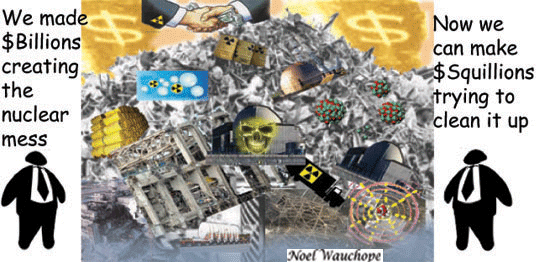
A number of nuclear facilities in the UK are scheduled for decommissioning, and all the 17 nuclear power plants that are still operating in Germany are due to close down by 2020. Japan must rehabilitate the areas after the accident at Fukushima, and the United States and Russia need to solve the problems of radioactive waste storage and reprocessing. Not all countries have the ability to solve these problems, but Russian technologies and facilities can come to their aid…..
in 2008, Russia was faced with a catastrophic situation because of the accumulation of radioactive waste and spent fuel remaining from the time of the creation of nuclear weapons and the Cold War. Storage sites were almost full and had not been provided with reliable insulation, creating a threat to people and the environment.
In this situation, Russia had no choice but to tackle the problem urgently. In 2007, it adopted a state program on nuclear and radiation safety, which was developed by the Rosatom State Atomic Energy Corporation. Then it approved a law on radioactive waste management, taking into account the latest standards and requirements………https://rbth.com/science_and_tech/2016/09/24/making-nuclear-power-plants-safe-after-they-shut-down_632711
Professor Geraldine Thomas and nuclear scientific misconduct
 This is part of a very important article, in which Dr Baverstock thoroughly refutes the claims that Professor Geraldine Thomas’ made in a BBC interview, about Fukushima ionising radiation not being much to worry about. The BBC has since withdrawn her statements.
But that hasn’t stopped the South Australian government bringing Thomas out here to spin her stuff, in  support of Weatherill’s push for SA as the global nuclear waste dump.
Thomas’ comments in the video were insulting to the intelligence of the Japanese authorities and their advisors, and extremely ill-judged from a professional radiological point of view. The BBC was right to withdraw her comments as incorrect.
 ‘This was quite clearly scientific misconduct’ by Dr Keith Baverstock, Fissiononline 23 Sept 16 . I will take the BBC interview first. In this interview Thomas questions the whole basis of the Japanese response to the Fukushima accident in terms of its evacuation policy. Is one to imagine that those authorities and the Japanese scientific establishment are so stupid as not to recognise that there is no risk entailing living in those areas?
The internationally agreed public dose limit is 1 mSv per year in addition to approximately 2 mSv per year from natural background radiation. The single measurement made in that television interview indicate 2.8 microsieverts per hour, which is close to 25 mSv per year. That includes the natural background doses o at that point the dose rate is at least 20 times the public dose limit.
Surely Thomas can recognise that this must demand serious consideration by the appropriate authorities as to the safety of those who would live there? However, to determine the safety or otherwise of living there it would be necessary to do a comprehensive survey of the area. My guess is that five years after the deposition of the radioactivity there will be a high degree of variability in measurements: some may be less in the measurement made on the programme, but others more and perhaps considerably more. Furthermore, if one were looking at a situation, for example in the UK, one would have to ensure that the most exposed person could not receive more that 1 mSv per annum. Therefore promises arguments that being indoors for example would reduce the dose rate are not valid in the context of the radiological protection of the public in general.
Whether a special dispensation applies when determining the return of evacuees to their homes is a question that I believe needs to be discussed, because as far as I’m aware the current situation in Japan is unique. Furthermore, we are not talking about a total dose of 20 mSv for someone who returns to live in this village. In many such villages remedial measures to reduce the dose rate are being taken, but only for the main “living areas”. Straying beyond these areas could lead to much higher doses, and eating natural produce, mushrooms etc, to even higher doses.
In the light of these considerations, Thomas’ comments in the video were insulting to the intelligence of the Japanese authorities and their advisors, and extremely ill-judged from a professional radiological point of view. The BBC was right to withdraw her comments as incorrect if that is indeed what they did.
Watching the video I am inclined to believe that Thomas is being disingenuous when she says she made a numeric al error when calculating the dose from the interviewer’s measurement. She made no attempt to do any kind of calculation: the figure she cited was something she clearly had in mond at the outset: she was delivering propaganda for the nuclear industry
That in the context in which the interview took place and the way in which she was introduced to the audience, is clearly scientific misconduct. One must also say here that the ninterviewer must have been, for an experienced journalist, amazingly gullible to have allowed the interview to be broadcast……….. https://issuu.com/fission/docs/fissionline_44
Dr Keith Baverstock led the Radiation Programme at the World Health Organisation’s Regional Office for Europe from 1991 to 2003.
1 This Month




Shut down the radiation-damaged Heysham nuclear reactors now
To see nuclear-related stories in greater depth and intensity – go to https://nuclearinformation.wordpress.com

Say No to NASA’s Reckless Nuclear Reactor on the Moon
Say No to NASA’s Reckless Nuclear Reactor on the Moon
-
Archives
- October 2026 (279)
- September 2026 (339)
- August 2026 (330)
- July 2026 (355)
- June 2026 (287)
- May 2026 (306)
- April 2026 (356)
- March 2026 (251)
- February 2026 (267)
- January 2026 (308)
- December 2025 (358)
- November 2025 (359)
-
Categories
- 1
- 1 NUCLEAR ISSUES
- business and costs
- climate change
- culture and arts
- ENERGY
- environment
- health
- history
- indigenous issues
- Legal
- marketing of nuclear
- media
- opposition to nuclear
- PERSONAL STORIES
- politics
- politics international
- Religion and ethics
- safety
- secrets,lies and civil liberties
- spinbuster
- technology
- Uranium
- wastes
- weapons and war
- Women
- 2 WORLD
- ACTION
- AFRICA
- Atrocities
- AUSTRALIA
- Christina's notes
- Christina's themes
- culture and arts
- Events
- Fuk 2022
- Fuk 2023
- Fukushima 2017
- Fukushima 2018
- fukushima 2019
- Fukushima 2020
- Fukushima 2021
- general
- global warming
- Humour (God we need it)
- Nuclear
- RARE EARTHS
- Reference
- resources – print
- Resources -audiovicual
- Weekly Newsletter
- World
- World Nuclear
- YouTube
-
RSS
Entries RSS
Comments RSS

