UN rejects UK appeal on Assange, Justice for Assange On 30 November 2016, the United Nations rejected the United Kingdom’s attempt to appeal the UN’s February ruling in favour of Julian Assange.
The decision therefore stands and the UK and Sweden are once again required to immediately put an end to Mr. Assange’s arbitrary detention and afford him monetary compensation.
Earlier this year the United Nations concluded the 16 month long case to which the UK was a party. The UK lost, appealed, and today – lost again. The UN instructed the UK and Sweden to take immediate steps to ensure Mr. Assange’s liberty, protection, and enjoyment of fundamental human rights. No steps have been taken, jeopardising Mr. Assange’s life, health and physical integrity, and undermining the UN system of human rights protection.
Now, the United Nations has found that the United Kingdom’s request for review of this decision (filed on March 24) was inadmissible; the United Kingdom has now reached the end of the road in its attempt to overturn the ruling. As a member of the Security Council and the United Nations Human Rights Council, the United Kingdom must respect its commitment to the United Nations, and release Mr. Assange immediately. Now, more than ever, moral leadership is required; maintaining Mr. Assange’s effective detention (which stands at six years as of 7 December, 2016) will only serve to green light future abuses against defenders of free speech and human rights.
Mr. Assange stated “Now that all appeals are exhausted I expect that the UK and Sweden will comply with their international obligations and set me free. It is an obvious and grotesque injustice to detain someone for six years who hasn’t even been charged with an offence.”….. https://justice4assange.com/?rejects
December 2, 2016
Posted by Christina Macpherson |
Legal, UK |
Leave a comment
 French nuclear power in ‘worst situation ever’, says former EDF director
In the week Britain exports electricity to France for first time in four years, Gérard Magnin says renewable power will match Hinkley Point C on cost, Guardian, Adam Vaughan, 29 Nov 16, The French nuclear industry is in its “worst situation ever” because of a spate of plant closures in France and the complexities it faces with the UK’s Hinkley Point C power station, according to a former Électricité de France director.
Gérard Magnin, who called Hinkley “very risky” when he resigned as a board member over the project in July, told the Guardian that with more than a dozen French reactors closed over safety checks and routine maintenance, circumstances for the state-owned EDF had deteriorated since he stepped down.
The closures have seen Britain this week exporting electricity to France for the first time in four years. An industry report on Tuesday also warned that the offline reactors could lead to a “tense situation” for energy supply in France, in the event of a cold snap this winter.
The situation is likely to be exacerbated by damage during Storm Angusto the main cable that carries electricity back and forth between the UK and France. It is believed a boat dropping anchor during the storm may have been responsible but National Grid is investigating the cause and working to repair the Interconnexion France-Angleterre, which is buried in the seabed and heavily armoured.
The operator said that four of the eight cables in the interconnector had been damaged, reducing its capacity from 2,000MW to 1,000MW until February next year. It added that due to the French reactor closures, it had already factored in a reduction in energy supplies from France this winter.
Magnin said that instead of backing new nuclear, the UK and France should capitalise on falling wind and solar power costs and help individuals and communities to build and run their own renewable energy projects. He founded an association of cities switching to green energy, joined the EDF board in 2014, and is now director of a renewable energy co-op in France.
“The most surprising [thing] for me is the attitude of the UK government which accepts the higher cost of electricity … in a time where the costs of renewables is decreasing dramatically,” he said. “In 10 years [when Hinkley Point C is due to be completed], the cost of renewables will have fallen again a lot.”
Of the Hinkley C design, known as the European Pressurised Reactor (EPR), Magnin said: “A lot of people in EDF have known for a long time the EPR has no future – too sophisticated, too expensive – but they assume their commitments and try to save the face of France.”
The UK’s business department conceded in September that by the time Hinkley is operational the price of electricity guaranteed to EDF will be above the comparable costs for large-scale solar and onshore windfarms. Officials argued that using renewables instead would cost more in grid upgrades and balancing the intermittent nature of wind and solar……. https://www.theguardian.com/environment/2016/nov/29/french-nuclear-power-worst-situation-ever-former-edf-director
November 30, 2016
Posted by Christina Macpherson |
business and costs, France |
Leave a comment
Giant new dome set to keep Chernobyl safe for generations http://www.japantimes.co.jp/news/2016/11/27/world/giant-new-dome-set-keep-chernobyl-safe-generations/#.WDtMp9J97Gh
AFP-JIJI NOV 27, 2016 CHERNOBYL, UKRAINE – The world’s largest metal moveable structure will be unveiled Tuesday over the Chernobyl nuclear power plant’s doomed fourth reactor in Ukraine to ensure the safety of future generations across Europe. The giant arch — nearly as long as two soccer fields and taller than New York’s Statue of Liberty — will edge into place over an existing crumbling dome that the Soviets constructed in haste when disaster struck three decades ago on April 26.
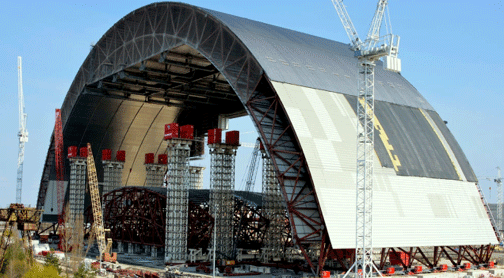
Radioactive fallout from the site of the world’s worst civil nuclear accident contaminated Ukraine and spread across three-quarters of Europe.
Work on the previous safety dome began after a 10-day fire caused by the explosion was contained but as radiation still spewed. “It was done through the superhuman efforts of thousands of ordinary people,” the Chernobyl museum’s deputy chief Anna Korolevska said. “What kind of protective gear could they have possibly had? They worked in regular construction clothes.”
About 30 of the cleanup workers known as liquidators were killed on site or died from overwhelming radiation poisoning in the following weeks. The toll from the accident caused by errors during an experimental safety check remains under dispute because the Soviet authorities did their best to cover up the tragedy.
Kiev held a May Day parade as invisible contamination spread over the city while then-Soviet leader Mikhail Gorbachev only admitted on May 14 that something had gone terribly wrong.
A United Nations estimate in 2005 said around 4,000 people had either been killed or were left dying from cancer and other related disease. But the Greenpeace environmental protection group believes the figure may be closer to 100,000. The authorities maintain a 30-kilometer-wide (19-mile-wide) exclusion zone around the plant in which only a few dozen elderly people live.
Concerns over the safety of the disintegrating concrete shelter — built by 90,000 people in just 206 days — prompted the European Bank for Reconstruction and Development (EBRD) to spearhead a 2.1-billion-euro ($2.2 billion) project to install a new safety dome.
The numerous problems with the Soviet-era solution included the fact that the protective structure only had a 30-year lifespan. Yet its deterioration began much sooner than that. “Radioactive dust inside the structure is being blown out through the cracks,” Sergiy Paskevych of Ukraine’s Institute of Nuclear Power Plant Safety Problems said.
Paskevych added that the existing structure could crumble under extreme weather.“This would especially be a potential problem if there was a tornado or an earthquake,” Paskevych said.
The new arch should be able to withstand tremors of 6.0 magnitude — a strength rarely seen in eastern Europe — and tornados the likes of which strike the region once every million years.
Chernobyl’s dangers are real but Kiev complains Europe’s help took a long time coming. The EBRD found 40 state sponsors to fund a competition in 2007 to choose who should build a moveable dome the likes of which the world had never seen. A French consortium of two companies known as Novarka finished the designs in 2010 and began construction two years later.
The shelter was edged toward the fourth reactor in just under three weeks of delicate work this month that was interrupted by inclement weather and other potential dangers. It will later be fitted with radiation control equipment as well as air vents and fire protective measures.
That equipment inside the arch is due to start working by the end of 2017.
“And only then will we begin to disassemble the old, unstable structure,” the head of Ukraine’s State Nuclear Regulation Inspections agency Sergiy Bozhko said.
But he said no time frame had yet been set for the truly hazardous work of removing all the remaining nuclear fuel from inside the plant or taking apart the old dome. “Those decisions will be made based on future studies,” Bozhko said.
Novarka believes that its arch will keep the continent safe from nuclear fallout for the next 100 years.
November 28, 2016
Posted by Christina Macpherson |
safety, Ukraine |
Leave a comment
https://realrussiatoday.com/2016/11/22/explosion-at-nuclear-power-station-in-russia/6th reactor building of the Novovoronezh nuclear power plant, that was built based on an experimental reactor VVER-1200, could only work a few weeks at full capacity until an accident occurred.
Locals reported a powerful explosion at the nuclear power plant, reports Russian ecological media Bellona.ru.
At the same time, Russian state-owned media traditionally kept extremely silent regarding the details of the incident. In particular, news agency RIA Novosti reported that “the 6th power unit of Novovoronezh nuclear power plant was disconnected from the grid due to failure of the power generator.” Meanwhile, independent environmental organizations found out that the problem is actually much more serious.
“Turning off the 6th unit at the night of November 10 was preceded by an explosion that smashed the turbine hall,” writes the local media “Notebook Voronezh”, citing eyewitness of the accident. “Alarm systems in all vehicles in the area were screaming for at least 15 minutes. The generator in the turbine hall of the 6th unit burned down beyond repair. Also, a transformer blown, and all electrics burned. A state commission is working at the station, the situation is an emergency.”
Employees of Novovoronezh NPP deny the information about an explosion. They say that a loud sound was caused by a fault trip.
“During the power test, an electrical generator failure occurred, which led to the shutdown of the power grid,” told a representative of Novovoronezh NPP administration on a condition of anonymity. “When you disconnect a power generator and a turbine, a system triggers that prevents building up pressure of the steam over the limit. The loud sound was caused by a rapid opening of valves.”
Source: rusjev.net
November 28, 2016
Posted by Christina Macpherson |
incidents, Russia |
Leave a comment
Swiss reject plan to speed up exit from nuclear energy Herald Courier, Associated Press |BERLIN (AP) , 27 Nov 16, — Swiss voters rejected a plan to accelerate the country’s exit from nuclear energy in a referendum Sunday, turning down an initiative that would have forced their government to shut the last plant in 2029.
The plan promoted by the Green party would have meant closing three of Switzerland’s five nuclear plants next year. Polls ahead of the referendum had shown a tight race, but voters shot down the initiative by 54.2 percent to 45.8 percent.
Under Switzerland’s direct democracy system, proposals need support from both a majority of the country’s cantons (states) and of the national vote to pass. Only six of Switzerland’s 26 states backed the nuclear shutdown plan.
After the Fukushima nuclear disaster in Japan, the Swiss government adopted a gradualist approach toward transitioning the country to renewable energy by 2050.
It said nuclear plants should continue to operate as long as they are deemed safe, but didn’t set a precise timetable. The government said it needs time to switch to other sources such as wind, solar and biomass energy.
If successful, the initiative would have limited the lifespan of nuclear plants to 45 years and meant the closure next year of the Beznau 1, Beznau 2 and Muehleberg reactors. The newest of the plants, in Leibstadt near the German border, started operating in 1984 and would have had to close in 2029.
The nuclear plants currently generate around a third of Switzerland’s electricity.
“We would have liked to win, that’s clear, but 45 percent for ‘yes’ is a good result,” Regula Rytz, the Greens’ chairwoman, told SRF television. Her party isn’t part of Switzerland’s broad coalition government.
“The problems haven’t been resolved with this referendum Sunday,” Rytz said. “We will keep at it on safety, on financial security … and on expanding renewable energies.”….
The referendum result “is a disappointment for all who had hoped for clarity on when the last nuclear power station in Switzerland will go offline,” Rita Schwarzeluehr-Sutter, a deputy German environment minister, said.
Nuclear power is “an outdated model in Switzerland, too,” she said, adding that the country has some of the world’s oldest reactors and “their days are numbered anyway.” http://www.heraldcourier.com/news/swiss-cast-ballots-on-referendum-on-nuclear-energy/article_92960829-a9d6-57a4-9cce-031054b7ab3a.html
November 28, 2016
Posted by Christina Macpherson |
politics, Switzerland |
Leave a comment
Swiss nuclear plants to remain on grid, swissinfo.ch
Swiss voters have thrown out a proposal to close the country’s five nuclear power plants after 45 years in operation. The Green Party initiative was rejected by 54.2% of the vote, according to final results.
Only six of the country’s 26 cantons, mainly in French-speaking Switzerland, came out in favour of the phase out. Despite the defeat, Regula Rytz, president of the Green Party, welcomed Sunday’s result.
“The high number of yes votes confirmed that citizens wanted to opt out of nuclear power in the long run,” she said.
The leftwing Social Democrats said the nuclear era was coming to an end, while the environmental organisation Greenpeace described the result as a “slap on the wrist” of the nuclear power industry.
Confidence
Energy Minister Doris Leuthard said the result was a vote of confidence in the government and its energy strategy. “Voters do not want a hasty shut down of nuclear power plants. A policy change is not feasible from one day to the next,” she told a news conference…….
Supporters of the initiative argued the safety of old reactors, operating since the early 1970s, could no longer be guaranteed. Instead, they called for more energy efficiency and renewable energy resources.
“An orderly phase out creates more safety and protects our country,” according to the campaign slogan of the initiative committee.
If it had been approved, three plants would have had to close as early as next year and Switzerland would have phased out nuclear energy production by 2029. Most of the Swiss nuclear reactors have unlimited operating licences, which are subject to approval by the regulator.
The proposal was backed by an alliance of leftwing parties, trade unions and environmental organisations……..
Energy Strategy
Following the nuclear disaster in Fukushima, the Swiss government in 2011 decided in principle to opt out of nuclear power production by 2034. In its energy policy, the government recommended decommissioning all nuclear reactors and to promote hydroelectric power, renewable energy and combined gas plants.
Last September, parliament approved an energy strategy, ending more than two years of debate. The programme foresees boosting renewable energy resources and outlaws the construction of nuclear power plants. However, it sets no deadline for the existing reactors to be shut down.
Unhappy with the Energy Strategy 2050, the rightwing Swiss People’s Party is challenging the law to a referendum, criticising planned government subsidies for renewable energy resources……
Nuclear votes
The Nov 27 was vote was the seventh nationwide ballot on nuclear power in Switzerland since 1979.
Ballots also took place at cantonal and local levels, notably on the storage of nuclear waste, public stock ownership in nuclear companies or a ban of nuclear power supplies for public utilities.
November 28, 2016
Posted by Christina Macpherson |
politics, Switzerland |
1 Comment
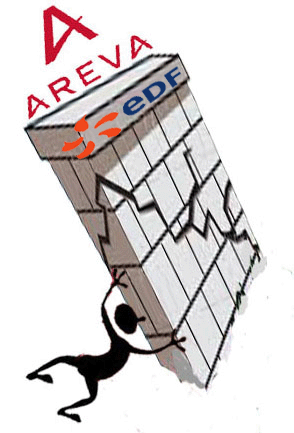
EDF faces a seemingly impossible financial equation. It has colossal debt of €37 billion; it must deal with the complex €2.5 billion takeover of Areva; and find the money to extend the life of its 58 reactors at costs estimated between €60 and €100 billion up to 2030. (8)
Meanwhile EDF has been accused by Greenpeace France of grossly underestimating the cost of nuclear electricity.
Greenpeace claimed that if EDF disclosed the true cost of running its fleet of reactors in France while financing two new ones in the UK, it would be declared bankrupt.
“In summary, the French nuclear fleet is at the end of its course, dilapidated and dotted with deficient parts. At the same time, the finances of EDF are in such a deplorable state that the company could soon join Areva in bankruptcy, and is in any case unable to properly maintain its reactors.”
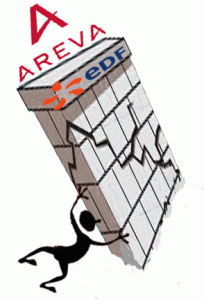 NuClear News No 90 , 26 Nov 16 Problems discovered at Areva’s metal forge at Le Creusot have been growing over the past six months and are now even threatening to derail EDF’s takeover of Areva’s reactor business.
Last spring when Economy Minister Emmanuel Macron visited to tell the workers at Le Creusot that he had every confidence in the nuclear sector, despite the difficulties, 400 files which were being examined for suspected “anomalies” had to be hastily moved out of the meeting room. Now, six months later a crane has been moving prefabricated office buildings into position so that 6,000 records concerning nuclear components – 2.4 million pages – forged at Le Creusot over the last 60 years can be re-examined. Areva has had to accept that the original 400 suspicious files are just the tip of an iceberg and not the only ones containing “irregularities”. 50 people are now trawling through the paperwork and as many more are being recruited for a job that will take at least another eighteen months.
EDF’s CEO Jean-Bernard Lévy says if Le Creusot’s “problems prove insurmountable, the acquisition will not happen”. (1)
With potentially more than half of France’s 58 reactors affected by the “carbon segregation” problem the French nuclear watchdog, the Autorité de Sûreté Nucléaire (ASN) has ordered preventative measures to be taken immediately to ensure public safety. ASN confirmed that, as of late October, 20 reactors were offline and more could be shut down over coming weeks.
Questionable Materials and Documentation
At the heart of France’s nuclear crisis are two problems. One concerns the carbon content of the steel used in critical reactor components, steam heat exchangers, and other components manufactured or supplied by AREVA SA, the French state-owned nuclear engineering firm and global producer of nuclear reactors. The second problem concerns forged, falsified, or incomplete quality control reports about the critical components themselves. Excessive levels of carbon in the steel parts could make them more brittle and subject to sudden fracture or tearing under sustained high pressure, which is obviously unacceptable.
Steam generators from 18 reactors have carbon levels that are above the acceptable level. Some of these were forged at Le Creusot, but others were forged in Japan by JCFC, a subcontractor of Areva. Twelve reactors equipped with JCFC steel are still at a standstill and will be in December while inspections are carried out.
The massive outages are draining power from all over Europe. In the event of severe cold weather this winter, there could be blackouts. Worse, new questions continue to swirl about both the safety and integrity of EDF’s nuclear fleet, as well as the quality of some French- and Japanese-made components that EDF is using in various high-profile nuclear projects around the world.
In October EDF was forced to reduce its 2016 generation targets from 395–400 TWh to 380– 390 TWh, while estimates for nuclear output in 2017 have also been lowered to between 390 TWh and 400 TWh. For perspective, annual nuclear production averaged 417 TWh in the period 2005–2015.
Flamanville
The problem was originally discovered at the Flamanville EPR project in 2014. Since then an internal probe at Le Creusot where many of the components in question were manufactured, has uncovered new anomalies. AREVA is now reported to be reviewing all 9,000 manufacturing records at the forge dating back as far as 1943, including files from more than 6,000 nuclear components.
This autumn there have been almost weekly revelations resulting in plant shutdowns, extended outages, reduced generation, and lots more questions. According to ASN there are now a significant number of reactors offline, with more to be inspected in the next few weeks. “We are now finding carbon segregation problems from components coming from both Le Creusot and [the Kitakyushu-based Japan Casting & Forging Corp.] JCFC plant. As for now, there [are] 20 EDF reactors offline,” the official said, noting that the number will fluctuate as inspections take place.
The analyses performed by EDF thus far have found that since 2015 certain channel heads of the steam generators manufactured by Le Creusot and JCFC “contain a significant carbon concentration zone which could lead to lower than expected mechanical properties,” according to ASN. The Japan Times reports that the JCFC is now also under scrutiny by Japan’s Nuclear Regulation Authority.
Shaun Burnie for Greenpeace said “As a result of substandard manufacturing in Japan, citizens in France have been unknowingly exposed to the risk of catastrophic failure of critical reactor components which could result in a reactor core meltdown. Japanese-supplied steel is now at the centre of France’s unprecedented nuclear crisis the scale of which has never been seen in any country. All 12 reactors supplied by JCFC are either in forced shutdown or about to be. It lacks all credibility that the Japanese nuclear industry would claim that there are no implications for the safety of their own nuclear reactors. The steel production records released in France did not reveal the scale of excess carbon, which was only found after physical testing. There are currently no plans for such tests in Japan. That is wholly unacceptable. There are many urgent questions that need to be answered by the industry and the NRA, and with full public disclosure and transparency.” (2)
Energy traders and analysts warn that the French market needs to prepare for longer maintenance periods in coming years given the age of the nuclear fleet and the continuing design flaw revelations. With the average French reactor now more than 30 years old, equipment will need to be replaced more frequently, and increasingly stringent safety requirements will mean that components could be delayed, especially as ASN imposes additional checks. The safety inspections and other reviews “will lead in particular to extensions of certain planned outages,” EDF said in a press release.
Erring on the Side of Safety?
Despite the outages and findings from the carbon quality investigations, EDF continues to downplay the risk. “The safety margins are very large and the carbon content does not undermine integrity or security, even in the case of an accident,” an EDF spokesperson told Le Monde newspaper. But questions about quality control practices at Le Creusot continue to grow. Indeed, the greater the scrutiny, the more problems are being discovered. The number of components affected by irregularities and already installed in operating reactors increased from 33 known issues in April to 83 by the end of September. Startlingly, irregularities affecting just the Flamanville EPR project increased from two to 20 during the same period.
While EDF and AREVA are dealing with costly damage control, ASN and other agencies are erring on the side of caution. Indeed, the ASN representative said, “We take no risks. That is the rule. If we don’t know the dangers of the carbon segregation, then we must take the reactors offline until we know what the situation is and [can confirm that] it’s not dangerous.”
ASN revealed that AREVA has now identified at least 87 irregularities concerning EDF reactors in operation, including vessels, steam generators, and main primary system piping, plus the 20 issues for parts intended for Flamanville 3, and one more affecting a steam generator planned for installation in Gravelines 5. Inspectors have also found four irregularities affecting transport packaging for radioactive substances. ASN said that whatever the outcome of these investigations, the irregularities “reveal unacceptable practices.”
External Parties Push for Answers
After the discovery of anomalies in the composition of steel in certain zones of the vessel closure head and the vessel bottom head of the EPR reactor being built at Flamanville in 2014, an internal audit was carried out and released in April 2015, suggesting the existence of many more anomalies. These were initially downplayed by ASN and AREVA. But in September 2015 an independent evaluation conducted by Large and Associates for Greenpeace France really set the cat amongst the pigeons. “The nature of the flaw in the steel, an excess of carbon, reduces steel toughness and renders the components vulnerable to fast fracture,” said the report’s author, John Large. The Greenpeace report, “Amplified the questions ASN already had,” said an ASN representative.
12 reactors have been identified by ASN to have carbon problems in replacement steam generators forged by JCFC. In these reactors initial surface tests were followed by more invasive studies. The first reactors to enter scheduled refuelling outages for a more thorough examination were Tricastin 1 and 3. The early nondestructive inspection results for the JCFC bottom channel heads at these reactors revealed an alarming 0.39% level of carbon present, almost 100% greater than the maximum permissible level. That finding, with its associated reduction in material toughness, rendered the component vulnerable to fast fracture, reported Greenpeace in a late October update. ASN decided to order the shutdown of all but one of these reactors and these shutdowns will remain in force until EDF can demonstrate each reactor is safe to re-enter service.
Uncertainty Remains
At a French parliamentary hearing into the situation on October 25, ASN said it would need another year or two to examine the thousands of documents at the Le Creusot foundry and more anomalies and irregularities will probably be discovered. (3
As of late October 2016 ASN has confirmed the following:
- Six reactors have been granted approval to restart and are operating normally: Blayais 1, Chinon 1 and 2, Dampierre 2 and 4, and Saint-Laurent-des-Eaux B2.
- Seven reactos are in planned outages and have been, or are being, inspected. They are: Bugey 4, Civaux 2, Dampierre 3, Gravelines 2, Saint-Laurent-des-Eaux B1, and Tricastin 1 and 3. (4) The Times reports that the re-start of Civaux 2 and Dampierre 3 has been delayed until 31st December.
(5) · Five reactors have been ordered by ASN to be taken offline to conduct checks before 18th January 2017. They are: Civaux 1, Fessenheim 1, Gravelines 4, and Tricastin 2 and 4. (6)
- Three reactors are currently scheduled to remain unavailable throughout the winter months. They are: Bugey 5, Gravelines 5, and Paluel 2.
- One reactor has been ordered by ASN to shut down following the detection of an irregularity in the lower shell of the steam generator. That unit is Fessenheim 2.
- Incidentally, Paluel 2 has been offline since May 2015. Its maintenance period is continuing, following an incident on March 31, 2016, in which a 465-ton steam generator tipped over during removal. (7)
EDF’s Debts
EDF faces a seemingly impossible financial equation. It has colossal debt of €37 billion; it must deal with the complex €2.5 billion takeover of Areva; and find the money to extend the life of its 58 reactors at costs estimated between €60 and €100 billion up to 2030. (8)
Meanwhile EDF has been accused by Greenpeace France of grossly underestimating the cost of nuclear electricity.
Greenpeace claimed that if EDF disclosed the true cost of running its fleet of reactors in France while financing two new ones in the UK, it would be declared bankrupt. Greenpeace commissioned an audit by AlphaValue, the equity research company. The French government has agreed to inject €3 billion into the group this year and has renounced dividend payments until next year. Shares in EDF, 85% of which are owned by the French state, have lost almost a third of their value in the past year and the company is no longer listed on the Paris blue-chip index.
The AlphaValue report described EDF as an “uncompetitive firm – incapable of reacting rapidly and efficiently to the variations in electricity needs and the changes created by the liberalisation of European markets”. It said that EDF’s rivals had written down the value of their nuclear plants because of the move to renewable energy and the fall in electricity prices and that EDF had failed to follow suit. Juan Camilo Rodriguez, author of the report, said the company might have to close 17 of its 58 French reactors to meet the government’s requirement that nuclear power should provide 50 per cent of the nation’s electricity in 2025, down from 75 per cent now.
“The provisions to safeguard the burden of financing the decommissioning of the French reactors are far from sufficient. [If 17 are closed], the group should increase its provisions by more than €20 billion.” Mr Rodriguez said the cost of handling nuclear waste added at least €33.5 billion to that figure. “Whatever scenario is retained, an adjustment of the nuclear provisions . . . would lead to the bankruptcy of EDF from an accountancy point of view,” he added. The report said that EDF would need to find a further €165 billion during the next decade to finance projects such as Hinkley Point and the renovation of reactors in France. EDF says it will spend €51 billion renovating its reactors and £12 billion on Hinkley Point. A spokesman for EDF accused AlphaValue of making erroneous calculations that failed to take account of long-term electricity price movements and differences between France and other European markets. (9) Greenpeace filed a complaint against EDF and its CEO, Jean-Bernard Lévy, for “stock trading offences” at the end of November and EDF responded by suing the group for making “false allegations”.
Greenpeace has asked the public prosecutor “to open a preliminary investigation or to appoint an investigating judge”, saying that “shareholders, investors but also French citizens are being misled by EDF and its CEO”. (10)
According to Stéphane L’homme, Directeur de l’Observatoire du nucléaire: “In summary, the French nuclear fleet is at the end of its course, dilapidated and dotted with deficient parts. At the same time, the finances of EDF are in such a deplorable state that the company could soon join Areva in bankruptcy, and is in any case unable to properly maintain its reactors.” http://www.no2nuclearpower.org.uk/nuclearnews/NuClearNewsNo90.pdf
November 26, 2016
Posted by Christina Macpherson |
business and costs, France, Reference, safety, secrets,lies and civil liberties |
Leave a comment
The AP1000 advanced passive nuclear reactor design has a weaker containment, and fewer back-up safety systems than current reactor designs..
The AP1000 appears to be vulnerable to a very large release of radioactivity following an accident if there were just a small failure in the steel containment vessel, because the gasses would be sucked out the hole in the top of the AP1000 Shield Building due to the chimney effect.
Recent experience with existing reactors suggests that containment corrosion, cracking, and leakage is more common than previously thought, and AP1000s are more vulnerable to containment corrosion than conventional reactors.
In addition the AP1000 shield building lacks flexibility and so could crack in the event of an earthquake or aircraft impact.
The AP1000 reactor design is not fit for purpose and so should be refused a Design Acceptance Confirmation (DAC) and Statement of Design Acceptability (SDA).
 NuClear News No 90 26 Nov 16 The AP1000 Reactor Design
NuGen, a consortium of Toshiba and Engie (formerly GDF Suez), is proposing to build three AP1000 reactors at Moorside in Cumbria – a site adjacent to Sellafield. These three reactors together would have a capacity of up to 3.8GW.

The AP1000 reactor is a pressurised water reactor (PWR) designed and sold by Westinghouse Electric Company, now majority owned by Toshiba. But unlike other PWR designs it is what is called an advanced passive design. The idea behind advanced passive design is that it shouldn’t require operator actions or electronic feedback in order to shut it down safely in the event of a loss of coolant accident (LOCA). Such reactors rely more on natural processes such as natural convection for cooling and gravity rather than motor-driven pumps to provide a backup water supply. Westinghouse claims that AP1000 plant safety systems are able to automatically establish and maintain cooling of the reactor core and maintain the integrity of the containment which holds in the radioactive contents indefinitely following design-basis accidents.
The nuclear regulators – the Office for Nuclear Regulation (ONR) and Environment Agency – have been carrying out a new process called ‘Generic Design Assessment’ (GDA), which looks at the safety, security and environmental implications of new reactor designs before an application is made to build that design at a particular site. Initially the GDA for the AP1000 was expected to be completed around spring 2011, when the regulators would have issued a statement about the acceptability of the design. By the end of 2010 it was clear that the ONR would only be able to issue “interim” approvals for the Areva EPR and Westinghouse AP1000 reactor designs at the end of the generic design assessment (GDA) in June 2011. Construction could only occur after any outstanding “GDA issues” had been resolved.
Eventually on 14th December 2011 the Regulators granted interim Design Acceptance Confirmations (iDACs) and interim Statements of Design Acceptability (iSoDAs) for the UK EPR and the AP1000 reactor designs. The Regulators also confirmed that they are satisfied with how EDF and Westinghouse plan to resolve the GDA issues identified during the process.
ONR’s interim approval for the AP1000 contained 51 GDA Issues. At this point Westinghouse decided to request a pause in the GDA process for the AP1000 pending customer input to finalizing it. Westinghouse has since become part of the NuGen consortium with its parent company Toshiba taking a 60% stake, the process for AP1000 has resumed, and is scheduled to be completed by March 2017 with issuance of DAC and SODA. By March 2016, the cost of the GDA for the AP1000 had reached £30 million. (5)
The GDA process is being carried out in, what is described as, an open and transparent manner, designed to facilitate the involvement of the public, who are able to view and comment on design information published on the web. Questions and comments can be submitted electronically via the Westinghouse website, or direct to the UK regulators. The deadline for making a comment on the AP1000 plant, as part of the GDA process is 30th November 2016. (6)
Edinburgh Energy and Environment Consultancy was commissioned by Radiation Free Lakeland to write a report on the AP1000 reactor design to submit to this consultation.
(Available here http://www.no2nuclearpower.org.uk/wp/wpcontent/uploads/2016/11/AP1000_reactors.pdf )
The report came to the following conclusions:
The AP1000 advanced passive nuclear reactor design has a weaker containment, and fewer back-up safety systems than current reactor designs. Conventional reactors rely on defence-indepth made up of layers of redundancy and diversity – this is where, say, two valves are fitted instead of one (redundancy) or where the function may be achieved by one of two entirely different means (diversity). In contrast advanced passive designs rely much more on natural processes such as natural convection for cooling and gravity rather than motor-driven pumps to provide a backup water supply.
The AP1000 appears to be vulnerable to a very large release of radioactivity following an accident if there were just a small failure in the steel containment vessel, because the gasses would be sucked out the hole in the top of the AP1000 Shield Building due to the chimney effect.
Recent experience with existing reactors suggests that containment corrosion, cracking, and leakage is more common than previously thought, and AP1000s are more vulnerable to containment corrosion than conventional reactors.
In addition the AP1000 shield building lacks flexibility and so could crack in the event of an earthquake or aircraft impact.
A thorough review of the AP1000 design in the light of the Japanese accident at Fukushima has shown that:
- Ongoing nuclear fission after a reactor has supposedly been shutdown continues to be the source of significant pressure inside the containment. The AP1000 containment is extraordinarily close to exceeding its peak post accident design pressure which means post accident pressure increases could easily lead to a breach of the containment.
- At least seven ways in which an AP1000 reactor design might lose the ability to cool the reactors in an emergency have been identified. These include damage to the water tank which sits on top of the shield building and some sort of disruption to the air flow around the steel containment.
- The accidents at Fukushima, especially the overheating and the hydrogen explosions in the Unit 4 Spent Fuel Pool showed that the calculations and assumptions about the AP1000 Spent Fuel Pond design were wholly inadequate.
- Fukushima showed that when several reactors share a site an accident at one reactor could damage other reactors. In the AP1000 the water tank on top of the reactor, and the shield building could be vulnerable to damage.
- Westinghouse assumes that there is zero probability of an AP1000 containment breach. But the accidents at Fukushima have shown that there is a high, probability of Containment System failure resulting in significant releases of radioactivity directly into the environment.
The AP1000 reactor design is not fit for purpose and so should be refused a Design Acceptance Confirmation (DAC) and Statement of Design Acceptability (SDA). http://www.no2nuclearpower.org.uk/nuclearnews/NuClearNewsNo90.pdf
November 26, 2016
Posted by Christina Macpherson |
Reference, technology, UK |
Leave a comment
China, U.S. agree on new sanctions to punish North Korea for nuclear test, but Russia ‘trying to hold it up’, National Post Michelle Nichols, Reuters | November 24, 2016 UNITED NATIONS — The United States and China have agreed on new U.N. sanctions to impose on North Korea over the nuclear test it conducted in September, but Russia is delaying action on a draft resolution, a senior Security Council diplomat said on Wednesday.
The diplomat, who spoke on condition of anonymity, believed China could persuade Russia to agree to the new sanctions and that the 15-member Security Council could vote on the draft resolution as early as next week.
Since North Korea’s fifth and largest nuclear test on Sept. 9, the United States and China, a close ally of North Korea, have been negotiating a new draft Security Council resolution to punish Pyongyang.
That draft text was recently given to the remaining three permanent council veto powers, Britain, France and Russia.
“The (permanent five members) are getting very close to agreement on a draft resolution,” the diplomat said. “The key thing is that China and the U.S., who have led this, have got to a position that they agree on. So the issue now is Russia…….http://news.nationalpost.com/news/world/china-u-s-agree-on-new-sanctions-to-punish-north-korea-for-nuclear-test-but-russia-trying-to-hold-it-up
November 26, 2016
Posted by Christina Macpherson |
China, North Korea, politics international, Russia, UK |
Leave a comment
Russian senator promises nuclear response to NATO expansion https://www.rt.com/politics/368146-russian-senator-promises-nuclear-response/25 Nov, 2016 In response to NATO’s efforts to enlist new member-countries, a member of the defense and security committee for Russia’s Upper House has said that Russia will target any sites it considers to be a threat with nuclear weapons.
“In reply to NATO’s aggressive actions, to the alliance’s attempts to draw more and more nations into their orbit, there will be a harsh and unambiguous response from Russia’s side. We will aim our weapons, including the nuclear ones, at any of the alliance’s site that would threaten us, wherever these sites are placed,” RIA Novosti quoted Senator Franz Klintsevich as saying. The senator also explained that by nuclear weapons he meant both stationary land-based systems, and mobile weapons, including sea- and air-based systems.
Vladimir Putin’s press secretary, Dmitry Peskov, told reporters on Friday that Klintsevich’s position was understandable, but also warned against jumping to hasty conclusions.
“Russian lawmakers have the right for own opinion, they are vividly reacting to international events, to NATO’s expansion towards Russian borders, and to the expansion of NATO’s military infrastructure. This makes their position understandable,” Peskov said. At the same time, he noted that, according to the Russian Constitution, lawmakers cannot determine the country’s foreign policy, as that is solely the president’s prerogative.
In late October of this year, Senator Klintsevich told Norwegian television TV2 that Russia was concerned about US plans to deploy marines at a Norwegian base which he sees as part of its Prompt Global Strike doctrine. The implementation of this plan would force Russia to target sites in Norway with strategic weapons, which it has never had to do before.
November 26, 2016
Posted by Christina Macpherson |
Russia, weapons and war |
Leave a comment
NucClear News No 90 , 26 Nov 16 A new report from a think-tank called E3G, which aims to accelerate the transition to a lowcarbon economy, says the Government needs to deliver new low carbon generation capacity as cheaply as possible. The UK will need new capacity capable of producing around 150TWh (terawatt hours = 1,000 million kWh) per year of electricity by 2030 – around half of all current output. All plausible scenarios imply that this can only be achieved by deploying a significantly increased volume of renewable generation – likely to be around 50GW, predominantly from a combination of onshore and offshore wind and solar PV.
The E3G report says there is an increasing body of evidence that the system integration costs of renewable generation are low and that the power system can operate securely and at least cost with more than 50% of electricity demand being met from variable renewable sources. System integration costs are predicted to remain less than £10/MWh which means that not only is it possible to securely operate the power system with high levels of renewable generation, but it also represents the cheapest option. E3G shows that under the current trajectory onshore wind will be at least 22% cheaper than nuclear with offshore wind and solar PV providing savings in excess of 4% and 8% respectively, and savings will probably be even greater as the flexibility of the electricity system improves.
The important conclusion from this E3G study is that the cheapest way to decarbonise the power system involves large volumes of variable renewable generation even when taking system integration costs into account. (1)
Renewable costs keep falling
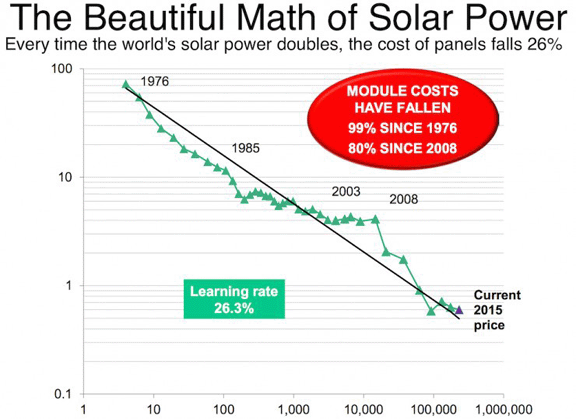
In fact researchers at Citi, a global investment bank, think that paying for energy could soon become a thing of the past. Cheaper storage and smart data analytics may soon make solar and wind energy available to consumers in some parts of the world – completely for free. (2)
Even the government now expects solar and wind power to be cheaper than new nuclear power by the time Hinkley Point C is completed. And Business Secretary, Greg Clark, has admitted that fears that intermittent renewables would jeopardise Britain’s ability to keep the lights on have been overblown. (3) An unpublished report by the energy department shows that it expects onshore wind power and large-scale solar to cost around £50-75 per megawatt hour (MWh) of power generated in 2025. New nuclear is anticipated to be around £85-125/MWh, in line with the guaranteed price of £92.50/MWh that the government has offered Hinkley’s developer, EDF. On previous forecasts, made in 2010 and 2013, the two renewable technologies were expected to be more expensive than nuclear or around the same cost. This is the first time the government has shown it expects them to be a cheaper option. The figures were revealed in a National Audit Office (NAO) report on nuclear in July. “The [energy] department’s forecasts for the levelised cost of electricity of wind and solar in 2025 have decreased since 2010. The cost forecast for gas has not changed, while for nuclear it has increased,” the NAO said. (4)
 Onshore Wind Costs
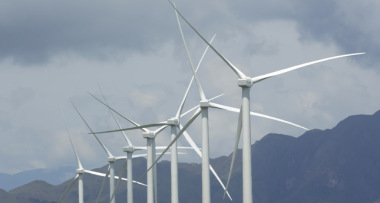
In Europe onshore wind has become one of the most competitive sources of new electricity. Mott MacDonald estimated in 2011 that costs would fall to around £52-55/MWh by 2040 compared with £83-90/MWh in 2011. (5) But according to Bloomberg New Energy Finance (BNEF) new onshore windfarms were the cheapest way for a power company to produce electricity in Britain by 2015 with costs dropping to £55/MWh. (6) The trade body, Scottish Renewables, has shown that costs could be cut by a further 20% if government, industry and regulators work together to make sure we can use the latest generation of turbines on suitable sites, reduce grid charges, and deploy energy storage technologies. (7)
 Solar Power
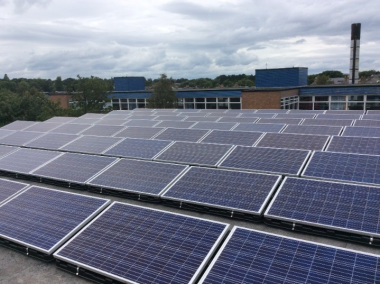
Sustainability expert, Chris Goodall, author of new book called “The Switch” (8), says cheap solar panels and advances in storage technology are about to transform the world. By 2030 or 2040 solar will be the cheapest way to generate electricity, indeed any form of energy EVERYWHERE. At the rate of growth that we are seeing at the moment of 35-45% per year solar will grow from providing 2% of global electricity to at least 50% by 2030. We can see the cost of batteries coming down in price dramatically. Turning surplus solar electricity generating during the summer into something we can put into natural gas networks is what we should be looking at in the UK. Generating hydrogen from water and, using microbes, combining it with carbon dioxide to form methane is the simplest way to do this. The era of fossil fuels is drawing to a close. (9)
 Offshore wind
Earlier this year DONG Energy of Denmark, the world’s largest offshore wind company, won a bid to build two wind farms 22 kilometres off the Dutch coast. The company says power will be produced for less than any other offshore scheme to date. It is estimated that when the scheme is fully operational, electricity will cost €72.70 per megawatt hour (MWh) and €87 MWh when transmission costs are included. (10)
At the time this was described as the cheapest offshore wind electricity in the world: “beyond even the most optimistic expectations in the market.” (11) Since then Swedish utility Vattenfall has agreed to build a giant offshore wind farm in Denmark that would sell power for €49.50 per MWh. Vattenfall has broken its own previous record of €60 per MWh.
Greenpeace has produced the chart below [on original] to show the cost of offshore wind power compared with the cost of Hinkley Point C. The UK’s cheapest offshore windfarm will produce power at roughly £120 per MWh, which is far more than the projects being built in Denmark and the Netherlands. Part of the reason for that is that those governments cover transmission costs, so in the name of fairness Greenpeace adds £25 per MWh. And then to address offshore wind’s intermittency, you’ve got to add another £7.6 per MWh — according to the UK government’s top climate advisers to cover the cost of the ‘balancing’the system. (12)
So we can see that the latest Vattenfall bid is coming in at £75.50/MWh compared with £100.50/MWh for Hinkley Point C. (The £92.50/MWh strike price agreed for Hinkley Point C was index-linked at 2012 prices so £8/MWh has been added to allow for inflation.)
 Energy Efficiency
Research out by sustainability expert, Chris Goodall, shows a business and government drive to promote switching of homes, street lights and offices to energy efficient LED light bulbs would see a huge reduction in the UK’s electricity demand for lighting – more than two Hinkley nuclear plants’ worth of electricity. Lighting is responsible for nearly a third (29%) of total winter peak electricity demand – a complete switch would halve that. Switching entirely to LEDs in homes will save about 2.7 GW of peak winter demand; street lighting 0.5 GW; offices and commercial buildings 4.5 GW.
An expenditure of about £62 in an average house, replacing about 21 of the bulbs in living areas would cut electricity bills by at least £24 per year. This could be done relatively quickly and the total cost of partially upgrading all UK homes to energy-efficient LED lights would be around £1.7 billion. The price of LED light bulbs is falling over time and they cost just £1.60 each at major retailers. Aside from saving money for the householder directly, the government would conservatively save £65 million per year on capacity market payments from this action in houses and more elsewhere in street lighting and commercial sector. (13)
There are good reasons for using investment in energy efficiency as a vehicle to stimulate the economy – the macroeconomic benefits of public energy efficiency programmes have been illustrated by economists time and time again. For instance Verco and Cambridge Econometrics estimate that if delivered as part of a major infrastructure investment programme for £1 invested by government £3.20 is returned through increased GDP resulting in increased employment of up to 108,000 net jobs per annum. A recent study by Frontier Economics calculates that an energy efficiency infrastructure programme could generate £8.7 billion of netbenefits to the economy.
We know from the German KfW loan scheme that public subsidies for energy efficiency are more than offset by the increase in tax revenues and savings in welfare spending due to lower unemployment. Now is the time to do this in the UK, according to Jan Resnow at the Science Policy Research Unit at Sussex University. The economic uncertainty caused by the Brexit vote will prevail for some time until Britain’s new status becomes clearer. At the same time, there will be no energy efficiency programme for the able-to-pay sector after 2017 and funds for fuel poverty alleviation are falling short of what is required to achieve the target. The economic evidence is clear – energy efficiency provides a golden opportunity for an economic stimulus in the UK. (14) http://www.no2nuclearpower.org.uk/nuclearnews/NuClearNewsNo90.pdf
November 26, 2016
Posted by Christina Macpherson |
renewable, UK |
Leave a comment
 NuClear News No 90 26 Nov 16 Radio Four’s Costing the Earth has been investigating whether it is safe to keep reactors running long past their expected lifespan of about 30 years. Five of Britain’s seven AGRs are already older (Torness and Heysham 2 are only 27 years old). Hinkley Point B and Hunterston B are already 40 years old but EDF energy wants them to continue operating for at least another 7 years.
In 2005 the Nuclear Installations Inspectorate (now the Office for Nuclear Regulation -ONR) expressed concern about the structure of the reactor core. The core is made up of 6,000 graphite blocks. Around half of these are 1 metre tall with a bore or channel running through each block. Around 200 of these channels contain rods of nuclear fuel. If anything goes wrong control rods are inserted between the channels to dampen the nuclear reaction and shut down the reactor.
Nuclear Engineering consultant John Large explains that graphite is not elastic, it doesn’t bend, and it is not particularly strong. And now the graphite bricks are cracking. The core is an assembly of several thousand bricks, loosely stacked together and the expectation was that the core would never fail, so there was no facility to replace any individual blocks if they did become damaged. But now there are physical changes occurring in the core, in the individual bricks – cracking and fracturing – that must result in some loss of strength – not only of the individual bricks, but of the core as a whole.
The BBC used a Freedom of Information request to obtain a number of documents. One paper from ONR reveals that one third of the channels inspected at Hinkley B and Hunterston B contain what they describe as significant cracks. EDF says the cracks were anticipated at this stage in the reactors’ life and it is safe to operate for years to come. It says evidence suggests that its predictions about cracking are accurate.
Brian Cowell, director of nuclear operations, says: “in fact we are looking to extend life further (than 2023) if we can.” The analysis suggests that we can have more than 1,000 axial cracked bricks and still operate with massive margins of safety. 1,000 cracked bricks would exceed the current safety limit set by ONR, but the regulator is considering changing that limit.
Mark Foy – Deputy Chief Nuclear Inspector says the percentage of cracked bricks ONR is currently happy to accept is 10%, but they are considering increasing that to 20%. Foy says that the original safety case provided by EDF was on the basis of 10% cracking. As experience is gained and analysis and research is undertaken it allows EDF and ONR to gain a more informed and accurate view of what is acceptable and what isn’t.
EDF has now provided ONR with a safety case for allowing 20% cracking. This is based on the analysis EDF has undertaken; samples they’ve taken and the inspections they’ve undertaken. The focus has been to look at the likelihood of core disruption after an earthquake which could prevent the control rods being inserted. ONR is considering the new safety case.
Keyway Route Cracking
The ONR is also investigating a very specific and more concerning form of cracking. The keyway is a slot that holds each brick to the adjacent brick, the bricks underneath and the bricks on top. These keyways, which are acknowledged to be the limiting factor in the life of these reactors, are beginning to fracture. John Large points out that this will make the graphite blocks a very loose set of bricks.
Prof Paul Bowen of Birmingham University sits on the graphite technical advisory committee for ONR. He says the keyway cracks could potentially prevent the entry of the control rods. If the core distorts too much, it’s easy to see how trying to feed anything in could become very difficult
Seven of the keyways have been discovered to have cracks at Hunterston B. John Large believes the presence of keyway cracks casts doubt on the safety of the reactor in the event of an emergency like an earthquake. We have a cracked and deteriorating core that’s lost its residual strength and we don’t know by how much. Some of the design case accidents will test the core – one of these would be a seismic shake where the whole core is wobbled. If the core becomes misaligned, and the fuel modules get stuck in the core, the fuel temperature will get raised and could undergo a melt. If the radioactivity gets into the gas stream and the reactor is venting because it’s over pressurised then you have a release to the atmosphere and you have dispersion and a contamination problem.
ONR agrees keyway cracks could compromise safety. One of the documents the BBC obtained said the discovery of keyway route cracks at Hunterston invalidates the previous safety case. EDF had to consider what information to present to ONR to satisfy them that the reactor was still safe to operate. EDF brought in articulated control rods and nitrogen injection systems to address the extra risks posed by the keyway route cracking. The new rods are bendy making them easier to insert into a distorted core and an injection of nitrogen could buy several hours of invaluable time in the event of an accident.
However, concern remains because we can’t be certain how many keyway route cracks there are. John Large explains that to examine where the cracks are you have to take the fuel out of the reactor and put a camera down to inspect the inside of the bore, but these keyway cracks are on the outside of the bricks so you can’t actually see them.
It’s very hard to inspect the channels in which the fuel sits. Around 10% are inspected each time the reactor is shutdown. So there may be keyway route cracks that have never been seen at Hunterston and Hinkley. In the absence of a full visual inspection a mathematical model is used to work out the likelihood of cracks in particular parts of the reactor. The trouble is the model has already been shown to be flawed.
Paul Bowen says they haven’t been able to get the exact timing of the cracks right. The industry argued that cracks would appear first in layers 4 and 5, but they actually appeared in level 6. John Large says the model relied upon by ONR is not working, so they can’t predict the strength of the core. More to the point they can’t work out where to put their investigative probes to see where cracking is taking place. So they’re in the dark.
If the ONR gives the go-ahead for an increase in the number of cracked bricks from 10 to 20%, it might be difficult for people living near theses reactors to understand why the definition of “safe” seems to be changing. http://www.no2nuclearpower.org.uk/nuclearnews/NuClearNewsNo90.pdf
November 26, 2016
Posted by Christina Macpherson |
Reference, safety, UK |
1 Comment
NucClear News, 26 Nov 16 New Reactor Notes The Environment Agency is planning to launch a consultation on its preliminary conclusions on the Advanced Boiling Water Reactor design which Horizon Nuclear is proposing to build at Wylfa on Anglesey and Oldbury in Gloucestershire. The consultation will run between 12 December 2016 and 3 March 2017. (1) EA will hold a consultation meeting on 24th January 2017 at the Botanical Gardens, Birmingham. This should give participants an introductory understanding of the reactor design currently being assessed through the GDA. (1)
The second stage of a public consultation into the two EPR reactors planned for Sizewell in Suffolk has been launched.
November 26, 2016
Posted by Christina Macpherson |
politics, UK |
Leave a comment
Sweden to scrap taxes on solar energy in 2017 http://www.france24.com/en/20161121-sweden-scrap-taxes-solar-energy-2017?ref=tw_i STOCKHOLM (AFP) – Sweden is set to ditch taxes on its production of solar energy in 2017 in a bid to run entirely on renewable energy by 2040, the government said on Monday.
Solar energy is currently marginal in the Nordic nation, accounting for less than 0.1 percent of electricity production. Sweden relies mostly on hydropower (39 percent) and nuclear power (36 percent). The finance ministry said in a statement that the production of solar electricity for own use would be entirely exempt from taxes. Electricity providers would meanwhile only be taxed 500 kronor (51 euros) per megawatt hour, which is a 98-percent reduction from the current level.
“This makes fast investments possible,” Social Democratic Finance Minister Magdalena Andersson said.
The proposal is likely to be adopted by parliament, with the centre-right opposition having criticised the minister for her lack of ambition with regards renewable energy investments.
The move must also be approved by the European Commission in Brussels, which aims to boost the EU’s share of renewable energy to at least 20 percent of consumption.
In October, the Swedish energy market regulator had estimated that in order to reach the target of 100 percent renewable energy, the share of solar electricity would have to rise to between five and 10 percent.
November 26, 2016
Posted by Christina Macpherson |
renewable, Sweden |
Leave a comment
 Russia successfully tests missiles that fire from ‘nuclear trains’ Latest missile advancement comes as Kremlin deploys nuclear-capable missiles to Polish boarder , The Independent, Samuel Osborne @SamuelOsborne93 Wednesday 23 November 2016 Russia has successfully tested intercontinental ballistic missiles intended for its “nuclear trains” program.
Tests on missiles for the Barguzin “railway-based combat rocket system” were carried out at the Plesetsk cosmodrome two weeks ago, the state-owned Interfax news agency reports…
The mobile weapons platform, made up of several train carriages designed to conceal the launchers of six Yars or Yars-M thermonuclear ICBMs and their command units, are expected to enter service between 2018 and 2020…….http://www.independent.co.uk/news/world/europe/russia-putin-nuclear-train-missiles-tests-success-a7433861.html
November 24, 2016
Posted by Christina Macpherson |
Russia, weapons and war |
Leave a comment