German legal case sets precedent for limiting the greed of nuclear and coal companies

 Limiting the greed of the nuclear industry http://www.dw.com/en/opinion-limiting-the-greed-of-the-nuclear-industry/a-36664176 The German Constitutional Court’s decision that an accelerated nuclear phase-out is legal, and limiting compensation for energy companies is good news, says DW’s Gero Reuter. This could even set a precedent for coal.
“Property entails obligations. Its use shall also serve the public good,” states article 14 of the German constitution. At the same time, the German constitution demands that expropriation is permissible for the public good, and will be compensated after balancing the interests of everyone affected.
That’s the most crucial background to Germany’s biggest power companies – Eon, RWE and Swedish state-owned company Vattenfall – having filed lawsuits against the German government. They asked for compensation for the government’s decision in 2011 to hurry through shutdown of nuclear reactors in the wake of the 2011 nuclear meltdown at Japan’s Fukushima reactor.
According to the energy companies, the nuclear phase-out is an unconstitutional expropriation of their power plants and possible energy production. They had asked for compensation of around 19 billion euros ($20 billion), which was supposed to be shelled out by taxpayers – around 230 euros from each citizen, babies to pensioners.
This week, Germany’s Constitutional Court mostly rejected their claims, saying the law for a nuclear phase-out from 2011 “is mostly compatible with Germany’s constitution.”
Only long-term investments that the power companies made between December 2010 and March 2011 are eligible for compensation, the court ruled, as the German government agreed to a maximum lifetime extension of nuclear power plants for 12 years in 2010.
What’s more, Germany’s Constitutional Court said some of the power companies received unequal treatment, and thus ruled that the German government has to adjust the law accordingly by June 2018.
Good news for taxpayers and the environment
The ruling is good news for taxpayers and the environment, as it will limit the greed of power companies to tap even more subsidies at the expense of public health, the environment and government budgets.
As to the requested compensation costs of around 19 billion euros – fortunately there’s not much left to this argument. It’s possible that the German government won’t have to pay anything to the energy companies at all. If worse comes to worse, it may pay a billion euros. This all depends on how the state will define unequal treatment of the different energy companies over the months to come.
What’s even more positive and groundbreaking is the legal reasoning behind the ruling. Germany’s Constitutional Court stressed several times that it attaches great importance to the protection of life, health and natural resources, and to the minimization of risks through the use of nuclear energy. It also said this could lead to an even faster nuclear phase-out, and that the German government could change its laws after the fact.
Thinking into the future, this decision could set a precedent for legal support to Germany being on the necessary path to withdraw from coal-powered electricity, and to shorten the long-term operating licenses power companies retain for mining lignite (brown coal).
The energy companies should carefully study this decision, and read between the lines to see how the German constitution truly works. “Property entails obligations. Its use shall also serve the public good.”
And if companies don’t use their property for the public good, then the state can expropriate this under certain circumstances. Obviously, the state then has to pay an appropriate compensation fee after balancing the interests of everyone involved – that’s fair.
But it should pay only what’s fair and not a cent more – especially not for big, powerful energy companies.
Mitsubishi Heavy makes huge and risky investment in AREVA nuclear
 Mitsubishi Heavy faces tough decisions in nuclear power business Orders dry up at home and abroad after Fukushima disaster, Nikkei Asian Review, 8 Dec 16, TOKYO –– Mitsubishi Heavy Industries and Japan Nuclear Fuel are putting the final touches on a plan to acquire a roughly 10% stake in the troubled French nuclear energy company Areva. But for Mitsubishi Heavy it is an agonizing decision.
Facing dim prospects for new domestic orders, both Mitsubishi Heavy and Japan Nuclear Fuel must find other ways to secure enough business to keep their equipment and workforces active.
Back in 2006, Mitsubishi Heavy partnered with Areva to develop a so-called Generation III+ pressurized-water reactor with state-of-the-art technologies. The team has been using the design to compete with the larger, older-generation pressurized-water systems promoted by two other groups: the team of Hitachi and General Electric, and the team of Toshiba and Westinghouse…….
The French government, which owns nearly 90% of Areva, is looking to cut its losses. Unprofitable businesses are being excised from Areva and a new company is being set up that will seek over 30% of its capital from Japan, China, and elsewhere. …
There are lingering worries inside Mitsubishi Heavy about this huge investment in Areva. To alleviate those concerns, Mitsubishi Heavy has voiced confidence that there will be another nuclear renaissance in 20 to 30 years……http://asia.nikkei.com/Business/Deals/Mitsubishi-Heavy-faces-tough-decisions-in-nuclear-power-business
German court ruling means only limited scope for utilities to claim compensation
 E.ON sees limited scope for nuclear claims after ruling -Bernstein, Reuters, Dec 8 E.ON sees limited scope for compensation claims following a court ruling related to Germany’s nuclear exit that paves the way for utilities to try to reclaim money, its chief executive told brokerage Bernstein in an interview.
Germany’s highest court on Tuesday ruled that hastening the shutdown of nuclear plants after Japan’s Fukushima disaster violated some of the property rights of utility companies, allowing them to seek limited damages.
It said that utilities could claim back stranded investments made between December 2010 and March 2011 when the government decided to extend the life of nuclear plants. In 2011, the government’s position changed and it decided to shut down all stations by 2022.
E.ON said earlier this week it had invested several hundred million euros in 2010 in the expectation that the government’s nuclear policy would remain unchanged.
“Of this, a low triple digit million amount was likely incurred in the four month period between December 2010 and March 2011, which should be eligible for compensation,” Bernstein quoted CEO Johannes Teyssen as saying.
Germany’s environment minister Barbara Hendricks said this week the court ruling meant demands by utilities for billions of euros in compensation was off the table……http://www.reuters.com/article/germany-nuclear-e-on-idUSL5N1E31FC
German nuclear compensation court case a precedent for limiting the greed of the nuclear industry
 Limiting the greed of the nuclear industry http://www.dw.com/en/opinion-limiting-the-greed-of-the-nuclear-industry/a-36664176 The German Constitutional Court’s decision that an accelerated nuclear phase-out is legal, and limiting compensation for energy companies is good news, says DW’s Gero Reuter. This could even set a precedent for coal.
“Property entails obligations. Its use shall also serve the public good,” states article 14 of the German constitution. At the same time, the German constitution demands that expropriation is permissible for the public good, and will be compensated after balancing the interests of everyone affected.
That’s the most crucial background to Germany’s biggest power companies – Eon, RWE and Swedish state-owned company Vattenfall – having filed lawsuits against the German government. They asked for compensation for the government’s decision in 2011 to hurry through shutdown of nuclear reactors in the wake of the 2011 nuclear meltdown at Japan’s Fukushima reactor.
According to the energy companies, the nuclear phase-out is an unconstitutional expropriation of their power plants and possible energy production. They had asked for compensation of around 19 billion euros ($20 billion), which was supposed to be shelled out by taxpayers – around 230 euros from each citizen, babies to pensioners.
This week, Germany’s Constitutional Court mostly rejected their claims, saying the law for a nuclear phase-out from 2011 “is mostly compatible with Germany’s constitution.”
Only long-term investments that the power companies made between December 2010 and March 2011 are eligible for compensation, the court ruled, as the German government agreed to a maximum lifetime extension of nuclear power plants for 12 years in 2010.
What’s more, Germany’s Constitutional Court said some of the power companies received unequal treatment, and thus ruled that the German government has to adjust the law accordingly by June 2018.
Good news for taxpayers and the environment
The ruling is good news for taxpayers and the environment, as it will limit the greed of power companies to tap even more subsidies at the expense of public health, the environment and government budgets.
As to the requested compensation costs of around 19 billion euros – fortunately there’s not much left to this argument. It’s possible that the German government won’t have to pay anything to the energy companies at all. If worse comes to worse, it may pay a billion euros. This all depends on how the state will define unequal treatment of the different energy companies over the months to come.
What’s even more positive and groundbreaking is the legal reasoning behind the ruling. Germany’s Constitutional Court stressed several times that it attaches great importance to the protection of life, health and natural resources, and to the minimization of risks through the use of nuclear energy. It also said this could lead to an even faster nuclear phase-out, and that the German government could change its laws after the fact.
Thinking into the future, this decision could set a precedent for legal support to Germany being on the necessary path to withdraw from coal-powered electricity, and to shorten the long-term operating licenses power companies retain for mining lignite (brown coal).
The energy companies should carefully study this decision, and read between the lines to see how the German constitution truly works. “Property entails obligations. Its use shall also serve the public good.”
And if companies don’t use their property for the public good, then the state can expropriate this under certain circumstances. Obviously, the state then has to pay an appropriate compensation fee after balancing the interests of everyone involved – that’s fair.
But it should pay only what’s fair and not a cent more – especially not for big, powerful energy companies.
France launches investigation of Fessenheim nuclear power plant
The investigation was launched by the Paris Prosecutor’s office, AFP reported on Monday evening, citing judicial sources.
The Fessenheim power plant is in the Haut-Rhin department in Alsace, eastern France, near the German and Swiss borders.
The plant’s activity is endangering the lives of people and it has equipment which doesn’t fulfill the requirements of safety, according to the AFP report.
READ MORE: France’s nuclear watchdog wants to shut down 5 reactors over failure risk
All these concerns were previously voiced by Greenpeace, which accused AREVA, a group specializing in nuclear power and renewable energy, and Électricité de France (EDF) of inaction.
In October this year, Greenpeace called upon the Paris prosecutor to investigate the abnormalities of both reactors of the plant.
“EDF and AREVA were aware of serious irregularities on Reactor 2 at Fessenheim,” the statement said. “The defective part is a steam generator, an essential component of nuclear reactors.”
The group also called for the immediate shutdown of Reactor 1 of the plant.
Greenpeace also accuses EDF and AREVA of falsifying safety certificates of the plant so that the authorities won’t shut it down.
“EDF, as the operator, has in fact decided to give priority to economic interests instead of protecting people and the environment.”
Fessenheim has recently been the topic of heated discussion, which even took place in the Elysee Palace. In April, President Francois Hollande promised to formally initiate the shutdown of France’s oldest nuclear reactors on the grounds of environmental and safety concerns.
READ MORE: Hollande vows to shut down France’s oldest nuclear power plant
Also in October, the Nuclear Safety Authority (ASN) asked EDF to shut down and inspect the plant. Fessenheim houses two 920 megawatt reactors and has been running since 1978, making it France’s oldest operating nuclear power plant. The German government and activists alike have long been calling for it to be permanently closed.
The plant is situated on a seismic fault line, making it vulnerable to earthquakes and flooding. The German government has repeatedly called on France to terminate the Fessenheim plant as soon as possible, after an April 2014 accident when one of the reactors had to be shut down as water was found leaking from several places.
France has 58 nuclear reactors with a total capacity of 63.2 Gigawatts. The country gets two thirds of its electricity from nuclear energy.
Radical Ukrainian politician Oleg Lyashko wants nuclear weapons
Radical MPs bid to make Ukraine nuclear again, Rt.com : 6 Dec, 2016 The Radical Party faction of the Ukrainian parliament is seeking to withdraw Ukraine’s membership of the 1968 international treaty which bans the development of nuclear weapons and keeps nuclear technology in check.
The Nuclear Non-Proliferation Treaty (NPT) recognizes only five nations as legitimate possessors of nuclear weapons: China, France, Russia, the UK and the US. A handful of UN members are not signatories to the treaty, including Pakistan and India, which were never part of the NPT but have nuclear weapons of their own, and North Korea, which withdrew in 2003 to develop a nuclear arsenal.
Now Kiev may follow Pyongyang’s example if the Radical Party faction in parliament has its way. The party’s leader, Oleg Lyashko, has long called for the government to restore the country’s nuclear capability, which Ukraine briefly possessed in the wake of the collapse of the Soviet Union.
The number of nuclear warheads deployed on Ukrainian territory by the USSR was only behind those possessed by Russia and the US. But by 1996, all of them had been handed over to Russia, which was busy dismantling a large portion of the costly Soviet nuclear stockpile.
In 1994, Ukraine was given security assurances by Russia, the US and the UK in the so-called Budapest Memorandum in exchange for its accession to the NTP. Similar documents were signed with Kazakhstan and Belarus, which were in a comparable position. China and France gave milder commitments to Ukraine in separate statements……..
Lyashko is a populist politician with a strongly nationalist voter base, and is well known for his publicity stunts. His bill to restore Ukraine’s nuclear status was registered in parliament Tuesday. A date for a committee discussion on the issue is yet to be set.
Ukraine’s ability to actually produce a nuclear weapon remains in question. While numerous research and production facilities based in what now is Ukraine were involved in building the Soviet nuclear arsenal, the country’s current economic troubles and technological backslide would make constructing even a simple nuclear device a major challenge – even if the Ukrainian government does undertake such a project.
Historically, only Pakistan and India have openly acquired nuclear capabilities without being alienated from the international community. …..https://www.rt.com/news/369363-ukraine-wants-nuclear-weapons/
German court orders compensation for nuclear operators following nation’s exit from nuclear power
German nuclear operators to get compensation for nuclear exit: court http://www.platts.com/latest-news/electric-power/london/german-nuclear-operators-to-get-compensation-26613982 London (Platts)–6 Dec 2016
* German supreme court says some rights violated by nuclear exit
* But confirms general constitutionality of exit law
* Government needs to set compensation framework by June 2018
Germany’s supreme court (Bundesverfassungsgericht) on Tuesday confirmed that the nuclear exit law from July 2011, although generally conforming with the German constitution, in part violates the property rights of nuclear operators.
Nuclear operators E.ON, RWE and Vattenfall brought the lawsuit after the government decided in 2011 to reverse its planned extension of nuclear runtimes in the wake of the Fukushima nuclear crisis, replacing remaining production quotas with a set deadline for the closure of reactors and a complete phase out of nuclear power by the end of 2022.
The court in Karlsruhe declared that the government needs to put in place “appropriate” compensation for investment based on the initial plan to extend runtimes by around 12 years after the 2009 elections.
The new compensation rules need to be in place by June 30, 2018, the court said in a statement
It did not give any guidance on the compensation sum.
According to a report by German news agency dpa, the operators so far have not quantified their compensation demands, speaking only of “massive economic damage” with dpa quoting estimates of around Eur19 billion.
In October, the government cleared the way for a financial solution to the nuclear storage issues with new rules under which the nuclear operators will pay a combined Eur23.5 billion into a state-run fund for the financing of mid- and long-term nuclear storage in Germany.
In return, the nuclear operators will be released from liability for interim and final storage of nuclear waste, but remain solely responsible for the decommissioning of nuclear power plants as well as the transport of the nuclear waste to the storage repository.
–Andreas Franke, andreas.franke@spglobal.com
–Edited by Alisdair Bowles, alisdair.bowles@spglobal.com
Belarus’s radiation tragedy of Chernobyl is only just developing
Exiled scientist: ‘Chernobyl is not finished, it has only just begun’
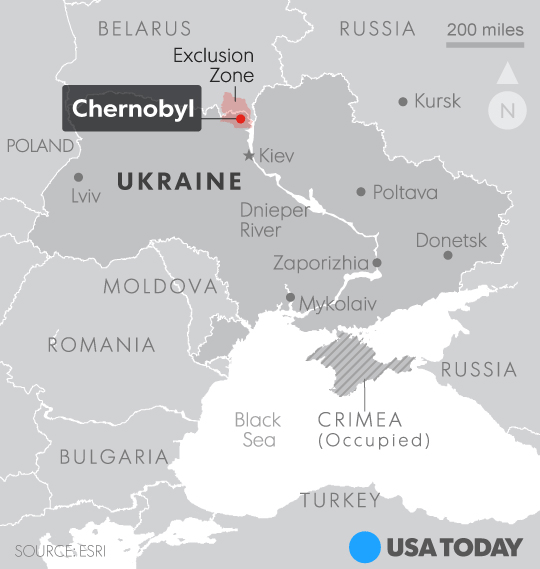
http://www.usatoday.com/story/news/world/2016/04/17/nuclear-exile-chernobyl-30th-anniversary/82896510/ YURY BANDAZHEVSKY DETAILED CHERNOBYL’S DEVASTATING IMPACT ON PEOPLE’S HEALTH, PARTICULARLY THAT OF CHILDREN, IN BELARUS. NOW HE LIVES IN EXILE WHILE THE GOVERNMENT INSISTS “EVERYTHING’S OK.”
Chernobyl through the eyes of an artist
Kim Hjelmgaard , USA TODAY Yury Bandazhevsky, 59, was the first scientist in Belarus to establish an institute to study Chernobyl’s impact on people’s health, particularly children, near the city of Gomel, about 120 miles over the border from Ukraine. He was arrested in Belarus in 1999 and sentenced to eight years in prison for allegedly taking bribes from parents trying to get their children admitted to his Gomel State Medical Institute. He denied the charges.
The National Academy of Sciences and Amnesty International say he was detained for his outspoken criticism of Belarus’ public health policies following the nuclear disaster. He was released in 2005 and given French citizenship, after rights groups took up his case along with the European Union, Britain, France and Germany. He now runs a medical and rehabilitation center outside Kiev dedicated to studying and caring for Chernobyl’s victims.
Here are his words, edited and condensed for clarity:
KIEV, Ukraine — If you were told that a lot is already known in Ukraine and Belarus about what Chernobyl has done to these countries, than I can tell you that you are wrong. How can I put it? It is only after 30 years that we are starting to see the real impact. We can say for sure that Belarus was affected more. There was more radioactive fallout there. The doses the general population received were huge. My students and colleagues and I observed it when I arrived in Gomel in 1990 to organize the medical institute (now a university).
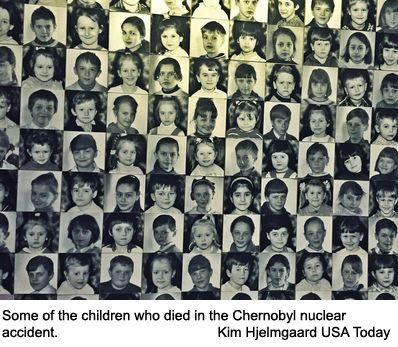
At the first, we were observing the effects of the large doses because Gomel was located in the epicenter of this high level of contamination. Then we started to look at the accumulation of radioactive elements in internal organs at lower doses, children’s in particular. We were already seeing a complex pathology affecting the endocrine system (which produces hormones), the cardiovascular system and almost all the internal organs. This was work that had never been done in Belarus and has not been done since.
When I arrived in Ukraine in 2009, I did not find any serious objective source of information about the state of health of the children and people in the Ivankiv and Polesskiy regions (two areas that neighbor Chernobyl). There was no interest. We have now examined about 4,000 second-generation children and most of them have serious problems with their cardiovascular systems. I was starting to see the same thing in Belarus before I left. I am especially disturbed by irregularities I see in teenagers, in particular boys ages 12-17.
Several million people in Ukraine live on land contaminated by radiation, so we need to evaluate a very large number of people. But there are no such projects. You have to live among the people here to truly understand what is happening, because the problem is very complicated. I have even tried to send interested people to the cemetery in Ivankiv so they can see for themselves how many graves are there — many who died at a very young age. None of this is in the official statistics.
I don’t have any objective information about what is happening now with the health of children in Belarus. Everything is closed. The government says, ‘Everything’s OK, everything’s OK.’ But I get telephone calls from people in Gomel and they tell me that many of the children we were observing before I left have died. They were of different ages: 6, 12, 14. I will never forget appearing on television in Belarus with the president (Alexander Lukashenko). I was saying we were seeing very serious problems in children because of radiation, while he was saying ‘Everything’s OK.’ But I can’t touch this, because I can’t go there, or work there.
For me, the problem of Chernobyl is not finished, it has only just begun.
I am very much afraid that in one or two generations from now, the (descendants) of the population of Belarus and Ukraine that were affected by Chernobyl will vanish. I am afraid of that very much. I don’t want my countrymen to perish. It’s possible that help from the international community to understand what is going on is needed now, just as much as it was immediately after the accident.
EDF’s nuclear reactor troubles pose another hindrance to UK’s Hinkley project
New blow for Hinkley Point contractor EDF after French safety checks
Safety issues force many reactors offline with warnings of power cuts across France, higher energy prices and a rise in emissions, Guardian, Adam Vaughan and Kim Willsher, 4 Dec 16, The company building the UK’s first new nuclear power station for decades is facing questions over the health of its fleet of French nuclear plants after an investigation which has left the country with the lowest level of nuclear power for 10 years and the prospect of power cuts during a cold snap.
Thirteen of Électricité de France’s (EDF) 58 atomic plants are offline, some due to planned maintenance, but most for safety checks ordered by the regulator over anomalies discovered in reactor parts……..
The problems stem from a fault identified last year by the Nuclear Safety Authority (ASN) in the as-yet-unfinished reactor at north-western France’s Flamanville plant – the same design approved for Hinkley Point C in the UK…….
Nuclear critics believe the situation shows the need for France to diversify away from nuclear and invest more in renewable sources such as wind and solar power, which account for less than 4% of electricity generation, compared with 25% in the UK.
Charlotte Mijeon, of the anti-nuclear group Sortir du Nucléaire (Get Out of Nuclear), said there was a “chain of responsibility” for the crisis in France’s nuclear industry which ranged from the government at the top to subcontracted private suppliers.
“The system of nuclear safety in France has always been limited,” she said. “It starts from the premise that the industrials are honest and the moment there is a problem they will flag it up to the safety authorities and it will be sorted out.” https://www.theguardian.com/environment/2016/dec/02/hinkley-point-edf-new-crisis-safety-checks-french-nuclear-plants
Britain’s planned new nuclear reactors will produce twice as much highly radioactive trash as now exists
The nuclear industry and government have repeatedly said the volume of nuclear waste produced by new reactors will  be small, approximately 10% of the volume of existing wastes; implying this additional waste will not make a significant difference to finding a GDF for the wastes the UK’s nuclear industry has already created. However, the use of volume as a measure of the impact of radioactive waste is highly misleading.
A much better measure would be the likely impact of wastes and spent fuel on the size or “footprint” of a GDF. New reactors will use so-called ‘high burn-up fuel’ which will be much more radioactive than the spent fuel produced by existing reactors. As a result it will generate more heat, so it will need to be allocated more space in the GDF’s disposal chambers. So rather than using volume as a yardstick, the amount of radioactivity in the waste – and the space required in a GDF to deal with it – are more appropriate ways of measuring the impact of nuclear waste from new reactors.
 The activity of existing waste – mostly stored at Sellafield amounts to 4,770,000 TBq. The proposed reactors at Moorside would produce spent fuel and ILW with an activity of around 4,206,012 TBq making a total of 8,976012 TBq stored in Cumbria. However the activity of spent fuel and ILW stored at new reactor sites outwith Cumbria would amount to 15,586,988 TBq – almost twice as much. And if we assume that the reactors at Bradwell goahead it will probably be more than twice as much.
NuClear News No 90 4. Nuclear Waste Updates The Department of Business, Energy and 
 Industrial Strategy – BEIS – (formerly called ‘DECC’) was planning to hold two public consultations, on the draft National Policy Statement for a Geological Disposal Facility and on Working With Communities based on the work of the Community Representation Working Group, this autumn, but the uncertainty caused by recent turbulence in the wider political environment means that these now look likely to be delayed until early 2017.
Energy Minister Baroness Lucy Neville-Rolfe hailed a “nuclear renaissance” when she addressed the Office for Nuclear Regulation Industry Conference in Cumbria. She said that as well as Hinkley Point C and proposals for new reactors at Moorside the Government is “going further, with proposals to develop 18GW of nuclear power across six sites in the UK.”
She said the Government would be launching a new siting process for a Geological Disposal Facility (GDF) in 2017. The Whitehaven News reported that the site for the GDF would almost certainly be in West Cumbria, but this was not in the Minister’s published speech. (1)
Just to finally knock on the head the idea that most of the nuclear waste is in Cumbria already so we might as well build the GDF there, nuClear News has done some number crunching:
Radioactive Waste Management Ltd (RWM) has developed a detailed inventory of radioactive waste for disposal in its proposed GDF which it calls the ‘Derived Inventory’. This inventory is subject to uncertainty due to a range of factors such as uncertainty about the life of the AGR reactors and what happens to the UK’s plutonium inventory, and, of course proposals for new reactors.
The Derived Inventory is therefore updated periodically to take into account new information. RWM published a new 2013 Derived Inventory in July 2015. This can be compared with the previous 2010 Derived Inventory to obtain further information about the impact of a new reactor programme. The table below is from an RWM report which does just that. (2)
The 2010 inventory showed a derived inventory (2010 DI) which did not include any spent fuel or other waste from new reactors and an upper inventory (2010 UI) – which did include spent fuel and wastes from a 10GW new reactor programme. On the other hand the 2013 Derived Inventory has only one set of figures which includes spent fuel and waste from a 16GW new reactor programme. As mentioned above this could increase in future to take account of the fact that the Government now anticipates the size of the new reactor programme will be 18GW, to allow for the latest additional to the proposed fleet – Bradwell B. Beyond that there are ambitions to build between 7 and 21GW of Small Modular Reactor (SMR) capacity by 2035.
The nuclear industry and government have repeatedly said the volume of nuclear waste produced by new reactors will be small, approximately 10% of the volume of existing wastes; implying this additional waste will not make a significant difference to finding a GDF for the wastes the UK’s nuclear industry has already created. However, the use of volume as a measure of the impact of radioactive waste is highly misleading.
A much better measure would be the likely impact of wastes and spent fuel on the size or “footprint” of a GDF. New reactors will use so-called ‘high burn-up fuel’ which will be much more radioactive than the spent fuel produced by existing reactors. As a result it will generate more heat, so it will need to be allocated more space in the GDF’s disposal chambers. So rather than using volume as a yardstick, the amount of radioactivity in the waste – and the space required in a GDF to deal with it – are more appropriate ways of measuring the impact of nuclear waste from new reactors. The total activity measured in Terabecquerels (TBq) of the 2010 Derived Inventory, (not including any wastes from new reactors) was 4,770,000 TBq.
The total activity given in the 2013 Derived Inventory, which includes waste and spent fuel from a 16GW new reactor programme, was 27,300,000 TBq. Not all of this huge increase in activity is down to new reactors. For instance there is a big jump in the activity of legacy spent fuel and 3,700,000 TBq from spent mixed plutonium-uranium oxide (MoX) fuel – a category which does not appear at all in the 2010 inventory. However, 19,793,000 TBq is activity from new reactor wastes and spent fuel. So the activity of radioactive waste from a new reactor programme would be roughly four times the activity in the total 2010 inventory.
Of course this figure is for a 16GW new reactor programme. For an 18GW programme the total activity of spent fuel and intermediate level waste would be about 22,267,125 TBq or almost five times the activity of existing waste.
[Table on original]
These numbers are significant because of the amount of repository space taken up by existing waste mostly located in Cumbria compared with waste stored on reactor sites outwith Cumbria. The NDA has estimated the total repository footprint for a baseline inventory (the total waste expected to be created by the existing programme) of between 5.6 km2 and 10.3km2 depending on the rock-type. However, the footprint from a maximum inventory which includes a 16GW new reactor programme would be between 12.3km2 and 25km2. (3) [Table on original]
So the activity of existing waste – mostly stored at Sellafield amounts to 4,770,000 TBq. The proposed reactors at Moorside would produce spent fuel and ILW with an activity of around 4,206,012 TBq making a total of 8,976012 TBq stored in Cumbria. However the activity of spent fuel and ILW stored at new reactor sites outwith Cumbria would amount to 15,586,988 TBq – almost twice as much. And if we assume that the reactors at Bradwell goahead it will probably be more than twice as much. http://www.no2nuclearpower.org.uk/nuclearnews/NuClearNewsNo90.pdf
Electricite de France (EDF) – what a nuclear mess!
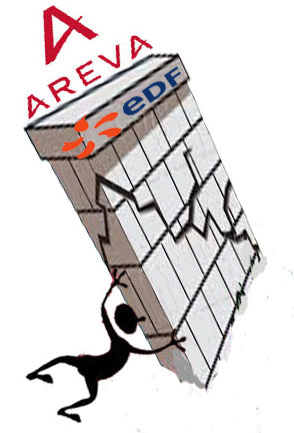 France’s nuclear-energy champion is in turmoil http://www.economist.com/news/business/21711087-electricit-de-france-has-had-shut-down-18-its-58-nuclear-reactors-frances-nuclear-energy Electricité de France has had to shut down 18 of its 58 nuclear reactors THESE are difficult times for Electricité de France (EDF), the country’s quasi-monopolistic electricity provider, serving 88% of homes. Outages at no fewer than 18 of the 58 EDF-owned nuclear reactors that provide three-quarters of France’s electricity have meant a slump in production: the company says annual nuclear output could fall to 378 terawatt hours (TWH), from 417 TWH last year. Eight reactors are currently lying idle and several may not restart for weeks or months. Power stations are burning coal at a rate not seen since the 1980s. As electricity imports and prices soar, officials are having to deny that a cold snap could bring blackouts.
The cause of the crisis—possibly faulty reactor parts throughout EDF’s fleet—suggests it may not be easily contained. France’s nuclear regulator, the Autorité de Sûreté Nucléaire (ASN), this summer ordered urgent tests of reactor parts, mostly bases of cylindrical steam generators. Inspectors are worried about high carbon levels found in steel forged by Creusot Forge, which is owned by Areva, another French firm, and by Japan Casting & Forging Corporation, a Japanese supplier. In some pieces carbon deposits are over 50% above permitted levels, risking fracture in case of a sudden change in the temperature of the steel.
The cost for EDF is rising. As well as lost earnings from shuttered plants, switching one generator (a reactor can have three) can take six months and cost €150m ($159m). And its decision in November finally to stump up €2.5bn for Areva Nuclear Power (most of Areva, including Creusot Forge) now seems rather like paying to swallow a highly radioactive dinner.The two firms have one important joint project: a new European Pressurised Reactor (EPR), built by Areva and mostly run by EDF. Here too, forging faults are a problem: they were first found last year on the installed reactor vessel at Flamanville 3, a new EPR near Cherbourg. Another serious source of concern is safety-valve design.
The regulator will rule on Flamanville’s future in mid-2017. More tests or design changes may mean putting off its opening far beyond 2018.That would also deliver another blow to France’s reputation in nuclear power. The only other EPR in Europe, that at Olkiluoto, Finland, is years overdue and three times over budget.
Delays might also hinder EDF in its plan to build two EPRs at Hinkley Point, in Britain, for £24.5bn ($30.7bn). British loan guarantees need certain conditions to be met, and these reportedly include seeing Flamanville operate by 2020. Steve Thomas, an energy expert in London, concurs with the opinion of many in the nuclear-power industry when he calls the EPR a dud. EDF is pushing on regardless, but the financial strain is mounting. In March, EDF’s then chief financial officer, Thomas Piquemal, quit, calling Hinkley Point unaffordable.
The sense of crisis looks likely to grow. Yves Marignac, a nuclear-energy expert in Paris, calls EDF “already financially crippled”. Only state backing prevents EDF’s credit rating falling steeply, analysts say. And it is not only the ASN that has EDF in its sights. On November 22nd French competition officials raided its offices, seeking evidence that its dominant position is squeezing rivals and sending prices higher than they should be (even though lower electricity prices in recent years have sapped its revenues). Its share price has halved in two years.
The future looks bleak. Some four-fifths of French nuclear plants were built in a decade from the late 1970s. The plants have a 40-year lifespan, meaning that several a year face retirement over the next decade. Energy planners have assumed there will be extensions to 50 years or more. But the ASN may hesitate after the forging problems, or impose higher costs. Cyrille Cormier, a nuclear engineer who is now at Greenpeace, a campaign group that opposes nuclear power, says a total refit could cost EDF an extra €60bn-200bn.
Closing plants permanently would be extremely costly, too. France has never closed a large one. EDF may be under-provisioning the costs of decommissioning plants. It has set aside €36bn, less than the €45bn that Germany has allowed, even though France’s neighbour has a smaller nuclear fleet. Then there is nuclear waste. The five pools storing spent fuel at La Hague, Areva’s central reprocessing plant, are nearly full, says Mr Marignac. When sorrows come, they come in battalions.
Legal ruling to come, on Germany’s nuclear exit
Preview: Legal or not? German utilities await landmark nuclear exit ruling
Germany’s highest court will rule next week on whether the country’s decision to exit nuclear power was legal, helping to determine whether or not three power firms can pursue damage claims of up to 19 billion euros ($20.16 billion).
German utilities are still reeling from the decision made in 2011 after Japan’s Fukushima disaster to shut down all nuclear power plants by 2022. E.ON, RWE and Vattenfall have sued the government over what they say amounts to expropriation.
The three claim the accelerated shutdown robbed them of 1,800 terawatt hours of future production, enough to power Europe’s biggest economy for about three years.The German government has rejected the claims, arguing its decision was in line with constitutional law.
The Constitutional Court will give its verdict on Tuesday, Dec. 6, in the city of Karlsruhe.
“Even if the verdict is partly in favour of utilities, there will be a separate lengthy process for determining the compensation. So it’s not really a bankable outcome,” said Deepa Venkateswaran, senior analyst at Bernstein.
In a two-day hearing in March, the court challenged the expropriation claims brought by power firms, arguing that Germany merely accelerated the shutdown of nuclear plants that was initially agreed on in 2002.
The ruling requires a majority of the eight-judge panel. If the judges are split evenly, the complaints will automatically be rejected.
Legal experts expect the court will throw out the complaint by Sweden’s Vattenfall because it is a state-owned entity, preventing it from lodging a complaint based on Germany’s constitution.
German utility EnBW, which is almost entirely owned by the public, has not lodged a complaint for that reason. According to Peter Rosin, partner and energy specialist at law firm White & Case, the court would not necessarily have to approve the utilities’ expropriation complaint to pave the way for damage claims.
It could also rule that Germany’s decision did not amount to expropriation but merely defined the scope and limitation of property in such a significant way that it required compensation, he said
The court could also throw out all complaints.
“Therefore, there is a range of possibilities regarding the court’s decision and the respective legal consequences. The outcome is open,” Rosin said.
($1 = 0.9427 euros)
(Additional reporting by Ursula Knapp in Karlsruhe)
It could take just one offshore nuclear incident to bankrupt Ireland
 Nuclear incident off our coast has potential to bankrupt Ireland, Irish Times, 2 Dec 16 Expert model shows best-case consequence of minor episode implies €4bn cost to State Dick Ahlstrom
Nuclear fusion project in doubt, because of Britain’s exit from EU
 Brexit puts Europe’s nuclear fusion future in doubt By
Brexit puts the future of the world’s largest nuclear fusion reactor, based in Oxfordshire, in doubt. By leaving the European Union the UK might also exit Euratom, the EU’s framework for safe nuclear energy.
“It would be bizarre and extreme for the UK, which has been at the forefront of fusion research for 50 years, to just leave these projects,” says Ian Chapman, CEO of the UK Atomic Energy Authority. “It would make no sense strategically.”
At the moment, JET hosts 350 scientists and is funded by 40 different countries. Its aim is to commercialise nuclear fusion, which releases energy by forcing atoms together in the same process that powers the sun.
The energy output should be far greater than that of current nuclear power stations and produce a smaller amount of waste. But making it work effectively has proved incredibly difficult, as reactors require huge amounts of energy to get going and only remain stable for short periods……https://www.newscientist.com/article/2114690-brexit-puts-europes-nuclear-fusion-future-in-doubt/
Chernobyl nuclear reactor now encased in steel tomb
Chernobyl reactor entombed in giant steel shield 30 years after worst nuclear disaster in history [Excellent photos] Mirror, 1 Dec 16 Thirty years after an explosion ripped apart the Chernobyl power plant and spewed radioactive dust across Europe, the devastated reactor number four has finally been sealed off. Built with bolts from Wrexham and overseen by a man from Bury, this gigantic steel shield encases the reactor responsible for the worst nuclear disaster in history.

Thirty years after an explosion ripped apart the Chernobyl power plant and spewed radioactive dust across Europe, the devastated reactor number four has finally been sealed off. Six years in the making, the 108-metre-high arch is the largest moveable land structure ever built. Its completion brings an end to a nightmare that has scarred two generations.
At a ceremony inside the radiation exclusion zone in Ukraine, British engineer David Driscoll, 66, told of his vital role as health and safety manager overseeing one of the most daunting construction projects ever undertaken….
The shimmering steel structure looms large over the frozen wasteland rendered uninhabitable by the catastrophe on 26 April, 1986.
More than 200,000 people were evacuated from their homes in the weeks afterwards as the then Soviet Union government slowly reacted to the poisoned legacy of the leak.
Deserted houses by the roadside in the exclusion zone have been slowly devoured by the forest.
In Pripyat, the Soviet city next to Chernobyl, the shells of deserted apartment blocks serve as a permanent reminder of the scale of the catastrophe.
At the top of one tower block is a faded Communist hammer and sickle………
Waterproof and temperature-controlled, the structure is fitted with an overhead crane to allow for the future dismantling of the previous, crumbling Soviet-era shelter and the remains of reactor four.
Igor Gramotkin, director-general of the Chernobyl Nuclear Power Plant, said: “We were not building this arch for ourselves.
“We were building it for our children, our grandchildren and our great-grandchildren.
“This is our contribution to the future, in line with our responsibility for those who will come after us.”
Ostap Semerak, Ukraine’s Minister of Ecology and Natural Resources, said of the completion of the project: “The sliding of the arch over reactor four at the Chernobyl Nuclear Power Plant is the beginning of the end of a 30-year long fight with the consequences of the 1986 accident.” http://www.mirror.co.uk/news/world-news/chernobyl-reactor-entombed-giant-steel-9360959
1 This Month




Shut down the radiation-damaged Heysham nuclear reactors now
To see nuclear-related stories in greater depth and intensity – go to https://nuclearinformation.wordpress.com

Say No to NASA’s Reckless Nuclear Reactor on the Moon
Say No to NASA’s Reckless Nuclear Reactor on the Moon
-
Archives
- October 2026 (279)
- September 2026 (339)
- August 2026 (330)
- July 2026 (355)
- June 2026 (287)
- May 2026 (306)
- April 2026 (356)
- March 2026 (251)
- February 2026 (267)
- January 2026 (308)
- December 2025 (358)
- November 2025 (359)
-
Categories
- 1
- 1 NUCLEAR ISSUES
- business and costs
- climate change
- culture and arts
- ENERGY
- environment
- health
- history
- indigenous issues
- Legal
- marketing of nuclear
- media
- opposition to nuclear
- PERSONAL STORIES
- politics
- politics international
- Religion and ethics
- safety
- secrets,lies and civil liberties
- spinbuster
- technology
- Uranium
- wastes
- weapons and war
- Women
- 2 WORLD
- ACTION
- AFRICA
- Atrocities
- AUSTRALIA
- Christina's notes
- Christina's themes
- culture and arts
- Events
- Fuk 2022
- Fuk 2023
- Fukushima 2017
- Fukushima 2018
- fukushima 2019
- Fukushima 2020
- Fukushima 2021
- general
- global warming
- Humour (God we need it)
- Nuclear
- RARE EARTHS
- Reference
- resources – print
- Resources -audiovicual
- Weekly Newsletter
- World
- World Nuclear
- YouTube
-
RSS
Entries RSS
Comments RSS

