Japanese government planning to subsidise Britain’s new nuclear build
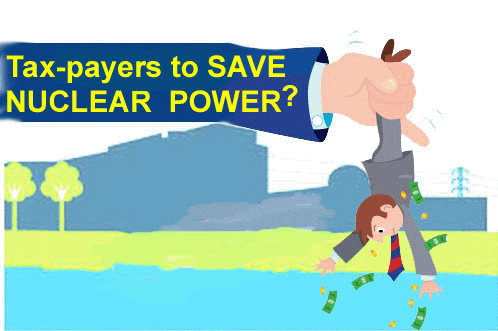 Tokyo eyes ¥1 trillion in financial support for Japanese firms pursuing U.K. nuclear plants http://www.japantimes.co.jp/news/2016/12/16/business/tokyo-eyes-%C2%A51-trillion-financial-support-japanese-firms-pursuing-u-k-nuclear-plants/#.WFONt9J97Gg The government is considering offering financial assistance through state-affiliated banks for projects won by Japanese companies for nuclear power plant construction in Britain, sources said Thursday.
Under study is a plan for the Japan Bank for International Cooperation and the Development Bank of Japan to invest in and provide loans to local companies that build and operate nuclear power stations, the sources said.
Visiting British Chancellor of the Exchequer Philip Hammond told reporters in Tokyo on Thursday that Britain is holding talks with the Japanese government, Hitachi Ltd. and Toshiba Corp. on a financial support framework for nuclear power plant construction projects in his country.
On the same day, Hammond met with Chief Cabinet Secretary Yoshihide Suga to exchange opinions about nuclear plant construction.
British Business, Energy and Industrial Strategy Secretary Greg Clark plans to visit Japan as early as next week and hold meetings with officials of Hitachi, Toshiba and the JBIC.
Under the envisaged scheme, the Japanese government expects to offer financial assistance to Horizon Nuclear Power Ltd., a unit of Hitachi, and NuGeneration Ltd., which is under the wing of Toshiba.
Cheap energy storage will change the renewable energy debate
 Storage – the missing link NuClear News No 91, Jan 2017 Bloomberg New Energy Finance (BNEF) predicts a six-fold increase in investment in energy storage to $8.2bn (£6.7bn) by 2024, and to $250bn (£197bn) by 2040. This massive growth in energy storage will create a “fundamentally different” global power system. This energy storage ‘megashift’ is already beginning to gather pace. The battery market has seen breath-taking levels of growth from utilities over the past 12 months, while non-utilities are increasingly realising that lithium-ion or flow storage systems can act as the perfect accompaniment to onsite renewable energy installation. (11)
Paul Massara, former CEO of RWE nPower, is now CEO of North Star Solar, a new solar PV + battery home energy system start-up. He says that lithium ion batteries for electrical storage are getting cheaper and cheaper, and PV + battery packages are now cost effective in the UK with the right financing package. Cheap, ubiquitous electrical energy storage will lead to a very different world and may change the focus of many of today’s energy policy debates. It is likely to help reduce peak demand, and allow renewables to provide a much higher percentage of electricity demand, especially if they are cheaper than alternative forms of low carbon electricity such as nuclear or fossil fuel with carbon capture and storage. (12)
North Star Solar has set up a joint scheme with the former colliery town of Stanley in Co Durham to offer in-home batteries and solar panels for free to all the town’s 35,000 households. Paul Massara says the combination of rooftop panels, a lithium battery and energy-efficient LED light bulbs will immediately cut power bills by 20%. (13)
The £19m ‘Big Battery’ installed at a sub-station in Leighton Buzzard, Bedfordshire has completed a two-year trial and successfully shown that power storage has the potential to be both technically and commercially viable. (14)
Camden Council has teamed up with Islington and Waltham Forest Councils to deliver a pilot programme to test the potential benefits of solar panels and energy storage systems for residents at risk of fuel poverty. The ’24/7 Solar’ initiative is being part-funded by national fuel poverty charity National Energy Action. The aim of the trial is to see if there is evidence that integrated solar and storage technologies can effectively reduce the energy bills of fuel poor households. (15) Meanwhile in Edinburgh and surrounding towns several housing associations have been working with Sunamp to install solar PV and heat storage ‘batteries’. Surplus solar generated electricity can be diverted to the heat battery and used for hot water or central heating when required later. (16) And in Orkney where renewable energy generators are often curtailed due to the constraints on the distribution of electricity around the Orkney grid, yet fuel poverty levels are at 63%, a new project, launched by Heat Smart Orkney Ltd, is aiming to divert unused renewable energy into affordable heat. (17) The Scottish Government has given a new 400-MW pumped-storage hydro power plant in Dumfriesshire permission to go ahead. (18)
Solar power is expected to be the cheapest form of energy (not just electricity) everywhere in the world by around 2030. Cheap solar panels and advances in storage technology are transforming the world. By 2030 or 2040 solar will be the cheapest way to generate electricity, indeed any form of energy EVERYWHERE. The proportion of global electricity provided by solar is likely to grow from 2% now to at least 50% by 2030. We can see the cost of batteries coming down in price dramatically, but turning surplus solar electricity generating during the summer into something we can put into natural gas networks will probably come soon. Generating hydrogen from water and, using microbes, combining it with carbon dioxide to form methane is the simplest way to do this. (19)
Even offshore wind costs are falling. Swedish utility Vattenfall has agreed to build a giant offshore wind farm in Denmark that would sell power for €49.50 per MWh. Vattenfall has broken its own previous record of €60 per MWh. Once the cost of transmission is included this works out at around £75.50/MWh compared with £100.50/MWh for Hinkley Point C (once inflation has been added to the £92.50 at 2012 prices). (20) http://www.no2nuclearpower.org.uk/nuclearnews/NuClearNewsNo91.pdf
Financially strapped French company AREVA gets a lifeline. EDF in dire financial straits, too.
 Areva receives offer for 10% stake in spun-off nuclear unit , Ft.com, 15 Dec 16
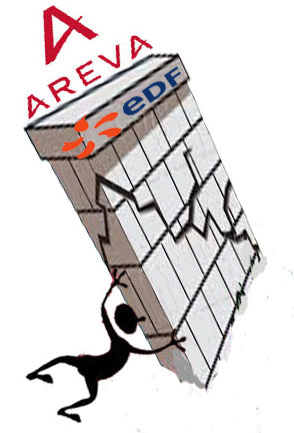
Deal would help recapitalise troubled French group Areva, the struggling French nuclear group, received a firm €500m offer for a 10 per cent stake in a new nuclear fuel company that will be split off from its parent in a wider reshaping of the French nuclear industry.
Areva is preparing to split off its uranium mining and nuclear fuel activities into NewCo as part of a government-backed rescue after the group was forced to the brink of collapse under the weight of its own debt this year.
Earlier this year it was agreed that the other half of Areva, the troubled reactor business, would be taken over by EDF, the larger French nuclear group, in a deal that values that part of the business at about €2.5bn.
EDF, the other major company in the sector, lost more than a tenth of its stock market value on Thursday after it warned of lower 2017 earnings becasue of an expected drop in power prices…….
Shares in EDF were down 12 per cent on Thursday. The stock has fallen 23 per cent over the past year after repeated warnings of weak profits. https://www.ft.com/content/4a1d5af6-c319-11e6-9bca-2b93a6856354
Studyfinds that wind farms have significantly reduced UK’s greenhouse emissions
 Wind farms play key role in cutting carbon emissions, study finds https://www.eurekalert.org/pub_releases/2016-12/uoe-wf120916.phpUNIVERSITY OF EDINBURGH: WIND FARMS HAVE MADE A SIGNIFICANT IMPACT IN LIMITING CARBON EMISSIONS FROM OTHER SOURCES OF POWER GENERATION IN GREAT BRITAIN, A STUDY SHOWS.
Power from wind farms prevented the creation of almost 36 million tonnes of greenhouse gas emissions from sources such as coal and gas, in a six-year period – the equivalent of taking 2.3 million cars off the road, analysis of nationwide output shows.
The figures from 2008-2014, analysed in the most accurate study of its kind to date, suggest that a greater investment in wind energy could help meet Scottish and UK government targets for carbon emissions reduction.
Engineers from the University of Edinburgh analysed National Grid figures for the power generated by various sources including wind, coal and gas. Their data detailed generator energy output figures for every half hour, creating a comprehensive picture of how demand over time was met by power from the various sources.
Their study improves on previous estimates because it uses real, rather than estimated, energy output figures and takes into account the inefficiency of individual conventional generators, researchers say. The calculations are complex because energy demand is met from a mix of sources at any one time, and when output from wind turbines increases, a number of different conventional sources may need to decrease their outputs.
The study demonstrates that government estimates for carbon savings underestimated the benefits from wind farms. Over the six year period, 3.4 million more tonnes of greenhouse gases were saved than thought – the equivalent of taking an extra 220,000 cars off the road.
Engineers say their methodology could be applied to give accurate estimates of possible future emissions savings for energy developers, planners and policymakers. They suggest wind power generation could play an increasingly important role in the future energy mix, which could also include carbon capture and storage, marine and nuclear power.
The study, published in Energy Policy, was supported by the Engineering and Physical Sciences Research Council.
Dr Camilla Thomson, from the University of Edinburgh’s School of Engineering, who led the study, said: “Until now, the impact of clean energy from wind farms was unclear. Our findings show that wind plays an effective role in curbing emissions that would otherwise be generated from conventional sources, and it has a key role to play in helping to meet Britain’s need for power in future.”
Global review of nuclear reactors, following news of cover-up of AREVA’s manufacturing flaws

 Coverup at French Nuclear Supplier Sparks Global Review Inspectors say Areva unit’s files suggest manufacturing flaws in critical parts were covered up for decades, WSJ, By MATTHEW DALTON and INTI LANDAURO in Paris and REBECCA SMITH in San Francisco, Dec. 13, 2016
Inspectors from the U.S. and other countries are investigating a decadeslong coverup of manufacturing problems at a key supplier to the nuclear power industry, probing whether flaws introduced in a French factory represent a safety threat to reactors world-wide.
Inspectors from the U.S., China and four other nations visited ArevaSA’s Le Creusot Forge in central France earlier this month to examine the plant’s quality controls and comb through its internal records.
A string of discoveries triggered the newly expanded review: First, French investigators said they found steel components made at Le Creusot and used in nuclear-power plants across France had excess carbon levels, making them more vulnerable to rupture. Then, the investigators discovered files suggesting Le Creusot employees for decades had concealed manufacturing problems involving hundreds of components sold to customers around the world.
The disclosure of flaws covered up by Le Creusot led to two reactor shutdowns this summer in France, and in September authorities ordered Areva to check 6,000 manufacturing files by hand, covering every nuclear part made at Le Creusot since the 1960s.
“I’m concerned that there keep being more and more problems unveiled,” said Kerri Kavanagh, who leads the U.S. Nuclear Regulatory Commission’s unit inspecting Le Creusot. Regulators are considering returning to Le Creusot or inspecting Areva’s Lynchburg, Va., offices to deepen their probe of the plant, a U.S. official said.
On Wednesday, Paris prosecutors opened a preliminary investigation into whether Le Creusot’s activities were fraudulent and dangerous, according to a spokeswoman for prosecutors.
“What we see now at Le Creusot is clearly unacceptable,” said Julien Collet, assistant general manager at France’s Nuclear Safety Authority.
Areva executives have acknowledged the records falsifications and blamed them on a breakdown of manufacturing controls spanning many decades at Le Creusot. Areva has since tightened its controls and is cooperating with the regulators’ reviews, company officials said…….
Beyond France, regulators are trying to determine whether other nuclear facilities that relied on components from Le Creusot are safe. Finnish inspectors visiting the forge last week said they learned of potential flaws in a component slated for a reactor in the southwestern island of Olkiluoto. In the U.S., the NRC has identified at least nine nuclear plants that use large components from Le Creusot……..
Last week’s inspection has turned up a concern with one of Areva’s next-generation reactors, the European Pressurized Reactor under construction in Finland, versions of which are also planned for plants in China, France and the U.K…….http://www.wsj.com/articles/problems-at-nuclear-components-supplier-spark-global-reviews-1481625005
Switzerland concerned over possible abnormalities in AREVA-supplied nuclear reactor components

 Two Swiss nuclear plants to be checked for irregularities, SwissInfo, 13 Dec 16, The Swiss Federal Nuclear Safety Inspectorate (IFSN) has confirmed that steam generators at the Beznau and Gösgen nuclear plants must be checked for possible anomalies.
In a statement on Tuesday, IFSN said it had asked the operators of the Beznau and Gösgen nuclear plants to check the quality of steel components used in the steam generators.
Plant operators must scrutinize documents relating to the components and report to IFSN by April. They should then carry out any physical checks on materials.
The news follows reports that the French nuclear safety authority (ASN) discovered in June that certain steam generator channel heads made by two different manufacturers – Areva’s Creusot plant and Japan Casting & Forging Corp (JCFC) – could contain a zone comprising a high carbon concentration. That could weaken the mechanical resilience of the steel and its ability to resist the spreading of cracks.
“This pushed us to check the steam generators at the Beznau and Gösgen plants,” said IFSN interim director, Georg Schwarz……http://www.swissinfo.ch/eng/nuclear-power_two-swiss-nuclear-plants-to-be-checked-for-irregularities/42759794
German government negotiates successfully with nuclear companies over costs of wastes.
 Germany Cuts Deal With Nuclear Power Companies Over Waste Costs Government, companies seek to put ceiling on costs related to disposal of radioactive waste, WSJ, By ZEKE TURNER Dec. 12, 2016 BERLIN—The German government has cut a deal with the nuclear power companies operating in the country that would guarantee them a ceiling on costs related to radioactive waste, lawmakers said Monday.

Germany’s E.ON SE, RWE AG, EnBW AG and Sweden’s Vattenfall AB already set aside about €17 billion ($18 billion) to finance the disposal of radioactive waste after the government moved to ban nuclear power five years ago.
Under Monday’s deal, they would pay an additional €6 billion into a public fund but be off the hook for any further payments if the cost of processing the radioactive material were to balloon out of control in the decades to come, as many experts fear.
Following a debate and vote on Thursday morning in the Bundestag, the government will negotiate the details over the fund’s capitalization with the companies……..http://www.wsj.com/articles/germany-cuts-deal-with-nuclear-power-companies-over-waste-costs-1481567999
Nuclear worker convicted of terrorism conspiracy – had worked for 3 years while under investigation!

 French Nuclear Plant Technician Continued Working While Under Investigation For Terrorism, BuzzFeed News, 14 Dec 16, Paris Rida E. was put under investigation for suspected ties to terrorist groups in Syria, but that didn’t prevent him from working for several months at a nuclear power plant.
A French radiation protection technician has been banned from working at nuclear power plants by a Paris court more than three years after he began posting in support of armed jihad on Facebook.
The 31-year-old technician, referred to in court proceedings as Rida E., was permitted to access nuclear plants for several months while he was being investigated by French authorities for suspected ties to terrorist groups in Syria. He was convicted on Dec. 7 of conspiring to commit acts of terrorism……https://www.buzzfeed.com/paulaveline/rida-e-employee-of-the-tricastin-and-devoted-def?utm_term=.xtWZDAWkLe#.fnNAdXYxOD
No room for wives in BBC’s staff nuclear cold war bunker

 BBC staff offered chance to survive nuclear holocaust – but wives left at
 home http://www.telegraph.co.uk/news/2016/07/23/bbc-staff-offered-chance-to-survive-nuclear-holocaust—but-wive/ Telegraph Reporters 23 JULY 2016
BBC employees were offered the chance to survive a nuclear holocaust by broadcasting from an underground bunker, but they could not tell their wives, newly released files reveal.
The broadcaster secretly drew up plans during the Cold War for how it would run a Wartime Broadcasting System in the event of a major disaster.
Early versions of the plan – known as the ‘War Book’ – say that staff were “assigned” or “designated” to go underground, but later editions suggest they were “invited”. Chosen workers were informed not to tell their wives or bring them to the bunker, the files released by the BBC reveal.
“My clearest memory is of a discussion about whether people with spouses could bring them along,” Bob Doran, an experienced editor in Radio News in the 1980s, who attended a civil service seminar in Yorkshire said. The answer was no.
BBC bosses planned to set up 11 protected bunkers – known as ‘Regional Seats of Government’ – spread across the UK, each with a studio and five staff from nearby local radio stations.
A bunker at the Engineering Training Department at Wood Norton in Worcestershire would be a headquarters staffed by 90 BBC staff including engineers, announcers, 12 news editors and sub-editors.
The output would be controlled by the government, but the BBC made a collection of cassette tapes of old radio comedies to entertain the public.
Shows chosen to amuse listeners during Armageddon included the Goon Show, Just a Minute and Round the Horne.
EDF’s financial crisis will leave french taxpayers with a huge nuclear bill
French taxpayers face huge nuclear bill as EDF financial crisis deepens, Ecologist, Paul Brown 8th December 2016
Nuclear giant EDF could be heading towards bankruptcy, writes Paul Brown, as it faces a perfect storm of under-estimated costs for decommissioning, waste disposal and Hinkley C. Meanwhile income from power sales is lagging behind costs, and 17 of its reactors are off-line for safety tests. Yet French and UK governments are turning a blind eye to the looming financial crisis.
Bankruptcy for EDF seems inevitable – and if such a vast empire in any other line of business seemed to be in such serious financial trouble, there would be near-panic in the workforce and in governments at the subsequent political fall-out.
But it seems that the nuclear-dominated EDF group is considered too big to be allowed to fail. So, to keep the lights on in western Europe, the company will have to be bailed out by the taxpayers of France and the UK.
The French government, facing elections next spring, and the British, struggling with the implications of the Brexit vote to leave the European Union, are currently turning a blind eye to the report by AlphaValue that EDF has badly under-reported its potential liabilities.
Ageing nuclear reactors
While EDF is threatening to sue people who say it is technically bankrupt, the evidence is that the cost of producing electricity from its ageing nuclear reactors is greater than the market price.
Coupled with the impossibility of EDF paying the full decommissioning costs of its reactors, it is inevitable that it is the taxpayers in France and the UK who will eventually pick up the bill. However this will not be easy due to the EU’s ‘state aid’ rules, which limit governments’ ability to support ailing companies.
There is also the ongoing thorny problem of disposing of the nuclear waste and spent fuel rods, which are building up in cooling ponds and stores on both sides of the Channel, with no disposal route yet in sight.
A looming problem for EDF, which already admits is has €37 billion of debt, is that 17 of its ageing fleet of nuclear reactors, which provide 70% of France’s electricity, are being retired.
According to AlphaValue, EDF has underestimated the liabilities for decommissioning these reactors by €20 billion. Another €33.5 billion should be added to cost of handling nuclear waste, the report says. Juan Camilo Rodriguez, an equity analyst who is the author of the report, says that a correct adjustment of nuclear provisions would lead to the technical bankruptcy of the company.
In a statement, EDF said it “strongly contests the alleged accounting and financial analyses by the firm AlphaValue carried out at the request of Greenpeace and relating to the situation of EDF”.
It says that its accounts are audited and certified by its statutory auditors, and that the dismantling costs of EDF’s existing nuclear power fleet have also been subject to an audit mandated by the French Ministry of the Environment, Energy and the Sea.
Even with its huge debts, EDF’s problems could be surmounted if the company was making big profits on its electricity sales, but the cost of producing power from its nuclear fleet is frequently greater than the wholesale price.
That creates a second problem – that unless the wholesale price of electricity rises and stays high, the company will make a loss on every kilowatt of electricity it sells. The new rightwing French presidential candidate, François Fillon, promises not to retire French reactors and to keep them going for 60 years. But this cannot be done without more cost.
This is the third problem: vast sums of capital are needed to refurbish EDF’s old nuclear fleet for safety reasons following the 2011 Fukushima nuclear disaster in Japan. …….
Repeated life extensions
Since the sale of UK nuclear plants to EDF in 2008 at a cost £12.5 billion, the company has continued to operate them, and has repeatedly got life extensions to keep them running.
But this cannot go on forever, and they are expected to start closing in the next ten years. Once this happens, the asset value of each station would become a liability, and EDF’s mountain of debt would get bigger.
So far, the French and UK governments, and the company itself, seem to be in denial about this situation. Currently 17 French reactors are shut down for safety checks, following the discovery of faulty safety-critical compenents including large, difficult to replace steel forgings like steam generators.
The company has issued reassuring statements that they will be back to full power after Christmas, however in so doing EDF is assuming that the safety checks will give the reactors a clean bill of health. In fact, there are three other possible outcomes:
- additional potentially time-consuming tests are needed that will create further months of downtime.
- remedial engineering works are required to make the reactors safe. These would probably be costly and time-consuming.
- key components at the heart of the reactors, for example steam generators, need to be replaced altogether. However this would be so costly that, for a nuclear plant already reaching the end of its lifetime, premature closure would be the only viable option.
Perhaps the most likely outcome is that some of the 17 reactors will fall into each of these four categories, creating as yet unquantifiable unbudgeted costs for the company.
Meanwhile, to make up the shortfall from the closed reactors, electricity is being bought from neighbouring countries, including the UK, to keep the lights on in France. The power shortage is temporarily causing an increase in wholesale prices – but one that EDF is unable to fully exploit because so many of its reactors are not generating.
The future remains unpredictable – but as long as there are no actual power cuts, no action is expected from governments. Despite official denials, however, the calculations of many outside the industry suggest that it is only a matter of time before disaster strikes.
The cost of producing electricity from renewables is still falling, while nuclear gets ever more expensive, and massive liabilities loom. Ultimately, the bill will have to be passed on to the taxpayers. http://www.theecologist.org/News/news_analysis/2988433/french_taxpayers_face_huge_nuclear_bill_as_edf_financial_crisis_deepens.html
Bulgaria pays compensation damages to Russia, for scrapping Belene nuclear plant
Bulgaria’s NEK settles arbitration damages for shelved Belene nuclear plant http://sofiaglobe.com/2016/12/09/bulgarias-nek-settles-arbitration-damages-for-shelved-belene-nuclear-plant/ Bulgaria’s state-owned electric utility NEK has paid 601.6 million euro in damages to Atomstroyexport, the foreign contracts subsidiary of Russia’s state nuclear corporation Rosatom, Energy Minister Temenouzhka Petkova said on December 9 during question time in Parliament.
The money was transferred into Atomstroyexport’s accounts on December 8, Petkova said.
In a statement, Atomstroyexport confirmed receipt of the funds and was satisfied with the fact that NEK disbursed its commitments in full under the terms of an agreement signed in October, which saw the Russian company drop the daily penalty interest as long as NEK paid the principal owed by December 15.
The accumulated amount of daily penalties would have reached 23.8 million euro by that date. NEK’s agreement with Atomstroyexport also saw the Russian company accept a 20.9 million euro deduction in the original amount of damages ordered by arbitration, following several objections raised by the Bulgarian side to the calculation methodology.
Atomstroyexport was picked to build two 1000MW nuclear reactors at Belene on the Danube River, a project that was shut down by Bulgaria in 2012. The Russian contractor filed for arbitration, asking for 1.2 billion euro in damages for equipment ordered for the nuclear power plant, which NEK never paid for, and won the court action in June, although it was awarded just over half of the amount it claimed.
NEK decided not to appeal the ruling in September after Parliament passed a bill on September 28 that authorised a cash injection from the state Budget to NEK to pay the damages awarded by the tribunal.
The delay in the disbursement was due to the fact that Bulgaria was waiting for the European Commission to rule on whether such a transfer was allowed under the EU’s state aid rules. The Commission gave its approval earlier this week, according to reports in Bulgarian media.
NEK will now take ownership of the equipment manufactured by Atomstroyexport, but uncertainty remains about what the company will do next. Bulgarian officials travelled to Iran earlier this year to discuss a possible sale of the equipment, but there has been no development in the months since then.
Speaking to reporters in Parliament on December 9, Petkova said the Belene assets – the site itself and the equipment from Atomstroyexport – could be spun off into a separate company that would be put up for privatisation.
“If there is [investor] interest, then the [Belene nuclear power plant] project could be carried out on a market basis. If there is no investor interest, we will go in another direction and seek other options,” she said, as quoted by Bulgarian National Radio.
France’s new nuclear reactors mired in debt
 French taxpayers face huge nuclear bill as EDF financial crisis deepens, Ecologist, Paul Brown 8th December 2016 “………New nuclear stations Even more money is required to finish new nuclear stations EDF is already committed to building. The first, Flamanville in northern France, is five years late and billions over budget. Questions over the quality of the steel in its reactor are still not resolved, and it may never be fully operational.
Add to that the need for €12 billion (or potentially considerably more) capital to complete the two nuclear stations EDF is committed to building at Hinkley Point in southwest England, and it is hard to see where all the money will come from.
To help the cash-strapped company, its ultimate owner, the French state, has already provided €3 billion in extra capital this year, and decided to forego its shareholder dividend. But that is a drop in the ocean.
Mycle Schneider, a Paris-based independent international consultant on energy and nuclear policy, says: “The French company overvalues its nuclear assets, and underestimates how much it will cost to decommission them.
“However, EDF’s biggest problem is the cost of producing power from these ageing power stations. The cost is greater than the wholesale price, so everything they sell is at a loss. It is impossible to see how they can ever make a profit.”
He says that is not the company’s only problem: France has not dealt with the problem of nuclear waste, and has badly underestimated the cost of doing so: “With German electricity prices going down and production increasing in order to export cheap electricity to France, it is impossible to see how EDF can ever compete. It is really staggering that no one is paying any attention to this.”
Even former EDF director Gérard Magnin agrees. He resigned from the board in July as he thought the Hinkley Point project too risky for the company because of its already stretched finances. Now he says that, with the reactors closed for safety checks, the French nuclear industry faces “its worst situation ever”.
The company’s troubles do not stop in France, as EDF also owns the UK nuclear industry. Ironically, it took over 15 reactors in the UK after British Energy went bankrupt in 2002 because the cost of producing the electricity was greater than the wholesale price – exactly the situation being repeated now in France.http://www.theecologist.org/News/news_analysis/2988433/french_taxpayers_face_huge_nuclear_bill_as_edf_financial_crisis_deepens.html
China’s global nuclear marketing drive -= now looking to Bulgaria
 China eyes nuclear project in Bulgaria http://www.euractiv.com/section/energy/news/china-eyes-nuclear-project-in-bulgaria/ A delegation from the China National Nuclear Corporation (CNNC), the country’s largest state energy company, visited Sofia and met with Bulgarian Prime Minister Boyko Borissov, to possibly resuscitate a shelved nuclear power plant project.The Belene nuclear power plant, situated near the Danube, was frozen in 2012, reportedly due to a lack of funds.
Suspected falsifying of documents: French prosecutors investigate Areva’s Le Creusot nuclear foundry

 French court probes forged documents case at Areva nuclear foundry http://www.reuters.com/article/us-france-nuclear-areva-court-idUSKBN13X20C, 8 Dec 16 The Paris prosecutor’s office has opened an investigation into the suspected falsifying of documents at Areva’s Le Creusot foundry that manufactures parts for nuclear reactors, a judicial source said on Thursday.
The case, which alleges forgery, use of forged documents, endangerment of lives and aggravated deception, will be put in the hands of the police, the source said. French nuclear safety regulator ASN said in October that it had asked the courts to step in to investigate after nuclear group Areva sounded the alarm in May over documentation irregularities involving 6,000 nuclear component manufacturing files.
Thousands of such documents used in the French nuclear sector dating back to 1965 are being looked at
“We have not been informed (of the investigation) at this point,” a spokeswoman for Areva told Reuters, adding that the group would cooperate with the investigation and hand over all information at its disposal.
The discovery of weak spots in the reactor vessel of the EPR reactor under construction in Flamanville in 2014 led Areva to review manufacturing procedures at its Creusot steel forging plant.
ASN said in September that Areva had identified 87 irregularities related to reactors operated by state utility EDF, 20 concerning equipment for the Flamanville reactor, and one related to a steam generator for EDF’s 900 MW Gravelines 5 reactor on halt since April.
Russia’s new ‘drone submarine’ with range of 6,200 miles
Russia tests terrifying unmanned ‘drone submarine’ capable of carrying nuclear warheads within range of the US,
Top-secret nuclear-capable submarine is code-named Kanyon by the Pentagon
It is feared to have a range of 6,200 miles with top speeds of up to 56 knots
US officials detected the testing on November 27 at an undisclosed location
It comes after Russia unveiled design of a robot submarine called Surrogat
The top-secret nuclear-capable sub, code-named Kanyon by the Pentagon, is feared to have a range of up to 6,200 miles with top speeds of 56 knots.
US security officials detected the test on November 27 after it was launched from a separate Sarov-class submarine though the location has not been revealed. …..
It would be used to help Russian navy training but could also be used for ‘mapping and reconnaissance’ trips, according to Russia’s Rubin Central Design Bureau for Marine Engineering. ….. http://www.dailymail.co.uk/news/article-4014014/Russia-tests-terrifying-unmanned-drone-submarine-capable-carrying-nuclear-warheads-range-US.html
1 This Month




Shut down the radiation-damaged Heysham nuclear reactors now
To see nuclear-related stories in greater depth and intensity – go to https://nuclearinformation.wordpress.com

Say No to NASA’s Reckless Nuclear Reactor on the Moon
Say No to NASA’s Reckless Nuclear Reactor on the Moon
-
Archives
- October 2026 (279)
- September 2026 (339)
- August 2026 (330)
- July 2026 (355)
- June 2026 (287)
- May 2026 (306)
- April 2026 (356)
- March 2026 (251)
- February 2026 (267)
- January 2026 (308)
- December 2025 (358)
- November 2025 (359)
-
Categories
- 1
- 1 NUCLEAR ISSUES
- business and costs
- climate change
- culture and arts
- ENERGY
- environment
- health
- history
- indigenous issues
- Legal
- marketing of nuclear
- media
- opposition to nuclear
- PERSONAL STORIES
- politics
- politics international
- Religion and ethics
- safety
- secrets,lies and civil liberties
- spinbuster
- technology
- Uranium
- wastes
- weapons and war
- Women
- 2 WORLD
- ACTION
- AFRICA
- Atrocities
- AUSTRALIA
- Christina's notes
- Christina's themes
- culture and arts
- Events
- Fuk 2022
- Fuk 2023
- Fukushima 2017
- Fukushima 2018
- fukushima 2019
- Fukushima 2020
- Fukushima 2021
- general
- global warming
- Humour (God we need it)
- Nuclear
- RARE EARTHS
- Reference
- resources – print
- Resources -audiovicual
- Weekly Newsletter
- World
- World Nuclear
- YouTube
-
RSS
Entries RSS
Comments RSS

