Vattenfall slides to Q4 loss as German nuclear costs weigh, Nasdaq, 7 Feb 17
Fourth-quarter operating loss 2.8 bln crowns * 5.6 bln provision for Germany nuclear waste storage costs * Proposes no dividend for 2016 for fourth year in a row (Adds detail, background) STOCKHOLM, Feb 7 (Reuters) – Swedish utility Vattenfall [VATN.UL] slumped to an operating loss of 2.8 billion crowns ($315 million) in the fourth quarter after booking provisions for nuclear waste storage in Germany and other one-off charges. Vattenfall had already taken a $3.5 billion charge in the second quarter, mainly for German lignite mines and power plants sold in September, and it ended 2016 with a record annual loss of 21.2 billion crowns. [nFWN1C60K7]
The company, which has struggled for years due to low energy prices and financially disastrous overseas expansion, said it would not pay an annual dividend to its owner, the Swedish government, for a fourth straight year……..
Weinberg Next Nuclear welcomes new Patron January 26th, 2017 Weinberg Next Nuclear, by Suzanna Hinson Weinberg Next Nuclear, the charity !!! promoting the next generation of nuclear energy, is delighted to announce its newest Patron – Professor Wade Allison, Emeritus Professor of Physics and Emeritus Fellow of Keble College. Professor Allison is a leading authority on medical physics, especially the effects of radiation on life……..
In Radiation and Reason (2009) he brought the scientific evidence of the effect of radiation to a wider audience. After the Fukushima accident this was translated into Japanese and Chinese. Nuclear is for Life (2015) is a broad study that contrasts the cultural rejection of nuclear energy with the evidence, at all but the highest levels, for the harmless, and even beneficial, interaction of radiation with life.
Upon his appointment, Professor Allison said:
‘’Fukushima showed that radiation is no threat to life ………
Stephen Tindale, Director of Weinberg Next Nuclear, said:
“Public opposition to nuclear energy on the basis of exaggerated and unscientific fear of radioactivity is a significant barrier to nuclear progress. The world needs more nuclear energy, and addressing the fear factor is a major part of nuclear advocacy. So I am delighted to welcome Wade as a Patron. Wade has immense scientific knowledge and is also extremely well versed in the need for new public communication on nuclear.” http://www.the-weinberg-foundation.org/2017/01/26/weinberg-next-nuclear-welcomes-new-patron/
Russia fixes a reactor it initially refused to say was broken Russian nuclear officials say they’ve fixed a generator glitch that more than two months ago shut down its prized, first of a kind AES-2006 reactor under a cloud of embarrassment and initial secrecy. Bellona, January 31, 2017 by Charles Digges, Russian nuclear officials say they’ve fixed a generator glitch that more than two months ago shut down its prized, first of a kind AES-2006 reactor under a cloud of embarrassment and initial secrecy.
The November 10 generator failure at the reactor, which began operating last year at the Novovoronezh Nuclear Power Plant south of Moscow, was kept under wraps by nuclear utility Rosenergoatom.
Official Russian news agencies reported the hiccup six days later, and referenced a statement from Rosenergoatom published the same day. Since then, however, the utility appears to have backdated its initial November 16 Russian language Web post on the incident to November 10.
When the company finally did publish information on the cause of the unexpected shutdown at the flagship reactor, also known as a VVER-1200, which Rosatom is building for a number of foreign customers, it cited a short circuit as the cause.
The apparently re-dated release emphasized that the shutdown was not unusual, and that it had no effect on the radiation safety of the plant. But the utility’s late reporting of the incident gave rise reports in local publications that the plant had suffered an emergency.
On November 15, Bloknot Voronezh, a Web site published in Voronezh Russia, ran a report citing an anonymous witness who reported hearing an explosion near the nuclear plant’s turbine hall, and who spoke of a burned out generator. The witness also reported burned out electrical equipment and a telltale loud noise.
Russia’s state nuclear corporation Rosatom has staked much of its reputation on the successful operation of the AES-2006, which had long been under development. Its launch at the Novovoronezh plant was initially scheduled for 2012, but there was a four-year delay in its construction…….
both the AES-2006 reactor, which is Novovoronezh’s unit 6, and the next reactor from the line at unit No 7 are already seriously behind schedule. The original launch date for unit No 7 passed in 2016.
Previous to that it had been expected to come online in 2014 and 2015 as well, so in total, it’s not on time at all, but rather running five years behind.
And Rosenergoatom’s initial impulse to not report the shutdown of Novovoronezh’s unit No 6 appeared to be an effort to keep things hushed up. Not until rumors of something far worse bubbled up in the local press did the utility attempt to correct the record by admitting a minor malfunction.
Even then, it apparently rewrote the date when the malfunction occurred on its press release to make it look like it had spoken up earlier. By turns, any of Rosatom’s customers should likely be prepared to receive backdated bills for late reactors when they finally get to building them.
SA’s nuclear build contract still wide open, says France minister,SUNDAY TIMES BUSINESS BY ASHA SPECKMAN, 2017-02-05France’s finance minister Michel Sapin believes the race between suppliers to win South Africa’s nuclear build is still wide open and that France has a trick up its sleeve.
Sapin addressed the media in Pretoria on Friday after a meeting with Finance Minister Pravin Gordhan on the same day that he discussed issues related to the nuclear build.
Communicating through a translator, he said he had reminded Gordhan of the “quality and the know-how of French companies” which operate in the nuclear sector and has asked for “full transparency” on the process. The talks had also broached the questions of price, financing and affordability of the project. But Sapin declined to go into further detail.
Russia’s Rosatom was rumoured to be a frontrunner in the bidding for the multibillion-rand nuclear contract. But last month it denied it had made an official bid. French nuclear companies EDF Group and Areva intend to put in a joint bid but had not yet done so, Sapin said. “I still have a feeling the competition is open and we’ll see how it unfolds. France is not afraid of competition … We have trump cards up our sleeves,” he said.
by Alexander Reed Kelly
Feb 2, 2017 In an interview with acTVism, investigative journalist Jeremy Scahill discussed the connection between President Trump’s Cabinet picks and the military-industrial complex.
Scahill also addressed the history of anti-war movements and Germany’s role in the United States’ “war on terror.” He examined the significance of the Ramstein Air Base in Germany, and questioned the legality of its activities.
Jeremy Scahill on the Military Industrial Complex, Donald Trump, Ramstein & Anti-War Movements
Government urged to guarantee Moorside nuclear funding, ITV.com, 3 Feb 17The Government is being urged to step in and guarantee funding for a new nuclear power station after Japanese giant Toshiba said it was reviewing its investment in overseas nuclear projects.
The GMB union said ministers should take urgent action to secure the development at Moorside in Cumbria.
France’s Next President May Face $3 Billion Nuclear Hangover, Bloomberg by Francois De BeaupuyFebruary 4, 2017,
Not enough left in the kitty to bail out both EDF and Areva
Sale of assets from phone company to Renault may be considered
Whoever succeeds Francois Hollande as France’s president may find one of their first tasks in office will be selling off some of the nation’s prized assets to prop up the state’s nuclear industry.
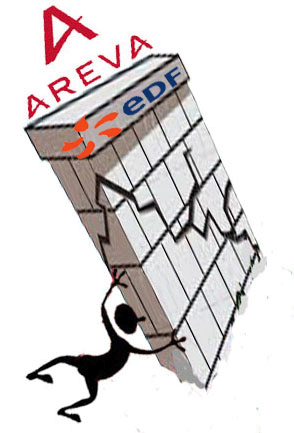
That’s because the government is as much as 3 billion euros ($3.2 billion) short of the 7.5 billion euros it has said it needs this year to fix the financial problems of Areva SA and Electricite de France SA, said two government officials with direct knowledge of the matter. Hollande will try to find an answer before he leaves office in June, one of the people said. If he can’t, his successor must decide how to plug the gap, said the other person.
France is preparing to rescue its nuclear industry after EDF was weakened by falling European power prices and Areva lost billions on a long-delayed project in Finland. The president must either increase the national debt or weigh politically sensitive privatizations of holdings in anything from automakers such as Renault SA to the former phone monopoly — a tall order with the first round of presidential elections just three months away…….
While the government has enough in its privatization account for the 3 billion-euro stimulus it plans for EDF this quarter, it remains almost 3 billion euros short of the 4.5 billion euros it wants to help its near-bankrupt reactor maker, Areva, complete its restructuring and meet debt repayments this year, said the officials. Areva shareholders on Friday voted in favor of a 5 billion-euro state-backed bailout, which includes 500 million euros from Japanese investors………https://www.bloomberg.com/news/articles/2017-02-03/france-s-next-president-said-to-face-3-billion-nuclear-hangover
Government urged to seek new investors to save Moorside project after concerns key partner will leave consortium, Guardian, Adam Vaughan, 3 Feb 17, Plans for a new nuclear power station in Cumbria are likely to be scrapped after a key backer pulled out, creating a major hole in the government’s nuclear strategy.
Two industry sources close to the process said Toshiba had privately decided to quit the consortium behind the planned Moorside plant, echoing sources who told Reuters and the Wall Street Journal that the Japanese company was withdrawing from new nuclear projects in the UK.
Toshiba said last month it was reviewing all its nuclear business abroad after suffering a multibillion-dollar writedown on its US business. It has promised to provide more details about its intentions when it publishes results on 14 February.
The French energy firm Engie, which is Toshiba’s partner in the NuGen consortium, has long been seen as wanting to get out of the project. Its chief executive said last year the future did not lie in nuclear power……..
“Any potential investor in that project is going to need to have very direct reassurance from the government; even if they are just starting an exploratory period, they are welcomed,” said Tim Yeo, the chairman of the pro-nuclear group New Nuclear Watch Europe.
The former Conservative MP said ministers should even consider taking a direct stake in the Moorside plant. Such an interventionist approach would have been anathema in recent years but appears more credible after recent leaks revealed the government was considering taking a stake in another new nuclear plant, at Wylfa in Wales……..
Moorside, near Sellafield, is a key part of the government’s hopes for a new fleet of power stations to fill the UK’s energy gap in the next decade as coal plants and ageing atomic plants close.
With Toshiba fast sinking due to failed nuclear projects, and other members of the Nugen consortium getting cold feet, the project is facing collapse. The only alternatives are a Korean rescue – or making British taxpayers pick up the bill upfront.
The financial fog swirling around the Moorside new-build project in West Cumbria continues to thicken by the day.
The development consortium NuGen must inadvertently have added to the gloom with its recently published statement that:
“NuGen’s shareholders [Toshiba and Engie] are committed to the development of the Moorside project.”
Folks with longish memories will recall an identical statement (though with names changed) coming just a few short weeks before the widely predicted departure from NuGen of Scottish & Southern Energy (SSE) in 2011 and in 2013 when Spain’s Iberdrola also pulled out of the project.
Whether the current consortium partners of Toshiba and Engie will survive NuGen’s kiss of death message remains to be seen, but the omens are not good for NuGen or those who support the development.
For Engie itself, on record last December as “trying to abandon its nuclear projects in Turkey and Great Britain” in order to concentrate on decentralized energy and renewables, is the odds-on favourite to be next through NuGen’s seemingly ever revolving doors.
Is Toshiba’s AP1000 reactor finished?
Toshiba, dubbed as “ailing” by the Japanese media and still suffering the aftershocks of an accounting scandal in 2015 that rocked the corporate world, now has to contend with its wayward and wholly owned subsidiary Westinghouse purchased from British Nuclear Fuels (BNFL) in 2006 and which has now landed its parent with a multi billion dollar loss on reactor building projects.
Selling Westinghouse, or lowering its equity stake in the reactor business is an option currently being considered by Toshiba, as is selling off some profitable Westinghouse segments such as its nuclear fuel business which includes the Springfields site in Lancashire.
With Westinghouse and its AP1000 modular reactors selected for Moorside by NuGen in 2014, the turmoil surrounding the reactor builder is set to further undermine the future prospects for the West Cumbrian development.
Toshiba’s decision on the “corrective measures” it intends to take to sort out its corporate mess will not be published until mid-February, but it is widely reported by the international media that the Corporation will cease taking orders related to the building of nuclear power stations in a move that would effectively mark its withdrawal from the nuclear construction business.
Though it will continue work on the two twin-reactor AP1000 nuclear plants under construction in the United States, Toshiba is reported to be reviewing its investment in Moorside. There is no doubt that Moorside’s future currently hangs precariously in the balance, its survival dependent on whether or not Toshiba pulls the plug on any further involvement in overseas developments.
Should that be the case, NuGen faces the game-changer not only of losing its main consortium shareholder and its Westinghouse subsidiary (with Engie to follow?) but having to find one or more new partners prepared to nail their colours to a failing new build renaissance on a greenfield site acknowledged as being less than optimum for new-build construction and ridiculously remote from where its output of electricity is needed.
Korea’s KEPCO to the rescue?
One such potential partner whose interest in Moorside has been quietly simmering on the back-boiler for the last few years is South Korea’s Korea Electric Power Corp (KEPCO).
In terms of involvement in Moorside, the company appears to have just two options, the first being to take over some of Toshiba’s stake in the development and thereby help finance the project. Such a move however must surely bite the dust if Toshiba does decide in mid-February that it no longer wants any part of Moorside.
The second and only remaing option is for KEPCO to take on the development itself with or without other partners and ditching the US AP1000 reactors in favour of using its own reactor technology such as its Advanced Power Reactor APR1400 – the first of which, Shin Kori 3 in Ulsan, went on line in South Korea only last year having taken eight years to build.
In turning NuGen’s original plan completely on its head, the adoption of KEPCO’s APR1400 at Moorside would automatically put back NuGen’s current but overly-optimistic projection of a Moorside construction start around 2021 by several years as the South Korean reactor undergoes its Generic Design Assessment by the UK’s Regulators. Such a delay may seem a small price to pay by NuGen whose pet project, without the APR1400, would be facing oblivion.
Yet given its recent history, others may take a different view of KEPCO, which is part-owned by the South Korean government.
For like Toshiba, KEPCO is itself still emerging from a major scandal that surfaced in 2012 involving bribery, corruption and faked safety tests for critical nuclear plant equipment which resulted in a prolonged shut-down of a number of nuclear power stations and the jailing of power engineers and parts suppliers.
Or make the taxpayer finance the project upfront?
Without ‘friends like this’, and in the absence of any change of mind by Toshiba, it is difficult to see how else Moorside might be financed in the future, unless the UK Government itself rides to the rescue with taxpayers money.
The suggestion, floated by NuGen to a House of Lords committee just two months ago that some of what it described as non-nuclear elements of the project – the local transport infrastructure and the offshore cooling systems – might qualify for Government support.
After a decade of posturing over its West Cumbrian project, that the private consortium now feels the need for taxpayer support for Moorside underscores the extent of NuGen’s financial woes and highlights the unattractive face of new nuclear build to would-be global investors.
Picking the UK taxpayer pocket to support a technology past its sell-by date wholly undermines the Government’s erstwhile promise that the full costs of developing, constructing and operating new-build reactors would be borne by the developer and is not likely to go unchallenged.
Right on cue however is the GMB union’s view announced today that “the sensible thing is for the Government to step in and guarantee the funding, this will keep Moorside on track and push down the price we will all have to pay for the electricity it will produce.”
In truth, the ulterior motive behind the Union’s support for Moorside as a means of ‘keeping the lights on’ is the rank fear that, without the development – and with Sellafield’s commercial operations soon to end, the decades of West Cumbria’s unhealthy domination by the nuclear industry will be a thing of the past.
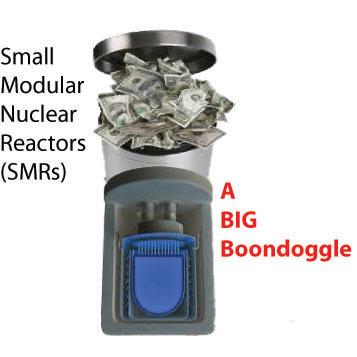
Small Modular Reactors NuClearNewsNo92 February 2017 Scotland Engineering giant Rolls-Royce is teaming up with a host of rivals including Amec Foster Wheeler and Arup and nuclear specialist Nuvia to develop mini-nuclear reactors. Rolls Royce believes the so-called next generation technology could support as many as 40,000 jobs if the industry flourishes. The consortium is entering a £250m competition started last March by the Government, which wants to find the best SMR design for civil use. It is hoped the technology will be more cost-effective than conventional plants. (1) The companies believe SMRs will strengthen the UK’s energy security by reducing reliance on foreign gas imports and smoothing out the impact of ‘intermittent generation’ technologies.
In November 2015, the British government announced plans to invest at least £250 million over the next five years in a nuclear research and development program including a competition to identify the best value SMR design for the UK. Rolls-Royce submitted a paper to the Department of Business, Energy and Industrial Strategy, outlining its plan to develop a fleet of 7 GWe of SMRs with its partners. Other participants in the UK’s SMR competition include French-owned EDF Energy and its Chinese partner CNNC, Westinghouse and US developer NuScale Power. (2)
In the US NuScale has formally completed its design submission to the Nuclear Regulatory Commission. The 12,000-page application will now undergo a lengthy review by the NRC, which must approve the design before construction can begin. (3)
According to City AM the Government’s work on SMRs appears to have slowed down, and many companies were expecting mention of plans in the industrial strategy published in January, but there was nothing specific. (4)
NuClearNewsNo92 February 2017Scotland and Hinkley A report, called ‘Scotland’s Wind’ (1), by Dr David Toke – Reader in Energy Politics at Aberdeen University and published by the Scottish Greens shows that UK, electricity consumers are set to pay around £16 a year for 35 years to subsidise Hinkley Point C. If Scottish consumers could go it alone their £16 levy could fund almost twice as much power from onshore and offshore wind farms.
The report says:
“If Scottish consumer s money was spent on supporting renewable energy rather than paying for their share of Hinkley Point C … then, even on conservative calculations, nearly double the amount of electricity would be generated from wind power as from Hinkley C”.
The costs of onshore windfarms and also offshore windfarms even on current prices need much less support from consumer surcharges to generate an equivalent amount of electricity compared to HPC. Wind power costs are falling rapidly, with some especially low prices being reported in Denmark and The Netherlands. Under such a programme organised by the Scottish Government the cheapest onshore windfarms could start generating in 2020 and offshore windfarms organised under a new, Danish-style framework, could be online in 2026.
The Scottish Government s own preference for renewable energy over nuclear power lends support to the suggestion that the Scottish Government should be able to use Scottish consumers money to pay for new renewable energy rather than new nuclear power. Moreover the best value for money for Scottish consumers in terms of generating non-fossil fuels is likely to come from the Scottish Government having powers to fund its own renewable energy programme from Scottish consumer bills. This is because the Scottish Government will be able to decide on what contract length to offer wind developers, for example offering to pay guaranteed prices for 20 years rather than 15 years as done by the Westminster Government now with renewable energy. Also, the Scottish Government will be able to organise a much more effective offshore windfarm programme than is being done by the Westminster Government. The Westminster Government’s methods are increasing the costs of offshore wind by leaving too much uncertainty to be dealt with by developers. The Scottish Government could organise a much cheaper offshore wind programme on the lines done by the Danish Energy Agency. This is likely to lead to lower costs and less confrontation in the courts over planning issues than is the case with the current offshore windfarm programme. (2)
We are heading for a senseless nuclear Brexit – with no political or legal mandate https://www.theguardian.com/science/blog/2017/feb/01/brexit-nuclear-eu-euratom-treaty-clare-moody Clare Moody Our nuclear energy, safety and research must not be subjugated to already chaotic Brexit negotiations – the government must put the national interest first Clare Moody is Labour MEP for South West England & Gibraltar. 3 February 2017
Last week we learned just how hard and how ill-conceived Brexit looks like being. The two line parliamentary bill published by the government last Thursday contained no detail, no plan, and no check or balance on the prime minister’s possible negotiation as it progresses.
One thing that was included, albeit buried in the explanation notes, is a brief reference to also ending Britain’s membership of Euratom – an entirely separate treaty. The implications of this will be deep and far-reaching for the future of UK’s energy supply, science, industry and workers. There is no political or legal mandate for the UK to leave Euratom, in fact it was barely even a footnote in the referendum campaign, and yet we are heading for a nuclear Brexit.
Euratom matters for the UK. Signed in 1957 as the European Atomic Energy Community, it is a separate treaty from the EU with the purpose of creating a single market for nuclear knowledge and resources in the peaceful pursuit of science and nuclear energy.
Whilst currently its only full members are EU countries, it is in fact a legally separate organisation to the EU. The UK is a leading member of Euratom, and plays host to one of its most important research institutions – the Joint European Torus (JET), based in Culham, Oxfordshire. JET is performing extraordinary and groundbreaking research in the pursuit of fusion energy, and is part of an EU-wide project to deliver on the vision of this revolutionary, safe and clean energy source. On the way, new technologies, materials and expertise are being developed here.
Euratom also provides safeguarding inspections for all civilian nuclear facilities in the UK, including Hinkley Point B, Sizewell and Torness in Scotland. It is the legal owner of all nuclear material, and is the legal purchaser, certifier and guarantor of any nuclear materials and technologies that the UK purchases. This includes our nuclear trade with the United States.
This means that 21% of the UK’s electricity generation is based on our membership of Euratom. It means that EDF can rely on secure supply chains for construction at Hinkley Point C and it is responsible for safeguarding inspections. Whether people are in favour of nuclear fission power or not we can all agree we want it to be as safe as possible, which is why leaving Euratom makes no sense.
Our own regulating authorities are not equipped to take over all of Euratom’s safeguarding work in the UK, and any British scientist will tell you that their work depends on international collaboration that is facilitated by this treaty.
Given this, it is hard to overstate the effect leaving Euratom will have on the UK –and the British people did not give the government a mandate to leave Euratom.
I think this is a bad decision, poorly thought out and with no explanation as to how our safety will be protected. The government must start at some point to put the national interest ahead of narrow party interest and Euratom would be a good place to start. Euratom is a separate treaty and the government should have the gumption to treat it as such – it requires separate and detailed negotiations. Our nuclear energy, safety and research must not be subjugated to the already chaotic wider Brexit negotiations.
Europe should act fast to preserve the Iran nuclear deal, Bulletin of the Atomic Scientists, Ellie Geranmayeh, 2 FEBRUARY 2017 US President Donald Trump has stirred all kinds of controversy with European allies during his first fortnight in office. Now, his administration’s evolving policy on Iran is becoming another source of concern across the Atlantic. Europe has a crucial but short window to clearly outline its position on the Iran nuclear deal in ways that could influence policymakers in Washington. In doing so, Europe should focus on preserving the agreement under existing terms as enshrined by the United Nations, and charting a course that minimizes confrontation—whether intentional or accidental—between Iran and the United States in an already turbulent Middle East.
On Wednesday, new National Security Advisor Michael Flynn declared that the United States was “putting Iran on notice.” While it is not clear what exactly he meant, he also criticized Iran’s missiles tests and behavior in the region, calling Tehran’s actions “provocative” and staking out a US position distinctly different from those of Europe and Russia. Although Flynn didn’t directly attack the nuclear deal reached between Iran and six world powers in July 2015, a war of words could easily escalate in ways that threaten it.
The Iran nuclear deal, also known as the Joint Comprehensive Plan of Action (JCPOA), scaled back the country’s nuclear activities in exchange for sanctions relief. As a presidential candidate, Trump suggested he would “dismantle the disastrous deal” or renegotiate it. As president-elect he condemned the deal, but has since said he would “rigorously” enforce it. And during a White House briefing the same day as Flynn’s comments, US officials stressed “that they were not linking Iran’s missile and regional actions to the nuclear deal at this point,” as Al-Monitor reported. On Thursday, though, Trump tweeted that Iran “should have been thankful for the terrible deal the U.S. made with them.” Going forward, it seems likely that Trump’s calculations over the nuclear deal and sanctions will be influenced by developments on non-nuclear issues and also events abroad—among Russia, US allies in Europe, the Gulf Arab states, and Israel.
An early test of the US administration’s stance will come this spring, when the president is required to renew sanctions waivers that enable non-US companies to do business with Iran, in accordance with the terms of the nuclear deal. ……
The Iran nuclear deal steered the United States and its allies away from resorting to yet another futile military encounter in the Middle East. It was never intended to solve every problem between the West and Iran, and the two sides continue to take opposing views on a number of critical issues. However, the agreement has proven that Iran and the West have the capacity to resolve complex security challenges through a transactional relationship if there are mutually beneficial outcomes. Instead of watching Tehran and Washington relapse into the rhetoric of war and conflict, Europe should encourage them to build on this winning formula. http://thebulletin.org/europe-should-act-fast-preserve-iran-nuclear-deal10488
Trump, Russia take a dangerous first step on nuclear arms control, The Hill, BY RICHARD NEPHEW AND ADAM MOUNT, 2 Feb 17In a recent interview with the the London Times, Donald Trump suggested that he would offer to lift U.S. sanctions over Russia’s invasion of Ukraine as part of a nuclear arms control agreement.
At a time when tensions between the two countries are growing, a verifiable and stabilizing new arms control agreement would be genuinely welcome. But a bad deal would only make matters worse.
The comments about sanctions relief raise real questions about whether the incoming administration is willing to pay any price to improve relations with Russia (and why).
Today, both countries are making investments to replace nuclear systems that were first fielded during the Cold War. An agreement to limit these modernization plans could save money, stabilize the nuclear balance, and be safer to maintain and operate.
Under President Obama, the United States found that it could meet its deterrence requirements after a further one-third reduction in deployed strategic warheads, beyond what was agreed in the New Strategic Arms Reduction Treaty (New START) in 2010, and offered this deal to Russia.
A new arms control agreement would be difficult to achieve today. Putin declined Obama’s one-third offer and has signaled that he is not willing to negotiate over his most dangerous systems, its vast and opaque stocks of low-yield and short-range weapons.
At the same time, Russia has violated the 1987 Intermediate-Range Nuclear Forces (INF) Treaty by developing a new prohibited cruise missile and indicated no real willingness to address the concerns of the United States and other treaty participants. Arms control accords are among the most consequential and the most difficult negotiations in the world, features that will surely attract Trump — but changing Putin’s position will be a very tall order. …….http://thehill.com/blogs/pundits-blog/foreign-policy/317403-trump-russia-take-a-dangerous-first-step-on-nuclear-arms