No2Nuclear Power nuClear news No.93, March 2017
The Hinkley Point C nuclear plant is risky and poor value for money, according to a House of Lords committee that urged the government to set out a “plan B” in case the £18 billion project is not built on time. (1)
In a damning report on energy policy, the Lords economic affairs committee said that household energy bills had already soared by 58% since 2003 and the risk of blackouts had increased, in part due to “poorly designed government interventions, in pursuit of decarbonisation”. Ministers should abandon plans to award subsidies to future nuclear plants through bilateral deals like that given to Hinkley, the committee said. Instead such projects should be forced to compete against wind farms, solar power farms and gas-fired power stations to find the cheapest way of keeping the lights on and cutting emissions. The committee said that the government should ensure that “the security of the UK’s energy supply is the priority of its energy policy” and suggested that climate change targets be “managed flexibly”. Lord Hollick, the committee’s chairman, highlighted Hinkley – which was signed off by Theresa May in September – as “a good example of the way policy has become unbalanced and affordability neglected”, and described it as “very, very expensive”. (2)
The total cost to consumers for Hinkley Point C is estimated to be £30bn. The committee called for an independent Energy Commission to advise Government on how to achieve an optimum balance of its three key objectives to keep the lights on at low cost while cutting carbon. “It would not be entirely different to the role that the OBR plays with regards to the Treasury. What it would do is provide a degree of transparency, not only for the Government itself to make its decisions but for industry and observers and analysts so that there is a greater degree of accountability as opposed to confusion,” he said. (3)
On the other hand the report was slammed by some environmentalists and renewable energy advocates for calling for decarbonisation to be relegated in favour of security of affordable supply. Critics said its conclusions were ‘out of touch’ and ‘backward-looking’. The report was accused of arguing that generation of electricity from fossil fuels is cheaper than renewable sources and that subsidies provided to clean energy generation have resulted in considerably higher costs for consumers…….. http://www.no2nuclearpower.org.uk/nuclearnews/NuClearNewsNo93.pdf
March 4, 2017
Posted by Christina Macpherson |
politics, UK |
Leave a comment
No2Nuclear Power nuClear news No.93, March 2017 A footnote in the Parliamentary Bill published on 26th January to authorise Brexit confirmed that the UK intends to leave EURATOM as well as the European Union. (1) Up until that point this was a grey area with disagreements over whether Brexit meant the UK would also have to leave EURATOM……..
The decision has wide-ranging implications for Britain’s nuclear industry, research, access to fissile materials and the status of approximately 20 nuclear co-operation agreements that it has with other countries around the world. The UK is going to have to strike new international agreements with all these countries to maintain access to nuclear power technology – crucially with the US because several of the UK’s existing and planned nuclear reactors use US technology or fuel. A new bilateral agreement will also be needed with the International Atomic Energy Agency. Nuclear co-operation agreements can take considerable time to agree and ratify. It may not be possible to complete them before Britain leaves the EU in 2019
New Reactors in Jeopardy? The concern now in the UK nuclear industry is that leaving EURATOM will complicate and delay the UK’s plans to build a new generation of nuclear power stations. “The new wave of British nuclear power stations was in jeopardy” said the Times. Withdrawal could cause “major disruption” according to the Nuclear Industry Association (NIA) particularly for Horizon and Nugen, which are developing plans for reactors on Anglesey and in Cumbria because their plans involve co-operation with US nuclear companies. Former Labour MP Tom Greatrex, now chief executive of the NIA, said: “The UK nuclear industry has made it crystal clear to the government before and since the referendum that our preferred position is to maintain membership of EURATOM.” (3) Although Horizon, whose reactors would use US nuclear fuel, says it is reassured by the government’s commitment to put new regulatory arrangements in place quickly. (4)
The Hinkley Point C station in Somerset could also face renewed problems….. http://www.no2nuclearpower.org.uk/nuclearnews/NuClearNewsNo93.pdf
March 4, 2017
Posted by Christina Macpherson |
politics, UK |
Leave a comment
CALCULATING CLIMATE CHANGE LOSSES. #AUSPOL https://jpratt27.wordpress.com/2017/03/02/calculating-climate-change-losses-auspol/, Johhn Pratt,
Risky business — calculating climate change losses in major European coastal cities
A new study that assesses potential future climate damage to major European coastal cities if, as currently, global carbon emissions continue to track the Intergovernmental Panel on Climate Change’s worst emission scenario
A new study that assesses potential future climate damage to major European coastal cities has found that, if, as currently, global carbon emissions continue to track the Intergovernmental Panel on Climate Change’s worst emission scenario (RCP8.5), overall annual economic losses may range from 1.2 billion USD in 2030 to more than 40 billion by 2100.
The paper, ‘Climate Risk Assessment under Uncertainty: An Application to Main European Coastal Cities’ published in the journal Frontiers in Marine Science, focused on 19 major European coastal cities including Istanbul, Rotterdam, Barcelona, Hamburg, London, Dublin, Marseille, St Petersburg and Copenhagen.
For the first time, the report’s authors adapted into their modelling methods for dealing with uncertainty well known in other fields of economics, such as financial economics.
They successfully applied them to so called ‘tail events’ and their possible impacts in the chosen cities.
The study’s results show that despite their low probability of occurrence the huge scale of damage that tail events may cause means that they should be carefully considered in coastal vulnerability analysis.
In 2030, just 13 years away, under a worst case emission scenario, Rotterdam tops the economic impact table with expected annual losses of almost 240-million USD, closely followed by Istanbul, St Petersburg and Lisbon.
By 2100 the expected annual losses in Istanbul could reach almost 10-billion USD, Odessa in the Ukraine could lose 6.5-billion USD annually and Rotterdam 5.5-billion. Glasgow and Dublin could both suffer economic losses of around 1.5-billion USD in annual economic losses by 2100.
About two thirds of our planet’s mega-cities–cities with populations of more than 5 million people–are located in low-lying coastal areas so protecting these areas from rising sea levels is critical to saving lives and property.
Being so vulnerable to the impacts of climate change, coastal cities also have a major role in adapting to them.
The report urges local, regional, and national policy-makers not to settle for traditional approaches to calculating climate impacts but instead seek to introduce risk assessments under uncertainty into their decision-making processes.
The author’s say that in line with the level of risk in each coastal city and the risk aversion of decision-makers, adaptation measures will need to be implemented in the near future in order to avoid critical damage and major losses.
Press link for more: Eureka Alert
March 4, 2017
Posted by Christina Macpherson |
climate change, EUROPE |
Leave a comment
Green MSP hits out at Hunterston B nuclear decision, Energy Voice, 1 Mar 17 Alan Shields A Scottish politician has criticised the UK’s Office for Nuclear Regulation (ONR) over changes to safety regulations for the Hunterston B power station in Ayrshire. THE ONR has ruled that a periodic safety review by operators EDF is “adequate”.
As a result the UK atomic agency has relaxed the safety case regarding the plant’s graphite core.
The revised safety case provides new limits and conditions of operation in response to keyway root cracking of the graphite in the core.
This is an expected part of the aging process as reactors get closer to their end of life. Acceptance of the safety case is also reliant on a revised inspection and monitoring strategy.
But Ross Greer, Scottish Green MSP for Wwest of Scotland, last night hit out at the lack of public consultation on the matter.
In January, Greer championed a report authored by an independent expert on nuclear safety, which concluded that despite it being probably illegal under international law, the Scottish public were being denied a say in the decision to keep Scotland’s oldest nuclear power station running.
The MSP said: “News that EDF are to be allowed more cracking within Hunterston’s reactor will concern residents across North Ayrshire, the West of Scotland and further afield. The lack of public consultation is simply unacceptable.
“It’s disappointing that the Scottish Government have not spoken out on the issue. European law says all ageing nuclear power stations should have an environmental impact assessment comparing their continued operation against alternative sources of energy such as renewables, and that the public should be involved, but that hasn’t happened.
“We should be putting efforts into building our renewables capacity and the secure, long term jobs which come with it, reducing demand through energy efficiency measures and ensuring a jobs transition for nuclear workers at sites such as Hunterston.”…….. https://www.energyvoice.com/otherenergy/133089/green-msp-hits-hunterston-b-nuclear-decision/– 0 2/
March 4, 2017
Posted by Christina Macpherson |
politics, safety, UK |
Leave a comment

 The nuclear fallout from Brexit When Britons voted to leave the EU few realised the implications for its nuclear industry. Financial Times, 2 Mar 17 by: Andrew Ward and Alex Barker Perched on a remote stretch of coastline in north-west England is Europe’s most dangerous building. Inside the innocuous-sounding Product Finishing and Storage Facility at the Sellafield nuclear plant is enough plutonium for about 20,000 nuclear bombs.
It is the world’s largest stockpile of civilian plutonium — one of the most toxic substances on the planet — accumulated from decades of reprocessing nuclear fuel from power stations not only in the UK but also Germany, France, Sweden and other countries. When Britain voted to leave the EU last June few voters contemplated what the decision would mean for this deadly stash of radioactive material. Yet, as officials in Whitehall and Brussels prepare to negotiate Brexit, regulation of nuclear energy is emerging as one of the most difficult and pressing issues to resolve. One senior negotiator simply called it “a nightmare”.
Britain’s plutonium stockpile is overseen by inspectors from Euratom, the pan-European body that regulates the use of nuclear energy. The organisation has a permanent presence at Sellafield and owns the cameras, seals and testing laboratory used to monitor Europe’s largest nuclear facility. Brexit threatens to upend this decades-old arrangement because the UK’s departure from the EU will require withdrawal from Euratom, a separate legal entity but one governed by EU institutions. At stake is not just the safeguarding of Sellafield but also critical pillars of UK energy security, scientific research and even medicine.
All trading and transportation of nuclear materials by EU countries, from fuel for reactors to isotopes used in cancer treatments, is governed by Euratom. The UK now faces a scramble to assemble a new regulatory regime to uphold safety standards, while negotiating dozens of international agreements needed to maintain access to nuclear technology. Rupert Cowen, a nuclear specialist at Prospect Law, a London law firm, told a parliamentary hearing this week that the UK was “sleepwalking” to disaster. “If we do not get this right, business stops,” he said. “If we cannot arrive at safeguards and other principles which allow compliance [with international standards] no nuclear trade will be able to continue.” The potential consequences of failure — from the shutdown of nuclear power stations to the loss of radiotherapy for cancer patients — seem implausible, but coming up with a fix will not be easy. British ministers must renegotiate a relationship with Euratom where no template for close co-operation with outsiders exists. They must pass legislation to set up a new safeguarding system, then find, hire and train the personnel needed to do the job in an industry known for its chronic skills shortage. And Britain must strike up to 20 deals to re-establish the basis on which it engages with other countries, such as the US and Japan, outside of Euratom.
“There is a plethora of nuclear agreements that would have to be struck . . . before we could begin to move not only materials but also intellectual property, services, anything in the nuclear sector,” Dame Sue Ion told MPs. She is chair of the Nuclear Innovation and Research Advisory Board, which advises the UK government. “We would be crippled without [these deals] in place,” she added. All this potentially must be done by 2019, when the UK is due to leave the EU. There is a safety valve — remaining part of Euratom for a transition period — but the EU will demand that European courts oversee the arrangement, which crosses one of the red lines in the UK’s negotiating strategy. Little wonder industry is rattled………
Today, Euratom’s 160-strong nuclear inspectorate spend about a quarter of their time focused on British facilities.
Critical to replacing the Euratom regime will be a bilateral deal with the International Atomic Energy Agency, which oversees global nuclear safety and security. Euratom reports into the IAEA on behalf of its members and the UK would need to replicate this relationship. One option would be for IAEA inspectors to replace those of Euratom in the UK, although industry leaders questioned whether the global body would want its resources diverted from its non-proliferation monitoring in places such as Iran.
Yukiya Amano, the IAEA director-general, told the Financial Times that a rapid deal with the UK was possible. But he added a catch. “It depends very much on the progress on the UK-Euratom, UK-EU side. UK-IAEA negotiations [do not] go ahead of the UK-Euratom negotiations, we always follow,” he said. “If negotiations with UK-Euratom go fast, we can fix this issue fast.” However, if Britain sticks to an expected exit date of 2019, at best the UK may have 18 months or a year to re-secure its place in the international nuclear market. “There is a chicken and egg situation,” says one official involved in Brexit preparations. “You have to move seamlessly from one regime to another. But you can’t do that without a new safeguarding regime that [other countries] are satisfied with.” Britain has little experience of negotiating nuclear agreements. It took four years of “lengthy and difficult” negotiations in the 1990s to agree an upgrade to the Euratom-US co-operation agreement, which was due to lapse. And even then the deal could not be ratified on time by the US Senate. The wait caused a three-month hiatus when all transatlantic nuclear trade stopped dead. That is something the UK would not want to risk today. …….
Asked by MPs whether new arrangements could be put in place within two years, Dame Sue said: “I do not think it is possible.” One option to buy time would be to carry on paying Euratom to provide safeguarding services. But it is run by the European Commission, the EU’s executive, rather than as an independent agency which would have given Britain political cover. Perhaps more importantly, it relies on the European Court of Justice to give teeth to its intrusive inspection powers. Britain is determined to leave ECJ jurisdiction. But the nuclear area is where the EU will be most reluctant to split legal authority; the powers are too important, and the potential consequences and liabilities too big. “The only framework we are comfortable with is the existing framework,” says one EU official preparing for talks. “It works rather well.”………..
https://www.ft.com/content/9b99159e-ff2a-11e6-96f8-3700c5664d30
March 3, 2017
Posted by Christina Macpherson |
politics, UK |
Leave a comment
UK funding development of autonomous robots to help clear up nuclear waste A new UK consortium will be developing robots to handle nuclear sites, bomb disposal, space and mining. International Business Times, By Mary-Ann Russon February 28, 2017 The UK government is funding a new consortium of academic institutions and industrial partners to jump start the robotics industry and develop a new generation of robots to help deal with situations that are hazardous for humans.

It is estimated that it will cost between £95 billion and £219 billion to clean up the UK’s existing nuclear facilities over the next 120 years or so. The environment is so harsh that humans cannot physically be on the site, and robots that are sent in often encounter problems, like the small IRID Toshiba shape-shifting scorpion robot used to explore Fukushima’s nuclear reactors, often break down and cannot be retrieved.Remote-controlled robots are needed to turn enter dangerous zones that haven’t been accessed in over 40 years to carry out relatively straightforward tasks that a human could do in an instant.
The problem is that robots are just not at the level they need to be yet, and it is very difficult to build a robot that can successfully navigate staircases, move over rough terrain and turn valves.
To fix this problem, the Engineering and Physical Sciences Research Council is investing £4.6m ($5.7m) into a new group consisting of the University of Manchester, the University of Birmingham, the University of the West of England (UWE) and industrial partners Sellafield, EDF Energy, UKAEA and NuGen…….http://www.ibtimes.co.uk/uk-funding-development-autonomous-robots-help-clear-nuclear-waste-1608985
March 1, 2017
Posted by Christina Macpherson |
Reference, technology, UK, wastes |
Leave a comment
 UK nuclear power stations ‘could be forced to close’ after Brexit Leaving Euratom treaty will shut down nuclear industry if international safety agreements are not made in time, MPs told, Guardian, Adam Vaughan, 1 Mar 17, Nuclear power stations would be forced to shut down if a new measures are not in place when Britain quits a European atomic power treaty in 2019, an expert has warned.
Rupert Cowen, a senior nuclear energy lawyer at Prospect Law, told MPs on Tuesday that leaving the Euratom treaty as the government has promised could see trade in nuclear fuel grind to a halt.
The UK government has said it will exit Euratom when article 50 is triggered. The treaty promotes cooperation and research into nuclear power, and uniform safety standards.
“Unlike other arrangements, if we don’t get this right, business stops. There will be no trade. If we can’t arrive at safeguards and other principles that allow compliance [with international nuclear standards] to be demonstrated, no nuclear trade will be able to continue.”
Asked by the chair of the Commons business, energy and industrial strategy select committee if that would see reactors switching off, he said: “Ultimately, when their fuels runs out, yes.” Cowen said that in his view there was no legal requirement for the UK to leave Euratom because of Brexit: “It’s a political issue, not a legal issue.”
The UK nuclear industry would be crippled if new nuclear cooperation deals are not agreed within two years, a former government adviser told the committee.
“There is a plethora of international agreements that would have to be struck that almost mirror those in place with Euratom, before we moved not just material but intellectual property, services, anything in the nuclear sector. We would be crippled without other things in place,” said Dame Sue Ion, chair of the Nuclear Innovation and Research Advisory Board, which was established by the government in 2013.
She said movement of the industry’s “best intellectual talent” was made easier by the UK’s membership of Euratom…….
Over the weekend, the GMB union called on ministers to reconsider their “foolhardy rush” to leave the treaty, claiming it could endanger the “UK’s entire nuclear future”…….
Norman also promised a decision was due soon on the next stage of a delayed multimillion-pound government competition for mini nuclear reactors, known as small modular reactors. “I love the projects and ideas but I want to be shown the value,” he told the peers. https://www.theguardian.com/business/2017/feb/28/british-nuclear-power-stations-could-be-forced-to-close-after-brexit
March 1, 2017
Posted by Christina Macpherson |
politics, UK |
Leave a comment

 Russia, Tajikistan to cooperate in nuclear energy field, AZER News, 1 March 17 By Kamila Aliyeva
Tajikistan and Russia have agreed to cooperate in atomic energy and border security. The relevant agreements were achieved within the framework of the visit of Russian leader Vladimir Putin to Tajikistan on February 27.
Thus an agreement on cooperation in peaceful uses of atomic energy was signed by Farhod Rakhimov, President of the Academy of Sciences of the Republic of Tajikistan, on behalf of the Government of the Republic of Tajikistan, and Alexey Likhachev, Director General of ROSATOM, on behalf of the Government of the Russian Federation.
The deal has provided the legal basis for interaction between Tajikistan and Russia in the nuclear power sector for the first time in history while determining a wide range of cooperation areas including design, construction, operation and decommissioning of research reactors; spent fuel and radioactive waste management; rehabilitation of tailing storage areas and utilization of decommissioned uranium mining and reprocessing facilities; production of radioisotopes; use of nuclear technology in industry, medicine, agriculture; education and training of highly skilled personnel for the nuclear power industry, etc.
Besides, the agreement envisages the formation of joint coordination commission with the view of further consulting in the issues relating to the implementation of the above mentioned peaceful uses of atomic energy and search for mutually beneficial opportunities…….http://www.azernews.az/region/109545.html
March 1, 2017
Posted by Christina Macpherson |
marketing, Russia |
Leave a comment
Did Putin help elect Trump to restore $500 billion Exxon oil deal killed by sanctions
Follow the money: Will Trump repay Putin by ending Russian sanctions and killing the Paris climate deal? Think Progess, Joe Romm , 28 Feb 17, “……. our democracy and our children have a new axis to worry about: Putin, Trump, and ExxonMobil, whose CEO Rex Tillerson — an extreme Russophile and long-time director of a US-Russian oil company — is Trump’s puzzling choice for Secretary of State.
I say “puzzling” because the long-serving Exxon employee (from age 23!) has no qualifications to be secretary of state — other than a history negotiating major oil deals with countries like Putin’s Russia, which in any sane world would actually disqualify him or at least force a recusal from all State Department dealings with Russia.
But that puzzle disappears if we follow the famous dictum from the Watergate era for uncovering a tangled web of covert campaign acts: “Follow the money.” And perhaps another puzzle is also solved: Why did Putin take such a “fearful risk,” as Frum put it, to “mount a clandestine espionage and disinformation campaign on behalf” of Trump and against Clinton, “when Putin had every reason to expect that he probably would end up facing a President Clinton,” and a tremendous backlash.
You can certainly make a plausible case, as U.S. intelligence agencies do in their bombshell new report, that Putin had plenty of motivation to interfere. He wanted to undermine the legitimacy of U.S. elections and a Clinton Presidency, he blamed Secretary Clinton for “inciting mass protests against his regime,” and he was angry with the U.S. for the Panama Papers leaks.
Those leaks showed a $2 billion trail of offshore accounts and deals that traced back to Putin and his cabal of kleptocrats, who, among other things, were getting rich “trading shares in Rosneft,” Russia’s state-owned (i.e. Putin run) oil monopoly.
But a half trillion dollars to line their pockets and prop up the Russian economy offers a much more tangible motivation for team Putin to get Trump elected. And it was Tillerson who had made the $500 billion oil dealwith Putin that got blocked by sanctions.
Blocking the deal did not just “put Exxon at risk,” as the Wall Street Journal reported in 2014. MSNBC’s Rachel Maddow explained last month the biggest oil deal in history was “expected to change the historical trajectory of Russia.”
The top priority for Putin and the kleptocrats who benefit from his rule is enriching the Kremlin’s coffers and their own, which have been hurt by the sanctions. And Trump’s election already appears to have delivered $11 billion to the Kremlin through sale of a 19.5 percent stake in Rosneft, “confounding expectations that the Kremlin’s standoff with the West would scare off major investors,” as Fortune has reported in a must-read piece.
Kleptocracy — and interfering with our election — pays…….
Indeed, if Trump and Tillerson instead end the sanctions that are blocking the Exxon-Rossneft deal, it is going to look suspiciously like a half trillion dollar quid pro quo for Putin’s help getting elected.
And if Trump and Tillerson work together to kill the Paris climate deal, the last best chance to save Americans from catastrophic climate change—and aridiculously good deal for the U.S.— that will look like they are putting Putin’s interests and Exxon’s profits above America’s national interest and the health and well-being of our children. It bears repeating that ExxonMobil’s future is inextricably tied to their stalled oil deal with Putin — and their future drilling plans would benefit from continued global warming and melting of polar ice…….. https://thinkprogress.org/putin-helped-trump-exxon-oil-deal-sanctions-6f169c4a4cd0#.hxgqiytyu
March 1, 2017
Posted by Christina Macpherson |
politics, politics international, Russia, USA |
Leave a comment
Wild boars roam Czech forests – and some of them are radioactive http://www.reuters.com/article/us-czech-boars-idUSKBN1611G0 Reporting by Robert Muller and Jiri Skacel, editing by Larry King Feb 22, 2017 The Czech Republic has an unusual problem this winter with its wild boar meat, a local delicacy. The boars are radioactive.
Actually, it’s not the boars themselves, but what they’re eating. A cold and snowy winter is forcing them to feed on false truffles, an underground mushroom common in the Sumava mountain region shared by Czechs, Austrians, Germans – and wild boars.
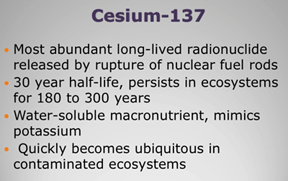
The mushrooms can absorb high levels of the radioactive isotope Caesium 137. And three decades ago the nuclear catastrophe at Chernobyl released a fair amount of Caesium 137 that eventually drifted down on the Sumava mountains.
Now the boars are eating the mushrooms, and ingesting the Caesium 137 along with them. That’s making their meat radioactive, Jiri Drapal at the State Veterinary Administration told Reuters.
“It is more or less a seasonal issue,” Drapal said.
But it’s a long season. The half life of Caesium 137 is 30 years – that is, it takes 30 years for the radioactivity of the isotope to fall to half its original value. Then another 30 to fall to half again, and so on. The boars could be glowing for quite a while.
“We can expect to find (affected) food for a number of years from now,” Drapal said.
And that could cause some problems with the supply of boar meat, which is popular in the Czech Republic. It often shows up on restaurant menus in goulash, a thick stew of meat, sauce and dumplings.
Any boar that ends up as goulash ought to be safe. Every wild animal hunted, not only boars, must be inspected before its meat can get to customers. Radioactive meat is banned from circulation, Drapal said.
That’s the good news. The bad news is that 614 animals were inspected from 2014 to 2016, and 47 percent were above the limit – almost half.
The semi-good news is that even meat from radioactive animals would be a health hazard only in large doses, Drapal said. You would have to eat it several times a week for couple of months, to get sick, he said.
February 27, 2017
Posted by Christina Macpherson |
environment, EUROPE |
Leave a comment

 Trump’s US nuclear stance alarms Russia http://www.skynews.com.au/news/politics/nthamerica/2017/02/25/trump-s-us-nuclear-stance-alarms-russia.html
Published: 10:16 am, Saturday, 25 February 2017 Russian politicians close to the Kremlin say US President Donald Trump’s declared aim of putting the US nuclear arsenal ‘at the top of the pack’ risked triggering a new Cold War-style arms race between Washington and Moscow.
In an interview with Reuters, Trump said the US had fallen behind in its nuclear weapons capacity, a situation he said he would reverse, and he said a treaty limiting Russian and US nuclear arsenals was a bad deal for Washington.
Russian officials issued no reaction, with Friday a public holiday, but pro- Kremlin politicians expressed consternation about the comments from Trump, who Moscow had hoped would usher in new, friendlier relations between the two countries.
‘Trump’s campaign slogan ‘Make America great again’, if that means nuclear supremacy, will return the world to the worst times of the arms race in the ’50s and ’60s,’ said Konstantin Kosachev, chairman of the international affairs committee in the upper house of the Russian parliament.
The president’s remarks in the interview with Reuters were, Kosachev said in a post on his Facebook page, ‘arguably Trump’s most alarming statement on the subject of relations with Russia’.
Over the course of the Cold War, the Soviet Union and the US realised that achieving supremacy was dangerous, and accepted the doctrine of parity as the best way to ensure peace, Kosachev wrote on his Facebook page.
‘Are we entering a new era? In my view we need an answer to that question as soon as possible.’
During the US presidential race, Trump said he would try to end the enmity that broke out between the Kremlin and Washington during Barack Obama’s presidency.
But just over a month into the Trump presidency, that prospect has receded, especially with the sacking of Michael Flynn, a leading proponent of warmer ties with Moscow, from his job as national security adviser.
Another pro-Kremlin lawmaker, Alexei Pushkov, wrote on Twitter that Trump’s comments on increasing US nuclear capacity ‘put in doubt the agreement on limiting strategic arms, returning the world to the 20th century’.
He said a Cold War arms treaty laid the foundation for nuclear stability between Moscow and Washington. ‘That needs to be preserved. And the United States cannot achieve decisive superiority.’
‘Instead of trying to achieve an illusory nuclear supremacy over Russia, the US administration should find a solution to the exceptionally complicated nuclear problem of North Korea,’ wrote Pushkov, a member of the defence and security committee in Russia’s upper house of parliament. – See more at: http://www.skynews.com.au/news/politics/nthamerica/2017/02/25/trump-s-us-nuclear-stance-alarms-russia.html#sthash.fwqZWCfw.dpuf
– See more at: http://www.skynews.com.au/news/politics/nthamerica/2017/02/25/trump-s-us-nuclear-stance-alarms-russia.html#sthash.fwqZWCfw.dpuf
– See more at: http://www.skynews.com.au/news/politics/nthamerica/2017/02/25/trump-s-us-nuclear-stance-alarms-russia.html#sthash.fwqZWCfw.dpuf– See more at: http://www.skynews.com.au/news/politics/nthamerica/2017/02/25/trump-s-us-nuclear-stance-alarms-russia.html#sthash.fwqZWCfw.dpuf
February 27, 2017
Posted by Christina Macpherson |
politics international, Russia, USA, weapons and war |
1 Comment
 Yeo: Treasury needs to pour billions into nuclear projects , Telegraph UK Jillian Ambrose 25 FEBRUARY 2017 The Treasury is facing calls to pour billions of pounds into a string of troubled new nuclear projects which threaten the UK’s energy supplies.
Tim Yeo, a former environment minister and energy committee chairman, is warning that the only way the Government can avert a crisis for the country’s nuclear programme is to take a direct financial stake in the projects.
Ministers should also actively encourage investment from nuclear companies in China, South Korea and Russia where the the industry is relatively insulated from the challenges faced by European companies thanks to strong state backing, he said.
Ministers are wary of involving the foreign powers in its energy security plans and have steadfastly resisted taking on the financial risk involved in nuclear construction.
In a letter to Business Secretary Greg Clark, the Tory grandee says there is a real danger that the pipeline of nuclear projects will fail to come on stream before 2030 unless Government agrees to intervene. Mr Yeo said the existing support regime, which guarantees a fixed price for each megawatt of power produced, does not go far enough to help investors who face billions in construction costs before the nuclear plant begins producing power……
February 27, 2017
Posted by Christina Macpherson |
politics, UK |
Leave a comment
 Belarusian Nuke Plant Could Face Baltic Blockade http://www.tol.org/client/article/26725-nuclear-belarus-astravets-latvia-lithuania.html Lithuania seeks allies for plan to stop electricity generated by plant from entering European power market. 24 February 2017
The three Baltic states may be close to agreement on blocking electricity from Belarus’s unfinished Astravets nuclear plant from crossing their borders.
Lithuania has decided to prevent electricity from the plant from entering its market, and Estonia supports the policy, the Baltic Course reports.
Lithuania has been the fiercest opponent of the plant, which is being built at a site only 50 kilometers from Vilnius, and has been unhappy with Latvia’s less stringent approach. Riga’s stance seems to have hardened, after its economy minister, Arvils Aseradens, met with Lithuanian Energy Minister Zygimantas Vaiciunas.
According to Vaiciunas, his counterpart agreed to evaluate the technical and economic consequences of the proposed ban on Astravets-generated electricity, LSM reports. So far Latvia has only insisted the highest security standards be implemented at the plant, which is scheduled to go online in 2019.
February 25, 2017
Posted by Christina Macpherson |
Belarus, EUROPE, opposition to nuclear |
Leave a comment
A radiation ‘sniffer plane’ is reportedly searching for the source of a cloud of nuclear isotopes floating across Europe, news.com.au FEBRUARY 23, 2017 A CLOUD of radioactive particles is floating across Europe — and no one knows where it came from. First detected in mid-January, spikes in the level of a radioactive isotope called Iodine-131, have been recorded all the way from Norway to Spain.
February 25, 2017
Posted by Christina Macpherson |
environment, EUROPE, radiation |
Leave a comment
Tories back plans for new nuclear power plants in Scotland, The Scotsman, SCOTT MACNAB 23 February 2017 The creation of two new nuclear power plants in Scotland has been backed by the Scottish Conservatives. They would be housed on the site of the current plants at Torness in East Lothian and Hunterston in Ayrshire which are coming to the end of their lifespans. Both have already had their operational lives extended – with the backing of the anti-nuclear SNP government – because they are seen as essential to keeping the country’s energy mix. Tory leader Ruth Davidson is also backing a target to ensure 50 per cent of Scotland’s energy comes from renewables by 2030 and a drive towards greater use of electric cars in proposals set out in a major new policy paper on the environment yesterday. The plans came under fire from opposition parties who dismissed the Tories’ “green” credentials.
….The Tory government at Westminster has already unveiled plans to rebuild the Hinkley Point nuclear power station in Somerset, which will be led by French operator EDF, with new nuclear projects in the pipeline…..the plans were dismissed by Greens environment spokesman Mark Ruskell. He said: “The Tories have no environmental credentials. Actions always speak louder than words, and the actions of their UK government have set back the creation of jobs in Scotland’s renewables industry. As they flap about, trying to shed their nasty image, people will recognise greenwash when they see it.” Liberal Democrat Liam McArthur accused the Tories at Westminster of “sweeping cuts” in renewables. “The Tories are about as eco-friendly as a dustbin fire,” Mr McArthur said… http://www.scotsman.com/news/politics/tories-back-plans-for-new-nuclear-power-plants-in-scotland-1-4374207
February 25, 2017
Posted by Christina Macpherson |
politics, UK |
Leave a comment