Jeremy Corbyn does not guarantee the Labour manifesto will back Trident nuclear weapons
Jeremy Corbyn was grilled on pushing the “nuclear button” and killing the leader of ISIS in his first big TV interview of the general election campaign, Mirror, BYDAN BLOOM 23 APR 2017
Jeremy Corbyn has thrown Labour’s controversial support for Britain’s nuclear weapons programme Trident into question by failing to guarantee it will be in the party’s manifesto.
The Labour leader swerved the question in a TV interview today by saying the document was still being drawn up.
Mr Corbyn is a lifelong anti-nuclear campaigner but Labour policy supports the renewal of
Trident – for which the government has set aside £41bn and campaigners say will cost £205bn.
That has caused ructions in the 18 months since he became Labour leader and the party split three ways on whether to back renewal last year. In a testy interview Mr Corbyn also did not guarantee he would push the so-called “nuclear button” to launch a pre-emptive strike.
And he did not guarantee he would authorise a strike to kill ISIS’ leader, instead saying any killing must support a “political solution”.
Pressed on whether killing ISIS’s leader would help that solution, Mr Corbyn said: “I think the leader of ISIS not being around would be helpful and I’m no supporter or defender in any way whatsoever of ISIS.”
But he added the bombing campaign had killed innocent civilians.
Labour later attempted to clarify Mr Corbyn’s remarks in a statement saying: “The decision to renew Trident has been taken and Labour supports that.”
Mr Corbyn clashed with the BBC’s Andrew Marr in his first major broadcast interview of the 2017 general election campaign……..http://www.mirror.co.uk/news/politics/jeremy-corbyn-not-guarantee-labour-10278663
April 24, 2017
Posted by Christina Macpherson |
politics, UK |
Leave a comment
Dorking narrowly avoided ‘nuclear bomb drop’ fiasco, http://www.bbc.com/news/uk-england-surrey-39684216, 23 Apr 17, Scientists working on the UK’s first atom bomb narrowly avoided a fiasco when they nearly dropped a five tonne replica on Dorking, it has emerged.
The dummy device was being flown to Orford Ness, a top secret military test site in Suffolk, in the early 1950s.It came loose in the bomb bay while over the Surrey town, about 20 miles from London, but the bomb doors held.An engineer who worked on the device said it was then dropped in the Thames estuary, where it remains to this day.
Fortunately, the device contained no explosives or nuclear material.
The revelation is made in a BBC Four documentary, Britain’s Nuclear Bomb: The Inside Story. Reg Milne, of the Royal Aircraft Establishment, told the programme: “One flight to Orford Ness, a bomb came loose over Dorking. It fell off its hook. “Luckily the bomb doors were strong enough to hold it.” He revealed: “The pilot took the aircraft over the Thames estuary, opened the bomb doors, and the bomb fell out.” He said the huge splash that resulted nearly drowned a couple of sailors nearby.
“They never found it – it’s still in the Thames somewhere,” he added.
The programme features interviews with military veterans and scientists who took part in the atomic bomb programme, some speaking for the first time, plus newly released footage of the British atomic bomb tests.
At the time, with the UK excluded from the US nuclear programme, scientists were scrambling to make a British bomb and seemingly cutting a few corners in the process. According to the programme, highly radioactive plutonium was also frequently transported in a lead-lined box by car from the research reactor in Cumbria to a testing site in south London.
On one occasion, the vehicle broke down and the driver had to knock doors to get help. As a result, the dangerous material allegedly spent several hours in the boot of a Vauxhall stranded in a pub car park. Britain’s Nuclear Bomb: The Inside Story will be broadcast on BBC Four on 3 May.
April 24, 2017
Posted by Christina Macpherson |
history, UK |
Leave a comment
Hitachi set for talks with business secretary Greg Clark over Welsh nuclear plant, http://www.cityam.com/263354/hitachi-set-talks-business-secretary-greg-clark-over-welsh Mark Sands City A.M’s political reporter, 23 Apr `17 . Bosses at Japanese energy giant Hitachi are due to meet business secretary Greg Clark for talks just weeks after the firm applied for approval to build its Wylfa nuclear project in Anglesey.
Hitachi chairman Hiroaki Nakanishi will meet with Clark this week as government planning continues over the creation of a fleet of new nuclear projects in the UK.
Horizon, a wholly owned subsidiary of Hitachi, plans to build and operate two nuclear reactors at Wylfa, capable of generating enough to power around 10 million homes by the mid 2020s.
The application to build the Wylfa reactors earlier this month was the first since 2011, and has been predicted to take around 19 months.
April 24, 2017
Posted by Christina Macpherson |
business and costs, UK |
Leave a comment

 The next French president’s nuclear problem, Candidates face tough decisions on the country’s nuclear energy future. Politico
By
MARION SOLLETTY AND SARA STEFANINI4/20/17,
France’s next president is in for a big nuclear headache.
He or she will have to figure out how to either extend the life of or shut down 58 reactors fast approaching retirement age and keep the country’s energy supply flowing at the same time. All the options risk being complicated and costly — financially and politically — and require savvy planning to encourage France’s dominant electricity company EDF to shift away from an energy source that has long been the core of its business.
The top candidates going into the April 23-May 7 election have widely varying nuclear energy policies, from a far-left push to get rid of it entirely to a far-right call to hang on to the country’s biggest energy source and a decades-old source of pride in the country’s industrial prowess. Center-left front-runner Emmanuel Macron falls somewhere in the middle: He wants to carry on with the existing policy, which aims to shrink the share of nuclear energy in France’s mix from 75 percent to 50 percent.
“These things are being discussed as if they were a matter of opinion, and they are not,” said Mycle Schneider, a Paris-based energy policy adviser. “The financial stress has become so harsh that it is virtually impossible to imagine maintaining a nuclear fleet of 58 reactors. They cannot afford to maintain the status quo, so consecutive shutdowns will be forced upon decisionmakers.”
Despite the industry’s financial problems, navigating the politics of nuclear power can be dangerous in a very close election campaign. A 2016 poll by the French public opinion institute Ifop found that 53 percent of people are against a nuclear phase-out. Right-leaning voters are generally pro-nuclear, while left-leaning ones support a phase-out — which keeps candidates from shifting positions.
EDF and France’s nuclear technology company Areva have experienced huge financial strain in recent years as European power prices dropped and new nuclear plants under construction in France and Finland ran into significant cost overruns and delays. As a result, the French government pushed EDF to take over Areva and approved €3 billion in support before EDF committed to building a new nuclear plant in the U.K. last year. The costs and problems around these projects, however, have raised doubts about the future of Areva’s European Pressurized Reactor technology after the British plant.
Nuclear battle lines
French divisions over nuclear were on display this month in a battle over the closure of France’s oldest nuclear power plant, the 39-year-old Fessenheim………
Whatever the campaign rhetoric, France’s next president will have to take into account an unpleasant truth: Any option is going to cost a lot of money.
Decommissioning nuclear power plants is complicated, long and expensive work, but so is building new reactors or upgrading old ones. A quick nuclear phase-out would cost €217 billion, according to the French liberal think tank Institut Montaigne. The Mélenchon and Hamon campaigns responded by pointing to a Court of Auditors estimate that it would cost €100 billion to keep existing reactors running. http://www.politico.eu/article/the-next-french-presidents-nuclear-problem-election-france-power-energy/
April 22, 2017
Posted by Christina Macpherson |
France, politics |
Leave a comment
Russia ‘moves troops and equipment’ to North Korea border, as Kim Jong-un warns of ‘super-mighty pre-emptive strike’, Telegraph UK Roland Oliphant Reuters 20 APRIL 2017 Russia has moved heavy military equipment towards its border with North Korea amid mounting fears of a military clash between Pyongyang and the United States over the North’s nuclear program.
A flurry of military activity in Russia’s far east came as the UN Security Council strongly condemned North Korea’s latest missile test and threatened to impose new sanctions against Pyongyang for its “highly destabilizing behavior.”
In a unanimous statement, the council demanded that North Korea “conduct no further nuclear tests” and said Pyongyang’s “illegal missile activities” were “greatly increasing tension in the region and beyond.”……
It was revealed earlier this week that a US aircraft carrier group led by the USS Carl Vinson would spend another 30 days at sea
before heading towards North Korean waters. Last week Donald Trump, the US president, said he had ordered an “armada” into the northwest Pacific in a show of force designed to deter North Korea from further missile and nuclear weapons test.
The US defence ministry acknowledged on Tuesday that the ships had actually travelled into the Indian Ocean to carry out manoeuvres with Australian forces, and only began its journey north recently.
Mr Trump has called on China, Pyongyang’s only ally, to rein in North Korean leader Kim Jong-un, but has threatened to act alone to “solve” the problem if necessary.
Residents and local media in Russia’s Far East reported large military convoys travelling in the direction of the North Korean border since the weekend, in what appear to be contingency plans to contain fallout from a possible military clash between the United States and North Korea.
A video published by local news site DVHab.ru showed a train carrying twelve tracked vehicles, including Tor surface to air missile systems, travelling through Khabarovsk in the direction of Vladivostok.
“Some say the situation around North Korea is a fiction, but this is the third train of equipment we’ve seen since this morning,” a man can be heard saying in the film. “Looks like something is being sent to the Korean border.”………
South Korean presidential candidates clashed on Wednesday night in a debate over the planned deployment in South Korea of a US-supplied Terminal High Altitude Area Defense (THAAD) anti-missile system, which has angered China.
Frontrunner Moon Jae-in was criticised for leaving his options open before the May 9 election.
On Monday, Hwang and Pence reaffirmed their plans to go ahead with the THAAD, but the decision will be up to the next South Korean president. For its part, China says the system’s powerful radar is a threat to its security.
The North has said it has developed a missile that can strike the mainland United States, but officials and experts believe it is some time away from mastering the necessary technology, including miniaturising a nuclear warhead.http://www.telegraph.co.uk/news/2017/04/20/north-korea-warns-super-mighty-preemptive-strike-will-reduce/
There has been some confusion over the whereabouts of a US aircraft carrier group after Trump said last week he had sent an “armada” as a warning to North Korea, even as the ships were still far from Korean waters.The US military’s Pacific Command explained that the USS Carl Vinson strike group first had to complete a shorter-than-planned period of training with Australia. It was now heading for the Western Pacific as ordered, it said.
China’s influential Global Times newspaper, which is published by the People’s Daily, the Communist Party’s official paper, wondered whether the misdirection was deliberate.
“The truth seems to be that the US military and president jointly created fake news and it is without doubt a rare scandal in US history, which will be bound to cripple Trump’s and US dignity,” it said. http://www.telegraph.co.uk/news/2017/04/20/north-korea-warns-super-mighty-preemptive-strike-will-reduce/
April 21, 2017
Posted by Christina Macpherson |
politics international, Russia, weapons and war |
Leave a comment
 Russia’s Secretive Floating Nuclear Power Plant Making Waves In St. Petersburg, Radio Free Europe, 20 Apr 17, ST. PETERSBURG, Russia — Ecologists in Russia’s northern capital are raising the alarm over government plans to fuel a floating nuclear power plant just 2 kilometers from the heart of the city.
Officials have been saying since December that they are nearly ready to begin fueling the Akademik Lomonosov, the country’s first-ever ship-borne nuclear-power station, which is scheduled to be deployed at Vilyuchinsk on the Far Eastern Kamchatka Peninsula in 2019. Because the process is shrouded in secrecy and the government has ignored requests for information, it is unclear what the status of the fueling process currently is.
“From this floating nuclear power plant to the city’s mining institute [for example] is probably only about 500 meters,” Rashid Alimov, director of energy programs for Greenpeace Russia, told RFE/RL. “The historical center is densely populated. We have to exclude even the thought of an accident. That is why we have written to the governor. … According to the law, carrying out such operations at the Baltic Shipyard must be approved by the city, evacuation plans have to be drawn up. We have asked the municipal authorities about this.”……..
Independent nuclear-energy analyst Aleksei Shchukin, who spent more than 30 years working on nuclear-powered icebreakers, told RFE/RL that the fueling operation presents risks. Although the reactors are based on designs developed in the 1960s, the configuration on the Akademik Lomonosov is unique and untested.
“That is why I think there is no point in taking a risk and fueling the reactors in the center of a huge city,” Shchukin said. “This is very dangerous. They could take the vessel to Murmansk or Arkhangelsk, where there are bases for repairing and refueling nuclear vessels. That would be much safer.”
Authorities have ignored requests to find out why they insist on conducting the refueling — and possibly other testing — in St. Petersburg, a UNESCO-protected World Heritage Site with a population of just under 5 million.
Previous Incidents……..
April 21, 2017
Posted by Christina Macpherson |
Russia, safety |
Leave a comment
These impediments—together with colossal capital outlay and several additional disadvantages shared with fission reactors—will make fusion reactors more demanding to construct and operate, or reach economic practicality, than any other type of electrical energy generator.
The harsh realities of fusion belie the claims of its proponents of “unlimited, clean, safe and cheap energy.” Terrestrial fusion energy is not the ideal energy source extolled by its boosters, but to the contrary: It’s something to be shunned.

 Fusion reactors: Not what they’re cracked up to be http://thebulletin.org/fusion-reactors-not-what-they%E2%80%99re-cracked-be10699 Daniel Jassby, 19 Apr 17 Daniel Jassby was a principal research physicist at the Princeton Plasma Physics Lab until 1999. For 25 years he worked in areas of plasma physics and neutron production related to fusion energy research and development. He holds a PhD in astrophysical sciences from Princeton University.
Fusion reactors have long been touted as the “perfect”energy source. Proponents claim that when useful commercial fusion reactors are developed, they would produce vast amounts of energy with little radioactive waste, forming little or no plutonium byproducts that could be used for nuclear weapons. These pro-fusion advocates also say that fusion reactors would be incapable of generating the dangerous runaway chain reactions that lead to a meltdown—all drawbacks to the current fission schemes in nuclear power plants.
And, a fusion-powered nuclear reactor would have the enormous benefit of producing energy without emitting any carbon to warm up our planet’s atmosphere.
But there is a hitch: While it is, relatively speaking, rather straightforward to split an atom to produce energy (which is what happens in fission), it is a “grand scientific challenge” to fuse two hydrogen nuclei together to create helium isotopes (as occurs in fusion). Our sun constantly does fusion reactions all the time, burning ordinary hydrogen at enormous densities and temperatures. But to replicate that process of fusion here on Earth—where we don’t have the intense pressure created by the gravity of the sun’s core—we would need a temperature of at least 100 million degrees Celsius, or about six times hotter than the sun. In experiments to date the energy input required to produce the temperatures and pressures that enable significant fusion reactions in hydrogen isotopes has far exceeded the fusion energy generated.
But through the use of promising fusion technologies such as magnetic confinement and laser-based inertial confinement, humanity is moving much closer to getting around that problem and achieving that breakthrough moment when the amount of energy coming out of a fusion reactor will sustainably exceed the amount going in, producing net energy. Collaborative, multinational physics project in this area include the International Thermonuclear Experimental Reactor (ITER) joint fusion experiment in France which broke ground for its first support structures in 2010, with the first experiments on its fusion machine, or tokamak, expected to begin in 2025.
As we move closer to our goal, however, it is time to ask: Is fusion really a “perfect”energy source? After having worked on nuclear fusion experiments for 25 years at thePrinceton Plasma Physics Lab, I began to look at the fusion enterprise more dispassionately in my retirement. I concluded that a fusion reactor would be far from perfect, and in some ways close to the opposite.
Scaling down the sun. Continue reading →
April 21, 2017
Posted by Christina Macpherson |
2 WORLD, France, Reference, technology |
Leave a comment

 Russia claims it can wipe out US Navy with single ‘electronic bomb’, Fox news 19 Apr 17 Russia has claimed it can disable the entire US Navy in one fell swoop using powerful electronic signal jamming.
A news report from the country – where the media is essentially controlled by the state – said the technology could render planes, ships and missiles useless.
The newsreader says: “Today, our Russian Electronic Warfare (REW) troops can detect and neutralise any target from a ship’s system and a radar, to a satellite.”
The news report claims a single Russian war plane flew several times around American destroyer the USS Donald Cook in the Black Sea several years ago, disabling its systems and leaving it helpless.
The report also claims they are capable to creating electronic jamming domes over their bases that make them invisible on radar screens.
The propaganda piece even quotes top US General Frank Gorenc as saying: “Russian electronic weapons completely paralyse the functioning of American electronic equipment installed on missiles, aircraft and ships.”
The reporter adds: “You don’t need to have expensive weapons to win – powerful radio-electronic jamming is enough.”……..http://www.foxnews.com/world/2017/04/19/russia-claims-it-can-wipe-out-us-navy-with-single-electronic-bomb.html
April 21, 2017
Posted by Christina Macpherson |
Russia, weapons and war |
Leave a comment
‘Trump’s U-turn on NATO: Making it more expansionist, rather than more defensive, ’https://www.rt.com/op-edge/384649-nato-trump-policy-defense/ 13 Apr, 2017 President Trump is going along with NATO chief Jens Stoltenberg on the alliance’s increased deployment in Eastern Europe to supposedly deter Russia, but it will only reduce European security, Martin Sieff of the Global Policy Institute told RT.
US President Donald Trump on Wednesday had his first face-to-face meeting with NATOSecretary General Jens Stoltenberg in Washington DC.
He admitted changing his position on NATO, calling the alliance the “bulwark of international peace and security.”
However, his stance on having peaceful relations with Russia also stays in place, and Stoltenberg supported it.
“It would be wonderful, as we were discussing just a little while ago if NATO and our country could get along with Russia. Right now, we’re not getting along with Russia at all. We may be at an all-time low in terms of a relationship with Russia. This has built over a long period of time. But we’re going to see what happens. Putin is the leader of Russia. Russia is a strong country. We’re a very, very strong country. We’re going to see how that all works out,” Trump said.
Former CIA analyst Elizabeth Murray shared her thoughts with RT on President Trump’s change of tune on NATO.
“That seems to be in line with a lot of contradictory messages that have been coming from the White House. It seems like just over a week ago we heard that the Syrian people were going to decide their leadership. Apparently now it seems they don’t have that option. So it seems that we’re hearing a lot of contradictory statements from the White House and it is hard to know what to make of it,” she said.
As to why this is happening, Murray suggested that perhaps this has something to do “with the ratcheting up of tensions and ratcheting up of rhetoric vis-à-vis both Syria and Russia.”
“As you well know, we have a record number of NATO troops massed on the border with Russia – in Poland and the Baltic States. This is consistent with the tensions that have been rising since last week after this chemical incident in Syria and then the bombing of the Syrian airfield. I’m just hoping that dialogue, cool heads, and adult supervision will prevail here,” she added.
Martin Sieff of the Global Policy Institute called Trump’s change of rhetoric “depressing” but at the same time “predictable.”
“President Trump is inexperienced in the foreign policy area. He has not made the same effort he made in the economic sphere to appoint senior officials and advisors who would implement the policies that he spilled out consistently during his election campaign. Instead, he is letting himself be swayed by establishment positions,” he told RT.
Effectively, in Seiff’s view, Trump has made a U-turn on his NATO policy.
“He repeatedly said during his campaign that NATO was obsolete, that it needs to be restructured. Now he says it is not obsolete,” he said. “If he is going to change NATO radically, it looks like he is going to change it by making it more expansionist rather than more defensive and stabilizing. This is exactly the opposite of the positions he took consistently during his campaign.”
Speaking on Wednesday Trump yet again raised the spending issue.
“Fair burden-sharing has been my top priority since taking office. We have now turned a corner,” the president said.
Seiff says that even if European countries do increase their NATO spending, it will make no difference in practical terms.
“Secretary General Stoltenberg today in Washington – and he is a hawk in these issues – expressed confidence that the overall spending rates would be rising to 3.8 per cent for NATO. He said there are now $10 billion more of defense spending in NATO. But when you look currently – only five NATO nations have reached the two per cent of GDP standard, which Stoltenberg has been pushing, and which Trump is now also pushing – last year in 2016. Stoltenberg says another two or three nations will reach this stage in the next year or two. This includes very small countries: Romania, which although is a large country geographically, has a very weak economic base; and Latvia, which is a very small country indeed,” he explained.
He went on to say that in Germany and France powerful political forces are emerging who want neither increases in defense spending nor heightened tension with Russia.
“This year we’re going to see elections in a couple of weeks in France – the first round of the presidential elections. And we’re going to see the German elections for the Federal government coming in the fall, in September. If those go against the hawks, then all of Trump’s hopes to have increased spending in NATO is going to go by the board. It is not going to happen,” he said.
Trump’s reassessment of NATO could also have an impact on the United States’ relations with Russia, the analyst said.
“The signs again in the short term are very pessimistic, unfortunately. NATO has been pushing under President Obama and under NATO Secretary General Stoltenberg to deploy increased numbers of forces in Eastern Europe allegedly to deter Russian aggression. This will only have the opposite effect. It is Russia that was invaded from Western Europe and devastated in WWI and WWII. It was the Russian people who suffered more than anyone else. This concern, these historic memories go deep in Russia. Even relatively small forward NATO deployments, especially in countries that have very anti-Russian popular traditions in them – small countries even like Latvia, or even larger countries like Poland – create great alarm in Russia,” he said.
“So far from giving increased security to NATO and to its eastern members, these deployments that Stoltenberg wants, and Trump is going along with, will reduce security in Europe, and are much more likely to threaten the very catastrophes and breakdown of peace and security that they allegedly claim to prevent,” Seiff concluded.
“If he is going to change NATO radically, it looks like he is going to change it by making it more expansionist rather than more defensive and stabilizing. This is exactly the opposite of the positions he took consistently during his campaign.”
April 19, 2017
Posted by Christina Macpherson |
EUROPE, politics international, USA, weapons and war |
Leave a comment
 Toshiba’s US nuclear problems provide cautionary tale for UK Experts say construction delays and cost problems at two plants are due to lack of experience and absence of supply chains, Guardian, Adam Vaughan, 14 Apr 17,
The roots of Toshiba’s admission this week that it has serious doubts over its “ability to continue as a going concern” can be found near two small US towns.
It is the four reactors being built for nuclear power stations outside Waynesboro, in Georgia, and Jenkinsville, South Carolina, by the company’s US subsidiary Westinghouse that have left the Japanese corporation facing an annual loss of £7.37bn.
Construction work on the units has run hugely over budget and over schedule, casting a shadow over two of the biggest new nuclear power station projects in the US for years.
Events came to a head last month when Westinghouse was forced to file for bankruptcy protection to limit Toshiba’s losses……..
Toshiba’s losses stem from Westinghouse’s acquisition in 2015 of the nuclear construction business CB&I Stone & Webster, which it hoped would solve the delays on the two sites. That deal has now backfired spectacularly, pushing Westinghouse and its parent company to the brink of financial collapse.
The regulator for one of the projects, Plant Vogtle, in Georgia, has said Westinghouse’s bankruptcy means the project will require more “time and money”.
Meanwhile the utility company paying for the Virgil C Summer Nuclear Generating Station, near Jenkinsville, South Carolina,
warned this week that abandonment of the project was one of the options it was now considering………
Nephew said: “This experience may push the US into a different model, perhaps focused on smaller modular reactors, or less complicated designs.”
The US energy secretary, Rick Perry, signalled the Trump administration’s support for nuclear this week, issuing a statement at the G7 summit in which he said the US backed “advanced civil-nuclear technologies”. That suggested support for next-generation reactors rather than the sort being built by Westinghouse.
Richard Morningstar, chairman of the Global Energy Centre at the international affairs thinktank Atlantic Council, said: “What is happening to Westinghouse and Toshiba only emphasises the need to double down on research on new, safe, nuclear technologies, such as small modular reactors. If we do not do so in the US, leadership will be ceded to other countries.”
One such aspiring atomic leader is the UK, where the government wants to build a new generation of nuclear power stations to help satisfy the country’s power needs for decades to come.
But there are obvious parallels between the two countries on the issues of recent experience and supply chains. The UK has not completed a new nuclear power station since Sizewell B on the Suffolk coast started generating power in 1995………
The EPR reactor design for Hinkley is the same as that for the reactors it is building in Finland, and at Flamanville, in France, though both of those are running late and over budget.
The other new nuclear projects proposed around the UK, all by foreign companies, look less certain and all are still years from construction starting in earnest.
Toshiba said this week it would consider selling its shares in the consortium behind another plant planned at Moorside, in Cumbria, which would utilise three of the same AP1000 Westinghouse reactors being built for the two crisis-hit US plants.
The South Korean power company Kepco last month expressed an interest in buying into the project, and the business secretary , Greg Clark, went to South Korea last week for talks on collaboration on nuclear power.
However, any rescue by Seoul is far from certain. The two leading candidates in South Korea’s elections in May said this week that they favoured rowing back on nuclear power and switching to renewable energy. Kepco would also face a regulatory delay of several years if it wanted to use its own technology at Moorside……..
While the government has argued that it has plans in place to keep the lights on if new nuclear projects do not materialise, others said the deepening crisis at Toshiba this week showed the need for ministers to consider a new energy policy.
“It’s time to come up with a new plan A,” said Paul Dorfman, of the Energy Institute, at University College London, who believes the Moorside project is dead. “It’s time for a viable strategy that talks about grid upgrades, solar, energy efficiency, and energy management.”
A report published on Thursday highlighted another alternative: a U-turn on the Conservative party’s manifesto commitment to block new onshore windfarms. Analysis for the trade body Scottish Renewables suggested wind turbines on land had become so cheap they could be built for little or no subsidy, compared to the lucrative contract awarded to EDF for Hinkley. https://www.theguardian.com/business/2017/apr/14/toshiba-us-nuclear-problems-uk-cautionary-tale
April 15, 2017
Posted by Christina Macpherson |
business and costs, UK |
Leave a comment
 MoD appoints nuclear chief to help keep Dreadnought submarines on course, Telegraph UK, Alan Tovey, industry editor 14 APRIL 2017 A Treasury troubleshooter has been brought in to run Britain’s military nuclear programmes with a remit to keep the massive Trident replacement submarine programme on track.
Civil servant Julian Kelly will join the Ministry of Defence in May in the new position of director-general nuclear, where he will be responsible for Britain’s nuclear submarines, nuclear warheads and day-to-day policy.
Top of his to do list in the £200,000-a-year role will be ensuring the £41bn programme to build the next generation of Dreadnought nuclear missile submarines for the Royal Navy stays on track. A key task will be working with the soon-to-be appointed head of the Submarine Delivery Authority (SDA), an arm’s-length body created to ensure the Dreadnought programme meets its targets.
The Telegraph understands that final interviews for this role took place in past fortnight, with top engineers and executives being lined up as the MoD looks to tap industry for its experience in running huge projects on time and budget.
The £500,000-a-year job as SDA chief executive is one of the highest paid public roles, reflecting the immense importance of the Trident programme to the UK’s security, with the Navy tasked with keeping one submarine armed with nuclear missiles at sea at all times.
Defence Secretary Sir Michael Fallon has repeatedly warned how critical Britain’s nuclear programmes are, saying delivery of the new submarines “cannot and must not slip”.
Suppliers including BAE Systems, which is leading overall programme, and Rolls-Royce, which is building the submarines’ nuclear powerplants, have been warned of a “pain and gain” regime to contracts. This will mean they will share the results of coming in under budget but cost over-runs and delays will result in heavy penalties.
“We will absolutely challenge BAE and other suppliers such as Rolls-Royce,” the Defence Secretary has warned. “They are going to be incentivised to keep the targets and they will suffer if they don’t.”
Building the four new Dreadnought submarines is seen as the biggest financial risk the MoD faces. Although the work has been costed at £31bn, a £10bn contingency was added on reflecting the huge complexity of the task and vital importance on being on time, with the current Vanguard class missile submarines coming to the end of their lives in the 2030s…… http://www.telegraph.co.uk/business/2017/04/14/mod-appoints-nuclear-chief-help-keep-dreadnought-submarines/
April 15, 2017
Posted by Christina Macpherson |
UK, weapons and war |
Leave a comment
Portugal news Online, BY TPN/ LUSA 12-04-2017 Environmental campaigners have called for an investigation into an unplanned stoppage at the nuclear plant at Almaraz, near the border with Portugal, while a member of the European parliament for Portugal’s governing Socialist Party said such incidents should prompt an “immediate halt” in the construction of a waste storage facility on the site.
“These incidents should prompt the Spanish authorities to immediately halt construction of the waste storage and to plan, in consultation with Portugal and the European Union, for the plant’s closure”, said EU MP Carlos Zorrinho, in a statement sent to Lusa News Agency.
While the incidents “are apparently without systemic risk (…) in the case of nuclear energy the precautionary principle and that of zero tolerance should apply”, he concluded.
Zorrinho’s comments came following an incident at the plant earlier this week, on Monday, when an unplanned stoppage occurred in one of the main pumps…….
In February, Spain and Portugal agreed to settle a dispute involving plans to build a nuclear waste storage facility at Almaraz with the help of European Union mediators.
That was after Portugal lodged a formal complaint because of Spain’s failure to carry out a full environmental impact study before advancing with the plan. http://www.theportugalnews.com/news/almaraz-nuclear-incident-sparks-calls-for-probe-halt-to-storage-plan/41642?utm_content=buffer6ac89&utm_medium=social&utm_source=twitter.com&utm_campaign=buffer
April 14, 2017
Posted by Christina Macpherson |
Spain, wastes |
Leave a comment
 New START 2017: Russia Decreasing, US Increasing Deployed Warheads https://fas.org/blogs/security/2017/04/newstart2017/ Apr.03, 2017 By Hans M. Kristensen
The latest set of New START aggregate data released by the US State Department shows that Russia is decreasing its number of deployed strategic warheads while the United States is increasing the number of warheads it deploys on its strategic forces.
The Russian reduction, which was counted as of March 1, 2017, is a welcoming development following its near-continuous increase of deployed strategic warheads compared with 2013. Bus as I previously concluded, the increase was a fluctuation caused by introduction of new launchers, particularly the Borei-class SSBN.
The US increase, similarly, does not represent a buildup – a mischaracterization used by some to describe the earlier Russian increase – but a fluctuation caused by the force loading on the Ohio-class SSBNs.
Strategic Warheads
The data shows that Russia as of March 1, 2017 deployed 1,765 strategic warheads, down by 31 warheads compared with October 2016. That means Russia is counted as deploying 228 strategic warheads more than when New START went into force in February 2011. It will have to offload an additional 215 warheads before February 2018 to meet the treaty limit. That will not be a problem.
The number of Russian warheads counted by the New START treaty is only a small portion of its total inventory of warheads. We estimate that Russia has a military stockpile of 4,300 warheads with more retired warheads in reserve for a total inventory of 7,000 warheads.
The United States was counted as deploying 1,411 strategic warheads as of March 1, 2017, an increase of 44 warheads compared with the 1,367 strategic deployed warheads counted in October 2016. The United States is currently below the treaty limit and can add another 139 warheads before the treaty enters into effect in February 2018.
The number of US warheads counted by the New START treaty is only a small portion of its total inventory of warheads. We estimate that the United States has a military stockpile of 4,000 warheads with more retired warheads in reserve for a total inventory of 6,800 warheads.
Strategic Launchers
The New START data shows that Russia as of March 1, 2017 deployed 523 strategic launchers, an increase of 15 launchers compared with October 2016. That means Russia has two (2) more launched deployed today than when New START entered into force in February 2011.
Russia could hypothetically increase its force structure by another 177 launchers over the next ten months and still be in compliance with New START. But its current nuclear modernization program is not capable of doing so.
Under the treaty, Russia is allowed to have a total of 800 deployed and non-deployed strategic launchers. The data shows that it currently has 816, only 16 above the treaty limit. That means Russia overall has scrapped 49 total launchers (deployed and non-deployed) since New START was signed in February 2011.
The United States is counted as deploying 673 strategic launchers as of March 1, 2017, a decrease of eight (8) launchers compared with October 2016. That means the United States has reduced its force structure by 209 deployed strategic launchers since February 2011.
The US reduction has been achieved by stripping essentially all excess bombers of nuclear equipment, reducing the ICBM force to roughly 400, and making significant progress on reducing the number of launch tubes on each SSBN from 24 to 20.
The United States is below the limit for strategic launchers and could hypothetically add another 27 launchers, a capability it currently has. Overall, the United States has scrapped 304 total launchers (deployed and non-deployed) since the treaty entered into force in February 2011, most of which were so-called phantom launchers that were retired but still contained equipment that made them accountable under the treaty.
The United States currently is counted as having 820 deployed and non-deployed strategic launchers. It will need to destroy another 20 to be in compliance with New START by February 2018.
Conclusions and Outlook
Both Russia and the United States are on track to meet the limits of the New START treaty by February 2018. The latest aggregate data shows that Russia is again reducing its deployed strategic warheads and both countries are already below the treaty’s limit for deployed strategic launchers.
In a notorious phone call between Russian President Vladimir Putin and US President Donald Trump, the Russian president reportedly raised the possibility of extending the New START treaty by another five years beyond 2021. But Trump apparently brushed aside the offer saying New START was a bad deal. After the call, Trump said the United States had “fallen behind on nuclear weapons capacity.”
In reality, the United States has not fallen behind but has 150 strategic launchers more than Russia. The New START treaty is not a “bad deal” but an essential tool to provide transparency of strategic nuclear forces and keeping a lid on the size of the arsenals. Russia and the United States should move forward without hesitation to extend the treaty by another five years.
Additional resources:
April 14, 2017
Posted by Christina Macpherson |
Russia, USA, weapons and war |
Leave a comment
 A Bankruptcy That Wrecked Global Prospects Of American Nuclear Energy, Forbes, Kenneth Rapoza , 13 Apr 17 “……….Unlike with fossil fuels, in nuclear, fuel assemblies are a high-tech and R&D-intensive product. These assemblies can make even reactors run more efficiently, sometimes exceeding their original lifespan. But under investment impacted the quality and comparative performance of WEC versus their main rival, Russian owned TVEL, a unit of Rosatom. In some markets fuel rods supplied by Westinghouse have failure rates almost 1.5 times greater than those manufactured by its competitors, according to at least one utility in Finland that has a Russian reactor.
Westinghouse supplies fuel assemblies mainly to Europe where it has always used its mighty lobbying clout in Brussels to prop their market share. Back in 2003, the European Commission adopted directive 2003/54/EC which made it compulsory for EDF, the French energy giant, to buy nuclear fuel from an “alternative vendor”. This completely opened the door to WEC, with wheels already in motion a year earlier. EDF buys about 15-20% of its fuel from Westinghouse today.
WEC had Washington’s help within companies operating Rosatom reactors, fiercely lobbying for nuclear fuel supply diversification in Eastern Europe. They tried to supply fuel assemblies to Finland and Czech Republic, but both countries eventually chose TVEL. The Czech even had to cancel their contract with Westinghouse amid safety concerns at their Temelin site, despite a large-scale lobbying push which involved letters from the European Commission to utilities encouraging them to switch to WEC. As of now, even after Washington’s cheerleading Toshiba, Westinghouse’s biggest star as far as nuclear fuel assembly diversification goes is Ukraine.
It’s quite understandable that Ukraine, effectively at war with Russia, may be tempted to turn a blind eye to the issues facing Westinghouse. But concerns over incident risks are growing amid reports that plants using WEC’s fuel have had frequent emergency outages. Many claim that corruption and lack of safety culture in Ukraine make it a really dangerous game potentially leading to another Chernobyl, according to a Washington Times columnist with a flare for the dramatic.
Westinghouse told me that their recent contracts with Ukraine to supply Russian built reactors with fuel assemblies was still intact……….
For Westinghouse’s global ambitions, China was the really big picture and Europe was its hub to challenge Russia’s market in the lucrative fuel assembly business. WEC says that the bankruptcy here will not affect their businesses there, but judge Michael Wiles rejected a request by the company to allow for Apollo’s loan to go towards WEC’s European units. Without those loans, the European companies could face their own funding woes now. AxilPartners said that a cash pool the European affiliates normally draws from was halted by the Swedish bank that serves as its monitor. It is unclear who this monitor is, or what that means precisely, Debtwire’s Tracy says. But without that bank, pensions in Europe could become a problem for Westinghouse, as well as tax and payroll issues cropping up in the U.K.
Westinghouse, meanwhile, is hoping for the best. Or as industry cynics would say: Westinghouse is hoping for pixie dust……https://www.forbes.com/sites/kenrapoza/2017/04/13/a-bankruptcy-that-wrecked-global-prospects-of-american-nuclear-energy/#608e8b7e17a1
April 14, 2017
Posted by Christina Macpherson |
EUROPE, technology, Ukraine |
2 Comments
Breaking the ice with loads of nuclear waste https://thebarentsobserver.com/en/security/2017/04/breaking-ice-loads-nuclear-waste Russia will build special purpose ship for voyages with radioactive waste and spent nuclear fuel along the Northern Sea Route. By Thomas Nilsen April 07, 2017

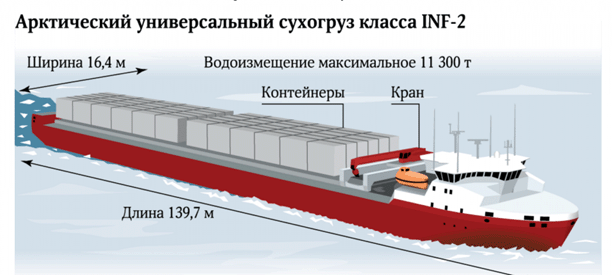
Construction starts in 2020 of the 140 meters long ice-classed vessel, approved for carrying irradiated nuclear fuel and High-Level radioactive waste, Izvestia reports.
Beneath the deck, it will be space for 40 to 70 special transport containers for spent nuclear fuel and the upper deck has space for containers with radioactive waste. The design, named INF-2, is made by Krylov State Research Centre in St. Petersburg, a design bureau that has Russia’s latest generation of nuclear powered icebreakers, submarines and warships on its list of merits.
In addition to sailing along the north coast of Siberia, the nuclear waste cargo vessel can make voyages up the Siberian Rivers like Ob and Yenisei, where several of Russia’s nuclear facilities are located, like the storage and planned reprocessing plant in Zheleznogorsk (former Krasnoyarsk-26).
Today, all transport of spent nuclear fuel from icebreakers, submarines and nuclear power plants from northwest Russia to the reprocessing plant in Mayak north of Chelyabinsk go by train through the most inhabited areas of Russia.
Where will the vessel sail?
Andrey Zolotkov, a nuclear expert and former head of the environmental group Bellona in Murmansk says the news that such cargo vessel will be built raises many questions.
«When stating that radioactive waste will be transported out of the Arctic and the Far East, where, interestingly will it then be taken?» asks Zolotkov. He does not immediately see an urgent need for transportation of spent nuclear fuel and radioactive waste, but agrees that transport to locations along the Siberian rivers could be an option.
«But, maybe they link this vessel to the plans for new floating and smaller nuclear power plants in the Arctic.»
Andrey Zolotkov, that earlier worked on board Atomflot’s service vessel «Imandra» says the icebreaker fleet will need a new service vessel as well in the future.
«Such vessel could very well replace «Imandra» for storage of spent nuclear fuel from icebreakers,» he says.
Floating nuclear power plant
Krylov State Research Centre says on its portal that one of the tasks for such vessel could be to transport the spent nuclear fuel from Bilibino nuclear heat power plant in Pevek on the Chukotka Peninsula. Bilibino is the world’s northernmost nuclear plant and shutdown procedure is likely to start in 2019. As a replacement, Russia’s first floating nuclear power plant, the «Akademik Lomonosov» will be placed in Pevek.
Another task for such new vessel, supposed to be operated in a consortium consisting of Rosatom and the military, could be to transport solid radioactive waste to a future repository. Location of such repository is yet to be decided; one option under consideration and approved by county authorities in Arkhangelsk is is the Arctic archipelago of Novaya Zemlya.
There are today stored tens of thousands of cubic meters of solid radioactive waste both on the Kola Peninsula, in Severodvinsk by the White Sea and at naval yards in the Far East.
On the Kola Peninsula, the Italian built vessel «Rossita» is later this year ready to start transport of containers with spent nuclear fuel out of the Andreeva Bay. The containers will be taken to Atomflot in Murmansk where they will be reloaded to railwagons for transport further to Mayak. «Rossita» is not suitable for voyages along the Northern Sea Route or into the river systems in Siberia.
Earlier, the Russian Northern Fleet had its own transport and storage vessels of the Malina-class (Project 2020) for spent nuclear fuel from submarines.
April 12, 2017
Posted by Christina Macpherson |
Russia, technology |
Leave a comment