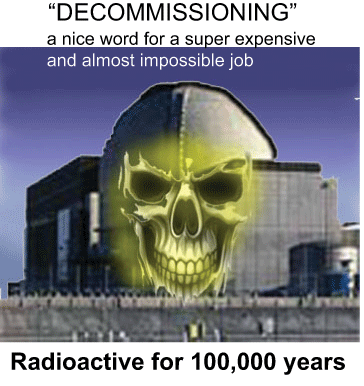
Toshiba considers sale of Moorside nuclear project in Cumbria as own survival in doubt in wake of £7bn losses http://www.telegraph.co.uk/business/2017/04/11/toshiba-questions-survival-warns-losses-could-hit-7bn/ Bradley Gerrard 11 APRIL 2017
Toshiba is considering selling a stake in its nuclear project in Cumbria after warning it could struggle to remain in business as a result of expected annual losses of more than 1trn yen (£7bn).

The Japanese conglomerate, which makes everything from flash memory drives to laptops and semiconductors, admitted it is considering selling some or all of nuclear specialist NuGeneration to keep itself afloat.
NuGen currently owns 100pc of the Moorside site, after buying 40pc back from France’s Engie for $138.5m (£111m) earlier this month.That sale followed the Chapter 11 bankruptcy filing of Westinghouse, another Toshiba-owned company which is set to provide reactors for Moorside.
Asked what it would do with NuGeneration, a Toshiba spokesman said while no final decisions have been made “we would like to explore alternatives, including the sales of shares.”
He went on to explain that Toshiba is “carefully monitoring the situation in consultation with other stakeholders including the British Government.”Separately NuGeneration said it had been looking for investors prior to Westinghouse’s troubles and emphasised that the construction of Moorside was always going to be done by a third party.
But a spokesman acknowledged “there is no certainty” with regards to Westinghouse’s involvement in the development stage of the project.
Theoretically, Westinghouse’s AP1000 reactors, which have received regulatory approval, remain attached to the project but if a new investor were to come on board, it is unclear if different reactors may be proposed, potentially delaying the already behind schedule project yet further.
Samira Rudiga an energy fund manager at Guinness Asset Management, said the news was another nail in the coffin for the UK’s nuclear hopes.
“Nuclear does not make sense in the UK,” she said. “It takes 10 years to build and can take as long if not longer just to come to a decision to build a plant.”However, she expects the Government to still consider nuclear projects and thought there would be companies in Europe and Asia able to take on Toshiba’s stake in Moorside.
Greg Clark, the Business secretary, travelled to South Korea earlier this month in a bid to save the project, appealing to Korean nuclear giant Kepco to invest.
Toshiba reported a pre-tax loss of 597bn yen for the nine months to December 31, smashing through its earlier guidance of a 390bn loss for the full financial year.
“For the reasons stated above, there are material events and conditions that raise the substantial doubt about the company’s ability to continue as a going concern,” Toshiba said.
At the end of 2016, the impending multi-billion-dollar write down triggered one of the worst-ever share fallsfor a major Japanese company, with ratings downgrades and investor pessimism erasing almost all of its 87pc rally so far that year. Toshiba delayed publication of its annual results twice prior to publication, and the company took the unusual step of publishing its accounts without sign-off from its auditor, PriceWaterhouseCoopers Aarata.
Toshiba said that while it had not yet fully determined the full cost of restructuring Westinghouse, its calculations suggested net income would fall by roughly 620bn yen.
April 12, 2017
Posted by Christina Macpherson |
business and costs, UK |
Leave a comment
 France’s oldest nuclear plant in Fessenheim to close by 2020 http://www.dw.com/en/frances-oldest-nuclear-plant-in-fessenheim-to-close-by-2020/a-38358239 Amid a whirlwind of controversy, the French government has ordered the closure of the nuclear power plant. But its closure is dependent on the commissioning of a state-of-the-art nuclear plant in Normandy. French Environment Minister Segolene Royal announced on Sunday that the country’s oldest nuclear power plant will close by 2020.
“The decree on the closure of the Fessenheim plant has been signed and published this morning in the official (government) journal,” Royal said in a tweet.
According to the decree, the Fessenheim plant will close once the new reactor being built at Flamanville on the Normandy coast “enters service.”
The plant has been operational since 1977 and sits near Germany’s border with France. The decree marks the partial fulfillment of French President Francois Hollande’s campaign pledge during the 2012 presidential election to close the plant during his term, which ends in May.
The government’s decision comes days after French nuclear plant operator EDF said it would only shutter the Fessenheim plant after receiving compensation for its closure alongside the successful commissioning of the Flamanville plant.
“I would like to pay tribute to the work of Fessenheim employees and services providers who operate our industrial equipment safely and with excellent performance. I assure them of the consideration I shall bring for their future in all circumstances,” said EDF chief executive Jean-Bernard Levy in a statement.
Problematic reactors The Fessenheim plant has been a source of tensions between France and its neighbors Germany and Switzerland. In 2014, one of the plant’s reactors had to be shut down after water was discovered leaking from several places.
According to documents obtained by the “Süddeutsche Zeitung,” the reactor had to be shut down by adding boron to the pressure vessel, an unprecedented procedure in Western Europe, according to experts. The incident allegedly occurred due to jammed control rods.
However, French authorities played down the incident by not divulging the gravity of the situation. An official report from France’s nuclear authority ASN did not contain information on the need to use boron, nor was the incident reported to the International Atomic Energy Agency in that manner.
Despite the incident, France continues to rely on nuclear energy, which covers 75 percent of its energy needs.
April 10, 2017
Posted by Christina Macpherson |
France, politics |
Leave a comment
Climate change action is good for the economy – and Britain is the proof, Guardian, Michael Howard,10 Apr 17 When John Major set up our global warming strategy, the doom-mongers said it would ruin living standards. New research shows how wrong they were.
Just before the Rio Earth summit 25 years ago, John Major, in whose cabinet I then served as environment secretary, made a bold prediction: reducing Britain’s carbon emissions in line with recommendations of climate science would not, he said, harm our economy: “Our initial measures … will bring a worthwhile economic payoff to the country, to business and to ordinary people.”
This was a controversial statement at a time when solar energy, for example, was a costly technology better suited to spacecraft than British rooftops. And indeed the argument can still be heard that reducing greenhouse gas emissions will ruin our economies – even that it will return us to a pre-industrial living standard.
A quarter of a century later, the approach that we took has been richly vindicated. As research published on Monday by the Energy and Climate Intelligence Unitdemonstrates, in that period the average Briton has grown richer faster than citizens of any other G7 nation; at the same time, his or her carbon footprint has fallen faster than in any other G7 nation. While it would be stretching reality to argue that Britain’s economic success has been driven by its climate change policies, no one can seriously argue any more that our climate policies have generated economic harm……..
Since 1992 science has shown us ever more clearly what “dangerous” climate change looks like. Meanwhile, evidence has been growing that a transition to a low-carbon economy is economically feasible, and will bring added benefits such as cleaner air in major cities. These two factors drove all governments to conclude the Paris agreement in 2015.
Globally, carbon emissions have remained flat for the past three years, even as the world economy has grown by 7.5%. China and India are fast reversing their previous policies of building greater fleets of coal-fired power stations. Replacing our own use of coal with gas and renewable energy has brought UK carbon emissions down to a level last seen during the general strike of 1926.
Yet neither these remarkable developments nor the Paris agreement will secure a stable climate. The latest science tells us that greenhouse gas emissions need to start declining by 2020 at the latest in order to give reasonable confidence that global warming will stay well below the 2C limit, the target governments adopted in Paris. So, having halted the once unstoppable tide, the next logical step is to reverse it – and quickly. This is the mission on which a new initiative launched by Christiana Figueres, until recently the UN’s top climate official, will embark this coming week.
Figueres is to be commended for her vision. The rationale remains exactly that which the British government put forward 25 years ago: thatunchecked, climate change presents unacceptable risks for the future. Fortunately these are not risks that we have to take. Britain has proved the doom-mongers wrong: economies can thrive while emissions fall. Now let us put our collective weight behind the Figueres initiative, and finish the job. https://www.theguardian.com/commentisfree/2017/apr/09/climate-change-good-for-economy-britain-john-major-global-warming
April 10, 2017
Posted by Christina Macpherson |
business and costs, climate change, UK |
Leave a comment
But Labour’s leader, Jeremy Corbyn, said the decision could worsen the humanitarian crisis.
“The US missile attack on a Syrian government airbase risks escalating the war in Syria still further,” he said. “Tuesday’s horrific chemical attack was a war crime which requires urgent independent UN investigation and those responsible must be held to account.”
 Syria airstrikes: UK offers verbal but not military support to US Defence secretary backs US response to gas attack but says Britain is not committed to military action against Assad, Guardian, Anushka Asthana, 7 Apr 17, The British
government was not asked to provide military support to the US attack on Syria but believes it was a “wholly appropriate” response to the deadly use of chemical weapons on civilians, the defence secretary has said.
Sir Michael Fallon said the UK would not get directly involved in action with combat troops or aircraft in Syria without parliamentary approval. But while he made clear that the decision to launch dozens of missiles on to a Syrian airbase in the early hours of Friday was a US one, he said Britain believed it was the right move. “We fully support this strike, it was limited, it was appropriate, and it was designed to target the aircraft and the equipment that the United States believe were used in the chemical attack and to deter President [Bashar al-]Assad from carrying out future chemical attacks,” Fallon said.
He urged Russia to learn a lesson from the action, suggesting President Vladimir Putin was the key figure to end the war. “It is Russia that has the influence over the regime that can … bring this slaughter to a stop.”
He said his American counterpart, James Mattis, had phoned him to share the US assessment of the regime’s culpability, and that the UK was later informed of Trump’s final decision to take action.
The UK foreign secretary, Boris Johnson, also expressed his support on Twitter, writing: “Fully support US action after deplorable chemical attacks.”
The position was supported by a number of Conservative backbenchers and the Liberal Democrat leader, Tim Farron, who wrote in the Guardian that the UK “cannot shy away from proportionate military intervention”
But Labour’s leader, Jeremy Corbyn, said the decision could worsen the humanitarian crisis.
“The US missile attack on a Syrian government airbase risks escalating the war in Syria still further,” he said. “Tuesday’s horrific chemical attack was a war crime which requires urgent independent UN investigation and those responsible must be held to account.”
Corbyn said there was a need to “urgently reconvene the Geneva peace talks and unrelenting international pressure for a negotiated settlement of the conflict”. Any intervention ought to be judged on its contribution to the outcome, he said.
Corbyn’s call to “urge restraint on the Trump administration” was backed up by the shadow foreign secretary, Emily Thornberry, but contradicted by the party’s deputy leader. ….https://www.theguardian.com/world/2017/apr/07/syria-airstrikes-uk-offers-verbal-but-not-military-support-to-us
April 8, 2017
Posted by Christina Macpherson |
politics international, UK |
Leave a comment
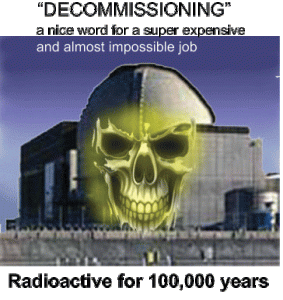 nuClear News No.94 April 2017 The UK Government has been forced to pay nearly £100m in a settlement with two US companies – Energy Solutions and Bechtel – for mishandling the way it awarded a £6.1bn nuclear decommissioning contract. Ministers have ordered an inquiry headed by the former boss of National Grid to find out why the procurement process was so flawed. Labour said the payout showed “dramatic levels of incompetence”. The Nuclear Decommissioning Authority (NDA) will also terminate the contract it awarded for cleaning up the UK’s old Magnox reactor sites nine years early. The sites include Bradwell, Chapelcross, Hinkley A and Hunterston A. (1)
The High Court ruled last summer that the NDA had “manipulated” and “fudged” the tender process. It meant that the wrong company won the work to decommission 12 UK nuclear sites (10 Magnox sites plus Harwell and Winfrith). The move opens the door for other bidders to attempt to reclaim their bid costs, which could run to an additional £50m. The contract was awarded in 2014 to Cavendish Fluor Partnership, a joint venture between the UK’s Babcock International and Texas-based Fluor. However, the consortium cannot be asked to take on the extra work because that could increase potential compensation claims by companies that wrongly lost out in the tender. Some industry sources have complained that the government plumped for an unrealistically low bid for the work at the outset. Another losing bidder, UK Nuclear Restoration Ltd, which is a consortium of Amec Foster Wheeler, Atkins and Rolls-Royce, said that the settlement “raises serious concerns” about the procurement process and that it has raised the implications of the judgment with the government and the NDA. (2)
Former National Grid chief executive Steve Holliday has been appointed to lead an independent inquiry into what went wrong. The inquiry will look at how the mistakes were made and by who, how the litigation was handled, and the relationship between the NDA and the government departments. Holliday will publish an interim report in October. The government now has the daunting task of starting a new tendering process for the 12 sites, as the deal with Cavendish Fluor Partnership (CFP) will end early, in September 2019 instead of 2028. (3)
Babcock said in a statement the CFP, in which it has a 65% stake, has come to a mutual agreement with the NDA to bring to an end the contract at the end of August 2019, having operated the contract for a full five years. Babcock said it had become apparent that the work that needs to be done is now materially different in volume from that specified in the NDA’s tender, and this puts the contract at risk of a legal challenge. What those material differences are remains a mystery.
The Business Secretary, Greg Clark, said: “It has become clear to the NDA through this consolidation process that there is a significant mismatch between the work that was specified in the contract as tendered in 2012 and awarded in 2014, and the work that actually needs to be done. The scale of the additional work is such that the NDA board considers that it would amount to a material change to the specification on which bidders were invited in 2012 to tender.” (4)
The failure of the contract award process was “inevitable” according to nuclear power expert Dr Paul Dorfman, from University College London’s Energy Institute. “They were set up to fail and have failed because the understanding of costs and complexity to nuclear decommissioning is changing all the time,” he said. “Magnox reactors were thrown up in a rush to give electricity too cheap to meter and create plutonium and there was no thought of how they would be decommissioned. Each Magnox reactor is bespoke so decommissioning each one is different with its own complexities and challenges. The more we learn about dealing with the ‘back end’ of nuclear power, the more we see how complex and costly it is.” (5)
Stop Hinkley Spokesperson Roy Pumfrey said: “Why should anyone believe that this astonishing level of incompetence will suddenly end when we start to build new reactors? Just because Hinkley Point C is not a Magnox reactor doesn’t just suddenly make the industry competent.” (6)
The Daily Telegraph declared today “if we could, we would stop this madness … In committing to new nuclear, we seem to have joined a runaway train, with no hope of getting off. Has not the time finally arrived for a fully fledged rethink of the merits of Britain’s nuclear energy strategy?” (7)
Roy Pumfrey continued: “We agree – it is time to stop this madness. The UK’s nuclear decommissioning costs have increased from £55.8 billion in 2008 to £117.4 billion at the last count. Although EDF is required to set aside funds for decommissioning Hinkley Point C, this is only up to an agreed limit. The taxpayer will be on the hook for the all too predictable shortfall.”
Chris Huhne, former energy secretary for the coalition government, said the remit for the enquiry by Steve Holliday was not broad enough and it needed to look at the total cost of nuclear decommissioning. “It is a complete mess, it’s deeply embarrassing but it’s actually I’m afraid only the latest in a long line of embarrassments,” Huhne told BBC Radio 4. “We’re not even scraping the surface with the problem that this legal case has exposed.” Huhne, who was energy secretary between 2010 and 2012 and left the before the contract was awarded, said the cost of decommissioning the UK’s old nuclear fleet had increased £107bn in the last five years to £161bn. “In terms of industrial strategy this makes every other disaster in the post-war period pale into insignificance.” He said the problem stemmed from how early reactors stations were complex bespoke constructions made without consideration to how they would later be disassembled. “We ordered a whole series of Savile Row suits rather than a bunch of work-a-day Marks & Spencer suits… Every single one of those reactors is different. Even the fuel rods in every single one of those reactors are different – crazy.” (8) Huhne called on the government not to allow subsidies for new reactors. That was the coalition government policy. It should be the policy again but the government seems to be relenting – it’s opening the door to exactly a repetition of the sort of disaster that we see today. (9) http://www.no2nuclearpower.org.uk/nuclearnews/NuClearNewsNo94.pdf
April 8, 2017
Posted by Christina Macpherson |
decommission reactor, politics, UK |
Leave a comment
 nuClear News No.94 April 2017 The UK’s Office for Nuclear Regulation (ONR) has published its assessment of the Periodic Safety Review (PSR) for Hunterston B (HNB) and Hinkley Point B (HPB). ONR has also accepted EDF’s revised graphite core safety case for both sites, but has included a number of recommendations as part of this acceptance. Acceptance of the safety case is reliant on a revised inspection and monitoring strategy. (1)
To comply with a nuclear site licence, a periodic review – a comprehensive study of plant safety – is carried out every ten years to justify continued safe operations. This requirement means that the site licence company regularly reviews and reassesses safety at nuclear sites, making improvements where necessary. The four Hunterston B and Hinkley Point B advanced gascooled reactors (AGRs) started up in 1976 are scheduled to close in 2023.
Graphite The graphite core of each of the reactors is made up of around 6000 graphite bricks – 3000 of these are the graphite bricks containing fuel channels – which are all connected together. Graphite ageing is one area used to determine the lifespan of an AGR nuclear power station. EDF says greater understanding of the ageing process by sampling and modelling can lead to them operating safely for longer.
In November 2015, EDF Energy said it had found cracks in three of the graphite bricks in one of the Hunterston B reactors. Similar cracks were found in October 2014 in two of the graphite bricks of the other reactor. A recent BBC Radio Programme revealed that the
ONR was considering doubling the limit it had set on the percentage of cracked bricks it is willing to accept from 10% to 20%. This has been a particularly controversial part of this process with people living near theses reactors finding it difficult to understand why the definition of “safe” seems to be changing. ONR has now agreed to this increased limit. It says:
“Continued operation of HPB/HNB reactors is now supported by NGL’s [EDF’s] safety case NP/SC 7716 which sets an operational limit of 20% cracking in the core. The justified period of operation of each reactor at HPB/HNB is therefore dependent upon the findings from the inspections at each outage.”
The ONR is also concerned about a very specific form of cracking. The keyway is a slot that holds each brick to the adjacent brick, the bricks underneath and the bricks on top. These keyways, which are acknowledged to be the limiting factor in the life of these reactors, are beginning to fracture. John Large points out that this will make the graphite blocks a very loose set of bricks. Seven of the keyways have been discovered to have cracks at Hunterston B. John Large believes the presence of keyway cracks casts doubt on the safety of the reactor in the event of an emergency like an earthquake. If the core becomes misaligned, and the fuel modules get stuck in the core, the fuel temperature will get raised and could undergo a melt. If the radioactivity gets into the gas stream and the reactor is venting because it’s over pressurised then you have a release to the atmosphere and you have dispersion and a contamination problem.
John Large says that if the cracks get any worse it could jeopardise the reactor’s stability in the event of a significant disaster – such as a small earthquake – and make it impossible to lower control rods to shut the reactor down. He said: “These keyways are beginning to fracture… that means the locking together – the way that force can be transferred from one brick to another – is lost, so it becomes a very loose stack of bricks.” Allan Jeffrey of Stop Hinkley added: “This weakness in the graphite core could end up distorting the channels the fuel and the boron control rods use. In cases of emergency there are sudden changes in temperature and pressure which could all end up starting to deform these channels. If you can’t get the control rod down then you can’t control the temperature inside the reactor and you’re heading for accidents – possibly even meltdowns.” (2)
ONR said that EDF had attempted to predict the rate of KWRC. Originally the first cracks were not expected to occur until 2019, but the first KWRC was observed at Hunterston B in 2015.
Inspection will “play a crucial role in supporting the period of safe operation of the reactor in later life,” the regulator said, adding that certain improvements are necessary, such as the development of a capability to measure the condition of control rod channels. EDF Energy should develop improved inspection and monitoring technology; in particular equipment capable of performing visual inspection and dimensional measurements of control rod channels, it said. http://www.no2nuclearpower.org.uk/nuclearnews/NuClearNewsNo94.pdf
April 8, 2017
Posted by Christina Macpherson |
safety, UK |
Leave a comment
Another month in UK’s failing new nuclear programme nuClear News No.94 April 2017 The ongoing collapse of the Moorside nuclear project has hit the headlines. But the French nuclear industry continues to be mired in scandal as EDF starts pouring nuclear safety critical concrete at Hinkley. And now we learn that the chief executive of Wylfa Newydd developer Horizon Nuclear Power says he needs to raise cash or the Anglesey project will not go-ahead.
Moorside Collapse On 29th March 2017, Westinghouse Electric Company, a subsidiary of Japanese company Toshiba and the largest historic builder of nuclear power plants in the world, filed for Chapter 11 bankruptcy protection in the U.S. Bankruptcy Court in New York. (1)
Toshiba owns 60% of the NuGen consortium which is planning to build 3 AP1000 reactors at Moorside next to Sellafield in Cumbria. Senior figures in the UK nuclear industry told the Financial Times that Westinghouse’s bankruptcy has crystallised doubts about the project. There is now considerable doubt about whether NuGen will be able to find a new source of funding. (2)
As we reported last month the owner of 40% of the NuGen Moorside consortium, French company Engie (33% owned by the French Government) declared last December that it would like to abandon the project. (3) Now the Company has exercised its right under the NuGen consortium agreement to sell all of its shares to Toshiba in the “event of a default”. Toshiba’s decision to place Westinghouse – into bankruptcy protection qualifies as such an event. Toshiba said it would pay around $138.7m for Engie’s stake. Under its agreement with the French utility, it is required to pay at least the amount that Engie invested to acquire the stake. (4)…….
Engie is the seventh international energy utility to give up on UK new nuclear build. Over the past decade, on top of Toshiba, E-on (Wylfa), RWE Npower (Wylfa), Iberdrola (Moorside), SSE (Moorside), and Centrica (Hinkley Point) have all pulled out of developing new nuclear reactors in the UK. (6)
This leaves a very limited field of companies for the UK to approach in its hunt for a new partner for the Moorside scheme. South Korea’s KEPCO remains the most likely suitor, but Reuters reports that the giant utility won’t be rushed. It is one of few utilities remaining with global nuclear ambitions, but despite the fact that the AP1000 reactor has now received approval from the Office for Nuclear Regulation and the Environment Agency, may still want to use its own technology – the APR1400. This would delay the development by a further four to five years No2NuclearPower nuClear news No.94, April 2017 3 whilst the South Korean reactor is put through its Generic Design Assessment by UK Regulators. Greg Clark, the Business Secretary, was in Seoul for talks at the beginning of April, but offered no evidence of concrete progress in the negotiations. (7)
KEPCO would also want to know more about the causes of the problems with two new nuclear projects in the US, involving AP1000 reactor designs which brought Westinghouse to its knees. Were the problems specific to the AP1000 reactor or a classic big project issue of not having done your homework before you start digging? (8)…….
KEPCO is unlikely to be tempted into taking over the troubled Moorside nuclear project without some sort of public financing, says former energy minister and chairman of New Nuclear Watch Europe, Tim Yeo. He says they will also be hesitant to step in and save the development unless it can use its own reactor technology. “I’ve been arguing for some time that we should look at providing during the construction phase some government finance.” Yeo said this would have to be on the basis of repayments beginning as soon as the plant is generating. (10) http://www.no2nuclearpower.org.uk/nuclearnews/NuClearNewsNo94.pdf
April 8, 2017
Posted by Christina Macpherson |
business and costs, politics, politics international, UK |
Leave a comment
 Another month in UK’s failing new nuclear programme nuClear News No.94 April 2017 Who will put up the cash for Wylfa? Hitachi Ltd, the owner of Horizon nuclear, which is proposing to build two Advanced Boiling Water Reactors (ABWRs) with a total capacity of 2.7MW at Wylfa on Anglesey, is set to lose tens of billions of yen this financial year after withdrawing from a uranium enrichment joint venture in the US.
Hitachi is expected to report a 70 billion yen ($620 million) non-operating loss by the time books were closed at the end of March. The deficit is largely attributed to the joint venture GE Hitachi Nuclear Energy Inc. withdrawing from the uranium enrichment project. Hitachi no longer expects any profits from the North Carolina-based company, of which it owns 40% and the rest by General Electric. Hitachi and GE were expecting more nuclear power plants to be built when they launched the joint fuel enrichment business, but orders have been sluggish across the globe, forcing the project to be shelved. Nevertheless, Hitachi says it will be sticking with its nuclear power business and plans to proceed with its project to build Wylfa by ensuring costs are thoroughly managed. (22)
The chief executive of Horizon Nuclear, Duncan Hawthorne, says funding is the key issue to ensure the nuclear plant gets built. Wylfa Newydd would be the “showcase plant” for Horizon and Hitachi and important for the UK and Japanese Governments, which means there is huge resolve to get the project done successfully. But without the private investment and Government support the £14bn project would not happen. He said the deal that was struck for Hinkley Point would not work for Wylfa Newydd due to the fact they are private investors. Hinkley is supported by state backed Chinese and French enterprises. Hitachi are funding the project to the ‘Final Investment Decision’, with around £2.5bn of cash. He said he was very aware of the need to keep the Anglesey community behind the project, showing them what benefits the scheme could bring: “Without community support we can’t do anything.” (23)
Meanwhile Horizon has taken another major step towards delivering The Wylfa Newydd power station with the submission of its application for a nuclear site licence. A site licence is one of the main permissions Horizon will need as it looks to build and operate two ABWRs on Anglesey. Receipt of the application by the Office for Nuclear Regulation (ONR) now triggers a rigorous 19-month programme of assessment and intervention to establish whether Horizon can demonstrate it will be in control of all safety related activities on its site. (24) http://www.no2nuclearpower.org.uk/nuclearnews/NuClearNewsNo94.pdf
April 8, 2017
Posted by Christina Macpherson |
business and costs, politics, UK |
Leave a comment
Another month in UK’s failing new nuclear programme nuClear News No.94 April 2017 EDF Finances A French Parliamentary report from the National Assembly’s Commission for Sustainable Development and Regional Development says the clean-up of French reactors will take longer, be more challenging and cost much more than French nuclear operator EDF anticipates. Whereas Germany has set aside €38 billion to decommission 17 nuclear reactors, and the UK Nuclear Decommissioning Authority estimates that clean-up of UK’s 17 nuclear sites will cost between €109‒250 billion over the next 120 years, France has set aside only €23 billion to decommissioning its 58 reactors. In other words France estimates it will cost €300 million per gigawatt (GW) of generating capacity to decommission a nuclear reactor, Germany estimates €1.4 billion per GW and the UK estimates €2.7 billion per GW.
EDF says it wants to set aside a €23 billion fund to cover decommissioning and waste storage for an estimated €54 billion final bill ‒ and the difference between these two figures will be closed through the appreciating value of its equities, bonds and investments ‒ in other words, ‘discounting’. Unfortunately, recent experience has taught us that markets can go up and down over time ‒ especially the very long-time periods involved in radioactive waste management. But for a company that has huge borrowings and an enormous debt of €37 billion, €23 billion is a large sum of money to find. Any significant change in the cost of decommissioning would have an immediate and disastrous impact on EDFs credit rating ‒ something that the debt-ridden corporation can simply not afford. EDF is already in financial trouble. Along with bailing out collapsing AREVA, EDF also has to bear the huge financial burden of the failing reactor newbuild at Flamanville. It will also have to pay for extending the life of France’s existing nuclear power stations (to 2025), at a cost of €55 billion.
On top of all this the French authority tasked with disposal of all the countries vast and increasing waste burden (Andra) has recently ramped up the estimated cost for the planned national nuclear waste repository at Cigéo, to €25 billion ‒ and EDF must pay for most of Cigéo’s construction. Although €5 billion more than EDF anticipated, it still seems a gross underestimation, and the costs are likely to rise considerably. (21) http://www.no2nuclearpower.org.uk/nuclearnews/NuClearNewsNo94.pdf
April 8, 2017
Posted by Christina Macpherson |
business and costs, decommission reactor, France, politics |
Leave a comment
Another month in UK’s failing new nuclear programme nuClear News No.94 April 2017 French nuclear scandal
EDF, Areva and the French nuclear regulator ASN have known since at least 2005 that Areva’s Creusot Forge factory was not capable of producing nuclear safety compliant components. Yet the factory has been allowed to continue manufacturing components which have now been found to contain anomalies, including the bottom and lid for the reactor pressure vessel (RPV) for the EPR at Flamanville. (12)
The French Radio Station which broke the news commented that:
“Never before has the French nuclear industry suffered such a scandal. And this case challenges the entire chain of control of a sector already shaken by the Fukushima disaster.” (13)
The Creusot Forge is under investigation by ASN after it was discovered to have produced potentially defective parts and substandard safety reports for reactors around the world. But the letters from 2005 and 2006 – obtained by France Inter – show that EDF and Areva were told by the ASN about “numerous incidents” at the facility, including “discrepancies during inspections”. This will raise serious concerns about EDF and Areva’s new nuclear project at Hinkley Point. (14)
In December 2005 ASN sent a letter to EDF alerting it to the deplorable condition of the Le Creusot plant, which was experiencing major malfunctions. Yet the lid and bottom for the RPV for the Flamanville EPR were manufactured by the Creusot Forge, in Burgundy, between September 2006 and December 2007. In August 2006 ASN asked Areva to demonstrate that the steel for these two parts was homogeneous. For seven years letters were exchanged between ASN and Areva, but no analysis was carried out. On 24th January 2014 the RPV arrived at Flamanville, and was placed in the reactor building. Nine months later Areva finally did some tests and discovered that the bottom and the lid had abnormalities. “The steel should normally contain 0.2% carbon,” explains Yves Marignac, of WISE Paris, but the concentration was 0.3%, enough to modify the mechanical properties of the steel and, in particular, to influence the temperature at which it becomes less supple and more brittle. (15)
The regulator – ASN – has been seriously at fault, according to the Observatoir du Nucleaire, since it has said nothing for many years about the criminal practices at Le Creusot. It says ASN is no less guilty than Areva and EDF because, although it was fully aware of the serious problems, it authorized EDF to install the pressure vessel in the EPR at Flamanville in December 2013. It is clear, says the website, that ASN is not able to withstand pressure from EDF and politicians who accuse them of seriously harming the industry if they enforce safety regulations. (16)
Following the discovery of manufacturing irregularities and the falsification of documents at Areva’s Creusot Forge foundry last year, French nuclear regulator ASN and several other international regulators inspected the site in early December. ASN said Le Creusot is not up to the job and did not have the right equipment to produce the parts for the nuclear reactors. “Creusot Forge is at the limit of its technical capacity. The tools at its disposal are not adequate to manufacture such huge components. In such a situation, errors are made.” (17) No2NuclearPower nuClear news No.94, April 2017 5
EDF’s oversight of AREVA, which will supply the Hinkley Point C reactors was questioned in an internal document by the UK Office for Nuclear Regulation (ONR). In an ONR report about the visit dated 16th December disclosed under a Freedom of Information request ONR said the nuclear safety culture at Creusot fell short of expectations and warned about the implications for Hinkley Point C. ONR said it has since decided to implement a series of additional inspections of EDF and its supply chain to ensure all components are manufactured to the required standard. The ONR report said after an inspection in late 2016, that an international team from France, Canada, the United States, China, Finland and Britain had concluded that the nuclear safety culture at Le Creusot Forge foundry fell short of what regulators expect from a major supplier of nuclear equipment. It added that improvement measures ordered by ASN were not yet effective and said despite the prohibition of the use of correction fluid on documents at the foundry, the inspectors found evidence of its continued use. (18)……… http://www.no2nuclearpower.org.uk/nuclearnews/NuClearNewsNo94.pdf
April 8, 2017
Posted by Christina Macpherson |
business and costs, France, secrets,lies and civil liberties |
Leave a comment
Russian sub causing nuclear headache in Denmark http://cphpost.dk/general/russian-sub-causing-nuclear-headache-in-denmark.html An elderly Russian nuclear submarine is to pass Denmark on its way to St Petersburg later in the year. April 6th, 2017 3:50 pm| by Stephen Gadd
This summer, a giant Russian typhoon-class nuclear submarine, 172 metres in length, is expected to pass Denmark.
The submarine will depart from Russia, pass Norway and then sail into the North Sea and the Skagerrak, onwards into the Baltic, where it will finally dock in St Petersberg, the Barents Observer writes. The sub will pass underneath the Øresund Bridge as the water is not deep enough by the Great Belt Bridge or at Flintreden.
All the preparations are underway, and now all that is needed is the signature of Russian President Vladimir Putin.
No nukes, please!
The submarine was built in 1981 and has the capacity to carry up to 20 missiles and 200 nuclear warheads at a time. However, nowadays it is used as a test platform for ballistic missiles and is based in the town of Severodvinsk in western Russia.
The age of the vessel might be cause for concern, though, according to Norwegian atomic physicist Nils Bøhmer.
“I’m worried when a 40-year-old atomic submarine with a relatively large reactor aboard sails along the Norwegian coast and into the Baltic,” he told Barents Observer.
“The authorities have to know the exact time of its voyage in order to be prepared. It is also vital to ensure there are not atomic weapons on board.”
April 8, 2017
Posted by Christina Macpherson |
Denmark, Russia, safety |
Leave a comment
 UK’s Moorside nuclear project in turmoil as Toshiba’s French partner backs out, Guardian, 5 Apr 17,
Troubled tech giant forced to take sole ownership of NuGen after Engie sells stake, adding to uncertainty over plan for three reactors Toshiba has been forced to buy out the French utility Engie from a project to build three nuclear reactors in Moorside, northwest England, further straining the Japanese company’s finances and adding to uncertainty over the project.
Engie said on Tuesday it was exercising its right to sell its 40% stake in the NuGen venture to Toshiba following the bankruptcy of the Japanese firm’s Westinghouse nuclear power plant business. Toshiba will pay 15.3 billion yen ($138.5m) for the stake.
Toshiba is now the sole owner of NuGen, but has said it is looking for more investors to join the $15-20bn project or to sell out altogether…..
EDF’s £18bn Hinkley Point C nuclear project in Somerset got the final go-ahead in 2016 after several years of delay, but only after securing backing from the French government.
The British government has been working to attract new investors to NuGen, and some analysts said Engie’s departure might make it easier for Toshiba to sell NuGen as a whole.
Korea Electric Power Corp (Kepco) is a potential investor: its chief executive said last month it was in talks to buy a stake in NuGen.
Britain’s energy minister is currently in South Korea for talks on future collaboration between the two countries, including nuclear projects, a government spokeswoman said…….https://www.theguardian.com/business/2017/apr/04/toshiba-moorside-nuclear-nugen-engie-reactor
April 7, 2017
Posted by Christina Macpherson |
business and costs, technology, UK |
Leave a comment
Britain’s secret Brexit nuke http://www.newindianexpress.com/opinions/2017/apr/06/britains-secret-brexit-nuke-1590353–1.html By Tom Arms 6th April 2017
May’s attempt to link trade and security sets a dangerous precedent for the world. Will she now offer N-protection to Saudi Arabia?
British Prime Minister Theresa May has linked Britain’s nuclear deterrent to Brexit negotiations. And in doing so she has pointed the way for India and other nuclear weapons states to use their irradiated umbrellas to secure their own lucrative trade deals.
Until now it has been accepted that nuclear weapons are the ultimate deterrent, and are to be used only in that capacity. Linking them to trade, as May has done, has added a new and dangerous level to the nuclear playing field.
The link came in the British prime minister’s letter to the European Commission triggering Article 50 of the Lisbon Treaty and the start of Brexit negotiations. In just one letter, she explicitly linked economic concessions with security issues nine times.
Alright, the n-word has yet to be dropped on a public stage, but it is being talked about behind closed Whitehall doors. The whispers have been loud enough for me to hear them and to contact the UK’s Department for Brexit negotiations. I pointedly asked them, “Is the government considering offering a nuclear deterrent—probably incollaboration with the French—to EU countries in return for trade concessions?” The reply was neither a confirmation nor a denial but an email pointing me to the links in May’s Brexit letter and a speech in which the British PM said, “The third … reason I believe we can come to the right agreement is that cooperation between Britain and the EU is needed not just when it comes to trade but when it comes to our security too.”
“Britain and France are Europe’s only two nuclear powers. … Britain’s armed forces are a crucial part of Europe’s collective defence.”
“… After Brexit, Britain wants to be a good friend and neighbour in every way, and that includes defending the safety and security of all of our citizens.”
Quick phone calls to embassies and European ministries of foreign affairs elicited a wall of no comments, until I came to the Poles where a spokesperson said, “Yes that’s right.”
But if the negotiating ploy is successful in Europe, what is to stop the British from offering the same protection to other regions of the world? Does Britain strike a deal with Saudi Arabia and the Gulf states to protect them from Iran? The British have just reopened a permanent naval base in Bahrain. How about East Africa? The Americans lease Diego Garcia but the British still own it. London has great relations with Singapore, an excellent base for an Asian presence.
And what about other nuclear weapon states? What is to stop India, Pakistan, France, Russia, China, and the US from using their nukes to extract trade concessions. It will cost more but the trade deals, or should I say protection money—should more than cover the costs, with a profit—adding a new and dangerous element to the problem of nuclear non-proliferation.
A stronger nuclear Britain willing to flex its muscles fits in nicely with the Trump view of the world. During his campaign, The Donald shocked analysts by floating the cost-cutting proposal that America supply nukes to Japan and Saudi Arabia. And although the US is making more positive noises about the NATO, the initial talk of obsolescence has left Europeans deeply worried.
Beefing up the British nuclear deterrent and tying it closer to Europe would save America money. However, it would also put several more links in the defensive chain that ties the US to the protection of Europe.
Trump may favour such a change, but it is not in the interests of either side of the Atlantic. Two World Wars have proven that. In both, the US adopted a hands-off role at the start. However, the fact is their interests were so intertwined with the European democracies that Washington was eventually forced to intervene to protect its national interests.
It is the growing American isolationism that makes it possible for May to test thendangerous nuclear waters. The EU is worried about losing its American nuclear umbrella. The UK is worried about losing their European market. Britain has nuclear weapons. The EU has markets. There is a clear fit.
Dr Ian Lesser, vice president at the German Marshall Fund, said it is “not incredible” that Britain is considering using its nuclear deterrent as part of the Brexit negotiations. He added, “But it would certainly be controversial.”
Trump’s foreign policy has prompted widespread calls for greater European defence cooperation, including—at the suggestion of the Polish Prime Minister Jaroslaw Kaczynski—a German-funded European nuclear deterrent. This was firmly and immediately rejected by Chancellor Angela Merkel.
April 7, 2017
Posted by Christina Macpherson |
politics, UK |
Leave a comment
Brexit brings nuclear (con)fusion http://www.politico.eu/article/world-leading-nuclear-fusion-project-threatened-by-brexit/ The world’s biggest active nuclear fusion project could lose EU funding just as it gears up for its grand finale. By SARA STEFANINI , 4/6/17, CULHAM, England — Just as European scientists here gear up to put decades of experiments to the test and try to bottle up the nuclear reaction that powers every star in the universe, Brexit is throwing the future of their work into doubt.
The 34-year-old Joint European Torus (JET), which sits in the Culham Centre for Fusion Energy’s retro 1960s laboratory, is a crucial part of an international research push on nuclear fusion that hopes to, one day, fuel homes and cities with energy free of greenhouse gases and waste.
Despite its location in the Oxfordshire meadows, JET is an EU venture through and through. The hundreds of scientists, engineers and technicians who visit the center to conduct experiments, as well as the parts used to assemble the world’s biggest nuclear fusion reactor so far, come from all around the Union.
Crucially, so does the €283 million that underpins the JET program for the five years through 2018. New European Commission funding, at least for 2019 and 2020, looked pretty certain — until Britain’s referendum, and London’s announcement in January that it would leave the European atomic energy community, Euratom, once the U.K. leaves the block in two years.
Talks to renew JET’s funding are now on hold, according to Culham center officials. What happens after 2018 depends largely on the outcome of Brexit negotiations.
The uncertainty could delay or even derail the JET program’s grand finale: Heating two hydrogen isotopes — heavy hydrogen (deuterium), which comes from water, and super-heavy hydrogen (tritium), from lithium — to temperatures hotter than the center of the sun.
April 7, 2017
Posted by Christina Macpherson |
technology, UK |
Leave a comment
Lapland reindeer herders still carrying radiation from Cold War nuclear tests, UUTISET News 5.4.2017 The Radiation and Nuclear Safety Authority is measuring radiation among people in Ivalo, northern Lapland this week. Measurements have been taken there since the 1960s, which is when radiation figures skyrocketed due to Soviet and US nuclear testing.
Reindeer herders in upper Lapland record higher levels of radiation than people elsewhere in Finland, but cancer cases there are actually somewhat rarer. The Radiation and Nuclear Safety Authority (Stuk) is measuring radiation among people in Ivalo in the far north this week.
The radiation levels of people living in the northernmost reaches of the country have been studied since the early 1960s. The USSR tested its nuclear capability in the atmosphere during the Cold War; and although the levels of cesium have gone down since those days, there is still more of it among the population of Lapland than elsewhere in Finland.
According to watchdog Stuk, Soviet nuclear bomb tests over Novaja Zemlja in the Arctic Ocean – some 1,000 kilometres from Ivalo – raised the radiation in the city a thousandfold compared with long-term levels.
The Finnish Meteorological Institute published its latest radiation report in 2011, fifty years after the Soviet tests.
Stuke laboratory head Maarit Muikku says that nuclear testing by the United States during the Cold War also released cesium into the stratosphere, from where they have descended to Finnish Lapland and other areas.
The highest average levels of cesium-137 in humans in Inari and Utsjoki – 45,000 becquerels – were recorded in the mid-60s. By comparison, the figures from 2011 have a mid range of about 1,100 becqurels; but that is still ten times higher than the rest of Finland’s population.
From moss to reindeer to person
Reindeer herder Taneli Magga has been involved in the measurements since their inception, first as a school boy in Inari in 1961.
“The levels have gone down every time I’ve been involved. This last time cesium levels had fallen by 200 becquerels in six years,” says Magga.
Most of the cesium in upper Lapland is from atmospheric nuclear testing. The Chernobyl power plant disaster in 1986 only caused a minor spike because the wind blew those cesium clouds south.
Herders obviously eat a lot of reindeer meat, which is full of cesium that the animals ingest when they eat moss and fungi. Fish and berries also contain artificial radiation…….http://yle.fi/uutiset/osasto/news/lapland_reindeer_herders_still_carrying_radiation_from_cold_war_nuclear_tests/9548131
April 7, 2017
Posted by Christina Macpherson |
environment, EUROPE |
Leave a comment