Rosatom to build Nuclear Technology Centre in Vietnam http://russianconstruction.com/news-1/28150-rosatom-to-build-nuclear-technology-centre-in-vietnam.html 29.06.2017 Rosatom State Atomic Energy Corporation and the Ministry of Science and
 Technology of Vietnam will create a Center of Nuclear Science and Technology in Vietnam, as it follows from documentation published on the Kremlin’s website.
“The Memorandum of understanding between Rosatom State Atomic Energy Corporation and the Ministry of Science and Technology of the Socialist Republic of Vietnam on a plan of the implementation of a project for construction Nuclear Science and Technologies Center in Vietnam”, the document reads.
The announcement came following a meeting of Russian President Vladimir Putin and President of Vietnam Tran Dai Quang.
July 1, 2017
Posted by Christina Macpherson |
marketing, Russia, Vietnam |
1 Comment

 Angela Merkel promises to tackle Donald Trump on climate change at G20 summit, ‘We cannot wait to act until the science has convinced every last doubter’, The Independent, Samuel Osborne @SamuelOsborne93 30 June 17, German Chancellor Angela Merkel said the EU is “more determined than ever” to make the Paris accord against climate change a success following the US decision to withdraw from the agreement, and insisted she would not “overlook tensions” with America on Donald Trump’s first attendance at the G20.
Ms Merkel stressed in a speech to the German parliament that the EU stands fully behind its commitment to the agreement.
“We cannot expect easy discussions on climate change at the G20 summit,” she said. “Our differences with the US are clear.””
She added that “the Paris agreement is irreversible and it is not negotiable.” The German Chancellor will host the summit of leaders of the Group of 20 economic powers in Hamburg on 7 and 8 July.
Ahead of that summit, she is hosting a meeting of the European leaders who will take part in the summit later on Thursday at the chancellery in Berlin.
“We are convinced that climate change is one of the greatest challenges facing humanity, an existential challenge,” she told the German parliament. “We cannot wait to act until the science has convinced every last doubter.”
She said she had agreed a plan with France’s newly elected President Emmanuel Macron to deepen cooperation in the European Union and the Eurozone, adding that the EU needed to take on more responsibility for tackling security concerns it faced, including a threat from “terrorism”.
The bloc’s remaining members would remain united in their negotiations with Britain over its planned departure from the EU, she added in Thursday’s speech to lawmakers……http://www.independent.co.uk/news/world/europe/angela-merkel-donald-trump-g20-summit-climate-change-germany-chancellor-us-president-trade-wilbur-a7813716.html
July 1, 2017
Posted by Christina Macpherson |
climate change, EUROPE |
Leave a comment
No Indonesian market for SMRs http://thebulletin.org/no-indonesian-market-smrs10868 28 June 17, M. V. RAMANA Ramana is the Simons Chair in Disarmament, Global and Human Security at the Liu Institute for Global…
In May 2017,
Indonesia’s government announced that Russia’s Rosatom State Atomic Energy Corporation had offered to develop nuclear power plants in Indonesia. But the person making the announcement, Luhut Pandjaitan—the coordinating maritime affairs minister—said he had told them that Indonesia was not ready yet because “we need to raise public awareness, which takes time.”
Saying it “takes time” is an understatement. The country’s National Nuclear Energy Agency, or BATAN as it is known from its acronym in the Indonesian language (Badan Tenaga Nuklir Nasional), was set up in the late 1950s and has been advocating nuclear power for Indonesia ever since. In 1972, BATAN started the process of selecting specific sites for nuclear plants when—in conjunction with the ministry in charge of public works and electricity—it established the Preparatory Commission for Development of a Nuclear Power Plant. That eventually led to various sites being chosen for nuclear plant construction on the Muria Peninsula on Indonesia’s most populated island, Java. But in each case, these efforts were stopped—primarily by local opposition, but partly also because of widespread skepticism about BATAN’s claims about the seismic safety of sites on the peninsula.
BATAN then turned its attention to other locations in the country, but with little success. To date, BATAN has conducted site studies on at least 16 potential locales.
BATAN’s efforts at setting up a nuclear power plant in Indonesia have not gone unnoticed. Many reactor vendors have beaten a path to Jakarta’s doorstep, hoping to sell their wares. The list includes South Korea, France, China and, of course—given its status as the leading reactor vendor in this decade—Russia. In recent years, all these countries’ offers have focused on one specific kind of reactor that BATAN has expressed an interest in: Small Modular Reactors (SMRs).
Why SMRs for Indonesia? Small Modular Reactors have electrical power outputs of less than 300 megawatts. They are being heavily promoted by many countries’ nuclear establishments as having several desirable characteristics when compared to traditional large reactors—in particular, cheaper construction costs per unit, higher safety levels, lower rates of radioactive waste generation, and less likelihood that these reactors and their fuel production facilities could be used to make fissile materials (plutonium or highly enriched uranium) for nuclear weapons. There are no operating SMRs, and it remains to be seen whether any real-world reactor would be built that features any, let alone all, of these characteristics. Indeed, of the different major SMR designs under development, none simultaneously fulfills the key requirements of lower cost, higher safety, less radioactive waste, and reduced opportunity for nuclear weapons proliferation. These are the key problems confronting nuclear power today and constraining its future. It is likely that addressing one or more of these four problems will involve design choices that make some of the other problems worse.
Among the target markets for such reactors are developing countries such as Indonesia. The International Atomic Energy Agency considers SMRs as a good option to electrify “remote regions with less developed infrastructures” because the low-capacity electricity grid that is typical of such areas makes it difficult to introduce a nuclear power plant with large power capacity—say 1,000 megawatts—without destabilizing the grid itself. Indeed, one of the reasons that BATAN claims to be interested in SMRs is that there are many islands in the Indonesian archipelago that require electricity or energy but do not have a high enough level of electrical demand to support the construction of a large nuclear reactor. One of the areas highlighted by BATAN officials as particularly suitable for SMRs is the province of West Kalimantan because its “grid capacity [is]… still limited.” BATAN also suggested that an attractive aspect of SMRs is the lower cost—due in large part to the fact that a small modular reactor will generate only a fraction of the power generated by a large reactor.
Among the SMR designs that have been offered by vendors, and explored by BATAN, are high temperature gas-cooled reactors, submarine-based reactors, floating power plants, and light water reactors.
Who’s in the competition? South Korea was the first to pitch the idea of SMRs to Indonesia: In October 2001, with IAEA approval, BATAN signed an agreement with the Korea Atomic Energy Research Institute to undertake a joint study titled “A preliminary economic feasibility assessment of nuclear desalination in Madura Island.” The Korea Atomic Energy Research Institute had been developing a small modular reactor called the System-Integrated Modular Advanced Reactor since 1996; it had the bonus feature of incorporating additional equipment that could desalinate water in addition to generating electricity.
In the case of China, BATAN signed an agreement with the China Nuclear Engineering Group Corporation in 2016 to jointly develop high temperature gas reactors and train Indonesian professionals to run them—an agreement that resulted from Chinese officials scouting around potential reactor markets.
With France, BATAN signed an agreement with DCNS, a company that has traditionally been involved in a range of naval defense systems but more recently has been developing a submarine-based electricity generating reactor project called Flexblue. (Link in Indonesian.) The idea is to park the submarine on the ocean floor and run a cable from it to land to supply electricity.
Russia, however, has been the most determined suitor. In the mid-2000s, Rosatom proposed a small Russian floating nuclear power plant to supply electricity to Gorontalo province on the Indonesian island of Sulawesi. Rosatom’s floating nuclear power plants are modeled after the reactors that have been used to power a small fleet of Russian nuclear-powered icebreakers for decades. The idea of a civilian floating nuclear power plant project has been around in Russia since the 1990s, but progress has been slow and erratic. China and the United States have also explored the idea of commercial floating nuclear power plants, but the United States abandoned the idea as uneconomical after spending millions of dollars in research and development.
In October 2006, the governor of Gorontalo announced that the province already had an agreement with Russia’s then state-owned Unified Energy System of Russia to buy a floating power plant.
But despite enthusiasm for the proposal from the provincial government, the Indonesian minister of Research and Technology rejected the idea of using a floating nuclear power plant. As Natio Lasman, then-deputy chairman of Indonesia’s nuclear agency and later chair of Indonesia’s Nuclear Regulatory Agency, told the Wall Street Journal: “I don’t want Indonesia to be used as an experiment.”
Public opposition: A major problem. Many problems may afflict nuclear proposals, regardless of whether the building plans are based on SMRs or large reactors. A key challenge has been public acceptance. Because of the potential for catastrophic accidents and the production of long-lived radioactive waste, nuclear power is perceived as a risky technology, and those living near areas selected to house a nuclear plant—such as the Muria Peninsula—often push back.
And apart from local opposition, the unpopularity of nuclear power among the general population nationwide is often a factor in whether a country develops nuclear power. A poll commissioned by the International Atomic Energy Agency in October 2005 found that only 33 percent of those Indonesians questioned felt that nuclear power was safe and that more plants should be built. In comparison, 28 percent felt that nuclear power was dangerous and all plants should be closed—while 31 percent agreed with the “middle opinion” that what was already in place should be used but that no new plants should be constructed. In the case of Indonesia, of course, that middle opinion is in practice the same as the 28 percent who wanted to close all reactors, because there was (and still is) no operating nuclear power plant in the country.
In 2011, an IPSOS poll conducted after the Fukushima nuclear reactor accident in Japan found that two-thirds of the Indonesian population expressed opposition: 33 percent of Indonesians strongly oppose nuclear power while 34 percent were somewhat opposed. About two-thirds of those polled said that their opinion was not influenced by Fukushima.
BATAN, not surprisingly, feels differently. And it has conducted a series of polls that show greater levels of support. But the proof of the pudding is in the eating. Nuclear power continues to be controversial in Indonesia, and there is widespread public opposition. Indeed, in December 2015, when then-Energy and Mineral Resources minister Sudirman Said publicly announced that the government had concluded that “this is not the time to build up nuclear power capacity,” one of his stated reasons for avoiding nuclear power was that he did not want “to raise any controversies.”
So, when people like Luhut Pandjaitan—Indonesia’s coordinating maritime affairs minister—talk about the “need to raise public awareness,” it’s reasonable to ask what they mean. Is raising public awareness really just code for coaxing or bribing the people in some areas to allow the construction of a nuclear power plant? The history of the many attempts to site nuclear reactors in Indonesia shows quite clearly that the public is already aware of the hazards involved in nuclear power. The Indonesian public’s longstanding opposition to nuclear power, especially in areas that have been earmarked for potential construction, include concerns about the security of reactor operations, the reliability of reactor designs, radioactive waste, the potential for nuclear proliferation, Indonesia’s geographical position within the seismically active Pacific Ring of Fire, and the proximity of nuclear sites to seismic faults or volcanoes. Many Indonesians are also concerned about nuclear power’s high economic costs and future dependence on foreign parties for nuclear technology or fuel, and they prefer local renewable energy resources.
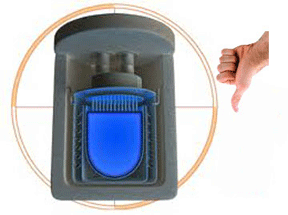
 Other problems with SMRs. My collaborators at the Indonesian Institute of Energy Economics and at the Nautilus Institute for Security and Sustainability and I recently issued a report that detailed the many challenges that would have to be overcome before any small modular reactors are constructed in Indonesia. These challenges include a lack of support for nuclear power at the highest political levels, the absence of tested SMR designs, and the higher electricity-generation costs of SMR technology. We also identified legislative regulations that could become obstacles for specific SMR technologies such as floating power plants, and the political and regulatory problems with SMR construction plans that involve fabricating the bulk of the reactor at off-site factories.
The cost of electricity generated by SMRs is high compared to large conventional nuclear power plants, and high compared to the range of readily available alternatives in Indonesia. The rapidly declining cost of photovoltaic technology is particularly relevant. Studies testify to the large potential of solar energy in Indonesia, and the government has been adopting policies that promise to accelerate the construction of significant amounts of solar capacity.
The lower power level of SMRs also implies that more reactors would have to be built using this technology to produce the same amount of electricity as a few larger reactors—meaning that planners would have to deal with public resistance at many more sites. Public opposition has played a major role in stopping the construction of nuclear power plants so far; small modular reactors might face even more of controversy.
For small modular reactors, the potential benefits accruing from electricity generation come at a higher economic and social cost than other energy sources would require. As a result, it would seem that the construction of SMRs is unlikely, especially in large enough numbers to make a sizeable contribution to Indonesia’s electricity generation.
July 1, 2017
Posted by Christina Macpherson |
Indonesia, marketing, Russia, technology |
Leave a comment
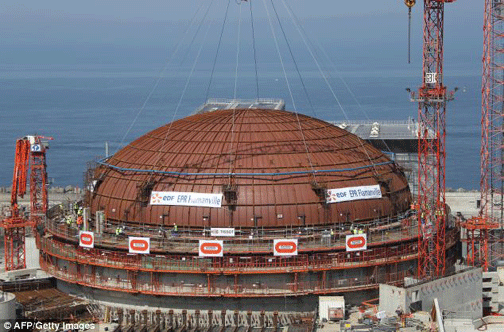
Journal de l’environement 28th June 2017 [Machine Translation] While acknowledging its weaknesses, the nuclear gendarme should authorize the entry into service of the Flamanville EPR
reactor at the end of next year.
In return, EDF will have to multiply the controls, some of which are impossible to achieve. And change the lid of
the reactor vessel “as soon as possible”.
The conference room of the Nuclear Safety Authority (ASN) was full on Wednesday afternoon. After
months of suspense, the regulator of the nuclear park was to return its “position” about the future of the flagship of the tricolor atomic industry: the Flamanville EPR.
In a few minutes, the case is dispatched. What do you expect from the ASN? Work will continue in Flamanville. If all
goes well, the third reactor is expected to start at the end of 2018. Prudente, EDF has ordered, from April, a Japanese blacksmith a new tank lid. In Pierre-Franck Chevet’s opinion, the machine should be ready to install in 2024, six years after the reactor is commissioned!
Cost: a hundred million euros. A drop of water, compared to the 10.5 billion already engulfed by EDF in the largest construction site in France.
http://www.journaldelenvironnement.net/article/epr-de-flamanville-une-decision-inaudible-de-l-asn,84091
July 1, 2017
Posted by Christina Macpherson |
France, safety |
Leave a comment
 Robin Des Bois 29th June 2017, [Machine Translation] Next week, MOX fuel should be loaded at Cherbourg on
the Pacific Egret or Pacific Heron to Japan and the Takahama nuclear power
plant. The MOX contains 10% plutonium and 90% uranium.
This journey throughthe seas of the world of dangerous fissile materials induces tensions and
risks throughout the journey. The problem of safe havens in case of damage
or fire is still unresolved. The ability of Pacific Nuclear Transport
Ltd.’s small ships to withstand North Korean cyclones, tsunamis and
missiles is not demonstrated.
But it is the business as usual that continues for Areva and for a French nuclear industry without guard crazy
besides being penniless. Perpetuating small business as in the good old
days before Fukushima means avoiding questioning the reprocessing plant for
irradiated fuel and plutonium mining in La Hague, which the Nuclear Safety
Authority and the unions say Since 2 years that it is in a worrying state
in terms of safety.
Areva’s transports always give the marines of the whole
world the opportunity of exercises for the most underwater. Our first
advice is therefore aimed at fishermen and especially trawlers. They must
deviate widely from the convoy to eliminate any risk of hook with a
submarine, hypothesis more and more plausible to explain the sinking of the
Bugaled Breizh in January 2004, a few days before the departure of
Cherbourg of a cargo of waste Nuclear activities to Japan.
http://www.robindesbois.org/moxquitue/
July 1, 2017
Posted by Christina Macpherson |
France, safety |
Leave a comment
The tumbling cost of offshore wind power could mean that it turns out to be
25 per cent cheaper than energy from Hinkley Point nuclear plant when
subsidies are awarded to new projects this year, the industry regulator has
suggested.
Developers behind a series of proposed offshore wind farms are
vying to secure government contracts that will guarantee a price for the
electricity they generate for 15 years. Dermot Nolan, chief executive of
Ofgem, said he hoped the winning projects would emerge at a price of “£70
or less” per megawatt-hour (MWh).
That would compare with £92.50/MWh that
was last year awarded to Hinkley Point for a 35-year contract, fuelling
debate about the merits of the project and future nuclear plants. The
difference between the guaranteed price and wholesale price, currently
£43/MWh, will be subsidised by consumers through energy bills, with
payouts for Hinkley forecast to hit £30 billion.
Just a few years agooffshore wind was one of the most expensive technologies in the market. In
2014 the government awarded some projects a price of £150/MWh.
Technological advances, including bigger, more efficient turbines,
economies of scale in manufacturing and the introduction of a competitive
“reverse auction” process to award subsidies to the cheapest projects have
helped to bring costs down rapidly.
Times 30th June 2017
https://www.thetimes.co.uk/edition/business/offshore-wind-power-could-be-25-cheaper-than-hinkley-s-nuclear-qk77fqhd9
July 1, 2017
Posted by Christina Macpherson |
renewable, UK |
Leave a comment
Independent 29th June 2017, The Government has been strongly criticised for its lack of action on
climate change by its own independent advisers, who warned that global
warming was “happening, not waiting” and it was “neither justifiable nor
wise to delay further”.
While the UK has been at the forefront of the world’s efforts to combat the risks from the rising temperatures, the
Committee on Climate Change – chaired by former Conservative Cabinet
Minister John Gummer, now Lord Deben – said there was now a “risk of
stalling” just when the economy was poised to take advantage of the shift
to a low-carbon economy.
A new Clean Growth Plan setting out how Britain
will cut carbon emissions in the late 2020s and early 2030s was now
“urgently needed”. Such a plan was legally required to be published as soon
as possible after the Government announced new targets last year, but is
not now expected until September.
One leading environmentalist said the
CCC’s report raised a “very serious red flag” about Ministers’ inaction,
while the Government admitted “there is a need to do more”. Claire Perry,
the newly appointed Climate Change Minister, told Parliament this week that
she wanted the Clean Growth Plan to be “as ambitious, robust and clear” as
possible, describing the document as “vitally important”. The CCC’s
report said many existing Government policies were “running out” and
new ones were needed. It recommended a string of different measures
including policies to boost electric vehicle ownership, which the report
said should make up around 60 per cent of new car and van sales by 2030. To
achieve those targets, the Government needed to provide some financial
support, preferential tax rates and ensure the “effective roll-out of
charging infrastructure”. Other measures included helping to develop a
carbon capture and storage system, looking for ways to remove carbon from
the atmosphere, having a contingency plan to delays to planned project –
“for example of new nuclear power plants” – and the tight regulation
of fracking operations to ensure a rapid response to leaks.
http://www.independent.co.uk/environment/government-climate-change-experts-unjustifiable-lack-action-environment-global-warming-fossil-fuels-a7813741.html
July 1, 2017
Posted by Christina Macpherson |
climate change, UK |
Leave a comment
Guardian 29th June 2017, The government must reverse its opposition to new building regulations that
ensure homes, hospitals and schools do not overheat as the number of deadly
heatwaves rises, according to its official climate change advisers. The
Committee on Climate Change (CCC) recommended the new regulations in 2015
but ministers rejected the advice, citing a commitment to “reduce net
regulation on homebuilders”.
Without action, the number of people dying as
a result of heat is expected to more than triple to 7,000 a year by 2040,
the CCC warns in its annual report on the UK’s pr ogress on tackling global
warming. Earlier in June, Britain experienced its longest period with
temperatures above 30C since 1976. Heatwaves are known killers in the UK
and the number of hot days is rising. On the hottest day of the year in
2016 there were almost 400 extra deaths, while a heatwave in 2006 led to
680 people dying and another in 2003 contributed to the deaths of about
2,000 people.
https://www.theguardian.com/environment/2017/jun/29/failure-to-update-building-regulations-could-triple-heatwave-deaths-by-2040
July 1, 2017
Posted by Christina Macpherson |
climate change, health, UK |
Leave a comment
The National 30th June 2017, RENEWABLE electricity generation in Scotland has reached a record high. A
new UK government report shows that generation was up by 13 per cent in the
first quarter of this year compared to the same period last year. There was
also a 16 per cent increase in capacity with more than half of all gross
electricity consumption in Scotland coming from renewables.
Scotland’s total installed renewable capacity – the amount of renewable electricity
the country is capable of producing – now stands at 9.3GW, which is four
times what it was just a decade ago.
The renewable electricity sector also supports 26,000 jobs and has a turnover of £5 billion which is set to grow
further as new capacity comes on stream. Acting director of WWF Scotland Dr
Sam Gardner said: “It’s fantastic news that Scotland’s renewable
electricity generation is at an all-time high and re-affirms the vital role
it plays in powering the country. The renewable electricity sector
continues to play a vital role at the heart of Scotland’s economy,
delivering jobs and attracting investment.” However, he added: “If we are
to replicate these benefits in the wider economy the Energy Strategy from
the Scottish Government should make clear the steps it plans to take to
remove fossil fuels from the heat and transport sectors. “The Scottish
Government now needs to set out clear policies for how it will replicate
its amazing progress on renewable electricity in the heat and transport
sectors to ensure we hit the 50 per cent target by 2030.”
http://www.thenational.scot/business/15381373.Record_renewable_levels_in_Scotland_as_minister_describes__vindication__of_policies/
July 1, 2017
Posted by Christina Macpherson |
renewable, UK |
Leave a comment
 FT 27th June 2017, A year after the break-up of Eon and RWE in a sweeping restructuring of Germany’s power industry, investors are bracing for the next wave of upheaval in European utilities. Bankers and industry executives say further deals look certain as electricity companies scramble to adapt to the accelerating shift towards renewable energy.
The £318m sale last week of two UK gas-fired power stations by Centrica to EPH of the Czech Republic was the latest example of a utility reshaping its portfolio. Now, expectations are growing of bigger transactions to come. Much of the anticipation is focused on the new companies created by the separation of Eon and RWE. Both German utilities split themselves in two, with one unit focused on traditional thermal generating businesses – dominated by coal
and gas-fired power – and the other comprising “cleaner” businesses, such as renewables, electricity distribution and consumer services.
Uniper, the conventional power business spun out of Eon, has been touted by analysts and bankers as a potential target for Fortum, the Finnish utility. Meanwhile, Innogy, the clean energy business split from RWE, has been linked with Engie of France.
Whatever constellation of deals emerges, it looks increasingly likely that the ripples from restructuring of RWE and
Eon will not stop at Germany’s borders. As Mr Critchlow says: “Once one player consolidates, like at a dance, everybody will look for a preferred dance partner.”
Helping customers reduce their energy bills does not sound like an especially appealing business model for an electricity company. Yet that was the aim when the UK arm of Engie paid £330m to acquire a business specialising in making buildings more energy efficient from Keepmoat, the construction company.
“There’s more value today in helping reduce consumption than in selling energy itself,” says Wilfrid Petrie, head of
Engie in the UK. He likens the shift to the one undergone by the telecoms industry, which today finds its growth in services and content rather than the line rental and phone calls that used to be its core business.
https://www.ft.com/content/90003746-57f7-11e7-9fed-c19e2700005f
June 30, 2017
Posted by Christina Macpherson |
ENERGY, EUROPE |
Leave a comment
 Greenpeace 28th June 2017, The Nuclear Safety Authority (NSA) is under unprecedented pressure from EDF
and AREVA. This unprecedented situation shows that ASN’s decision is no longer limited to nuclear safety: it has become a political one.
What do EDF and AREVA want to do? Derogating from the most basic standards of nuclear safety so that the Flamanville EPR is put into operation despite its defective parts. Behind the authorization of this tank of the EPR, it
is indeed the survival of the French nuclear industry is at stake. Indeed, EDF and AREVA play a big part in the EPR in Flamanville.
The decisions that will be taken on this site will have far-reaching consequences for the future of the projects sold in the United Kingdom, Finland and China.
We appeal to the responsibility of Nicolas Hulot, Minister of Ecological and Solidarity Transition and in charge of nuclear safety. The ASN can no longer take a safety decision independently and cannot resist the pressure.
As for us French citizens, we do not have to pay the price of strategic and technical errors of EDF and AREVA. By putting an end to the Flamanville shipyard, Nicolas Hulot can still avoid it.
https://www.greenpeace.fr/nicolas-hulot-ne-laissez-pas-lasn-sacrifier-la-surete-pour-sauver-lindustrie-nucleaire/
June 30, 2017
Posted by Christina Macpherson |
France, politics |
Leave a comment
 Kepco confirms talks with Toshiba over UK nuclear — but only with its own reactors, Telegraph Jillian Ambrose 28 JUNE 2017 South Korea’s largest power company is in talks with Toshiba to prop up its plans to build Europe’s largest new nuclear plant in the UK.
Jong-hyuck Park, an executive from Kepco, confirmed the group’s interest in buying a stake of the embattled Moorside nuclear project on the sidelines of an industry event, but said Kepco would want to use its own reactor design.
The South Korean state-backed utility is one of the world’s strongest nuclear developers and has harboured an interest in Moorside since 2013. Its appetite for a UK nuclear project was revived following the collapse of Toshiba’s US nuclear business, Westinghouse, which was supposed to provide the reactor design for the project.
A deal with Toshiba, the last remaining group behind the NuGeneration venture, could rescue the £10bn project. But a change in reactor design would also derail the 2025 start date by at least two years in a further blow to the UK’s new nuclear ambitions.
Earlier this week a French newspaper reported that EDF’s internal review of the Hinkley Point C new nuclear plant is expected to show a €3bn (£2.6bn) overspend and a two year delay, which would also push the start-date back to 2027.
The slow progress in securing new investment in baseload power generation raises questions over the UK’s energy supplies in the middle of the next decade. More than two thirds of the country’s power generation capacity will have retired between 2010 and 2030.
Moorside was plunged into doubt in recent months due to the Japanese conglomerate’s financial woes which threatened to derail the use of the Westinghouse 1000 reactor and cost the project its junior partner Engie. ….
Kepco’s renewed interest in Moorside emerged the same day that South Korean president Moon Jae-in suspended construction of two of Kepco’s partially built nuclear reactors to consult on whether they should move forward.
The decision comes following Mr Moon’s pledge to stop building nuclear reactors, and rid the country of nuclear power entirely by 2060. http://www.telegraph.co.uk/business/2017/06/28/kepco-confirms-talks-toshiba-uk-nuclear-but-reactors/
June 30, 2017
Posted by Christina Macpherson |
business and costs, politics, South Korea, UK |
Leave a comment

 Russia has ‘enormous’ underground bunkers ready for nuclear war http://nypost.com/2017/06/29/russia-has-enormous-underground-bunkers-ready-for-nuclear-war/By Ruth Brown, June 29, 2017 Russia is maintaining giant bunkers underneath Moscow where Kremlin bigwigs can live underground for months after a nuclear attack, because the administration is convinced the U.S. plans on overthrowing President Vladimir Putin, according to a newly revealed Pentagon report.
“A deep underground facility at the Kremlin and an enormous underground leadership bunker adjacent to Moscow State University are intended for the national command authority in wartime,” says the report, according to the Times of London.
“Highly effective life-support systems may permit independent operations for many months following a nuclear attack.”
The Defense Intelligence Agency report on Moscow’s military might — the first since the Cold War — says the “enormous” bunkers are 985 feet underground and can house as many as 10,000 people in the case of nuclear Armageddon, according to the paper.
The shelters are linked to other bunkers outside of the city — as well as the VIP terminal at Vnukovo airfield, in case the honchos need to flee, the report said.
The report, which predates President Trump’s election but was released Wednesday, says Putin believes the U.S. is intent on regime change as part of our “efforts to promote democracy around the world.”
“The Kremlin is convinced the United States is laying the groundwork for regime-change in Russia,” the report says.
June 30, 2017
Posted by Christina Macpherson |
Russia, safety, weapons and war |
Leave a comment
 Le Monde 26th June 2017,[Machine Translation], EPR of Flamanville: a report warns EDF on the
reliability of the lid of the tank. The operator may have to quickly
replace this reactor masterpiece after commissioning, which is still
scheduled for the end of 2018.EDF executives have been overly optimistic,
obviously convinced that the future reactor tank of the Flamanville
(Manche) EPR reactor would pass without difficulty before the “judges” of
the Nuclear Safety Authority (ASN) and its armed wing, the Institute of
Radiation Protection and Nuclear Safety (IRSN).
The situation is ultimately more complex: it is not excluded that the plant operator must at least
change the lid of this tank, only a few years after the EPR has been put
into service. Meeting on Monday 26th and Tuesday 27th June, the 31 members
of the permanent group of experts for nuclear pressure equipment
(industrialists, associations …) took note of a long report (193 pages)
of the IRSN and the Direction des Equipment under ASN’s nuclear pressure,
which is very critical in some respects. If it does not question the future
of the powerful third generation reactor (1,650 MW), designed by Areva in
the 1990s, it puts an additional mortgage on a project that will already
cost 10.5 billion d ‘ Three times more than expected. http://www.lemonde.fr/economie/article/2017/06/26/un-feu-vert-sous-condition-attendu-pour-l-epr-de-flamanville_5151256_3234.html
June 30, 2017
Posted by Christina Macpherson |
business and costs, France, safety |
Leave a comment
Nuclear ship proceeds despite protests, Herald Sun ,Wolfgang Jung and Stephen Wolf, Deutsche Presse Agentur June 29, 2017 A transport ship loaded with highly radioactive nuclear waste has continued its journey along a German river after being halted by protesters.
Four activists from the German environmental group Robin Wood abseiled from a bridge over the Neckar river in the town of Bad Wimpfen in southwest Germany, unfurling a banner reading, “Prevent, don’t put off.”
The stunt halted for several hours the first-ever river transport of atomic waste in Germany while specially trained forces attempted to remove them from the bridge…….http://www.heraldsun.com.au/news/breaking-news/nuclear-ship-proceeds-despite-protests/news-story/baef982d1bccf91bafd6fe21e909e660
June 30, 2017
Posted by Christina Macpherson |
France, opposition to nuclear |
Leave a comment



 Russia, however, has been the most determined suitor. In the mid-2000s, Rosatom proposed a small Russian floating nuclear power plant to supply electricity to Gorontalo province on the Indonesian island of Sulawesi. Rosatom’s floating nuclear power plants are modeled after the reactors that have been used to power a small fleet of Russian nuclear-powered icebreakers for decades. The idea of a civilian floating nuclear power plant project has been around in Russia since the 1990s, but progress has been slow and erratic. China and the United States have also explored the idea of commercial floating nuclear power plants, but the United States abandoned the idea as uneconomical after spending millions of dollars in research and development.
 Other problems with SMRs. My collaborators at the Indonesian Institute of Energy Economics and at the Nautilus Institute for Security and Sustainability and I recently issued a report that detailed the many challenges that would have to be overcome before any small modular reactors are constructed in Indonesia. These challenges include a lack of support for nuclear power at the highest political levels, the absence of tested SMR designs, and the higher electricity-generation costs of SMR technology. We also identified legislative regulations that could become obstacles for specific SMR technologies such as floating power plants, and the political and regulatory problems with SMR construction plans that involve fabricating the bulk of the reactor at off-site factories.