 CORE 2nd July 2017, The Pacific Heron and sister shipPacific Egret, armed with naval canon and
carrying security ‘swat- squads’ sailed unladen from their home port of Barrow-in-Furness early this morning en-route to Cherbourg where MOX (mixed oxide) plutonium fuel assemblies will be loaded for onward delivery to Japan.
The 16 fuel assemblies, fabricated in French company Areva’s MeloxPlant and containing some 500kg of nuclear weapons useable plutonium aredestined for Kansai Electric’s Takahama 4 reactor in the south west of Japan. Preparation for the two-month voyage have been evident over the last few days at Barrow’s Ramsden Dock nuclear terminal with the loading of stores, the arrival of the security swat-squads provided by the Civil Nuclear Constabulary’s Strategic Escort Group (aka Sea-Plods), the
loading of ammunition and the sweeping of the ships’ hulls by divers.
Commenting on the preparations, CORE’s spokesman Martin Forwood said today that the need for this level of armed security brings home the reality of the very real and significant dangers of transporting plutonium – in this case enough for around one hundred nuclear weapons – and demolishes the industry’s complacent and short-sighted claim that such shipments pose no risks.
“At a time of heightened and increasingly sophisticated action by terrorists we re-iterate our condemnation of the trans-world shipment of such dangerous material by sea. This voyage not
only foists needless risks on the marine environment and communities along the route, but also raises additional and significant concerns in Japan on the use of MOX fuel in the Takahama reactor (as also used in the fated Fukushima reactors) which has only just re-started after the overturning of a court injunction by local activists which kept the reactor off-line for inadequate safety standards”
http://corecumbria.co.uk/news/nuclear-gunships-sail-from-barrow-on-plutonium-voyage-to-japan/
July 5, 2017
Posted by Christina Macpherson |
safety, UK |
Leave a comment
 EON’s Old Nuclear Money Spinners Are Now Just a Big Hassle, Bloomberg, By Weixin Zha and Tino Andresen, 4 July 2017,
Brokdorf reactor halt has cost more than 100 million euros
Utility awaiting regulatory approval after February outage
An EON SE nuclear plant that made billions for the German utility is now losing money.
Essen-based EON is battling repeated delays to production at its Brokdorf reactor that has cost the company more than 100 million euros ($114 million) since halting in February, the utility said by email. The unit is now scheduled to start July 19.
Brokdorf, a 1.4-gigawatt reactor capable of powering 2.8 million homes, is offline after regulators raised concerns about oxide layers on fuel rods discovered when the unit stopped for maintenance. EON has submitted its examination results to the regulator and is awaiting approval to restart.
EON, which last year separated its conventional power plant business into a new company called Uniper SE, still operates three atomic plants including the 31-year-old Brokdorf facility. EON had to keep the nuclear business after the government made plant operators permanently liable for decommissioning costs under the nation’s plan to exit atomic power.
“For the market, it will be an issue if Brokdorf still wasn’t available in the fall,” said Lueder Schumacher, an analyst at Societe Generale SA in London.
EON transferred on Monday its share of 24 billion euros that the government demanded from utilities into a fund that will pay for costs related to the final storage of radioactive waste.
Brokdorf’s outage contributed to a 20 percent drop in EON’s first quarteradjusted net income to 525 million euros, the utility said in May.
“The financial damage to our company due to the production loss is now at a three-digit million amount,” Almut Zyweck, a spokeswoman for EON’s nuclear unit, said by email on Monday…….https://www.bloomberg.com/news/articles/2017-07-04/eon-s-old-nuclear-money-spinners-are-now-just-a-big-hassle
July 5, 2017
Posted by Christina Macpherson |
business and costs, Germany |
Leave a comment
Morning Star 1st July 2017, A BUNGLING Brexit bureaucrat has blown the lid on the government’s
“shocking attitude towards climate change,” official documents seen by
the Star reveal today. The files were part of a bundle of “sensitive”
papers seen by a Star reporter travelling on the Eurostar to Brussels on
Thursday morning.
They revealed how negotiators “have not yet engaged
with the EU Commission” on climate change and indicated that agreed
targets to reduce carbon emissions could be used as “political and
bureaucratic capital for bigger issues in the exit negotiations.”
GreenMP Caroline Lucas said the documents “appear to reveal a shocking
attitude towards climate change at the heart of government” and warned
that the government’s failure to take the issue seriously was a “dark
stain on their already tainted record.”
The papers suggest that on Britain’s exit, should Britain decide to no longer act jointly with the
EU on climate change, the EU will be faced with a decision of either
meeting the Paris Agreement by increasing remaining members’ targets or
setting a lower target overall — “both of which are politically
difficult.” http://www.morningstaronline.co.uk/a-b7f9-Sensitive-Documents-Reveal-Climate-Deals-are-at-Risk-Following-Brexit
July 5, 2017
Posted by Christina Macpherson |
climate change, UK |
Leave a comment
EU Observer 3rd July 2017, A meeting of the parties to the UN convention on environmental impact
assessment in a transboundary context (Espoo) took place last week in
Minsk, Belarus. Among other things, it helped to showcase the influence
that politics and the nuclear industry lobby have over decisions that have
potentially severe impacts on European citizens’ health and the
environment.
The meeting – gathering over 200 people, including
government delegates, civil society, EU officials and business – ended in
an unprecedented way, without the endorsement of any decision, despite
worrying evidence of the non-compliance of several governments’ nuclear
energy plans.
With many more decisions coming up in Europe on either the
construction of plants, or the prolongation of old nuclear units, the lack
of a decision following the Espoo meeting leaves no legal precedent for
countries to follow. It also provides the public with even more unclarity
on the participation procedures that ought to be followed.
July 5, 2017
Posted by Christina Macpherson |
EUROPE, politics international |
Leave a comment
Russia begins cleaning up the Soviets’ top-secret nuclear waste dump https://www.theguardian.com/environment/2017/jul/02/russia-begins-cleaning-up-the-soviets-top-secret-nuclear-waste-dump
When the Soviet Union collapsed a vast store of spent nuclear fuel was abandoned in the Russian Arctic – an environmental disaster waiting to happen. Decades later an international clean-up has finally begun, Guardian, Shaun Walker in Andreyeva Bay, 2 July 17,

As the Rossita pulled away from the pier at Andreyeva Bay, sounding a long boom of its horn, a military band struck up a jaunty march. On board the ship were nine sealed metal casks, each four metres high and weighing 45 tonnes, containing canisters of spent nuclear fuel. Dozens of Russian and foreign nuclear specialists looked on applauding, as the chilly rain of a northern summer fell on the bay deep inside the Russian Arctic.
The ceremony, held on Tuesday afternoon, marks the culmination of a long international project to begin removing nuclear fuel from the site, formerly a top-secret Soviet installation. Nuclear specialists say Andreyeva Bay contains the largest reserves of spent nuclear fuel in the world, in fragile conditions that have disturbed the international community for years.
During the Cold War period, nuclear submarines were refuelled at sea, and the spent nuclear fuel was then shipped to Andreyeva Bay, where it was placed in a special storage facility to cool off before being transported to a reprocessing plant at Mayak, in the Urals. But in the early 1980s, leaks sprung up in the storage system, causing high levels of radioactive contamination.
When the Soviet Union collapsed, transfers of the spent fuel ceased, and about 22,000 spent nuclear fuel caskets were left at Andreyeva Bay in leaky dry storage units, creating the potential for an environmental catastrophe.
“I’ve been all over the world to pretty much every country that uses nuclear power and I’ve never seen anything so awful before,” said Alexander Nikitin, a former naval officer and environmentalist who has been monitoring the site for years.
“With nuclear material, everything should be done very carefully, and here they just took the material and threw it into an even more dangerous situation.”
In the decade after the Soviet collapse, the main concern was that poorly maintained facilities could lead to an onsite disaster. Nearly 250 nuclear submarines were decommissioned in the aftermath of the Soviet collapse, and facilities such as Andreyeva Bay were left in a perilous state.
“There wouldn’t have been a big explosion, but it could still have been something serious,” said Nikitin. “With nuclear fuel, once processes start, you have no way of knowing how they will develop.”
Over the next decade, security fears also increased. “Before 9/11, nobody would really think anyone would be crazy enough to try to handle spent nuclear fuel, but with the new type of terrorist threat we face, this became a bigger worry,” said Balthasar Lindauer of the European Bank for Reconstruction and Development (EBRD), which has managed the donor funds from western countries to help with the clean-up.
The facility at Andreyeva Bay was one of many top-secret installations in the Soviet Arctic. A two-hour drive from the regional centre of Murmansk along a road cut out of mossy rocks, still dusted with snow in late June, the entire area around Andreyeva Bay is closed to all foreigners and even Russians who are not registered there. A heavily armed military checkpoint on the outskirts of town keeps out all those who do not have security clearance . This is partly because Russia has a working nuclear submarine base on the other side of the bay at Zaozyorsk.
It might seem odd that, as Russia ploughs more money into its current military budget, western nations who see Moscow as a military threat are helping to fund the clean-up of the mess the Soviet military left behind. 13 countries have provided €165m in funding since 2003 for nuclear decommissioning in Russia’s north-west. There have also been a number of bilateral projects, with Britain, Norway and other countries funding a long project to help clean up Andreyeva Bay.
The Norwegian foreign minister, who was present at Tuesday’s ceremony, said the funding for the project was committed nearly two decades ago, when Russia was in no economic state to deal with the problems alone. He also pointed out that the Andreyeva Bay facility is only about 40 miles from the Norwegian border, making the decommissioning issue one in which Norway has long taken a strong interest.
“Nuclear challenges recognise no borders, and it is in our common interest to deal with nuclear waste now rather leaving the problems to future generations,” said the Norwegian foreign minister, Børge Brende.
A suite of new buildings has been constructed around the area where the spent nuclear fuel caskets are kept, replacing the decaying structures that stood there previously. Work to load canisters into the giant protective casks can now be done using specially commissioned machinery.
The Rossita, a ship constructed for the task, will take the huge fuel casks to Murmansk, where they will be put on fortified trains which will proceed under armed guard on the long journey from the Arctic to the Mayak reprocessing site. At the Mayak facility, the spent fuel will be recycled and the Russians say they will turn it into fuel to be used in civilian nuclear reactors.
Specialists at the plant estimate it could take 10 years to remove all the fuel. About half of the caskets have some kind of surface damage to their containers and will be dealt with after the non-problematic batches have been removed.
“This is the end of a long process, but also the beginning of another long stage in the clean-up,” said Marina Kovtun, the governor of Murmansk region. “Despite international tensions, work went on every day. Everyone who was working on this project understood that they were doing this for all of humanity and for protecting our environment.”
Indeed, in the current climate of hostility between Russia and the west, it was an unusual tale of bonhomie and cooperation, as the ceremony included the flags of 10 western nations as well as the Russian tricolour.
“The Barents Sea is maybe the cleanest sea in the world, and if something had happened here, it would have affected the whole Arctic,” said Brende. “This process is not completely without risk, but compared to doing nothing, the risks are now much lower.”
July 3, 2017
Posted by Christina Macpherson |
Russia, wastes |
5 Comments
Forgotten Fact: Russia and China Almost Started a Nuclear War in 1969, National Interest, Kyle Mizokami, 2 Jul 17, In 1969 the two pillars of the communist bloc, the Soviet Union and the People’s Republic of China, nearly went to full-scale war. Years of deteriorating ties between the two countries, once the staunchest of allies, finally led to skirmishing on the long mutual border between the two countries. While tensions were eventually de-escalated, what if the two countries had gone to war?
On March 2, 1969 Soviet troops patrolling Damansky Island (Zhenbao) on the Ussuri River came under fire from Chinese troops. The attack, just 120 miles from the major Soviet city of Khabarovsk, killed fifty Soviet troops and wounded many more. The Moscow believed that the attack was premeditated, with Beijing bringing in a special combat unit to ambush Soviet forces. Alleged atrocities against wounded Soviet troops made the Soviet leadership furious.
Soviet border guards counterattacked Chinese forces in and around the island on March 15,
according to the CIA killing “hundreds” of Chinese troops. Clashes continued through the spring and summer, and by August, CIA director Richard Helms had informed the press that the Soviet leadership had been discreetly inquiring with foreign governments about their opinion on a preemptive strike on China………
The de-escalation of the Sino-Soviet crisis in 1969 avoided what could have been yet another large, destructive war of the twentieth century. The current friendship between Moscow and Beijing is a reflection of that crisis and the realization that it’s much better for both countries to be allies than enemies. This is particularly in Moscow’s interests: given Beijing’s rapid military and economic progress over the past thirty years, next time, the Kremlin may find the tables turned. http://nationalinterest.org/blog/the-buzz/forgotten-fact-russia-china-almost-started-nuclear-war-1969-21398
July 3, 2017
Posted by Christina Macpherson |
China, history, Russia, weapons and war |
Leave a comment
Energy Post 27th June 2017,The introduction of renewables auctions in Germany, replacing administratively set feed-in premiums, has led to considerably lower prices and very high realization rates. However, community participation was very low in the first solar PV auctions.
Now a new rule favouring community projects in onshore wind auctions turned out to be so attractive that most
bidders created community projects to profit from them. This is turning the
market upside down. Corinna Klessmann and Silvana Tiedemann of consultancy Ecofys, a Navigant company, look at the effects of auctions on the German renewables markets and make recommendations. http://energypost.eu/germanys-first-renewables-auctions-are-a-success-but-new-rules-are-upsetting-the-market/
July 3, 2017
Posted by Christina Macpherson |
business and costs, decentralised, Germany |
Leave a comment
 Solar Portal 29th June 2017, What is expected to be Europe’s largest community battery is set to be
installed at an innovative regeneration scheme in Nottingham, with a 2MWh
Tesla battery to be deployed in September as part of a housing scheme
alongside community solar.
The £100 million Trent Basin project is a new housing development built at the site of an inland dock previously derelict
for around two decades. It is expected to deliver 500 homes over five
phases with 375kW of rooftop and ground mounted solar and the Tesla battery
to be installed by EvoEnergy.
In an innovative use of the solar farm, planning permission has been granted on the basis that the site shall be
cleared by 28 February 2020. By this time, the panels from the ground
mounted installation will be removed and installed on new homes built as
part of the development. https://www.solarpowerportal.co.uk/news/tesla_install_to_bring_europes_largest_community_battery_to_nottingham
July 3, 2017
Posted by Christina Macpherson |
decentralised, UK |
Leave a comment
Times 1st July 2017, Turbines for the world’s first floating wind farm are set to arrive in
Scottish waters within weeks after taking to the seas off Norway. Five
turbines for the £200 million Hywind project, being built by Statoil, the
Norwegian energy group, were floated near Stord island on the country’s
southwest coast. They will be towed on a four-day journey to a location 16
miles off Peterhead.
The five turbines, standing 175m above sea level, are
kept afloat by ballasted steel cylinders that extend 78m beneath the waves.
Each will be attached to the seabed by chains. Together they should
generate up to 30 megawatts of power, enough to supply 20,000 homes.
https://www.thetimes.co.uk/edition/business/turbines-sail-closer-to-the-wind-8bfzgdxnl
July 3, 2017
Posted by Christina Macpherson |
decentralised, UK |
Leave a comment
Climate News Network 1st July 2017, Trucks, trains and ships using hydrogen fuel cells for propulsion are no longer just theoretically possible: they have reached the trial stage. Decades of work on refining the technology have coincided with the need to store surplus energy from solar and wind farms when supply exceeds demand.
And making and storing hydrogen from surplus renewable energy that can then be used as fuel for vehicles is good economic sense, according to the Norwegian research group SINTEF. Fuel cells are much lighter than batteries
and with hydrogen fuel they provide a better method of propulsion for all sorts of freight and passenger transport. The only residue of burning hydrogen is water, so there is no pollution.
Top-secret research and development has been going on since 1980 at SINTEF in an attempt to make
fuel cells competitive with the internal combustion engine for transport. The technology is already used in some niche markets, but it is now expected to become mainstream, according to Steffen Møller-Holst, vice-president for marketing at SINTEF. He says: “In Japan, 150,000 fuel cells have been installed in households to generate power and heat, and in
the United States more than 10,000 hydrogen-powered forklifts are operatingin warehouses and distribution centres.”
In Norway SINTEF has been working on advancing that technology. Engineers there also want to power
forklifts, but they’re planning more: they want as well to power heavyduty trucks and passenger ferries with fuel cells. Norway is also working on a plan to make its railways greener, running long-distance trains on hydrogen as an alternative to electrifying lines currently operated by diesel locomotives.
“In Germany, the first fuel cell train is alreadyundergoing trials, and Norway is one of many European countries now
considering hydrogen-powered trains based on the conclusions of a studycarried out by SINTEF for the Norwegian Railway Directorate,” saysMøller-Holst. He is convinced Norway should follow the German example.
Surprisingly, the report concluded that between €36 and 45 billion could be saved annually on one section of the line if battery- or hydrogen-powered trains were used instead of the more conventional electric trains drawing power from overhead wires. http://climatenewsnetwork.net/hydrogen-fuel-reaches-lift-off/
July 3, 2017
Posted by Christina Macpherson |
energy storage, EUROPE |
Leave a comment
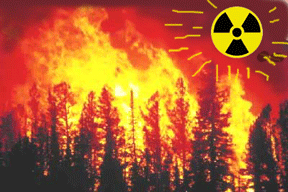 Ukrainian Firefighters Battle Forest Fire Near Chernobyl Nuclear Plant, https://www.rferl.org/a/firefighters-battle-forest-fire-near-chernobyl/28588006.html June 30, 2017 RFE/RL’s Ukrainian Service, Ukrainian firefighters are battling to contain a forest fire inside the irradiated exclusion zone around the Chernobyl nuclear plant, officials say.
The fire erupted around midday on June 29 during tree cutting works at the Lubyanskoye Forestry and spread to an area of some 25 hectares by early June 30, the emergency services said.
More than 100 firefighters and scores of trucks and aircraft were dispatched to the area, a statement said.
It is not the first wildfire to break out near the site of the 1986 reactor explosion and fire, the world’s worst civilian nuclear disaster. In 2015 alone, fires engulfed some 400 hectares of forests in the exclusion zone.
July 1, 2017
Posted by Christina Macpherson |
climate change, safety, Ukraine |
Leave a comment
 Rosatom to build Nuclear Technology Centre in Vietnam http://russianconstruction.com/news-1/28150-rosatom-to-build-nuclear-technology-centre-in-vietnam.html 29.06.2017 Rosatom State Atomic Energy Corporation and the Ministry of Science and
 Technology of Vietnam will create a Center of Nuclear Science and Technology in Vietnam, as it follows from documentation published on the Kremlin’s website.
“The Memorandum of understanding between Rosatom State Atomic Energy Corporation and the Ministry of Science and Technology of the Socialist Republic of Vietnam on a plan of the implementation of a project for construction Nuclear Science and Technologies Center in Vietnam”, the document reads.
The announcement came following a meeting of Russian President Vladimir Putin and President of Vietnam Tran Dai Quang.
July 1, 2017
Posted by Christina Macpherson |
marketing, Russia, Vietnam |
1 Comment

 Angela Merkel promises to tackle Donald Trump on climate change at G20 summit, ‘We cannot wait to act until the science has convinced every last doubter’, The Independent, Samuel Osborne @SamuelOsborne93 30 June 17, German Chancellor Angela Merkel said the EU is “more determined than ever” to make the Paris accord against climate change a success following the US decision to withdraw from the agreement, and insisted she would not “overlook tensions” with America on Donald Trump’s first attendance at the G20.
Ms Merkel stressed in a speech to the German parliament that the EU stands fully behind its commitment to the agreement.
“We cannot expect easy discussions on climate change at the G20 summit,” she said. “Our differences with the US are clear.””
She added that “the Paris agreement is irreversible and it is not negotiable.” The German Chancellor will host the summit of leaders of the Group of 20 economic powers in Hamburg on 7 and 8 July.
Ahead of that summit, she is hosting a meeting of the European leaders who will take part in the summit later on Thursday at the chancellery in Berlin.
“We are convinced that climate change is one of the greatest challenges facing humanity, an existential challenge,” she told the German parliament. “We cannot wait to act until the science has convinced every last doubter.”
She said she had agreed a plan with France’s newly elected President Emmanuel Macron to deepen cooperation in the European Union and the Eurozone, adding that the EU needed to take on more responsibility for tackling security concerns it faced, including a threat from “terrorism”.
The bloc’s remaining members would remain united in their negotiations with Britain over its planned departure from the EU, she added in Thursday’s speech to lawmakers……http://www.independent.co.uk/news/world/europe/angela-merkel-donald-trump-g20-summit-climate-change-germany-chancellor-us-president-trade-wilbur-a7813716.html
July 1, 2017
Posted by Christina Macpherson |
climate change, EUROPE |
Leave a comment
No Indonesian market for SMRs http://thebulletin.org/no-indonesian-market-smrs10868 28 June 17, M. V. RAMANA Ramana is the Simons Chair in Disarmament, Global and Human Security at the Liu Institute for Global…
In May 2017,
Indonesia’s government announced that Russia’s Rosatom State Atomic Energy Corporation had offered to develop nuclear power plants in Indonesia. But the person making the announcement, Luhut Pandjaitan—the coordinating maritime affairs minister—said he had told them that Indonesia was not ready yet because “we need to raise public awareness, which takes time.”
Saying it “takes time” is an understatement. The country’s National Nuclear Energy Agency, or BATAN as it is known from its acronym in the Indonesian language (Badan Tenaga Nuklir Nasional), was set up in the late 1950s and has been advocating nuclear power for Indonesia ever since. In 1972, BATAN started the process of selecting specific sites for nuclear plants when—in conjunction with the ministry in charge of public works and electricity—it established the Preparatory Commission for Development of a Nuclear Power Plant. That eventually led to various sites being chosen for nuclear plant construction on the Muria Peninsula on Indonesia’s most populated island, Java. But in each case, these efforts were stopped—primarily by local opposition, but partly also because of widespread skepticism about BATAN’s claims about the seismic safety of sites on the peninsula.
BATAN then turned its attention to other locations in the country, but with little success. To date, BATAN has conducted site studies on at least 16 potential locales.
BATAN’s efforts at setting up a nuclear power plant in Indonesia have not gone unnoticed. Many reactor vendors have beaten a path to Jakarta’s doorstep, hoping to sell their wares. The list includes South Korea, France, China and, of course—given its status as the leading reactor vendor in this decade—Russia. In recent years, all these countries’ offers have focused on one specific kind of reactor that BATAN has expressed an interest in: Small Modular Reactors (SMRs).
Why SMRs for Indonesia? Small Modular Reactors have electrical power outputs of less than 300 megawatts. They are being heavily promoted by many countries’ nuclear establishments as having several desirable characteristics when compared to traditional large reactors—in particular, cheaper construction costs per unit, higher safety levels, lower rates of radioactive waste generation, and less likelihood that these reactors and their fuel production facilities could be used to make fissile materials (plutonium or highly enriched uranium) for nuclear weapons. There are no operating SMRs, and it remains to be seen whether any real-world reactor would be built that features any, let alone all, of these characteristics. Indeed, of the different major SMR designs under development, none simultaneously fulfills the key requirements of lower cost, higher safety, less radioactive waste, and reduced opportunity for nuclear weapons proliferation. These are the key problems confronting nuclear power today and constraining its future. It is likely that addressing one or more of these four problems will involve design choices that make some of the other problems worse.
Among the target markets for such reactors are developing countries such as Indonesia. The International Atomic Energy Agency considers SMRs as a good option to electrify “remote regions with less developed infrastructures” because the low-capacity electricity grid that is typical of such areas makes it difficult to introduce a nuclear power plant with large power capacity—say 1,000 megawatts—without destabilizing the grid itself. Indeed, one of the reasons that BATAN claims to be interested in SMRs is that there are many islands in the Indonesian archipelago that require electricity or energy but do not have a high enough level of electrical demand to support the construction of a large nuclear reactor. One of the areas highlighted by BATAN officials as particularly suitable for SMRs is the province of West Kalimantan because its “grid capacity [is]… still limited.” BATAN also suggested that an attractive aspect of SMRs is the lower cost—due in large part to the fact that a small modular reactor will generate only a fraction of the power generated by a large reactor.
Among the SMR designs that have been offered by vendors, and explored by BATAN, are high temperature gas-cooled reactors, submarine-based reactors, floating power plants, and light water reactors.
Who’s in the competition? South Korea was the first to pitch the idea of SMRs to Indonesia: In October 2001, with IAEA approval, BATAN signed an agreement with the Korea Atomic Energy Research Institute to undertake a joint study titled “A preliminary economic feasibility assessment of nuclear desalination in Madura Island.” The Korea Atomic Energy Research Institute had been developing a small modular reactor called the System-Integrated Modular Advanced Reactor since 1996; it had the bonus feature of incorporating additional equipment that could desalinate water in addition to generating electricity.
In the case of China, BATAN signed an agreement with the China Nuclear Engineering Group Corporation in 2016 to jointly develop high temperature gas reactors and train Indonesian professionals to run them—an agreement that resulted from Chinese officials scouting around potential reactor markets.
With France, BATAN signed an agreement with DCNS, a company that has traditionally been involved in a range of naval defense systems but more recently has been developing a submarine-based electricity generating reactor project called Flexblue. (Link in Indonesian.) The idea is to park the submarine on the ocean floor and run a cable from it to land to supply electricity.
Russia, however, has been the most determined suitor. In the mid-2000s, Rosatom proposed a small Russian floating nuclear power plant to supply electricity to Gorontalo province on the Indonesian island of Sulawesi. Rosatom’s floating nuclear power plants are modeled after the reactors that have been used to power a small fleet of Russian nuclear-powered icebreakers for decades. The idea of a civilian floating nuclear power plant project has been around in Russia since the 1990s, but progress has been slow and erratic. China and the United States have also explored the idea of commercial floating nuclear power plants, but the United States abandoned the idea as uneconomical after spending millions of dollars in research and development.
In October 2006, the governor of Gorontalo announced that the province already had an agreement with Russia’s then state-owned Unified Energy System of Russia to buy a floating power plant.
But despite enthusiasm for the proposal from the provincial government, the Indonesian minister of Research and Technology rejected the idea of using a floating nuclear power plant. As Natio Lasman, then-deputy chairman of Indonesia’s nuclear agency and later chair of Indonesia’s Nuclear Regulatory Agency, told the Wall Street Journal: “I don’t want Indonesia to be used as an experiment.”
Public opposition: A major problem. Many problems may afflict nuclear proposals, regardless of whether the building plans are based on SMRs or large reactors. A key challenge has been public acceptance. Because of the potential for catastrophic accidents and the production of long-lived radioactive waste, nuclear power is perceived as a risky technology, and those living near areas selected to house a nuclear plant—such as the Muria Peninsula—often push back.
And apart from local opposition, the unpopularity of nuclear power among the general population nationwide is often a factor in whether a country develops nuclear power. A poll commissioned by the International Atomic Energy Agency in October 2005 found that only 33 percent of those Indonesians questioned felt that nuclear power was safe and that more plants should be built. In comparison, 28 percent felt that nuclear power was dangerous and all plants should be closed—while 31 percent agreed with the “middle opinion” that what was already in place should be used but that no new plants should be constructed. In the case of Indonesia, of course, that middle opinion is in practice the same as the 28 percent who wanted to close all reactors, because there was (and still is) no operating nuclear power plant in the country.
In 2011, an IPSOS poll conducted after the Fukushima nuclear reactor accident in Japan found that two-thirds of the Indonesian population expressed opposition: 33 percent of Indonesians strongly oppose nuclear power while 34 percent were somewhat opposed. About two-thirds of those polled said that their opinion was not influenced by Fukushima.
BATAN, not surprisingly, feels differently. And it has conducted a series of polls that show greater levels of support. But the proof of the pudding is in the eating. Nuclear power continues to be controversial in Indonesia, and there is widespread public opposition. Indeed, in December 2015, when then-Energy and Mineral Resources minister Sudirman Said publicly announced that the government had concluded that “this is not the time to build up nuclear power capacity,” one of his stated reasons for avoiding nuclear power was that he did not want “to raise any controversies.”
So, when people like Luhut Pandjaitan—Indonesia’s coordinating maritime affairs minister—talk about the “need to raise public awareness,” it’s reasonable to ask what they mean. Is raising public awareness really just code for coaxing or bribing the people in some areas to allow the construction of a nuclear power plant? The history of the many attempts to site nuclear reactors in Indonesia shows quite clearly that the public is already aware of the hazards involved in nuclear power. The Indonesian public’s longstanding opposition to nuclear power, especially in areas that have been earmarked for potential construction, include concerns about the security of reactor operations, the reliability of reactor designs, radioactive waste, the potential for nuclear proliferation, Indonesia’s geographical position within the seismically active Pacific Ring of Fire, and the proximity of nuclear sites to seismic faults or volcanoes. Many Indonesians are also concerned about nuclear power’s high economic costs and future dependence on foreign parties for nuclear technology or fuel, and they prefer local renewable energy resources.
 Other problems with SMRs. My collaborators at the Indonesian Institute of Energy Economics and at the Nautilus Institute for Security and Sustainability and I recently issued a report that detailed the many challenges that would have to be overcome before any small modular reactors are constructed in Indonesia. These challenges include a lack of support for nuclear power at the highest political levels, the absence of tested SMR designs, and the higher electricity-generation costs of SMR technology. We also identified legislative regulations that could become obstacles for specific SMR technologies such as floating power plants, and the political and regulatory problems with SMR construction plans that involve fabricating the bulk of the reactor at off-site factories.
The cost of electricity generated by SMRs is high compared to large conventional nuclear power plants, and high compared to the range of readily available alternatives in Indonesia. The rapidly declining cost of photovoltaic technology is particularly relevant. Studies testify to the large potential of solar energy in Indonesia, and the government has been adopting policies that promise to accelerate the construction of significant amounts of solar capacity.
The lower power level of SMRs also implies that more reactors would have to be built using this technology to produce the same amount of electricity as a few larger reactors—meaning that planners would have to deal with public resistance at many more sites. Public opposition has played a major role in stopping the construction of nuclear power plants so far; small modular reactors might face even more of controversy.
For small modular reactors, the potential benefits accruing from electricity generation come at a higher economic and social cost than other energy sources would require. As a result, it would seem that the construction of SMRs is unlikely, especially in large enough numbers to make a sizeable contribution to Indonesia’s electricity generation.
July 1, 2017
Posted by Christina Macpherson |
Indonesia, marketing, Russia, technology |
Leave a comment
Journal de l’environement 28th June 2017 [Machine Translation] While acknowledging its weaknesses, the nuclear gendarme should authorize the entry into service of the Flamanville EPR
reactor at the end of next year.
In return, EDF will have to multiply the controls, some of which are impossible to achieve. And change the lid of
the reactor vessel “as soon as possible”.
The conference room of the Nuclear Safety Authority (ASN) was full on Wednesday afternoon. After
months of suspense, the regulator of the nuclear park was to return its “position” about the future of the flagship of the tricolor atomic industry: the Flamanville EPR.
In a few minutes, the case is dispatched. What do you expect from the ASN? Work will continue in Flamanville. If all
goes well, the third reactor is expected to start at the end of 2018. Prudente, EDF has ordered, from April, a Japanese blacksmith a new tank lid. In Pierre-Franck Chevet’s opinion, the machine should be ready to install in 2024, six years after the reactor is commissioned!
Cost: a hundred million euros. A drop of water, compared to the 10.5 billion already engulfed by EDF in the largest construction site in France.
http://www.journaldelenvironnement.net/article/epr-de-flamanville-une-decision-inaudible-de-l-asn,84091
July 1, 2017
Posted by Christina Macpherson |
France, safety |
Leave a comment





 Russia, however, has been the most determined suitor. In the mid-2000s, Rosatom proposed a small Russian floating nuclear power plant to supply electricity to Gorontalo province on the Indonesian island of Sulawesi. Rosatom’s floating nuclear power plants are modeled after the reactors that have been used to power a small fleet of Russian nuclear-powered icebreakers for decades. The idea of a civilian floating nuclear power plant project has been around in Russia since the 1990s, but progress has been slow and erratic. China and the United States have also explored the idea of commercial floating nuclear power plants, but the United States abandoned the idea as uneconomical after spending millions of dollars in research and development.
 Other problems with SMRs. My collaborators at the Indonesian Institute of Energy Economics and at the Nautilus Institute for Security and Sustainability and I recently issued a report that detailed the many challenges that would have to be overcome before any small modular reactors are constructed in Indonesia. These challenges include a lack of support for nuclear power at the highest political levels, the absence of tested SMR designs, and the higher electricity-generation costs of SMR technology. We also identified legislative regulations that could become obstacles for specific SMR technologies such as floating power plants, and the political and regulatory problems with SMR construction plans that involve fabricating the bulk of the reactor at off-site factories.





