Nuclear submarines left to rot at Devonport for nearly 30 years.

Plymouth Herald 14th Jan 2018, 13 former Royal Navy subs are awaiting disposal in Plymouth – with a further seven in
Rosyth. The MoD says the submarines are “safely stored” and subject to
rigorous checks. It adds that there has been “no measurable increase in
exposure for local people”.
But the cost of storing and maintaining the laid-up vessels is vast. Over five years – between 2010 and 2015- the total
bill for storing the vessels at the two sites, both owned by Plymouth-based engineering firm Babcock, reached more than £16million.
The estimated cost of the MoD’s submarine dismantling programme, which started in December 2016 and is due to take more than 25 years to complete, have not been released. The MoD says this is due to ongoing commercial negotiations withBabcock – it’s main contractor for the programme – and other key suppliers.
http://www.plymouthherald.co.uk/news/plymouth-news/nuclear-submarines-left-rot-devonport-1043977
UK government national environment strategy ignores nuclear dangers
 Nuclear polluting elephant in the great green room Dr David Lowry http://drdavidlowry.blogspot.com.au/2018/01/nuclear-polluting-elephant-in-great.html
The UK Government launched on 11 January – with a media fanfare- its long delayed 150-page national environmental strategy (for England) titled ‘A Green Future: Our 25 Year Plan to Improve the Environment (https://www.gov.uk/government/publications/25-year-environment-plan).
Prime Minister May asserted in her foreword: “We hold our natural environment in trust for the next generation. By implementing the measures in this ambitious plan, ours can become the first generation to leave that environment in a better state than we found it and pass on to the next generation a natural environment protected and enhanced for the future.
……. We will use this opportunity to strengthen and enhance the protections our countryside, rivers, coastline and wildlife habitats enjoy, and develop new methods of agricultural and fisheries support which put the environment first.”
In his own foreword, Environment Secretary Michael Gove added:“Environment is – at its roots – another word for nature, for the planet that sustains us, the life on earth that inspires wonder and reverence, the places dear to us we wish to protect and preserve. We value those landscapes and coastlines as goods in themselves, places of beauty which nurture and support all forms of wildlife….We will underpin all this action with a comprehensive set of environmental principles. To ensure strong governance, we will consult on plans to set up a world-leading environmental watchdog, an independent, statutory body, to hold Government to account for upholding environmental standards.”
These warm green words are, however, not backed up with the kind of action that recognizes the real environmental priorities with which ministers need to get a grip.
The most egregious omission for action is anything to halt, reverse and deal with nuclear industry radiological pollution and nuclear waste from power generation, spent irradiate nuclear fuel reprocessing and nuclear warhead production.
Chapter 4 is titled’ Increasing resource efficiency and reducing pollution and waste’ but makes zero mention of nuclear waste or radiological pollution, but does expend time and effort addressing far less ecologically damaging no radiotoxic waste pollution. Here is an extract:
- Improving management of residual waste
Since 2000 we have diverted significant quantities of residual waste – i.e. waste that cannot be reused or recycled – from landfill through the development of energy from waste (EfW) facilities. These generally recover energy from the waste to produce electricity. In 2016/17, some 38% of waste collected by Local Authorities went to EfW compared with 16% that went to landfill. More can be done however. We want to make sure that materials ending up in the residual waste stream are managed so that their full value as a resource is maximised and the impact on the environment of treating them is minimised.
We will continue to encourage operators to maximise the amount of energy recovered from residual waste while minimising the environmental impact of managing it, for example by utilising the heat as well as electricity produced. The actions set out in this Plan will help us build on this to ensure that the value of residual waste as a resource is fully realised and that emissions of carbon dioxide during the energy recovery process are kept as low as possible. We must bear in mind that any infrastructure must be able to adapt to future changes in the volume and make-up of residual waste generated and developments in technology. That way, waste is not locked into residual waste treatment processes when it could be reused or recycled. (page 94)
Annex 2 of the two Government reports on Environment 25 titled Government strategies to protect and improve the environment(https://www.gov.uk/government/uploads/system/uploads/attachment_data/file/673160/25-year-environment-plan-annex2.pdf comprises of nearly 50 “strategies and plans for some of the government’s work to protect and conserve the environment,” but contains not one report that addresses environmental protection from radiation or from nuclear industry operations!
However, two days before the 25-year green strategy was issued, the Government quietly released ( to absolutely zero media attention) a 221- page document that explains how it plans to deal with nuclear waste in the UK. Clearly ministers wanted attention on plastic waste policy, but none fon radioactive waste policy.
The report, titled UK’s sixth national report on compliance with the obligations of the Joint Convention on the safety of spent fuel and radioactive waste management states it “considers each of the Joint Convention’s obligations and explains how the United Kingdom addresses them.”https://www.gov.uk/government/uploads/system/uploads/attachment_data/file/672640/20171020_-_UK_Sixth_National_Report_to_the_Joint_Convention.pdf )
Document (The fifth report was published in January 2015.)
China unlikely to go ahead with AREVA’s nuclear reprocessing plan, despite Macron’s support
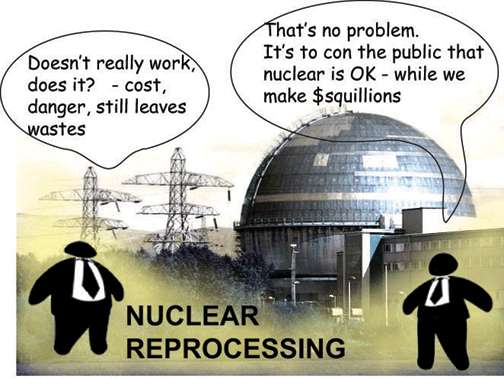 Reuters 11th Jan 2018, So close yet so far: China deal elusive for France’s Areva. A deal long
sought by French company Areva to build a $12-billion nuclear waste
reprocessing plant in China looks increasingly unlikely to go ahead despite
a visit to Beijing by President Emmanuel Macron meant to drum up business.
During Macron’s state visit this week, Areva and China National Nuclear
Corp (CNNC) signed a new “protocol agreement” to build the plant but,
not for the first time, no definitive contract was signed.
Since talks began more than a decade ago – when uranium prices UXXc1 were near record
highs – a series of non-committal French-Chinese memorandums of
understanding have been signed for building a reprocessing plant in China
modeled on state-owned Areva’s plant in La Hague, northern France.
The reprocessing of nuclear fuel waste involves separating plutonium from the
spent uranium and reusing it in “Mixed Oxide” (MOX) fuel at nuclear
power stations.
But the 2011 Fukushima nuclear disaster and competition
from renewable energy are weighing on the nuclear sector, and uranium
prices are down 80 percent from a decade ago, making the expensive and
dangerous recycling process less attractive. Chinese nuclear scientist Li
Ning, dean of Xiamen University’s College of Energy and a member of State
Nuclear Power Technology Corporation’s (SNPTC) expert committee, sees
“a fairly low probability” that China will sign a formal contract for
the project.
https://www.reuters.com/article/us-areva-china-nuclearpower-analysis/so-close-yet-so-far-china-deal-elusive-for-frances-areva-idUSKBN1F01RJ
Japanese and British taxpayers at risk as their governments commit to $20 billion loan for Wylfa nuclear project
 Asahi Shimbin 11th Jan 2018, Japan and Britain have agreed to provide the lion’s share of financing for
a nuclear power plant project planned by Hitachi Ltd. on the island of
Anglesey off northwest Wales, sources said.
financial institutions and acquire a stake in Horizon Nuclear Power Ltd., a
British company purchased by Hitachi to operate the plant. The total cost
of the project is estimated at 3 trillion yen.
doing so, they must share the risk if the project suffers a financial loss,
but that tab could eventually be passed on to taxpayers.
http://www.asahi.com/ajw/articles/AJ201801110057.html
European civic leaders worried about dangers of nuclear facilities stationed near borders of their counties

 DiaNuke 12th Jan 2018, A joint letter, co-signed by the Chairs of the Cities for a Nuclear Free
Europe (CNFE) and the UK and Ireland Nuclear Free Local Authorities (NFLA),
has been submitted to the European Commission over concerns around the
international inspection of nuclear plants in Europe.
The letter arises from concerns raised by the Dutch city Bergen op Zoom, which is located
less than 20 kilometres from the nuclear power plant Doel in Belgium, but
has no legal rights regarding the life time extension of this nuclear
plant.
Many towns and cities around Europe are in the same position. One
third of existing European nuclear power plants are situated in a border
region. As such, these nuclear power plants are situated in such a way that
more than one country is affected when security and safety is at risk.
For example, on numerous occasions Luxembourg, Germany and the Netherlands have
expressed their concerns about the nuclear plants in Doel and Tihange,
Belgium. Furthermore, an internal audit of the Belgian nuclear regulator
Federal Agency for Nuclear Control (FANC) from 2016 showed that its own
independence is to be questioned.
In the joint letter signed by CNFE, NFLA
and by the Mayor of Bergen op Zoom, they ask to place the supervision of
nuclear plants not only in the hands of national authorities, but at a
European level as well. In their collective view, creating effective
instruments for supervision shall ensure that the legitimate interests of
the population of neighbouring countries are safeguarded, as well as those
of the people of the country of origin.
Nuclear Liability – UK government sets out new rules for ‘intermediate risks’
 The Department for Business, Energy & Industrial Strategy (BEIS) late last
week published its position on the criteria for determining the new
category of ‘intermediate risk’ nuclear sites that is to be established in
UK law.
Helen Peters, a nuclear expert at Pinsent Masons, the law firm
behind Out-Law.com, said that the changes that BEIS has made to the
criteria are to be welcomed and would enable the government to move forward
with laying the draft Nuclear Installations (Prescribed Sites and
Transport) Regulations in parliament at some point in the near future.
The new regulations once introduced will come into force at the same time as
the amendments to Nuclear Installations Act 1965 which are set out in the
Nuclear Installations (Liability for Damage) Order 2016. These amendments
support the implementation of the 2004 Protocols to the Paris Convention on
nuclear third party liability and the Brussels Supplementary Convention.
The decision on the criteria for intermediate risk sites has been made
further to a consultation in 2016 on the proposed definitions for the
purposes of nuclear liability for low risk nuclear sites, intermediate
sites, relevant disposal sites and the transport of low risk nuclear
matter.
After considering the responses to the 2016 consultation, the
government elected to further consider the definition for intermediate risk
sites. It elected to reconsult on the matter in 2017 because the proposed
revised definition was significantly different to the one set out in the
2016 proposal. The BEIS paper published last week contained the
government’s response (12-page / 101KB PDF) to the feedback it received to
its reconsultation. A new liability limit of €160 million will apply to
nuclear sites classed as ‘intermediate risk’ once the legislative changes
come into force. As many as 14 nuclear sites could qualify as ‘intermediate
risk’ sites under the new criteria that has been established, BEIS said.
https://www.out-law.com/en/articles/2018/january/uk-government-clarifies-criteria-for-intermediate-risk-nuclear-sites/
The troubled and exorbitantly expensive history of the EPR nuclear reactor.
 Romandie 9th Jan 2018, [Machine translation] The EPR, the flagship of the French nuclear industry
with many setbacks. Paris – The EPR, to be launched for the first time in China in about six months, is a third-generation nuclear reactor designed to offer improved power and safety, but whose yards have accumulated setbacks in France and elsewhere. Finland.
Launched in 1992, this technology, touted as the flagship of the French nuclear industry, was co-developed by the French company Areva and German Siemens, within their joint venture Areva NP, which Siemens has since withdrawn. EDF has just taken control of this activity as part of the reorganization of the French nuclear industry orchestrated by the State.
The first project was launched in Olkiluoto (Finland) in 2005, on behalf of the TVO electrician, with Areva and Siemens directly prime contractors. But the setbacks and budget slippages have accumulated. TVO lamented an umpteenth delay in the commissioning of the EPR in October, which is now scheduled for May 2019. It was initially scheduled for 2009.
There is a dispute between TVO and Areva and Siemens, with each party blaming the delays on the other.
claiming billions in compensation. The case is under arbitration.
The second EPR, which has been under construction since 2007 in Flamanville (western France) has also accumulated setbacks, mainly due to anomalies discovered on the composition of the steel cover and bottom of the tank. The Nuclear Safety Authority (ASN) requires that the tank cover be replaced before the end of 2024. EDF, prime contractor, has postponed the commissioning of the reactor several times. The electrician plans to start the Flamanville EPR at the end of 2018, for commercial commissioning in
2019, when the initial schedule was for 2012.
Its cost has meanwhile more than tripled to 10.5 billion euros. Two other EPRs are under construction in Taishan (China), with a joint venture owned 51% by the Chinese state power company CGN, 30% by EDF and, since 2012, 19% by the electrical utility of
Guangdong province.
https://www.romandie.com/news/878943.rom
France’s nuclear company AREVA to join China National Nuclear Corp in nuclear reprocessing
 Areva to sign 10 bln euros China nuclear re-processing MoU -sourcehttps://www.reuters.com/article/china-france-areva/areva-to-sign-10-bln-euros-china-nuclear-re-processing-mou-source-idUSP6N1NF02R, Reuters Staff,
PARIS, Jan 9 (Reuters) – French power group Areva is set to sign a memorandum of understanding (MoU) for a Chinese nuclear re-processing deal worth about 10 billion euros ($11.9 billion), a source with knowledge of the matter said.
The deal with the China National Nuclear Corp (CNNC) was expected to be signed on Tuesday, during a state visit to China by French President Emmanuel Macron.
$1 = 0.8375 euros Reporting by Benjamin Mallet; Writing by Sudip Kar-Gupta; Editing by Leigh Thomas and Jean-Michel Belot
Putin fears that terrorists might attack nuclear power stations, using drones

 Putin fears nuclear power plant drone attack: Special military until is set up to prevent terrorist strike after the gadgets are used to bomb Russian bases in Syria Daily Mail Australia
The move involves developing of technology to reliably zap incoming drones
It comes amid fears that terrorists could destroy bases using long-range missiles
Concerns have been heightened by jihadist attacks on its military bases in Syria
The move – involving the development of technology to reliably zap drones – comes amid fears that terrorists could use sophisticated long-distance weapons to target nuclear bases.
Russian concerns have been heightened by jihadist attacks on its military bases in Syria using UAVs – unmanned aerial vehicles.
Vladimir Putin is poised to create a special force to protect key Russian installations like nuclear power stations from drone attacks in the same week his forces came under attack from ‘assault drones’ at its Khmeimim air base and Tartus naval base in Syria
He made clear nuclear power plants were among the state facilities that required protection.
Russia’s Ministry of Defence this week shared an image of what it claims is a drone fitted with explosives brought down before it attacked one of their military bases in Syria.
Russian concerns have been heightened by jihadist attacks on its military bases in Syria using UAVs – unmanned aerial vehicles.
The Kremlin has demanded that the Defence Ministry, several secret service agencies and the Russian National Guard work together to find a solution to destroy drones before they reach their targets.
Technology to zap drones has been developed in Russia but needs testing, said Col-General Sergey Melikov, first deputy director of the national guard.
He made clear nuclear power plants were among the state facilities that required protection.
‘We are considering an option to create groups to test experimental equipment to fight UAVs within our units,’ he said.
‘We have a certain device but it is not clear how easy is it to use.
‘It needs to be tested first.
‘If we realise that a special unit with a team of specialists needs to be created, of course we will do so.’
The move – involving the development of technology to reliably zap drones – comes amid fears that terrorists could use sophisticated long-distance weapons to target nuclear bases.
He revealed the plan is being studied by experts including those from the Defence Ministry and FSB, the former KGB counter-intelligence service.
Security expert Yury Zakharchenko said there was no universal technology yet to fight sophisticated drone attacks.
Such a system or systems must recognise and identify incoming UAVs and then launch an appropriate strike by either radio electronic attack or missile.
‘This task has not been resolved anywhere in the world because it’s difficult, but the work is being done,’ he said.
‘The establishment of a separate unit of Rosgvardia (national guard) will perhaps allow us to intensify research and development in this area.’
Recent pictures of captured Jihadist drones in Syria were released.
This week Russian forces came under attack from ‘assault drones’ at its Khmeimim air base and Tartus naval base in Syria, said the defence ministry………..http://www.dailymail.co.uk/news/article-5247523/Drone-attack-Russian-bases-Syria-no-casualties-Moscow.html
Cumbria not the safest, nor cheapest, nor easiest place to bury UK’s nuclear waste
 Cumbria Trust 9th Jan 2018, Former Leader of Cumbria County Council, and current Director of Cumbria Trust, Eddie Martin was interviewed by BBC Radio Cumbria, to discuss the latest plans to find a site to bury the UK’s nuclear waste. Our members will recall that it was Eddie Martin who along with his cabinet, halted the last search process. During the interview Eddie is challenged to respond to a point from Professor Francis Livens of Manchester University, who claimed that it would be possible to engineer a Geological Disposal Facility (GDF) in West Cumbria, although he admitted that it would be quicker, easier and cheaper elsewhere.
What Professor Livens omitted to say was that it would also be safer elsewhere as well since geology forms the final barrier. That was the conclusion of the £400m Nirex investigation in the 1980s and 90s, and the government-funded geologist during the last process backed the view that the prospects of finding the right geology were so poor in Cumbria that no commercial organisation would continue.
Perhaps Professor Livens,who is a radio-chemist rather than a geologist, is unaware of the history of this project, and particularly the conclusions reached by geologists on both sides of the debate. The entire purpose of the National Geological
screening exercise is to seek volunteers from geologically suitable areas and his intervention appears to preempt the report which is due to be released in the next few months.
As Eddie Martin points out there are potentially far safer and more suitable GDF sites in the UK, including a
site under the North Sea and the job of the government should be to encourage those areas to volunteer.
https://cumbriatrust.wordpress.com/2018/01/09/2018-and-the-gdf-is-back-in-the-news/
New study planned into effectiveness of Britain’s Nuclear Decommissioning Authority’s work at Sellafield
 The Nuclear Decommissioning Authority, https://www.nao.org.uk/work-in-progress/the-nuclear-decommissioning-authority/
| Scheduled | Summer 2018 |
|---|---|
| Sector | Energy, Environment |
| NAO Team | Director: Michael Kell
Audit Manager: Zaina Steityeh |
| Media contact | Steve Luxford Direct line: 020 7798 7861 Mobile: 07985 260074 Email: pressoffice@nao.gsi.gov.uk The Nuclear Decommissioning Authority (NDA) is a non-departmental public body sponsored by the Department for Business, Energy & Industrial Strategy. The NDA is responsible for the operation, decommissioning and clean-up of 17 nuclear reactor and research sites in the UK. Of the 17 sites, Sellafield is the largest in terms of size and annual expenditure. It is also one of the most complex and hazardous nuclear sites in Europe. In 2015, the NDA announced that the management arrangements it had in place for the Sellafield site were ineffective; in April 2016, Sellafield Ltd became a wholly-owned subsidiary of the NDA. The NDA says these new arrangements will enable faster hazard and risk reduction at the site, and a more effective management of major projects. Alongside these changes, Sellafield is readying itself for the end of its reprocessing activities in 2020, meaning its operational focus will be on reducing high hazard reduction and decommissioning nuclear facilities. Sellafield has set out a transformation plan to support these changes. This study will examine whether the new arrangements at Sellafield are effective in reducing high risk and hazard on the site, and whether the NDA is making progress with the performance of its major projects. If you would like to provide evidence for our study please email the study team on enquiries@nao.gsi.gov.uk, putting the study title in the subject line. The team will consider the evidence you provide; however, please note that due to the volume of information we receive we may not respond to you directly. If you need to raise a concern please use our contact form. |
France phasing out nuclear power at home: happy to export it abroad
 China, France sign deal to enhance cooperation on nuclear energy Xinhua | 2018-01-10 07:17 GUANGZHOU — A Chinese nuclear power operator signed an agreement Tuesday with a French energy organization to deepen cooperation on nuclear power technology.
The deal, between China General Nuclear Power Corporation (CGN) and the French Alternative Energy and Atomic Energy Commission (CEA), focuses on areas such as nuclear reactor technology, advanced fuels and materials, and nuclear fuel cycles.
Under the agreement, CGN and CEA will deepen cooperation in the upstream and downstream nuclear power industry chain, including reactor life management and the concept design of the fourth-generation nuclear energy technology.
He Yu, chairman of CGN, said the new agreement will enhance bilateral exchanges in nuclear power technology and open new space for Sino-French nuclear power cooperation.
Founded in 1994, CGN is the largest nuclear power operator in China, with 39,000 employees worldwide. It focuses on the development of clean energies such as nuclear power, nuclear fuel, wind power and solar power.
The CEA is a key organization in research, development and innovation in France. Its main areas include defense and security, nuclear and renewable energy, and physical and life sciences.
http://www.chinadaily.com.cn/a/201801/10/WS5a554d97a3102e5b17371b35.html
Protest opposing USA military use of Ireland’s Shannon Airport
Peace group stages early morning march on Shannon Airport to protest US military use, https://www.breakingnews.ie/ireland/peace-group-stages-early-morning-march-on-shannon-airport-to-protest-us-military-use-821608.html 07/01/2018, By Patrick Flynn
A group of anti-war protestors marched on Shannon Airport early this morning to show their opposition to the US military’s use of the airport.
The march was led by 82-year-old peace activist Margaretta D’Arcy who was previously jailed for making an illegal incursion onto the runway at Shannon in 2012. Shortly before 7am today, Ms D’Arcy led the group of about 15 women on the 2km walk to the main airport building.
The women had been taking part in a 25-hour peace vigil at a camp at Drumgeely close to the airport.
The 25-hour event was organised by Shannon Airport Women’s Peace Camp to mark Nollaig na mBan
A spokeswoman said: “We gathered to draw attention to the use of Shannon Airport as a military base and to demonstrate the revulsion at state-sponsored violence and facilitation of the US military.”
When the group reached the security checkpoint at the entrance to the airport, they were advised they could march to the terminal but would not be allowed inside.
On reaching the airport building, the women sat and sang peace songs before dispersing again at around 9am and returning to their camp.
Some members of ShannonWatch, a group that monitors US military used of Shannon Airport, also attended and supported the event.
UK Trident bomb base in Scotland has ‘significant’ radioactive waste problem
During an August 2017 visit to the Royal Naval Armaments Depot at Coulport, Scottish Environment Protection Agency (Sepa) staff found untested waste from submarines, potentially containing radioactive material, had been mixed with other waste.
This meant that radioactive waste could have been taken off site and disposed of as if it were non-radioactive waste.
The Ministry of Defence (MOD) is supposed to tell Sepa ‘without delay’ when an environmental incident occurs. It should then provide a written report within 14 days.
Documents released under freedom of information legislation show that an internal MOD probe found that no radioactive waste left the site. But the only reason the untested material was not taken off the base is because vigilant civilian waste contractors refused to pick up the incorrectly processed waste.
A Sepa letter to the MOD said that the watchdog considered this type of incident as “significant” adding that had the Royal Navy been a civilian operator, it would have considered issuing a formal written warning.
Sepa’s chief officer, John Kenny, told The Ferret that the incident raised concerns regarding the “adequacy of arrangements for radioactive waste handling” at the Coulport site…….
Campaign group Navy not Nuclear pointed to a long history of MOD “poor practice” when it comes to handling nuclear materials in Scotland, dating back more than a decade.
“The most damning thing about this is that nothing has changed,” it said. “The MOD are still failing to follow their own operating procedures, and they’re still failing dismally when it comes to telling the regulator and protecting the environment.”
The group called for more to be done by both the MOD and Sepa to alert the public when environmental incidents occur.
“It shouldn’t be the case that this information should come to light by freedom of information, they should have a statutory public duty to disclose this information,” it said. https://theferret.scot/trident-sepa-radioactive-waste/
Japanese taxpayers now join in Britain’s scandalous subsidising of the nuclear industry

The profitability of nuclear plant construction has been worsening all over the world
Nevertheless, the government intends to extend all-out support for the project.
Japanese gov’t to guarantee bank loans for Hitachi’s nuclear plant project in Britain https://mainichi.jp/english/articles/20180103/p2a/00m/0na/004000c (Mainichi Japan) The Japanese government is poised to guarantee the full amount of loans that three megabanks will extend for a nuclear plant construction project in Britain by Hitachi Ltd., sources familiar with the project said.
A group of banks, including the three megabanks and the government-affiliated Japa n Bank for International Cooperation (JBIC), will extend approximately 1.5 trillion yen in loans to Hitachi’s atomic power station project.
Of the amount, the government will fully guarantee loans to be extended by the megabanks, while the governmental Development Bank of Japan (DBJ) will support the project by making capital investments. Chubu Electric Power Co. and other utilities are also considering investing in the project.
The state will thus join hands with the private sector in extending all-out support for the project to export a nuclear plant worth some 3 trillion yen.
However, concerns have been raised that if the project were to run into the red, taxpayers could be forced to shoulder the burden.
The project to be covered with loans and investments is an atomic power station that a Hitachi subsidiary in Britain is aiming to build in Anglesey, Britain. The firm hopes to start operations at the plant in the mid-2020s.
Hitachi Ltd. is poised to make a final decision on whether to invest in the project by the end of fiscal 2019. However, Hitachi is consulting with the Japanese and British governments and financial institutions over loans, their guarantees and investment on the grounds that the electronics giant alone cannot take risks.
Japanese financial institutions and the governmental Nippon Export and Investment Insurance (NEXI) offered in December last year to extend financial assistance for the project.
According to the sources, Hitachi estimates the total cost of the project at about 3 trillion yen. Hitachi aims to obtain about 1.5 trillion yen in loans to cover half of the amount while raising another 1.5 trillion yen through investments.
Each of the three megabanks — the Bank of Tokyo-Mitsubishi UFJ, Ltd., Sumitomo Mitsui Banking Corp. and Mizuho Bank, Ltd. — intend to extend loans of more than 100 billion yen, totaling some 500 billion yen. NEXI will guarantee the loans. Hitachi intends to obtain the reminder of the loans from the JBIC and commercial financial institutions in Britain.
The DBJ has notified Hitachi of its intention to make capital investments in the atomic power station project, while Chubu Electric Power and Japan Atomic Power Co. are also considering investing in the venture.
Hitachi has also asked other utilities including Tokyo Electric Power Co. and trading houses to invest in the project in a bid to disperse risks involving the project.
The British government, which is speeding up the construction of nuclear plants, also intends to invest in the project, and Japanese and British Cabinet ministers in charge of energy policy exchanged a memorandum on cooperation in December last year.
The profitability of nuclear plant construction has been worsening all over the world due to an increase in the costs of ensuring safety since the outbreak of the Fukushima nuclear crisis in March 2011, contributing to the financial crisis of Toshiba Corp., another electronics giant.
Nevertheless, the government intends to extend all-out support for the project.
“It’s essential to win a contract on the British project in order to maintain Japan’s nuclear technology,” said a high-ranking official of the Economy, Trade and Industry.
1 This Month
23-25 October – on Zoom – World BEYOND War’s annual global conferenc


Shut down the radiation-damaged Heysham nuclear reactors now
To see nuclear-related stories in greater depth and intensity – go to https://nuclearinformation.wordpress.com

Say No to NASA’s Reckless Nuclear Reactor on the Moon
Say No to NASA’s Reckless Nuclear Reactor on the Moon

-
Archives
- October 2026 (209)
- September 2026 (339)
- August 2026 (330)
- July 2026 (355)
- June 2026 (287)
- May 2026 (306)
- April 2026 (356)
- March 2026 (251)
- February 2026 (267)
- January 2026 (308)
- December 2025 (358)
- November 2025 (359)
-
Categories
- 1
- 1 NUCLEAR ISSUES
- business and costs
- climate change
- culture and arts
- ENERGY
- environment
- health
- history
- indigenous issues
- Legal
- marketing of nuclear
- media
- opposition to nuclear
- PERSONAL STORIES
- politics
- politics international
- Religion and ethics
- safety
- secrets,lies and civil liberties
- spinbuster
- technology
- Uranium
- wastes
- weapons and war
- Women
- 2 WORLD
- ACTION
- AFRICA
- Atrocities
- AUSTRALIA
- Christina's notes
- Christina's themes
- culture and arts
- Events
- Fuk 2022
- Fuk 2023
- Fukushima 2017
- Fukushima 2018
- fukushima 2019
- Fukushima 2020
- Fukushima 2021
- general
- global warming
- Humour (God we need it)
- Nuclear
- RARE EARTHS
- Reference
- resources – print
- Resources -audiovicual
- Weekly Newsletter
- World
- World Nuclear
- YouTube
-
RSS
Entries RSS
Comments RSS

