Is UK’s regulator of Hinkley nuclear project ignoring the seismic risks of fracking in the area?
Drill or Drop 12th Oct 2019, Hinkley. The safety regulator for the nuclear industry has no information about the risk of earth tremors from fracking near the Hinkley Point power station, a campaign group has revealed. Frack Free Exmoor, Quantocks and Sedgemoor.
(FFEQS) has also shown that the Office for Nuclear Regulation (ONR) has had no correspondence on the subject with either the oil and gas industry regulator, the power station operator, local exploration companies or Somerset County Council. FFEQS has described the failure to assess the risk of fracking on the nuclear station, which includes the new Hinkley Point C facility, as “a gaping hole” in the safety case.
In August 2019, fracking by Cuadrilla near Blackpool caused more than 130 earth tremors, including the UK’s largest fracking-induced seismic event, measuring 2.9ML. This tremor led to formal complaints of cracks to walls, windows and doors to about 100 properties, DrillOrDrop understands. Hinkley Point is a few miles from an area where the exploration company, South Western Energy, has indicated it is interested in drilling for hydrocarbons (DrillOrDrop report).
Opposition to fracking appears to be growing in the region.
Sedgemoor District Council voted unanimously on 9 October 2019 to be a Frack Free zone. This follows previous similar votes in Somerset West and Taunton councils.
Energy Efficiency – effective, but forgotten since UK privatisation of Energy Saving Trust and the Carbon Trust.

Business Green 10th Oct 2019, Energy Efficiency. The public needs reminding that saving energy is good for the planet, argues Andrew Warren.
British people are very confused about what they should most usefully be doing, in order to assuage any guilt they might feel about damaging the climate. A Smart Energy GB study released this week found just three in 10 people think being energy efficient would have the biggest impact on protecting the environment.
This startling finding was backed up another a survey of 2,000 people undertaken by Opinium Research. That found saving energy tends to come way down the list of possible practical response under consideration. The most popular response to the Opinium survey was to “avoid throwing away food”. This was followed by various moves to reduce plastic wastage – buying plastic-packed groceries, single-use plastic bottles, using plastic shopping bags – or simply not recycling enough.
Steven Day, co-founder of Pure Planet, which sponsored the opinion survey, commented: “It is great that the majority of people are thinking more about their impact on our environment. But it looks like they
are feeling guilty about the smaller things – not the biggest-impact
activities causing the greatest harm.”
This lack of awareness of the potential for saving energy contrasts enormously with similar surveys undertaken twenty years ago, admittedly when overall awareness of the threat of climate change was far lower. Then, the vast majority of people would always respond to questions to the threat of climate change by emphasising the need to save energy, both at home and at work.
Since 2010 there have been no publicly funded awareness campaigns supporting energy efficiency funded by central government. Their abandonment directly followed the privatisation of the two main public advice agencies, the Energy Saving Trust and the Carbon Trust.
35,454 Petitioners call for scrapping of UK’s “regulated asset base” (RAB) funding for Sizewell nuclear project
 Sizewell.
TASC 11th Oct 2019, Just one major problem with the Sizewell C plans is that nuclear new build projects have been largely a financial disaster. Almost every major nuclear project in the West has been plagued by delays and cost overruns: Some delays are in the order decades. Likewise, the cost overruns are of epic proportions.
Some new-build projects have had cost overruns that run into billions. Changing the funding method for the planned Sizewell C to a
regulated asset base model would shift the risk of rising costs from EDF to consumers, and could lead to even worse project planning because the existing RAB model would offer little incentive for EDF to build on-time and on-budget. EDFs investment is safe regardless, and we wind up footing the bill no matter how incompetently EDF proceeds.
TASC 11th Oct 2019,Today, campaigners from Sizewell, Hinkley Point and Bradwell nuclear sites and consumer group SumOfUs will visit the Department of Business, Energy and Industrial Strategy to deliver a 35,454-signature petition protesting the government’s proposal to subsidise new nuclear power plants by hiking energy bills.
The petition calls on the government to scrap plans to subsidise the nuclear industry through a “regulated asset base” (RAB) funding model, under which consumers would be forced to pay a surcharge on their energy bills for new nuclear power projects such as Sizewell C in Suffolk and Bradwell B in Essex.
Russia’s fatal Skyfall missile test- a fatal nuclear accident
- A report from a US State Department official on Thursday provides a clearer picture as to how the August 8 Skyfall accident occurred at a secret Russian military testing range.
- “The United States has determined that the explosion near Nyonoksa, Russia, was the result of a nuclear reaction that occurred during the recovery of a Russian nuclear-powered cruise missile,” the official wrote. “The missile remained on the bed of the White Sea since its failed test early last year, in close proximity to a major population centre.”
- Amid confusion and obfuscation from Russia and speculation from analyst, the report gives a clearer picture of how the accident, which killed seven Russians, occurred.
A report to the UN General Assembly First Committee on Thursday by Thomas G. DiNanno, the deputy assistant secretary and senior bureau official at the State Department’s Bureau of Arms Control, Verification, and Compliance, ended months of speculation about the exact cause of the accident, which killed seven Russians.
While experts at the time determined that the cause was a nuclear-reactor explosion and tied it to the 9M730 Burevestnik nuclear-powered cruise missile, which NATO calls the SSC-X-9 Skyfall, DiNanno’s report gives a clearer picture of how the accident occurred.
After the accident, Russia’s explanations and reactions to it varied greatly, from ordering an evacuation of the area to canceling it hours later. Four radiation sensor sites also went mysteriously offline after the accident, pointing to a potential cover-up. Russian officials said they were not obligated to share the data, which could have helped point to the cause of the accident, The New York Times reported.
Officials also declined to tell doctors treating engineers affected by the blast that they had been exposed to nuclear radiation and requested hospital staff sign a nondisclosure agreement, The Moscow Times originally reported……. https://www.businessinsider.my/us-putins-skyfall-missile-failed-test-and-exploded-during-recovery-2019-10/
Flamanville nuclear reactor repairs will cost $13.6 billion

 EDF Cost Overrun at French Plant Piles Pressure on Nuclear Giant, by
- Repairs at Flamanville reactor will lift cost to $13.6 billion
- Plant won’t load nuclear fuel until end of 2022 at earliest
The latest budget hike at the Flamanville-3 reactor is yet another blow to the French state-controlled utility, which raised its cost estimate for two similar reactors it’s building in the U.K. just weeks ago. It also fuels doubts about nuclear’s future in France, where the government has been reluctant to approve new projects before Flamanville-3 is online….. (subscribers only) https://www.bloomberg.com/news/articles/2019-10-09/edf-lifts-cost-of-french-nuclear-reactor-by-14-to-13-6-billion
Russia has a pointless, but scary Seaborne Nuclear Weapon
Key point: Moscow’s deadly weapon is pointless but is still apart of mutually-assured-destruction.On May 22, 2018, the Russian submarine Yuri Dolgoruky slipped beneath the waves of the Arctic White Sea. Hatches along the submerged boat’s spine opened, flooding the capacious tubes beneath. Moments later, an undersea volcano seemingly erupted from the depths.
Amidst roiling smoke, four stubby-looking missiles measuring twelve-meters in length emerged one by one. Momentarily, they seemed on the verge of faltering backward into the sea before their solid-fuel rockets ignited, propelling them high into the stratosphere. The four missiles soared across Russia to land in a missile test range on the Kamchatka peninsula, roughly 3,500 miles away.
You can see the launch sequence in this video.
Like the nuclear-powered ballistic missile submarines (SSBNs) operated by United States, China, France, the United Kingdom, and India, the primary purpose of Borei-class submarines is almost unimaginably grim: to bring ruin to an adversary’s cities, even should other nuclear forces be wiped out in a first strike.
Each of the submarine’s sixteen R-30 Bulava (“Mace”) missiles typically carries six 150-kiloton nuclear warheads designed to split apart to hit separate targets. This means one Borei can rain seventy-two nuclear warheads ten times more destructive than the bomb dropped on Hiroshima on cities and military bases over 5,800 miles away.
The Borei is the most advanced SSBN in the Russian Navy, and is designed to replace its seven Soviet-era Delta-class SSBNs. Throughout most of the Cold War, Soviets submarines were noisier than their Western counterparts, and thus vulnerable to detection and attack by Western attack submarines. …….
The Bulava has an unusually shallow flight trajectory, making it harder to intercept, and can be fired while the Borei is moving. The 40-ton missiles can deploy up to forty decoys to try to divert defensive missiles fire by anti-ballistic missiles systems like the Alaska-based
Ground-based Midcourse Defense system. https://news.yahoo.com/russia-terrifying-seaborne-nuclear-weapon-053000241.html
French nuclear company EDF rules out any interest in UK’s Wylfa nuclear plan
New Civil Engineer 10th Oct 2019, EDF Energy has ruled out taking an interest in the new Wylfa nuclear site in Wales despite claiming it is the ‘best site in the UK’ for nuclear
power. https://www.newcivilengineer.com/latest/edf-rules-out-wylfa-bid-despite-naming-it-best-site-in-uk-10-10-2019/
EDF’s Flamanville nuclear project – more costs, more delays
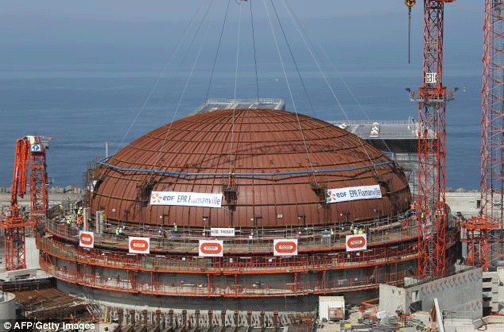
EDF adds further €1.5bn to Flamanville nuclear plant costs https://www.ft.com/content/fc6a8610-ea5e-11e9-a240-3b065ef5fc55 French energy group also confirms latest delay to opening of long-awaited project.
David Keohane in Paris 9 Oct 19, French energy giant EDF announced increased costs to its long-troubled flagship nuclear project at Flamanville on Wednesday as it confirmed delays to the opening of the plant due to faulty weldings. The company said construction costs would rise by €1.5bn to €12.4bn and the loading of nuclear fuel would be delayed until the end of 2022, which had previously been scheduled for the end of 2019 with commercial activity starting in 2020. The group, which is 83.7 per cent owned by the French government, had flagged the delays at the plant in north-western France to the end of 2022 during its half-year results in July. Flamanville was originally expected to cost €3.3bn and start operations in 2012.
Analysts at Morningstar said that the increase in costs was in line with estimates but warned “the worst-case scenario has not gone away totally” — alternative more expensive plans — since EDF had to get approval for its repair proposals by the end of 2020. This involves the use of remotely operated robots. Flamanville is considered a litmus test for the next-generation European Pressurised Reactor technology. One EPR is already up and running in China, but Flamanville remains the bigger test for EDF because it is 100 per cent owned by the company and the French regulators are known to be exacting. There are two other EPR projects being built in Europe: The Olkiluoto project in Finland, which is more than a decade late, and the UK’s Hinkley Point, which EDF warned in September would cost an extra £2.9bn to complete.
The news comes as EDF pushed back the formal presentation to the government of an internal reorganisation plan, called Project Hercules, which had been due by the end of the year, at the request of French president Emmanuel Macron. Project Hercules will create a government-owned mother company, EDF Bleu, containing the nuclear assets as well as hydroelectric assets. Bleu’s main subsidiary, EDF Vert, will house renewable energy, the networks and the services businesses and will be listed, with some 20 per cent to 40 per cent sold to raise funds.
The quid pro quo for the reorganisation, as seen by EDF, is a new regulated price for nuclear energy, assuming it can be agreed with Brussels. However, Project Hercules has been deferred due to delays in discussions with Europe. In an internal email to staff sent late last week, EDF chief executive Jean-Bernard Lévy said “a reorganisation without better regulation would not be enough to give EDF the financial means to play its role in the investments necessary for the success of [France’s] energy transition”.
Massive Nuclear Explosion similar to Kyrshtym by Mayak Can Happen Happen at Hanford if the site is not Monitored and tanks not taken care of
Lane, 6 Oct 19 Mayak Explosion
Ten Thousand Gallon Tank at Mayak Exploded from Heat Decay. The Heat Deacy was from Strontium 90, Cesium 137, Cobalt 60 and Plutonium Stored in the Underground Tank. The explosion was equivalent to 100 tons of TNT. There are55 million gallons of the same Radionuclide Mix stored at Hanford, in UnderGround Tanks. If they become too concentrated and hot, the same thing will Happen there, contaminating a Great Portion of the Pacific NW USA and southe western Canada.
Medvedev, Zhores A. (4 November 1976). “Two Decades of Dissidence”. New Scientist.
Medvedev, Zhores A. (1980). Nuclear disaster in the Urals translated by George Saunders. 1st Vintage Books ed. New York: Vintage Books. ISBN 978-0-394-74445-2. (c1979)

In 1957 the cooling system in one of the tanks containing about 70–80 tons of liquid radioactive waste failed and was not repaired. The temperature in it started to rise, resulting in evaporation and a chemical explosion of the dried waste, consisting mainly of ammonium nitrate and acetates (see ammonium nitrate/fuel oil bomb). The explosion, on 29 September 1957, estimated to have a force of about 70–100 tons of TNT,[10] threw the 160-ton concrete lid into the air.[8] There were no immediate casualties as a result of the explosion, but it released an estimated 20 MCi (800 PBq) of radioactivity. Most of this contamination settled out near the site of the accident and contributed to the pollution of the Techa River, but a plume containing 2 MCi (80 PBq) of radionuclides spread out over hundreds of kilometers.[11] Previously contaminated areas within the affected area include the Techa river, which had previously received 2.75 MCi (100 PBq) of deliberately dumped waste, and Lake Karachay, which had received 120 MCi (4,000 PBq).[7]
In the next 10 to 11 hours, the radioactive cloud moved towards the north-east, reaching 300–350 km (190–220 mi) from the accident. The fallout of the cloud resulted in a long-term contamination of an area of more than 800 to 20,000 km2 (310 to 7,720 sq mi), depending on what contamination level is considered significant, primarily with caesium-137 and strontium-90.[7] This area is usually referred to as the East-Ural Radioactive Trace EURT
Russia’s manipulations in supplying Bangladesh with nuclear technology
 Derek Abbott Nuclear Fuel Cycle Watch Australia,7 Oct 19

I’m at an engineering meeting and got to meet an engineer working on the nuclear program in Bangladesh.
I asked him if Bangladesh had renewables. He said they have a lot.
I then made the point that nuclear is therefore not a good investment as his grid is now in greater need of sources that turn on and off quickly. As nuclear can’t do that, nuclear is not cost effective.
He agreed and said for that reason the Bangladeshi govt would actually never pay upfront for a nuclear station on an economic basis.
He said the nuclear program was a result of a political deal with the Russians.
He said that Pakistan and India have nuclear in the region, so the idea of Bangladesh having a nuclear station is a show of “arm flexing.”
The Russians were pushy and made a deal too hard to resist: The Russians will only charge 1% of the cost per annum for the first 30 years of operation and have agreed to remove all waste and ship it back to Russia.
I said that deal does seem too hard to resist.
I then naively asked why on earth the Russians would go to such lengths at an apparent economic loss to them.
His answer was that Bangladesh is seen as an economically strategic region. Labour costs are lower than India, and it has a very capable workforce with a GDP that is over 5 times (per head) higher than India!
I hadn’t realised that and asked how they are making money. He said that India is no longer the power house of the clothing industry. Due to lower wages, clothes are now made in Bangladesh. All your designer labels you might be wearing come from there and have been rebranded.
There are very strong trade deals between China and Bangladesh, and it his belief that Russia’s “bargain basement” nuclear deal is way of getting a foothold in the region themselves. It is a geopolitical maneuver.
What the Russians giveth with one hand, they’ll probably find a way to taketh with another.
Scrutiny on Britain’s nuclear plans: small modular reactors uncompetitive

UK nuclear: a Golden Egg or Poisoned Chalice? UK nuclear power isunder  intense scrutiny as costs balloon on the controversial Hinkley Point C station in southwest England
Nuclear company EDF denounced by France’s economy minister as a “state within a state”
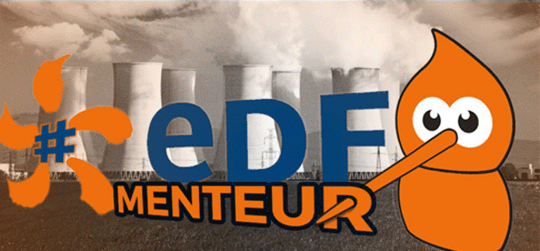 Times, 30 Sept 19 President Macron’s economy minister has accused the French state-owned
company building Britain’s new nuclear plant of “unacceptable” failings as he threatened sweeping change at the group.
denounced cost overruns and delays in the construction of the Hinkley Point C nuclear reactor in Somerset and similar projects in Flamanville in Normandy and Olkiluoto in Finland. “We will not accept this drift month after month, year after year,” Mr Le Maire said.
four-year term as chief executive of EDF by Mr Macron in February. Mr Le Maire said that he had ordered an independent audit into the French nuclear industry, which provides about 75 per cent of nation’s electricity, and into the decision to build a new generation of the increasingly questioned European pressurised reactors in Britain, France, Finland and China.
that Hinkley Point C would cost £3 billion more than expected and may not meet its latest launch date of 2025, which is already eight years late.
https://www.thetimes.co.uk/article/2a8ccefa-e2e8-11e9-bc3e-661ff0438ed9
UK energy chief advises that Hinkley Point nuclear project should be scrapped
Telegraph 28th Sept 2019 Scrap Hinkley Point: nuclear plant is expensive and out of date, says Ovo Energy chief, Britain’s next nuclear power plant should be scrapped because it is wastefully expensive and out of date, according to the boss of Ovo Energy. The industry should instead look to the future with ever-cheaper renewable energy, said Stephen Fitzpatrick, the founder and chief executive of the group that will soon be the UK’s second-biggest supplier as Ovo acquires SSE’s consumer business.
“We should just call it a day. I thought at the time the deal was struck at £92.50 per megawatt
hour (MWh), inflation-linked, that it was a bad deal for customers. Unfortunately the technology, the design it is based on, is unproven,” he said. “Looking at the cost for customers of renewables, solar, and wind, the cost just keeps coming down. The cost for nuclear keeps going up.
It strikes me that this does not represent value for money for consumers, never more so than this week when the cost went up by £2.9bn.” The Hinkley Point C reactor will cost up to £22.5bn to build as costs keep rising above initial plans.
Mr Fitzpatrick would prefer the industry to invest in restructuring the energy network to handle more renewables, including the variable supply of wind and solar. This could be handled in
part with a “smart network” using batteries to handle shifting supply and demand.
“If you think about the £39/MWh that was achieved at the last auction for offshore wind, and when Hinkley Point goes live it is going to be about £100 more per MWh some time in the late 2020s,” he said. “If we make smart decisions and focus on value for money and what is best for the end consumer, I am quite sure we can keep costs [of decarbonising thenetwork] under control.” https://www.telegraph.co.uk/business/2019/09/28/scrap-hinkley-point-nuclear-plant-expensive-date-says-ovo-energy/
Nuclear waste is piling up – governments need to stop dithering and take action
Nuclear waste is piling up – governments need to stop dithering and take action https://theconversation.com/nuclear-waste-is-piling-up-governments-need-to-stop-dithering-and-take-action-123977 Claire Corkhill
Research Fellow in nuclear waste disposal, University of SheffieldSeptember 26, 2019 The UK government has launched a process to find a volunteer community who would be willing to host a £12 billion geological disposal facility for nuclear waste. It’s about time – the initiative comes after seven decades of successive governments putting the decision off. The situation is similar in many other countries, with dangerous nuclear material being stored unsafely because of political inaction.
In the UK, nuclear waste is currently kept in safe but high-maintenance conditions, with some canisters deteriorating, at Sellafield in Cumbria. This is costing tax payers £3 billion per year.
The new geological disposal facility is a vast underground bunker, to be buried around 500m below the Earth’s surface. It is intended to safely store approximately one Wembley Stadium’s worth of highly radioactive waste that has been generated over the past 70 years. Here, it will be isolated from the biosphere – and human populations – for the 100,000 years it will take for the radioactivity to decay to safe levels.
Radioactive waste is generated from nuclear energy, military uses and also the extensive use of isotopes in medicine. The most highly radioactive portion comes from spent nuclear fuel – the used uranium fuel from inside nuclear reactors and the materials produced through recycling of spent nuclear fuel. The latter includes fission products that are transformed to glass and plutonium (which is currently neither a resource nor a waste).
These materials contain radioactive isotopes that have half-lives (the amount of time taken for half of the radioactivity to decay) of tens to hundreds of thousands of years. This means any storage solution must be extremely long-lived. That’s a significant challenge – the oldest known man-made materials are of the order of several thousands of years old.
The principle of geological disposal of nuclear waste is to use multiple barriers, much like a set of Russian Dolls. This makes it possible to contain the waste and prevent it from meeting with groundwater which would start to dissolve it – releasing radioactive materials to the environment. Engineered barriers are intended to contain the waste until most of the radioactivity has decayed.
If the disposal vaults are dug in a good, impermeable rock (such as clay or mudstone), the geology provides a natural barrier that will isolate the waste from the biosphere. This will reduce the likelihood of human intrusion into the facility. Being several hundreds of metres below the ground, there will also be long transport pathways to delay any significant migration of radioactive materials from the waste to the biosphere until far into the future.
International issue
The UK is not the only country opting for this solution. In Finland, construction of the Onkalo facility has already begun. A licence application has even been made to start disposing of spent nuclear fuel.
But progress in other nations has stalled: in France protesters surround the disposal facility in the village of Bure, while in Sweden, the Environmental Court has rejected the construction licence for a facility near the coastal town of Forsmark, due to safety concerns over the corrosion resistance of copper canisters.
In the USA, senators are suing the Federal Government for not building a disposal facility. The lack of a disposal facility has meant that thousands of metric tonnes of spent nuclear fuel, have built up – stored temporarily in dry casks at sites across the country.
The controversy is expected to extend to the UK’s new geological disposal siting process. Recent media articles have criticised the idea that see all areas of the UK – including national parks – could be suitable to host a facility. A previous siting process, launched in 2003, failed to find a site. Although two local authorities from near the Sellafield site came forward, Cumbria County Council was able to veto the vote.
The government hopes that new communities will step forward in this second process. It has proposed an incentive package offering communities £1m per year for having discussions about hosting the facility. This will increase to £2.5m per year when geological investigations are undertaken.
But environmentalists are likely to object, as they fear a better storage facility will only lead to more nuclear power stations. And indeed, Oliver Eden, former parliamentary undersecretary for energy under Theresa May’s government between 2017-2019, highlighted the disposal facility as being “the key to the future of the UK’s new nuclear build programme … providing a safe and secure way to dispose of the waste new nuclear reactors produce.”
Whatever the outcome of the current siting process, something must be done about nuclear waste. Leaving it for our grandchildren to deal with is simply not fair. What’s more, we can’t assume that future civilisations will be able to keep it safe.
The first step on the road to a solution is to initiate a public conversation about what we should do with the world’s most dangerous materials in the long term. If you are interested, a good first step could be to watch the video above and start discussing the topic with your friends, family and local authorities.
Russia’s deadly explosion in August has awakened Russians to the nuclear danger
|
Blast, Radiation Unnerve Russians Living Near Test Site Deadly August explosion during missile trial was wake-up call; ‘We’re worried it could happen again’ WSJ, By Ann M. Simmons The Wall Street Journal, Sept. 25, 2019 SEVERODVINSK, Russia—For decades, the Russian military conducted trials at a restricted site near this northern city, testing missiles that Moscow loaded onto Cold War-era submarines. Residents paid little heed for years. That changed on Aug. 8, when an explosion during a missile test killed at least seven people and caused radiation levels to spike in the area around Severodvinsk. U.S. officials said the explosion confirmed that Russia is endeavoring to develop high-grade specialized nuclear weapons, as Moscow makes fresh efforts to produce a new generation of arms capable of overcoming U.S. defense systems. University student Alexandra Volkova closed all her windows when she heard about the blast hours after it occurred, but is afraid she acted too late. “I’m not sure if I have been exposed to radiation,” the 22-year-old said. “I’m not sure whether it’s a serious problem. I’m not sure whether I should have taken some iodide.”……… Russian President Vladimir Putin said the incident occurred during the test of a “promising weapons system” and praised the personnel who perished as national heroes.
The demise in August of the 1987 Intermediate-range Nuclear Forces Treaty lifted decades-old constraints on Russia and the U.S. on developing nuclear and conventional ground-based ballistic and cruise missiles with ranges of 300 to 3,400 miles.
It is now unclear whether a parallel accord, New START, which limits U.S. and Russian long-range nuclear arms, will be renewed when it expires in 2021. The Kremlin hasn’t named the weapon that was being tested in the explosion in an area called Nyonoksa, which a CIA report declassified in 2013 described as a prominent weapons testing site. Experts believe the explosion resulted from Russia’s failed test of its nuclear-powered Burevestnik missile, known as Skyfall, which it started developing in the 2000s. Mr. Putin unveiled the weapon last year in a slick animated video, showcasing a guided missile gliding untracked over oceans and circumventing air-defense systems. The Kremlin has described the missile as virtually unstoppable, with potentially unlimited range and an unpredictable flight pattern. Little is publicly known about it. Matt Korda, a research associate for the Nuclear Information Project at the Federation of American Scientists in Washington, said it wouldn’t be an overstatement to describe it as “a kind of flying Chernobyl,” referring to the 1986 nuclear accident at this Soviet nuclear power plant.
If completed, Skyfall would be an “unshielded nuclear reactor that’s essentially just flying around pumping out radiation,” Mr. Korda said. The accident sowed concerns among residents around Severodvinsk, home to a naval base and around 183,000 people. “As far as we knew, there was never any nuclear testing here and there had never been any accidents with radiation involved,” said Oleg Mandrykin, a businessman and environmental activist in the city. “People died because of this explosion, because of high exposure to radiation,” he said. “Now people here are worried because they just don’t understand what happened.” Russian authorities’ Soviet-era style secrecy in the aftermath of the explosion exacerbated fears. A notice on the Severodvinsk city website announcing a spike in radiation levels following the blast was quickly deleted. An initial order for residents of Nyonoksa to evacuate was canceled. And at least four Russian monitoring stations designed to detect nuclear radiation were switched off soon after the blast, the Comprehensive Nuclear-Test-Ban Treaty Organization said. Authorities in Severodvinsk, where foreigners still need official permission to visit, didn’t respond to requests for comment on the statements following the incident and accusations that officials are deceiving the public about the severity of the radiation and the current risk. https://www.wsj.com/articles/blast-radiation-unnerve-russians-living-near-test-site-11569403801
|
|
|
1 This Month
23-25 October – on Zoom – World BEYOND War’s annual global conferenc


Shut down the radiation-damaged Heysham nuclear reactors now
To see nuclear-related stories in greater depth and intensity – go to https://nuclearinformation.wordpress.com

Say No to NASA’s Reckless Nuclear Reactor on the Moon
Say No to NASA’s Reckless Nuclear Reactor on the Moon
-
Archives
- October 2026 (170)
- September 2026 (339)
- August 2026 (330)
- July 2026 (355)
- June 2026 (287)
- May 2026 (306)
- April 2026 (356)
- March 2026 (251)
- February 2026 (267)
- January 2026 (308)
- December 2025 (358)
- November 2025 (359)
-
Categories
- 1
- 1 NUCLEAR ISSUES
- business and costs
- climate change
- culture and arts
- ENERGY
- environment
- health
- history
- indigenous issues
- Legal
- marketing of nuclear
- media
- opposition to nuclear
- PERSONAL STORIES
- politics
- politics international
- Religion and ethics
- safety
- secrets,lies and civil liberties
- spinbuster
- technology
- Uranium
- wastes
- weapons and war
- Women
- 2 WORLD
- ACTION
- AFRICA
- Atrocities
- AUSTRALIA
- Christina's notes
- Christina's themes
- culture and arts
- Events
- Fuk 2022
- Fuk 2023
- Fukushima 2017
- Fukushima 2018
- fukushima 2019
- Fukushima 2020
- Fukushima 2021
- general
- global warming
- Humour (God we need it)
- Nuclear
- RARE EARTHS
- Reference
- resources – print
- Resources -audiovicual
- Weekly Newsletter
- World
- World Nuclear
- YouTube
-
RSS
Entries RSS
Comments RSS

