nuclear-news

The News That Matters about the Nuclear Industry Fukushima Chernobyl Mayak Three Mile Island Atomic Testing Radiation Isotope

Nuclear industry in Japan – as corrupt as ever?

Hidden gold, ‘murky’ payoffs threaten Japan nuclear revival,  Straits Times,  TOKYO (BLOOMBERG) 9 Oct 19, – A payoff scandal has struck Japan’s nuclear world, threatening to delay the restart of idled reactors in what’s becoming the industry’s biggest crisis since the Fukushima meltdown of 2011.The issue, which emerged at the end of last month, centres around how an influential municipal official in a town that hosts a nuclear plant spent years doling out large gifts to executives of its operator, one of the country’s biggest power producers.

It’s an example of how big business and small towns work together, sometimes at the expense of corporate governance.

The payments to senior management at Kansai Electric Power Co included hundreds of millions of yen, US currency, vouchers for tailored suits and even gold coins hidden in a box of candy.

To make matters worse, the official in question was close to – and received money from – a company that won construction work from the utility.

The news is a blow to an already deeply unpopular industry as it seeks to resume operations at plants that were shuttered after Fukushima. It’s likely to have an impact beyond Kansai Electric, with the government’s top spokesman, who called the payoffs “murky,” vowing to investigate whether there are similar cases at other companies.

It’s also a headache for Prime Minister Shinzo Abe, who has set his stall as a proponent of nuclear power, a cheaper source of energy than imported fuels such as oil, coal and natural gas. And questions in Parliament about the scandal may delay Mr Abe’s efforts to pass a US trade deal and proceed towards changing the country’s pacifist Constitution.

…….The scandal is the latest exposure of governance issues at Japanese companies, which include the arrest last year of Nissan Motor Co’s chairman for concealing more than US$140 million (S$193 million) in compensation and Kobe Steel’s indictment in 2018 for falsifying quality data.

Kansai Electric chairman Makoto Yagi and president Shigeki Iwane bowed in apology at a three-hour public briefing last week as they detailed how they and 18 other executives received almost 320 million yen (S$4.12 million) in cash and presents from 2006 to 2018 from Mr Eiji Moriyama, the former deputy mayor of Takahama town, where a nuclear power plant is located. Mr Moriyama died at the age of 90 in March……..

The immediate risk for Kansai Electric is that the issue may delay the restart of three of its reactors, including two in the town in question, Takahama. Every month a reactor stays offline saddles the utility with extra fuel costs of 3.6 billion yen ……….

Kansai Electric’s investigation will leave no stone unturned to determine the cause and events surrounding the payments, the company said in an e-mailed response. The utility will also make efforts to ensure that this type of incident doesn’t happen again, it said.

In a sense, the goings-on at Kansai Electric suggest things haven’t changed in the nuclear industry. They mirror what independent investigators said in a 2012 report led to the scale of the Fukushima meltdown: collusion between government officials and a power company.

“This is the nuclear village at its worst,” Temple University’s Mr Kingston said, referring to the nexus of companies, politicians, bureaucrats and others that promote atomic power. “The cosy and collusive ties are a hotbed of corruption and raise questions about other plants.” https://www.straitstimes.com/asia/east-asia/hidden-gold-murky-payoffs-threaten-japan-nuclear-revival

October 10, 2019 Posted by | Japan, secrets,lies and civil liberties | Leave a comment

Drones a threat to nuclear facilities

Korea Times 6th Oct 2019, National infrastructure sites are vulnerable to possible drone strikes, with a growing number of intrusions at nuclear power plants here using the small unmanned aircraft being confirmed, according to a lawmaker, Sunday.
Rep. Lee Sang-min of the ruling Democratic Party of Korea (DPK) said the
Nuclear Safety and Security Commission (NSSC) reported 13 cases of the
illegal flying of drones near the power plants from 2015 to 19. Ten of the
13 cases occurred just in 2019 ― and six took place near the Kori Nuclear
Power Plant in northern Busan in August.
https://www.koreatimes.co.kr/www/tech/2019/10/133_276717.html

Bulletin of Atomic scientists 4th Oct 2019, A terrorist attack by swarming drones may seem farfetched, and it is important not to engage in hyperbole. However, scenarios similar to this are playing out around the world, often in a hostile manner. Once again, the recent attacks on Saudi Arabia should give pause for concern. At least 18 drones and seven cruise missiles were reportedly used to break through national defenses and strike the designated targets in Abqaiq and Khurais.
The use of these systems in swarms makes tactical sense, as it increases
the likelihood of a successful strike, by overwhelming and saturating
defenses. Drones may also be used to help identify targets, allowing
secondary systems to strike with precision. In a different, but not
unfamiliar manner, swarms have been used for saturation, spotting, and
strike purposes by both criminal gangs and terrorists.

https://thebulletin.org/2019/10/the-dark-side-of-our-drone-future/

October 10, 2019 Posted by | safety, Taiwan | Leave a comment

The nuclear industry looks to Trump to bail them out

US nuclear, uranium mining industries hope for Trump bailout  https://www.washingtonpost.com/national/us-nuclear-uranium-mining-industries-hope-for-trump-bailout/2019/10/09/3a857ff2-eaca-11e9-a329-7378fbfa1b63_story.html By Ellen Knickmeyer, Felicia Fonseca and Mead Gruver | AP, October 9 19

WASHINGTON — A plea from uranium mining companies and nuclear power plant operators for tax breaks and other federal financial boosts is going before President Donald Trump, as his administration studies reviving the U.S. uranium industry in the name of national security.

Trump is scheduled to receive recommendations Thursday from a task force of national security, military and other federal officials about ways to revive U.S. uranium mining, which has lagged against global competition amid low uranium ore prices.

Uranium is a vital component for the country’s nuclear arsenal, submarines and nuclear power plants. U.S. uranium users get about 10% of their supply from domestic sources, the federal Energy Information Administration has said. Most of the rest comes from Canada and Australia, followed by Russia and former Soviet republics.

U.S. uranium mining interests have pushed Trump to require uranium users to get 25% of what they use from domestic suppliers, saying the global market is vulnerable to geopolitical turmoil. Trump rejected the quota idea this past summer and gave the task force 90 days to come up with other ideas.

An Aug. 18 letter from the Nuclear Energy Institute industry group laid out the sector’s requests, including a recommendation for the Defense Department to procure more domestic uranium for military needs and for subsidies for electric utilities or uranium producers for the production of up to 3 million pounds (1.4 million kilograms) of partially processed uranium yearly.

Nuclear power plants, which have been suffering in the U.S. marketplace against cheaper natural gas and renewables, also are seeking assistance. Plant operators and utilities had opposed the production quota sought by mining interests.

“There are reactors out there that are financially in difficulty,” Matthew Wald, a Nuclear Energy Institute spokesman, said this week. “We would like to see a thriving domestic uranium industry … We don’t want something that will raise the costs of domestic reactors.”

If the Trump administration ever imposes sanctions against Russia, that could limit the U.S. uranium users can get from that country, said Curtis Moore, a spokesman for Colorado-based Energy Fuels Inc., a uranium mining company.

“Do we really want to put our energy security and national security in the hands of our adversaries? That’s just not smart policy,” Moore said.

But conservation groups and other opponents said the U.S. has enough uranium stockpiled to supply decades’ worth of defense needs. They argue the availability of high-quality imported uranium from close allies, including Canada, means more taxpayer support for the industry is unnecessary.

U.S. uranium producers want “the federal government to prop up their industry through enormous subsidies and self-serving quotas,” plus easing of environmental protections and the opening of more public land for mining, said Randi Spivak, public lands program director for the Center for Biological Diversity.

“It’s not a national security issue,” she said.

The nuclear power industry is “trying to leverage the ‘America First’ moment to get more government financial support for the operating fleet,” said Edwin Lyman, a nuclear expert with the Union for Concerned Scientists advocacy group.

Other industry requests to a working group made up of representatives from the Pentagon and agencies including the Commerce and Energy departments include vastly expanding a U.S. uranium reserve that could be tapped in times of supply disruption.

The American Assured Fuel Supply Reserve established in 2011 currently has six so-called “reloads” of low enriched uranium. A nuclear plant needs reloading with processed fuel at least every two years. The U.S. over the next seven to 10 years should expand the reserve to 30 reloads, or 25 million tons of partially processed uranium ore, the industries say.

Some uranium mining companies also have said Trump should reconsider his July decision not to limit imports by reserving 25% of U.S. uranium use for domestic producers.

The administration already has done plenty to ease environmental and other regulations and at this point, only tariffs and quotas would “move the needle” to help the industry, said Travis Deti, director of the Wyoming Mining Association, which represents the state’s mining companies.

Most uranium in the U.S., including all of it from Wyoming, is mined by pumping a solution of water and chemicals into uranium-bearing deposits underground. The water is then pumped to the surface and ore is extracted.

One of the richest known reserves of uranium ore spans parts of northwestern New Mexico. Previous booms in what was once known as the uranium capital of the world occurred during the 1950s and again in the 1970s. Environmentalists have been fighting to prevent future mining in the region and in Arizona around the Grand Canyon.

Amber Reimondo of the Flagstaff, Arizona-based Grand Canyon Trust says she fears moves to boost domestic uranium mining could end protections put in place during the administration of President Barack Obama for uranium-bearing lands outside Grand Canyon National Park.

Uranium mining in the Southwest during the atomic age left a legacy of death and disease, Reimondo said. Hundreds of uranium mines that dot the Navajo Nation, for example, have not been cleaned up. The tribe, whose reservation extends into New Mexico, Utah and Arizona, banned uranium mining and transport on its lands in 2005.

“When people talk about past uranium mining, they talk about it as if the problem is in the past, as if people aren’t still living with the consequences of uranium contamination and that uranium contamination can be segregated in some bubble when it just inherently lasts for longer than any of us can fathom,” she said. “We shouldn’t be meddling in that.”

Fonseca reported from Flagstaff, Arizona and Gruver reported Cheyenne, Wyoming. Associated Press writer Brady McCombs in Salt Lake City and Susan Montoya Bryan in Albuquerque, New Mexico contributed to this report.
October 10, 2019 Posted by | politics, USA | Leave a comment

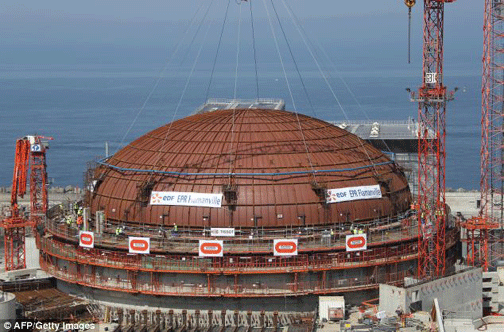
EDF’s Flamanville nuclear project – more costs, more delays

EDF adds further €1.5bn to Flamanville nuclear plant costs https://www.ft.com/content/fc6a8610-ea5e-11e9-a240-3b065ef5fc55  French energy group also confirms latest delay to opening of long-awaited project.

David Keohane in Paris 9 Oct 19, French energy giant EDF announced increased costs to its long-troubled flagship nuclear project at Flamanville on Wednesday as it confirmed delays to the opening of the plant due to faulty weldings. The company said construction costs would rise by €1.5bn to €12.4bn and the loading of nuclear fuel would be delayed until the end of 2022, which had previously been scheduled for the end of 2019 with commercial activity starting in 2020. The group, which is 83.7 per cent owned by the French government, had flagged the delays at the plant in north-western France to the end of 2022 during its half-year results in July. Flamanville was originally expected to cost €3.3bn and start operations in 2012.

Analysts at Morningstar said that the increase in costs was in line with estimates but warned “the worst-case scenario has not gone away totally” — alternative more expensive plans — since EDF had to get approval for its repair proposals by the end of 2020. This involves the use of remotely operated robots. Flamanville is considered a litmus test for the next-generation European Pressurised Reactor technology. One EPR is already up and running in China, but Flamanville remains the bigger test for EDF because it is 100 per cent owned by the company and the French regulators are known to be exacting. There are two other EPR projects being built in Europe: The Olkiluoto project in Finland, which is more than a decade late, and the UK’s Hinkley Point, which EDF warned in September would cost an extra £2.9bn to complete.

The news comes as EDF pushed back the formal presentation to the government of an internal reorganisation plan, called Project Hercules, which had been due by the end of the year, at the request of French president Emmanuel Macron.  Project Hercules will create a government-owned mother company, EDF Bleu, containing the nuclear assets as well as hydroelectric assets. Bleu’s main subsidiary, EDF Vert, will house renewable energy, the networks and the services businesses and will be listed, with some 20 per cent to 40 per cent sold to raise funds.

The quid pro quo for the reorganisation, as seen by EDF, is a new regulated price for nuclear energy, assuming it can be agreed with Brussels. However, Project Hercules has been deferred due to delays in discussions with Europe. In an internal email to staff sent late last week, EDF chief executive Jean-Bernard Lévy said “a reorganisation without better regulation would not be enough to give EDF the financial means to play its role in the investments necessary for the success of [France’s] energy transition”.

October 10, 2019 Posted by | France, politics | Leave a comment

Global Nuclear Power Reactor Closures Creep Up to 181, Report Says

Global Nuclear Power Reactor Closures Creep Up to 181, Report Says

BY EXCHANGE MONITOR, 9 Oct 19
A total of 181 nuclear power reactors around the world have been retired as of July 1, but only 19 of those have been fully decommissioned, according to the 2019 version of the World Nuclear Industry Status Report. The number of shuttered reactors rose by eight…. (subscribers only)  https://www.exchangemonitor.com/global-nuclear-power-closures-creep-181-report-says/

October 10, 2019 Posted by | Uncategorized | Leave a comment

USA Congress needs a new approach to the intractable problem of nuclear wastes

nuclear and climate change. While many argue that we have to do everything in our power to bolster nuclear energy in order to effectively fight the climate crisis, bluntly, nuclear energy is not a realistic solution

The price tag for new nuclear is too high and the timeline for expansion too long—Plant Vogtle and VC Summer show us that. And while nuclear reactors may not directly emit greenhouse gases, that doesn’t mean that it’s a clean energy source. There are significant traditional environmental impacts from nuclear energy, primarily regarding radiation risks and impacts to water quality. Then there’s the effects climate change will have on the functioning and safety of nuclear plants themselves. The more we look at the issue, the more we see that sea level rise and heat waves risk the safety and dependability of nuclear plants. 

It’s Time to Bury These Nuclear Waste Talking Points https://www.nrdc.org/experts/caroline-reiser/its-time-bury-these-nuclear-waste-talking-points

October 09, 2019 Caroline Reiser

This year we’re seeing yet another attempt from Congress to address the fifty-year problem of what to do with the 80,000 tons of nuclear waste sitting across the country, with approximately 2,000 more tons produced every year by the 96 operating U.S. nuclear reactors. Unfortunately, the multiple nuclear waste bills that sprung up in both the House and Senate (including H.R.2699 which just cleared an Energy and Commerce subcommittee) simply offer the same worn out ideas.

So when NRDC was invited to testify—first by the Senate Committee on Environment and Public Works, then by the House Subcommittee on Environment and Climate Change, and finally by the Senate Committee on Energy and Natural Resources—we decided to present a new way forward.

NRDC has an answer to one difficult fact everyone at the hearings seemed to agree on—that all the important actors in the process have utterly lost trust in one another. As NRDC senior attorney Geoffrey Fettus explained: “Our government is at its strongest when each players’ role is respected. State consent and public acceptance of potential repository sites will never be willingly granted, unless and until power on how, when, and where the waste will be disposed of is shared, rather than decided by federal fiat.”

Trust—especially in a dangerous undertaking like deep geologic storage of nuclear waste—can only flourish when there is an equal balance of power. And consent to host a permanent nuclear waste repository will only be granted when states can trust the deal they are making. Right now, however, there is no equal balance of power and therefore states don’t trust that they can consent to hosting any nuclear waste without being forced to open their doors to the country’s entire waste burden.

Strong environmental laws founded on federalism have a proven track record on precisely this point. But because there has been a presumption of federal exclusivity over it, nuclear waste is exempt from environmental laws and therefore also exempt from the state and EPA regulatory oversight that comes with them. We think this needs to change. Giving states the regulatory authority over nuclear waste that they currently lack will build trust and allow states to consent on realistic scientific and political terms.

We presented this idea before all three Congressional Committees with growing interest from members. (See NRDC’s testimony herehere, and here). And yet Congress is still reluctant to move away from common talking points which have only led to the repeated failures of the past. So let’s take a minute to debunk some of those repetitive points.

First incorrect talking point: Yucca Mountain. Let’s be clear about how we got stuck on Yucca Mountain and why proceeding pretending that it is a ready or wanted solution is naive.  Yucca Mountain was not picked as the permanent nuclear waste repository because it is the best scientifically and technically sound site. Originally, the law set out an adaptive, phased, and science-based process to narrow down potential repository sites. But in 1987, faced with the high cost of comprehensively comparing multiple potential sites, Congress abandoned all pretext of equity and scientific-basis, and instead simply picked the most politically expedient choice at the time, Yucca Mountain.

But Yucca Mountain did not remain the expedient, or for that matter the rational, choice. The science simply doesn’t line up—of particular note are the serious groundwater concerns with the site. And Nevada has been able to stand together for decades to say with one voice: “No!” If the Yucca Mountain process does ever get moving again, Nevada and its supporters are on-deck with the science to prove it’s a bad choice.

Nevada isn’t unique in rejecting any hint of a proposal to host nuclear waste. Utah, Tennessee, South Dakota, New Mexico, and Texas have all rejected nuclear waste storage just as firmly. This is why we need a new system that allows for real consent backed with state authority.

Second incorrect talking point: waste is holding the industry back. At the hearing before the House Energy and Climate Change Subcommittee, the expert witness from the Nuclear Energy Institute stated that the failure to address nuclear waste is “the albatross on the neck of the nuclear industry.” While this reference to Coleridge’s poem The Rime of the Ancient Mariner is a nice use of imagery to describe waste as the industry’s self-inflicted burden and curse, it’s a façade for the larger truth.

Since at least 1957, there has been consensus that nuclear waste must end up in a geologic repository. But no repository has been developed and licensed to address the 80,000 tons of nuclear waste from nuclear power plants that has been piling up in 35 states. And yet over the same timeframe more than 100 domestic commercial reactors were built. Even today two new reactors are being built at Plant Vogtle in Georgia with little discussion on how much it will add to the country’s nuclear waste burden.

So what is the real albatross on the nuclear industry’s neck? The gigantic up-front costs of building nuclear reactors and a lack of economic competitiveness in modern energy markets.

Existing nuclear plants exist thanks to decades of direct subsidies and legal protections provided by the federal government. These reactors are now at risk of early closure because they are no longer economical, have potential safety issues, and simply cannot compete in a marketplace dominated by low-priced natural gas and renewable energy.

The failed VC Summer plant in South Carolina and the on-going Vogtle construction in Georgia are stark examples of how the astronomical up-front costs of new reactors limit expansion of the nuclear industry. $9 billion went into the VC Summer project before the plug was pulled and Vogtle is now estimated to cost approximately $28 billion—twice its originally projected cost. (This isn’t just a US problem either).

It’s not nuclear waste that’s burdening nuclear growth, it’s simple economics.

Third incorrect talking point: reprocessing. While the process of using nuclear waste to create more fuel for energy production seems like a magic wand to wave away the nuclear waste problem, it ignores the reality of reprocessing. Reprocessing doesn’t just create more fuel for energy; it also separates plutonium, dramatically increasing the threat of nuclear proliferation. Further, reprocessing doesn’t consume all the nuclear waste—it has its own radioactive toxic waste streams like the Cold War legacy of reprocessing to create nuclear weapons left in Washington, South Carolina, and Idaho.

And even if you could ignore these bad by-products, reprocessing is simply not economic. Plants that use reprocessed fuel are even more expensive than the traditional nuclear plants that already struggle with upfront costs. So, while on the surface reprocessing may seem like the answer to our 80,000-ton problem, the truth is that reprocessing should never be on the table.

Final incorrect talking point: nuclear and climate change. While many argue that we have to do everything in our power to bolster nuclear energy in order to effectively fight the climate crisis, bluntly, nuclear energy is not a realistic solution.

The price tag for new nuclear is too high and the timeline for expansion too long—Plant Vogtle and VC Summer show us that. And while nuclear reactors may not directly emit greenhouse gases, that doesn’t mean that it’s a clean energy source. There are significant traditional environmental impacts from nuclear energy, primarily regarding radiation risks and impacts to water quality. Then there’s the effects climate change will have on the functioning and safety of nuclear plants themselves. The more we look at the issue, the more we see that sea level rise and heat waves risk the safety and dependability of nuclear plants.

This is why NRDC has laid out a clean energy pathway to cost-effectively reach a low-carbon future while allowing the role of nuclear energy to continue its decline.

Rather than continue to blunder blindly down a legislative path that only leads us through the same unrealistic circles of conversation laid out above, it is time for Congress to take a step back and forge a new path by regulating nuclear waste under standard environmental laws. This is a way to get states to say “yes,” and in a way that can work in our democracy.

That’s not to say that this change will be like waving a wand and suddenly all the waste is gone. But it’s a new direction with real potential because it relies on well-established laws. It is time to regulate nuclear waste the same way as every other pollutant, with the federal government and states sharing authority under our foundational environmental statutes. Now we just need someone brave enough to lead the way.

October 10, 2019 Posted by | USA, wastes | Leave a comment




