Close security on village where France’s nuclear waste inquiry commission works
The nuclear product burial project at Bure (Meuse) has been under study
for twenty years. Highly sensitive, this site is subject to several
controversies. The material will remain radioactive for several hundred
years.
The village of Soudron (Haute-Marne) is placed under close
surveillance. The small town of 40 inhabitants has almost as many
gendarmes, who came to ensure the safety of the public inquiry commission,
which collects the opinion of the inhabitants on the project of burying
radioactive waste 500 meters underground. A laboratory was built for the
occasion in a layer of clay, at great depth.
France TV 21st Oct 2021
France: public inquiry into disposal of nuclear waste
Cigeo project: the public inquiry into the burial of radioactive waste
ends. More than 3,000 contributions were collected, mainly on the digital
register, for this stage prior to a possible declaration of public utility.
The commission of inquiry is expected to report in December 2021.
Ouest France 23rd Oct 2021
Growing movement to stop the dumping of radioactive wastes into the Severn Estuary
Save the Severn Estuary is a non-partisan coalition of scientists,
experts, individuals and organisations calling on the Marine Management
Organisation (MMO) to revoke the license granted to EDF (Électricité de
France) which allows for the dumping of sediment contaminated by the
Hinkley nuclear power stations in the Severn Estuary near Portishead.
This is a consequence of building a water intake for the new power station which
in itself will kill millions of fish when operational. Please also make a
donation towards the costs of legal action we are taking. We have set up a
company for this purpose in order to make the fundraising easier. We are
represented by Leigh Day, and the legal case seeks the quashing of EDF’s
license. In order to proceed with a judicial review against the MMO, we are
aiming to raise £60,000 to cover all of the costs associated with the
legal action. We need your support: please contribute and share this page
now!
Crowd Justice (accessed) 22nd Oct 2021
https://www.crowdjustice.com/case/save-the-severn-estuary/
France may have hidden agenda in promoting small nuclear reactors

“Countries that are clinging on to nuclear power are often nuclear weapon states — such as the UK, the US and France,” he explained, and pointed to a speech by Macron in December 2020.
“Without civil nuclear power, no military nuclear power; and without military nuclear power, no civil nuclear power,” the president had said
Do France’s plans for small nuclear reactors have hidden agenda? DW, 22 Oct 21,
Although France plans to invest in small modular nuclear reactors, experts doubt that this is ecologically and economically sensible. Yet it may be more about geopolitical strategy than energy.”…… A French law says the country will have to reduce its share of nuclear energy from currently roughly 70% — the highest in the world — to 50% in 2035, a goal President Emmanuel Macron has in the past called unrealistic.
But in pursuing small modular reactors (SMRs), some experts believe France may have a hidden agenda.
€1 billion planned investment
Recently, the president announced plans to invest in so-called small modular reactors (SMRs) “to lead the sector with groundbreaking innovations.” The new reactors are ostensibly to help France reduce its CO2 emissions.
The announcement came when Macron unveiled his France 2030 investment strategy of €30 billion ($35 billion) at the Elysee Palace.
“We have a decisive competitive advantage — our historical model, the existing nuclear power plants,” the president said during the ceremony.
The strategy allocates €8 billion to the development of hydrogen power and only €1 billion to SMRs, yet Macron declared the plans to develop the small plants “goal No. 1.”
The country’s SMRs will have a capacity of 50 megawatts to 500 MW each – considerably less than France’s current reactors with their capacity of up to 1,450 MW. SMRs are to be built in clusters to increase sites’ total capacity.
But nuclear champion France is not the frontrunner in the SMR race — the US is……
France’s first demonstration plant is only scheduled to be completed in 2030.
And yet, Nicolas Mazzucchi, of the Paris-based Foundation for Strategic Research, thinks the country could take the lead in the sector………
A discussion based on ‘hot air’
But Mycle Schneider thinks nuclear energy is inefficient in the fight against the climate emergency — “too expensive, too slow,” he says. He’s the editor of the annual World Nuclear Industry Status Report (WNISR), which assesses trends in the global nuclear power industry.
“Last year, more than 250 GW of renewable energy capacity has been added to the grid and only 0.4 GW of net nuclear capacity — nuclear power has become irrelevant,” he asserted.
Schneider says nuclear power plants only appear to be more reliable than renewables: “France’s nuclear reactors, on average, had to be switched off during one-third of the time in 2020, mostly due to maintenance, also as they now have been running for a long time, on average more than 35 years.”
“The discussion around SMRs is orchestrated hot air and has become hugely hyped,” he explained to DW.
He added that renewables had to be seen as a bouquet of different energies. Through demand response management, one type of energy could offset the temporary unavailability of the other. Environmentalists also often point out that construction of nuclear power plants has a significant carbon footprint.
“It takes ages to build new nuclear power plants,” Schneider added. French utility EDF and Siemens started to develop EPRs, a third-generation pressurised water reactor design, after the Chernobyl nuclear catastrophe in 1986, he explained. “And 35 years on, there’s still no EPR in Europe up and running.”
EDF is building a 1.6 GW EPR in Flamanville in northern France. But constructing the plant will exceed €11 billion, instead of the initially planned €3.3 billion, and the EPR is only scheduled to be completed next year — 10 years later than initially intended.
Nevertheless, President Macron could soon announce plans to build six additional EPRs in France.
Nuclear very capital-intensive
Such delays have Kenneth Gillingham, a professor of environmental and energy economics at Yale University in the US, wondering if investing in nuclear makes economic sense.
“The safety requirement for new nuclear plants are that strict, that constructing them becomes very costly and capital-intensive,” he told DW.
“I don’t really see why you would spend money on SMRs, especially as you don’t know if they will work in the end,” he said.
Philip Johnstone, a research fellow at the University of Sussex School of Business in southern England, thinks that SMRs turn the logic of economies of scale on its head.
Ulterior motives behind investment in SMRs
“We were told all along that building bigger nuclear plants would help us save money through the scale effect, and now it’s supposed to suddenly work the other way around?” Johnstone told DW.
He believes that France has other reasons for continuing to invest in nuclear energy.
“Countries that are clinging on to nuclear power are often nuclear weapon states — such as the UK, the US and France,” he explained, and pointed to a speech by Macron in December 2020.
“Without civil nuclear power, no military nuclear power; and without military nuclear power, no civil nuclear power,” the president had said, praising a sector that employs 220,000 people in France.
“The investment in SMRs seems first and foremost a strategic decision, even though it means wasting a lot of time and money,” Johnstone said.
Time and money that could instead be more effectively invested in climate protection.
According to the United Nations, global CO2 emissions will need to be reduced by more than 7% percent each year until 2030 — based on the year 2019 — to limit global warming to 1.5 degrees Celsius (2.7 degrees Fahrenheit). https://www.dw.com/en/do-frances-plans-for-small-nuclear-reactors-have-hidden-agenda/a-59585614
Stop Sizewell C anti nuclear campaigners taking their fight to London, and the UK government
Campaigners fighting to stop a new nuclear power station being built on
the Suffolk coast have taken their battle to Number 10 Downing Street.
Ahead of the Chancellor’s spending review and Budget, the Stop Sizewell C
group visited key locations in the capital with its message and campaign
video on a digital Advan.
East Anglian Daily Times 20th Oct 2021
https://www.eadt.co.uk/news/stop-sizewell-c-campaign-visits-downing-street-8428226
Nuclear industry ecstatic about costly UK’s nuclear policy, but in reality it is a low priority for the government

UK Net Zero Strategy puts nuclear as a low priority, Nuclear Engineering
22 October 2021 ”………………………………. Detail on plans for nuclear
The 368-page report itself does not include much about plans for nuclear. “The net zero economy will be underpinned by cheap clean electricity, made in Britain,” it says. “A clean, reliable power system is the foundation of a productive net zero economy as we electrify other sectors – so we will fully decarbonise our power system by 2035, subject to security of supply. Our power system will consist of abundant, cheap British renewables, cutting edge new nuclear power stations, and be underpinned by flexibility including storage, gas with CCS, hydrogen and ensure reliable power is always there at the flick of a switch….
By 2035 the UK will be powered entirely by clean electricity, subject to security of supply, the report notes. One of the key policies listed there is to: “Secure a final investment decision on a large-scale nuclear plant by the end of this Parliament, and launch a new £120 million Future Nuclear Enabling Fund, retaining options for future nuclear technologies, including Small Modular Reactors, with a number of potential sites including Wylfa in North Wales.”
The report says that, “in the past year, we have already taken important action on climate change, delivering on the commitments in the Prime Minister’s Ten Point Plan”. With respect to nuclear, it recalls that the government committed to delivering new and advanced nuclear power, including:
- Pursuing large-scale nuclear projects, subject to value for money;
- Legislating for a new financing model for nuclear projects;
- A £385 million Advanced Nuclear Fund to enable up to GBP215 million for Small Modular Reactors; and
- £170 million for a R&D programme on Advanced Modular Reactors.
…………….. The only detailed mention of nuclear is in the Power section (10 pages) of Chapter 3 on “Reducing Emissions across the Economy”. It constitutes just one of 14 listed key commitments, to “Secure a final investment decision on a large-scale nuclear plant by the end of this Parliament whilst taking measures to inform investment decisions during the next Parliament on further nuclear projects as we work towards our net zero target.”
There are 43 numbered paragraphs in the section. Nuclear is mentioned in paragraph 2 (subsection “Progress to date”) as follows:
“On delivering new and advanced nuclear power, we have committed to reaching a final investment decision on a large-scale nuclear plant this parliament, subject to value for money and approvals. We are in negotiations with the developer on Sizewell C project in Suffolk. We have since taken further steps.”
Nuclear is the subject of three small paragraphs in the sub-section “Policies and proposals”:
38. We also need to increase our nuclear capacity, which is why we said in the Energy White Paper that we will aim to bring at least one large-scale nuclear project to the point of final investment decision by the end of this Parliament, subject to clear value for money and all relevant approvals. In December 2020 we announced the start of formal negotiations on Sizewell C and those negotiations are ongoing. To facilitate a decision this Parliament, we plan to establish the Regulated Asset Base model to fund new nuclear projects at a low cost of capital, saving consumers money.
39. The government will also take measures to inform investment decisions during the next Parliament on further nuclear projects as we work towards our net zero target. This will include consideration of large-scale and advanced nuclear technologies, including Small Modular Reactors (SMRs) and potentially Advanced Modular Reactors (AMRs). As part of this, we are announcing a new £120 million Future Nuclear Enabling Fund to provide targeted support in relation to barriers to entry. Further details of how this fund will operate will be published in 2022 alongside details of a roadmap for deployment that takes into account value for money.
40. We are also providing funding for a SMR design through our £385m Advanced Nuclear Fund and are progressing plans for an Advanced Modular Reactor demonstrator in the early 2030s. Whether large- or small-scale projects, there remain a number of possible sites available for these options, including Wylfa in North Wales.
Industry reaction
The strategy was, nevertheless, enthusiastically received by the nuclear industry. Nuclear Industry Association Chief Executive Tom Greatrex said: “It is very welcome to see the government commit new money to the development of nuclear projects and set out its intention to bring Sizewell C to a Final Investment Decision. We need to invest quickly to clean up the grid by 2035 and ensure our energy security, so we look forward to seeing details of this new fund, money for SMR deployment and legislation for Regulated Asset Base financing coming forward soon.”
A US consortium led by Westinghouse and Bechtel immediately released a statement that was widely reported by the Welsh media. It noted: “We welcome the publication of the Government’s net zero strategy today and are pleased to see that nuclear power features prominently throughout the proposal as an intrinsic part of achieving the UK’s net-zero goals……………https://www.neimagazine.com/news/newsuk-net-zero-strategy-puts-nuclear-as-a-low-priority-9176564
l’association négaWatt reports on planned closure of nuclear reactors, and carbon neutrality to be achieved by reducing energy consumption and by renewables.

Caution, efficiency and renewables: the negaWatt scenario for achieving carbon neutrality. The association presents the broad outlines of the 5th edition of its prospective work, which provides for the closure of the last nuclear reactor in 2045. No construction of a new nuclear reactor, energy consumption halved, electricity production 100% from renewable energies …
The fifth edition of the scenario of the negaWatt association will undoubtedly contribute to fueling the debate, more and more lively in the context of the presidential campaign, on the contours of the energy transition. Although the association, led by independent experts, will not publish its detailed report until October 26, it unveiled its broad outlines
on Wednesday October 20.
Le Monde 20th Oct 2021
Mini nuclear reactors claim to be the cheap, effective, action for reaching net zero carbon emissions: UK and others are buying this!

Mini nuclear reactors vie for key role in UK’s push to hit climate targets, Ft.com 21 Oct 21, SMRs promise huge cost savings over traditional large-scale plans, Ever since the Wylfa nuclear power plant on Anglesey stopped generating electricity in December 2015, communities on the Welsh island that are supportive of atomic power have been waiting for its revival. This week that likelihood increased when the UK government named a site near where the old reactors are being decommissioned as a possible location for a new large-scale plant or the first place in the UK to host a new technology under development, known as small modular reactors (SMRs).

One of the big selling points of SMRs is that they promise huge cost savings over traditional large-scale reactors. Rolls-Royce, the UK engineering group which is leading a consortium to produce a UK design, expects the first five SMR reactors to cost £2.2bn each, falling to £1.8bn for subsequent units. The government’s decision this week to give nuclear a central role in its net zero emissions strategy has given fresh impetus to replacing Britain’s existing reactors, which are all due to be retired by the end of 2035. Ministers committed a total of £505m in funding to the nuclear initiative, which calls for a mix of large plants, SMRs and other emerging technologies.

More than £200m of that funding is soon expected to be channelled into the consortium led by Rolls-Royce. It has been seeking private match-funding so it can submit its SMR reactor design to the extensive regulatory approval process before the end of the year. Wylfa had been earmarked for a new plant under British plans to build a new generation of large-scale reactors, financed mainly by the private sector, that dates back to 2006. But successive governments have struggled to attract private capital to these projects, where cost-overruns are commonplace because of the engineering risks in such complex structures.
So far work has only started on one: Hinkley Point C in Somerset and costs have spiralled with the latest estimate put at £23bn. The developer behind the proposed Wylfa plant, Japan’s Hitachi, pulled the plug last year after failing to reach a financing agreement with the UK government, although a US consortium is trying to resurrect it.
The UK is not alone in pushing smaller reactors. Other governments around the world looking to tap nuclear power to meet their challenging decarbonisation targets are also showing interest in the technology. Along with the promise of much lower build costs, the smaller power plants are also attractive because of their footprint. The UK, for example, has a limited number of sites suitable for large plants.
France, one of the world’s leaders in nuclear engineering, this month announced €1bn in funding for state-backed utility EDF to develop its own SMR technology by the early 2030s. The technology is similar to existing pressurised water reactors that are used in nuclear power plants today. But the key difference is that the small, modular design would allow the parts to be built in factories ready for quick assembly at the chosen location. This, SMR advocates argue, not only cuts costs and the long lead times but also avoids many of the construction risks that bedevil larger plants………..
……. Rolls-Royce is tight-lipped about its SMR fundraising but Tom Samson, who heads the consortium, said he was in talks with a “number of interested investors and developers in deploying the technology”. If the design gets regulatory approval, a process that can take up to five years, Rolls-Royce believes it could complete its first 470 megawatt SMR plant by 2031. After that it expects to build two units a year.
At 470MW the plant would have a generating capacity similar to some of Britain’s earliest reactors but would be about seven times less capable than the proposed next large-scale plant in the UK: Sizewell C on England’s east coast.
………. Among those other options are what the UK dubs “advanced modular reactors”. One of the most viable designs looks to be a high temperature gas-cooled reactor. The technology is being tested in a number of countries, including Japan. The government set a target this week of having the first advanced modular reactor demonstrator in Britain “in the early 2030s”. But analysts question whether any of these technologies would be commercialised in time to help the UK reach its 2035 target for a carbon neutral grid.
Moreover, some environmentalists argue a big challenge is the UK’s lack of experience with modularisation manufacturing techniques that are key to their economics. “We have never done it,” said Tom Burke, co-founder of E3G, a climate think-tank, arguing that modularisation would require a “very large factory” that could only be funded with a long line of orders.
Burke questioned how it would be possible to secure those orders when the first SMR is, as yet, unproven. But Rolls-Royce’s Samson remains unfazed. In contrast to future large atomic plants, which are likely to require a financing model that will be underpinned by British households through their energy bills, modularisation promises a radical shift in funding nuclear power. He conceded that government backing would be needed to help finance the initial manufacturing set-up and first orders but insisted private capital would ultimately pay for the bulk of the fleet. “This is an important transition for us. https://www.ft.com/content/7da30202-2db9-4ab3-9428-458a9d8728bd?signupConfirmation=success
The RTE (Electricity Transport Network) Energy Futures 2050 study shows that $100 renewables is feasible
The RTE (Electricity Transport Network) Energy Futures 2050 study, which
will be published on Monday, October 25, shows that it is possible to move
towards 100% renewable energy. We therefore have the choice and the study
of RTE, as well as the other recent scenarios, should allow a real
democratic debate on this issue.
Reseau Climate Action 20th Oct 2021
West Lothian halving its carbon emissions through energy conservation and renewables

West Lothian has nearly halved its carbon emissions in eight years,
building on the 40% cut it achieved after declaring its climate emergency
policy in September 2019. The report added: “There are a number of direct
actions that have contributed to our emissions reductions including the
implementation of energy efficiency projects, replacing street lighting
with low energy LED equivalents, investing in renewable and low carbon
technologies such as biomass boilers and solar photovoltaic (PV) panels and
reducing the volume of waste being sent to landfill.”
Edinburgh Reporter 19th Oct 2021
Large windfarm development off the coast of Suffolk
Leading utility Iberdrola announces new investment plans at today’s
Global Investment Summit. Leading renewable energy utility Iberdrola is set
to invest an additional £6bn in its offshore wind farm development off the
coast of Suffolk, the company confirmed at today’s Global Investment Summit
hosted by Boris Johnson. Speaking at the Summit, Iberdrola’s chairman and
CEO Ignacio Galán announced a new £6bn investment in offshore wind
projects, in addition to the £10bn already being invested by the company
to double renewable generation capacity between 2020 and 2025. The £6bn
investment will go towards Iberdrola subsidiary ScottishPower’s East Anglia
Hub, a wind farm development off the coast of Suffolk, consisting of three
wind farms: East Anglia ONE North, East Anglia TWO and East Anglia THREE.
Business Green 19th Oct 2021
https://www.businessgreen.com/news/4038888/iberdrola-floats-gbp6bn-boost-uk-offshore-wind-industry
UK govt teams up with Bill Gates – (coyly – no public mention of nuclear)
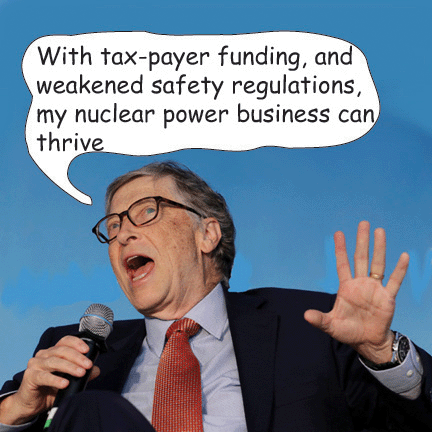
Government teams up with Bill Gates and top corporates to catalyse wave of
green [?] tech investment. Prime Minister announces £9.7bn of inward
infrastructure investment, as government launches new £400m public-private
clean tech innovation fund.
Prime Minister Boris Johnson this morning used
the Global Investment Summit as a curtain-raiser for the government’s
much-anticipated Net Zero Strategy, announcing almost £10bn of new foreign
investment in a wave of primarily low carbon infrastructure projects.
The government confirmed a new package of 18 deals worth £9.7bn, which are set
to ramp up investment in a host of clean infrastructure projects, including
offshore wind, hydrogen development, carbon capture and storage (CCS), and
green homes.
Meanwhile, Johnson shared a virtual stage with billionaire
philanthropist Bill Gates to announce the UK government has teamed up with
Gates’ Breakthrough Energy Catalyst clean tech venture to each invest
£200m in a new fund for supporting cutting edge clean tech projects. “The
world’s top investors have seen the massive potential in the UK for growth
and innovation in the industries of the future,” Johnson said. “The
fantastic £9.7bn of new investment we have secured today will power our
economic recovery, creating thousands of jobs and helping to level up
across the country.
Business Green 19th Oct 2021
UK’s ”low carbon” strategy relies too much on unproven technologies – what we need is energy conservation
| Finally, we have a plan to reduce emissions, but much of it rests on technology that is yet to be tested at scale. The PM confidently claimed that we will be flying and driving everywhere, guilt-free, with zero-emission technology. This optimism – based on a techno-centric, market-driven vision of the future low carbon society – is what underlines the entire net zero strategy. Take for instance the reliance on greenhouse gas removal technologies that remain untested at scale. Between now and 2050, the government envisions removing and storing more carbon than we currently emit from all our homes today. It would of course be a mistake to dismiss out of hand the possibilities that these technologies offer, but to have them play such a central role in our strategy is a gamble. To make it work would require careful planning. A similar reliance is placed on hydrogen, which the strategy foresees us using a tremendous amount of, though we barely have any production facilities in the UK today. None of this is impossible, but climate change offers very little slack for policymakers to try to fail, so getting it right the first time is paramount. The headline-grabbing announcement of a £5,000 subsidy for heat pumps distracts us from the lack of investment in insulation and making our homes warmer. At the New Economics Foundation, we estimate that the scale of finance committed by the government in decarbonising our leaky housing stock is less than a quarter of what is actually needed by 2025. That is why we launched a campaign called the Great Homes Upgrade, calling on the government to retrofit 19m homes by 2030. Without an investment of at least 2% of GDP annually, the strategy could well remain a non-starter, but the chancellor has an opportunity to fix that in his upcoming budget and spending review. Guardian 19th Oct 2021 https://www.theguardian.com/commentisfree/2021/oct/19/government-net-zero-technology-emisssions |
ALL UK energy can be obtained from renewables – Prof Mark Barrett
How we can get ALL our energy from renewables – a talk by Professor Mark
Barrett- talk slides published! Professor Mark Barrett from UCL has given a
talk about how ALL UK energy can be supplied by renewables. He focused on
heat in particular.
100% Renewables 18th Oct 2021
Spain is turning rapidly away from coal and nuclear, going for renewable energy
Spain is expected to see a sharp decline in nuclear and coal power
capacity by 2030 in its turn towards renewable energy sources.
Power Technology 21st Oct 2021
https://www.power-technology.com/comment/spain-nuclear-power-phase-out/
-
Archives
- October 2026 (112)
- September 2026 (339)
- August 2026 (330)
- July 2026 (355)
- June 2026 (287)
- May 2026 (306)
- April 2026 (356)
- March 2026 (251)
- February 2026 (267)
- January 2026 (308)
- December 2025 (358)
- November 2025 (359)
-
Categories
- 1
- 1 NUCLEAR ISSUES
- business and costs
- climate change
- culture and arts
- ENERGY
- environment
- health
- history
- indigenous issues
- Legal
- marketing of nuclear
- media
- opposition to nuclear
- PERSONAL STORIES
- politics
- politics international
- Religion and ethics
- safety
- secrets,lies and civil liberties
- spinbuster
- technology
- Uranium
- wastes
- weapons and war
- Women
- 2 WORLD
- ACTION
- AFRICA
- Atrocities
- AUSTRALIA
- Christina's notes
- Christina's themes
- culture and arts
- Events
- Fuk 2022
- Fuk 2023
- Fukushima 2017
- Fukushima 2018
- fukushima 2019
- Fukushima 2020
- Fukushima 2021
- general
- global warming
- Humour (God we need it)
- Nuclear
- RARE EARTHS
- Reference
- resources – print
- Resources -audiovicual
- Weekly Newsletter
- World
- World Nuclear
- YouTube
-
RSS
Entries RSS
Comments RSS

