France’s Global Chance association recommend renewable energies, see nuclear power as unsustainable
Ten-year delays, unequal access, vulnerability … For the members of the
Global Chance association, chaired by the polytechnician Bernard Laponche,
nuclear energy is not up to the challenge of ecological transition. On the
contrary, they promote renewable energies, the sources of which are “in
essence local and sovereign”.
La Croix 18th Oct 2021
https://www.la-croix.com/Debats/Lenergie-nucleaire-repond-pas-defi-climatique-2021-10-18-1201181087
Suffolk Wildlife Trust and RSPB not impressed by EDF’s bribes for environment
A joint statement by the Suffolk Wildlife Trust and RSPB has outlined the
two charities “significant concerns” with proposals for a new £20 billion
power station on the Suffolk coast.
Earlier this month EDF Energy, which
has a controlling stake in the Sizewell C project, set out £250m of
financial contributions, known as the Deed of Obligation, designed to
mitigate the impacts of the project, provide legacy benefits and compensate
some of those affected. This included £78 million to form an independent
environmental body to enhance the landscape of the area and £22m for
biodiversity improvements and the creation of wildlife and habitat areas.
However, the Suffolk Wildlife Trust and RSPB, who have been against the
construction of Sizewell C since consultations began, are still adamant
that, if built, the power station would cause considerable environmental
damage.
Suffolk Live 21st Oct 2021
https://www.suffolklive.com/news/animal-charities-warn-protected-wildlife-6092590
The value of energy efficiency in UK’s emissions reduction programme

Improving the energy efficiency of homes in deprived areas would cut seven
million tonnes of CO2 emissions per year, a Times investigation can reveal.
Despite much of the housing being older, insulating leaky boilers,
replacing inefficient lighting and installing solar panels in the poorest
30 per cent of neighbourhoods in England and Wales would be about as cost
effective as making the same improvements in the richest areas. It would
also reduce energy bills for those struggling the most. According to
analysis of Energy Performance Certificates (EPCs), for every £1,000 spent
in poorer parts of the country, 166kg of CO2 would be saved. Boris Johnson
has put both levelling up the country and a commitment to improving the
environment at the heart of his premiership.
Times 24th June 2021
COVID Restrictions Deny Southern Belarus Children Rare Escape From Chernobyl Radiation
COVID Restrictions Deny Southern Belarus Children Rare Escape From Chernobyl Radiation https://www.voanews.com/a/covid-restrictions-deny-southern-belarus-children-rare-escape-from-chernobyl-radiation/6278627.html
October 20, 2021 Ricardo Marquina. In Belarus, just across the border from Ukraine, many children have been living with chronic radiation sickness since a reactor at the Chernobyl nuclear power plant exploded in 1986. They have returned to school after being unable to escape contamination for yet another summer due to COVID-19 pandemic border restrictions. For VOA, Ricardo Marquina has more from the Gomel region of southern Belarus in this report narrated by Miguel Amaya.
The nuclear industry might get taxpayers money by calling itself ”amber”, if it’s too hard to appear ”green”
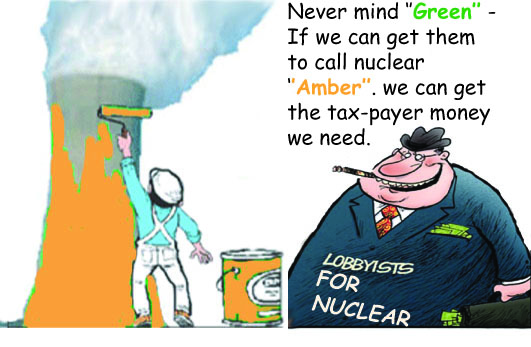
possible compromises included creating an “amber” label for activity that did not win the green label but would still secure a place in the bloc’s transition and not discourage private sector investment. ………..
Brussels to delay decision on how to classify nuclear power for green finance. Debate over energy has been supercharged by surging electricity costs, Ft.com Mehreen Khan and Sam Fleming in Brussels, 20 Oct 21
Brussels will delay long-awaited proposals on how to classify nuclear power and natural gas under the EU’s landmark labelling system for green finance, as member states demand looser rules to help counteract the continent’s energy crisis. EU financial services commissioner Mairead McGuinness told the Financial Times that Brussels would take more time before deciding how to deal with the controversial energy sources under the so-called “taxonomy on sustainable finance” that had been due this autumn.
The debate about how to classify low carbon natural gas and nuclear energy, which produces no CO2 [ ed.except in its long complex fuel and waste chains] but whose waste byproducts are toxic for the environment, has been supercharged by surging electricity costs that have prompted EU governments into emergency financial action to protect households. European leaders are due to debate the taxonomy and how to mitigate soaring prices at a summit in Brussels on Thursday.
“As we come to the end of the year there will be more pressure to resolve this,” said McGuinness. “We don’t have a ready-made solution because this is, both technically but politically . . . one of those issues where you have very divided views.” Europe’s pro-nuclear countries, led by France, and pro-gas member states in the south and east, are demanding the taxonomy rules do not penalise technologies they say are vital in securing the transition to net zero emissions. Environmental groups, however, want the system to abide by scientific criteria to ensure the rules stamp out, rather than encourage, so-called “greenwashing” in the investment industry. ………..
Europe’s energy crisis is the latest challenge to the credibility of the EU’s green labelling system which was designed to be a “gold standard” for investors to know what counts as truly sustainable economic activity. But the rules have been mired in controversy as Brussels struggles to balance science with sensitive political decisions about whether to award some activities the highest green label — penalising those that do not. Ten countries, including France, Finland, Poland and Hungary this week said it is “absolutely necessary that nuclear power was included in the taxonomy framework”.
McGuinness said it remained an “open question” as to whether the green label would be expanded to “accommodate nuclear and gas”. She said possible compromises included creating an “amber” label for activity that did not win the green label but would still secure a place in the bloc’s transition and not discourage private sector investment. ………..
The rules are being closely watched by investors and regulators in the US and UK, who have also said they will come up with their own classification systems. Within the EU, the taxonomy will be used to judge whether investments made by member states are truly green and will form the basis for an EU “green bond standard” that will be used to issue €250bn in sustainable debt under the bloc’s recovery fund. https://www.ft.com/content/898e6c53-8e85-4cfc-b00b-16a09d50b462
UK’s ”Net Zero” climate strategy fails to give concrete commits to reduce energy use, promote renewables.

| In reaction to the government’s Net Zero Strategy, Rebecca Newsom, Greenpeace UK’s head of politics, said “This document is more like a pick and mix than the substantial meal that we need to reach net zero. Extra cash for tree planting and progress on electric vehicles doesn’t make up for the lack of concrete plans to deliver renewables at scale, extra investment in public transport, or a firm commitment to end new oil and gas licences. There are only half-hearted policies and funding commitments to decarbonise our draughty homes at the speed necessary, and it fundamentally fails to grapple with the need to reduce our meat and dairy consumption to stop global deforestation. With just eight years left to halve global emissions, the government can’t just keep dining out on its ‘ambitious targets’. Until the policy and funding gaps are closed, Boris Johnson’s plea to other countries to deliver on their promises at the global climate conference next month will be easy to ignore.” Greenpeace 19th Oct 2021 https://www.greenpeace.org.uk/latest-updates/?news_type=press-release |
Rolls Royce ”small” nuclear reactors – not really small, not useful against climate change, but useful for military purposes

Answers to the energy and climate crises are needed NOW. These answers are available based on a comprehensive programme of developing renewable energy and energy conservation technologies.
Every pound wasted on nuclear power will be a pound taken away from faster and more effectivesolutions offered by renewable energy and energy conservation.
It is reported that the Tory government will restate its support on Monday, 18 October to buiding a fleet of modular nuclear reactors. The favoured reactor is the Rolls Royce SMR, namely ‘Small ModularReactor’. This term is very misleading as the Rolls Royce reactor would produce 450MW of electricity, which is more than the output of the old Magnox station at Trawsfynydd, and the same size as one of old big Magnox reactors at Wylfa.

It is known that Rolls Royce are asking for huge public subsidies to realise their nuclear ambitions. This movement towardsbuilding reactors to produce electricity is closely related to their wish to safeguard skills in the reactors they provide for submarines carrying nuclear weapons. Civil and military nuclear are two sides of the same coin. Rolls Royce claim they would like to build 18 SMRs.
How far will the government be prepared to go to fund a far from new technology and like larger nuclear reactors, is open to accidents and radioactive leaks, and produces poisonous and lethal radioactive waste.
Also mentioned is the possibility of Bechtel/Westinghouse trying to push the Westinghouse AP1000 reactor on the Johnson government to be developed at the Wylfa site. This is the very reactor on the V.C.Summer site in South Carolina that
bankrupted Toshiba Westinghouse in 2017. That happened due to huge overspending and the project was abandoned 40% of the way into construction. It was therefore no surprise that the NUGen Consortium project to build three AP1000s at Moorside near Sellafield collapsed in 2018. Nobody was prepared to invest in it. Exactly the same fate as the Hitachi/Horizon plan at Wylfa. Johnson and his ministers in the Treasury and the Business,
Energy and Industrial Stratregy Department are missing the point entirely as they cling on to past imperial grandeur by blindly
promoting nuclear power. Nuclear power is dirty, dangerous, extortionately expensive, and a threat to environmental and human health. Nuclear power will do nothing to tackle the present energy crisis, nor will it effectively counteract the effects of climate change., and we certainly cannot afford to waste the fifteen years needed to build large new nuclear stations
Answers to the energy and climate crises are needed NOW. These answers are available based on a comprehensive programme of developing renewable energy and energy conservation technologies. Every pound wasted on nuclear power will be a pound taken away from faster and more effectivesolutions offered by renewable energy and energy conservation.
People Against Wylfa B 18th Oct 2021
British government’s enthusiasm for mini nuclear reactors, led by Rolls Royce and 8 other organisations

Brexit Britain strikes historic £210m deal with Rolls-Royce to create nuclear reactors
BREXIT Britain is set to see its emissions slashed as the Government is poised to make a landmark deal with Rolls-Royce to fund a fleet of nuclear mini-reactors.
Express UK, By JACOB PAUL, Mon, Oct 18, 2021 The move is set to help Prime Minister Boris Johnson race to his target of zero-carbon electricity by 2035 in a move set to impress ahead of the COP26 climate summit in Glasgow in less than two weeks time. Mr Johnson visited Rolls-Royce’s Bristol factory on Friday, where he was shown their state-of -the-art facility by their CEO, Warren East. A consortium led by Rolls-Royce had already secured £210million in backing from private investors for the small modular reactor (SMR) project, a sum that the Government is expected to match and even surpass.
Confirmation is expected before the spending review on October 27.
The consortium called UK SMR, is set to rebrand British engineering firm Rolls-Royce SMR under a request from the Government. Tom Greatrex, chief executive of the Nuclear Industry Association (NIA), said: “Match-funding for Rolls-Royce would be a huge signal to private investors that the government wants SMRs alongside new large-scale stations to hit net zero.
It would also show investors that the Government believes in nuclear as a green technology.”
Government support will help with the consortium’s multi-billion pound plans to build 16 SMRs up and down the country……………… Rolls-Royce is also being advised by HSBC, which has helped it secure £210million from private investors, which was a condition set by the government for them to hand out at least the same amount of funding.
This move could also signal a possible U-turn from the Government on their scheduled phasing out of nuclear power in the UK.
13 nuclear reactors capable of producing 7.8GW of power currently produce around 20 percent of the nation’s electricity.
But over half of that capacity comes from reactors that are scheduled to be replaced or halted by 2025. https://www.express.co.uk/news/science/1507881/brexit-britain-rolls-royce-nuclear-power-boris-johnson-cop26-climate-change
Clyde nuclear base emergency staff to strike from tomorrow over safety fears
Clyde nuclear base emergency staff to strike from tomorrow over safety fears, Herald Scotland, By Martin Williams @Martin1Williams, Senior News Reporter 18 Oct 21, EMERGENCY workers at the home of Britain’s nuclear weapons on the Clyde are set to strike over “major safety concerns” after managers slashed firefighter numbers.
Action has been previously been given the go-ahead following a ballot of workers after managers proceeded with cuts to eight posts from the specialist fire safety crew at HM Naval Base Clyde, a reduction in strength of 15 per cent, with the a union describing it as an “an accident waiting to happen”.
Unite members working for outsourcing services firm Capita Business Services will now start strike action from Tuesday in a dispute over cuts to fire and rescue crew levels, and a lack of consultation………………
Workers believe the cuts impair the abilities of the onsite fire crews to do their jobs properly, particularly, in relation to incidents that would involve wearing breathing apparatus.
Capita has previously stated that they intend to mitigate safety risks due to the cuts through an investment in new technology to reduce fire risk”.
But workers have said they are not aware of any new technology which would address ongoing safety concerns…………………………… https://www.heraldscotland.com/news/homenews/19655524.clyde-nuclear-base-emergency-staff-strike-tomorrow-safety-fears/
Flamanville nuclear power plant has exceeded the threshold for discharging a powerful greenhouse gas.
Flamanville nuclear power plant has exceeded the threshold for discharging
a powerful greenhouse gas. In nine months, the quantity of SF6, the most
powerful greenhouse gas, released by the Flamanville nuclear power plant in
La Manche, has already exceeded the annual declaration threshold. This
threshold was reached on September 27, 2021, as confirmed by EDF on
Thursday, October 14, 2021.
Ouest France 14th Oct 2021
UK government’s grand energy plan – focus is on saving the nuclear industry
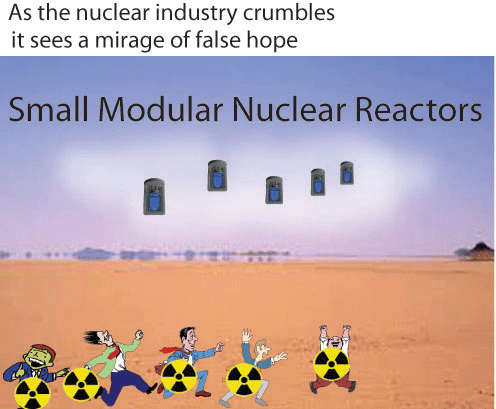
”Nuclear power is slow, dangerous and extortionately expensive. It will do nothing to address the current energy crisis, neither will it be effective to counter climate change”
Reviving nuclear power station projects such as Wylfa B on Anglesey and Trawsfynydd in Gwynedd is at the heart of the UK Government’s ambitions to attain net zero carbon emissions by 2035, government sources have said.
The UK Government is expected to reveal its new nuclear strategy in documents to be published next week, alongside a plan for how to pay for the new array of nuclear plants. US nuclear company Westinghouse is planning to revive plans for a nuclear power plant at Wylfa that was abandoned by Japan’s Hitachi in 2019, and the UK Government has indicated that it is keen to see the plan come to fruition.

Ministers are also expected to back smaller modular reactors which are being developed by a consortium led by Rolls-Royce. One of these is planned for installation in the now-decommissioned Trawsfynydd nuclear plant. Kwasi Kwarteng, the business secretary who has been under fire from industry this week due to
the rising cost of energy prices, is to unveil the overarching ‘Net Zero Strategy’ paper on Monday.
According to the Financial Times, the strategy will have a “heavy focus” on Britain’s languishing nuclear power
programme. Under the plans, an energy levy on consumers by the UK Government finance the cost of producing the power before the nuclear energy plants are built. Kwasi Kwarteng has set a target of 2035 to reach
‘net zero’ based on nuclear power, renewables and carbon capture and storage.
Anti-nuclear groups have already criticised the plans, saying that the emphasis should be placed on green renewable energy instead. Dylan Morgan of PAWB (People Against Wylfa B) said: “We have an immediate crisis now. Building huge reactors at a nuclear power station take at least 15 years. “Nuclear power is slow, dangerous and extortionately expensive. It will do nothing to address the current energy crisis, neither will it be effective to counter climate change”
Nation Cymru 16th Oct 2021
Orano’s nuclear reprocessing problems at La Hague
Nuclear: the CGT denounces “a congestion” of rejects from Mox in Orano La
Hague. Due to recycling problems at the Marcoule plant, Orano La Hague has
to deal with scraps from Mox. A situation denounced by Greenpeace, but
under control according to Orano.
La Presse de la Manche 15th Oct 2021
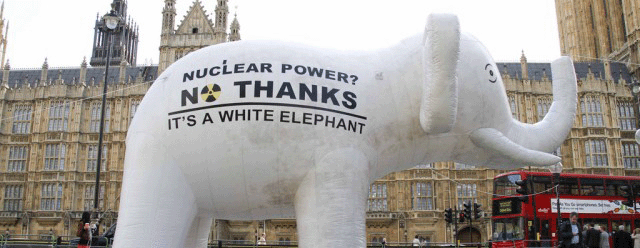
Sizewell C nuclear station – a white elephant that will irreversibly damage the environment
Campaigners protesting the building of Sizewell C have responded with
frustration to EDF’s £250 million package of funding to mitigate the
impacts of the proposed site. The biggest concern for those against the
project was the money put towards environmental causes – £78 million for
an independent environmental body to enhance the landscape of the area and
£22 million for investment in landscape impact mitigation and creation of
wildlife and habitat areas.
“It’s notable that by far the biggest sum –
£100 million – is for environmental projects,” said Alison Downes from
Stop Sizewell C. “This work will have to be ongoing for decades – through
the life of the station and potentially decommissioning – to make any
significant difference.”
“The environmental funding is simply a
recognition of the long term and irreversible damage they will do to the
environment,” said Pete Wilkinson of Together Against Sizewell C. “The
rest is a measure of the damage to this community EDF intends to inflict
for what will be a huge white elephant on our eroding, heritage coast.”
East Anglian Daily Times 15th Oct 2021
https://www.eadt.co.uk/news/sizewell-c-campaigners-react-to-money-plans-8415128
Demonising China is unhelpful while encouraging China to participate in Cop26
As Britain prepares to host the Cop26 climate conference in Glasgow next month, it is pursuing two contradictory policies that undermine its chances of success. On the one hand, it is seeking a unified global response to the climate crisis with nations agreeing to targets for the reduction of their coal and petroleum emissions.
But at the same time, it has joined the US in escalating a new cold war directed at confronting China and Russia at every turn. The two policies have polar opposite objectives in trying to persuade China, responsible for 27 per cent of global carbon emissions, to cut back on building new coal-fuelled power stations, but at the same time demonising China as a pariah state with whom political, commercial and intellectual contacts should be as limited as possible.
Independent 15th Oct 2021
https://www.independent.co.uk/climate-change/opinion/china-russia-climate-cop26-b1939164.html
European Commission urges member states to speed up solar energy deployment
The European Commission (EC) has urged member states to accelerate solar
deployment in order to tackle Europe’s rising electricity prices and has
released a ‘toolbox’ to address the short-term impact of prices and
strengthen resilience against future shocks.
Speaking at a press conference
earlier this week (13 October), the EC Energy Commissioner, Kadri Simson,
called the current situation in Europe, which has pushed energy prices up
to record levels, “exceptional” but urged member states to future proof
their countries from further shocks.
PV Tech 15th Oct 2021
-
Archives
- October 2026 (112)
- September 2026 (339)
- August 2026 (330)
- July 2026 (355)
- June 2026 (287)
- May 2026 (306)
- April 2026 (356)
- March 2026 (251)
- February 2026 (267)
- January 2026 (308)
- December 2025 (358)
- November 2025 (359)
-
Categories
- 1
- 1 NUCLEAR ISSUES
- business and costs
- climate change
- culture and arts
- ENERGY
- environment
- health
- history
- indigenous issues
- Legal
- marketing of nuclear
- media
- opposition to nuclear
- PERSONAL STORIES
- politics
- politics international
- Religion and ethics
- safety
- secrets,lies and civil liberties
- spinbuster
- technology
- Uranium
- wastes
- weapons and war
- Women
- 2 WORLD
- ACTION
- AFRICA
- Atrocities
- AUSTRALIA
- Christina's notes
- Christina's themes
- culture and arts
- Events
- Fuk 2022
- Fuk 2023
- Fukushima 2017
- Fukushima 2018
- fukushima 2019
- Fukushima 2020
- Fukushima 2021
- general
- global warming
- Humour (God we need it)
- Nuclear
- RARE EARTHS
- Reference
- resources – print
- Resources -audiovicual
- Weekly Newsletter
- World
- World Nuclear
- YouTube
-
RSS
Entries RSS
Comments RSS

