Kazakhstan may build nuclear power plant to provide electricity for energy-guzzling Bitcoin mining.

Kazakhstan Mulls Nuclear Power to Deal With Electricity Shortages Blamed on Crypto Miners, Bitcoin.com, 31 Dec 21, The government in Kazakhstan is considering building a nuclear power plant to overcome an electricity deficit allegedly caused by the booming crypto mining industry. Problems with power supply are driving away miners that saw the Central Asian country as a new home when China recently cracked down on the industry.
NPP Project Revived Amid Short Supply of Energy for Crypto Mining Sector in Kazakhstan
Authorities in Kazakhstan are now thinking of implementing a decade-old plan to construct a nuclear power plant (NPP) in order to solve the country’s pressing issues with a growing electricity deficit. With capped tariffs and a crypto-friendly attitude, the former Soviet republic attracted a throng of Chinese miners chased away by Beijing’s offensive against the crypto industry launched in May of this year. However, some of them are now leaving the country as their hardware is idling.
Two locations are currently under consideration as potential sites for a nuclear station, Kazakhstan’s Energy Minister Magzum Mirzagaliev revealed this week. These are the village of Ulken in the Alma-Ata region and the city of Kurchatov in the East Kazakhstan region………… https://news.bitcoin.com/kazakhstan-mulls-nuclear-power-to-deal-with-electricity-shortages-blamed-on-crypto-miners/
Germany aiming for far-reaching methods to reduce carbon emissions across all sectors
Germany is likely to fail to hit its carbon emissions reduction targets in
the coming two years, Economy and Climate Protection Minister Robert Habeck
told Die Zeit newspaper. The previous government set more ambitious CO2
reduction targets, including being carbon neutral by 2040, after a top
court ruled in April that Germany must tighten its climate protection law.
The new coalition government presented plans to step up climate protection
efforts entailing far-reaching reforms for the utility sector and across
manufacturing industries, buildings, transport and agriculture.”We will
probably miss our targets for 2022. … Even for 2023 it will be difficult
enough. We are starting with a drastic backlog,” said Habeck, co-leader of
the Greens who are part of the new ruling coalition. Germany aims to cut
emissions in industry, the biggest carbon emitting sector, to 177 million
CO2 tonnes in 2022, down 38% compared with 1990.
Independent 30th Dec 2021
https://www.independent.co.uk/climate-change/news/germany-carbon-targets-robert-habeck-b1984463.html
With 15 nuclear reactors shut down, France faces risk of power cuts
With nuclear production at its lowest in January, RTE admits the risk of
voltage drops. French nuclear production will reach a historically low
level in January. RTE accepts the possibility of brownouts or calls to
reduce consumption. Even, as a last resort, power cuts. L’Usine Nouvelle 31st Dec 2021
Electricity: the availability of French nuclear power plants at its
lowest. Out of 56 reactors, 15 are shut down, which can pose a problem in
the event of extreme cold, underlines the manager RTE, who has raised his
level of vigilance.
Le Monde 30th Dec 2021
Dismantling of German nuclear reactor will be expensive, but provide jobs for several decades.
Asked about possible job losses, Gundremmingen mayor Tobias Buehler said
the plant’s employees would be busy with dismantling the reactor after the
shutdown. “And this period of dismantling will certainly take another one
or two decades,” Buehler said. Total costs for the dismantling are
estimated by E.ON at 1.1 billion euros ($1.25 billion) per plant. In 2020,
E.ON made provisions of 9.4 billion euros for the nuclear post-operational
phase, including dismantling the facility, packaging and cleaning up the
radioactive waste. The dismantling is expected to be completed by 2040.
NBC 30th Dec 2021
https://www.nbcnews.com/news/world/germany-pull-plug-3-its-last-6-nuclear-power-plants-n1286771
Germany will pull the plug on 3 of its last 6 nuclear power stations
Germany will pull the plug on three of its last six nuclear power stations
on Friday, another step towards completing its withdrawal from nuclear
power as it turns its focus to renewables.
The government decided to speed
up its phasing out of nuclear power following Japan’s Fukushima reactor
meltdown in 2011 when an earthquake and tsunami destroyed the coastal plant
in the world’s worst nuclear disaster since Chernobyl 25 years earlier.
The reactors of Brokdorf, Grohnde and Gundremmingen C, run by utilities E.ON
(EONGn.DE) and RWE (RWEG.DE), will be shut down on Friday after three and
half decades in operation. The last three nuclear power plants – Isar 2,
Emsland and Neckarwestheim II – will be turned off by the end of 2022.
Reuters 30th Dec 2021
https://www.reuters.com/world/europe/germany-pull-plug-three-its-last-six-nuclear-plants-2021-12-30/
Increased compensation for those damaged by nuclear accident – OECD
| The protocols to amend two international instruments that bolster the compensation rights of those affected by nuclear energy accidents were formally ratified in Paris on 17 December 2021 at the OECD headquarters by all the Contracting Parties, except for Turkey who has approved the ratification and will be depositing its instrument of ratification soon. The Protocols to amend the Paris Convention on Third Party Liability in the Field of Nuclear Energy and the Brussels Convention Supplementary to the Paris Convention will enter into force on 1 January 2022. These revised conventions combined ensure that those suffering damage resulting from an accident in the nuclear energy sector will be able to seek more compensation – the operator liability will be of at least EUR 700 million under the Paris Convention and the public funds provided under the Brussels Supplementary Convention will complement up to EUR 1.5 billion, a sharp increase from the previous 5 million Special Drawing Rights (SDR) (approximately EUR 6 million as of 13 December 2021) and SDR 125 million (approximately EUR 155 million as of 13 December 2021) respectively. The revised Paris Convention also provides now for a minimum of EUR 70 million and EUR 80 million in case of accidents at low-risk installations and during transport of nuclear substances, respectively. OECD-NEA 17th Dec 2021 https://www.oecd-nea.org/jcms/pl_63006/new-treaties-to-strengthen-rights-of-people-affected-by-nuclear-accidents |
UK’s fossil fuel use at an all-time low , as renewables generate 67% of Britain’s electricity

Fossil fuel use on the UK’s power grid dropped to an all-time low this week, in a sign analysts say is further evidence of the “renewables revolution” under way on the British electricity generation.
Just before midnight on Wednesday evening coal and gas were providing just six per cent
of electricity, according to Drax Electric Insights. “Renewables generated 24.19 GW – 65 per cent of the country’s entire electricity needs – while fossil fuels were at a new record low,” the analysts said
in statement on Thursday.
iNews 30th Dec 2021
https://inews.co.uk/news/fossil-fuels-power-wind-renewable-1375827
UK govt delays final decision on Sizewell nuclear project
The Government has agreed to a six-week extension to the final decision on
proposals for two nuclear reactors to be built on the Suffolk coast. As a
result of the Business Secretary, Kwasi Kwarteng, agreeing to the
extension, the Planning Inspectorate now has until February 25 to produce a
report on the project proposals. However, it appears that Mr Kwarteng was
not overly happy to extend the deadline by six weeks and has asked the
Planning Inspectorate to “ensure that future timetables, including the
reporting stage, are adhered”.
Suffolk Live 30th Dec 2021
https://www.suffolklive.com/news/sizewell-c-nuclear-power-station-6418440
Nuclear power in the EU taxonomy and Germany’s position

Q&A: Why is Germany phasing-out nuclear power and why now? 28 Dec 2021, Kerstine Appunn ”……………………………..Nuclear power in the EU taxonomy and Germany’s position
Observers have called France’s push to include nuclear power projects in the EU taxonomy as a sustainable investment a “political nightmare” for Germany. Backed by a group of other European countries such as Bulgaria, Croatia, Czechia, Finland, Hungary, Poland and Romania, French President Emmanuel Macron tries to make nuclear power a pillar of the EU’s decarbonisation strategy, while Germany is betting heavily on wind and solar power. It is supported in its push for a nuclear-free taxonomy by Portugal, Austria, Luxembourg and Denmark. Germany’s new Chancellor Olaf Scholz, of the Social Democrats (SPD), has told Macron that he has always been opposed to nuclear power, much like his coalition partner, the Green Party.
If included in the taxonomy, nuclear power investments could be part of green funds, banks could declare loans to nuclear projects as sustainable investments – all in aid of getting more private investment to flow into climate friendly economic activities and businesses.
Agora Energiewende’s Müller says the German approach is still more future-proof. “The idea that nuclear power stations can be built at predictable costs and by a predictable schedule has not proven to be realistic. We also still have the unresolved problem of nuclear waste storage as well as the possibility of a major accident. Germany’s decision to focus on the expansion of renewables instead of nuclear is reflected also by the markets as renewables dominate electricity investments internationally.”
The European Commission is set to come out with a proposal for the taxonomy in January 2022, which EU member states will then decide on with a majority vote. Instead of an in-or-out decision on nuclear (and natural gas), the commission is likely to present a compromise that would classify nuclear as a temporary, transitional technology which has to be labelled and declared in funds so that consumers and investors have the choice between “entirely green” products, e.g. renewable energies, or second or third tier products that include nuclear or gas technology.
Whatever the decision, Müller says Germany and France should focus more on the common ground concerning the energy transition. “Recent French studies show – independently of the future of nuclear energy – that a massive expansion of renewables is needed to reach the climate targets. And there are also opportunities for cooperation between Germany and France on green hydrogen.”
Shouldn’t Germany – like other countries – embrace and support the use of new small modular reactors?
Using a large fleet of small modular reactors (SMR) to secure climate neutral electricity supply in the future – as proposed by billionaire and philanthropist Bill Gates – has been hailed as a climate change solution. In Belgium, which is set to shutter its two remaining nuclear power stations by 2025, the government agreed to invest 100 million euros in the research on SMR.
SMR proponents claim that, once produced in bulk, these small plants are cheaper and safer thanks to advanced reactor designs and can be operated with converted short-lived radioactive materials, solving the waste problem.

But two assessments commissioned by the Federal Office for the Safety of Nuclear Waste Management (BASE) have found that these tens of thousands of small reactors would carry enormous risks with regard to the proliferation of weapons-grade materials and will probably never be as cheap as their advocates say.
What is different in Germany compared to other countries in Europe which embrace nuclear as a CO2-free solution?
Germany not only has strong public support for, and a long history of, anti-nuclear sentiment, it also has only 11 percent of nuclear left in its power mix. Leaving it behind entirely is therefore a more obvious and easy decision than for other countries, such as France, where the share of nuclear power in domestic generation stands at 70.6 percent, but also in Bulgaria with 40.8 percent, in Sweden with 29.8 percent (in Spain: 22.2%, Russia at 20.%, United States at 19.7%, UK 16%, all in 2020).
Historians also explain the different attitude towards nuclear with the different reactions to the Chernobyl accident, which was felt much closer and more threatening to Germans compared to French or UK citizens. Another explanation for Germany’s sensitivity to nuclear power is that early on, the post-war critique of nuclear weapons was linked to the civilian use of nuclear fission. (A second wave of the German peace movement in the 1980s would also bolster a younger generation’s resistance to nuclear power.)
And even if there are people who make a case for nuclear for climate protection reasons, the exit has now proceeded too far to be reversed, and there is simply no influential political power that would consider re-opening the painful, decade-long debate on nuclear power that has finally been put to rest. https://www.cleanenergywire.org/news/qa-why-germany-phasing-out-nuclear-power-and-why-now
The murky world of financing Small Nuclear Reactors (SMRs)

IKEA it ain’t: don’t go looking for friendly nuclear option, no matter the spin
MICHAEL WEST MEDIA, By Noel Wauchope|December 30, 2021
”……………..[Everyone] should be aware of the financial gymnastics going on in the USA, with NuScale, and in the UK, with Rolls-Royce. That’s just to single out the two most advanced of the many dubious SMR projects still at the starting gate.
The Murdoch media is enthusiastic about SMRs. Missing from the hype are a lot of unanswered questions. For a start — the ”M” stands for ”modular” — meaning that these reactors will be built in pieces, sort of, and transferred to a site, where they will be assembled, like a piece of IKEA furniture. But in fact there are at least 50 designs being promoted, and not all are modular.
The critical question comes down to – the money
The enthusiasm of the SMR lobby for the economic viability of SMRs is not matched by the facts.
For one thing to consider – there’s the price of the electricity to be eventually delivered by these small nuclear reactors. The Minerals Council of Australia estimates that by 2030 and beyond, SMRs could offer power to grids from $64-$77MWh, depending on size and type.
An analysis by WSP / Parsons Brinckerhoff, prepared for the 2015-16 South Australian Nuclear Fuel Cycle Royal Commission, estimated a cost of A$225 / MWh for a reactor based on the NuScale design, about three times higher than the MCA’s target range. CSIRO estimates SMR power costs at A$258-338 / MWh in 2020 and A$129-336 / MWh in 2030.
Then there are the costs of actually getting SMRs in the first place.
In Russia, China, France, and Argentina, the construction is done entirely or largely at taxpayers’ expense, and there is little or no transparency about the costs. But generally in the Western world, electricity production is supposed to be a commercially viable operation. In the context of promoting low -carbon technologies, SMRs are promoted as being cheaper than large ones. It is generally acceptable for the government to kick-start the process, with some funding, but with the understanding that the industry will become successful, profitable.
NuScale financing contortions
In the US, NuScale leads the pack. After its efforts to partner with Romania, UK, Canada and Jordan, NuScale has joined with a Utah-based utility consortium to develop what initially was proposed to be a power plant with 12 small reactors. The project, which is now forecast to cost $5.1 billion, has since been scaled back to six reactors, expected to start coming online in 2029. The Department of Energy (DOE) is to provide an annual supplement of about $130 million a year for a decade. However, that would be dependent upon annual renewals of the funding by Congress during that decade, which is a risk.
NuScale promises to deliver electricity at $55/MWh. UAMPS and NuScale have not explained the methodology used to develop this figure. Meanwhile PacifiCorp and Idaho Power have concluded that electricity from NuScale reactors would cost $94-$121/MWh.
Now NuScale is to go public by merging with what’s known as a special purpose acquisition company, or SPAC. The company, Spring Valley Acquisition Corporation, is already publicly traded. The new company named NuScale Power Corporation will list on the Nasdaq under the ticker symbol SMR. Their new SMR power plants will be called VOYGR, and NuScale will open centres at universities to promote technical training for them. The Department of Energy (DOE) will support these centres with funding, and NuScale will open centres at universities to promote technical training for them. DOE will support these centres with funding.
A SPAC is a type of shell company (shell companies being those not having actual business operations, just specific objectives, in this case, raising capital) The SPAC raises money from the public through initial public offerings, the sponsor getting 20% of the funds invested. Later private investments through public equity, or PIPES, can be added, often bought at a discount price by big institutions. The whole process is done relatively speedily, and with much less scrutiny than in usual mergers. US Securities and Exchange Commission Chair Gary Gensler wants to tighten regulations on SPACs:
Glitzy corporate presentation decks, hyped press releases and celebrity endorsements can balloon a SPAC’s equity well beyond a reasonable value long before proper disclosures are filed, Gensler said.
SPACs have had a chequered history — they enable the sponsors to avoid financial loss, even if the business fails, as many did, in the 1990s. Sixty-five per cent of deals completed in 2021 at a valuation above $1bn are trading below $10 — the price at which they were floated. All of the companies are trading below their stock market highs with some of them down by as much as 70%. Senator Elizabeth Warren and three other Democrats are investigating the imbalance between the financial results for the sponsors and banks versus the early investors.
Rolls-Royce still looking for money
The process of getting funding for the UK’s SMRs is equally tortuous. The government invested £18 million in November 2019, which delivered significant development of the initial design as part of Phase One of the project. At the beginning of November 2021, Rolls-Royce Holdings Plc raised 455 million pounds ($608 million) to fund the development of SMRs, with almost half of the financing coming from the U.K government Rolls-Royce Small Modular Reactor (SMR) business is a consortium, backed by BNF Resources and Exelon Generation. BNF Resources UK Limited is a subsidiary of BNF Capital Limited. Other members of the consortium are Assystem, Atkins, BAM Nuttall, Laing O’Rourke, National Nuclear Laboratory (NNL), Jacobs, The Welding Institute (TWI) and Nuclear AMRC, as well as Rolls-Royce. It’s not at all clear how much each group has put into the venture.
For the plan to have the planned £30 billion fleet of mini-nuclear power stations, the business will have to rely on UK taxpayers to help fund the construction of the first of the new designs. New government funding of £210 million announced on November 9 will take forward phase 2, over the next three years, of the so-called Low-Cost Nuclear project to further develop SMR design and take it through the regulatory processes to assess suitability of potential deployment in the UK. Exelon is contributing under an agreement from a year ago to find international markets. Rolls-Royce expects the first five SMR reactors to cost £2.2bn each, falling to £1.8bn for subsequent units.
Rolls-Royce will be seeking more investment for the project to help fund the building of actual SMRs.
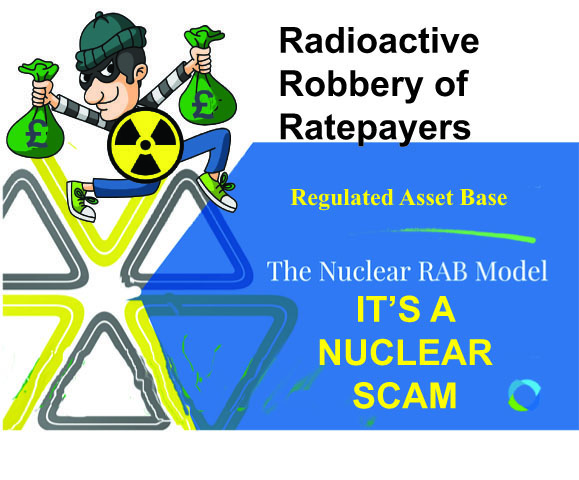
The government is currently passing legislation that will allow investors to back projects like SMRs using a regulated asset base (RAB) model, which allows them to recoup upfront costs from the consumers, over the construction period, long before those consumers actually get any electricity from the project.
Mythical beasts
So — what it all boils down to is an agreement to spend about £400 million over the next three years — to perhaps produce a design for a reactor, which might get approved by the regulators, and might find investors who might be willing to pay what will be at least £2 billion to build each one.
It’s not at all clear who is going to end up paying the most for small nuclear reactors, or indeed, if that fleet of SMRs will ever become a reality. It will probably be the taxpayers. I haven’t mentioned all those ancillary costs — of winning community approval, of security, waste disposal.
In the meantime, it’s worth being wary about the financial aspects, given the obscure manipulations going on in the US and UK, and remembering that not yet does one of these mythical beasts, Small Modular Nuclear Reactors actually exist.
Renewables remain the cheapest “new-build” source of energy generation. They exist. They work. https://www.michaelwest.com.au/ikea-it-aint-small-modular-nuclear-reactors/
.
What it’s like to live in an energy efficient ‘power home’ ‘I haven’t had to put my heating on in December’

What it’s like to live in an energy efficient ‘power home’: ‘I haven’t had to put my heating on in December’
Jo Law and her children are the first family to move into an energy-efficient all-electric ‘power home’ in Kent, more https://inews.co.uk/news/environment/energy-efficient-power-home-not-put-heating-on-december-1373278 29th Dec 2021 By Aasma Day
Jo Law shakes her head in disbelief as she says: “I’ve only had to put my heating on twice since I moved here in September – and one of those times was to test it out.
“I’ve never lived anywhere before where I’ve not needed the heating on in December.”
Like many people, mother-of-two Jo wants to do her bit for the planet, safeguarding it for her children and future generations. But she never imagined that her choice of home could be beneficial to the planet – as well as safeguarding her against energy price increases by saving her money.
Jo and her children were the first family to move into a new generation of “power homes” that are designed so they can generate more energy than they consume.
The 38-year-old had been through a turbulent time with major life changes as she separated from her partner, battled with Crohn’s disease, was diagnosed with bowel cancer and had to shield during the pandemic. Her new home signifies a fresh start.
“I had to sell my home I had with my partner after we separated and I couldn’t afford a mortgage to buy a place on my own,” explains Jo, who lives in Sittingbourne, Kent.
When she heard about new energy-efficient all-electric “power homes” in Kent which were becoming available to rent, she and her two children Molly, 13, and Harry, 10, became the first family to move in.
The all-electric modular homes are built in a factory in Cambridgeshire in partnership with offsite manufacturer Premier Modular Group and can generate more energy than they consume.
Featuring a roof covered in photo-voltaic solar roof panels which are disguised to blend in with traditional roof tiles allows the properties to generate their own electricity.
With an EPC rating of A, the homes are kept warm by airtight high performance structural panels and consume less electricity by being fitted with A energy-rated dishwashers, fridge freezers and washer dryers.
Meanwhile, a traditional boiler isn’t needed to heat water as hot water is provided to the home by a hot water tank with an integrated air source heat pump.
The homes generate enough electricity to charge an electric vehicle for free every day and any excess electricity can be sold back to the grid. The overall energy bills can be up to 85 per cent cheaper than those faced by an average household.
While millions of families across Britain live in old, cold and draughty homes, Jo says that she and her children have already noticed the difference since moving into their energy-efficient home from Public Sector Plc.
I love the energy efficiency and simplicity, and for the first time in my life, I’m not at all worried about needing to put the heating on all the time through the winter months.” Jo tells i.
“In fact, I’ve not needed the heating on because the house is so warm without it. Like most people, I have spent most of my life living in older homes which become difficult to keep warm during the winter.
“Even when we do need to put the heating on, we know we won’t have the worries of not being able to afford it. Even though a lot of the rooms in this house are bigger than our old home, our overall bills are a lot less.”
Mark Davis, partnerships director at Public Sector Plc, says that according to the UK Green Building Council, the built environment contributes 40 per cent of the UK’s total carbon footprint.
“Instead of creating homes which only consume energy, we wanted to flip this approach on its head and deliver homes which produce energy too.” he explains.
“In achieving this, we’ve been able to create new homes which act as mini power stations rather than major energy drains.”
He adds: “As millions of us face steep energy price increases across the country, we think it’s incredibly important to highlight there are alternative types of homes to live in.”
Public Sector Plc designed the homes in Kent specifically for council and housing association partners and they are currently working with a number of public sector organisations to develop new, affordable homes across the UK.
For Jo, the knowledge that she is doing her bit for the environment is just as important as saving money.
“We all want to help save the planet and are doing things like trying not to use plastic.” she says. “I want my kids to grow up in a better environment and knowing our home is better for the planet is comforting.
“I can see normal houses nearby and when they turn their heating on, you can see fumes from the boiler coming out of the house. But there’s nothing from our boiler and you can’t even hear it as it’s so quiet.
“All the eco stuff is in the loft and locked, so it just feels like a normal home and doesn’t seem any different and is warm, safe and secure.
“After the difficult time I’ve had with bowel cancer and shielding, moving into this home has felt like a weight off my shoulders and we feel settled and the children are happy here.
“As we all start to become more conscious of climate change, it’s heartwarming to know that we’ll not be wasting energy or money this winter.”
Q&A: Why is Germany phasing-out nuclear power and why now?

Q&A: Why is Germany phasing-out nuclear power and why now?
28 Dec 2021, 10:18 Kerstine Appunn
Content
Facts of the German nuclear phase-out.……………..
How did the nuclear phase-out come about in Germany?…………….
Why the nuclear phase-out was the enabler of the energy transition………………..
What do different stakeholders in Germany think about the nuclear exit?………………..
Is there still a debate to continue the use of nuclear power and could its proponents succeed?………….
Why isn’t Germany phasing out coal before nuclear?………….
Will Germany emit more CO2 because of the nuclear phase-out?……………
No nuclear, no coal: Will the lights stay on?……………..
How does Germany want to make net-zero happen without nuclear?………………..
Why doesn’t Germany get an energy system with both renewables AND nuclear?………….
Will Germany become dependent on (nuclear) power imports from abroad?…………..
What’s more expensive – renewables or nuclear?…………
Nuclear power in the EU taxonomy and Germany’s position………….
Shouldn’t Germany – like other countries – embrace and support the use of new small modular reactors? …………………
What is different in Germany compared to other countries in Europe which embrace nuclear as a CO2-free solution?………………
Facts of the German nuclear phase-out
The last nuclear power plant in Germany will cease operation in December 2022. This definitive end-date is part of the 2011 Nuclear Energy Act (Atomgesetz) which withdrew the authorisation to operate nuclear reactors for power generation according to a phase-out schedule. From having a share of 22.2 percent in total electricity generation in 2010, the contribution of nuclear decreased to 11 percent in 2020. At the same time, renewables such as wind, solar PV and biogas provided around 45 percent of power generation in 2020. After three out of six remaining reactors are shuttered in December 2021 (Grohnde, Gundremmingen C and Brokdorf), only three (with a combined capacity of 4 GW) will remain in service throughout 2022 (Isar 2, Emsland and Neckarwestheim 2).
………………………………….. What do different stakeholders in Germany think about the nuclear exit?
Ever since the latest nuclear phase-out was decided by a large majority in the federal parliament (Bundestag) in 2011, the public has remained supportive of exiting nuclear power for good.
The German government since 2011 has remained steadfast in its decision despite going through a difficult process of securing the money from reactor operators to ensure their safe deconstruction and storage of radioactive waste, initiating the search for a permanent waste storage facility, and weathering the legal proceedings following the not-quite constitutional compensation regulations in the nuclear exit law.. SPD environment minister Svenja Schulze said at the 2021 anniversary of the Fukushima accident that “nuclear power is neither safe nor clean” and could not be a part of a low-carbon power production. Angela Merkel reiterated in her last summer press conferences before the end of her chancellorship, that “the nuclear phase-out is the right thing to do for Germany”, adding that this could be seen differently by other countries and activists who push for climate neutrality. “I don’t think nuclear energy is a sustainable form of energy in the long term,” Merkel said.
The new German government of Social Democrats (SPD), Green Party and Free Democrats (FDP) which took office in December 2021 wrote in its coalition treaty “we stand by the nuclear phase-out”. The new (Green Party) environment minister Steffi Lemke said in December 2021: “Nuclear power would make our energy supply neither safer nor cheaper. A technology that has no solution for the disposal of toxic waste cannot be sustainable.” Climate and economy minister Robert Habeck (Green Party) said on 28 December: “The nuclear phase-out in Germany has been decided, clearly regulated by law and is valid. Security of supply in Germany continues to be guaranteed. Now it is important to consistently push ahead with the transition of our energy supply.”…………
Energy utilities and operators of Germany’s remaining nuclear power stations are adamant that there will be no extension of the reactors’ runtime. The large German utilities have – after years of struggling – embraced a renewable future and the planning security that the end of nuclear power gives them. They also point out that all the legal (compensation) issues of the nuclear phase-out have been resolved, operating licenses are scheduled to expire and difficult to re-obtain, contracts with suppliers and other service companies have been terminated, staff has been reassigned and there is no longer enough fuel…………….
It is “completely out of the question” that German nuclear power plants will get another lifetime extension, said Rainer Baake. “Because the operators don’t want it. Because there is no serious force in politics that is pursuing a lifetime extension, and the topic played no role in the coalition negotiations. Voters have not forgotten Chernobyl and Fukushima and know that there are better alternatives.”…………
Will Germany emit more CO2 because of the nuclear phase-out?……………
Economists of the German Institute for Economic Research (DIW) conclude in a recent paper that “the decline in nuclear power will temporarily lead to a higher use of fossil energies and imports, which will increase CO2 emissions in the short term. However, these should be quickly reduced by the accelerated expansion of renewable energies.” In the short term, nuclear power will indeed be substituted by fossil power plants and via imports. Imports increase by 15 terawatt-hours (TWh), emissions will be around 40 million tonnes CO2 higher, according to the DIW. Other research shows that in the context of the overall cap of the European Emissions Trading System (EU ETS), rising emissions in Germany would be compensated by lower emissions in other countries, therefore keeping overall emissions stable and, at the same time, seeing a slight rise in the price for CO2 allowances.
Overall, renewables are now better placed to prevent carbon emissions than nuclear, physicist Amory B. Lovins, adjunct professor of civil and environmental engineering at Stanford University concludes in an op-ed for Bloomberg Law: “Renewables swelled supply and displaced carbon as much every 38 hours as nuclear did all year. As of early December, 2021’s score looks like nuclear –3 GW, renewables +290 GW. Game over.”……………..
How does Germany want to make net-zero happen without nuclear?
Germany’s energy transition in the electricity sector has turned into a comprehensive plan to decarbonise the entire economy and reach net-zero greenhouse gases in 2045. With nuclear power and coal out of the picture by the end of the decade, the new government – which is adhering to the previous government’s climate targets – is putting the focus on renewables growth. Its aim is to reach a share of 80 percent renewables in electricity demand (which is envisaged to grow). Several “Germany net-zero” studies have shown that a system based on renewables is possible……………………
What’s more expensive – renewables or nuclear?
One of the reasons why it is an obvious choice for Germany to make wind and solar its main power source rather than nuclear, is that new renewable installations have become cheaper than all other electricity sources – especially where a CO2 price is applied.
According to the World Nuclear Industry Status Report 2021 and Institute for Applied Ecology (Öko-Institut), the energy costs for nuclear power generation are currently 15.5 cents per kilowatt hour, compared to 4.9 cents for solar energy and 4.1 cents for wind power.
The British government has given a price guarantee of 11 cents per kilowatt-hour for 35 years to the nuclear power plant project Hinkley Point C. In Germany, feed-in tariffs for onshore wind and solar PV are between 6-7 ct/kwh or, in some tenders, even lower. Offshore wind parks are now being built without any government support.
New reactor projects often turn out to be much more expensive than envisaged. The costs for a new “Evolutionary Power Reactor (EPR)“ in Flamanville, France, have risen from 3.4 billion to more than 19 billion euros, while the project will likely take at least 11 years longer than planned. Similar price hikes and delays have occurred in the UK, Finland and the U.S.
“Nuclear technology has had negative learning rates, which means that new projects became more expensive instead of cheaper. If we take current investment costs as a basis, then it is clear that the cheapest power system is one that is fully based on renewables,” Simon Müller said. The global market situation shows that renewables dominate investments. The 2050 long-term projections by the International Energy Agency (IEA) see nuclear energy supplying about 10 percent of electricity. “For the transformation, we need to thus look to renewables,” Müller said.
As many new nuclear projects also take considerably longer to construct than planned, the Öko-Institut concludes that it would also be faster to build a system based on renewables………. https://www.cleanenergywire.org/news/qa-why-germany-phasing-out-nuclear-power-and-why-now
Germany’s Brokdorf nuclear station closes, so activists end their 35 year vigil against it.
Germany’s long anti-nuclear protest ends, DW, 29 Dec 21,
Activists have been protesting in front of the nuclear power plant in Brokdorf, northern Germany for 35 years. But now that the plant is set to be removed from the grid, their vigil is finally over………
Singing peace songs and chatting while standing in a circle, the groups appear well-adjusted to the freezing cold, having met at the power plant’s gate on the sixth day of each month for the last 35 years.
Today, the activists are once again holding a vigil to commemorate the victims of nuclear catastrophes while also demanding the shutdown of the nuclear reactor in their neighborhood.
Today is different, however. This 425th vigil will be the last. Later this month, the Brokdorf nuclear power plant will be shut down as part of Germany’s 2022 nuclear phaseout.
First nuclear reactor after Chernobyl
Amid the growing anti-nuclear movement in the 1980s, hundreds of thousands protested against the construction of the nuclear plant in Brokdorf.
Time and again, the protesters clashed with the police — especially after the nuclear accident in Chernobyl in 1986 saw increased radiation levels in soil and foods across Germany…..
Opening in late 1986, Brokdorf was the first nuclear reactor in the world to go into operation after the Chernobyl disaster.
At that time, Werner and a few allies protested peacefully and decided to continue their protests in the future. They vowed to meet once a month until Brokdorf was shut down…….
Increased cancer risk, and an ice rink
His fears weren’t unjustified. In 2008, a study found that children growing up in close proximity to a German nuclear power plant face a higher risk of developing leukemia.
Yet plants stayed open amid such health threats. One reason might be the decades of high revenues earned by the Brokdorf municipality through a commercial tax on the plant. Local politicians were loath to give up this income…….
Meanwhile, the nuclear power lobby is promoting nuclear energy as an allegedly clean and, most importantly, climate-friendly alternative……….. compared to power from wind and solar energy, the technology costs are much higher, and the construction of nuclear plants takes significantly longer.
Military motives
The fact that states still stick with nuclear power clearly also has another reason, said Andrew Stirling, professor of science and technology policy at the University of Sussex.
“Globally speaking, those countries that are the most truly dedicated to a civil use of nuclear energy either also have nuclear weapons or they are very keen on getting them,” he said.
According to Stirling, the civil use of nuclear energy is often needed for the realization of nuclear weapons programs, a point admitted by nuclear armed France and the US.
Without the engineers and specialists working in the commercial nuclear power sector, it would be impossible to build nuclear-powered submarines, for example, Stirling explained.
“The reports from the USA are absolutely clear. Even if the costs of nuclear energy were twice as high, it would still make sense for them to build reactors because this allows them to keep up their military activities,” he said……….
although Brokdorf will be removed from the grid on December 31, the plant will continue to serve as a temporary storage facility for nuclear waste for decades. There is still no final repository for radioactive waste.
“Therefore, our commitment is not yet over,” said one of the activists. https://www.dw.com/en/germanys-long-anti-nuclear-protest-ends/a-60278006
Secretive transports returning nuclear waste from UK to Australia

Nuclear waste from Britain heading to Lucas Heights, THE AUSTRALIAN, JACQUELIN MAGNAY 30 DECEMBER 21, LONDON@jacquelinmagnay,
Australia is to receive a two-tonne shipment of nuclear waste from Britain that will arrive under tight security and amid high secrecy in the coming months.
The shipment of intermediate-level nuclear waste has been prepared for delivery to the Australian Nuclear Science and Technology Organisation facilities at Lucas Heights, in Sydney’s south.
It will be just the second tranche of intermediate-level nuclear waste returned to the country, and its arrival shines a spotlight on Australia’s lack of a long-term storage plan for nuclear waste classified above low-level material.
The radioactive uranium and plutonium waste has been vitrified in four glass containers and then encased in an outer container made of specialised steel, known as a TN81 cask.
ANSTO says its previous experience in receiving intermediate-level nuclear waste – which occurred in 2015 when a larger shipment was returned from France – will mitigate any risks.

In that shipment, all local roads along the route were shut for more than five hours, and the operation involved the NSW Riot Squad and other police units to contain antinuclear protesters.
In the coming weeks, the nuclear waste will be moved by rail from the decommissioned nuclear plant at Sellafield in Cumbria to the British coast before being loaded onto a ship operated by Nuclear Transport Solutions.
It is expected to travel through Australian waters, including some maritime parks, before berthing.
The cargo is likely to be unloaded at Port Kembla in Wollongong under heavy guard, arriving sometime before the middle of next year.
Wherever the ship berths, the container will be loaded onto a truck for transport through residential and industrial areas, as well as along the Princes Highway through the Royal National Park south of Sydney and on to the Lucas Heights facility.
ANSTO says the final route will be a closely guarded secret and will be decided in consultation with NSW authorities.
NTS confirmed that the return of the intermediate-level waste in the form of vitrified residue to Australia had first been expected to take place last year.
Preparations for the shipment have been carried out since 2014……..
The Australian Radiation Protection and Nuclear Safety Agency has recently certified “the transport package”, and it will allow ANSTO to “temporarily” store the nuclear waste in the Interim Waste Store at Lucas Heights before another temporary storage facility for intermediate waste – currently being considered for Napandee, near the town of Kimba in South Australia – is ready to receive it.
This planned alternative storage solution, which is known as the National Radioactive Waste Management Facility, would bring together all the low-level radioactive waste from 100 different sites around the country and allow temporary storage of intermediate-level waste.
However, the proposed site in Kimba is being contested, with a judicial review requested earlier this month by traditional landowners the Barngarla Determination Aboriginal Corporation.
Longer-term storage plans for the intermediate waste are yet to be considered.
Despite this uncertainty, Australia is committed to receiving the waste after 114 ANSTO spent fuel rods were sent to Dounreay, Scotland, to be reprocessed of plutonium and uranium in 1996.
The processed waste being returned is of an equivalent radioactive level, but in a more condensed form than was originally exported to Scotland, and it has now been transported to the old Sellafield power station.
This means that instead of 52 500-litre drums of cemented waste, the British shipment will comprise four canisters of glass waste of an equivalent level.
It is classified by British authorities as having radioactivity levels greater than four GBq/tonne for alpha emitters and Beta/gamma emitters greater than 12 GBq/tonne – which puts it in the intermediate category.
ANSTO says it has experience in handling and storing such waste, citing the 2015 arrival of 25 tonnes of similar-level nuclear waste from France.
The new shipment will be stored next to that waste……………..
It is unclear if local councils positioned along the expected transport route will be notified when the shipment lands.
Previously, some export transportation of spent nuclear fuel rods from ANSTO to France for reprocessing has been carried out in the middle of the night with tight secrecy and no prior notice. Several councils, including Wollongong through which the nuclear waste will be carried, have called for Australia to sign and ratify the Treaty on the Prohibition of Nuclear Weapons.
Australia can expect to have to receive further shipments of returned waste every six or seven years, including spent fuel elements from the Opal reactor sent to La Hague in France for reprocessing before being returned. https://www.theaustralian.com.au/world/nuclear-waste-from-britain-heading-to-lucas-heights/news-story/e5e8511403cd24de66c79be3d1d96fe6
Massive leak of tritium at France’s Tricastin nuclear power plant.

A massive leak of tritium, a radioactive isotope of hydrogen, occurred earlier this month at the Tricastin nuclear power plant, one of the oldest in France, when subsequent radiation levels recorded in groundwater below it reached 28,900 becquerels per litre.
Both the plant’s operator, EDF, and the French nuclear safety watchdog, the ASN, insist that the spill has
been contained. But, as Jade Lindgaard reports, despite that claim it appears inevitable that that the radioactive effluent will pollute the local environment.
Mediapart 28th Dec 2021
-
Archives
- October 2026 (104)
- September 2026 (339)
- August 2026 (330)
- July 2026 (355)
- June 2026 (287)
- May 2026 (306)
- April 2026 (356)
- March 2026 (251)
- February 2026 (267)
- January 2026 (308)
- December 2025 (358)
- November 2025 (359)
-
Categories
- 1
- 1 NUCLEAR ISSUES
- business and costs
- climate change
- culture and arts
- ENERGY
- environment
- health
- history
- indigenous issues
- Legal
- marketing of nuclear
- media
- opposition to nuclear
- PERSONAL STORIES
- politics
- politics international
- Religion and ethics
- safety
- secrets,lies and civil liberties
- spinbuster
- technology
- Uranium
- wastes
- weapons and war
- Women
- 2 WORLD
- ACTION
- AFRICA
- Atrocities
- AUSTRALIA
- Christina's notes
- Christina's themes
- culture and arts
- Events
- Fuk 2022
- Fuk 2023
- Fukushima 2017
- Fukushima 2018
- fukushima 2019
- Fukushima 2020
- Fukushima 2021
- general
- global warming
- Humour (God we need it)
- Nuclear
- RARE EARTHS
- Reference
- resources – print
- Resources -audiovicual
- Weekly Newsletter
- World
- World Nuclear
- YouTube
-
RSS
Entries RSS
Comments RSS

