France’s oldest nuclear power plant, shut in 1985, still highly radioactive

“You can’t see radioactivity, you can’t feel it, so people don’t care”: in Brennilis, nuclear power is no longer operating. Shutdown in 1985, the monts d’Arrée power plant was the first in France to begin dismantling.
The reactor block of the Finistère nuclear power plant in Brennilis remains one of the last vestiges of the gigantic installation, in operation from 1967 to 1985. Despite the decades, its dismantling has not yet been completed. It is in this building, however, that the most radioactive elements of the infrastructure are stored, a prototype of a heavy water reactor cooled with carbon dioxide, never reproduced in France afterwards.
Le Monde 28th Dec 2021
France to lead the European Council – a worrying situation as Macron cosies up to polluting corporations, especially nuclear.

In January, France will take on the rotating Presidency of the Council of
the EU for six months. This Presidency will have a particular resonance
both in France itself, coinciding as it does with Emmanuel Macron’s
re-election campaign, and at the European level, with many critical pieces
of legislation and policy on the line.
It is therefore worrying that this
Presidency has been prepared in close collaboration with the French
corporate sector, and is setting a policy agenda that strongly reflects
business demands.
In the name of climate action, the French Government is
pushing for more public support and funding for controversial industries,
including a renewed push for the nuclear sector. For the sake of nuclear
energy, the French Government appears willing to undermine the integrity of
the European Green Deal and other EU policies on the climate crisis, for
instance with the demand that gas is seen as ‘green’ in the Green
Taxonomy which will direct financial flows accordingly, and generally
through the prioritisation of industry-pushed ‘techno-fixes’ instead of
structural changes to make our lives more sustainable.
Corporate Europe 20th Dec 2021
https://corporateeurope.org/en/under-influence-distorted-priorities
Consider the potential risks of having nuclear submarines on Devonport Dockyard
After news broke this year that Devonport Dockyard is getting a £1billion
rebuild to meet the requirements of the Navy’s futuristic
Dreadnought-class ballistic missile subs, you might be left thinking about
the potential risks of an increased nuclear presence in the west of
Plymouth. Although the subs won’t enter service until the 2030s, it’s
better to be safe than sorry. Or maybe you’ve considered the potential risk
associated with the 12 submarines which still have their nuclear cargo
intact on the dock.
Plymouth Live 29th Dec 2021
https://www.plymouthherald.co.uk/news/plymouth-news/what-nuclear-disaster-declared-plymouth-6238969
Plutonium found on a beach near Sellafield
While in Cumbria on a visit hosted by Radiation Free Lakeland in 2015,
former United States Nuclear Industry Regulator Arnie Gundersen now nuclear
educator with Fairewinds took samples from the beaches. These samples were
tested back in the US. One of the samples unintentionally collected was
found in Arnie’s coat pocket. It turned out to be plutonium. “Arnie’s
time sampling near Sellafield is part of our worldwide campaign to protect
families and communities from the devasting and lasting impact of radiation
exposure. Currently, we have begun the process of researching and
documenting our Irish Sea data for another peer-reviewed journal
article.”
Radiation Free Lakeland 27th Dec 2021
Ukraine aims to produce enough uranium for nuclear energy needs
Ukraine aims to produce enough uranium for nuclear energy needs
Reuters KYIV, 29 Dec 21, – Ukraine, facing a lack of fuel for thermal power plants and surging gas prices, aims to increase its uranium production to cover fully the needs of its nuclear power units after 2026, the government said on Wednesday.
Under a national programme the government adopted on Wednesday, Ukraine will invest 9.1 billion hryvnia ($335 million) over the next five years to increase uranium mining and processing facilities in the centre of the country.
It said the production at four Ukrainian uranium deposits would total 995 tonnes in 2022 and should rise to 1,265 tonnes in 2026.
It gave no uranium output figure for 2021 but said current production meets around 40% of Ukraine’s needs for nuclear fuel.The rest comes from imports from Russia and the United State…….. https://www.reuters.com/markets/commodities/ukraine-aims-produce-enough-uranium-nuclear-energy-needs-2021-12-29/
A Ukrainian invasion could go nuclear: 15 reactors would be in a war zone
 | |||
|
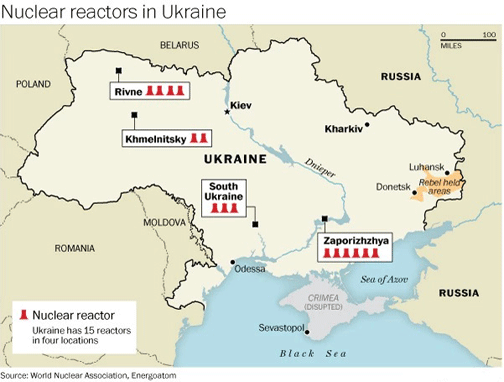
A Ukraine Invasion Could Go Nuclear: 15 Reactors Would Be In War Zone https://www.forbes.com/sites/craighooper/2021/12/28/a-ukraine-invasion-will-go-nuclear-15-reactors-are-in-the-war-zone/?sh=1c9a8a0a27aa&fbclid=IwAR1k5sz1_5PLOb7Lg6qMjULu_lj0nqF-6SXx7NifPxr6uakDliSUlgyHFqI Craig HooperSenior Contributor
As Russia’s buildup on the Ukrainian border continues, few observers note that an invasion of Ukraine could put nuclear reactors on the front line of military conflict. The world is underestimating the risk that full-scale, no-holds-barred conventional warfare could spark a catastrophic reactor failure, causing an unprecedented regional nuclear emergency.
The threat is real. Ukraine is heavily dependent upon nuclear power, maintaining four nuclear power plants and stewardship of the shattered nuclear site at Chernobyl. In a major war, all 15 reactors at Ukraine’s nuclear power facilities would be at risk, but even a desultory Russian incursion into eastern Ukraine is likely to expose at least six active reactors to the uncertainty of a ground combat environment.
The world has little experience with reactors in a war zone. Since humanity first harnessed the atom, the world has only experienced two “major” accidents—Chernobyl and Japan’s Fukushima disaster. A Russian invasion, coupled with an extended conventional war throughout Ukraine, could generate multiple International Atomic Energy Agency “Level 7” accidents in a matter of days. Such a contingency would induce a massive refugee exodus and could render much of Ukraine uninhabitable for decades.
Turning the Ukraine into a dystopian landscape, pockmarked by radioactive exclusion zones, would be an extreme method to obtain the defensive zone Russian President Vladimir Putin seems to want. Managing a massive Western-focused migratory crisis and environmental cleanup would absorb Europe for years. The work would distract European leaders and empower nativist governments that tend to be aligned with Russia’s baser interests, giving an overextended Russia breathing room as the country teeters on the brink of technological, demographic, and financial exhaustion.
Put bluntly, the integrity of Ukrainian nuclear reactors is a strategic matter, critical for both NATO and non-NATO countries alike. Causing a severe radiological accident for strategic purposes is unacceptable. A deliberate aggravation of an emerging nuclear catastrophe—preventing mitigation measures or allowing reactors to deliberately melt down and potentially contaminate wide portions of Europe—would simply be nuclear warfare without bombs.
Such a scenario can’t be ruled out. Russia has repeatedly used Ukraine to test out concepts for “Gray Zone” warfare, where an attacker dances just beyond the threshold of open conflict. Given Russia’s apparent interest in radiation-spewing nuclear-powered cruise missiles, robotic undersea bombs with a radiological fallout-oriented payload, destructive anti-satellite tests and other nihilistic, world-harming weapons, Russia’s ongoing dalliance with “Gray Zone” warfare in Ukraine may, for the rest of Europe, become a real matter of estimating radiological “grays,” or, in other words, estimating the amount of ionizing radiation absorbed by humans.
When War Comes To Zaporizhzhia
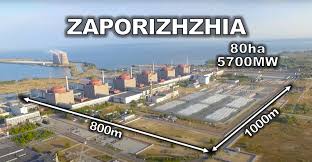
Ukraine’s Zaporizhzhia nuclear power plant is a particular risk. It is the second-largest nuclear power plant in Europe (essentially tied with a French reactor complex near Calais), and one of the 10 largest nuclear power plants in the world. The site has little protection, and the six VVER-1000 pressurized water reactors could easily be embroiled in any Russian invasion.
If war comes, the fight will be close by. The Zaporizhzhia nuclear power plant is located only 120 miles from the current “front line” in the Donbass region and is on the hard-to-defend east bank of the Dnieper River. Aside from the geographical hazards, the power plant provides about a quarter of Ukraine’s total electrical power. Given the importance of the electricity, plant managers will be reluctant to shut it down, securing the reactors only at the very last possible second. Ukraine’s desperate need for energy only compounds the opportunities for an accident.
Outside of direct battle damage, cyber and other Russian-sourced “grey zone” mischief could make the plant unmanageable even before the battle arrives at the reactor gates.
Though unlikely, direct bombardment could cause serious damage to reactor containment structures. While the reactor structures themselves are strong, warfare at the plant could kill key personnel and destroy command-and-control structures, monitoring sensors or critical reactor-cooling infrastructure. And, as an operating power plant, the reactors are not the only threat. Dangerous spent fuel rods are sitting in vulnerable cooling ponds, while older fuel sits in the site’s 167 dry spent fuel assemblies.
If the reactors suffer any operational anomalies, crisis management is not going to happen. Support infrastructure needed for safe reactor management will collapse during conflict. Plant security forces will disappear, operators will flee, and, if an accident occurs, mitigating measures will be impossible.
It seems unlikely that Russia has mobilized trained reactor operators and prepared reactor crisis-management teams to take over any “liberated” power plants. The heroic measures that kept the Chernobyl nuclear accident and Japan’s Fukushima nuclear disaster from becoming far more damaging events just will not happen in a war zone.
Again, the risks are very high. The world has never dealt with an unmanaged meltdown at a large nuclear power plant. The very real prospect of an extended and unmitigated incident at a six-reactor powerplant in a war zone is worth urgent and immediate consultations throughout Europe and NATO.
Gray Zone Nuclear Conflict Can Happen
The world has never experienced war that threatens active nuclear power infrastructure, and world leaders may be underestimating the peril conventional warfare presents to these powerful and perilous assets.
On the other hand, heedless purveyors of “gray zone” warfare may be underestimating the risk themselves, all too eager to determine just how degraded nuclear infrastructure might serve as a “less risky” surrogate for nuclear conflict.
To them, it’s not nuclear war, but just a series of unfortunate nuclear accidents.
The science-based case for excluding Nuclear Fission Technologies from the EU Taxonomy

The question whether nuclear fission energy complies with the ‘do no significant harm’ (DNSH) criteria of the EU Taxonomy was the focus of the Technical Expert Group (TEG) DNSH assessment on nuclear fission technologies which recommended to the Commission that nuclear should not be included in the EU Taxonomy of environmentally sustainable activities.
The independent scientific evidence which the TEG presented to the European Commission, shows evidence of adverse impacts to the natural environment arising from the many processes involved in the nuclear power lifecycle (from uranium mining to waste disposal) that are operational today.
The Argument against Nuclear Power as Sustainable for FinancePetitions.net, 26 Dec 21, Europe’s ‘science-based’ Sustainable Finance Taxonomy is politicised to include nuclear power.
The Science-based case for excluding Nuclear Fission Technologies from the EU Taxonomy One of the most influential policy initiatives of the European Commission in the past years has been the “EU Taxonomy”, essentially a shopping list of investments that may be considered environmentally sustainable across six environmental objectives.
To be deemed EU Taxonomy aligned, the activity must demonstrate a substantial contribution to one environmental objective, such as climate change mitigation, whilst causing no significant harm to the remaining five environmental objectives (climate change adaptation, sustainable use and protection of water and marine resources, transition to a circular economy, pollution prevention and control, and protection and restoration of biodiversity and ecosystems).
All eligible activities are required to comply with technical screening criteria (TSC) for ‘substantial contribution’ and ‘do no significant harm’ and to demonstrate that social safeguards are in place.
The EU Taxonomy provides a common language for sustainability reporting, a foundation for green bond reporting and much more. It is intended to be used by international financial markets participants whose products are sold within the EU in order to evaluate the sustainability of their underlying investments. The use of the EU Taxonomy is furthermore compulsory for the EU and member states when introducing requirements and standards regarding environmental sustainability of financial products, such as an EU ecolabel for investment products or an EU Green Bond Standard.
It will also apply to 37% of activities earmarked as ‘climate-friendly’ financed by the EU COVID-19 recovery funding. Its science-based approach is designed to give confidence to a wide range of international stakeholders that environmental claims are not greenwashing.
The question whether nuclear fission energy complies with the ‘do no significant harm’ (DNSH) criteria of the EU Taxonomy was the focus of the Technical Expert Group (TEG) DNSH assessment on nuclear fission technologies which recommended to the Commission that nuclear should not be included in the EU Taxonomy of environmentally sustainable activities.
Taking into account the significant financial implications of adopting the TEG recommendations, it became the starting point of intense behind-door lobbying. France led a coalition of 10 EU Member States arguing that nuclear fission as well as gas-fired power plants should be included in the Taxonomy. Together with Finland (Olkiluoto-3), France is at present the only EU country constructing a new nuclear power plant (Flamanville-3). The Finnish and French construction sites were meant to be the industrial demonstration of an evolutionary nuclear technology (the “European Pressurised water Reactor” or EPR). Olkiluoto-3 was meant to start generating power in 2009, followed by Flamanville-3 in 2012. Instead, the projects turned out to have multiple engineering difficulties and financial constraints that resulted in significant delays culminating in missed deadlines for various production start dates and tripling unit cost……………………. the independent scientific evidence which the TEG presented to the European Commission, shows evidence of adverse impacts to the natural environment arising from the many processes involved in the nuclear power lifecycle (from uranium mining to waste disposal) that are operational today. …………
Does the present generation of nuclear fission power plants ‘do no significant harm’? To answer this question, two specific issues for nuclear power stand out: the risk of a catastrophic accident and the management of high-level nuclear waste (HLW)………………………………
Especially relevant for nuclear fission power is the fact that the liability of the operator in the case of a severe accident is limited and the remaining costs are (largely) taken on by the state (privatization of profits, socialization of risks).
The Taxonomy architecture is not designed to cater for such risks that carry an intergenerational impact lasting for thousands of years, making it an unsuitable instrument to decide on the sustainable nature of nuclear power. The characteristics and nature of HLW generated by the nuclear fission process presents long-term intergenerational risks and thereby challenge the principle of ‘do no significant harm’ to the extent that nuclear fission energy may not be considered eligible for the EU Taxonomy.
This was made abundantly clear to the Commission in the TEG’s recommendations, which were not published in their entirety. Independent, scientific, peer-reviewed evidence compiled by TEG provided confirmation of the risk of significant harm arising from nuclear waste. The back end of the fuel cycle is currently dominated by the containment of spent fuel rods and waste from nuclear power facilities. Safe and secure long-term storage of nuclear waste remains unresolved and has to be demonstrated in its operational complexity. ……….
The fact that a ‘solution’ has to be found for the existing quantities of waste (as well spent fuel as conditioned high level waste forms), and that geological disposal is the least bad solution for this, does not imply that nuclear power can suddenly be classified as a ‘green’ energy source.
Other concerns with regard to DNSH criteria Nuclear fission power plants require about three cubic metres of cooling water per megawatt hour (MWh) produced. A nuclear plants’ cooling water consumption is higher than that of fossil-fuel plants. Throughout the world, new nuclear plants and existing plants increasingly face cooling water scarcity induced by heat waves, a situation that is likely to be aggravated by climate change…..
For reasons of having access to enough cooling water, nuclear plants are mostly sited in coastal or estuarine locations, but this makes them vulnerable to flooding and extreme events that climate change may occasion. The siting of nuclear power plants along coastal zones presents adaptation risks associated with sea-level rise, water temperature rise, coastal erosion as well as natural catastrophes such as the Fukushima disaster demonstrates. ………………..
when major nuclear plant accidents occur significant land areas become unsuitable for human habitation (e.g. Chernobyl, Fukushima). …….
Surface or underground mining and the processing of uranium ore can substantially damage surrounding ecosystems and waterways. The huge volumes of associated mining waste in developing countries are normally not considered in life cycle waste inventories of nuclear energy producing countries. More critically, the adverse effects on local environmental conditions of routine discharging of nuclear isotopes to the air and water at reprocessing plants have not been considered thoroughly enough. A number of adverse impacts (of radiation) on soil/sediment, benthic flora and fauna and marine mammals has been demonstrated.
Should nuclear fission power be included in the taxonomy as a transition activity? According to Article 10 (2) of the Taxonomy Regulation, which is the law underpinning the EU Taxonomy, activities that are incompatible with climate neutrality but considered necessary in the transition to a climate-neutral economy can be labelled and supported as ‘transition activities’…………
A key principle of the EU Taxonomy is to avoid environmentally harmful ‘lock-in’ effects of activities. Lock-in describes the phenomenon whereby it is difficult to set a technical and political system on a new path once it has developed a momentum of its own and once it is ‘locked-in’ on a certain path. ……
Nuclear fission plants require at least 10 years to be built (with recent experience even pointing in the direction of 20 years for the EPR), while they have to remain operational for 50-60 years. Decommissioning will then take another 20-50 years. This means that a decision to build new nuclear power plants will lock in societies for some 80-130 years, not counting the years needed to store spent fuel or dispose of high-level waste. …
A decision to include nuclear fission into the energy mix of the EU Taxonomy sustainable activities will during this period therefore channel much needed capital away from renewable energy technologies, which do not present long-term and catastrophic risks to humans and the environment as nuclear fission does. ……………………………………..
Signed by EU Taxonomy subgroup DNSH TEG members and expert supporters:
Dawn Slevin, Dr. Erik Laes, Paolo Masoni, Jochen Krimphoff, Fabrizio Varriale, Andrea Di Turi, Dr. Ulrich Ofterdinger, Dr. Dolores Byrne, Dr. Petra Kuenkel, Ursula Hartenberger, Kosha Joubert
Link to PDF Version of the Statement of Concern sent to the Commission on 21 Dec 21:
https://www.petitions.net/the_argument_against_nuclear_power_as_sustainable_for_finance .petitions.net/the_argument_against_nuclear_power_as_sustainable_for_finance
Julian Assange’s lawyers start process for UK Supreme Court appeal against his extradition to America

Julian Assange’s lawyers start process for Supreme Court appeal to stop WikiLeaks founder being extradited to US and tried on espionage charges
- Fiancee Stella Moris said application to bring appeal filed after 11am Thursday
- Judges must now decide whether to hear the case before any appeal takes place
- He is wanted in the US over alleged conspiracy to disclose national defence information
Daily Mail. By TOM PYMAN FOR MAILONLINE, 24 December. Julian Assange‘s lawyers have started the process for a Supreme Court appeal to stop the WikiLeaks founder being extradited to the US and tried on espionage charges, his fiancee has said.
Stella Moris said Assange filed an application to bring an appeal shortly after 11am on Thursday.
As his lawyers have applied to take his case to the Supreme Court, the UK’s highest court, judges must now decide whether to hear the case before any appeal takes place. Ms Moris, a lawyer and the mother of his two children, said in a statement on Thursday the High Court must first ‘certify that at least one of the Supreme Court appeal grounds is a point of law of general public
importance’ before the application has a chance to be considered by the Supreme Court.
A decision is not expected before the third week of January, Ms Moris added.
Birnberg Peirce Solicitors, who are representing Assange, said in a statement: ‘We believe serious and important issues of law of wider public importance are being raised in this application.
They arise from the Court’s judgment and its receipt and reliance on US assurances regarding the prison regimes and treatment Mr Assange is likely to face if extradited.
‘Because this application is now the subject of judicial consideration, his lawyers do not propose to comment further at the moment.
‘We hope and trust the High Court will grant a certificate on the questions raised as well as giving permission to appeal in order that they can thereafter be fully argued before the Supreme Court.’……………….. https://www.dailymail.co.uk/news/article-10341045/Julian-Assanges-lawyers-start-process-Supreme-Court-appeal.html?ito=social-twitter_dailymailUK
Germany steadfast in rejecting nuclear power, aims for 100% renewables
The Germans persist and sign against nuclear power and for renewables. Across the Rhine, the debate pushed by France on nuclear power, presented as “green” energy, is clearly not taking hold. The consensus remains around the bet made by the new government that a direct switch to “all renewable” is possible and will ultimately pay off much more, even if it involves painful decisions. Mediapart 25th Dec 2021 https://www.mediapart.fr/journal/international/251221/les-allemands-persistent-et-signent-contre-le-nucleaire-et-pour-le-renouvelable |
Belgium to shut down all 7 nuclear reactors in 2025
Nuclear: the Belgian government confirms the shutdown in 2025 of the
country’s seven reactors. As planned, Belgium will shut down its two power
plants, but is not closing the door to new generation nuclear power. An
agreement was torn off on Thursday after a night of negotiations between
the partners of the government coalition.
Liberation 23rd Dec 2021
https://www.liberation.fr/environnement/nucleaire/nucleaire-le-gouvernement-belge-confirme-larret-en-2025-des-sept-reacteurs-du-pays-20211223_5HUXXHO645DKBPEHJZUGINMR3M/
Les Echos 23rd Dec 2021
Radiation Free Lakeland joins the call against watering down safety regulations for nuclear fusion reactors.
Radiation Free Lakeland add our voice to the call from Nuclear Free Local Authorities that the already inadequate nuclear regulations are not watered down when it comes to dangerous fusion reactors. Fusion experiments require enormous amounts of heat and energy. The nuclear wastes from the fusion experimental reactors already amounts to 3000 cubic metres of nuclear wastes from the Culham experimental reactor alone. Nuclear Free Local Authorities say the following and RaFL agree that: Public safety must come before profit: Nuclear Free Local Authorities call for ‘no watering down’ of nuclear regulation for fusion reactors. Radiation Free Lakeland 23rd Dec 2021 https://mariannewildart.wordpress.com/2021/12/23/fusion-licensed-to-kill/ |
France’s Environmental Authority requires a list of all the problems encountered in building the Flamanville EPR nuclear reactor
An inventory of incidents on the EPR required according to the
Environmental Authority. In its latest opinion, the Environmental Authority
recommends a listing of all the problems encountered during the
construction of the EPR, as well as an update on the various solutions
provided.
France Bleu 23rd Dec 2021
Science & Avenir 23rd Dec 2021
https://www.sciencesetavenir.fr/nature-environnement/nucleaire-l-autorite-environnementale-reclame-plus-d-informations-sur-flamanville_160059
Le Figaro 23rd Dec 2021
Belgian government to close its nuclear plants by 2025
The Belgian government agreed in principle on Thursday to close its
nuclear power plants by 2025, but left open the possibility of extending
the life of two reactors if it could not otherwise ensure energy supply.
The seven-party coalition has wrestled for months with the topic, with the
Greens adamant that a 2003 law setting out a nuclear exit be respected,
while the French-speaking liberals favoured extending the life of the two
newest reactors. The government had given itself an end-2021 deadline to
settle the matter.
Reuters 23rd Dec 2021
https://www.reuters.com/markets/commodities/belgian-government-reaches-deal-nuclear-exit-media-2021-12-23/
The Belgian government agreed in principle on Thursday to close its
nuclear power plants by 2025, but left open the possibility of extending
the life of two reactors if it could not otherwise ensure energy supply.
Globe and Mail 23rd Dec 2021
Euro News 23rd Dec 2021
https://www.euronews.com/2021/12/23/belgium-to-shut-down-all-seven-of-its-nuclear-reactors-by-2025
BBC 23rd Dec 2021
France short of electricity, as it shuts down 2 nuclear reactors due to safety concerns
In the face of a continent-wide energy
crisis, France has resorted to using fuel oil to meet its power needs in
order to avoid a blackout. Despite the fact that Paris is usually a major
power exporter, it has recently increased electricity imports and even
burned fuel oil to “keep the lights on” in the country.
This energy shortage has arisen as a result of EDF Energy’s decision to shut down two
nuclear power plants due to safety concerns. At its Civaux nuclear power
station, the state-owned energy company discovered flaws in a safety
system’s pipes. It also stated that another plant, which used the same
type of reactors, would be shut down. In the two reactors in Western
France, the problem was discovered near the welds on the pipes of the
safety injection-system circuit.
Brinkwire 22nd Dec 2021
European Commission experts call on EU not to label nuclear ‘green’.

Commission experts call on EU not to label nuclear ‘green’, https://euobserver.com/climate/153891, By WESTER VAN GAAL 22 Dec 21
BRUSSELS, Thirteen members of the EU Commission’s Technical Expert Group (TEG) put out a petition on Tuesday (21 December) calling on nuclear energy not to be labelled as ‘green’.
“We recommend that nuclear fission has no place on the EU taxonomy of sustainable activities,” the group, led by Dawn Slevin, a financial expert and core member of the commission’s financial stability TEG, wrote.
Dealing with the “do no significant harm” principle in the taxonomy, they concluded nuclear may damage the environment due to the need to store it in underground bunkers for thousands of years, and “because the risk of a severe nuclear accident cannot be excluded, even in the best commercially available nuclear power plants.”
They also warn against politicisation of the rules. “Proponents of nuclear energy use the taxonomy to put a ‘scientific’ stamp on what is primarily a political position on nuclear fission energy aiming to satisfy the few EU member states that wish to promote the associated technologies,” the petition states.
France is spearheading an alliance of 10 member states that argue that nuclear fission and gas-fired power plants should be included in the taxonomy.
The TEG members point out that France and Finland are currently the only EU countries actively building nuclear facilities.
The Finnish Olkiluoto-3 was meant to start generating power in 2009, followed by the French Flamanville-3 in 2012.
However, both are still not operational, tripling anticipated costs, the group wrote. The group includes Paolo Masoni, a nuclear engineer, and Eric Laes, a post-doctoral researcher specialising in atomic energy at the Technical University of Eindhoven.
Politicised debate
In recent months, the decision on whether to include nuclear and gas in the taxonomy has become politicised.
Last week, EU internal market commissioner Thierry Breton told five European newspapers, including Die Welt, that “it is a lie that the EU can become CO2-neutral without nuclear power.”
French president Emmanuel Macron said last week that France and Germany will try to find a compromise on whether the EU should label nuclear and gas as green investments.
But on Monday, the German Greens, part of the new ruling coalition, came out strongly against nuclear, reiterating their opposition to the inclusion of nuclear in the taxonomy.
“The German government’s stance is that nuclear power is not one of the sustainable forms of energy [that] remains,” environment minister Steffi Lemke told fellow EU environment ministers in Brussels on Monday.
German climate and economics minister Robert Habeck later echoed his colleague on German radio Deutschlandfunk, saying: “I do not think nuclear power is the right technology.”
However, chancellor Olaf Scholz (SPD) did not make such a clear statement at the last EU summit on Friday – and admitted Germany will probably not be able to stop the French push for nuclear.
“France is taking a different path [than Germany]. Other countries do as well,” he said.
“That is why it’s important that you can follow your paths and at the same time stay together across Europe,” he added.
The commission planned to present its decision on nuclear and gas on Wednesday, but this has been postponed until mid-January next year.
It now plans to consult a draft version of the taxonomy with member states before the end of the year or at the start of January 2022 – a process that will be clarified on Wednesday.
The Sustainable Finance Platform, a group of 57 NGOs, scientific and financial experts will also be consulted.
The commission has faced backlash in the past from some of its members, including one of the signatories of the petition, for allowing gas an nuclear to be considered in what was meant to be a science-led exercise.
-
Archives
- October 2026 (104)
- September 2026 (339)
- August 2026 (330)
- July 2026 (355)
- June 2026 (287)
- May 2026 (306)
- April 2026 (356)
- March 2026 (251)
- February 2026 (267)
- January 2026 (308)
- December 2025 (358)
- November 2025 (359)
-
Categories
- 1
- 1 NUCLEAR ISSUES
- business and costs
- climate change
- culture and arts
- ENERGY
- environment
- health
- history
- indigenous issues
- Legal
- marketing of nuclear
- media
- opposition to nuclear
- PERSONAL STORIES
- politics
- politics international
- Religion and ethics
- safety
- secrets,lies and civil liberties
- spinbuster
- technology
- Uranium
- wastes
- weapons and war
- Women
- 2 WORLD
- ACTION
- AFRICA
- Atrocities
- AUSTRALIA
- Christina's notes
- Christina's themes
- culture and arts
- Events
- Fuk 2022
- Fuk 2023
- Fukushima 2017
- Fukushima 2018
- fukushima 2019
- Fukushima 2020
- Fukushima 2021
- general
- global warming
- Humour (God we need it)
- Nuclear
- RARE EARTHS
- Reference
- resources – print
- Resources -audiovicual
- Weekly Newsletter
- World
- World Nuclear
- YouTube
-
RSS
Entries RSS
Comments RSS

