Julian Assange tests positive for COVID-19
WSWS, Thomas Scripps 10 Oct 22,
Julian Assange has contracted COVID-19. He received the test result Saturday, on the day several thousand people formed a human chain around Parliament in London to protest his persecution.
His wife, Stella, told the press, “I am obviously worried about him and the next few days will be crucial for his general health. He is now locked in his cell for 24 hours a day.” She said Assange had been feeling ill throughout the week and developed a fever and cough on Friday.
Assange’s infection confirms the repeated warnings of medical professionals and his legal team that his health and life are endangered by his wrongful imprisonment. It must lend renewed urgency to the demand for his immediate release.
Just months before the pandemic, over 100 doctors signed an open letter to the British government warning that Assange’s life was at risk while he was kept in HMP Belmarsh—the UK’s top-security prison. When COVID-19 began to spread rapidly throughout Britain, one of the lead signatories, Dr Stephen Frost, told the World Socialist Web Site, “Given what we know about this case, Mrs Assange is right to be concerned. Julian Assange, because he is immuno-compromised, following years of arbitrary detention first in the Ecuadorian Embassy and latterly in Belmarsh prison, is necessarily at higher risk of contracting any viral or bacterial infection, including infection by coronavirus.
“He should be released on bail immediately, so that he can access the health care which he urgently requires. The UK government is effectively playing Russian roulette with Julian Assange’s life.”
Another doctor, Lissa Johnson, explained, “As long ago as 2015 medical and human rights experts warned that anything more than a trivial illness could prove fatal for Julian Assange. His health is even more fragile now, and the coronavirus only renders those warnings more urgent and more dire.”
She added, “If Julian Assange does succumb to coronavirus or any other catastrophic illness in prison, it will not be an accident. It will be a foreseeable result of prolonged psychological torture and wilful medical neglect.”
…………………………. By the end of October 2020, Ministry of Justice figures showed that 1,529 inmates had been infected, 600 in the previous month alone. At least 32 prisoners had been killed by the virus.
In November, a wave of infections hit Belmarsh prison. Stella Assange revealed, “I’ve been told the number of people infected with COVID on Julian’s house block is 56, including staff.” This was on a block with fewer than 200 inmates.
Assange and the other inmates were placed under an indefinite lockdown, kept in their cells 24 hours a day. His lawyer Edward Fitzgerald had warned at his bail application of the “risk to his mental health and his human contact” posed by lockdown procedures. At Assange’s extradition hearing that autumn, his defence team presented extensive medical evidence of the damage done to his mental health and of the risk of suicide.
……………………………. Nils Melzer, UN Special Rapporteur on Torture, examined Assange with a medical team inside Belmarsh Prison in May 2019 and concluded that he showed symptoms of psychological torture. He commented on his illness, “Assange’s stroke is no surprise. As we warned after examining him, unless relieved of the constant pressure of isolation, arbitrariness and persecution, his health would enter a downward spiral endangering his life. [The] UK is literally torturing him to death
Melzer added, “As Assange clearly was not medically fit to attend his own trial through videolink, how can they even discuss whether he is fit to be exposed to a show trial in the US, a country that refuses to prosecute its torturers and war criminals but persecutes whistleblowers and journalists?”
Saturday’s protest was the largest yet organised in defence of Assange, attracting a broader range of ages and social backgrounds. It indicated the potential that exists for a mass, global campaign to secure the WikiLeaks founder’s freedom and safety. ………… https://www.wsws.org/en/articles/2022/10/10/picp-o10.html
Austria Sues EU Executive Over Green Label for Gas, Nuclear
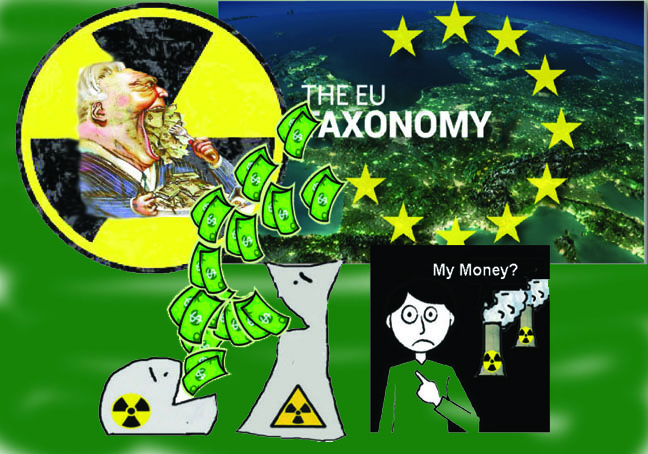
https://www.voanews.com/a/austria-sues-eu-executive-over-green-label-for-gas-nuclear-/6784510.html BERLIN — 10 Oct 22,
The Austrian government said Monday it has filed a legal complaint with the European Union’s top court over plans by the bloc’s executive branch to label natural gas and nuclear power generation as sustainable energies.
Austria’s environment minister, Leonore Gewessler, warned that the measure could “greenwash” nuclear power and gas despite the environmental damage they cause.
Another EU member, Luxembourg, announced later that it would stand by Austria in the legal case, adding more political weight to the move.
The EU’s executive Commission plans to add certain nuclear and gas plants next year to a list that helps investors determine which projects are sustainable.
Gewessler said the disasters in Chernobyl in Ukraine and Fukushima in Japan have showed that nuclear power plants come with “incalculable risks.” Meanwhile, the burning of natural gas, a fossil fuel, adds greenhouse gas emissions to the atmosphere, stoking climate change.
A dozen environmental groups have already launched legal challenges to the Commission’s plans, backed by the bloc’s lawmakers in July.
Austria’s environment minister, Leonore Gewessler, warned that the measure could “greenwash” nuclear power and gas despite the environmental damage they cause.
Another EU member, Luxembourg, announced later that it would stand by Austria in the legal case, adding more political weight to the move.
Ukraine is preparing a law on full control over the media, as the last vestiges of press freedom disappear in Kiev
Rt.com By Olga Sukharevskaya, ex-Ukrainian diplomat, 8 Oct 22,
A bill approved by the Verkhovna Rada will finally finish off freedom of speech in Ukraine.
While fierce battles continue to rage between the Ukrainian and Russian armies in Donbass, Kherson Region, and Zaporozhye, the Kiev regime is busy eradicating the last vestiges of freedom of speech in the country.
On August 30, Ukraine’s rubber-stamp parliament, the Verkhovna Rada, passed a bill on the media at the first reading. Despite the numerous changes that the 300-page document has undergone since President Vladimir Zelensky’s team developed and submitted it a few years ago, its essence remains unchanged. If it becomes law, the authorities’ power over virtually all outlets will be essentially limitless.
The main danger this bill presents is that it grants government agencies the authority to block internet resources without any court proceedings, and revoke licenses from broadcast and print media solely on the basis of complaints. This huge power would be vested in the National Council for Television and Radio Broadcasting.
No room in the EU
Ukrainian journalists have been criticizing this bill since the first version appeared in 2018, asserting that it abolishes both freedom of speech and freedom of the press. OSCE Representative on Freedom of the Media Harlem Desir called that version of the law “a blatant violation of freedom of speech,” stating that its adoption “could jeopardize pluralism in the media market, impose additional costs on the media, and negatively affect the reflection of a diversity of ideas and opinions.”
Criticism of the bill from both the OSCE and Ukrainian journalists had an effect. In 2020, it was sent for revision, but the changes only include some clarifications concerning gender equality and coverage of sexual orientations.
At the same time, it still contains a ban on publishing any messages contradicting the official government line on military issues. It is likewise forbidden to cover speeches made by officials of the ‘aggressor country’ [meaning Russia] or cast former USSR party functionaries in a positive light. For example, including Ukraine’s own Leonid Brezhnev.
The law would also hold foreign media responsible for any of its audiovisual content available in Ukraine. Moreover, social networks, including foreign ones, will be obliged to remove any material the National Council deems undesirable. The deadlines for removing ‘incorrect’ content or replacing it with ‘correct’ material have also been tightened. Among the ‘offenses’ that can get a media outlet banned is distributing programs in which any participant is on the ‘list of persons who pose a threat to the national media space of Ukraine.’ This is compiled by the National Council itself and does not require anyone’s consent.
Otherwise, the essence and spirit of the bill is preserved, including severe censorship of “objectionable” media. The American Committee for the Protection of Journalists (CPJ) didn’t call on the Verkhovna Rada to reject Bill No. 2693-D ‘On Media’ for nothing.
Maya Sever, president of the European Federation of Journalists, has bluntly stated that it means compulsory media regulation “fully controlled by the government worthy of the worst authoritarian regimes.” She is convinced that “a state that would apply such provisions simply has no place in the European Union.
From Gongadze to Shariy
Kiev’s war on journalists did not begin today. In 2000, there was the abduction and death of Georgiy Gongadze, the creator of the ‘Ukrainian Truth’ website, who harshly criticized corruption in the country’s highest echelons of power. A number of high-ranking officials were accused of being involved in the murder of the journalist, who then-President Leonid Kuchma viewed as objectionable, but the investigation revealed the involvement of only four perpetrators. One of these was the head of the Ukrainian Ministry of Internal Affairs’ main Criminal Investigation Department, General Pukach, who allegedly gave the order to liquidate Gongadze.
Nevertheless, there are many grey areas in the case. It was highly politicized and used as one of the pretenses for demanding a change of power during the days of the Orange Revolution.
Anatoly Shariy, who was engaged in high-profile investigative journalism for a number of Ukrainian publications from 2008 to 2011, almost shared Gongadze’s fate……………………………..
It is noteworthy that Shariy’s name has also been brought up in current discussions of the scandalous media bill. In justifying her support for the legislation, the head of the Board of the National Association of Ukrainian Media, Tatiana Kotyuzhinskaya, mentioned the authorities’ desire to limit the influence of Shariy and other bloggers in Ukraine’s infosphere.
It’s possible that, among other things, the reason the blogger’s activities have met with such disapproval was his publication of screenshots from messages sent by the Consul of Ukraine in Hamburg, Vasily Marushchinets, which contained calls for “death to anti-fascists,” comments like “it’s honorable to be a fascist,” and statements in the spirit of “Jews declared war on Germany back in March of 1934.” It was only after this that Nazi views in Ukraine’s Foreign Ministry became widely known to the public.
Threats, sanctions, arrests, attacks, and murders
Although the Ukrainian media has always had to fight the authorities’ attempts to restrict its activities, it was the Western-backed 2014 Euromaidan that triggered systematic persecution of press freedom in general, and individual journalists in particular.
Less than a month after the coup the new government tried to close down one of the two most widely read Ukrainian weeklies specializing in news analysis, ‘2000’, which took a negative view of the political forces that had violently seized power. The newspaper’s editorial offices were ransacked, and many left-wing outlets were shuttered. In particular, these included Borotba, as well as Rabochaya Gazeta, whose editor-in-chief ended up in the dungeons of Ukraine’s secret police, the SBU.
In the same year, Konstantin Dolgov, the editor-in-chief of ‘Glagol’, an online publication based in Kharkov, and Andrey Borodavka, a journalist, were arrested and persecuted by the new authorities. Olga Kievskaya, editor-in-chief of the ‘Anti-Orange’ website, was forced to emigrate due to threats ………………….
The vast majority of these cases were not covered in the Ukrainian media because these people were immediately declared “subversive elements” based on the so-called “moratorium on criticism of the authorities,” which the authorities announced themselves back in March of 2014, long before the start of hostilities in Donbass.
In 2018, Igor Guzhva, the head of the ‘strana.ua’ website, was forced to flee to Austria, where he received political asylum. The authorities’ efforts to prosecute him began after his investigations into Pyotr Poroshenko’s scandalous commercial activities. Later, under Zelensky, Ukraine imposed personal sanctions on Guzhva, and his website was blocked extrajudicially, while he himself, along with one of his journalists, Svetlana Kryukova, were entered into the ‘Register of State Traitors’. According to the head of Ukraine’s Union of Journalists, Sergey Tomilenko, these sanctions are political, and the European Federation of Journalists issued a statement condemning these actions as “a threat to the press, freedom, and media pluralism in the country.”
But not all Ukrainian journalists managed to emigrate, even after surviving prison. In April of 2015, the famous Ukrainian writer-historian and journalist Oles Buzina died at the hands of ‘Patriots of Ukraine’ after receiving threats and attacks due to his views. Despite appeals from the UN, the authorities have hampered the investigation in every possible way, and the murder suspects are still at large, evidence notwithstanding. In July of 2016, another journalist, Pavel Sheremet, was killed by participants in Kiev’s ‘Anti-Terrorist Operation’ (ATO) and supporters of the “purity of the white race.”
“Government critics, journalists, and non-profit organizations have come under increasing pressure from the authorities and far-right groups, which have embarked on the path of infringing freedom of speech and freedom of association under the pretext of countering Russian aggression,” Amnesty International said in a 2017 report.
No room for foreigners
Since the first half of 2014, even calling for a peaceful settlement of the conflict in the east of the country has been considered a crime in Ukraine. In particular, Ruslan Kotsaba, a journalist who refused to be drafted due to the consequences of a stroke, was imprisoned for this reason. In fairness, it should be noted that he was acquitted by an Appeals Court after a year and a half of imprisonment.
A few years before the start of Russia’s military operation, journalists whose material was published in the Russian media were subject to criminal prosecution…………………………………………….
The OSCE is aware, but Ukraine’s authorities don’t care
In 2018, a report was published by OSCE Representative on Freedom of the Media Harlem Desir in which he asserts that he had handed the Ukrainian authorities more than 20 statements and appeals collected from July 6 to November 21, 2018, concerning freedom of speech and the rights of journalists in Ukraine. ………………………………………
No room for freedom of speech in Ukraine
We have specifically chosen the report of the OSCE Representative on Freedom of the Media, which was published quite some time ago, to demonstrate that the attitude of the Ukrainian authorities towards freedom of speech and the right of journalists to freely express their own opinions have long-standing roots, and their persecution is systemic. Any similar report covering any period from 2014 to the present would contain no fewer instances of violations of these rights and freedoms. The whole list would require a decent-sized book to document………………………………………………………………………….
The fact that the Verkhovna Rada of Ukraine supported the bill ‘On Media’ gives reason to fear that the situation for the country’s journalists will become even worse. Once again, the Zelensky regime has confirmed that it’s not building a democratic, but an authoritarian or even totalitarian state, which has no room for such concepts as freedom of speech and the press. https://www.rt.com/russia/564217-ukraine-vs-freedom-of-speech/
Belarus has no intention to go to war with neighbors, but it will defend itself — defense minister
TASS, Mon, 10 Oct 2022
Belarus will not go to war with neighboring states provided there are no wrong steps on their part, Defense Minister Viktor Khrenin said on Monday.
“We don’t want to be at war with Lithuanians or Poles, let alone Ukrainians. If you don’t want to and don’t take wrong steps, then there will be no war,” the Defense Ministry’s press-service quotes Khrenin as saying.
He urged Ukraine not to provoke the Belarusian side and to refrain from spreading fake news about an allegedly impending attack by Minsk……………….
7,000 form human chain in London to protest treatment of Assange
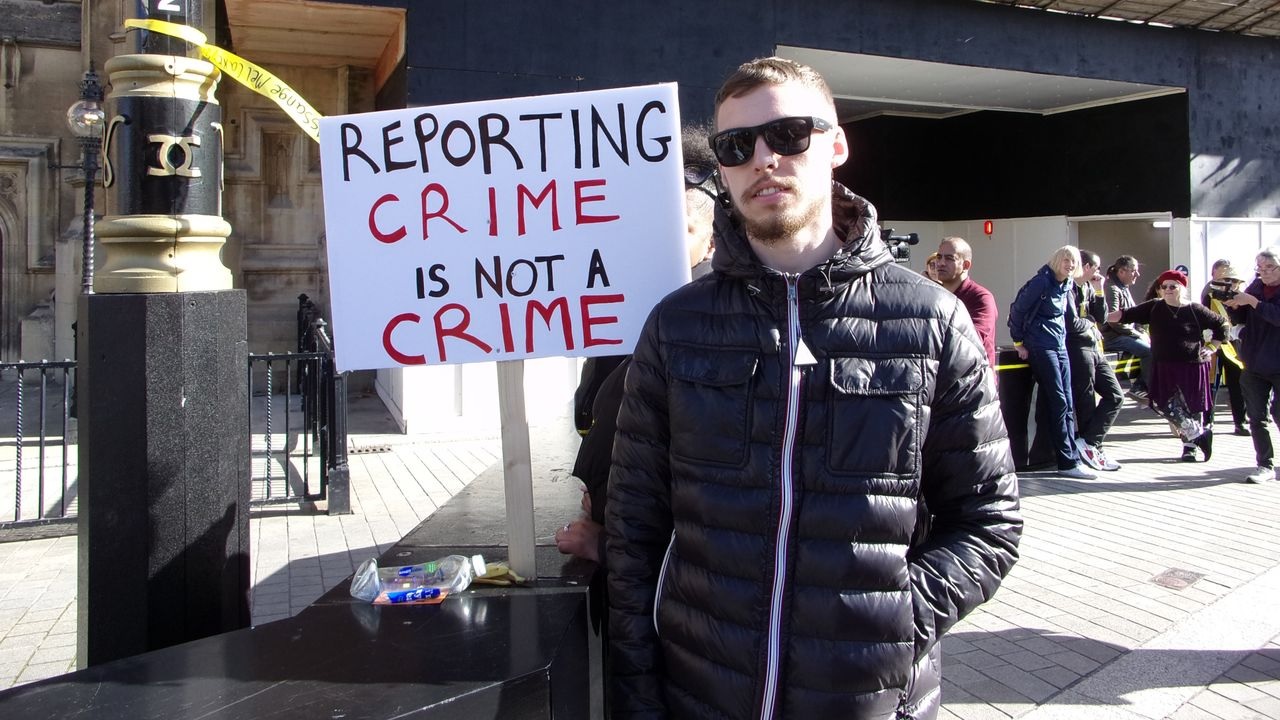
WSWS 9 Oct 22, Around 7,000 people formed a human chain around the Houses of Parliament in the UK Saturday, protesting the British government’s persecution of WikiLeaks founder Julian Assange.
The chain ran continuously from Parliament Square along the Palace of Westminster, across Lambeth Bridge, along South Bank to Westminster bridge, then back over the Thames river to Parliament Square—roughly two miles. The event was organised by the Don’t Extradite Assange campaign.
Assange is currently held in Belmarsh maximum security prison in London. The United States government is seeking his extradition under the Espionage Act for exposing the war crimes and human rights abuses of US imperialism and its allies. It has plotted his assassination and levelled charges which carry a life sentence in solitary confinement. The WikiLeaks founder is seeking to overturn orders by the British judiciary and the home secretary approving his extradition. His legal team filed an appeal with the High Court in August.
Stella Assange, the WikiLeaks publisher’s wife, told protestors on Saturday, “Julian is suffering and part of the point of making this human chain was to show that what is happening here is not a legal process, it’s not a legitimate process. It is the instrumentalisation of the law in order to persecute a person, a journalist, in order to keep him in prison indefinitely.
“People around the world are witnessing this atrocity and that is what compels them to come here to show their solidarity, to show that they care about Julian. That they believe in justice, that they see what is happening here is a state that has committed crimes against innocent, that is now committing crimes against a journalist who exposed those crimes they committed.
“Let’s not forget that the US planned to assassinate Julian in the UK, while he was in the embassy and now they’ve put him in the harshest prison in the UK for almost four years.”
WikiLeaks editor Kristinn Hrafnsson said proceedings against Assange were “not a legal case,” because of the way the legal system has “bent itself to the demands and requests of the government… it’s appalling.”
He continued, “Julian is a political prisoner. He’s being politically persecuted. The chain around Parliament is sending a message to those inside. They are there to serve the people on the outside. And those are Julian’s supporters. Thousands of them here today, and millions around the world who know that this is a travesty.”
Labour MP and former shadow chancellor John McDonnell had the brass neck to announce, “As we go into the 18 months up to a general election, this will become a general election issue. Every MP will be asked: do you stand up for journalism, do you stand up for the rights of journalist to report freely, do you stand up for his basic human rights, do you stand up for justice?”……………………..
Reporters from the World Socialist Web Site spoke with some of the protestors……………………………………………
A number of those protesting travelled to London from other countries to do so. Mantas, who traveled from Lithuania that day to support Assange as part of the chain, told our reporters, “Assange told the truth about war crimes, and he fought for human rights and freedom of the press.”
The US and UK governments “want to make a clear and obvious example of Assange so that no-one attempts what he did. The powers that be are trying to impose their own world view, control how people think, to seduce them into thinking nothing can be done or that the world is as it’s supposed to be, when we are actually entering into wholesale madness in the world.”
He said of the war in Ukraine that the weapons manufacturers and businesses “want to promote a new war, and they don’t care about the consequences for the Ukrainian people or the Russian people. I don’t agree with Putin’s actions, but I think there was another option, but Zelensky was encouraged to take a hard line and oppose any deals from the Russian Federation.”
Listing the crimes exposed by WikiLeaks he said, “Where do you start? You can look at the video of an Apache helicopter shooting civilians. The Afghan and Iraq war logs and so on. People should look into it. There’s too much to go into herethat many crimes have been uncovered. People should look into what WikiLeaks has done what its expose and be objective about the matter.”
Assange’s case “shows that if anyone finds out something like this and tries to tell the public then they can be prosecuted for it. So obviously that can threaten everyone.” https://www.wsws.org/en/articles/2022/10/08/chai-o08.html?fbclid=IwAR0oU-kS9VcRD34qsOcy2SC2BTcKB2CmeY6IwAoPfyc-MniCzPt3xsgXEu4
The great ratepayer robbery: how UK new nuclear rips off its customers

the taxpayer will be liable for the inevitable cost overruns and the RAB scheme itself makes it even less likely that developers will keep within the bounds of their agreements, thereby further increasing costs.
decision on Sizewell C as a stitched up deal behind closed doors, bringing extra cost to the consumer, producing unmanageable waste and squandering our capital on a white elephant scheme.
it is criminal that our time and money is wasted and all our futures thrown away on the back of this scam.
How new nuclear rips off its customers
By Linda Clare Rogers
A recent BBC documentary called Big Oil versus the World exposed the excellent job by oil companies in fending off what could have been an existential threat to their future, at the cost of one for the rest of us. The program revealed how the oil industry brought us near to catastrophe while knowingly lying about the role of fossil fuels in creating global warming.
There are vital lessons to be learned from this about the nuclear power industry. As with the oil industry, the nuclear industry continues to mislead us about the need for nuclear power to save the planet, in order to preserve itself. And, like the oil industry, it contributes to the catastrophe of global warming.
Nuclear power stations take too long to build to help mitigate the effects of global warming, and divert money from renewable power and other more immediate means of doing so.
To add insult to injury, we, as taxpayers, are now being asked to contribute to this catastrophe by paying for the building of yet more destructive nuclear power stations. The astronomical cost of nuclear power means that the industry itself can’t and won’t take on the economic risk.
Instead, money taken from our earnings and our benefits (in the U.K, low-income people on Universal Credit are not to be exempted), to set up new nuclear build, is meant to encourage other investors to take the risk in the future. This is before the plants are actually built.
The name of the UK government scheme , or, more accurately, scam, is the Regulated Asset Base model, known as RAB. (Editor’s note: In the U.S., a similar fleecing of ratepayers exists in some states, known as Construction Work In Progress or CWIP.)
In the introduction to RAB — the Ministerial Foreword to the Statement on Procedure and Criteria for Designation — we are told that the government will be taking one nuclear project to Final Investment Decision this parliament and two projects to Final investment Decision in the next parliament, including small modular reactors. The push for this scenario is undermining safety, fleecing the taxpayers at a time of economic crisis, and disregarding the real problems increasingly associated with nuclear power.
The Nuclear Energy Financing Act 2022 implements the nuclear RAB model and is meant to facilitate investment in the design, construction, commissioning and operation of new nuclear energy generation projects.
There are two criteria that government say have to be met in order that a new nuclear power project should receive RAB funding. But both of these criteria are largely meaningless:
Criterion one: the Secretary of State is of the opinion that the development of the relevant nuclear project is sufficiently advanced to justify the designation of the nuclear company in relation to the project, for instance, that the project has received a Development Consent Order (DCO).
Criterion two: the Secretary of State is of the opinion that designating the nuclear company in relation to the project is likely to result in value for money.
The government draft designation document for the two-reactor EDF project at Sizewell C in Suffolk, emphasizes these criteria. To fulfill the first, it is necessary that a DCO is approved, amongst other markers. The DCO contains evidence about the suitability of the proposed site for the project as well as the impact on the local community and its environment.
The Planning Inspectorate have advised that the DCO for Sizewell C be rejected. This in itself is really important news. Those of us who have been fighting against the building of Wylfa B, or Wylfa Newydd, are familiar with this scenario.
The Planning Inspectorate also advised the Secretary of State to reject the DCO application for Wylfa B. Many of the reasons were on similar grounds as those given for the rejection of the application for Sizewell C. The scheme broke habitat regulations and had detrimental impacts on biodiversity and the environment.
Notably, one of the main reasons for the advised rejection of the DCO for Sizewell C was the impact on the local water supply. We need only see what happened in France this past summer, with the shutdown of nuclear power stations due to the overheating of the rivers necessary for the cooling of the plants, to see that issues over water supply will only get worse as climate change gets worse.
So, for RAB funding to be designated, the DCO has to be granted. The Planning Inspectorate recommended it be rejected, and the government went ahead and passed it anyway. This is a profoundly dangerous decision and needs to be fought.
Hard on issuing the DCO will come the designation of RAB funding. The second criterion to allow for this will also be sure to pass: value for money for the taxpayer. The government explains that RAB will be eliminating significant compound interest on capital invested, thus saving us money. It makes the hopeful statement that, “the RAB model has the potential to reduce the financial cost for new nuclear projects, thereby reducing consumer bills while still preserving incentives for the private sector to complete nuclear projects to time and budget”.
Commentators have made it clear that the taxpayer will be liable for the inevitable cost overruns and the RAB scheme itself makes it even less likely that developers will keep within the bounds of their agreements, thereby further increasing costs.
The model has been criticized by two advisory bodies, the Climate Change Committee and the National Infrastructure Commission.
The draft document for the designation of RAB for Sizewell C would be laughable if it were not so serious in its implications and its precedent for further nuclear developments.
Under the heading —Results: Value for Money for Consumers — we are told, “this has been calculated by comparing the cost of the electricity system with and without Sizewell C….. The modelling compares the cost of an electricity system with a RAB funded Sizewell C against two different net zero compliant counterfactuals.” (These latter are the use of renewables and carbon capture and storage.)
It then provides a chart showing the costings and savings for the taxpayer. All that can be seen in each and every box are a row of the letter x. No figures at all.
When the chief executive of the Nuclear Industry Association, Tom Greatrex, was asked what he knew about the lack of figures available for the Sizewell C agreement on Radio 4, he could give no answer, but offered that RAB was a “different finance mechanism” that would allow for a very predictable price for electricity for a very long time.
This is another example of the nuclear industry and government getting together to present a false narrative: this one uses the present scandal of the cost of energy to persuade us that nuclear power can give us future security and control over future energy supplies.
It should be noted that Hitachi withdrew its application to build Wylfa Newydd for cost reasons, prior to the advised rejection of the DCO. The £5 billion offered by UK government to subsidize building that project was not enough for the Japanese company. This underlines how little risk developers are willing to take and how much risk government is happy to heap on us.
Another major issue with the RAB funding scheme is that, as government documents delicately put it, “the Secretary of State is aware that there could be a perception of a conflict of interest between his role in determining the DCO application for the Sizewell C project and his role in determining whether or not to designate the nuclear company. To avoid any perceived conflict of interest the Secretary of State will delegate the final decision on the DCO to another BEIS minister.”
Well that sorts that problem out then. Of course, while the taxpayer is paying for a nuclear project, it is unlikely to be halted by government. The overriding of the Planning Inspectorate findings against Sizewell C bears this out. How will the government not grant a Final Investment Decision, due next year?
Greenpeace has described the decision on Sizewell C as a stitched up deal behind closed doors, bringing extra cost to the consumer, producing unmanageable waste and squandering our capital on a white elephant scheme.
We say no to nuclear, no to RAB and will be looking to other allies and partners to fight this scheme. Maybe, like the Peace Tax 7, we can find ways to withhold our payments. Perhaps there are legal ways to stop the self -serving deceptions and corruption.
We need to keep calling out the UK government and the Welsh government on these deceptions. When so many people are in fuel poverty and it is so important that the best is made of our precious resources, it is criminal that our time and money is wasted and all our futures thrown away on the back of this scam.
Linda Clare Rogers is a member of People Against Wylfa B and CND Cymru.
Austria has filed a legal case against European Union’s inclusion of nuclear and gas as “clean” in the EU “taxonomy”

Staunchly anti-nuclear Austria said on Friday it had followed through on a
pledge to file a legal challenge to the European Union’s inclusion of
natural gas and nuclear energy in a list of “green” investments. At issue
is the European Union’s so-called taxonomy, a rulebook defining which
investments can be labelled climate friendly and designed to guide
investors toward green projects that will help deliver the bloc’s
emissions-cutting targets.
Reuters 7th Oct 2022
US comments on Zelensky’s ‘preemptive strike’ appeal

Washington has no plans to attack Russian forces in Ukraine, the State Department has said
https://www.rt.com/news/564292-us-zelenskys-preemptive-strike-russia/ 8 Oct 22,
The US is not about to get directly involved in the hostilities between Moscow and Kiev, a State Department spokesman said on Friday, after Ukrainian President Vladimir Zelensky had urged the West to conduct “preventive strikes” against Russia.
When asked about the Ukrainian leader’s latest appeal to the West, State Department Principal Deputy Spokesperson Vedant Patel said that the administration of US President Joe Biden has repeatedly stated that it has no intention of taking part in the fighting.
“As long as the United States or our allies are not attacked, we are not going to get directly engaged in this conflict either by putting American troops to fight in Ukraine or attacking Russian forces,” he reiterated, adding that Washington’s message on this matter has been “very clear.”
On Thursday, Zelensky, speaking at an online conference at the Australian Lowy Institute, called for “preventive strikes” against Russia so that Moscow knew what to expect should it resort to nuclear weapons.
Later, Zelensky’s press secretary attempted to clarify these remarks, arguing that they should not be interpreted as a request for NATO to attack Russia. The Ukrainian leader himself also stepped in, telling BBC on Friday that he had meant “preventive kicks, not attacks.” The UK outlet also clarified that Zelensky was “referring to sanctions.”
The comments made by the Ukrainian president sparked a backlash from Moscow, which accused him of attempting to spark a world war, which would lead to “unforeseeable disastrous consequences.” Foreign Ministry spokeswoman Maria Zakharova went so far as to describe him as “a monster, whose hands can destroy the planet.”
Russia has repeatedly stated that a nuclear war should never be fought, while Russian Defense Minister Sergey Shoigu in August made it clear that Moscow is not considering a nuclear strike on Ukraine, given that there are no targets warranting such drastic measures.
Ukraine’s ZNPP Must Be Urgently Protected, IAEA’s Grossi Says After Plant Loses All External Power Due to Shelling
https://www.iaea.org/newscenter/pressreleases/ukraines-znpp-must-be-urgently-protected-iaeas-grossi-says-after-plant-loses-all-external-power-due-to-shelling 8 Oct 22, Ukraine’s Zaporizhzhya Nuclear Power Plant (ZNPP) has lost its last remaining external power source due to renewed shelling and is now relying on emergency diesel generators for the electricity it needs for reactor cooling and other essential nuclear safety and security functions, Director General Rafael Mariano Grossi of the International Atomic Energy Agency (IAEA) said today.
The ZNPP’s connection to the 750 kilovolt (kV) power line was cut at around 1am local time today, Director General Grossi said, citing official information from Ukraine as well as reports from the team of IAEA experts present at the site of Europe’s largest nuclear power plant.
Sixteen of the plant’s diesel generators started operating automatically, providing its six reactors with power. After the situation stabilised, ten of the generators were switched off, leaving six to provide the reactors with necessary electricity.
“The resumption of shelling, hitting the plant’s sole source of external power, is tremendously irresponsible. The Zaporizhzhya Nuclear Power Plant must be protected,” Director General Grossi said. “I will soon travel to the Russian Federation, and then return to Ukraine, to agree on a nuclear safety and security protection zone around the plant. This is an absolute and urgent imperative.”
All the plant’s safety systems continue to receive power and are operating normally, the IAEA experts were informed by senior Ukrainian operating staff at the site. Although the six reactors are in cold shutdown, they still require electricity for vital nuclear safety and security functions. The plant’s diesel generators each have sufficient fuel for at least ten days. ZNPP engineers have begun work to repair the damaged 750 kV power line.
Lasting peace in Europe only possible with Russia’s input – Angela Merkel

Rt.com 7 Oct 22,
The Cold War won’t really be over until Russia has contributed to European security architecture, the former German Chancellor said.
Sustainable peace in Europe may only be achieved if Russia is part of it, former German Chancellor Angela Merkel said on Thursday.
Speaking during the 77th anniversary of the German newspaper ‘Suddeutsche Zeitung,’ Merkel explained that while the West has been adamant in its support for Ukraine as the nation remains locked in conflict with Russia, it should also keep its mind open about what might seem as “unthinkable” now – Moscow’s future role in Europe’s affairs.
She stressed that “a future European security architecture within international law will meet the requirements” only if it involves Russia. “As long as we haven’t achieved that, the Cold War is not really over either,” she added.
Merkel described February 24 – the day Russia launched its military campaign in Ukraine – as a “turning point,” adding that statements made by various parties to the conflict should be taken “seriously and not to be classified as a bluff from the start.”………………………..
She also noted that former German chancellor Helmut Kohl, who before his death, was widely regarded as her political mentor, would have kept an open mind about “how relations to and with Russia could one day be redeveloped” after hostilities in Ukraine end.
Such a stance, however, did not sit well with Ukrainian officials. Last week, Andrey Melnik, Kiev’s outgoing ambassador to Berlin, called Merkel’s attitude towards Russia and its role in European security “almost perverse.” https://www.rt.com/news/564203-merkel-peace-europe-ukraine-russia/;/
Scotland government will double down on opposition to new nuclear power stations north of the border.
JOHN Swinney is set to renew the Scottish Government’s opposition to new
nuclear power stations being built north of the border. The Deputy First
Minister will double down on his Government’s stance when he delivers his
keynote speech to SNP conference today.
Energy policy is reserved to Westminster, but the Scottish Government can effectively veto proposals
north of the border through devolved planning rules.
Since becoming Prime Minister last month, Liz Truss has repeatedly called for the Scottish
Government to change its tune on nuclear power. But the Scottish Government
has insisted it has no intention of doing so, when its delayed updated
energy strategy is published later this year.
Mr Swinney is expected to tell the SNP conference: “Scotland is a nation rich in energy resources
– we have a plentiful supply of clean, green, affordable renewable
energy. “The equivalent of almost 100 per cent of our electricity demand
is from renewable sources.
Not only is Scotland self-sufficient in natural
gas, we are a huge exporter. “Scotland is secure in energy.
So, we need no lectures from Liz Truss about security of energy supply. It is the UK
that has failed to achieve energy security, with the National Grid warning
of possible power cuts this winter. “And Scotland is not going to put up
with a new round of nuclear power stations to make up for the failure of
energy policy in the United Kingdom.” He will add: “Despite our huge
strength in energy, 150,000 more people in Scotland will be forced into
extreme fuel poverty as a result of the UK Government’s increase to the
energy price cap in September. “We are an energy rich nation, but 35% of
our citizens live in fuel poverty. Why is that? Because, while Scotland has
the energy, Westminster has the power. And how Westminster chooses to use
its reserved power has consistently, and deliberately, disadvantaged
Scotland.”
Herald 9th Oct 2022
Truss call for Scottish nuclear power is to make up for UK mistakes
Truss call for Scottish nuclear power is to make up for UK mistakes –
Swinney. The Prime Minister previously said she wanted to see nuclear power
stations built in Scotland.
Evening Standard 8th Oct 2022
25 years ago Australia’s Paul Keating warned against expanding NATO
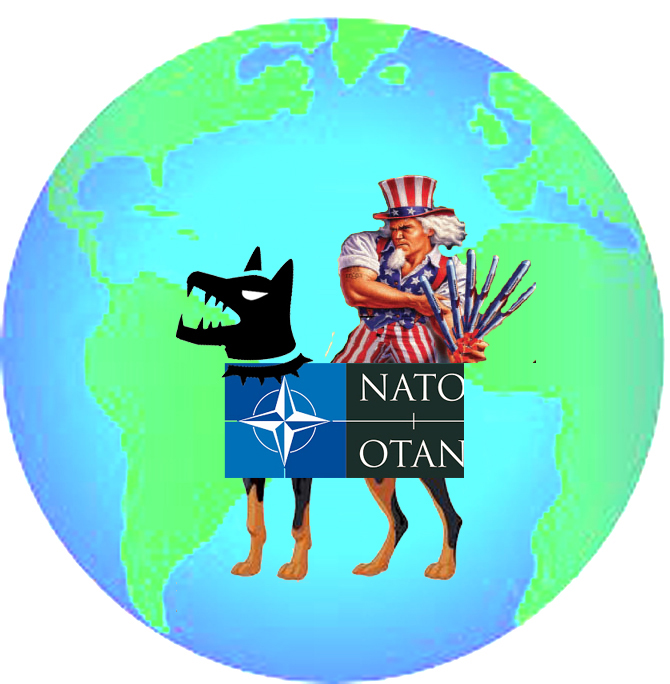
25 Years ago, I warned expanding NATO ranked with the errors that led to WWI and II
Expanding NATO’s military demarcation point to the very borders of the former Soviet Union was an error which may rank with the strategic miscalculations which prevented Germany from taking its full place in the international system at the beginning of this century.
Paul Keating said these things twenty-five years ago in a major address to the University of New South Wales, 4 September 1997:
“Partly as a result of the reluctance of current members to move faster in expanding EU membership, I believe a great security mistake is being made in Europe with the decision to expand NATO. There is no doubt this was seen by some in Europe as a softer option than EU expansion.
NATO and the Atlantic alliance served the cause of western security well. They helped ensure that the Cold War finally ended in ways which serve open, democratic interests. But NATO is the wrong institution to perform the job it is now being asked to perform.
The decision to expand NATO by inviting Poland, Hungary and the Czech Republic to participate and to hold out the prospect to others – in other words to move Europe’s military demarcation point to the very borders of the former Soviet Union – is, I believe, an error which may rank in the end with the strategic miscalculations which prevented Germany from taking its full place in the international system at the beginning of this century.
The great question for Europe is no longer how to embed Germany in Europe – that has been achieved – but how to involve Russia in a way which secures the continent during the next century.
And there was a very obvious absence of statecraft here. The Russians, under Mikhail Gorbachev, conceded that East Germany could remain in NATO as part of a united Germany. But now just half a dozen years later NATO has climbed up to the western border of the Ukraine. This message can be read in only one way: that although Russia has become a democracy, in the consciousness of western Europe it remains the state to be watched, the potential enemy.
The words used to explain NATO’s expansion have been nuanced, and the dangers have been acknowledged. But however careful the words are, whatever the window dressing of the Permanent NATO-Russia Joint Council, everybody knows that Russia is the reason for NATO’s expansion.
The decision is dangerous for several reasons. It will fuel insecurity in Russia and strengthen those strains of Russian thought, including the nationalists and former communists in the parliament, which are opposed to full engagement with the West. It will make more likely the restoration of military links between Russia and some of its former dependencies. It will make arms control, and especially nuclear arms control, more difficult to achieve.
And NATO expansion will do much less to strengthen the new democracies of eastern Europe than would enlargement of the EU.”
The above from Paul Keating was posted earlier in Pearls and Irritations. See extract from an earlier post John Menadue.
Zelensky aide attempts to walk back call for ‘preemptive strike’

It’s not clear what Zelensky meant by a “pre-emptive strike”. He might not have meant that NATO/USA should use a nuclear weapon.
But – he might well have meant that USA/NATO should strike at Russian nuclear sites
And that would indeed mean a Nuclear Pre-emptive Strike
https://www.rt.com/russia/564204-zelensky-no-nuclear-strike/ 7 Oct 22, The Ukrainian president didn’t urge NATO to attack Russia with nuclear weapons, he pointed out.
Ukrainian President Vladimir Zelensky’s call for a preemptive NATO strike against Russia should not be interpreted as a request to attack the country, his press secretary has insisted.
“Colleagues, you have gone a bit too far with your nuclear hysterics and hear ‘nuclear strikes’ where there are none,” Sergey Nikoforov wrote on Facebook on Thursday, responding to widespread alarm over the president’s words.
The press secretary pledged that Ukraine will never resort to nuclear threats, calling it something only the “terrorist state Russia” would do.
Moscow has denied that its senior officials were threatening anybody when they described the country’s official nuclear posture, in the context of warning NATO members against attacks on Russia.
Hours earlier, Zelensky told the Australian Lowy Institute that NATO should carry out preemptive strikes against Russia so that it “knows what to expect” in the event that it uses atomic weapons.
Such an attack would “eliminate the possibility of Russia using nuclear weapons,” the Ukrainian leader claimed. He urged the US and its allies to make a show of force, recalling how he appealed to other nations for preemptive measures against Russia before Moscow sent troops into Ukraine in late February.
“I once again appeal to the international community, as it was before February 24: preemptive strikes so that they [Russians] know what will happen to them if they use it, and not the other way around,” he said.
His press secretary also noted that before the hostilities started, “the only measures we talked about were preemptive sanctions”.
Russian officials have accused Zelensky of trying to provoke a global nuclear war. Foreign Ministry spokeswoman Maria Zakharova described him as “a monster, whose hands can destroy the planet,” after being pumped with Western weapons.
The Russian military doctrine allows the use of nuclear weapons in a conventional conflict, if Moscow believes that the existence of the country is under threat. Russian officials have repeatedly warned against escalating the crisis in Ukraine, stating that it could spiral out of control and result in a global nuclear exchange.
TODAY. Folie a deux? – Liz Truss and Emmanuel Macron – besties, in going all out for nuclear power
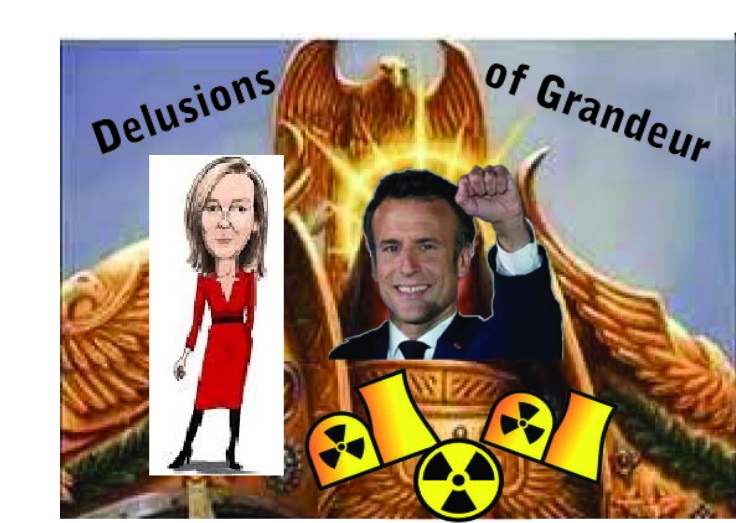
What a pair! They have so much in common. Especially their glorious abandon in going back on previous promises. Macron promised to phase out nuclear power. Truss wanted Britain to stay in the European Union. Then – hey presto! Macron’s all for the nuclear industry, and Liz all for “Brexit” – UK getting out of the EU.
But now, Liz and Emmanuel are besties again, as both go hell for leather for the dangerous, weapons-proliferation, environment-damaging and – oh dear! unaffordably costly nuclear power!
Is this some sort of subconscious Folie à deux – a strange political suicide wish?
They’re committed to work together to get EDF’s Sizewell C nuclear station project happening.
For France – by the end of this year, EDF’s net debt is already forecast to swell to about €60bn, while its French construction programme alone could cost another €52bn.
For Britain – not counting the astronomic cost , ( up to £30 billion, to be paid sort of upfront by the odious Regulated Asset Base ) Sizewell C will be foreign owned, and years to build, with dangerous, hazardous waste and horrendous decommissioning costs – not to mention a potential target for terrorists. Located on low-lying Suffolk coast – vulnerable to rising seas due to global heating.

One point of difference. Liz Truss opposes the idea of Britons conserving energy, whereas the Macron government is promoting energy conservation. Macron’s a bit less nutty?
1 This Month





PLEASE OPPOSE HR 8255 AND S.3639 – bills would accelerate satellite deployment, with no environmental review or safeguards – https://ncstd5li.quorum.us/campaign/169331/
To see nuclear-related stories in greater depth and intensity – go to https://nuclearinformation.wordpress.com
-
Archives
- October 2026 (74)
- September 2026 (339)
- August 2026 (330)
- July 2026 (355)
- June 2026 (287)
- May 2026 (306)
- April 2026 (356)
- March 2026 (251)
- February 2026 (267)
- January 2026 (308)
- December 2025 (358)
- November 2025 (359)
-
Categories
- 1
- 1 NUCLEAR ISSUES
- business and costs
- climate change
- culture and arts
- ENERGY
- environment
- health
- history
- indigenous issues
- Legal
- marketing of nuclear
- media
- opposition to nuclear
- PERSONAL STORIES
- politics
- politics international
- Religion and ethics
- safety
- secrets,lies and civil liberties
- spinbuster
- technology
- Uranium
- wastes
- weapons and war
- Women
- 2 WORLD
- ACTION
- AFRICA
- Atrocities
- AUSTRALIA
- Christina's notes
- Christina's themes
- culture and arts
- Events
- Fuk 2022
- Fuk 2023
- Fukushima 2017
- Fukushima 2018
- fukushima 2019
- Fukushima 2020
- Fukushima 2021
- general
- global warming
- Humour (God we need it)
- Nuclear
- RARE EARTHS
- Reference
- resources – print
- Resources -audiovicual
- Weekly Newsletter
- World
- World Nuclear
- YouTube
-
RSS
Entries RSS
Comments RSS

