Ukraine gets highly anticipated arms from Germany – Spiegel
https://www.rt.com/russia/564488-ukraine-germany-iris-system 13 Oct 22,
Kiev has received the IRIS-T air defense system even before Berlin’s own military.
Ukraine has received the first of four IRIS-T SLM air defense systems from Germany, Der Spiegel reported on Tuesday. With its own weapons stockpiles seriously depleted, Germany is gifting this ultra-modern system to Kiev before its own forces.
The system – which comprises a command vehicle, a radar vehicle, and a truck-mounted launcher capable of firing eight missiles – was handed over to the Ukrainian military next to the Polish-Ukrainian border on Tuesday, the German magazine reported.
The handover took place four days after German Defense Minister Christine Lambrecht made an unannounced visit to Ukraine, where she promised her Ukrainian counterpart, Aleksey Reznikov, that his country would receive the IRIS-T “in a few days.” German Chancellor Olaf Scholz pledged to provide this system to Ukraine back in June, with delivery initially slated for November.
In an update on Monday, Lambrecht said that Russia’s devastating missile strikes on Ukrainian military and infrastructure targets that morning showed “how important it is to supply Ukraine with air defense systems quickly.”
Berlin has promised Ukraine at least four IRIS-T systems, each of which can supposedly strike incoming missiles up to 40 kilometers (25 miles) away. Ukraine has reportedly asked Germany for at least a dozen of these systems, and offered to purchase them directly from the manufacturer, Diehl Defense.
Germany’s own military has yet to field a single ground-based IRIS-T system, with the remaining three pledged to Ukraine yet to be manufactured, Der Spiegel reported. Germany has faced persistent criticism from Kiev for its supposed hesitance in donating sufficiently heavy weaponry, but the arms it has sent have left its own stocks depleted.
Foreign Minister Annalena Baerbock warned of “absolute deficits” in Germany’s weapons stocks in August, and a report by Business Insider on Saturday revealed that the Bundeswehr (German Army) has only enough ammunition for two days of warfare.
Russia open to talks with West: Lavrov
Canberra Times, 12 Oct 22, Moscow is open to talks with the West on the war in Ukraine, Russian Foreign Minister Sergei Lavrov Moscow says, which Washington has dismissed as “posturing” because Russia continues to strike Ukrainian cities.
In an interview on state television, Lavrov said Russia was willing to engage with the United States or with Turkey on ways to end the war, now in its eight month, but had yet to receive any serious proposal to negotiate……………………..
Lavrov said officials, including White House national security spokesman John Kirby, had said the United States was open to talks but that Russia had refused.
“This is a lie,” Lavrov said. “We have not received any serious offers to make contact.” https://www.canberratimes.com.au/story/7938759/russia-open-to-talks-with-west-lavrov/?cs=14264
German Greens lay out nuclear power extension position amid coalition infighting
DW 15 Oct 22, The Green Party decided to support reserve operation of nuclear power plants in Germany, but rejected procurement of new fuel rods. Their party conference coincides with a conflict in the coalition on the issue.
…………………………………………. No to new nuclear fuel
The issue has also put Habeck in a difficult position with the party grassroots, given the Green Party’s longstanding objection to German nuclear power and the pride it took in being part of the first government to declare that the country would stop using it altogether.
The Greens said their red line on any nuclear extension would be the procurement of new nuclear fuel elements. The Greens would not agree to any legal regulation in the Bundestag that would procure new nuclear fuel.
Party co-leader Ricarda Lang said in the debate that new fuel rods or a return to nuclear power “will not happen with us.” Renewable energies need to be expanded, and “nuclear power is not the future,” Lang said.
Habeck also described a return to nuclear power as “wrong”, adding: “There’s no way that’s going to happen to us.”
As for the reserve operation of the two nuclear power plants, he said that “we shouldn’t rule out this contribution from the outset” because of the emerging gap in the energy supply…………………………….. more https://www.dw.com/en/german-greens-lay-out-nuclear-power-extension-position-amid-coalition-infighting/a-63449846
Stockpiling iodine tablets in Europe, as fears rise over dangers in Zaporizhzhia nuclear station
The war in Ukraine has heightened fears about nuclear exposure – and
interest in iodine pills that can help protect the body from some
radiation. Concerns have grown in recent weeks over periodic power cuts to
the Zaporizhzhia nuclear plant that have increased the risk of a meltdown.
And threats from Russian President Vladimir Putin that he will use “all
means necessary” to win the war in Ukraine has raised the specter of
nuclear warfare.
Some countries in Europe have started stockpiling the
tablets and pharmacies in Finland began to run low on the pills after that
country’s health ministry recommended households buy a single dose in case
of emergency.
Daily Mail 13th Oct 2022
Crimean Bridge Attack: Ukraine’s Sabotage Teams Take Orders From Washington, Senior Official Reveals
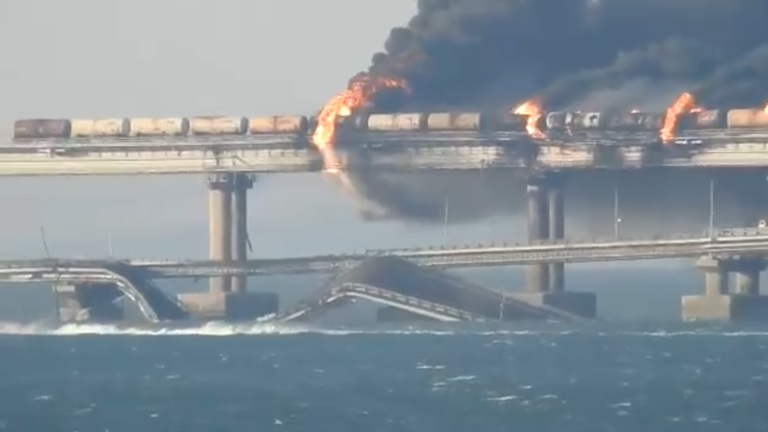
https://sputniknews.com/20221010/crimean-bridge-attack-ukraines-sabotage-teams-take-orders-from-washington-senior-official-reveals-1101698419.html Ilya Tsukanov, 12 Oct 22, The 19-km bridge linking the Crimean Peninsula to the Russian mainland sustained serious damage following the detonation of a truck bomb on one of its road sections on Saturday morning. Ukrainian officials boasted to US media that Kiev was responsible.
Ukrainian officials keep their US counterparts abreast of Kiev’s sabotage ops and other anti-Russian actions, Sergey Pashinsky, the head of the Association of Ukraine’s Defense Enterprises, accidentally revealed.
“We are planning several operations. My position is: we must and are obliged to inform our American partners about them. And those operations which I am conducting right now – I have the opportunity to conduct operations myself, I http://cut channels this is also the CIA http://cut have their own intentions. Because I understand that the US also carries responsibility for them and has the right to veto all of our operations,” Pashinsky said, speaking to infamous Russian pranksters Vladimir ‘Vovan’ Kuznetsov and Alexei ‘Lexus’ Stolyarov, who posed as US officials.
Pashinsky clarified that he has been in charge of some major Ukrainian military actions, including operational planning on Zmeiny (‘Snake’) Island – the small but strategically significant island situated off the western coast of Romania in the Black Sea, and which saw heavy fighting between Ukrainian and Russian forces earlier this year.
“I planned the Zmeiny Island operation, I carried it out personally [using] Ukrainian Bohdan and French Caesar [howitzers]. Yes, this was my operation in its entirely,” the official said.
Pashinsky indicated that operations against a piece of infrastructure like the Crimean Bridge became possible only once the US gives the green light.
“As soon as you tell me that the US approves the sabotage of the Crimean Bridge, the situation can move forward. [Laughs]. A verbal message is enough for me. We don’t want to take responsibility of this scale for ourselves, while Mr. Zelensky – I don’t know, I don’t even want to know about this situation,” Pashinsky said.
“The Crimean Bridge is an important artery, but on the other hand I think you know [Vladimir] Putin better than I do. That is, who can analyze Putin’s actions in the event of sabotage against the Crimean Bridge? Who?” the official asked.
The pranksters did not clarify whether the interview with Pashinsky was conducted before or after Saturday’s sabotage attack.
Two senior Ukrainian officials told the New York Times on Sunday that Ukrainian intelligence were behind the attack on the bridge, one of them grading the success of the attack as “excellent” and saying that the operation “showed the failure of the Russian system to guarantee the security even of the most significant and sacred targets.”
Ukrainian officials also publicly gloated over the act of terror, with presidential advisor Mikhail Podolyak saying the bridge attack was only “the beginning” and that “everything illegal must be destroyed” and “everything stolen must be returned to Ukraine.”
“Today was not a bad day and mostly sunny on our state’s territory. Unfortunately, it was cloudy in Crimea. Although it was also warm,” President Vladimir Zelensky said in a sarcasm-laden address to the nation on Saturday night.
Russia launched a series of missile strikes deep into Ukraine on Monday in the wake of the bridge attack after confirming Ukrainian special forces’ involvement, with the strikes targeting Ukrainian energy infrastructure and military command and communications posts across the country. President Putin warned that strikes would be followed up if Ukrainian attacks against Russian infrastructure continue.
Finnish pharmacies run out of iodine pills as Russian nuclear fears increase
SMH 13 Oct22, Helsinki: Many Finnish pharmacies ran out of iodine tablets on Wednesday, a day after the Nordic country’s health ministry recommended that households buy a single dose in a case of a radiation emergency amid increasing fears of a nuclear event due to Russia’s war in Ukraine.
“An accident at a nuclear power plant could release radioactive iodine into the environment, which could build up in the thyroid gland,” the Finnish Ministry of Social Affairs and Health said on Tuesday.
Chemists in many locations in Finland reported on Wednesday they had run out of iodine tablets as citizens rushed to purchase the medicine. Drug wholesalers also said their stockpiles were emptied out.
The ministry said the iodine tablet recommendation is limited to those aged 3-40 because of the potential risks that radiation exposure poses to that age group…………………………
In a case of a radiation emergency, sheltering indoors is the main way for people to protect themselves from hazardous radiation, the Finnish health ministry stressed. https://www.smh.com.au/world/europe/finnish-pharmacies-run-out-of-iodine-pills-as-russian-nuclear-fears-increase-20221013-p5bpef.html
France’s Finance Minister : Priority is to restart nuclear reactors a soon as possible
https://www.reuters.com/business/energy/frances-le-maire-priority-is-restart-nuclear-reactors-soon-possible-2022-10-11/—PARIS, Oct 11 (Reuters) – French Finance Minister Bruno Le Maire said on Tuesday the government’s priority was to restart EDF’s (EDF.PA) nuclear reactors – with more than half of them currently offline – as soon as possible.
During a press conference at the headquarters of grid operator RTE, Le Maire also said the goal was still to go back to 50GW of nuclear production capacity for the network at the start of 2023.
French nuclear power output is at a 30-year low for the year, owing to an unprecedented number of outages at EDF’s fleet of 56 reactors, with more than half offline because of corrosion issues and scheduled maintenance.
EU Taxonomy Labelling Gas and Nuclear as ‘Green’ Faces Legal Challenges
Activists and environmental organisations immediately opposed the decision, saying the new law discredits EU efforts to establish itself as a global leader on climate policy and only risks delaying Europe’s transition to a net-zero economy by further encouraging investments in the fossil fuel industry.
In September, Greenpeace and a separate alliance of environmental groups, including Client Earth and the World Wildlife Fund (WWF), requested a legal review of the decision. Austria’s recent lawsuit is now adding to the legal challenges the European Commission is already facing.
https://earth.org/eu-taxonomy-legal-challenges/ MARTINA IGINIE OCT 13TH 2022
Austria has filed a lawsuit against the European Commission’s decision to label nuclear and gas as ‘green’ investments. The controversial EU taxonomy approved by the European Parliament in July is already facing two other legal challenges from environmental groups.
On Friday, Austria submitted a lawsuit to the Court of the European Union, asking for an overturn of the contentious EU taxonomy.
Approved in July, the legal text designated natural gas and nuclear as environmentally sustainable energy sources, encouraging investments in these energy sources. Under the EU taxonomy, new nuclear and gas-fired plants built through 2030 will be recognised as a transitional energy source as long as they are used to replace dirtier fossil fuels such as oil and coal.
The country’s minister for climate action and Green politician, Leonore Gewessler, described the EU’s decision as “irresponsible” and “unreasonable” and said it was “misleading” to consumers and investors to label gas – a fossil fuel responsible for climate change for its greenhouse gas emissions – as “green”.
However, Brussels reassured that gas and nuclear-related activities may be labeled as “green” only if they meet certain criteria. Particularly, the legal text specifies that gas projects should only be financed if direct emissions are kept under a maximum cap and they switch to fully renewable energy by 2035. Similarly, nuclear power may be funded only in compliance with certain standards for the disposal of radioactive waste.
Activists and environmental organisations immediately opposed the decision, saying the new law discredits EU efforts to establish itself as a global leader on climate policy and only risks delaying Europe’s transition to a net-zero economy by further encouraging investments in the fossil fuel industry.
In September, Greenpeace and a separate alliance of environmental groups, including Client Earth and the World Wildlife Fund (WWF), requested a legal review of the decision. Austria’s recent lawsuit is now adding to the legal challenges the European Commission is already facing.
Despite not joining the legal action, Germany supported the country’s decision to file a lawsuit, adding that “it is good that the objections to the taxonomy regulation will now be reviewed by the courts.”
Growing the economy – but growth of what?

Michael Jacobs: Liz Truss dreams of growth – but even if she pulls it off, it won’t help Britain. Fifty years ago, the landmark report The Limits to Growth warned that, unless the composition of growth was
radically changed, its environmental impacts would lead to ecological and social collapse within 100 years.
Many of the projections made by The Limits to Growth have proved prescient. Yet it is also true that developed economies have been able to “uncouple” growth from some environmental
impacts. Over the past 20 years, the UK and others have notably seen rising GDP accompanied by falling greenhouse gas emissions.
Economists have described this as “green growth”, and many have argued that this, rather than growth per se, should be governments’ goal. Some environmentalists argue that environmental sustainability does not allow for any economic growth. Only the “degrowth” of western economies, they claim, is compatible with ecological salvation (and indeed, wellbeing). Others claim that GDP could still grow in a radically greener form. But in present circumstances this is a rather arcane dispute.
Both sides agree that some parts of the economy must degrow, notably the fossil fuel sector and fossil-intensive industries, while growth is clearly needed in others, such as renewable energy and the “care economy” of health, education, social care and childcare. The real question is therefore not “growth or
not?”, but “growth of what?”
Guardian 10th Oct 2022
https://www.theguardian.com/commentisfree/2022/oct/10/liz-truss-dreams-growth-income-stall-gdp
France won’t retaliate with nuclear weapons if Russia uses them in Ukraine
French President Emmanuel Macron says he intends to avoid ‘global war’
https://www.thenationalnews.com/world/europe/2022/10/13/france-wont-retaliate-with-nuclear-weapons-if-russia-uses-them-in-ukraine/ Soraya Ebrahimi, Oct 13, 2022,
France will not respond with nuclear weapons should Russia use them against Ukraine, French President Emmanuel Macron has said.
“Our doctrine rests on the fundamental interests of the nation,” Mr Macron told public broadcaster France 2 on Wednesday.
“They are defined clearly and wouldn’t be directly affected at all if, for example, there was a ballistic nuclear attack in Ukraine, in the region.”
It was the first time he has discussed France’s nuclear deterrence doctrine regarding Ukraine in detail.
Mr Macron said it was not good to talk about it too much.
So far, despite his threats, there is no sense that Russian President Vladimir Putin is moving nuclear assets.
Mr Macron said Mr Putin must “return to the table” to discuss peace in Ukraine and that he thought Kyiv would have to negotiate with him at some point.
“Today, first of all, Vladimir Putin must stop this war, respect Ukraine’s territorial integrity and come back to the table for talks,” he said.
Asked if he would back a Ukrainian offensive to recapture Crimea, which was annexed by Russia in 2014 in a move not recognised internationally, Mr Macron said that “at some point as the conflict develops”, Russia and Ukraine “will have to come back to the table”.
“The question is whether the objectives of the war will only be reached by military means,” he said, although “it’s up to the Ukrainians to decide” what those aims should be.
When reminded that Ukraine no longer wanted to negotiate with Mr Putin, Mr Macron replied: “I tell you that at some point … it will be necessary. That’s why I have always refused maximalist positions.”
He said France would supply air defence systems to Ukraine after Russia’s wave of air strikes this week, which was aimed at “breaking Ukrainian resistance”.
“We’re going to deliver … radars, systems and missiles to protect them from these attacks,” Mr Macron said.
He said France was also negotiating to send another six Caesar mobile artillery units.
Putin vows continued ‘tough’ attacks against Ukraine – video
He said the war had entered “an unprecedented stage” since the weekend because “for the first time all over Ukraine civilians have been killed … and electricity and heating facilities have been destroyed”.
“The aim of the Russians these last few days has been to break, to shatter Ukrainian resistance,” Mr Macron said.
He acknowledged that France was “unable to deliver as much as the Ukrainians ask for. I’m obliged to keep some for us to protect ourselves and our eastern flank (of Nato)”. The extra Caesar guns were made for Denmark, but talks are under way to redirect them to Ukraine.
Ukraine held talks with Britain for destruction of Crimean bridge
https://apa.az/en/europe/ukraine-held-talks-with-britain-for-destruction-of-crimean-bridge-382809—15 August 2022,
Deputy of the Rada Goncharenko announced negotiations with Wallace on the destruction of the Crimean bridge, APA reports.
Ukraine held talks with British Defense Secretary Ben Wallace on a plan to destroy the Crimean Bridge at the NATO summit in June, Verkhovna Rada deputy Oleksiy Goncharenko said.
The parliamentarian drew attention to the statement of expert Igor Korotchenko, who said on the air of the Rossiya 1 TV channel that, according to some information, the plan for striking the bridge was allegedly being developed under the personal supervision of the head of the British military department.
“Ben Wallace and I discussed the plan to destroy the Crimean bridge back in June,” Goncharenko wrote, posting a photo from the talks, which, in addition to him and the head of the British Ministry of Defense, shows British Prime Minister Boris Johnson.
In July, Aleksey Arestovich, an adviser to the head of Vladimir Zelensky’s office, said that Ukraine could attack the Crimean Bridge as soon as the first technical opportunity appeared.
Maintenance on eight French nuclear reactors delayed by strike
https://www.reuters.com/markets/europe/maintenance-five-french-nuclear-reactors-delayed-over-strike-2022-10-12/ By Forrest Crellin, 12 Oct 22,
PARIS, (Reuters) – France’s FNME trade union said on Wednesday that some workers at EDF’s (EDF.PA) nuclear plants resumed their strike over salaries, delaying maintenance work on eight reactors as the union sent a message of support to striking refinery workers.
Reporting by Forrest Crellin; Editing by Tomasz Janowski and Elaine Hardcastle
Three of the Cruas nuclear plant’s reactors are affected by the strike, while two reactors at the Cattenom and Tricastin plants and one Bugey reactor have had their maintenance delayed by the strike, FNME said.
EDF nears cut-price deal for GE nuclear turbine unit with Russian contracts
French energy group renegotiates terms for business that also supplies Rosatom
Sarah White in Paris YESTERDAY 6 Print this page French power operator EDF has renegotiated a deal to buy a nuclear turbine maker from General Electric, cutting its offer price for a business seen as strategic for France’s atomic industry but that is exposed to the risk of sanctions because of orders from Russia’s Rosatom. State-controlled EDF, which is on the cusp of being fully renationalised, was encouraged into making a move on the turbine company by the French government in a deal announced by President Emmanuel Macron at the start of the year.
The acquisition was touted as a way of recovering French control of the technology as EDF gears up to build new reactors, while also securing the future of a large factory in eastern France at a time when GE was exploring asset sales and looking to cut jobs. But the business has since been caught up in the fallout from Russia’s invasion of Ukraine, even though its dealings with state-owned Rosatom, one of the world’s biggest nuclear plant developers, have not faced sanctions so far………………………. more https://www.ft.com/content/4e3f8a9e-e89c-47c9-9caa-b84825db1e70—
Julian Assange tests positive for COVID-19
WSWS, Thomas Scripps 10 Oct 22,
Julian Assange has contracted COVID-19. He received the test result Saturday, on the day several thousand people formed a human chain around Parliament in London to protest his persecution.
His wife, Stella, told the press, “I am obviously worried about him and the next few days will be crucial for his general health. He is now locked in his cell for 24 hours a day.” She said Assange had been feeling ill throughout the week and developed a fever and cough on Friday.
Assange’s infection confirms the repeated warnings of medical professionals and his legal team that his health and life are endangered by his wrongful imprisonment. It must lend renewed urgency to the demand for his immediate release.
Just months before the pandemic, over 100 doctors signed an open letter to the British government warning that Assange’s life was at risk while he was kept in HMP Belmarsh—the UK’s top-security prison. When COVID-19 began to spread rapidly throughout Britain, one of the lead signatories, Dr Stephen Frost, told the World Socialist Web Site, “Given what we know about this case, Mrs Assange is right to be concerned. Julian Assange, because he is immuno-compromised, following years of arbitrary detention first in the Ecuadorian Embassy and latterly in Belmarsh prison, is necessarily at higher risk of contracting any viral or bacterial infection, including infection by coronavirus.
“He should be released on bail immediately, so that he can access the health care which he urgently requires. The UK government is effectively playing Russian roulette with Julian Assange’s life.”
Another doctor, Lissa Johnson, explained, “As long ago as 2015 medical and human rights experts warned that anything more than a trivial illness could prove fatal for Julian Assange. His health is even more fragile now, and the coronavirus only renders those warnings more urgent and more dire.”
She added, “If Julian Assange does succumb to coronavirus or any other catastrophic illness in prison, it will not be an accident. It will be a foreseeable result of prolonged psychological torture and wilful medical neglect.”
…………………………. By the end of October 2020, Ministry of Justice figures showed that 1,529 inmates had been infected, 600 in the previous month alone. At least 32 prisoners had been killed by the virus.
In November, a wave of infections hit Belmarsh prison. Stella Assange revealed, “I’ve been told the number of people infected with COVID on Julian’s house block is 56, including staff.” This was on a block with fewer than 200 inmates.
Assange and the other inmates were placed under an indefinite lockdown, kept in their cells 24 hours a day. His lawyer Edward Fitzgerald had warned at his bail application of the “risk to his mental health and his human contact” posed by lockdown procedures. At Assange’s extradition hearing that autumn, his defence team presented extensive medical evidence of the damage done to his mental health and of the risk of suicide.
……………………………. Nils Melzer, UN Special Rapporteur on Torture, examined Assange with a medical team inside Belmarsh Prison in May 2019 and concluded that he showed symptoms of psychological torture. He commented on his illness, “Assange’s stroke is no surprise. As we warned after examining him, unless relieved of the constant pressure of isolation, arbitrariness and persecution, his health would enter a downward spiral endangering his life. [The] UK is literally torturing him to death
Melzer added, “As Assange clearly was not medically fit to attend his own trial through videolink, how can they even discuss whether he is fit to be exposed to a show trial in the US, a country that refuses to prosecute its torturers and war criminals but persecutes whistleblowers and journalists?”
Saturday’s protest was the largest yet organised in defence of Assange, attracting a broader range of ages and social backgrounds. It indicated the potential that exists for a mass, global campaign to secure the WikiLeaks founder’s freedom and safety. ………… https://www.wsws.org/en/articles/2022/10/10/picp-o10.html
Austria Sues EU Executive Over Green Label for Gas, Nuclear
https://www.voanews.com/a/austria-sues-eu-executive-over-green-label-for-gas-nuclear-/6784510.html BERLIN — 10 Oct 22,
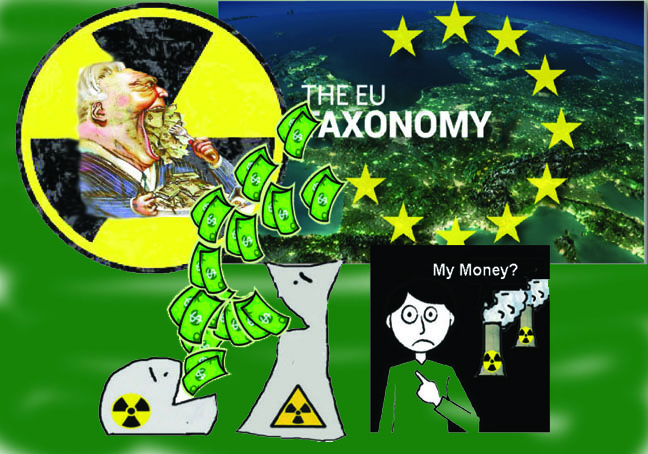
The Austrian government said Monday it has filed a legal complaint with the European Union’s top court over plans by the bloc’s executive branch to label natural gas and nuclear power generation as sustainable energies.
Austria’s environment minister, Leonore Gewessler, warned that the measure could “greenwash” nuclear power and gas despite the environmental damage they cause.
Another EU member, Luxembourg, announced later that it would stand by Austria in the legal case, adding more political weight to the move.
The EU’s executive Commission plans to add certain nuclear and gas plants next year to a list that helps investors determine which projects are sustainable.
Gewessler said the disasters in Chernobyl in Ukraine and Fukushima in Japan have showed that nuclear power plants come with “incalculable risks.” Meanwhile, the burning of natural gas, a fossil fuel, adds greenhouse gas emissions to the atmosphere, stoking climate change.
A dozen environmental groups have already launched legal challenges to the Commission’s plans, backed by the bloc’s lawmakers in July.
Austria’s environment minister, Leonore Gewessler, warned that the measure could “greenwash” nuclear power and gas despite the environmental damage they cause.
Another EU member, Luxembourg, announced later that it would stand by Austria in the legal case, adding more political weight to the move.
1 This Month





PLEASE OPPOSE HR 8255 AND S.3639 – bills would accelerate satellite deployment, with no environmental review or safeguards – https://ncstd5li.quorum.us/campaign/169331/
To see nuclear-related stories in greater depth and intensity – go to https://nuclearinformation.wordpress.com
-
Archives
- October 2026 (69)
- September 2026 (339)
- August 2026 (330)
- July 2026 (355)
- June 2026 (287)
- May 2026 (306)
- April 2026 (356)
- March 2026 (251)
- February 2026 (267)
- January 2026 (308)
- December 2025 (358)
- November 2025 (359)
-
Categories
- 1
- 1 NUCLEAR ISSUES
- business and costs
- climate change
- culture and arts
- ENERGY
- environment
- health
- history
- indigenous issues
- Legal
- marketing of nuclear
- media
- opposition to nuclear
- PERSONAL STORIES
- politics
- politics international
- Religion and ethics
- safety
- secrets,lies and civil liberties
- spinbuster
- technology
- Uranium
- wastes
- weapons and war
- Women
- 2 WORLD
- ACTION
- AFRICA
- Atrocities
- AUSTRALIA
- Christina's notes
- Christina's themes
- culture and arts
- Events
- Fuk 2022
- Fuk 2023
- Fukushima 2017
- Fukushima 2018
- fukushima 2019
- Fukushima 2020
- Fukushima 2021
- general
- global warming
- Humour (God we need it)
- Nuclear
- RARE EARTHS
- Reference
- resources – print
- Resources -audiovicual
- Weekly Newsletter
- World
- World Nuclear
- YouTube
-
RSS
Entries RSS
Comments RSS

