The World’s Biggest Fusion Reactor Just Hit a Milestone
By Haley Zaremba – May 06, 2026,
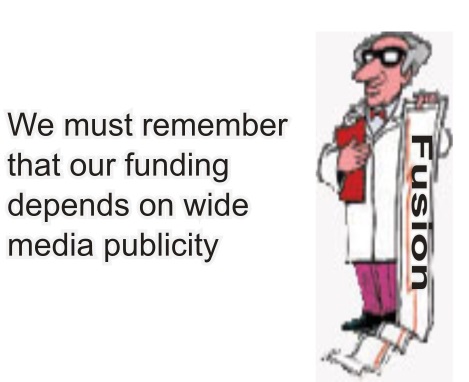
- The final components of ITER’s central solenoid magnet — a 59-foot, 3,000-tonne superconducting system 15 years in the making — have arrived in France, clearing a major path toward first plasma.
- ITER will never supply electricity to the grid; it exists purely as a research tool, and at €22 billion and counting, it’s still years from achieving its primary milestone.
- A wave of well-funded private fusion startups is on track to hit the same technical benchmarks as ITER faster and more cheaply — raising real questions about the megaproject’s relevance even as it celebrates progress……………………………………………………………………………………………………………… https://oilprice.com/Energy/Energy-General/The-Worlds-Biggest-Fusion-Reactor-Just-Hit-a-Milestone.html
Accountability is optional
Hamza Yusuf | Declassified UK , May 8, 2026
| The Metropolitan Police has declined to investigate Britons accused of committing war crimes while serving with the Israeli military in Gaza.Last April, the Palestinian Centre for Human Rights (PCHR) and the Public Interest Law Centre (PILC) filed an extensive, 240-page dossier to the Met’s War Crimes Team. |
The report detailed the alleged involvement of the 10 British nationals, including dual citizens, in the “targeted killings of civilians and aid workers, indiscriminate attacks on civilian areas, attacks on hospitals and protected sites, and the forced transfer and displacement of civilians”.
Over 70 legal and human rights experts urged the Met’s War Crimes Team to investigate all suspected war crimes and crimes against humanity allegedly committed by Britons when the dossier was handed in.
In its recent decision letter, the Met Police accepted that international bodies have found that Israel’s actions in Gaza “could amount to war crimes” and identified at least four individuals of “particular interest.”
However, the War Crimes Team has refused to move beyond a scoping exercise, saying there was “no realistic prospect of conviction” and that an “effective investigation could not be conducted.”
Paul Heron, a solicitor at PILC, said: “We reject The Met’s conclusions”.
“By demanding evidence capable of securing a realistic prospect of conviction before even opening an investigation, the Police have applied the wrong legal test and set the bar far too high. British nationals and residents cannot be allowed to participate in atrocities abroad with impunity.”The PILC maintains that the referral provided credible material warranting a full investigation. We recently revealed that at least 2000 Britons served in Israel’s military during the Gaza genocide. Meanwhile, Britain’s recognition of a Palestinian state may also place British nationals serving in the Israeli army in breach of the 1870 Foreign Enlistment Act. The act prohibits citizens from fighting for a foreign state at war with another state at peace with the UK, but there is no sign of enforcement. |
And what is absent is equally telling: The Foreign, Commonwealth and Development Office (FCDO) travel advice for Ukraine explicitly warns British nationals that fighting there “may amount to offences under UK legislation”and that they “could be prosecuted on your return”.
No equivalent warning appears in FCDO advice for Israel or the Occupied Palestinian Territories.
This exposes a glaring and systemic accountability gap – one the Foreign Office recently deepened by quietly shutting down its unit tracking Israeli breaches of international law.
The Met’s refusal is the latest in a pattern of dereliction: British institutions, one by one, declining to act on Israel’s crimes.
Labour and SNP row over submarines at Rosyth Dockyard

THE SNP have been accused of “scaremongering” after warning that Rosyth
has become a bigger target for terrorists and “rogue nations”. Labour
councillor Patrick Browne took aim and said the request for a public
consultation, on the prospect of Trident submarines carrying nuclear
missiles being maintained at the dockyard, was pointless and never going to
be accepted. He said: “The SNP have been scaremongering for months about
the contingent dock proposal for Rosyth. “With their latest comments they
have reached new levels of doom-mongering.”
But SNP councillor Brian
Goodall, who stated that having subs with warheads on the Forth increased
the threat of attack on Rosyth, said that response and the criticism of his
actions showed “just how right wing many in the Labour Party have become”.
The dispute has arisen due the plan for a contingent dock at Rosyth by 2029
to temporarily house the UK’s next generation of nuclear subs until a
permanent home at Faslane on the Clyde is ready in the 2030s.
Dunfermline Press 6th May 2026, https://www.dunfermlinepress.com/news/26084331.labour-snp-row-submarines-rosyth-dockyard/
When will the new nuclear operators be required to put money aside for decommissioning?
4 May 26
https://www.newcivilengineer.com/ai-search/?q=When%20will%20the%20new%20nuclear%20operato
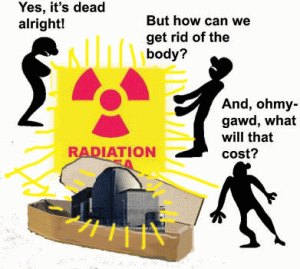
New nuclear operators are required by law to set aside funds for decommissioning and waste disposal from the very first day of a plant’s operation . Under the legal framework established by the government, energy firms must have a robust, funded decommissioning plan (FDP) in place and approved by the Secretary of State before they are even granted permission to begin construction on a new power station
Key Funding Requirements
The regulations are designed to ensure that the financial risk of cleaning up nuclear sites remains with the developers rather than the taxpayer. According to the government’s Funded Decommissioning Programme Guidance:
- Insolvency-Proof Funds: Operators must establish funds for clean-up that are administered independently of both the operator and the government to ensure they remain protected even if the company faces financial difficulties .
- Full Cost Responsibility: Operators are responsible for the full costs of decommissioning and their share of waste disposal. Energy Secretary Charles Hendry stated that requiring a credible funding plan “is the best way to protect taxpayers from having to pick up the bill” .
- Waste Transfer Pricing: To provide cost certainty for investors, the government proposed a cap on the waste transfer price for disposing of higher-activity waste in a Geological Disposal Facility (GDF). This cap was suggested to be set at a high level—roughly three times current cost estimates—with an additional risk fee charged to operators to compensate the government for accepting any residual risk .
Evolving Models: The Sizewell C Precedent
While the standard requirement involves operators building up independent funds, the government has introduced a new financial model for the Sizewell C project. As detailed in the written ministerial statement Sizewell C | Public on the hook for decommissioning costs of up to £12bn, this project utilises a Regulated Asset Base (RAB) model:
- Consumer Funding: Decommissioning for Sizewell C will be funded via the RAB, which can include additional costs on consumer electricity bills .
- Contingent Liabilities: While the RAB includes protections to minimise public risk, the government has acknowledged a potential exposure of up to £12bn in “remote circumstances” where a fund shortfall materialises .
- Timeline: For modern plants like Sizewell C, decommissioning is expected to be a long-term process, potentially beginning toward the end of the 21st century and continuing until 2160
The government continues to update these roadmaps to ensure they remain suitable for new technologies, such as Small Modular Reactors (SMRs), while protecting future generations from bearing legacy costs .
You may be interested in learning more about the estimated total cost of the UK’s nuclear cleanup mission, the progress of the Geological Disposal Facility, or how the Regulated Asset Base model impacts consumer energy bills.
Scots are right to back renewables over nuclear energy.
By Dr Paul Dorfman, Bennett Institute, University of Sussex; Dr Keith
Baker FRSA, Glasgow Caledonian University; Professor Peter Strachan, Robert
Gordon University; Professor Steve Thomas, University of Greenwich; Dr
David Toke, University of Aberdeen.
POLLING released a couple of weeks ago
found that nuclear power has a “miserable” level of support in
Scotland, with more than half of those surveyed saying that the main focus
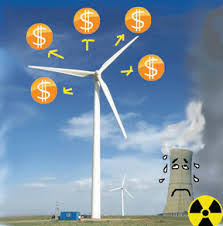
should be on renewables. According to the facts, this makes sense. Solar
and wind now dominate global electricity generation. Worldwide, solar and
wind power will both surpass nuclear in 2026.
This surge has halted the
fossil fuel power generation rise, with renewables overtaking coal,
supported by battery storage providing system flexibility at scale. All
this points to a shift in the dynamics of the power system. When renewable
energy generation exceeded the rise in global electricity demand last year,
an important threshold was crossed. In 2025, solar became the EU’s top
power source, with wind and solar now the bedrock of European energy
self-reliance. Power generation from renewables in Europe has reached a new
record of 384.9 Terrawatt-hours (TWh).
Meanwhile, Scottish wind power has
also set new records. More renewable energy is produced in the Scottish
Highlands per household than any other area of the UK. Annual renewable
generation across the Highlands is staggering. Renewable energy development
will be further supported by SSEN’s investment of £7 billion in Scotland
in 2026-31, creating 17,500 jobs. More than 100% of Scotland’s
electricity demand has been produced by renewables for the first time,
supporting more than 42,000 jobs and an economic output of more than
£10.1bn.
New UK nuclear plans would be yet another blow to electricity
bill-payers, when Scottish families are already paying what amounts to a
“nuclear tax” to fund the two most expensive nuclear power plants in
the world, England’s Hinkley Point C and Sizewell C.
Meanwhile, the
Norwegian Nuclear Committee has just said no to nuclear power in Norway.
Due to new nuclear construction timescales – up to 17 years according the
UK Government – and the vast cost over-runs, fissile fuel is a policy
dead end, diverting scarce resources away from realistic climate and energy
solutions.
Small modular reactors (SMRs) are another a costly distraction.
They are still in development and decades away from deployment at scale.
All this means that new nuclear is too late for the climate and energy
crises. What’s worse, every pound invested in nuclear is a pound not
invested in renewables, energy efficiency, storage and grid resilience –
investments that would provide a much bigger pay-off.
The National 6th May 2026,
https://www.thenational.scot/business/26081051.scots-right-back-renewables-nuclear-energy/
The UK Descends Into Confected Antisemitism Hysteria
Nate Bear, Do Not Panic May 05, 2026
The UK has descended into confected hysteria over antisemitism to protect Keir Starmer and Labour from being wiped out by the Greens in local elections this week.
The British establishment is well-practiced in manufacturing antisemitism hysteria, of course, having used it to destroy Jeremy Corbyn’s Labour Party when it got too close to power.
Now the UK’s political and media establishment is trying to pull the same trick, but this time on the Green Party and its Jewish leader, Zack Polanski.
This fresh round of hysteria really ramped up after a man with a history of mental illness (and of stabbings) stabbed two Jews in north London last week. Neither died and both will live. Omitted from almost all state-corporate media coverage was the fact that he also stabbed a third man, a Muslim. Also omitted was his history of stabbings (he previously stabbed his own dog, a Somali man, and two police officers), and his history of psychotic breaks.
Despite the circumstances clearly pointing to random attacks by a person suffering an acute mental episode, the police treated it not just as a planned antisemitic attack, but as terrorism.
The terrorism threat level in the UK was raised to severe.
I remember when terrorism used to mean car bombs, political goals, manifestos and scores of dead people, not a mentally disabled man with a butter knife scratching a few people.
But the attack was perfect fodder for the British media and political establishment, who blamed support for Palestine and opposition to genocide for enabling antisemitism, and instantly began demanding pro-Palestine protests were fully outlawed.
The environment of hysteria that ensued is hard to describe if you don’t follow British media or politics closely, but it has been extraordinary.
Keir Starmer gave a primetime televised address to the nation.
His speech was a complete misrepresentation of the facts of the case, completely omitting the Muslim victim, completely omitting the man’s history of illness and random stabbing attacks. But they were deliberate lies of omission critical to constructing an antisemitism narrative.
And it worked.
Every headline, every news broadcast for a week led with the story about ‘the antisemitism crisis in Britain.’
I remember when terrorism used to mean something. I also remember when antisemitism used to mean something. And implying all Jews support the actions of Israel used to be considered antisemitic.
But now that’s all anyone with political or media power does.
Starmer said that anti-genocide, pro-Palestine protests have created the environment for antisemitic attacks. The Green Party’s opposition to Israel’s genocide, the media said, has fuelled antisemitism. The Guardian had a story on the Green Party’s ‘struggle against antisemitism,’ a story which presumably included how just eight months ago the entire Green Party membership antisemitically elected a Jewish leader.
And when you deconstruct the logical conclusions behind the implication that Jews are being attacked because of what Israel has done, it will break your brain.
Firstly the implication that Jews are attacked because of Israel, not because of their religion, means Israel represents all Jewish sentiment……………………………….
We’ve reached the point where everything is antisemitism apart from the thing that is actually antisemitism.
And this is because the Zionists have lost the propaganda war. Genocide is not going back in the bottle. Everyone sees what Israel has done. Everyone can now see what Israel is: a genocidal settler-colony apartheid state run by ethno-supremacists.
The deliberate conflation of antisemitism and anti-Zionism then is intended to silence criticism of Israel, and erase the truth about what Israel is and has done.
It’s also intended to stop the Green Party inflicting a humiliating defeat on Keir Starmer and his Labour Party in local elections this week.
The establishment calculation is that if you can establish in the mind of progressives the idea that a vote for the Greens is actually a vote for hate, not a vote against genocide or apartheid, you can stop Labour bleeding leftist votes to the Greens.
If the Zionist establishment can reestablish that black is white, they think they have a chance.
But it goes even deeper than that.
The UK establishment aren’t just using the attack for rhetorical purposes, they are using it to actually get Green Party election candidates arrested.
Andrew Gilligan, a former adviser to Boris Johnson and Rishi Sunak, and now a right-wing journalist, wrote a story about two Green Party candidates Saiqa Ali and Sabine Mairey who he said had made ‘antisemitic’ posts. Last week, he gloated that following his stories, they’d both been arrested…………………………………………………
Three people are stabbed every day in London. Over one thousand people a year, of all religions and none.
None of these ever warrant a national prime ministerial TV address.
Twenty-seven mosques in the UK were attacked between July and October last year.
No extra security funding (Starmer has promised an extra £25 million for Jewish areas). No discourse about Islamophobia. Just tumbleweed.
But a random attack on two Jews gets the full national psychodrama treatment because it can be so usefully weaponised to serve the interests of Zionism.
Are people going to fall for this?
I don’t think so.
Is Zack Polanski going to fall for this after seeing what happened to Corbyn?
Hopefully not.
We have more than enough evidence by now to know that you can never appease Zionists.
There is no middle-ground, no strategy of accommodation.
Any concession is interpreted as a sign of weakness. As Corbyn showed us, once they’ve drawn blood, they’ll bleed you dry.
The only anti-Zionist strategy that makes any sense is one of full confrontation.
The only route to victory is their full defeat. https://www.donotpanic.news/p/the-uk-descends-into-confected-antisemitism
Nuclear Sector Must Step Up Cybersecurity

The nuclear industry is weak on cyber security, says a policy institute analysis. To respond, the sector has to take a more transparent and collaborative approach – and speed up action on improvement
Staff Writer NS ENERGY, 4th May 2026
THE ROYAL INSTITUTE OF INTERNATIONAL Affairs (a UK policy institute colloquially known as ‘Chatham House’) has described the nuclear industry’s status on cybersecurity as “playing catch-up”. It has warned that “the nature of licensing systems for nuclear operators means that long periods of risky working practices are often tolerated”. As an example, it highlighted the UK’s Sellafield fuel cycle site, which pleaded guilty in June 2024 to criminal charges that related to gaps in its cybersecurity between 2019 and 2023. The site had been repeatedly flagged in inspections by the UK Office for Nuclear Regulation (ONR), which warned it would apply ‘enhanced regulatory attention’ to cybersecurity practices.
The Royal Institute of International Affairs (RIIA) warning came in a report, ‘Cybersecurity of the civil nuclear sector’ that considered the threat landscape and the international legal framework for cybersecurity as it applies to the nuclear industry. The group examined the issue because it saw the civil nuclear industry expanding worldwide at the same time as cyber threats are evolving, and because cyber operations targeting civil nuclear systems have been reported worldwide…………………………………………………………………………
Playing catch-up
RIIA says that the nuclear sector lacks a comprehensive understanding of the threat landscape around cybersecurity and effective resilience strategies.
Vulnerabilities arise from technical and non-technical factors, including the use of older software, personnel being targeted and the lack of sufficient sector-wide awareness and collaboration. Cyber incidents can also occur accidentally as a result of existing vulnerabilities in commercial software. These vulnerabilities include: entry points such as inadequate IT infrastructure maintenance; missing patches and updates; unsafe working practices such as connection to unprotected networks; the use of portable storage devices; legacy systems; and inadequate data protection. The report says, “this range of potential threats makes it doubly essential to ensure fundamentally secure working practices, as it is very difficult to identify and protect against every individual vulnerability”.
The authors say “the nuclear industry was a comparatively late starter” on cybersecurity, compared with other industries associated with critical national infrastructure or sectors such as finance. They add that “the nuclear industry’s strong pre-existing physical security, and its use of bespoke or uncommon industrial control software, meant that there was a sense within the sector that all aspects of security were sufficiently covered.” That sense has gone: more systems in nuclear power plants have acquired digital elements, including commercial off-theshelf software solutions and more cyber vulnerabilities have been introduced as a result. This has increasingly left systems and facilities open to attack and, “in some respects, the civil nuclear industry is thus still playing catch-up”.
The group also says that another challenge to realising cyber security is that the nuclear industry is isolated from other sectors. It is therefore difficult to exchange experiences of best practice with other industries; instead the exchange is “ad hoc, often informal, and largely based on the personal drive and networks of individuals in cybersecurity roles”. The industry is not transparent about incidents, because it is concerned about revealing information about vulnerabilities and equally concerned about public perception if vulnerabilities are revealed. Regulators typically discuss cybersecurity gaps only with specific operators rather than sharing concerns more widely. The report says, “the nuclear industry’s preoccupation with perceptions can get in the way of transparency, even though stronger disclosures would help to bolster confidence in the safety of working practices”…………………………………………………………
………… SMRs may have more cyber vulnerabilities because they are less bespoke than traditional reactors, are connected to the internet and cannot have sterile ‘air gaps’ where there is no connection, because operators require remote access. They may be “more of a target for opportunistic cybercriminals”. In addition, SMRs will also be vulnerable through the construction supply chain, while using artificial intelligence (AI) could lower the entry barrier for cyberattack by making tools for cyber intrusions more accessible and affordable. Finally, if they are successful there will simply be more SMRs, in more places where cyber criminals can attack…………………………………………………………………………….. https://www.nsenergybusiness.com/analysis/playing-catch-upon-cyber-safety/
Ukraine drone attacks hit nuclear power plant, Baltic port
President Volodymyr Zelenskyy hails ‘successful destruction’ of the port, as Russia warns of oil price rises.
By AFP and Reuters 3 May 20263 May 2026
Ukrainian drone attacks have targeted the Russian-held Zaporizhzhia nuclear power plant in southeastern Ukraine and a Russian Baltic Sea port, as Kyiv and Moscow accuse each other of killing civilians in overnight air raids.
The International Atomic Energy Agency (IAEA) said a drone had targeted the external radiation control laboratory, a part of the plant located outside the nuclear power plant’s perimeter, on Sunday. It said it was not yet clear if there had been injuries.
“IAEA team at the site has requested access to the lab,” agency chief Rafael Grossi said. He reiterated that attacks near nuclear sites pose nuclear safety risks – both sides have repeatedly targeted nuclear infrastructure
Earlier on Sunday, Ukrainian forces also launched an attack on the Russian Baltic Sea port of Primorsk, Russian and Ukrainian authorities said,
The attack on Primorsk, a major oil-exporting outlet, did not result in an oil spill but it caused a fire in the town that was extinguished, Leningrad Governor Alexander Drozdenko said.
More than 60 drones were downed overnight over the northwestern region, he added.
Ukraine confirmed the attack on the port, with Ukrainian President Volodymyr Zelenskyy claiming it as a “successful destruction of the facilities of the port of Primorsk”.“The missile ship ‘Karakurt’ was hit, as well as a patrol boat and another tanker of the shadow oil fleet,” the Ukrainian president said in a post on Telegram.
“Significant damage was also done to the infrastructure of the oil loading port,” Zelenskyy also claimed………………………………………………………………………………………. https://www.aljazeera.com/news/2026/5/3/ukraine-drone-attack-hits-russian-baltic-port-governor-says
|
Chernobyl at 40: Belarus took the brunt
April 28, 2026, https://beyondnuclear.org/chernobyl-at-40-belarus-took-the-brunt/
A report from Olga Karatch, Belarussian founder in exile of Our House:
On April 26, it marked 40 years since the largest nuclear technological disaster in history — the explosion at the Chernobyl nuclear power plant. Although the plant is geographically located in Ukraine, Belarus suffered the greatest damage due to weather conditions.
The Chernobyl disaster resulted in radioactive contamination of nearly 150,000 km², while around 5,000 km² became an exclusion zone with the strictest restrictions.
The distance from Chernobyl to the Belarusian border is only 11 km. To Minsk — about 330 km. To Vilnius, where the action took place — less than 490 km.
In 1986, an RBMK reactor exploded at the plant. This type of reactor used graphite rods to control the reaction, as well as water. At a certain point, water could interfere with the insertion of the graphite rods.
These rods function as the reactor’s brakes. When the brakes fail, disaster becomes inevitable — and it did.
Similar reactors were operating at other plants, including the Ignalina nuclear power plant in Lithuania.
According to the IAEA report INSAG-7, as early as 1983 a so-called positive feedback effect (positive scram effect) was identified — later becoming one of the key factors in the Chernobyl disaster.
The RBMK reactor itself was considered high-risk: incidents occurred at the Leningrad plant (1975), at Chernobyl (1982, 1984), and at Ignalina.
Nuclear power plants are often presented as environmentally friendly, but this is an oversimplification.
In the Soviet Union, the nuclear sector was part of a closed system, overseen by a separate ministry.
Nuclear power plants did not exist in isolation: they were part of a broader industry, one of whose end products was weapons-grade plutonium and uranium.
Information about radiation accidents was often concealed. Victims were misdiagnosed and forced to sign non-disclosure agreements. People died, and even doctors sometimes did not know the real causes — because of secrecy.
Today, safety standards have improved, but the risks have not disappeared.
Moreover, the economic efficiency of nuclear energy is increasingly questioned. In some cases, the cost of decommissioning a plant exceeds the profits generated during its operation.
Belarus continues to pursue nuclear projects while serious concerns remain regarding safety and transparency.
During the construction of the Belarusian NPP:
— a reactor vessel was dropped (2016)
— equipment was damaged during transportation
After launch, shutdowns, disconnections, and periods of downtime have been repeatedly reported.
The Lithuanian regulator (VATESI) has repeatedly pointed to recurring failures and a lack of transparency.
Conclusion
Due to the clear mismatch between high risks and questionable benefits, “Our House” advocates phasing out nuclear energy.
We will continue to participate in public actions and speak about these issues openly.
Starmer plan to relax nuclear regulation opposed by Holyrood

“The weakening of environmental protection is a slippery slope opening the way for increased radiation doses to members of the public and the workforce.” – Pete Roche, Scottish Campaign to Resist the Atomic Menace
UK Government plans which could “weaken” oversight of nuclear safety in Scotland have been rejected by the Scottish Government.
Rob Edwards, May 03 2026, https://www.theferret.scot/starmer-nuclear-regulation-holyrood/
The prime minister Sir Keir Starmer’s plans to reform the regulation of nuclear power and weapons to make new developments easier have provoked “serious concerns” within the Scottish Government, according to emails obtained by The Ferret.
The Scottish energy minister, Gillian Martin, wrote to the UK nuclear minister, Lord Vallance, in March, rejecting the suggestion that Scotland could “reap the benefits” of the reforms in helping to build new nuclear reactors.
She also expressed worries that proposals for a “lead regulator” system designed to simplify and speed up the handling of nuclear projects would threaten the independence of the Scottish Environment Protection Agency.
Campaigners warned that the “weakening” of nuclear safety regulation could lead to workers and the public being exposed to more radiation, which can cause cancer. They stressed that Scotland did not need nuclear power and its “toxic legacy”.
The UK Government said that Starmer would “like to see benefits delivered across the UK”. But it promised to work with the Scottish Government “in good faith without presuming an outcome”.
Nuclear power has become one of the most contentious issues in the run-up to the Scottish Parliament elections on 7 May.
Scottish Labour has repeatedly attacked the Scottish National Party (SNP) for “blocking” the building of new nuclear power stations, which it argued would bring jobs, investment and energy security.
The SNP has maintained the move would drive up electricity prices, create long-lived radioactive waste and undermine renewables, which offer Scotland a better energy future.
In February 2025, Starmer announced plans to “rip up rules to fire up nuclear power”, and set up a nuclear regulatory taskforce to “deliver new projects more quickly”. The Ferret reported in May 2025 that in doing so, he had ignored warnings from his nuclear safety watchdog that regulation was not to blame for delays.
The taskforce, headed by business expert John Fingleton, published its final report in November 2025. It recommended a “radical reset” introducing a “lead regulator” followed by a new regulatory commission to reduce “risk aversion” and “accelerate delivery”.
The report covered both nuclear power and nuclear weapons, and suggested that the civil safety watchdog, the Office for Nuclear Regulation, and the Ministry of Defence’s internal watchdog, the Defence Nuclear Safety Regulator, should be merged “to reduce duplication”.
Starmer published his full response to the taskforce in March 2026, accepting all its recommendations. The aim, he said, was to “build a Britain that reclaims its place as a leading nuclear nation”.
His response acknowledged that the taskforce had not made recommendations for the Scottish Government and other devolved administrations. But it promised to “work closely with them to ensure that they too can reap the benefits of these reforms”.
The UK Government was “committed to nuclear across the UK”, the response said. It highlighted government involvement in plans for a new fleet of so-called small modular reactors at Wylfa in Wales.
These statements were highlighted by Scottish minister Martin in an email on 13 March 2026 to UK minister Vallance, released in response to a freedom of information request from The Ferret.
Martin expressed “concerns” that the UK Government was making commitments to take forward the taskforce’s recommendations in Scotland, despite having promised not to. The Scottish Government was yet to be convinced that there was “any merit” in adopting Westminster’s proposals, she said.
“We need to ensure we are reaching our full renewables potential rather than ploughing billions of pounds into a nuclear industry that will leave a long and toxic legacy for future generations.” – Patrick Harvie, Scottish Greens.
Martin pointed out that Scottish ministers had “a longstanding position on new nuclear energy in Scotland and matters of environmental regulation remain devolved to Scottish ministers and the Scottish Parliament.”
She also said that the Scottish Environment Protection Agency (Sepa) had been invited to a meeting in London on 26 March 2026 to discuss the UK Government’s plans for a “lead regulator” for nuclear projects.
“We have serious concerns about a lead regulator model and the impact that would have on Sepa’s independence,” Martin warned. She sought clarification “on how the implementation of this will be done in a way which does not impact on areas of devolved competence.”
Another email released to The Ferret is from an unnamed Scottish Government official to the UK Department for Energy Security and Net Zero on 12 March. It complained that Starmer’s response to the taskforce “impinges on devolved issues without the agreement of Scottish ministers” and was “problematic”.
“Ministers will have to be robust on this with language and next steps,” the email said.
Other files disclosed that Martin had an online meeting with Vallance to discuss the nuclear regulatory taskforce on 25 February. According to Martin’s pre-meeting briefing from officials, there were “significant issues” with what the taskforce recommendations would mean for Sepa.
Another Scottish Government email to Westminster back in February 2025, when the nuclear regulatory taskforce was announced, said there had been “no engagement with, or agreement from, Scottish ministers”. It suggested that ministers “should not be part” of the taskforce’s work.
“The weakening of environmental protection is a slippery slope opening the way for increased radiation doses to members of the public and the workforce.” – Pete Roche, Scottish Campaign to Resist the Atomic Menace
Vallance responded to Martin’s email raising concerns on 18 March. Starmer would “like to see benefits delivered across the UK”, he said, but the “recommendations apply only to England”.
The UK Government’s intention was to work with the Scottish Government to “discuss what reforms they may wish to echo or engage with”, he added. “We want to do so in good faith and without presuming an outcome.”
Vallance pointed out that regulatory reform was not just about building new nuclear reactors, but also covered the dismantling of defunct reactors. Major nuclear decommissioning projects, expected to take decades, are under way at Hunterston in North Ayrshire and Dounreay in Caithness.
“We do not consider that it implies an intention for the development of new nuclear power in Scotland,” he stated. Vallance also insisted that he “respected” Sepa’s independence.
“None of the measures in the government’s response are intended to, or would, cut across Sepa’s statutory remit or independence of judgment,” he said.
The plan for a “lead regulator” did not give legal powers to that regulator, he maintained. “It simply seeks to facilitate collective, consensus-based decisions.”
The Scottish Campaign to Resist the Atomic Menace backed the Scottish Government’s concerns. The UK Government seemed to be following president Trump’s lead in relaxing nuclear safety regulation, warned the campaign’s spokesperson, Pete Roche.
The story of the cooks of Chernobyl, 40 years later
Vikram Doctor, ET BureauLast May 03, 2026,
https://economictimes.indiatimes.com/magazines/panache/the-story-of-the-cooks-of-chernobyl-40-years-later/articleshow/130728007.cms
Synopsis
Forty years ago, a nuclear disaster struck Chernobyl. Women from Rivne Nuclear Power Plant were sent to cook for clean-up crews. They faced radiation and health problems. Food meant for workers was often wasted or contaminated. Some food was smuggled out. Decades later, these women fight for promised pensions. Their experiences offer insight into the disaster’s lasting impact.
When Raya heard of a nuclear power plant accident, she turned to Ukraine’s Rivne Nuclear Power Plant close by: “We looked at our gherkin barrels — that’s what we call our power plant chimneys — and we could see there was nothing wrong with them.” But then the truth emerged: The accident was at their sister plant in Chernobyl, 180 miles east, and Raya had to go there to cook.
It has been 40 years since the world’s worst nuclear disaster and so much has been written and filmed about Chernobyl. But Polish writer Witold Szablowski found a little-known story for his book What’s Cooking in the Kremlin, a history of Russia through food. Szablowski knew how, even in the worst disasters, those working to save the situation had to eat, so someone had to cook for them. He found seven women alive, out of a group of 15 sent from Rivne after the disaster.
All the women suffered health issues, though not being in the actual plant spared them a bit. Dosimeters, to measure radiation, were placed at the entrance of the canteen, and when clean-up workers came from the plant, their buzzing became frantic and continuous. “It was a dreadful sound,” recalled Valentina, the head of the group.
Finally, the dosimeters were removed. Why remind people about radiation, when nothing could be done? The countryside around Chernobyl was abandoned. Raya recalled cows “mooing pitifully, because the people had been taken away and there was no one to milk them”. The canteen had also been abandoned. An earlier group of cooks were so terrified, they fled through the forest. That act had probably sealed their death warrants since Chernobyl’s forest was one of the worstaffected areas.
Food shortages were the norm in the latter days of the Soviet Union, but a guilty state ensured Chernobyl’s workers were given the best meats, dairy and fruit from across the country. “There was a whole sea of produce there,” Luba, another cook, recalled. “Little cubes of butter, full-fat cream — it sounds funny, but in those days, under Gorbachev, that was a real delicacy.” Workers had to drink glasses of cream, perhaps in the hope that its calcium would counter the depletion in their bones ..
Yet this food, which would normally have been the stuff of fantasies for people, was mostly wasted. Workers just wanted fruit juices and vodka. “They were burning up Witold. Burning up from inside,” Olga said. It was hard for the cooks to see such food disregarded. By habit, Luba would tell workers to take chocolate and give it to a kid, if they didn’t want it for themselves. Then she realised the food was contaminated by just being there, and no kid should have it.
Inevitably, some food was smuggled out. In Nobel Prize winner Svetlana Alexievich’s Voices from Chernobyl , one woman tells her how, in the months of fear afterwards, she only bought the most expensive meats to be safe: “Then we found out it was the expensive salami that they mixed contaminated meat into, thinking, well, since it was expensive, fewer people would buy it.” It is almost grimly comic how quickly the usual compromises and corruptions of life reasserted themselves.
Decades later, Valentina is fighting for the special pensions they were promised. An agent says she’ll arrange it for a thousand dollars — and tells an outraged Valentina that it’s a discount: “She charged those who hadn’t been in Chernobyl several thousand.”
Chernobyl’s 40th anniversary has been marked by articles lamenting how it set back nuclear power for decades. Sam Dumitriu, a British policy analyst, notes with some puzzlement that polls show women are far less likely to support nuc ..
Dissecting An “Antisemitism” Psyop
Caitlin Johnstone, May 03, 2026, https://www.caitlinjohnst.one/p/dissecting-an-antisemitism-psyop?utm_source=post-email-title&publication_id=82124&post_id=196309636&utm_campaign=email-post-title&isFreemail=true&r=1ise1&triedRedirect=true&utm_medium=email
I recently watched a Sky News segment on the need to ban pro-Palestine marches which nicely illustrates the way the mass media have been working to manipulate the public into believing these demonstrations are causing antisemitic attacks.
Reporting on British prime minister Keir Starmer’s recent assertion that the “repeat nature” and “cumulative effect” of pro-Palestine marches may necessitate a ban on some protests following the Golders Green stabbing, reporter Mollie Malone repeatedly told the audience of Sky News that the marches are happening in the “context” of antisemitic incidents and “against the backdrop” of attacks on Jewish people.
There is no evidence whatsoever for the claim that pro-Palestine marches have anything at all to do with antisemitic attacks. But watch how this Sky News propagandist marries the two in the minds of her viewers by repeatedly mentioning them in the same breath and connecting them with words like “context” and “backdrop”.
“The prime minister has gone somewhat further than he has previously in discussing and commenting on how to approach and manage these protests which we’ve seen for a long time now, but clearly they now come against the backdrop of increased attacks on our Jewish communities, most recently of course on Wednesday where two Jewish men were stabbed in Golders Green,” Malone said.
Malone made the obligatory appeal to emotion by talking about the feelings of British Jews by saying that antisemitic attacks are “adding to fears among Jewish people,” and then said “it’s in that context that these pro-Palestine marches are being discussed.”
I could make the exact same type of argument to suggest that the faint humming sound from my refrigerator is causing the pain in my ankle. I could say I’m experiencing ankle soreness and the soreness is making my feelings feel very upset, and it is in this context and against this backdrop that the buzzing from the refrigerator is happening. At no point am I actually presenting evidence that the soreness in my ankle has anything to do with the faint buzzing sound; I’m just using fallacious associations and appeals to emotion to get you to think of them as having a causal relationship.
Malone uncritically quoted the UK’s Independent Reviewer of Terrorism Legislation Jonathan Hall asserting on no basis whatsoever that pro-Palestine marches “incubate antisemitism,” then repeated the bogus hasbara talking point that the phrase “globalise the intifada” is “seen to incite violence towards Jewish people.”
“The context here is everything,” Malone concluded after a few moments of pro-Palestine activist rebuttals to provide the illusion of impartiality.
As the British political/media class have been doing for days when discussing the Golders Green stabbings, Malone neglects to mention that a third man who was not Jewish was also attacked in the same incident, and that the assailant had recently emerged from the care of a psychiatric hospital. You might think the perpetrator’s extensive history of mental health struggles combined with the fact that he did not solely target Jewish people would dissuade serious news reporters from framing this as an act motivated by hateful ideology, but British news media employees are not serious news reporters. They are propagandists.
This frenzied propaganda push to stomp out pro-Palestine protests across the western world has nothing to do with protecting Jewish people from antisemitic attacks. It’s about protecting the interests of Israel and the murderous western governments with whom it is aligned, and nothing else.
Central Asia celebrates 20 years as a nuclear-weapon-free zone
By Nargiz Shekinskaya, 30 April 2026
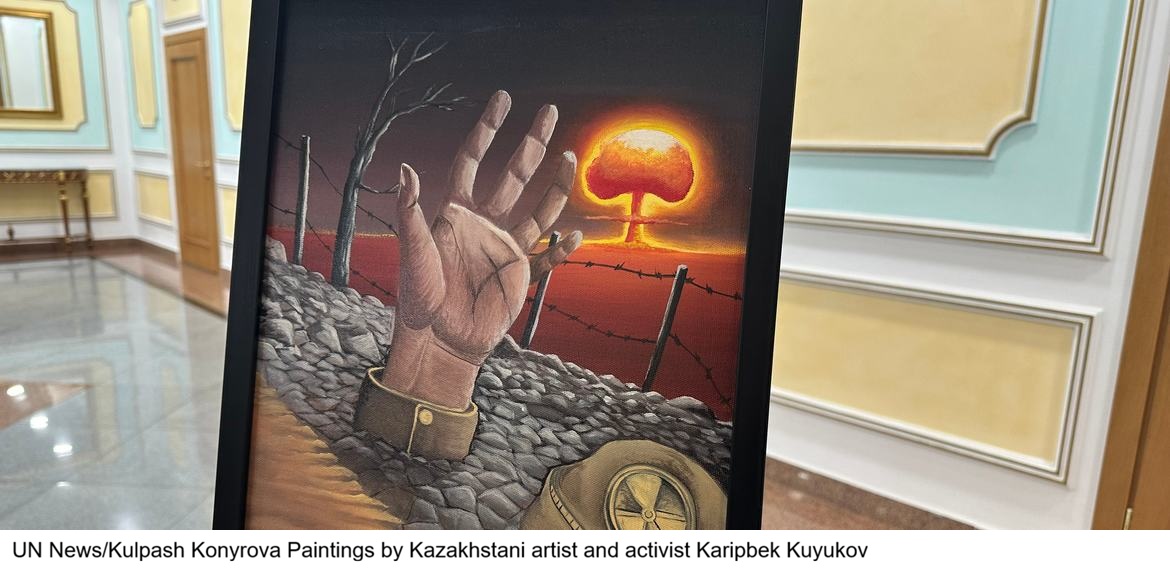
Semipalatinsk, Kazakhstan was once the Soviet Union’s primary testing ground for nuclear weapons. Today, in an age of rising nuclear threats, the Semipalatinsk Treaty – which saw a group of Central Asian countries renounce nuclear weapons in 2006 – is more relevant than ever.
The accord, which brought together Kazakhstan, Kyrgyzstan, Tajikistan, Turkmenistan and Uzbekistan, enshrines the voluntary commitment of these States not to develop, acquire, test or deploy nuclear weapons.
“Nuclear-weapon-free zones (NWFZs) are not only historical achievements but also living instruments of regional security, non-proliferation and nuclear risk reduction,” says Christopher King, Chief of the Weapons of Mass Destruction Branch at the UN Office for Disarmament Affairs (UNODA).
Nations bound together
He notes that the Central Asian zone stands as an example of effective regional cooperation, bringing the five countries under a legally binding commitment.
“Such zones contribute to transparency, confidence-building and risk reduction, and they can help maintain a practical bridge between regional security concerns and global non-proliferation and disarmament architecture,” Mr. King adds.
First Deputy Minister of Foreign Affairs of the Republic of Kazakhstan Yerzhan Ashikbayev, who is leading the country’s delegation at the 2026 review conference of the Nuclear Non-Proliferation Treaty, also believes that its significance extends far beyond the region.
“The contribution of the Semipalatinsk Treaty to ensuring security not only in Central Asia but also beyond its borders, is undeniable,” he says.
According to the diplomat, the creation of the zone reflects a shared commitment by the countries of the region to strengthen peace, stability and security, and to overcome the legacy of nuclear testing.
Commitments questioned
Today, amid growing geopolitical tensions, some experts question the durability of such agreements. However, Mr. Ashikbayev disagrees. “On the contrary, in such critical periods the zone demonstrates that its existence is a positive factor,” he argues. Kazakhstan, he added, remains committed to multilateral diplomacy, with the further development of the zone forming part of that policy.
The Central Asian experience is drawing interest in other regions of the world but, as Ashikbayev pointed out, the establishment of such zones must be a sovereign decision of the States concerned.
At the same time, the legacy of the nuclear past continues to be felt today, particularly around the former Semipalatinsk test site, but rehabilitation programmes are under way.
A modern oncology centre has been established, and parts of previously restricted territories are, following a thorough assessment, gradually being returned to economic use.
The Central Asian Nuclear-Weapon-Free Zone
- Mr. King and Mr. Ashikbayev took part in a round table organised by Kazakhstan at UN Headquarters on Wednesday, marking the 20th anniversary of the Central Asian Nuclear-Weapon-Free Zone.
- Participants discussed how the agreement contributes to strengthening international security in an increasingly unstable global environment.
- The event took place on Tuesday, on the margins of the 2026 Review Conference of the Parties to the Treaty on the Non-Proliferation of Nuclear Weapons, currently underway at UN Headquarters.
- The event was recorded and can be seen on UN WebTV.
Nuclear-Weapon-Free Zones
The following treaties form the basis for the existing NWFZs:
- Treaty of Tlatelolco — Treaty for the Prohibition of Nuclear Weapons in Latin America and the Caribbean
- Treaty of Rarotonga — South Pacific Nuclear Free Zone Treaty
- Treaty of Bangkok — Treaty on the Southeast Asia Nuclear Weapon-Free Zone
- Treaty of Pelindaba — African Nuclear-Weapon-Free Zone Treaty
- Treaty on a Nuclear-Weapon-Free Zone in Central Asia
“We are waiting for Nuclear Waste Services to Come Up with Recommendations on Siting….”

Marianne Birkby, May 02, 2026, https://radiationfreelakeland.substack.com/p/we-are-waiting-for-nuclear-waste
“We are waiting for Nuclear Waste Services to Come Up with Recommendations on Siting….”
But meanwhile ‘we are already building new nuclear reactors which would produce even hotter nuclear wastes. Hot nuclear wastes are in the pipeline for which there is no “away” in blatant disregard of the Flowers Report: “There should be no commitment to a large programme of nuclear fission power until it has been demonstrated beyond reasonable doubt that a method exists to ensure the safe containment of long-lived highly radioactive waste for the indefinite future.”
Well it is safe to say that not only is there reasonable doubt that a method exists as no country has demonstrated beyond reasonable doubt that they can contain high level wastes indefinitely without repackaging – but there is also no where NO WHERE willing to be the ultimate nuclear guinea pig in the UK. Unless that is you count the four members of Copeland now Cumberland Council that said on behalf of the region, ‘hey yes let’s sacrifice the safety of Cumbria and her neighbours for nuclear £bungs’.
Good on Wera Hobhouse LibDem MP for Bath for asking the questions.. Click for video on facebook
Inside the bizarre race to secure Earth’s nuclear tombs
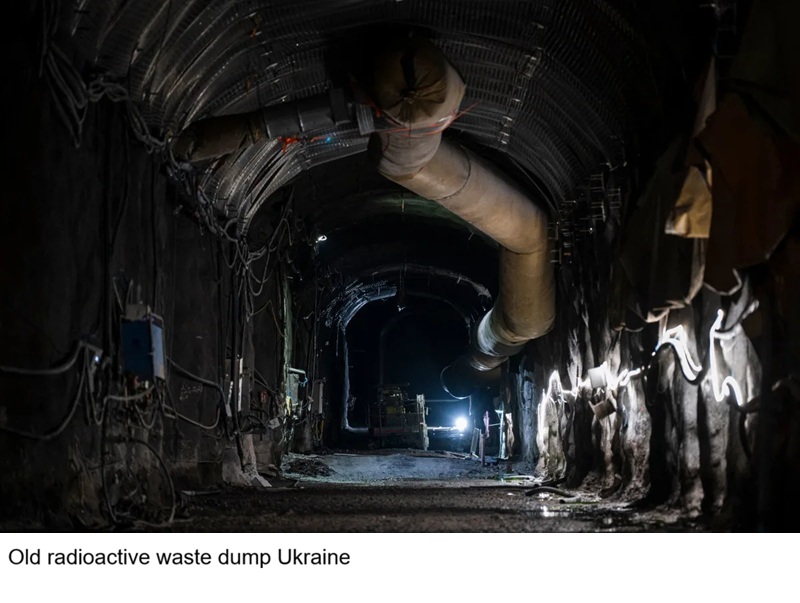
Our generation must find a way to bury the waste very deep to avoid radioactive pollution or exposure to people and animals up to one million years into the future.”
With nuclear energy production increasing globally, the problem of what to do with the waste demands a solution. But where do you store something that stays dangerous for thousands of years?
Jheni Osman, Science Focus, May 1, 2026
Uniformed guards with holstered guns stand at the entrance and watch you lumber past. Ahead lies a wasteland of barren metal gantries, dormant chimney stacks and abandoned equipment.
You trudge towards the ruins of a large, derelict red-brick building. Your white hazmat suit and heavy steel-toe-capped boots make it difficult to walk. Your hands are encased in a double layer of gloves, your face protected by a particulate-filtering breathing mask. Not an inch of flesh is left exposed.
Peering into the building’s gloomy interior, the beam from your head torch picks out machinery and vats turned orange with rust. On a wall nearby, a yellow warning sign featuring a black circle flanked by three black blades reminds you of the danger lurking inside.
Apart from the sound of your own breathing behind your mask, the only thing you can hear is the crackling popcorn of your Geiger counter.
This is what entering the Prydniprovsky Chemical Plant is like for nuclear researchers, including Tom Scott, professor of materials at the University of Bristol and head of the UK Government’s Nuclear Threat Reduction Network.
Prydniprovsky was once a large Soviet materials and chemicals processing site on the outskirts of Kamianske in central Ukraine. Between 1948 and 1991, it processed uranium and thorium ore into concentrate, generating tens of millions of tonnes of low-level radioactive waste.
When the Soviet Union dissolved, Prydniprovsky was abandoned and fell into disrepair.
“The buildings are impressively awful and not for the faint-hearted,” says Scott. “As well as physical hazards, such as gaping holes in the floor, there’s no light or power. And obviously there are radiological hazards. Until very recently, the Ukrainian Government didn’t have a clue what had gone on at the site, so there were concerns about the high radiation levels and ground contamination.”…………………………………”
Scott and his team are known as industrial nuclear archaeologists, and they’re working to find, characterise and quantify the ‘legacy’ radioactive waste at sites around the world.
“High-level radioactive waste gives off a significant amount of radioactivity, sufficient to make humans sick if they get too close,” he says. “Some of this waste will be dangerously radioactive for very long periods of time, meaning that it needs to be physically kept away from people and the environment to ensure that no harm is caused.”
But finding legacy waste like this, which has been amassing since the 1940s, is only part of the challenge. Once it’s been found, it has to be isolated and stored long enough for it to no longer pose a threat. And that’s not easy.
“Currently we’re storing our high-level wastes above ground in secure, shielded facilities,” Scott says. “Such facilities need to be replaced every so often because buildings and concrete structures can’t last indefinitely.”
Safely storing the nuclear waste that already exists is only the start of the problem, however. With the world moving away from fossil fuels towards low-carbon alternatives, nuclear energy production is set to increase, which means more waste is going to be produced – a lot more……………………………………………………
Safe spaces
In the UK, most nuclear waste is currently sent to Sellafield, a sprawling site in Cumbria, in the north-west of England, with about 11,000 employees, its own road and railway network, a special laundry service for contaminated clothes and a dedicated, armed police force (the Civil Nuclear Constabulary).
Sellafield processes and stores more radioactive waste than anywhere in the world.
But more hazardous material is on the way, much of which will come from the new nuclear power station being built at Hinckley Point in Somerset. To keep pace, experts have been hunting for other, much stranger, disposal solutions.
t’s a challenge for nuclear agencies all around the world. All sorts of proposals have been put forward, including some bizarre ideas like firing nuclear waste into space. (The potential risk of a launch failure showering the planet with nuclear debris has silenced that proposal’s supporters.)
So far, the most plausible solution is putting the waste in special containers and storing them 200–1,000m (660–3,280ft) underground in geological disposal facilities (GDFs). Eventually, these GDFs would be closed and sealed shut to avoid any human intrusion.
These ‘nuclear tombs’ are the safest, most secure option for the long-term and minimise the burden on future generations.
“In the UK, around 90 per cent of the volume of our legacy waste can be disposed of at surface facilities, but there’s about 10 per cent that we don’t currently have a disposal facility for. The solution is internationally accepted as being GDFs,” says Dr Robert Winsley, design authority lead at the UK’s Nuclear Waste Services.
“We estimate that about 90 per cent of the radioactive material in our inventory will decay in the first 1,000 years or so. But a portion of that inventory will remain hazardous for much longer – tens of thousands, even hundreds of thousands of years.
“GDFs use engineered barriers to work alongside the natural barrier of stable rock. This multi-barrier approach isolates and contains waste, ensuring no radioactivity ever comes back to the surface in levels that could do harm.”
But how do you keep that radioactivity in the ground? Radioactive waste is typically classified as either low-, intermediate- or high-level waste………………………………………………………………………………..
Rock solid
The hunt is also on to find facilities with bedrock that can withstand events such as wars and natural disasters (‘short-term challenges’, geologically speaking). Sites that won’t change dramatically over the millennia needed for nuclear waste to no longer pose a risk.
“A misconception is that we’re looking for an environment that doesn’t change, but the reality is the planet does change, very slowly,” says Stuart Haszeldine, professor of carbon capture and storage at the University of Edinburgh.
“Our generation must find a way to bury the waste very deep to avoid radioactive pollution or exposure to people and animals up to one million years into the future.”
To achieve this, the site ideally needs to be below sea level. If it’s above sea level, rainwater seeping down through fractures in the rock around the site might become radioactive and eventually find its way to the sea.
When this radioactive freshwater meets the denser saltwater, it’ll float upwards, posing a risk to anything in the water above.
Another challenge is predicting future glaciations, which happen roughly once every 100,000 years. During such a period, the sort of glaciers that cut the valleys in today’s landscape could form again, gouging new troughs in the bedrock that might breach an underground disposal facility.
“Accurate and reliable future predictions depend on how well you understand the past,” says Haszeldine.
“Typically, repository safety assessments cover a one-million-year timeframe, and regulations require a GDF site to cause fewer than one human death in a million for the next million years. Exploration doesn’t search for a single best site to retain radioactive waste, but one that’s good enough to fulfil these regulations.”
Hiding places……………………………………………………………………………………………………….
Hide and seek
But even after you’ve found a suitable site and buried the radioactive material safely inside it, you still need to warn future generations about what’s hidden inside.
The trouble is, even if humans are still around in a million years’ time, there’s no guarantee the languages our ancestors speak, or the symbols they use, will be anything like those of today…………………………………………………………………………………………………………………………………………………. https://www.sciencefocus.com/planet-earth/inside-the-bizarre-race-to-secure-earths-nuclear-tombs
1 This Month



26 September – International Day for the Total Elimination of Nuclear Weapons


PLEASE OPPOSE HR 8255 AND S.3639 – bills would accelerate satellite deployment, with no environmental review or safeguards – https://ncstd5li.quorum.us/campaign/169331/
To see nuclear-related stories in greater depth and intensity – go to https://nuclearinformation.wordpress.com
-
Archives
- September 2026 (219)
- August 2026 (330)
- July 2026 (355)
- June 2026 (287)
- May 2026 (306)
- April 2026 (356)
- March 2026 (251)
- February 2026 (267)
- January 2026 (308)
- December 2025 (358)
- November 2025 (359)
- October 2025 (375)
-
Categories
- 1
- 1 NUCLEAR ISSUES
- business and costs
- climate change
- culture and arts
- ENERGY
- environment
- health
- history
- indigenous issues
- Legal
- marketing of nuclear
- media
- opposition to nuclear
- PERSONAL STORIES
- politics
- politics international
- Religion and ethics
- safety
- secrets,lies and civil liberties
- spinbuster
- technology
- Uranium
- wastes
- weapons and war
- Women
- 2 WORLD
- ACTION
- AFRICA
- Atrocities
- AUSTRALIA
- Christina's notes
- Christina's themes
- culture and arts
- Events
- Fuk 2022
- Fuk 2023
- Fukushima 2017
- Fukushima 2018
- fukushima 2019
- Fukushima 2020
- Fukushima 2021
- general
- global warming
- Humour (God we need it)
- Nuclear
- RARE EARTHS
- Reference
- resources – print
- Resources -audiovicual
- Weekly Newsletter
- World
- World Nuclear
- YouTube
-
RSS
Entries RSS
Comments RSS
 nuclear-news