‘Fish disco’ not enough to protect nature at nuclear plant, says green quango.
Natural England demands new salt marshes be created before Hinkley Point C can open
Matt Oliver, Industry Editor
The Hinkley Point C nuclear power station is facing fresh
delays as a green quango demands extra nature protections on top of a
controversial “fish disco”. Natural England has told developer EDF that
existing plans to stop aquatic life in the Severn Estuary from being sucked
into the Somerset plant’s cooling pipes will not be enough to satisfy
environmental rules.
The company had proposed using £700m of special
equipment to ward off fish, including a bespoke underwater loudspeaker
system which campaigners have called the “fish disco”. EDF provided new
research data to regulators in February following promising trials of the
technology, formally known as the acoustic fish deterrent, by university
scientists.
But in recent weeks, Natural England is understood to have
claimed that further protections are necessary, such as the creation of new
salt marshes to boost fish populations in the area. The quango is refusing
to sign off the plant until new plans are set out and approved.
It has prompted concern that Hinkley’s targeted 2030 opening date is now
effectively impossible to deliver, owing to the time it will take to win
approval for and build the new salt marshes. Sam Richards, the chief
executive of Britain Remade, a Right-leaning think tank, said: “Hinkley
Point C is already the most expensive nuclear power station ever built.
“It also has more fish protection measures than any reactor built
anywhere in the world. “For Natural England to now demand even more
mitigation – regardless of the wider impact on the project and for
minimal added benefit to nature – shows just how out of touch with
reality they really are. “This out of control quango has become a direct
threat to Britain’s energy security.”
Telegraph 2nd May 2026, https://www.telegraph.co.uk/business/2026/05/02/fish-disco-not-enough-to-protect-nature-at-nuclear-plant/
US to give $100 million to repair damaged Chornobyl nuclear shelter, Kyiv says
By Reuters, April 30, 2026, Reporting by Max Hunder Editing by David Goodman
The U.S. will give $100 million towards repairs of the vast radiation containment dome at the Chornobyl plant in northern Ukraine, site of the world’s worst atomic accident in 1986, after the dome was damaged by a Russian drone, Kyiv’s energy minister, Denys Shmyhal, said on Wednesday.
One of Chornobyl’s four reactors exploded in 1986 and is now enclosed by a shelter to contain the lingering radiation. A Russian drone hit that structure in February last year.
In a post on Telegram, Shmyhal said funding for repairs of the dome, at an estimated cost of 500 million euros ($584.95 million), was discussed with international partners at a recent conference about the plant.
Rosyth councillor Brian Goodall wants public consultation.
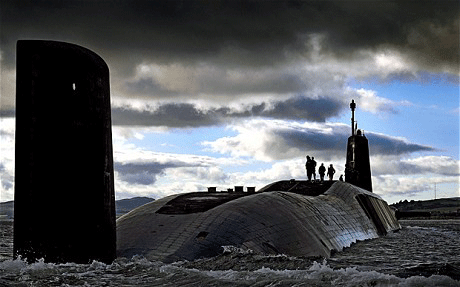
29th April, By Ally McRoberts, Content Editor, https://www.dunfermlinepress.com/news/26063183.rosyth-councillor-brian-goodall-wants-public-consultation/
THE UK Government’s refusal to give local residents a say in Trident nuclear submarines coming to Rosyth has been slammed as “disgusting and undemocratic”.
Local SNP councillor Brian Goodall was fuming that a request for a public consultation on the move, which he said would require “radiation shelters” and iodine tablets for people who live in the town, has been sunk.
He said: “The UK Government are effectively saying we won’t ask the Scottish public if we should do this because we know they’d say no.”
Cllr Goodall added: “The MoD confirmed at a previous meeting of the area committee that these nuclear submarines may have nuclear missiles on board when they come into Rosyth.
“This not only presents massive additional health and safety concerns but also makes Rosyth even more of a target for rogue nations and international terrorist groups.”
The next generation of Trident nuclear submarines is the Dreadnought class and a contingent dock is to be in place at Rosyth Dockyard by 2029.
The vessels are to be maintained at Faslane but a temporary home is needed in Fife, and the UK Government have provided £340 million to help “bridge the gap”, as the site on the Clyde won’t be ready until the mid 2030s.
In December the MoD told local councillors they would not reveal if any of the subs that need repairs or maintenance at Rosyth will be carrying nuclear warheads.
In February, at the South and West Fife area committee, Cllr Goodall submitted a successful motion asking the convener to write to the Secretary of State of Defence, requesting that the public are consulted on plans to “potentially bring nuclear weapons” to the dockyard.
Opponents have argued that maintaining nuclear-powered subs and storing nuclear weapons are entirely separate – and that nuclear warheads are not kept onboard when a sub goes in for maintenance.
This week Cllr Goodall said: “The UK Government, through the MoD, have now responded to the request for them to hold a public consultation on their plans to bring nuclear fuelled, and possibly nuclear armed, submarines to Rosyth Dockyard, and their response is as predictable as it is disgusting and undemocratic.”
He said the letter from the Minister for Defence Readiness and Industry, Luke Pollard MP, “not only confirms their refusal to consult with local residents on their plans, it also admits that public safety, while a major concern, is not the main priority of the MoD”.
Cllr Goodall went on: “These submarines will still have their nuclear fuel onboard, unlike the decommissioned subs that are already at the dockyard, so there will need to be additional emergency plans put in place, including arrangements for radiation shelters for some local residents and to distribute potassium iodide tablets to the local population.
“The communities around the dockyard should be allowed to have their say on this and the campaign for a public consultation will go on.”
The work on the Dreadnought class would be in addition to the submarine dismantling project at the dockyard, which is cutting up an old nuclear sub, Swiftsure, and removing the radioactive waste left within it.
There are another six decommissioned subs laid up at Rosyth – and 15 at Devonport – and although no decision has been made, Babcock are recruiting for more people to work on the dismantling project.
Cllr Goodall has also expressed concern about the Swiftsure demonstrator scheme, arguing that work to remove the reactor should not go ahead as it’d be cheaper not to do so and there was nowhere safe to store the radioactive waste.
Charles III and Britain’s pathological obsession with Russia

British political class has had a pathological obsession with Russia for nearly two centuries, and has been scheming to wage wars against her at least since the Crimean War of 1853. In all cases, Britain is always eager to lead such wars from behind and incite other powers to do the actual fighting. One of the most blatant examples was their weaponizing of Hitler’s Germany in preparation for the largest ever invasion force in 1941, counting over 3.8 million troops. This was not really a “German invasion” as our historical curriculum suggests; it was a German-led invasion.
Yesterday, Charles III called for World War III, echoing the 1945 “Project Unthinkable” Britain’s obsession with waging war on Russia is now a mortal danger to all of us.
Alex Krainer, Apr 30, 2026, https://alexkrainer.substack.com/p/charles-iii-and-britains-pathological?utm_source=post-email-title&publication_id=1063805&post_id=195907312&utm_campaign=email-post-title&isFreemail=true&r=1ise1&triedRedirect=true&utm_medium=email
On Monday, 27 April, Britain’s king Charles III came to Washington for a four-day state visit to the United States hosted by President Donald Trump. His “majsesty,” is also known to his fans as late Jimmy Saville’s BFF and the brother of Jeffrey Epstein’s BFF Andrew, formerly known as prince.
Yesterday, Charles graced the joint session of U.S. Congress with an inspiring speech during which he found it appropriate to call on his American audience to get on with the business of World War III already. Thus spoke his majesty:
“In the immediate aftermath of 9/11 when NATO invoked Article 5 for the first time, and the United Nations Security Council was united in the face of terror, we answered the call together as our people have done so for more than a century, shoulder to shoulder through two world wars, the Cold War, Afghanistan, and moments that have defined our shared security. Today, Mr. Speaker, that same unyielding resolve is needed for the defence of Ukraine and her most courageous people.”
Glorifying wars of the past, particularly Afghanistan, and invoking NATO Article 5 which was “needed for the defence of Ukraine and her most courageous people,” was a naked call for the United States to commit to war against Russia: another great war on the European continent.
Given that the last two World Wars resulted in some 70 million casualties, one would think that the king’s warmongering would prompt U.S. elected representatives to tar and feather the British royal and run him out of town on a rail, but of course, one would be wrong. King’s call for World War III elicited an enthusiastic standing ovation from the politicians, otherwise passionately supportive of the ‘no kings’ protests in their country.
Britain’s incurable Russia derangement
British political class has had a pathological obsession with Russia for nearly two centuries, and has been scheming to wage wars against her at least since the Crimean War of 1853. In all cases, Britain is always eager to lead such wars from behind and incite other powers to do the actual fighting. One of the most blatant examples was their weaponizing of Hitler’s Germany in preparation for the largest ever invasion force in 1941, counting over 3.8 million troops. This was not really a “German invasion” as our historical curriculum suggests; it was a German-led invasion.
The 3.8 million strong invasion force (which grew to six million within its first year of fighting) was sourced from nearly all European countries. Soviet Union repelled that invasion at a cost of 27 million casualties. One in 9 Russians died and almost every Russian family lost someone in that war. When it became clear that the invasion had failed and that Hitler’s army would be defeated, British Joint Planning Staff thought up “Project Unthinkable”: a new&improved plan to attack Russia.
The document was submitted to Winston Churchill on 22 May 1945 (it is available at this link) proposing a surprise attack against Russia, planned for July 1, 1945 by the combined UK and the US forces, supported by the Polish and German troops. The project’s political objective was to submit Russia “to our will”:
“A quick success might induce the Russians to submit to our will at least for the time being; but it might not. … if they want total war, they are in the position to have it.”
The “elites” in London were dreaming up a new war against Russia even as World War 2 was still raging and the Soviet Union was finishing off Hitler’s Wehrmacht at the Eastern front. Britain was ostensibly allied with the USSR at that time, but the king and the cabal, as Winston Churchill named it, were secretly rooting for Hitler.
A total war is necessary
Britain’s Joint Planning Staff advanced two hypotheses: (1) that “a total war is necessary,” and (2) that “a quick success would suffice to gain our political objective.” However, the quick victory in a surprise attack might only yield a temporary result. A lasting one would require victory in a total war:
“The only way we can achieve our object with certainty and lasting results is by victory in a total war.”
However, this “total war,” as they well understood, would have to be a very long term project:
To achieve the decisive defeat of Russia in a total war would require, in particular, the mobilisation of manpower to counteract their present enormous manpower resources. This is a very long term project and would involve: the deployment in Europe of a large proportion of the vast resources of the United States; and the re-equipment and reorganization of German manpower and of all the Western allies.
It would be interesting to know what made the Joint Planning Staff believe that they could reorganize German manpower together with the “vast resources of the United States?” Whatever it was that they knew, they concluded that, “the only thing certain is that to win it would take us a very long time.”
Exactly how long was unclear, but perhaps it was the time needed to organize some form of a North Atlantic Treaty Alliance, to dismember the USSR and to weaponize at least one of its former republics, like Ukraine, as a battering ram to wield against Russia.
High cabal… has made us what we are
Two years after formulating “Project Unthinkable,” the British government drafted the “Fundamentals of Our Defence Policy,” reaffirming that, “The most likely and most formidable threat to our interests comes from Russia,” and that, “Ensuring that we have the active and early support of the United States of America and of the Western European States” was essential.
Well, as the war in Ukraine is now clearly headed for the same result as Hitler’s “Operation Barbarossa,” active support of the United States of America is now quite urgent, and this is why king Chuck was busy charming his American audience to revive Project Unthinkable.
The king’s speech and his kingdom’s foreign policy over decades suggest that their obsession with waging a total war against Russia remains all consuming for the British political class. This poses a mortal danger to the whole world by now, and we can be sure their obsession won’t stop with a speech: furious lobbying and influence campaigns will be unleashed, perhaps only requiring a well-orchestrated false flag attack attributed to Russia.
If they are successful in their endeavor, we can expect a nuclear war. Recall, last year we learned that the UK was/is willing and ready to help Ukraine build a nuclear weapon. The criminal insanity of it is truly hard to fathom, calling to mind Winston Churchill’s cryptic quip upon learning about the allies’ brutal bombardment of Rotterdam: “Unrestricted submarine warfare. Unrestricted air bombings – this is total war… Time and ocean and some guiding star and high cabal have made us what we are.”
‘I miss our land. Chernobyl broke us’: The families who lost their homes after world’s worst nuclear accident
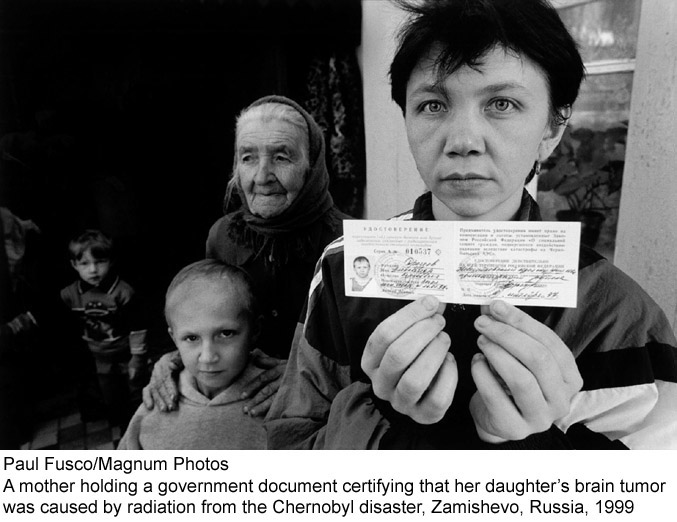
For 40 years, the residents of northern Ukraine and southern Belarus have grappled with the devastating effects of the world’s worst nuclear accident. They tell Alex Croft about the day that their lives were changed forever
25 April2026, https://www.independent.co.uk/news/world/europe/chernobyl-40-years-family-reel-hostages-b2963417.html EXCELLENT PHOTOS
lena Maruzhenko remembers her mother sobbing when Soviet police told them to evacuate their home in the village of Korogod in northern Ukraine.
Just 12km away, a reactor at the Chernobyl nuclear power plant had exploded, sending a shaft of blue light into the night sky and throwing clouds of radioactive material into the surrounding area.
Local authorities told Olena and their mother that they would only need to leave their home for three days. They had no idea that the worst nuclear disaster in history had unfolded.
“We believed we would definitely return,” Olena recalls to The Independent as the world marks the 40th anniversary of the Chernobyl disaster.
“The 26 April, 1986, is a date that is forever etched in my memory with black sadness. We could not imagine leaving our homes without knowing where to go.”
Olena and her mother were among 350,000 people who were evacuated from the Chernobyl exclusion zone. Hundreds of buses were sent to ferry workers from Pripyat, an industrial city created to house workers from the nearby plant located around 100km north of Kyiv.
The disaster began when reactor number 4 at the power plant exploded at 1.23am, after a test went catastrophically wrong.
In the days that followed, a massive and uncontainable release of radioactive material spread across Europe. Firefighters and workers were exposed to lethal radiation as they attempted to contain the blaze. Thousands of animals were mercifully slaughtered as residents were evacuated from nearby towns.
The Soviet government sought to downplay the scale of the accident.
In the 40 years since Chernobyl, thousands of people have suffered devastating health consequences due to high radiation exposure, including thyroid cancer.
Vast areas were contaminated by the radiation, devastating the region’s environment. Luscious green forests turned a reddish brown, while vital soil for agriculture was polluted for decades.
Korogod was once a town surrounded by forests, rivers and lakes that provided rich sources of mushrooms, berries, fish and herbs sold in bustling local markets. After the disaster, it became a grey and decrepit ghost town in the Chernobyl Exclusion Zone, a 30km area restricted to human habitation.
The official Soviet death toll, given in 1987, was 31. But after including those who suffered lasting health effects, the toll is significantly higher.
The husband of Natalia Dykun, another resident of Korogod, was one such person. He was diagnosed with cancer after the disaster and eventually died from the disease.
“We became hostages of the Chernobyl disaster,” she says. “The treatment did not help and he died very young. In almost every house near us, someone from the family began to get sick, and later almost every family lost a relative to cancer.”
Natalia was 28 at the time of the explosion. She recalls the silence from the Soviet authorities causing “great harm”, with residents “completely unprotected, both morally and physically”.
Most residents from the towns near Chernobyl only truly understood the scale of what had happened when they discovered new towns were being built to house them.
Natalia says she was “devastated” to see a new village being built in an open field with “no forest or water nearby”. Her home used to be surrounded by nature.
Olga Mikhalova was only 15 when she learned she would never be returning home. “The accident and evacuation changed us forever,” she says.
“Family ties were broken, neighbourly ties. We would not wish this on anyone.”
Olena, who was living with strangers in the aftermath of the tragedy, watched the news in tears when she found out new homes were being built. “I still dream of my village, my native house. I miss our land. The Chernobyl accident broke us.”
Slavutych, a planned city on the western bank of the Dnieper River, still houses around 20,000 people. It was built for those evacuated from the abandoned city of Pripyat, perhaps the most famous of those evacuated after the explosion. Chilling images of Pripyat, including its haunting abandoned fairground, are an enduring symbol of the lives and communities lost in just a matter of hours.
“When we realised that we would not return home, it was very difficult for us, the young, to come to terms with this, and it was even more difficult for the older generation,” says Olga. “This is a tragedy for many generations.”
As war rages in Ukraine, with Russian forces playing fast and loose around Chernobyl and the southern Zaporizhzhia nuclear power plant, experts have told The Independent that we are closer than ever to another nuclear disaster.
For those who have suffered the most catastrophic effects of a nuclear accident, this is unthinkable.
“As a person who survived the evacuation, I feel especially acute anxiety when war touches nuclear facilities,” Olena says. “This causes fear and incomprehension, why humanity, having had such an experience, is taking risks again.”
Natalie fears for the future generations. “This irresponsibility of the enemy and the risks for the surrounding world of a repeat of the disaster are very frightening and we are in constant stress and fear. We are no longer afraid for ourselves, but for our children and grandchildren.
“Irresponsibility and insecurity in relation to nuclear energy and infrastructure is a crime before the whole world.”
Inside Chornobyl: 40 years after disaster, nuclear site still at risk.

Sat 25 Apr 2026 , Guardian,
In February 2025, a cheap Russian drone tore through Chornobyl’s confinement shelter. Workers warn the site of the world’s worst nuclear accident is not safe yet.
The dosimeter clipped to your chest ticks faster the moment you step off the designated path inside the Chornobyl nuclear power plant. Step back, and it slows again – an invisible line between clean ground and contamination.
Above rises the “new safe confinement” (NSC) – the largest movable steel structure ever built, taller than the Statue of Liberty, wider than the Colosseum, its arch curving overhead like an aircraft hangar built for giant planes.
Completed in 2019 at a cost of $2.5bn (£1.85bn) and funded by 45 countries, the NSC was built to shield the world from what lies beneath it. It sits at the heart of a vast exclusion zone, a radioactive landscape the size of Cyprus, largely abandoned by humanity. Stray dogs roam the plant in packs – workers advise against petting them.
Inside is “the sarcophagus” – a grey concrete tomb erected in just 206 days to cover the ruins of reactor No 4, which exploded on 26 April 1986 in the worst nuclear accident to date.
Up close, the sarcophagus looks almost makeshift – massive slabs stacked like giant building blocks, rust streaking the joins. Inside, 180 tonnes of nuclear fuel and four to five tonnes of radioactive dust remain trapped.
The NSC was constructed to buy time: to allow the unstable sarcophagus to be dismantled safely over decades, while shielding against the consequences in case it collapses.
What its funders did not anticipate was a war – Chornobyl was occupied in the first weeks of Russia’s 2022 invasion of Ukraine – much less a drone strike on the facility three years later.
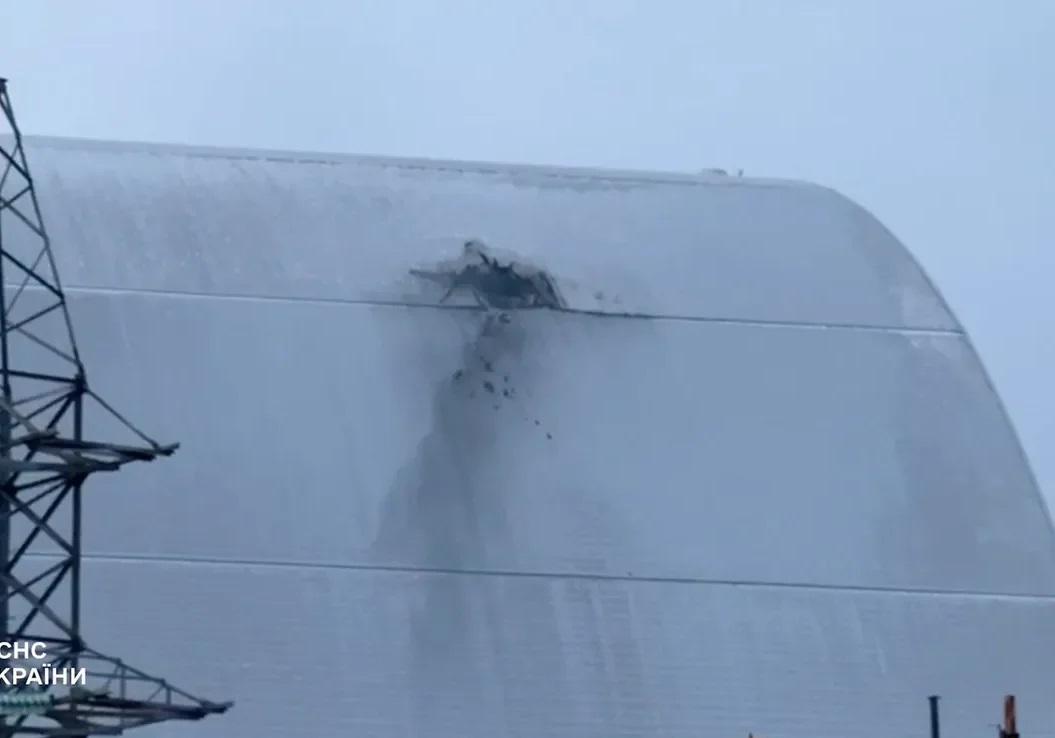
In the north-west corner of the roof, a temporary patch marks where a cheap $20,000 Russian drone tore through the structure on 14 February 2025, punching a hole in the arch and compromising the very function the arch was built for.
“If the sarcophagus collapses, over a hundred tonnes of nuclear fuel would be released into the air,” said the plant’s director general, Serhii Tarakanov.
A full repair is required within four years, Ukrainian officials and western experts say, or the NSC’s 100-year lifespan can no longer be guaranteed. It is estimated to cost up to €500m (£432m) – money that Ukraine’s cash-strapped government has not yet found.
Meanwhile, war continues in Ukraine, and Russia has repeatedly launched drones and missiles along flight paths near the Chornobyl nuclear plant, raising the risk of another disaster.
On the 40th anniversary of the Chornobyl disaster, one of the world’s most vulnerable sites remains under threat…………………………………………………………………………..
Should the sarcophagus collapse – whether from a strike, structural failure or age (built for 20 years, now standing for 40) – experts say it would release another cloud of radioactive particles into the air with no safeguard to contain it.
“The collapse of the sarcophagus would primarily be an enormous hazard for those working at the Chornobyl plant and set back dealing with the disaster for many more years,” said Shaun Burnie, a senior nuclear specialist with Greenpeace.
Beyond the financial costs and the war, there is the question of how the repairs of the confinement shelter are done at all. High radiation levels directly above the damaged section mean workers can legally spend no more than about 20 hours a year in that zone before hitting their annual dose limit.
“Workers will be able to perform their assignment there for a few hours, if not just a few minutes at a time,” said Tarakanov, adding that the work would require about 100 qualified construction workers operating in short rotations at height on a curved, contaminated surface……………………………………………………………………………………………………………………………………………………………………………………………………………………………………………………………………………………..
the exclusion zone’s isolation offers no protection from the war.
The plant has experienced four total blackouts since October 2024 caused by Russian strikes on the electricity grid, each requiring emergency diesel generators to keep the spent fuel cooling systems running.
Additional air defences and soldiers have been brought in, said Vadim Slipukha, the deputy director general for security at the site, though the threat has not gone away, he said. Even an unintentional strike from a drone knocked off course by electronic warfare could trigger a collapse of the sarcophagus.
“We are begging the international community to understand,” said Tarakanov. “There is a real risk of a new incident. It could happen any night, any day.” https://www.theguardian.com/news/ng-interactive/2026/apr/25/chornobyl-power-plant-at-risk-amid-russia-
Dangerous and expensive, nuclear power is a dead end for Scotland

I’ve been through every argument that the nuclear industry
makes promoting new nuclear power stations – but scratch the surface and
they just melt through the floor. New nuclear is fundamentally not needed –
numerous studies, including by Stanford University and renowned energy
modellers at LUT show that the UK, and indeed most, if not all, other
countries can meet their energy needs with 100% renewables.
Politicians’ fears about the wind and sun and the rain and the waves and tides being
unable to meet all our needs are misplaced. Renewables, energy storage,
energy efficiency and flexible power with a modern upgraded grid can do it
all – cheaper, quicker, safer and a hell of a lot cleaner, and create many
more thousands of jobs.
The cost of nuclear power is eye-watering. Look at
Hinkley Point C and Sizewell C – nearly £100bn to build them both with
massive delays and cost -over-runs. That is enough to install a 5kWh
battery in every one of the 28 million homes in Britain, and leave £44bn
for other things. Combine that with solar and every home becomes a power
station with its own ‘baseload’.
Alternatively, £100bn could fund planned
upgrades to the grid needed to facilitate large and small renewables, twice
over. The Coire Glas pumped hydro storage project in the Highlands could be
built 50 times over. £100bn spent on a nuclear-free transition could be
revolutionary.
What a renewables-based system needs is flexible power,
energy storage and a smart, modern grid. Surplus renewable electricity
could also be used to generate ”green hydrogen” to generate electricity
on calm, dull days. It could also be used to power heavy transport and
industry.
Battery systems, including compressed air and pumped storage
hydro, alongside vehicle-to-grid technology, can all be parts of the
bedrock of energy security and an energy system that would be cooking with
green power 24/7.
Nuclear does nothing to help any of this. Indeed, it is
worse, it directly causes wind and solar plants to be switched off when
green power is plentiful, because nuclear is so inflexible. Not only does
nuclear cost an arm and a leg, it adds cost to the consumer for renewables
We only have to look at the recent history of nuclear power to see how
dangerous and polluting it is. Fukushima remains a slow motion disaster for
Japan as they scramble to deal with millions of gallons of radioactive
water and melted reactor cores. Chernobyl’s 40-year anniversary this week
is another timely reminder, that when things go wrong, they can go very
wrong.
At least when a wind turbine breaks down you don’t need an exclusion
zone for decades and mass public health measures – you just get some
engineers with a crane and some spanners to go fix it.
And despite what the
‘nuke, baby, nuke’ lobby says, there is no solution for the waste yet,
other than to store and guard the most highly radioactive cores for
hundreds of years to cool down out of the way somewhere. That’s the
solution!
The hype about Small Modular Reactors is just that, hype. In
fact, the only two operational SMRs are in China and Russia, and both have
been beset by delays and cost increases. The economies of scale are lost,
and studies have shown that they produce more highly radioactive waste for
the same generating capacity than their slightly larger cousins.
These projects are pure spin, a clever wheeze by industry lobbyists intended to
promote nuclear acceptability – small, click and collect, a kind of
middle-aisle at LIDL feel to it. In the words of energy expert Amory Lovins
on SMRs: “This illusion neatly fits the industry’s business-model shift
from selling products to harvesting subsidies.”
The Rolls Royce SMR –
chosen by Great British Energy-Nuclear to be built at Wylfa in North Wales
– is a 470MW reactor, not much smaller than the two Torness reactors, which
are about 600MW each. And then there is the fuel – uranium ore is needed
and we don’t have any, (and the mining of it is handily missed out in
nuclear promotional graphics comparing its land use to renewables, which
also fail to point out that the land around solar arrays and turbines can
still be used for traditional purposes).
Mind you, there is some
recoverable uranium ore on the Orkney mainland – and when it was proposed
to dig it up to use it at Dounreay last century, all hell broke loose and
Orcadians stopped it by popular protest. So we would have to rely on
imports of this global commodity – a market that is dominated by Russia and
associates.
Pete Roche of SCRAM put this well when commenting on a recent
poll indicating only 14% of Scots thought we should focus on uranium
fuelled nuclear reactors for our long term energy security needs:
“Relying on a uranium-fuelled nuclear future is like jumping out of the
oil and gas frying pan and into a nuclear fire – it makes no sense and
Scots seem to get that.”
We should just get on with building a country
that is a renewable energy powerhouse so that future generations can look
back and thank us for choosing a green, clean and sustainable energy route.
Nuclear is NOT a natural partner with renewables, indeed, it is a delaying
tactic, holding back rapid decarbonisation, and adds extra and unnecessary
cost to a renewables-based energy system.
Herald 29th April 2026, https://www.heraldscotland.com/politics/viewpoint/26064131.dangerous-expensive-nuclear-power-dead-end-scotland/
Deadly strike by Ukraine at Europe’s biggest nuclear power plant as chilling warning issued

An employee has been killed in a drone attack carried out by the Ukrainian Armed Forces at the Zaporizhzhia Nuclear Power Plant, Russia’s State Atomic Energy Corporation has said.
Mirror Joe Smith News Reporter, 27 Apr 2026,
The International Atomic Energy Agency (IAEA) has issued an urgent warning after a deadly attack at the Zaporizhzhia Nuclear Power Plant in Ukraine.
Russia’s State Atomic Energy Corporation said a driver was killed by a drone strike in an operation carried out by the Ukrainian Armed Forces.
The Rosatom corporation said an employee at the Zaporizhzhia Nuclear Power Plant died this morning. The Russian agency said the strike was a “great tragedy” and added that attacks on the nuclear plant “pose a threat not only to people but also to security as a whole”.
Meanwhile the IAEA’s Director General said in a statement today that strikes on or near nuclear power plants (NPPs) can endanger nuclear safety and “must not take place”.
The IAEA statement said: “IAEA has been informed by the Zaporizhzhia Nuclear Power Plant that a drone strike this morning killed a driver at its transport workshop in the vicinity of the plant site.
“Director General Rafael Mariano Grossi reiterates that strikes on or near NPPs can endanger nuclear safety and must not take place. The IAEA’s team on the site will look into the incident and continue to monitor the situation.”
In a separate statement Russian agency Rosatom, which has controlled the plant since it was captured by Russian forces, said: “A Zaporizhzhia Nuclear Power Plant employee has been killed in a strike by the Ukrainian Armed Forces
“Today, a driver was killed as a result of a strike by a Ukrainian Armed Forces drone on the premises of the transport workshop at the Zaporizhzhia Nuclear Power Plant.”
The plant bosses called the man’s death “a terrible and irreplaceable loss,” adding that “employees of the nuclear industry must not be targeted.” They continued: “Any attacks on the Zaporizhzhia NPP pose a threat not only to people but also to security as a whole. It is a blow to life and to the future……………………. https://www.mirror.co.uk/news/world-news/zaporizhzhia-nuclear-power-plant-ukraine-37074915
40 years after Chernobyl, Stasi files reveal scale of Soviet misinformation

For decades, researchers, political leaders and advocacy groups have worked to uncover the story of the explosion
Lauren Cassidy The Conversation, Monday 27 April 2026, https://www.independent.co.uk/news/world/europe/chernobyl-disaster-anniversary-secret-stasi-files-b2965335.html
On April 26, 1986, Soviet engineers at the Chernobyl nuclear power plant were conducting a safety test. Doomed by a fatal design flaw and pushed to the limit by human negligence, reactor 4 exploded amid an attempted shutdown during a routine procedure, setting off a chain of events that ultimately released radioactive material hundreds of times greater than that of the atomic bomb dropped on Hiroshima.
Although the accident occurred north of Kyiv, Ukraine, near the border with Belarus, radioactive fallout was soon detected throughout northern and central Europe. Yet the Soviets did what they could to prevent the spread of information that would reveal the true horror of what had occurred.
For decades, researchers, political leaders and advocacy groups have worked to uncover the story of the explosion. While science has allowed us to understand the circumstances of the explosion itself, it has taken much more work to uncover the layers of mismanagement, negligence and misinformation that resulted in human suffering, ecological disaster and economic damage.
One of the problems is that many of the official Soviet records of the event, such as the KGB files, are located in Moscow and are inaccessible to all but a few Russian government agencies.
But there is a partial workaround: Because East Germany was a Soviet satellite state and not a full member of the Soviet Union, official documents remained in the country after the fall of the Berlin Wall. In 1991, after the reunification of Germany, the German government passed a law allowing for the declassification of certain files from the Stasi, East Germany’s secret police and intelligence service. These files can now give us further insight into the mismanagement of Chernobyl, since the East German Stasi and the Soviet KGB were in communication on the matter.
I have spent the past three years reading Stasi files and researching the creation of misinformation in the former Eastern bloc, meeting with Stasi archivists in Berlin and viewing the original archival rooms in the former Stasi headquarters.
Looking at formerly top secret communication between the KGB and Stasi, it is clear that despite publicly insisting everything was under control, both intelligence agencies knew the explosion was absolutely devastating. They kept detailed records of hospitalizations, casualties, damaged crops, contaminated livestock and radiation levels.
But only the very top officials in East Germany and the Soviet Union had access to these numbers. The main fear for both the KGB and Stasi was not the radiation that would harm affected populations but the damage done to their respective countries’ reputations.
Controlling the message
Handling the press was a top priority.
In the Soviet Union, top government officials created their own briefings for the media to be published at precise dates and times. In a set of classified documents that one government official bravely saved and later published, the concreteness with which the lies were devised is apparent. It documents Mikhail Gorbachev, then-leader of the Soviet Union, saying in a Politburo meeting with top government officials: “When we inform the public, we should say that the power plant was being renovated at the time, so it doesn’t reflect badly on our reactor equipment.”
Later in the same meeting, another senior Soviet official, Nikolai Ryzhkov, suggests that the group prepare three different press releases: one for the Soviet people, one for the satellite states and another for Europe, the U.S. and Canada.
In East Germany, the Stasi reports mirrored this messaging. Although top officials are briefed on the presence of radioactive contaminants, the formerly classified Stasi files reiterate that the public is to be told that “absolutely no danger” is present. East German media, controlled by the state, then disseminated this information to the public.
The problem for the East German state was that by the mid-1980s, a lot of people were able to pick up Western TV and radio signals. Many recognized that their own government wasn’t telling them the truth. However, they also knew that Western media would take any chance they got to disparage the Eastern bloc. The result was that many people knew that they weren’t being told the truth, but they weren’t sure exactly what the truth was.
Much of the East German and Soviet propaganda at that time was designed to confuse and cast doubt, not necessarily to fully persuade. The idea was that enough conflicting information would tire people out.
Downplaying economic concerns
One of the Stasi’s major concerns following the disaster was the economic damage that was sure to affect East Germany. Once people began to learn of the radioactive fallout over much of Europe, they grew fearful of their own produce and dairy products.
Children began refusing to drink milk at school, while people frequently asked produce vendors whether their products were grown in a greenhouse or outdoors. On the whole, people stopped buying many of these products.
With an excess of these goods, the East German government needed to devise a plan to continue to make money off potentially contaminated goods. The Stasi’s solution was to increase export of these goods to West Germany.
In the formerly classified files, Stasi officials claim that exports would spread out the consumption of radioactive products, so that no one would consume unsafe levels of contaminated meat and produce.
The problem for the East Germans was that West Germany quickly amended their regulations for border crossings from East to West. Vehicles emitting certain levels of radiation were no longer allowed across the border. As a response, the lower-ranking Stasi workers were required to clean radioactive vehicles themselves. In doing so, the state was knowingly risking the health and safety of its own officials.
The East German food export plan was modeled on a similar one proposed by the Soviet government. The Soviet strategy, however, was not to export contaminated goods abroad but rather to send contaminated meat products to “the majority of regions” in the Soviet Union “except for Moscow.”
How disinformation proved an Achilles’ Heel
When the Stasi was founded in 1950, many of its employees genuinely believed in the East German cause.
Having witnessed the horrors of Nazi Germany, many older Stasi workers saw the East German state as the answer to creating a just and equitable society. By the 1980s, however, this sentiment had grown rare. Instead, many Stasi workers viewed their jobs as means to a decent income and privileged government treatment.
As a result, many Stasi workers had grown disillusioned and dispassionate.
It was little surprise, then, that the Stasi put up little resistance when protesters stormed their headquarters in 1990, months after the Berlin Wall fell. While there are many factors in the demise of the communist bloc, the way the East German and Soviet governments handled the aftermath of Chernobyl contributed greatly to the growing popular sentiment against each regime.
In East Germany, the disinformation campaign after the nuclear disaster only strengthened the message that the state did not have its people’s best interests in mind and that it was willing to sacrifice their health and well-being in order to maintain a certain image.
The Buzz About Chornobyl, 40 Years Later. How Do We Tell the Bees?

April 26, 2026, , by Ann McCann, https://www.nirs.org/the-buzz-about-chornobyl-40-years-later-by-ann-mccann/?eType=EmailBlastContent&eId=b8cab31a-e1b5-41e6-9e5a-3ff568976c1b
No, the bees in the Chornobyl exclusion zone (CEZ) are not mutated–in the visual ways we think of–nor are they glow-in-the-dark. They didn’t turn into giant, killer bees, and they don’t light up green at night. But what they did do was begin to produce fewer and fewer queens. A lot fewer, “with upper estimates of a 30-45% reduction compared with unexposed colonies (Raines).” When fewer queens are produced, fewer bees are produced, period. With fewer queens laying eggs and building colonies, the population struggles to sustain itself within the CEZ.
On the surface and from the outside, it appears that nature is “flourishing” within the CEZ. Large mammal populations appear abundant, and many use the CEZ as evidence for the utopic idea that there has been reclamation of the Earth in the zone’s time without human interference. While this idea certainly feels hopeful outside of the context of a nuclear disaster, it is simply not what it seems. “Wild” dogs roam the CEZ, which are not so wild at all, but actually descendants of the pets left behind in the evacuation after the meltdown. Larger mammals like boars and bears have taken over the area in the exclusion zone simply because there are no humans, can be no humans, around the zone to keep them at a distance as human-populated areas do. And there indeed appears to be a higher diversity rate among bee species in the exclusion zone, but again, this is not as it seems. Researchers correlate this to the abandoned farmlands that have now been overturned to wildflower meadows, creating more resources for diversity, but not necessarily for the long-term health of any species. Similarly, scientists who have studied the population effects of the contamination believe that “higher numbers [of animals in the area] may reflect the fact that there are fewer competitors or predators for these species in highly radioactive areas (Mousseau).”
Additionally, among the various species in the area, a number of ill effects are consistently documented, including cataracts in their eyes, smaller brains, tumors on their bodies, and reproductive issues such as a low sperm count and even complete infertility (Møller, et al). None of which, in my own estimation, bodes well for the idea of an ecological utopia in the aftermath of nuclear contamination. And this is not even mentioning the fact that many scientists believe we don’t see mutations in the fauna of the area (yes, those kinds of mutations) because most mutations, unsurprisingly, wouldn’t exactly help an animal live long enough to be consistently documented by researchers. Which isn’t to say deer are being born with two heads or that fish are growing legs and walking out of the water, all before scientists are miraculously able to see them. What it does imply, however, is that when there are genetic mutations or effects from radioactive contamination that cause, for example, a stunted immune system or a malformed part of the body, at best, the animal is simply not going to thrive long enough to reproduce and continue that mutation. At worst, these animals are born, suffer, and die of their biological weaknesses, whether through predation or through the failings of their own bodies.
If we do not see this as a mirror to ourselves, what happens to those humans exposed to radioactive contamination, be it in the form of a nuclear accident, nuclear terrorism, or the waste produced by mining and power generation? Scientists are now getting long-term data on this exact question. Stated by science researcher, the late Alexey V. Yablokov, “observations of both wild and experimental animal populations in the heavily contaminated areas [of the CEZ] show significant increases in morbidity and mortality that bear a striking resemblance to changes in the health of humans–increased occurrence of tumor and immunodeficiencies, decreased life expectancy, early aging, changes in blood and the circulatory system, malformations, and other factors that compromise health.” Once again, these findings do not seem to bode well for the idea of ecological revitalization in the aftermath of nuclear disaster, so why do we keep racing toward a future full of nuclear reactors that do not glow green as they do in cartoons, but should be lit up bright red–a stoplight, a warning sign? We do not need our communities sitting as tinder boxes of fodder for the next long-term study on the effects of radiation.
It’s additionally worth noting that the dangers of the radiation from Chornobyl didn’t stop after the initial meltdown. Nuclear sites are notorious war targets, as we’ve seen in just the last several years. In 2022, Russian forces attacked and gained control of the Chornobyl site–an exclusion zone intended to minimize risks to human life for the hundreds of years it will remain a radioactive contamination site–damaging the new containment structure and setting it on fire for several days, releasing unknowable amounts of continued radioactive contamination.
I’m going to bring us back to our apiary lesson. In the 18th and 19th centuries, it was common for beekeepers and their families to inform the bee colony, to “tell the bees,” of major events, including births, marriages, and deaths. It was even believed that if a hive was not told of someone’s death, the colony would either die itself or abandon the hive. It seems that there is a race between a world that has seen the aftermath of disaster and is charging, headfirst, back into the flames, and the slow death of the CEZ bees. If we put any stock into that old folk-belief, I wonder then, what happens when there are simply no bees left to tell?
Works Cited
Mousseau Professor of Biological Sciences, Timothy A. “At Chernobyl and Fukushima, Radioactivity Has Seriously Harmed Wildlife.” The Conversation, 3 Oct. 2025, theconversation.com/at-chernobyl-and-fukushima-radioactivity-has-seriously-harmed-wildlife-57030.
Møller, Anders Pape, et al. “Chernobyl birds have smaller brains.” PLoS ONE, vol. 6, no. 2, 4 Feb. 2011, https://doi.org/10.1371/journal.pone.0016862.
Starmer’s Talking Points: King Charles III Visits Washington
29 April 2026 Dr Binoy Kampmark https://theaimn.net/starmers-talking-points-king-charles-iii-visits-washington/
He can hardly be blamed for being given the brief by his Prime Minister. King Charles III is in the United States on a repair job, playing diplomatic handyman and mender for Sir Keir Starmer and the US-UK alliance so long regarded as special. On the occasion of the 250th anniversary of American independence, it was easy to forget that the British, despite losing its American colonies, gained some vengeance through the exploits of Major General Robert Ross, who, on August 14, 1814, burned down the White House, the Capitol building, and an assortment of other government facilities.
The US President Donald Trump has made it clear that alliances are only special if they serve his bullying and selfish needs, transient and fickle as they are. Otherwise, the whole notion of an alliance can be allowed to go by the wayside or stung into decay by venomous statements on social media. The UK’s ambassador to Washington, Christian Turner, who replaced the disastrously appointed Peter Mandelson in February, has even gone so far to suggest that the term “special relationship” be scrapped as dated and musty. The phrase, he unguardedly told a group of British students visiting that month, was “quite nostalgic” and “quite backwards-looking,” encumbered with “baggage.” Instead of leaving it at that, Turner proceeded to offer the only exemplar in the US diplomatic inventory that might count, whatever the baggage. “I think there is probably one country that has a special relationship with the United States – and that is probably Israel.”
Any ruffles arising from that leaked audio has been seemingly contained. On the occasion of this state visit Trump was cordial, even sprightly. “The Americans have had no closer friends than the British,” he declared on April 28. The same language was spoken, the same values shared, the “warriors” of the two nations having “defended the same extraordinary civilization under the twin banners of red, white, and blue.”
Before a joint sitting of Congress, Charles delivered a speech filled with the usual solecisms on the US political system, not to mention a few on his own. The US Congress is hardly a “citadel of democracy created to represent the voice of all American people, to advance sacred rights and freedoms,” being the republican vision of slave owning plantation owners who were nervous about the mob and ever keen to keep them at bay with a dampening system of checks and balances. The “revolutionary” notions of “life, liberty, and the pursuit of happiness” were to be kept on a firm leash. And while the United Kingdom has democratic pretensions, it exercises power through that mysterious political and legal construction known as the Crown. In a short note for the Spectator in October 1959, the conservative, at times reactionary novelist Evelyn Waugh made an abundantly clear point: “Great Britain is not a democracy. All authority emanates from the Crown.” All figures of note from judges and bishops to the Poet Laureate “exist by the royal will.” Elections are, rather, “a very hazardous process” to select ill-chosen advisors.
Starmer, as advisor-in-chief, clearly fed the monarch a rather odd assortment of dishes to temper and placate the businessman tyrant trainee. Lay it heavy with the friendship issue, talking of that “bond of kinship and identity” that is “priceless and eternal.” Accept that disagreements can happen between close allies (“no taxation without representation”, for instance, stirring the anger of the American colonists). “Ours is a partnership born out of dispute, but no less strong for it.” When the countries found ways to agree “what great change is brought about – not just for the benefit of our peoples, but of all peoples.”
A fig leaf of soothing assurance was offered to US lawmakers and the Trump administration. The UK, recognising “that the threats we face demand a transformation in British defence,” was swelling the defence budget, “the biggest sustained increase in defence spending since the Cold War.” The defence of Ukraine, not high on Trump’s list but very much top of the Starmer summit, also warranted a mention.
Damnably foolish things can be said about defence, that area of spending scandalously exempt from the usual, fiscal scrutiny reserved for welfare budgets and services. And Charles was not spared the Starmer talking points about joint efforts to build F-35 fighter jets and pursuing “the most ambitious submarine program in history, AUKUS.” AUKUS was being pursued “in partnership with Australia, a country of which I am also immensely proud to serve as sovereign.”
AUKUS continues to warp the imagination of its executors, distort military planning, and, importantly, make the most telling demands on Australia, the junior yet, in some ways, most essential partner in the relationship. For one thing, it remains the most duped and witless of the three, having made staggering concessions to both the US and UK in terms of military real estate and investment. Despite turning Australia into a garrison state invigilating over the rise of China in the Indo-Pacific, the agreement makes no guarantee that the Royal Australian Navy will ever receive Virginia-class nuclear-powered submarines it does not need, let alone any assurance that it will exercise control over their use and command.
The US Congressional Research Service (CRS) report, published on January 26, does much to scupper suggestions that Australian sovereignty would ever be a serious consideration, given an analysis of the “benefits, costs, and risks compare[d] with those of an alternative of procuring up to eight additional Virginia-class SSNs that would be retained in US Navy service and operated out of Australia along with the US and UK SSNs that are already planned to be operated under Pillar 1.” Even as these doubts are being expressed, the Australian taxpayer continues to invest in the US submarine industrial base.
Obsessed by the deterrent value of such boats against China, the nail-biting worry in the Pentagon and Congress is that any transfer from a navy that remains tardy in meeting the set target of 2 SSNs a year will blunt potency. “Selling three to five Virginia-class SSNs to Australia would thus convert those SSNs from boats that would be available for use in a US-China crisis or conflict into boats that might not be available for use in a US-China crisis or conflict.” Such considerations would have been unlikely to feature in Starmer’s mind when mulling over the details of the King’s speech. The British PM has shown himself to be stunningly short on political judgment and incapable in making sound decisions. However polished the performance by Charles in Washington, it may not be enough to save his prime ministership.
More costs for Europe in the never-ending effort to keep Chornobyl safe.
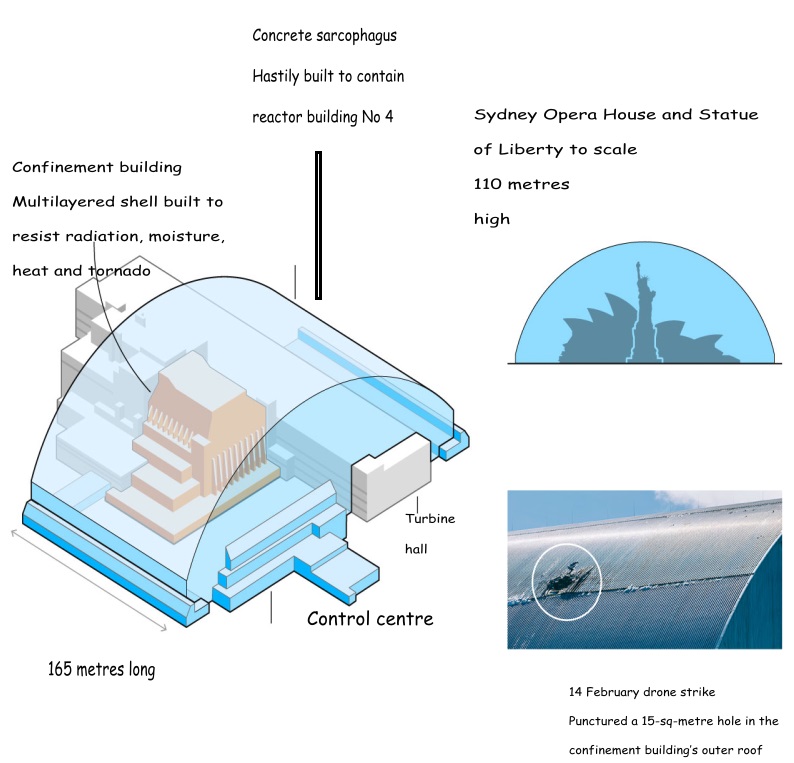
An agreement was signed with the EBRD for EUR30 million (USD35 million) of
funding for the initial phase of restoration work on the giant arch-shaped
New Safe Confinement shelter, which covers the initial shelter, which was
hastily built in 1986 and encases the wreckage of unit 4. The NSC was
damaged by a drone strike in February last year during the ongoing
Russia-Ukraine war, and assessments have put the cost of restoring it to
its full design function at about EUR500 million.
World Nuclear News 27th April 2026, https://www.world-nuclear-news.org/articles/funding-pledge-and-tributes-paid-at-conference-marking-chernobyl-anniversary
UK parliament’s AUKUS inquiry report questions if Britain can keep nuclear submarine promises.

By Riley Stuart and Europe correspondent Elias Clure in London, Tue 28 Apr, 26, https://www.abc.net.au/news/2026-04-28/aukus-report-released-by-house-of-commons-defence-committee/106613750
In short:
The House of Commons Defence Committee has released its report on the AUKUS defence pact after launching an inquiry last year.
While the report was broadly supportive of AUKUS, it also “laid bare the scale of the endeavour that will be required to deliver it”.
What’s next?
There have been calls to hold a public inquiry into AUKUS in Australia too, although right now one has not been announced.
British politicians have cast doubt on their country’s ability to develop and deliver nuclear submarines promised as part of the AUKUS defence pact.
The House of Commons Defence Committee on Tuesday released the findings of its year-long review into the trilateral partnership.
While the report was broadly supportive of AUKUS, it also “laid bare the scale of the endeavour that will be required to deliver it”.
As part of the deal, the United Kingdom and Australia are working together to design and build a new class of nuclear-powered attack submarine, known as SSN-AUKUS, scheduled to enter service in the late 2030s and the early 2040s.
“For the UK, delivering SSN-AUKUS will be a lengthy and complex undertaking requiring a sustained financial commitment from government across several electoral cycles,” the report noted.
“It is deeply concerning that there are signs that the investment pipeline that underpins that commitment has already faltered.”
The report urged the UK government to devote more money to the partnership.
“Shortfalls or delays in funding risk a failure to deliver SSN-AUKUS on time, with potentially severe consequences for UK and wider Euro-Atlantic security, and our standing with our trilateral partners,” it read.
While the White House has reiterated its commitment to the partnership, and Australia has already given the United States $US500 million ($798 million) to try to reinvigorate the country’s shipbuilding industry, critics contend the AUKUS deal’s fine print means nothing is guaranteed.
Australia is expected to invest a total of $US3 billion in US submarine manufacturing capabilities as part of the deal.
It has been estimated AUKUS could cost Australia about $368 billion by the mid-2050s.
“For Australia, AUKUS is an unprecedented undertaking to be delivered to ambitious timescales,” the House of Commons report noted.
“The UK will need to work closely with Australia at both industry and government level to share expertise and support Australia in meeting its own milestones.”
Trump ‘an unreliable ally’, submission says
US President Donald Trump has expressed his support for the trilateral pact, but the House of Commons inquiry received submissions saying the president’s “America First” approach to foreign policy, Russia’s full-scale invasion of Ukraine, and other geopolitical factors “had undermined the case for AUKUS and its chances of successful delivery”.
The Australian Peace and Security Forum — a not-for-profit that has been calling for a public inquiry into AUKUS to be held in Australia — gave a written submission to the inquiry in which it contended the US under Mr Trump was “an unreliable ally”.
The group also claimed that “geopolitical circumstances have changed for both the UK and Australia since AUKUS was conceived in 2021”.
“Strategic priorities for both countries do not align,” the submission read, adding “the UK should not proceed with AUKUS if it cannot guarantee delivery of its commitments on time and on budget”.
But the inquiry also heard from the UK’s minister for defence readiness, Luke Pollard, who said the changing geopolitical context and increasing threats meant “the importance of making sure that AUKUS delivers is even more prominent than it was when the original initiative was launched all those years ago”.
The House of Commons report highlighted difficulties in staff movement between the AUKUS partner countries due to the security clearances required to work in the defence sector.
A consultancy company involved in AUKUS told the inquiry that moving employees between its UK and Australian businesses was a “time-consuming and administratively burdensome” process.
While AUKUS enjoys significant support from both major political parties in Australia, the deal has also attracted criticism, notably from former prime ministers Malcolm Turnbull and Paul Keating.
Tan Dhesi, the Labour MP for Slough and chair of the House of Commons Defence Committee, told the ABC the inquiry was designed to review the UK government’s progress with regard to AUKUS.
“Many of us had concerns that things were perhaps not progressing at the pace they should be, but we wanted to gain expert advice as well as evidence,” he said.
Mr Dhesi said as part of the inquiry, representatives of the defence committee visited locations in the UK, US and Australia.
“Our key recommendation is that the UK government needs to do much more and it needs to do it faster in order to reap the full benefits of this once-in-a-generation, long-term strategic partnership with Australia and the US,” he said.
Links to Full Report –
https://committees.parliament.uk/work/9068/aukus/publications/ and https://committees.parliament.uk/publications/52831/documents/294641/default/
Adi Roche: My nightmare is that the next Chernobyl event occurs at Chernobyl itself
There may be an impression 40 years on that Chernobyl is something which happened a very long time ago and no longer poses a threat to the world, but the reality is very different. Chernobyl is not something from the past – Chernobyl is forever. The impact of that single nuclear incident can never be undone; its radioactive footprint is still affecting countless millions of people.
For the first time in history, nuclear facilities have been weaponised in active warfare. This is not Cold War rhetoric – it is a new and terrifying reality. If we remain silent, we are playing with a loaded gun.
.
There may be a view that the nuclear disaster is an event from long ago and no longer poses a threat, but the reality is very different
Adi Roche, Sat Apr 25 2026 – https://www.irishtimes.com/opinion/2026/04/25/adi-roche-my-worst-nightmare-is-that-the-next-chornobyl-could-be-chornobyl-itself/
At exactly 01:23 on the morning of April 26th, 1986, a chain of events in Reactor No 4 at Chernobyl nuclear power station in Ukraine triggered the world’s worst nuclear disaster.
The first of the explosions blew a 1,000-ton roof off reactor No 4 as though it was the lid of a saucepan, and a second, bigger explosion disintegrated the reactor core, rocketing tons of deadly radioactive material high into the night sky like a blazing meteor.Only 3 per cent of the reactor’s nuclear fuel escaped in the first catastrophic moments. Up to 200 tons of uranium dioxide fuel remains buried in the broken heart of reactor 4.
In that instant, the world changed forever.
A new word, Chernobyl, entered into the history of world disasters and the history of the world with deadly and frightful force. The sun shone, the wind blew, rain fell – and so did the deadly radioactive poison with it.
A nuclear catastrophe does not conclude when the cameras leave. It seeps into the soil, the water, the food chain, and embeds itself in the DNA of all living things. It passes silently from one generation to the next, creating what has become commonly known as “Chernobyl lineage”, as the damage and devastation leans into the next generation.
For four decades, I have walked beside the victims of this tragedy. I have held children whose tiny thyroid glands were attacked by poisonous radioactive iodine 131, as their small bodies mistook it for naturally occurring safe iodine. I have listened to some of “liquidators” – the 800,000 young men, including many conscripted, who were sent into the convulsing fires of hell with shovels and bare hands to contain the inferno – describe running across radioactive rooftops for 60 seconds at a time, knowing that every second shortened their lives. We missed a far greater nuclear explosion at Chernobyl by a hair’s breadth because of these brave men. Without the intervention by the liquidators, there would have been even further widespread contamination and radioactivity on a global level.
“To those who saved the world” are the words on the monument to the liquidators at the site in Chernobyl. Hailed as heroes in 1986, they are now discarded and forgotten, their ill-health dismissed by the authorities as being unrelated to their exposure to extraordinary levels of radiation and the lack of adequate safety precautions. Many of them paid with their health and their lives. Today, too many of them battle for pensions and medical care while their suffering is dismissed or minimised. Their self-sacrifice cannot be overstated.
There may be an impression 40 years on that Chernobyl is something which happened a very long time ago and no longer poses a threat to the world, but the reality is very different. Chernobyl is not something from the past – Chernobyl is forever. The impact of that single nuclear incident can never be undone; its radioactive footprint is still affecting countless millions of people.
It is impossible to say whether we are over the peak of the consequences of radioactive contamination, or whether we are just on the threshold. The consequences will last for up to 20,000 years. Other disasters are vying for the world’s attention while Chernobyl has been relegated to history, even though the latency period for some cancers is estimated to be up to 60 years – so the worst could yet be to come.
The ghost of Chernobyl was dragged back into headlines on February 24th, 2022, as Russian troops drove tanks through the Chernobyl Exclusion Zone on their way to Kyiv. Places such as Chernobyl’s Red Forest, regarded as among the most radioactive landscapes on Earth, became a military corridor, and deeply radioactive soil that had lain undisturbed for decades was churned up again. Radiation does not need a passport. It does not respect boundaries or borders, travelling wherever the wind takes it. Soon after, Russian forces occupied Europe’s largest nuclear plant in Zaporizhzhia. For the first time in history, nuclear facilities have been weaponised in active warfare. This is not Cold War rhetoric – it is a new and terrifying reality. If we remain silent, we are playing with a loaded gun.
‘We must call for nuclear facilities to be declared permanent “no war zones” under international law. Attacks on nuclear sites must be treated unequivocally as war crimes’
Nuclear power plants were always considered globally “off-limits” because of their deadly catastrophic potential. The collision between warfare and nuclear energy has created a threat with consequences not just for Ukraine, but for Europe and the world and all the generations yet unborn. This weaponising of nuclear facilities has resulted in a collision between warfare and nuclear power, which is a whole new threat with potentially devastating, unimaginable consequences for humankind for centuries to come. This is nuclear terrorism.
The issues associated with Chernobyl have become even more urgent, particularly following the Valentine’s Day 2025 drone strikes on the nuclear power plant, further escalating the war. The impregnable sarcophagus that is meant to protect humanity from radiation is scarred and breached, heightening the risk of another nuclear catastrophe and bringing with it a sense of foreboding for wars of the future.My worst nightmare in this conflict is that the tragedy of a second Chernobyl would be unleashed on the world. The next Chernobyl-type event could happen at Chernobyl itself.
Ireland knows something about solidarity. Compassion became our calling card and is the heartbeat of our society.
That is needed now more than ever. The Irish proverb “Ar scáth a chéile a mhaireann na daoine” hasnever been more apt.
We must call for nuclear facilities to be declared permanent “no war zones” under international law. Attacks on nuclear sites must be treated unequivocally as war crimes.
The “war” that has been waged by what happened at Chernobyl is a silent, invisible but deadly one. No associated smells, no visible signs – nothing to forewarn you of danger.
Deadly radiation flows in rivers, towns, streams and forests. It clicks endlessly, ferociously, in Geiger counters, into the silent numbness that is, and sadly always will be, Chernobyl
If we fail to learn from Chernobyl, we betray those who died and those who still suffer. If we fail to act, we risk repeating the unthinkable. Chernobyl is not history, it is a warning. We cannot, will not, turn away.
Adi Roche is the founder and voluntary chief executive of Chernobyl Children International
EU economic sanctions ramp up NATO war plan on Russia
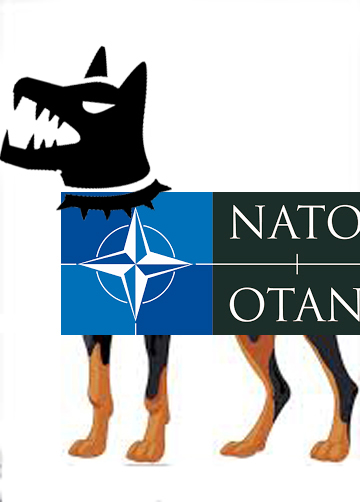
Two-thirds of the EU loan – some €60 bn – is reportedly allocated for military aid. Ursula von der Leyen, the European Commission president, said that the first tranche worth €45 bn will be transferred to Ukraine within weeks and that it would be used to increase the production of aerial combat drones
Strategic Culture Foundation, 24 April 2026, https://strategic-culture.su/news/2026/04/24/eu-economic-sanctions-ramp-up-nato-war-plan-on-russia/
The European Union announced its 20th round of economic sanctions against Russia this week. The bloc of 27 nations began imposing sanctions on Moscow when the conflict in Ukraine erupted in February 2022. Every six months, the EU has been extending these economic measures, which Brussels claims is support for Ukraine to “deter Russian aggression.”
The 20th round of sanctions unveiled this week attempts to go much further in inflicting damage on the Russian economy. It was flagged as the biggeset package yet and a “multi-layered targeting of key sectors” of the Russian economy, primarily its energy industry.
It is tempting to dismiss the EU sanctions policy as feeble and a form of insanity. The bloc keeps repeating an action expecting a different result each time, when the record shows that the action of sanctions is having little detrimental impact on Russia. If anything, it is the EU that has suffered an economic downturn as it unilaterally cut itself off from Russian oil and gas, the traditional source of affordable energy feedstock for European industries. Russia’s economy has not crashed as was anticipated when the sanctions were first imposed more than four years ago. In fact, the Russian Federation has maintained a robust economic performance as it finds alternative markets in Asia for its oil and gas products. The soaring price for a barrel of crude due to the reckless U.S.-Israeli aggression on Iran has given Russia a further boost.
However, it would be a mistake to simply brush off the EU sanctions as futile and self-defeating.
There is a more blatant and sinister aspect to the new round of sanctions. Brussels is nakedly showing its war agenda. The new measures aim to restrict all sectors of Russian energy production, including “exploration, extraction, refining and transportation.” The EU is endeavoring to tighten restrictions on “third countries” to prevent Russia from circumventing existing embargoes on shipping, port access and trade. Whether these new measures achieve their objective of “crippling the Russian economy” is debatable. But it is the belligerent intention – stated now with more determination – that is significant. The EU is brazenly laying out a plan to strangle Russia in conjunction with upping the military threat.
It is the accompanying developments that are ominous and which give full meaning to the economic measures.
This week the EU hailed that its €90 billion ($105 bn) loan to Ukraine had finally been approved. That financial aid was blocked by Hungary since December. But with the recent election loss for Viktor Orbán’s government, Budapest’s veto has been lifted under the new prime minister, Péter Magyar. EU leaders were ecstatic that the financial transfer to Ukraine can now go ahead.
Two-thirds of the EU loan – some €60 bn – is reportedly allocated for military aid. Ursula von der Leyen, the European Commission president, said that the first tranche worth €45 bn will be transferred to Ukraine within weeks and that it would be used to increase the production of aerial combat drones. “Drones from Ukraine for Ukraine,” she said by way of trying to give the impression that the EU is not a party to the war.
An EU leaders’ two-day summit held in Cyprus on April 24-25 was reported with celebratory mood. Von der Leyen and European Council President Antonio Costa, along with the EU’s Foreign Affairs Commissioner, Kaja Kallas, were cock-a-hoop at the “breakthrough” of releasing the largest single financial package to Ukraine so far in combination with the new economic sanctions aimed at drilling down on Russia’s economic core. Attending the summit in Cyprus was Ukraine’s nominal president, Vladimir Zelensky, who reportedly joined the EU leaders for dinner to discuss new developments.
It gets even more sinister. The Kiev regime has been stepping up deep air strikes on Russian energy and other industrial infrastructure. There is no doubt the regime is being assisted with NATO expertise in finding such wide-ranging targets in Russia’s vast territory. This week, for example, a drone strike hit an industrial facility in Novokuybyshevsk in the central Samara region, nearly 900 kilometers southeast of Moscow and nearly 2,000 kms from the warzone in Donbass.
Clearly, the EU’s economic strikes are designed to reinforce the damage that NATO is trying to inflict with drones and missiles on Russia’s industrial base. These are not separate initiatives but an integral war strategy.
In announcing the latest round of sanctions Kaja Kallas could hardly contain her Russophobic glee. “Today we have broken the deadlock. On top of the €90-billion loan for Ukraine, we have adopted the 20th sanctions package,” she said.
Deceptively, the sanctions were billed as “increasing pressure on Russia to stop its brutal war of aggression and engage in meaningful negotiations towards a just and last peace.”
That’s a cynical con – a con that is betrayed by the EU’s own stated objective of “crippling” the Russian economy. How can one have a “just and lasting peace” by crippling a country?
The real purpose of the funds that EU citizens will have to pay through decades of indebtedness is to escalate NATO’s war in Ukraine against Russia. The economic sanctions are war measures aimed at maximising the impact of military attacks.
Other developments this week raise the stakes to even more sinister levels.
French President Emmanuel Macron and Poland’s Prime Minister Donald Tusk discussed joint nuclear weapons “scenarios” in a bilateral summit in Gdansk. The French leader wants to share his country’s nuclear weapons capabilities with other European countries. It is reported that French and Polish warplanes will begin joint exercises on flying nuclear weapons in the Baltic region. This is evidently meant as a threat to Russia. It amounts to Paris and Warsaw carrying out training exerises for nuclear strikes on Russia.
In yet another provocative development, it is reported that Britain is leading a NATO Joint Expeditionary Force to formulate a naval plan to blockade the Russian enclave of Kaliningrad located between Poland and Lithuania. Kaliningrad provides Russia with vital port access to the Baltic Sea.
The European NATO leaders are concerned that U.S. President Donald Trump has lost interest in the “Ukraine project” against Russia owing to his reckless war with Iran. That is why they are ramping up the war effort against Russia while telling barefaced lies about wanting to achieve “lasting peace.”
So far, the EU’s economic sanctions against Russia have been an abject failure. But the failure of economic measures is no longer the point. It is what they reveal about an intensifying NATO war plan against Russia.
Moscow has repeatedly called for a negotiated end to the conflict while the EU and NATO accuse Russian leader Vladimir Putin of “not wanting peace.”
People can make their own minds up about who the aggressors are. NATO is at war with Russia and is not interested in negotiations. Criminally, the NATO aggressors are creating a boiling frog situation for Russia. The European russophobic leaders seem to want war at any cost.
1 This Month



26 September – International Day for the Total Elimination of Nuclear Weapons


PLEASE OPPOSE HR 8255 AND S.3639 – bills would accelerate satellite deployment, with no environmental review or safeguards – https://ncstd5li.quorum.us/campaign/169331/
To see nuclear-related stories in greater depth and intensity – go to https://nuclearinformation.wordpress.com
-
Archives
- September 2026 (219)
- August 2026 (330)
- July 2026 (355)
- June 2026 (287)
- May 2026 (306)
- April 2026 (356)
- March 2026 (251)
- February 2026 (267)
- January 2026 (308)
- December 2025 (358)
- November 2025 (359)
- October 2025 (375)
-
Categories
- 1
- 1 NUCLEAR ISSUES
- business and costs
- climate change
- culture and arts
- ENERGY
- environment
- health
- history
- indigenous issues
- Legal
- marketing of nuclear
- media
- opposition to nuclear
- PERSONAL STORIES
- politics
- politics international
- Religion and ethics
- safety
- secrets,lies and civil liberties
- spinbuster
- technology
- Uranium
- wastes
- weapons and war
- Women
- 2 WORLD
- ACTION
- AFRICA
- Atrocities
- AUSTRALIA
- Christina's notes
- Christina's themes
- culture and arts
- Events
- Fuk 2022
- Fuk 2023
- Fukushima 2017
- Fukushima 2018
- fukushima 2019
- Fukushima 2020
- Fukushima 2021
- general
- global warming
- Humour (God we need it)
- Nuclear
- RARE EARTHS
- Reference
- resources – print
- Resources -audiovicual
- Weekly Newsletter
- World
- World Nuclear
- YouTube
-
RSS
Entries RSS
Comments RSS
 nuclear-news