EDF ordered to inspect 200 nuclear pipe weldings after more cracks discovered

By America Hernandez and Forrest Crellin, 10 Mar. https://www.reuters.com/business/energy/edf-ordered-inspect-200-nuclear-pipe-weldings-after-more-cracks-discovered-2023-03-10/
PARIS, March 10 (Reuters) – France’s nuclear safety watchdog ASN has ordered energy utility EDF (EDF.PA) to inspect about 200 pipe weldings across its 56-nuclear reactor fleet after discovering three additional cracks this week, the regulator said on Friday.
In addition to a major corrosion-related crack on the Penly 1 reactor in Normandy revealed on Tuesday, which the watchdog attributed to faulty welding, two fissures on EDF’s Penly 2 reactor and the Cattenom 3 reactor in Moselle were disclosed on Thursday.
An EDF spokesperson declined to comment on ASN’s criticism, but said the two newer cracks were due to “thermal fatigue”, which happens when very hot and cold water meet inside pipes, causing the steel to dilate, contract and become more fragile over time.
EDF regularly inspects pipes via ultrasound for this phenomenon during maintenance, the spokesperson added.
The latest defects and watchdog scrutiny come as France and the Britain announced a new energy partnership on Friday to strengthen cooperation on nuclear power, including construction of power stations, innovation and safety.
Neither French President Emmanuel Macron nor British Prime Minister Rishi Sunak mentioned the nuclear operator’s latest setbacks after a bilateral summit.
“You are helping us secure our supply of nuclear power thanks to EDF’s incredible work,” Sunak told Macron.
EDF is building a new nuclear plant in Britain, Sizewell C, which has suffered from cost overruns and construction delays. A second plant, Hinkley Point C, is also in the works.
The utility’s Penly 2 and Cattenom 3 in France are part of a group of 16 reactors flagged by EDF as being susceptible to corrosion-related cracks due to a design flaw, and prioritised for checks in its inspection and maintenance plan.
That plan is now being updated to accommodate the additional check of 200 weldings, and will be published “in coming days”, EDF has said.
European forward-curve power prices rose sharply on Friday following the announcement of new cracks, after French nuclear output in 2022 fell to a 34-year low while EDF scrambled to fix stress corrosion issues at several sites.
“Some market participants may be worried that the issues with corrosion are trickier than first anticipated, and that EDF will struggle both long- and short-term to fix it and bring generation back to pre-2022 levels,” Rystad analyst Fabian Ronningen said.
“Thermal fatigue” is causing flaws in the cooling pipes of France’s nuclear reactors

Electricite de France SA discovered new defects at two of its nuclear
reactors that were halted for maintenance and repairs, raising fresh
concerns that its electricity output will remain largely constrained this
year after plunging in 2022.
Flaws tied to so-called thermal fatigue have
been found on the pipes of the Penly-2 and Cattenom-3 reactors, the utility
said in a statement. The pipes have been replaced as part of broader
repairs related to “stress corrosion” cracks — a different type of
faults — that are affecting emergency cooling pipes of some of the EDF’s
atomic plants, according to the nuclear safety authority.
The nuclear giant has been forced to halt more than a dozen of its 56 reactors for months of repairs since it first found signs of such stress corrosion phenomenon in
late 2021. The announcement comes just days after the country’s nuclear
safety authority asked EDF to revise its program of reactor checks
following the utility’s discovery of a “significant” stress corrosion
crack earlier this year on its Penly-1 reactor. EDF said it will propose an
update of its reactor check strategy to the watchdog in the coming days.
The fresh setbacks could force EDF to carry out more extensive checks on
its atomic plants, reviving concern that France will have to import large
amounts of power this year. Last year, worries about electricity shortages
combined with dwindling deliveries of Russian gas pushed European energy
prices to records.
Bloomberg 10th March 2023
https://www.bnnbloomberg.ca/edf-finds-new-flaws-at-2-reactors-stoking-power-supply-woes-1.1893577
British government poised to label nuclear as “green”, but investors are not impressed
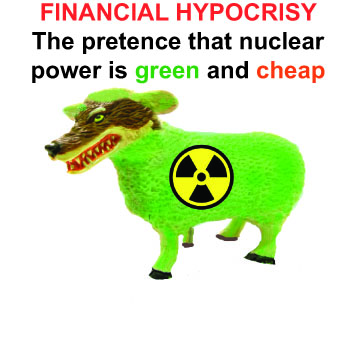
The British government is poised to redefine nuclear power as “green”
as it seeks to drum up more private investment in the sector to improve
domestic energy resilience. Ministers are set to consult on proposals to
change the so-called “taxonomy” — or financial classification system
— of energy in order to redefine nuclear projects as sustainable
investments. It is expected to lead to a reversal of the decision by the
Treasury as recently as 2021 to exclude nuclear power from the so-called
green investment framework.
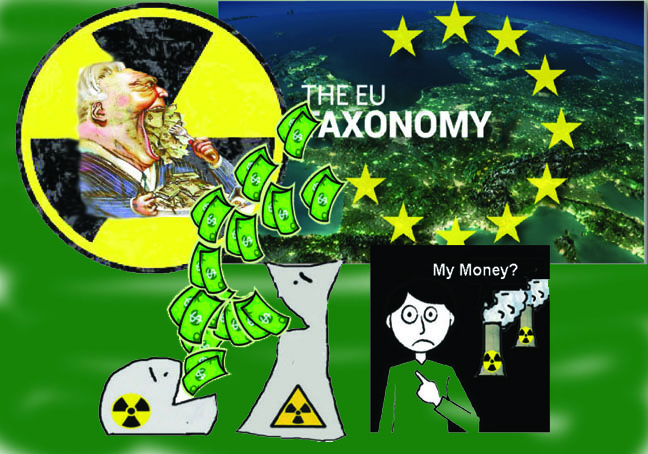
The move echoes a decision last year by the
European Commission to label both nuclear and some forms of gas as
“green” investments, which prompted legal challenges from Greenpeace
and a coalition of WWF and Client Earth.

The consultation comes as thegovernment is set to provide about £80mn
in seed funding for the launch ofGreat British Nuclear, a new body which will
oversee plans to build a new
generation of nuclear power stations in the UK, according to two people
familiar with the negotiations. Ministers are anxious to accelerate the
programme which has been dogged by delays and cost overruns on the only new
nuclear plant under construction at Hinkley Point in Somerset. The
government, together with French state-backed utility EDF, are trying to
raise £20bn in private finance for the next power station at Sizewell in
Suffolk.

But investors have shown little interest in backing greenfield
nuclear projects, because of the construction risks in the highly
regulated, safety- critical sector. All new nuclear projects across Europe
have been hit by delays and big cost overruns.
Nick Stansbury, head of
climate solutions at Legal and General Investment Management, warned that
the changes to the taxonomy were unlikely to drive investment. Ministers
will also update their strategy for reaching net zero by 2050 after a judge
ruled last July that the original document provided insufficient detail and
gave the government a deadline to rewrite it by the end of this month. The
energy department refused to comment.
FT 9th March 2023
https://www.ft.com/content/2bef8242-d04b-47b9-84f8-b301692ea2f4
Britain’s “Regulated Asset Base” funding method for nuclear power is deemed not likely to work

National Infrastructure Commission model spells trouble for nuclear RAB
funding. Dr Jim Cuthbert questions whether the government’s funding method
for its nuclear power programme provides value for money, given it now
expects the plants to take nearly twice as long to build.
A major part of
the government’s energy strategy is a programme of eight new nuclear power
stations, to be funded by the Regulatory Asset Base (RAB) funding method.
One of the main features of RAB is that it involves consumers paying from
the start of construction for benefits they will only begin to receive when
construction is completed, and the plant is producing electricity.
One of
the key questions that should be answered in assessing whether a RAB-funded
project should go ahead is whether the eventual benefit consumers could
receive, in this case through cheaper electricity charges in the long run,
is enough to compensate them for the opportunity cost of the payments made
while receiving no benefit.
Given the long construction periods now
anticipated for new nuclear plants, it is unlikely that RAB financing will
be able to attain a sufficient cost advantage to do so. In 2019, the
National Infrastructure Commission (NIC) produced a paper on the
application of the RAB approach to nuclear energy, illustrating a
methodology including an approach to answering the above key question.
The NIC paper set out the results of illustrative calculations of the impact of
a range of factors on the likely value for money of RAB projects.
Unfortunately, it is something of a mixed bag. On the negative side, the
results in the paper are not presented in a way that allows the impact of
different factors to be separately identified: and, critically, the NIC
makes a central assumption about the likely length of the construction
period for new nuclear projects only about half of what the government now
assumes. On the plus side, having clarified with the NIC what methodology
it was using in the opportunity cost component of their model, their basic
approach seems sensible.
Although not clear from the original NIC paper,
the length of the construction period has a critical effect on the likely
value for money of a RAB-funded nuclear project. If the NIC’s basic model
is applied to a project with the government’s current assumption of a
13-to-17-year-long construction period, instead of the NIC’s central
assumption of eight years, then RAB nuclear is unlikely to achieve a
sufficient cost advantage over alternative approaches to compensate
consumers for the opportunity cost of their initial payments.
Public Finance 9th March 2023
Low-dose radiation linked to increased lifetime risk of heart disease

by British Medical Journal, https://medicalxpress.com/news/2023-03-low-dose-linked-lifetime-heart-disease.html 8 March 23,
Exposure to low doses of ionizing radiation is associated with a modestly increased excess risk of heart disease, finds an analysis of the latest evidence published by The BMJ today.
The researchers say these findings “have implications for patients who undergo radiation exposure as part of their medical care, as well as policy makers involved in managing radiation risks to radiation workers and the public.”
A linked editorial suggests that these risks “should now be carefully considered in protection against radiation in medicine and elsewhere.”
It’s well recognized that exposure to high dose radiation can damage the heart, but firm evidence linking low dose radiation to heart disease (e.g., scatter radiation dose from radiotherapy or working in the nuclear industry) is less clear.
To address this knowledge gap, an international team of researchers examined scientific databases for studies evaluating links between a range of cardiovascular diseases and exposure to radiation (mostly radiotherapy and occupational exposures).
They excluded uninformative datasets or those largely duplicating others, leaving 93 studies, published mainly during the past decade, suitable for analysis. These studies covered a broad range of doses, brief and prolonged exposures, and evaluated frequency (incidence) and mortality of various types of vascular diseases.
After taking account of other important factors, such as age at exposure, the researchers found consistent evidence for a dose dependent increase in cardiovascular risks across a broad range of radiation doses.
For example, the relative risk per gray (Gy) increased for all cardiovascular disease and for specific types of cardiovascular disease, and there was a higher relative risk per dose unit at lower dose ranges (less than 0.1 Gy), and also for lower dose rates (multiple exposures over hours to years).
At a population level, excess absolute risks ranged from 2.33% per Gy for a current England and Wales population to 3.66% per Gy for Germany, largely reflecting the underlying rates of cardiovascular disease mortality in these populations.
This equates to a modest but significantly increased excess lifetime risk of 2.3-3.9 cardiovascular deaths per 100 persons exposed to one Gy of radiation, explain the authors.
Substantial variation was found between studies, although this was markedly reduced when the authors restricted their analysis to higher quality studies or to those at moderate doses (less than 0.5 Gy) or low dose rates (less than 5 mGy/h).
The authors suggest that mechanisms for these cardiovascular effects are poorly understood, even at high dose.
They also acknowledge that few studies assessed the possible modifying effects of lifestyle and medical risk factors on radiation risk, particularly major modifiable risk factors for cardiovascular disease like smoking, obesity, diabetes, high blood pressure and high cholesterol, and say further research is needed in this area.
In conclusion, they say their findings support an association between acute high dose and (to a lesser extent) chronic low dose radiation exposure and most types of cardiovascular disease and suggest that “radiation detriment might have been significantly underestimated, implying that radiation protection and optimization at low doses should be rethought.”
This view is supported by Professor Anssi Auvinen at Tampere University in Finland in a linked editorial, who points out that while inconsistencies and gaps remain in the evidence linking vascular disease to low dose radiation exposure, “evidence for cardiovascular disease will soon need to be added to the existing list of radiation-induced health risks.”
This will involve revisiting concepts and standards in radiological protection, while more stringent standards for justification and optimization, especially for high dose procedures, will have to be considered, he explains.
Their implementation will also require training to improve awareness, knowledge, and understanding of the risks associated with specific procedures and cumulative exposure, as well as risk communication for patients and the public, he concludes.
Fake ‘nuclear bomb’ alert on TV and radio scares Russians
Moscow viewers and radio listeners spooked by fake warning
Hackers took over Russian state media on Thursday to tell listeners to rush to nuclear bomb shelters and take anti-radiation pills.
Radio and television broadcasts in Moscow and the western Sverdlovsk area were interrupted with a phony warning of a missile strike on the country.
The Kremlin blamed the false alarm, which told listeners to take potassium iodine, put on gas masks and seek shelter, on a cyber attack.
“Urgent message. There was a strike,” a Russian voice boomed, while television viewers were presented with a map of Russia being covered in red.
“Urgently go to a shelter,” the voice declared. “Seal the premises. Use gas masks of all types.”
The Telegraph reported that after the message was broadcast, screens displayed a black and yellow radiation warning symbol.
“A false air raid alert was broadcast in Moscow after servers of radio stations and TV channels were hacked,” said the Kremlin’s emergency ministry.
There has been no claim of responsibility for the latest cyber attack with it possibly originating from Ukraine dissidents or potentially Russian
It was the third time in the past month that Russian broadcasters have been targeted. Last month a false warning was released in the Crimea urging caution against an incoming missile attack. For this event, Ukraine was blamed. A similar broadcast was run a week later during Vladimir Putin’s state of the union address.
Ukraine has not taken responsibility for any of the alleged cyber attacks………………………. https://www.independent.co.uk/news/world/europe/fake-nuclear-bomb-alert-russia-television-b2298070.html
Nuclear reactor: a deep crack discovered at Penly 1 risks destabilizing EDF
Nuclear reactor: a deep crack discovered at Penly 1 risks destabilizing
EDF. A new “stress corrosion” problem found by the the company on a
shutdown reactor in Seine-Maritime could have significant repercussions,
due to its size and location.
The discovery could have serious consequences
for EDF. The company detected a major crack on a weld of an emergency
circuit of a shutdown reactor, Penly 1, in Seine-Maritime, a new problem
for the energy giant whose nuclear fleet is heavily disturbed since 2021 by
these phenomena.
In a note, which went unnoticed until its media coverage
on Tuesday by the Context site , EDF mentioned having detected a
“significant stress corrosion defect” on an emergency pipe used to cool
the reactor in an emergency. For Yves Marignac, ” the fact that larger
cracks are possible raises the question of keeping the 6 reactors of the
same type P’4″ in operation while awaiting their preventive repair” ,
announced in December by EDF for the current year 2023.
Liberation 8th March 2023
The narrow field of options for safely managing Ukraine’s Zaporizhzhia Nuclear Power Plant
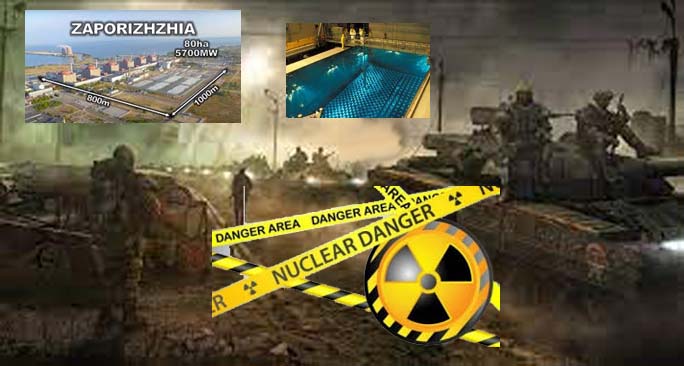
By Mark Hibbs | March 10, 2023 Bulletin of the Atomic Scientists,
One year after Russia’s assault and takeover of the Zaporizhzhia plant, Russians and Ukrainians face decisions about the operation status of the six reactors that will significantly impact nuclear safety and security. Decision makers might mothball the reactors, or instead elect one or more of a range of modes for operating them, on a scale from cold shutdown to resumed criticality and low-power operation…………………………………………………………………………………………..
the safest option for the Zaporizhzhia nuclear power plant would be to shut all reactors down, depressurize the circuits, and remove their fuel until the end of the war. As an IAEA peer reviewer in one European country with similar reactors said: “There would be no heat, no pressure, no radioactivity, and no severe accident.”
But the plant’s fuel inventory is another key consideration in decisions about how or if the Zaporizhzhia reactors are to be run. If removed from reactor cores, hot, highly radioactive fuel must be safely stored and contained.
Ukraine regulations require that the spent fuel storage pool at each reactor accommodate a full core of fuel in an emergency. As part of EU post-Fukushima upgrades, Zaporizhzhia reactors were outfitted with portable equipment to supply water in an emergency to spent fuel pools and to reactor cores. But moving a core of fuel into a pool would significantly increase the heat load, and safe storage margins might be limited following previous re-racking to pack more fuel in the pools.
Safety authorities may ultimately decide that the fuel would be better protected if left in the reactors, since they were designed to protect and cool the fuel including in an emergency. Separately, the owner/operator may not want to undertake prolonged outages of de-fueled reactors in the interest of limiting restart authorization requirements………………………………… https://thebulletin.org/2023/03/the-narrow-field-of-options-for-safely-managing-ukraines-zaporizhzhia-nuclear-power-plant/
How the nuclear lobby scuttled the EU’s anti-greenwashing tool
Succumbing to member states’ pressure and giving nuclear energy a “sustainable” label in a key regulation could derail the EU’s climate progress.
Aljazeera, Christiana Mauro, Senior advisor at the Biosphere Institute , Kacper Szulecki, Research professor in climate governance, 8 Mar 23,
One year ago, hopes were high for what was considered to be the most important environmental legislation in Europe. The European Union’s taxonomy regulation was meant to become the global “gold standard” for science-based policy that directs investment towards climate-friendly goals.
Their argument is that the “sustainable” label given to nuclear energy and natural gas breaches the EU’s climate commitments, violates EU environmental law and is incompatible with the “do no significant harm” criteria of the taxonomy regulation itself. The EC refused to revoke the act leading the complainants to launch a lawsuit at the European Court of Justice.
As we await the court’s decision, it is important to recall how this legislation was undermined by the nuclear lobby and what the consequences will be if it is not struck down
………………………………………………………………the EU taxonomy regulation ….. was supposed to be a list of scientifically-based technical criteria to set apart economic activities that are genuinely sustainable from those that are harming the environment.
It defined environmentally sustainable activities as contributing substantially to specific environmental objectives that will speed up the decarbonisation of the economy, comply with safeguards and “do no significant harm” to the environment.
Nuclear energy and natural gas initially failed to meet the taxonomy criteria. Of course, that went against big interests in the energy sector and predictably a lobbying blitz was launched to reverse this decision.

A report by Reclaim Finance, an NGO which scrutinises the impacts of financial actors on climate, revealed a lobbying campaign worth millions of euros was initiated to amend the regulation in favour of the natural gas and nuclear industries.
Lobbyists met frequently with EU representatives during critical phases of the deliberations over the taxonomy. Russia, which would have been a major financial and geopolitical beneficiary of the financial incentives that would ensue from the inclusion of gas and nuclear, was an extremely active “stakeholder” during the entire legislative process.
But there were also EU countries which sought to put pressure on the European Commission to change the regulation’s provisions. At the forefront of that effort were Poland, France, the Czech Republic, Hungary, Romania, Slovakia and Slovenia, whose leaders wrote a joint letter arguing for the inclusion of nuclear power in the regulation.
The document used various common claims and arguments in support of nuclear sustainability. We were part of a team of fact-checkers from four EU countries who determined that 20 statements in the letter were false or misleading.
Among them were assertions that nuclear power is “environmentally friendly”, “essential to the transition towards clean energy sources”, a “promising source of hydrogen” and “affordable”.
A full analysis of the letter can be found here.
Why nuclear energy is not green
Why nuclear energy is not green is perhaps less obvious to the general public than natural gas. This likely is due to efforts by governments – such as the seven mentioned above – and organisations to mislead it.
False narratives of “clean” nuclear are also peddled by intergovernmental organisations such as the International Atomic Energy Agency (IAEA), the OECD, and the UN Economic Commission for Europe (UNECE).

A common claim – which is also made in the letter to the EC – is that nuclear energy has a low carbon emission status. But if nuclear power can be said to produce lower carbon emissions, it is only true at the point of generation. When the entire life cycle of nuclear power plants is taken into consideration this contention crumbles.
Nuclear energy’s “upstream” activities that are necessary for operation, such as mining uranium, as well as transporting fuel, building and then decommissioning a power plant, and managing the radioactive waste that is a by-product of the process – are all linked to CO₂ emissions. Thus, the carbon footprint of nuclear energy generation is considerable, and according to some estimates, considerably higher than that of renewables.

Nuclear technology also needs significant amounts of cooling water and creates waste that is so toxic to the environment that no permanent storage solution has been developed for 70-odd years. It also represents a risk of seriously and permanently harming large swaths of territories in the case of an accident – which is now growing amid the current militarisation of civil nuclear facilities in Ukraine.
Posing an unmanageable danger to the environment, nuclear power falls short, even as a so-called “transitional activity”, defined in the regulation as an economic activity for which low-carbon alternatives are not available. This is because its financing today would derail the implementation of renewables by diverting investment away from them.
As Amory Lovins, a Stanford University professor and energy expert, says: “a low- or no-carbon energy source that costs more or takes longer to deploy will make climate change worse than one that is cheaper or faster, because the latter could have saved more carbon per euro and per year.”
Energy demand in Europe can easily be met by non-nuclear power sources, and considering the unreliability of nuclear power, with its ageing and deteriorating reactors, and vulnerability to extreme weather events, it is unlikely to have any energy contribution to make at all in the transition to renewables.
Even the most favourable calculations of the cost of nuclear energy show no advantage over renewable, which is seeing costs of deployment plummeting.
Government schemes keep consumer nuclear electricity prices artificially low. In fact, nuclear energy can only be made “competitive” with “hugely significant” government financing, as the EU Energy Commissioner inadvertently admitted in a recent speech. Hence, the seven governments’ letter also pleaded for “active support” for nuclear energy.
The profusion of nuclear delusions
There is a long history of attempts to link nuclear technology to overoptimistic technocratic environmental achievements that never materialise.
Media-hyped nuclear fiction abounds. For example, a recent fusion experiment in the US was touted as a major milestone in the search for an abundant source of clean energy. Predictably, it had a rather anticlimactic ending for anyone paying attention.
The energy generated in the experiment was significantly less than the amount needed to power the lasers involved in it. And the laboratory where the celebrated breakthrough took place was established to develop thermonuclear weapons, not civil nuclear energy projects, which explains its multibillion-dollar budget.
Such nuclear myths are usually debunked by independent experts whose critical voices are often buried beneath irresponsibly promoted fantasies. The morass of disinformation is meant in part to mask the industry’s own failures, but also the military interests of nuclear governments, by pushing unsupported theories to legitimise public funding. It is meant to confuse, demoralise and disable any organised effort to change things.
And the media, instead of challenging this intentional misleading of the public, has played a part in it. European media, for example, reported on the letter of the seven EU countries lobbying for nuclear to be included in the EU taxonomy regulation without checking the veracity of its claims.
Thus, a misinformed public and passive media have allowed political actors to influence regulations that are supposed to be politically neutral. Well-intentioned, vital, and comprehensive legislation, years in the making, has been subverted.
In its current form, this delegated act is likely to derail key 2030 and 2050 climate goals, and damage the Green Deal by influencing negatively green taxonomies being developed around the world. It will encourage greenwashing practices, redirect capital flows towards polluting sectors, and upset progress made on implementing the objectives of the Paris Agreement. https://www.aljazeera.com/opinions/2023/3/8/how-the-eus-most-promising-anti-greenwashing-tool-was-scuttled
Nuclear and space lobbies increase their grip on universities, a new example in UK

Bangor University in Wales will develop a nuclear thermal fuel system to
support deep space exploration with funding provided by the UK Space
Agency. It is one of eight projects receiving a total of GBP1.6 million
(USD1.9 million) in funding through the agency’s Enabling Space Exploration
fund.
World Nuclear News 7th March 2023
https://www.world-nuclear-news.org/Articles/Welsh-university-to-develop-space-nuclear-propulsi
Crack in piping of Penly nuclear reactor further complicates EDF’s situation.
Unlike the microcracks detected on other reactors (such as those of Chooz,
in the Ardennes, and Civaux, in Vienne, 1,450 MW, the most powerful and
most recent), the defect observed at Penly is described as particularly
important:
the ASN describes a crack extending over 155 millimeters (mm),
“that is approximately a quarter of the circumference of the piping”.
The nuclear policeman adds that its maximum depth is 23 mm, for a pipe
thickness of 27 mm.
Although the Penly 1 reactor had already been
identified as being among the most sensitive to the phenomenon of stress
corrosion, this portion of the circuit in particular was considered
“non-sensitive” by EDF, due to its geometry. The licensee, like ASN,
considers that the presence of corrosion could be explained by the double
repair to which the piping was subjected during the construction of the
reactor.
Time News 8th March 2023
Ukraine: A war to end all wars in Europe
BY M. K. BHADRAKUMAR, Indian Punchline,
The dash for the White House in Washington on Friday by German Chancellor Olaf Scholz remains a riddle wrapped in a mystery. Scholz landed in DC, drove to the White House and was received by President Biden in Oval Office for a conversation that lasted over an hour. No aides were present. And he flew back to Berlin.
Associated Press reported cryptically, “If any agreements were reached or plans made, the White House wasn’t saying.”……………………………………………..
Scholz’s dash to the Oval Office came at a defining moment in the Ukraine conflict. Russia has seized the initiative in the Donbass campaign and its spring offensive may start in the coming weeks. Ukraine’s military took heavy battering and the country depends almost entirely on western financial handouts and military aid for survival.
Most important, Kiev’s western backers are no longer sure of its ability to reclaim all the territory under Russian control — roughly, one-fifth of erstwhile Ukraine. An inchoate belief is also gaining ground in the western mind, behind all rhetoric, that the burden of the war effort is not going to be sustainable for long if the conflict extends into an indeterminate future.
Support for Ukraine is waning in the western public opinion. …………………………………………
the display of Western unity with Ukraine that Biden claims is wearing thin against a backdrop of strains within the trans-Atlantic alliance and a growing sense of despondency that the war has no end in sight.
……………………………………. What complicates matters further is an emerging divide in Europe over how to end the war. While Old Europeans, including Scholz, are urging peace talks now, the Russophobic East European and Baltic leaderships are clamouring for Russia’s defeat and a regime change in Moscow.
………………………………………………………. The good part is that the UK, France and Germany are in this together. Yet, the road ahead is long and winding. For Putin, the bottomline will be that no NATO membership for Ukraine and the ground realities must be heeded. But, fundamentally, peace talks would vindicate the raison d’être of Russia’s special military operation, which aimed to force the West to negotiate regarding NATO expansion. ………………. https://www.indianpunchline.com/ukraine-a-war-to-end-all-wars-in-europe/
Observations on the NATO-Russia Ukrainian War, No. 2
Russian and Eurasian Politics, by GORDONHAHN, March 8, 2023
The Russian Winter Offensive: Steamroller or Blitzkreig
Russia’s late winter offensive is under way. Seemingly unnoticeable, Russia’s forces in Donbass have been gaining steam over the last month and are now moving into high gear. The lack of visibility is relative. Expectations of a Nazi-like blitzkrieg have blinded eyes to the slowly moving steamroller that is now being unleashed. One need only compare a map of the disposition of Russian forces and the front along the Donbass front to see what is happening. [Maps supplied here on original]
In this two month period, Russian forces have taken Soledar and Bakhmut, while deterring a Ukrainian offensive in the north around Kupyansk and advancing on Kupyansk themselves. They have made gains in the battle around Serebranka Forest as well. Russian forces also deterred Ukrainian offensives in the south in Zaporozhe and Kherson. In the latter, Russian forces are inflicting heavily casualties in positional artillery battles across the Dnepr River and may force the Ukrainianians to abandon Kherson city. While advancing on Vugledar (Ugledar) in the southeast, however, their storm of the city failed, and they have been forced to step back and regroup. Ukrainian forces have been successful in blocking Russian advances on the Liman front as well as in Vugledar, inflicting higher numbers of Russian casualties than is usual.
The most important of Russian successes is the encirclement and the inevitable and imminent seizure of Bakhmut/Artyomevsk. There and in the battles surrounding Serebryanka Forest and Kherson in recent weeks, Ukrainian forces have been taking unprecedented casualties and equipment losses, far outstripping those suffered by the Russians.
As the Russian steamroller muscled forward to Bakhmut – a city Russians call ‘Artyomevsk’ – the former’s power was revealed in the preemptive propaganda campaign initiated in Ukraine and parts of the West asserting that Balhmut is of no strategic importance. The campaign revealed not only the propaganda value of any Russian seizure of Bakhmut would have for Moscow, reversing false image of ‘Ukraine is winning’ created by the propaganda victories for Kiev that the Russian withdrawals from – not routs at the hands of Ukrainian forces as the West/Ukraine propaganda claimed or implied – Kharkov (Kharkiv) in the northeast and Kherson in the south. But whereas Kharkov and Kherson have not proved to be strategic victories, Bakhmut’s fall will be. ………………………………………………………………………..
…………….. it is possible that by the end of the year, Russian forces will be in a position to force the Dnepr river, probably increasing the chances of ceasefire, peace, or surrender talks. This, along with any Ukrainian offensive on Crimea or Russian offensive in Zaporozhe and/or Kherson will define the war throughout 2023.
……………………………………………………………………………….. War and Authoritarianization
The war is instigating authoritarianization around the world. In Ukraine, President Volodomyr Zelenskiy has banned all non-nationalist, non-ultranationalist, and non-neofascist opposition political parties. The government has taken over mass media, instituting a de facto censorship regime. More recently, the government has instituted an online monitoring system that will track the websites citizens visit, and should they visit banned Russian and ‘pro-Russian’ sites, they will be arrested and can face imprisonment.
Vigilante groups are allowed to roam the streets in Kiev and all cities, making citizens’ arrests of sorts for alleged crimes and tying the alleged perpetrators to telephone and street light poles and leaving them there for hours in rain and snow, sometimes beating them. Children are being recruited into the army, which is a violation of international law. Oddly, the Western press, academia, and think tank milieu ignores or whitewashes all this. …………………………………………..
This reflects just one way in which the West is further dismantling its liberal republicanism in a misguided effort to lie in order to maintain public support for Ukraine. American media has banned almost all alternative views on the war other than ‘Ukraine is winning’ and Russian and Putin are evil, incompetent losers, deliberately murdering civilians in mass and otherwise committing war crimes as a matter of routine practice and policy.
A virtual gag order has been implemented in the case of the Nord Stream pipeline terrorist attack and other issues. US intelligence is helping Ukraine target attacks on civilian areas in Donbass using American-supplied HIMARS and assisting Ukrainian and Russian anti-Russian terrorists to carry out terrorist attacks and guerrilla activity in Russia.
………………………. One particular trend is the mainstreaming of neofascism across the West, especially in the US and the Baltic states, with Ukraine’s Azov and other neofascist groups and individuals being given positive news coverage, national awards, and visits with the Pope.
But the most deleterious development in American republicanism is the Soviet-like politicization of the law enforcement and intelligence departments. US intelligence and the FBI colludes with High Tech social network sites, like Facebook and Twitter, to censor Americans.
……………………………. In Russia, an already authoritarian system is becoming more so, with state media monopoly, censorship, and punishments for various oppositional articulations on the Internet and society at large being intensified. There is a deepening of the militarization of Russian society, the glorification of war, and mystification of Russia’s military, the State, and national culture, and a growing number of intensely anti-Western expressions, ………………………..
……………………………………Did the US Bait Putin Into War?
It appears increasingly likely that the US baited Putin to invade after he embarked on his strategy of coercive diplomacy by massing troops not far from the Ukrainian border in 2021. Washington ignored the Minsk process, built up the Ukrainian military to NATO level, did nothing to deter the strengthening of neo-fascism in Ukraine or Kiev’s plans to undertake a counteroffensive in Ukraine and Donbass rather than focus on the Minsk process.
Then we have recent revelations over the past year that not only did the US never engage the Minsk process but als the Western parties faked their engagement and the US foiled a ceasefire plan readied by Moscow, Kiev, and Tel Aviv in the first weeks of the war. Zelensky followed similar admissions by former Ukrainian President Petro Poroshenko, former German Chancellor Angela Merkel, and for French President Francois Hollande to this effect……………………………………………………………….. more https://gordonhahn.com/2023/03/08/observations-on-the-nato-russia-ukrainian-war-no-2/
The extraordinary popularity of renewable energy university courses

The number of students on renewables-related courses in Scotland has
soared by 70% in four years, figures reveal. Scottish Renewables found that
22,000 undergraduates were studying subjects which cover the sector,
ranging from engineering to maths. The same survey in 2019 reported around
13,000 young people studying in similar areas. Scottish Renewables said it
demonstrated the attractiveness of the industry.
BBC 7th March 2023
Britain’s Public Accounts Committee reveals that UK’s nuclear reactors have been a poor investment
It’s almost a year since Boris Johnson’s announcement that a new
nuclear power station will be built at Wylfa, Ynys Môn. ‘Wylfa
Newydd’ is part of the proposed new nuclear scheme, Great British Nuclear
(GBN). But GBN, if it goes ahead, will be the third generation of nuclear
reactors in the UK.
Let’s look back at the past two generations of
nuclear power stations in the UK, and see how they’ve performed, and ask
if Wylfa Newydd is really the boon for Cymru that the Tories claim it is.
As Johnson made his Wylfa announcement in April 2022, the Public Accounts
Committee (PAC) was busy finalising a report on the economic performance of
Britain’s previous, second generation of reactors. The PAC report,
entitled ‘The Future of Advanced Gas-cooled Reactors [AGRs],’ was
released just a month after Johnson’s announcement.
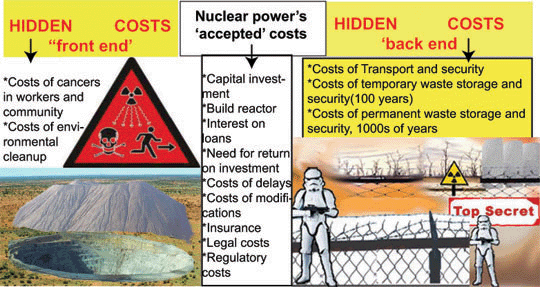
It revealed: hownthese retirement-age AGR reactors have been a poor investment, not serving
Britain well economically; how the estimated cost of decommissioning them
had nearly doubled since 2004, and would likely climb further; and how
these astronomical, escalating costs of decommissioning the AGR sites (now
at £23.5 billion) is being put onto UK tax-payers.
Nation Cymru 7th March 2023 https://nation.cymru/opinion/great-english-nuclear-should-wales-be-involved/
1 This Month





PLEASE OPPOSE HR 8255 AND S.3639 – bills would accelerate satellite deployment, with no environmental review or safeguards – https://ncstd5li.quorum.us/campaign/169331/
To see nuclear-related stories in greater depth and intensity – go to https://nuclearinformation.wordpress.com
-
Archives
- October 2026 (49)
- September 2026 (339)
- August 2026 (330)
- July 2026 (355)
- June 2026 (287)
- May 2026 (306)
- April 2026 (356)
- March 2026 (251)
- February 2026 (267)
- January 2026 (308)
- December 2025 (358)
- November 2025 (359)
-
Categories
- 1
- 1 NUCLEAR ISSUES
- business and costs
- climate change
- culture and arts
- ENERGY
- environment
- health
- history
- indigenous issues
- Legal
- marketing of nuclear
- media
- opposition to nuclear
- PERSONAL STORIES
- politics
- politics international
- Religion and ethics
- safety
- secrets,lies and civil liberties
- spinbuster
- technology
- Uranium
- wastes
- weapons and war
- Women
- 2 WORLD
- ACTION
- AFRICA
- Atrocities
- AUSTRALIA
- Christina's notes
- Christina's themes
- culture and arts
- Events
- Fuk 2022
- Fuk 2023
- Fukushima 2017
- Fukushima 2018
- fukushima 2019
- Fukushima 2020
- Fukushima 2021
- general
- global warming
- Humour (God we need it)
- Nuclear
- RARE EARTHS
- Reference
- resources – print
- Resources -audiovicual
- Weekly Newsletter
- World
- World Nuclear
- YouTube
-
RSS
Entries RSS
Comments RSS

