Step forward in £4.6 billion Sellafield nuclear decommissioning programme
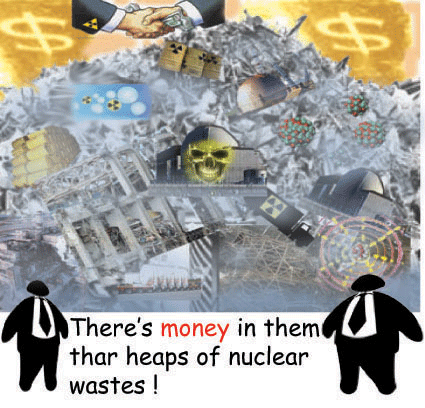
Hundreds of delegates gathered for an event which saw SMEs meet with
industry leaders to discuss how a £4.6 billion programme of work will be
delivered over the next 15 years. The Decommissioning Nuclear Waste
Partnership Supply Chain Engagement event saw dozens of SMEs meet with DNWP
partners, Sellafield leaders, and the wider supply chain. The full-day
event at Energus, at Lillyhall, near Workington, gave suppliers early
visibility of upcoming opportunities in the decommissioning process. They
had direct access to buyers, project teams and decision-makers, and were
given a clear understanding of how work will flow. The event was organised
by Industrial Solutions Hub (iSH) in collaboration with the BECBC Nuclear
Sector Group.
Business Crack 3rd June 2026, https://businesscrack.co.uk/2026/06/03/step-forward-in-4-6-billion-sellafield-nuclear-decommissioning-programme/
Ukraine’s military has a real Nazi problem
It also desecrates the memory of Nazism’s victims in Ukraine: 1.5 million Jews murdered in the Holocaust, along with millions of Slavs, prisoners of war, Roma, the mentally ill, forced laborers, and countless others consumed by the machinery of racial extermination and exploitation.
In their zeal to deconstruct Russian propaganda, Western elites have tried to hide the fact there are Third Reich extremists among Kyiv’s ranks.
Marta Havryshko, Jun 02, 2026, https://responsiblestatecraft.org/nazis-in-ukraine-military/?mc_cid=044f4b8379
When Vladimir Putin launched his invasion of Ukraine in February 2022, he claimed one of his goals was the country’s “denazification.” The Kremlin still uses this narrative as a cornerstone of its war propaganda.
Both Ukraine and the West reacted by dismissing the claim outright as a cynical abuse of Holocaust history. Politicians, media outlets, academics, and educational institutions rushed to prove that Putin’s argument was fraudulent.
But in their zeal to deconstruct Russian propaganda, Western elites created a propaganda myth of their own: there are no Nazis in Ukraine. Or, if there are, they are supposedly isolated cranks with no influence.
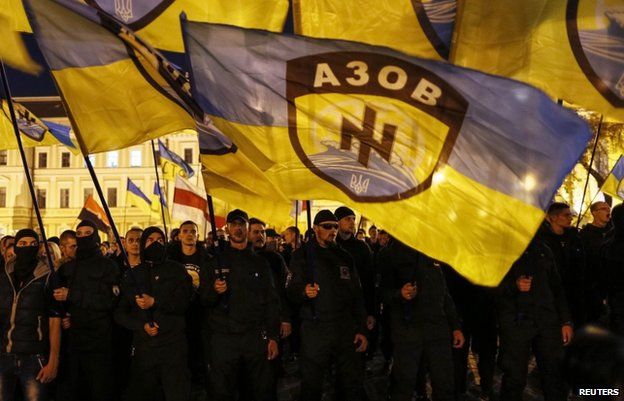
This fiction required the whitewashing of Azov, a unit founded in 2014 by the neo-Nazi group Patriot of Ukraine under the leadership of Andriy Biletsky. Azov became notorious for extremist ideology, Nazi symbolism, and allegations of war crimes in the Donbas. In 2018, the U.S. Congress banned the group from receiving American weapons, funding, or training.
After Russia’s full-scale invasion, that stigma vanished almost overnight. Kyiv repackaged Azov, separating the most radical elements into a new formation, the 3rd Assault Brigade. Western media rebranded and whitewashed it. The language of “de-radicalization” and “depoliticization” became mainstream. Questioning this narrative became taboo and labeled as “Russian propaganda.” The result is a culture of deliberate silence.
Neo-Nazi networks are deeply embedded in parts of Ukraine’s military structure. Their presence is visible in units such as Azov, the Third Assault Brigade, the Russian Volunteer Corps, Bratstvo, the German Volunteer Corps, Karpatska Sich, and others. Yet Ukraine’s Western backers continue to arm, fund, and train these units without meaningful scrutiny.
Even more striking is the normalization of Nazi imagery itself. Official Ukrainian military channels and mainstream media regularly publish images of soldiers wearing swastikas, Waffen-SS insignia, and patches linked to neo-Nazi groups like Combat 18 and Misanthropic Division. This is no longer treated as scandalous. It has been normalized.
Most disturbing of all, some Ukrainian military units have incorporated Nazi-linked symbols into their official insignia.
The far right and Ukraine’s military culture
Many Ukrainian military units using Nazi symbols are led by men shaped by Azov and the far-right milieu around it. For example, there is Oleksandr Kravtsov, the well-known commander of the Vedmedi unit, which was part of Azov. His body is covered in Nazi imagery, including 1488 — references to the white supremacist “14 Words” slogan coined by David Lane and the coded salute “Heil Hitler.” (“H” is the eighth letter of the alphabet.) Tattooed across his chest is the SS motto: “My Honor Is Loyalty.” He turned that slogan into the motto of his own unit. SS lightning bolts became part of its official insignia.
After returning from Russian captivity, Kravtsov’s unit was folded into the Ukrainian military structure — first the 36th Brigade, then the 39th Coastal Defense Brigade. Nothing changed. The SS symbols and motto remained.
Many commanders in the 3rd Assault Brigade also came out of Azov and still hold extremist views. Unsurprisingly, they openly embrace the corresponding symbolism. A subunit of the 3rd Assault Brigade adopted a modified insignia (replacing two grenades with three) of the Dirlewanger SS Brigade — one of the most notorious Nazi formations of World War II. In 2025, the brigade unveiled the emblem publicly at a memorial in Kyiv. No scandal followed.
Azov also normalized the Black Sun — a symbol born in Himmler’s SS cult headquarters at Wewelsburg Castle and now used globally by neo-Nazis and white supremacist terrorists, including the 2019 Christchurch mosque terrorist in New Zealand and the recent San Diego Islamic Center shooter.
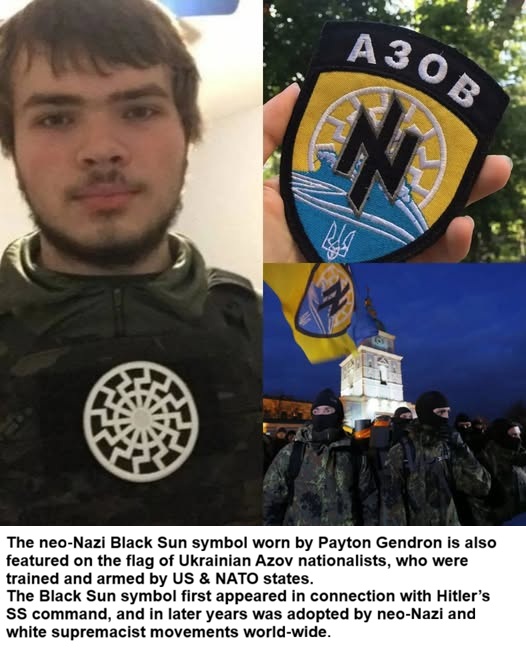
After 2022, Black Sun spread rapidly through Ukrainian military culture. It appeared in Azov-linked units such as the Decepticons platoon and the Mortars unit of the 3rd Assault Brigade. Soon it migrated further — into units with no openly ideological profile at all — and became part of the insignia of the 156th Zvaha Battalion and the Unmanned Systems Battalion of the 110th Brigade named after Marko Bezruchko.
Azov mainstreamed another Nazi-linked emblem as well: the Wolfsangel, used historically by several Waffen-SS divisions. Rebranded as the “Idea of the Nation,” it became one of the most recognizable symbols in Ukraine’s wartime military culture. The symbol now appears far beyond Azov itself. The newly created Nachtigall Battalion — named after the Nachtigall Battalion formed by German military intelligence in 1941 — uses the same Wolfsangel-inspired insignia.
Some units within Ukraine’s military do not hide their fascination with the Third Reich’s military culture. For example, the 422nd Regiment of Unmanned Systems calls itself “Luftwaffe” and uses virtually the same eagle as Hitler’s air force. Its commander, Mykola Kolesnyk, regularly appears with the symbol on patches and clothing. The unit even sells merchandise featuring the Nazi eagle — hoodies, mugs, T-shirts, caps, keychains — to fundraise for the war.
Not just aesthetic choices
The use of Nazi symbols in Ukraine’s military is not merely an aesthetic problem. It is moral, political, historical, and legal.
First, it represents a form of historical revisionism and the gradual rehabilitation of Nazism itself — a direct challenge to the postwar Western consensus built on the memory of World War II. Within far-right military culture, Nazi imagery is often wrapped in romanticized narratives about anti-Soviet struggle. In practice this trivializes the sacrifice of the seven million Ukrainians who fought Nazism in the ranks of the Red Army alongside the Western allies (in contrast to the 300,000 who served in various military formations and police units on the side of Nazi Germany).
Second, the problem is not only historical. It is profoundly contemporary. Every SS rune, Black Sun, or Wolfsangel displayed by Ukrainian soldiers hands the Kremlin another propaganda victory. Russian propagandists do not need to invent imaginary Nazis in Kyiv. They simply point to the insignia openly worn by some of Ukraine’s most celebrated military units — including formations branded as “elite,” such as the 3rd Assault Brigade.
Third, there is also a glaring legal contradiction. By openly using Nazi imagery, these units violate Ukraine’s own 2015 memory laws, which explicitly ban the propaganda of the Nazi regime and the public use of its symbols. The law describes such acts as an insult to the memory of millions of victims and have penalties of up to five years in prison.
Yet no one is prosecuted.
Why?
Because the Zelensky government — and President Volodymyr Zelensky himself as commander-in-chief — have made a political bargain with the far right. Since 2022, far-right activists and networks have flooded into the security and defense sector. In conditions of total war and chronic manpower shortages, this alliance became politically convenient, perhaps even inevitable. Now it is becoming entrenched.
The state depends on radicalized military formations for manpower and battlefield effectiveness. The far right, in turn, receives legitimacy, weapons, influence, and institutional protection. What emerged from wartime necessity is evolving into mutual dependence.
Ukraine’s Western partners have made their own bargain. They, too, depend on Ukrainian manpower to weaken Russia. And so they tolerate extremists inside Ukraine’s armed forces as long as those extremists continue fighting. More than that, they remain largely silent about the ideology and symbols involved, because acknowledging them would mean admitting an uncomfortable truth — that the neo-Nazi problem in Ukraine is not simply a Kremlin invention.
Marta Havryshko is a U.S.-based author and researcher focused on Ukrainian nationalism, the far right, and the Russo-Ukrainian War. Havryshko holds a PhD in History from the Ivan Franko National University of Lviv in Ukraine.
The Karaganov Fallacy – Nuclear strike against Europe IS NOT the right answer for Russia
Karaganov advocates preemptive Russian nuclear strikes against a Europe he deems bellicose, banking on American passivity. Scott Ritter believes conventional missiles, not nukes, are the only credible path.
warlike ruminations by some of NATO’s leading military minds do not exist in a vacuum but rather are reflective of a general posture of war preparation being promoted by the NATO alliance itself. Just ask Mark Rutte, the NATO Secretary General, who recently warned that NATO was in a race against time when it came to preparing for an inevitable war with Russia.
the true lesson is that nuclear wars cannot be won, should never be fought, and as such nuclear weapons should be done away altogether to avoid falling into intellectual traps such as the one offered by Karaganov, where their use is deemed possible.
Mon 01 Jun 2026, Scott Ritter, https://forumgeopolitica.com/article/the-karaganov-fallacy
Editor’s Note : After publishing our article “Is 1914 repeating itself? Will war between Europe and Russia finally break out openly?” where we discussed – among others – the nuclear doctrine of the Russian Federeation and also the Karaganov doctrin, Dmitry Orlov published the article «How to survive a Russian tactical nuclear strike». In today’s article Scott Ritter analyses the Karaganov doctrine and argues that nuclear weapons are not the right tools for Russia.
Back in the late 1970’s and early 1980’s, the Wallstreet brokerage firm, E.F. Hutton, came up with one of the most iconic television ad campaigns in history, built around the catch phrase “When E.F. Hutton speaks, people listen.”
Sergei Karaganov is the Russian analog to E.F. Hutton—when Karaganov speaks, people listen. The 73-year old political scientist, who currently heads the Council for Foreign and Defense Policy and serves as the dean of the Faculty of World Economy and International Affairs at Moscow’s Higher School of Economics, has advised both post-Soviet era Russian Presidents, Boris Yeltsin and Vladimir Putin, and his opinion continues to carry weight among the senior-most decision making circles of the Russian government.
Karaganov has, for the past several years, been warning about the growing threat to Russia from NATO, and in particular the European nations of NATO who have constructed a world view which postulates Russia as an existential threat which must be decisively confronted and defeated.
In this Karaganov is not wrong.
The language of the Europeans is self-indicting.
According to a newly published German military strategy, Russia represents “the greatest and most immediate threat for the foreseeable future” to Germany and transatlantic security. The classified strategy concludes by declaring “Russia is laying the groundwork for a military attack on NATO member states.”
Germany’s chief of defense, General Carsten Breuer furthered this argument in a 2025 statement to the media where he noted that “There’s an intent and there’s a buildup of the stocks” by Russia for a possible future attack on Nato’s Baltic state members.
Brueuer and Germany’s defense minister, Boris Pistorious, are using the threat from Russia as an excuse for the rearmament of Germany, with the goal of making the German army the most powerful in Europe by 2029.
Why that date?
According to General Breuer, this is when Russia will attack Europe. “This is what the analysts are assessing,” Breuer said, “in 2029. So we have to be ready by 2029.”
The German analysis is nearly identical to that of their British allies. Former Chief of the General Staff, General Sir Patrick Sanders, who retired in the summer of 2025, has warned that a war with Putin was a “realistic possibility” by 2030. “If Russia stops fighting in Ukraine,” Sanders told the British media, “you get to a position where within a matter of months they will have the capability to conduct a limited attack on a NATO member that we will be responsible for supporting, and that happens by 2030.”
These warlike ruminations by some of NATO’s leading military minds do not exist in a vacuum but rather are reflective of a general posture of war preparation being promoted by the NATO alliance itself. Just ask Mark Rutte, the NATO Secretary General, who recently warned that NATO was in a race against time when it came to preparing for an inevitable war with Russia. “We are Russia’s next target,” Rutte said. “I fear that too many are quietly complacent. Too many don’t feel the urgency. And too many believe that time is on our side. It is not. The time for action is now. Conflict is at our door. Russia has brought war back to Europe. And we must be prepared. Russia has brought war back to Europe. We must be prepared for the scale of war our grandparents and great-grandparents endured.”
The rhetoric of Breuer, Sanders and Rutte lends itself to an argument where the nations of NATO are responding to Russian aggression. But one must not be fooled into believing that aggression is a one-way street. Enter, stage left, Lithuanian Foreign Minister Kestutis Budrys, who recently opined that “We [NATO] must show the Russians that we can break through the small fortress they have built in Kaliningrad. NATO has the means to flatten Russian air defense bases and missile systems if necessary.”
Budrys’ lunacy, which even if successful would amount to little more than the collective suicide of NATO, didn’t appear from a vacuum, but rather echoed similar sentiment expressed by General Chris Donahue of the US Army, who serves as the commander of US forces in Europe. Donahue bragged that Kaliningrad, Russia, is approximately 47 miles wide and surrounded by NATO on all sides. He claimed that NATO and the US Army now have the capability to “take that down from the ground in a timeframe that is unheard of and faster than we’ve ever been able to do.” Donahue went on: “We’ve already planned that and we’ve already developed it.”
In many ways, Donahue’s bluster is far more embarrassing that the pugilistic nonsense espoused by his NATO colleagues, if for no other reason than he more than anyone should know both the extreme limitations of US and NATO power (something demonstrated very publicly with the recent US failed aggression against Iran) and the consequences of any NATO attack on Kaliningrad, which would be immediately fatal to Donahue, his staff, and the entire leadership of NATO, given the inevitability and severity of the anticipated Russian retaliation.
And therein lies the rub. NATO’s jingoistic rhetoric aside, there is no conventional military power in Europe, whether singularly or collectively, which poses an existential threat to Russia. Recent NATO military exercises demonstrated just how inexperienced NATO ground forces were in modern combat operations incorporating drone warfare on any appreciative scale. Imagine for a moment a NATO Brigade running into a Rubicon detachment on the battlefield. The results would be as one-sided as they would be fatal to the defeated party, which would in every scenario imaginable be the NATO forces.
The words of Breuer, Sanders, Rutte, Budrys, and Donahue amplify one universal constant when it comes to NATO today: militarily it is very much a paper tiger, incapable of sustained intensive ground combat at any appreciable level. The warlike verbiage spouted by these mouthpieces of mayhem is simply a desperate plea for relevancy in an effort to mobilize public support for a militarization campaign requiring energizing both populations and industry in a way hitherto fore unimaginable in post-Cold War Europe, and for all sense and purposes impossible to achieve today.
As the fictional Commander, Air Group (CAG) told Tom Cruise’s Maverick in the first Top Gun movie, “Son, your mouth is writing checks your body can’t cash.”
Welcome to the NATO collective today.
While Sergei Karaganov and his fellow Russian hardliners are more than justified in taking extreme umbrage at the warlike posturing Europe is assuming today in opposition to Russia, the reality is Europe poses absolutely no threat whatsoever to Russia as things currently stand, and the probability of Europe overcoming the sizeable political and economic hurdles required to build a military force capable of surviving on a Russian battlefield, let alone prevailing, is slim to none.
More worrisome, however, is the nuclear posturing being done by certain NATO countries to compensate for the alliance’s extreme shortcomings regarding conventional military power projection. This nuclear flexing has taken on an even greater urgency now that President Trump’s hostile ambivalence toward NATO and European security throws into question America’s commitment to fulfilling any hypothetical Article 5 scenario—a stance which simultaneously throws into question the reliability of America’s nuclear umbrella. France and the United Kingdom are working to create a joint nuclear doctrine to offset the loss of America’s nuclear arsenal, and both nations are in active discussions with other NATO members to extend their respective nuclear umbrellas over the Arctic, the Baltics, Poland and Germany.
Sergei Karaganov famously postulated that no American President would be willing to trade Boston for Poznan, meaning that if Russia were to hypothetically attack this unfortunate Polish urban center with a nuclear weapon, the United States would not respond in kind.
This, of course, is the kind of hypothesis that should never be tested and, given the fact that Russia faces no threat of an existential nature from the European collective, has zero justification for even being contemplated being tested.
Russia, together with the other major nuclear weapons states (the US, China, UK and France) co-signed a joint statement in early 2022 which affirmed that a nuclear war cannot be won and must never be fought. The statement went on to declare that “As nuclear use would have far-reaching consequences, we also affirm that nuclear weapons—for as long as they continue to exist—should serve defensive purposes, deter aggression, and prevent war.”
Russia has not officially renounced that joint declaration, which on the surface would indicate that the Karaganov initiative to preemptively use nuclear weapons against Europe has zero viability when it comes to reflecting official Russian policy.
There is, of course, one major problem—Karaganov was instrumental in crafting the 2025 nuclear posture for the Russian Federation, which in part declared that nuclear weapons could come into play in situations where conventional forces are insufficient to deter an opponent or achieve a military objective. So far, the SMO in and of itself does not meet the criteria for preemptive nuclear weapons usage. Whether a large-scale conventional war with NATO would cross this threshold is a separate matter.
But the situation Russia faces today, which Karaganov addresses, involves a nuclear armed power aiding a non-nuclear armed state to launch conventional attacks on Russia that could pose an existential threat. This is, of course, the very definition of what the ongoing proxy conflict between Russia and the collective West over Ukraine is, especially when it comes to the ongoing NATO-backed campaign of drone strikes against strategic Russian targets.
It’s not just Karaganov who is crying foul. Dmitri Polyansky, the Russian Ambassador to the OSCE, noting that the ongoing Ukrainian drone strikes against Russia are only possible with Western military expertise, technology, and intelligence, recently declared that it might already be “too late” to avert a Russian retaliatory strike against European targets directly affiliated with the facilitation of Ukrainian long-range drone strikes against Russia.
But even in this circumstance, nuclear weapons are not necessarily called for, something even Karaganov acknowledges. Conventional missile strikes, using weapons such as the Oreshnik intermediate-range missile, should be mounted against select European targets. But Karaganov then goes further, advocating for the use of nuclear strikes if the conventional missiles don’t “deter Europe.” Here, Karaganov puts value on the need to instill “primal fear” in Europe not by the threat of nuclear weapons, which clearly hasn’t worked, but through their actual use.
In this instance, Karaganov is dead wrong.
The use of nuclear weapons obviates the strategic advantages Russia has accrued by building the World’s largest, most combat capable (and tested) military. It nullifies the escalatory dominance Russia has achieved by deploying the Oreshnik conventional strike system. But worst of all it erases the very doctrinal paradigm that has prevented the world from stumbling down the path of nuclear oblivion—the idea that nuclear wars cannot be won and therefore must never be fought.
The Karaganov doctrine, so to speak, introduced a new paradigm—nuclear wars can, in fact be won, and as such should be fought.
Karaganov proves his thesis by postulating an unproven hypothesis—the US won’t trade Boston for Poznan.
He avoids the uncomfortable question as to whether France or the United Kingdom, singularly or together, would opt to put forward a nuclear response by declaring that Russia would eliminate both these nations and all of Europe if they were to try.
But this begs the question whether a Russian leader would be willing to trade Saint Petersburg or Moscow for London, Berlin and Paris.
Does Karaganov really want to test this hypothesis?
But let’s postulate, just for the sake of argument, that Karaganov’s thesis holds, and that Europe is collectively cowed by a Russian preemptive nuclear strike on Poznan, and the US opts out of sacrificing Boston and doesn’t retaliate.
Then what?
Nuclear war has, to date, been averted by the notion that there can be no winners.
Karaganov’s doctrine flips the script, and declares that there can, in fact, be winners.
But what exactly has been “won”? Decades of deterrence theory will have been washed away, leaving in its stead a massive strategic imbalance that cannot stand. There can be no nuclear deterrence if one side is willing to use nuclear weapons and the other side isn’t. Yes, the United States may likely forego sacrificing Boston or any other American city for a European urban victim of Russian nuclear annihilation. But the United States will need to immediately equalize the nuclear deterrence equation by demonstrating that it, too, can use nuclear weapons, and thus test the hypothesis of whether Russia would be willing to sacrifice Kazan for Tehran.
The answer is likely to be no.
Crisis averted.
Or not.
No longer is the world one where nuclear war cannot be fought, but rather one where nuclear war has become an accepted practice. War gaming and basic game theory hold that once nuclear weapons are used, it is simply a matter of time before matters escalate toward a full nuclear exchange, terminating all life on the planet. This isn’t idle speculation. In 1983 the Pentagon conducted a war game called Proud Prophet, an unscripted event involving the highest levels of the US military and its global warfighting commands, using real-world communication channels, doctrines and secret war plans. The game allowed for the consideration of limited small-scale nuclear strikes, but always ended the same way—global nuclear Armageddon.
Karaganov doesn’t address this issue, with good cause—because no leader, Russian or American, would start a nuclear war in a situation that fell short of manifesting a threat to their respective existential survival, if they knew that no matter what, the result was always the same—everyone dies.
Karaganov has done the world a great service in forcefully postulating the possibility of a winnable limited nuclear war.
Not just because it allows the world to once again embrace the foundational notion that nuclear wars cannot be won, and as such should never be fought.
No, the true lesson is that nuclear wars cannot be won, should never be fought, and as such nuclear weapons should be done away altogether to avoid falling into intellectual traps such as the one offered by Karaganov, where their use is deemed possible.
There is no greater justification for nuclear arms control and disarmament than the scenarios put forward by Karaganov.
And in the present time, when nuclear arms control has been removed from the global diplomatic playbook, the world needs the kind of kick in the seat of the pants that any reasoned reflection on the fallacy of Sergei Karaganov’s nuclear theories brings—without nuclear arms control, our collective demise at the hands of the weapons we refuse to eliminate is all but assured.
European countries split on Macron’s nuclear deterrence offer
Questions remain over how it would complement the US nuclear umbrella
DefenceCharles Cohen/Pietro Guastamacchia, Euractiv, 5 June26, https://www.euractiv.com/news/macrons-advanced-nuclear-deterrence-gains-supporters-but-questions-remains/
France’s offer to extend its nuclear deterrence has so far seduced nine European countries, but the benefits the scheme would provide on top of the US nuclear umbrella remain unclear to others.
Last week, Norway, which has long believed its security was best ensured through close alignment with Washington, announced it would join France’s ‘forward deterrence’ initiative, joining eight other countries: Germany, the Netherlands, Greece, Belgium, Poland, Sweden, Denmark and the United Kingdom.
This shift sends a very strong signal to both European allies and Washington, Etienne Marcuz, a senior analyst on strategic armaments at the Foundation for Strategic Research, told Euractiv, adding that it could encourage other countries in the region to follow suit.
Eastern flank
Neighbouring Finland, which shares a 1,340-km border with Russia, is also assessing whether to take part in the initiative, Defence Minister Antti Häkkänen said last week.
“The 2022 invasion (of Ukraine by Russia) generated a sense of vulnerability, particularly in terms of being potentially susceptible to nuclear coercion. Now Finland considers nuclear deterrence legitimate,” Matti Pesu, a senior research fellow at the Finnish Institute of International Affairs, said.
The Baltic countries have been particularly exposed to Russia’s hybrid attacks, with Ukrainian drones veering off course by electronic warfare crashing into their territory. Such incidents have prompted the collapse of the Latvian government. So far, the three countries have not publicly expressed interest in taking up France’s offer.
According to Marcuz, if all Nordic countries joined, this would provide new corridors from which to hit Russia, especially through the Arctic.
“An entire part of the Russian flank would be vulnerable,” he said.
But such decisions could take time, amid reports that Washington is debating extending its deployment of nuclear weapons in Europe to Poland and the Baltic states.
“The US is putting pressure on Europeans, so they don’t distance themselves from their nuclear dependency,” Marcuz noted. “The fundamental lever of US influence in Europe is the nuclear weapon,” he added.
Macron’s deterrence is not a nuclear umbrella
Emmanuel Macron unveiled the concept of ‘forward deterrence’ last March during a long-awaited revision of France’s nuclear doctrine.
“It enables French nuclear deterrence to deploy French forces abroad, either in peacetime for strategic signalling or in wartime to disperse and to be able to spread out across the European space,” Marcuz said.
“There is no explicit security guarantee,” he added, one of the key differences with American deterrence in Europe.
Instead, the French president said in his Ile Longue speech that the territories of partner countries would have an “affirmed bond” with France’s deterrence.
For Marcuz, the term is strategically ambiguous so as to avoid clearly laying out France’s ambitions to adversaries, in this case, Russia.
Macron said he would open deterrence exercises to European allies and deploy the country’s strategic forces, including the air force, across Europe. France runs quarterly nuclear exercises involving its air-based nuclear deterrence, carried by a fleet of Rafale fighter jets. The last such exercise was held on Monday.
Partner countries could take part in the drills, playing the role of an adversary, Marcuz noted.
Italy’s doubts
Rome, which has the EU’s third-biggest army, is notably absent from the list. Italian bases host US tactical nuclear bombs – the B61 models.
Italian Prime Minister Giorgia Meloni has long enjoyed a privileged relationship with US President Donald Trump. But Rome’s refusal to authorise the use of its bases for the war in Iran has drawn Washington’s ire.
Still, Italy is so far standing strongly behind the American deterrent.
“This government, like others in the past, will do everything it can to maintain the best possible relations with its US ally,” Alessandro Politi, director of the NATO Defence College Foundation, said.
Additionally, the French doctrine could expose partner countries to security risks, Politi argued, if French nuclear-armed Rafales were to fly through their airspace.
“Such planes are easily vulnerable, and the last guarantee of France’s response capability is four nuclear-powered ballistic missile submarines, which means, on average, about one or two on patrol during the year. Frankly, that’s a bit meagre.”
Several countries currently host American nuclear weapons, Politi said, adding these are framed within the context of the NATO alliance.
But Paris and Rome have already collaborated in the field of nuclear deterrence. Italy was the first foreign country to participate in a French nuclear exercise by providing refuelling assets in 2022.
This sets a precedent and so “Italy’s non-participation therefore seems to be more closely tied to political reasons related to the less-than-idyllic relations between Macron and Meloni,” Antonio Missiroli, former NATO assistant secretary general, said.
Both the French programme and any future Italian cooperation will depend on the outcome of national elections in the two countries, both scheduled for 2027, he added.
Polish politician urges EU veto on Ukraine accession after Zelenskyy’s UPA move
by Daria Dmytriieva. 3 June 26, https://www.msn.com/en-gb/news/world/polish-politician-urges-eu-veto-on-ukraine-accession-after-zelenskyys-upa-move/ar-AA24E3wR?ocid=BingNewsSerp
What move by Zelenskyy sparked backlash in Poland?
Calls are growing in Poland to block Ukraine’s accession to the European Union over a decision by Ukrainian President Volodymyr Zelenskyy regarding the UPA, Krzysztof Bosak, leader of the far-right Confederation party, stated.
According to Bosak, Poland should officially announce that it will block Ukraine’s accession to the EU until Kyiv abandons what Warsaw views as the cult of historical figures considered criminals in Poland. He said the key condition for resuming Ukraine’s European integration process is the full restoration of exhumations of all victims of the Volhynia tragedy.
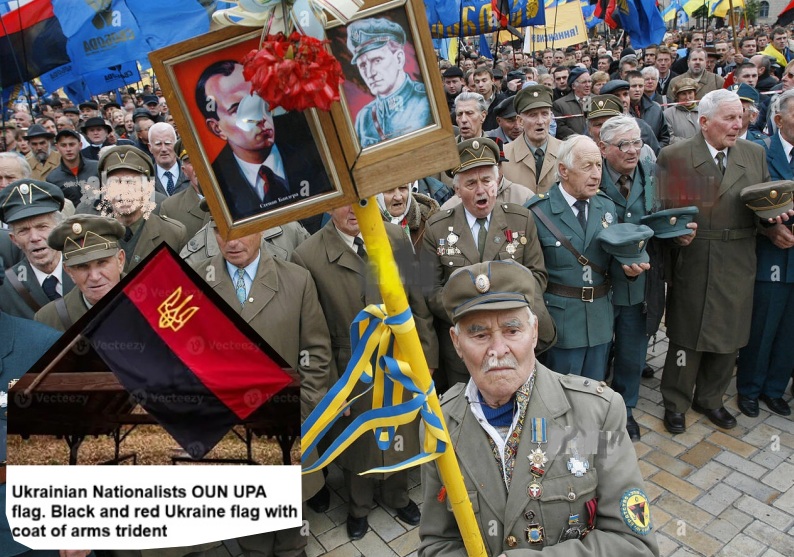
The politician’s reaction came after Zelenskyy decided to grant the name “Heroes of the UPA” (Ukrainian Insurgent Army) to the Separate Special Operations Center “North” of Ukraine’s Special Operations Forces.
Bosak stressed that Warsaw must move from words to concrete and tougher measures in order to exert real pressure on Kyiv, arguing that Ukraine allegedly views the current position of Polish politicians as weak.
Among additional measures, the far-right leader proposed that the Polish government stop paying for Starlink terminals used by the Ukrainian Armed Forces. He also called for ending joint borrowing schemes with other EU member states to finance assistance for Ukraine.
According to Bosak, the situation in which countries go into debt to provide non-repayable aid to another state while assuming responsibility for repaying those loans is unprecedented in the history of international finance.
As a reminder, on May 26, Zelenskyy signed a decree granting the Separate Special Operations Center “North” the honorary title “named after the Heroes of the UPA.” The decision was made in recognition of the exemplary performance of combat missions by its personnel.
Reacting to the move, Polish President Karol Nawrocki said he would consider stripping Zelenskyy of Poland’s highest state award.
Ukraine’s Foreign Ministry stressed that Kyiv had no intention of offending the Polish people. The ministry emphasized that, for Ukraine, the UPA symbolizes resistance against Moscow’s imperial policies and occupation.
Cigéo: years of authorizations for burying 83,000 m³ of nuclear waste.

The Cigéo project in Bure (Meuse) aims to bury 83,000 m³ of radioactive waste. Its regulatory process spans decades, with partial commissioning expected by 2050 and a public inquiry in 2026.
The Cigéo geological storage project in Bure (Meuse) is entering a regulatory process that will extend over several decades before burying 83,000 cubic meters of highly radioactive nuclear waste at a depth of 500 meters. This long administrative path unfolds amid heightened surveillance of nuclear facilities, as evidenced by the fire after a drone strike near the Barakah nuclear plant and IAEA warnings about drone risks near Ukrainian nuclear sites.
Origins and legislative milestones
Launched by the Bataille law in 1991, the project was sited in 1998 in Bure, on the border of Meuse and Haute-Marne. An underground laboratory of the French National Agency for Radioactive Waste Management (Andra) was established in 1999 to study the rock. In 2006, Parliament opted for deep geological storage with a reversibility period of 100 years, and the 2016 law defined the modalities for the creation of Cigéo, standing for Centre industriel de stockage géologique.
Approvals and upcoming steps
After a disrupted public debate in 2013, the project was declared of public utility by decree of the Council of State in July 2022. Andra filed its application for creation authorization (DAC) in January 2023. The Nuclear Safety and Radiation Protection Authority (ASNR) deemed the safety conditions “satisfactory” in December 2025, ahead of a public inquiry scheduled from May 18 to July 2, 2026, without in-person meetings. The project cost was revised to €33.4 billion by the state in April 2026, up from the initial €25 billion.
Industrial phasing and opposition
The decree authorizing the creation of Cigéo is expected in late 2027 or early 2028, a prerequisite for construction. A pilot industrial phase with dummy packages will require further approvals. Limited commissioning for this pilot phase is targeted for 2050, followed after 2050 by a law setting conditions for continuation. Full storage of all high-activity waste would only begin in the 2080s, pending authorizations, with final closure expected around 2170 after a monitoring period. The project faces strong opposition from environmental and local groups contesting deep storage.
The UK Is Getting Even Crazier In Defense Of Israel
Caitlin Johnstone, Jun 01, 2026
The UK is getting crazier and crazier in its defense of Israel. Now they’re canceling the visas of mainstream normie political pundits for criticizing the state of Israel, and investigating people for antisemitic hate crimes when they denounce Zionists who aren’t even Jewish.
American progressive commentator Cenk Uygur and his nephew Hasan Piker have both been denied visas by the British government, saying they were blocked from entering the country because of their criticism of Israel.
“I’ve been banned from the UK,” Uygur said in a tweet. “I tried to get on a flight to London to attend SXSW London and give a speech at Oxford. I’ve been banned for criticizing Israel. Are we free anymore? This is oppression of Western citizens by our own governments on behalf of a different country!”
“the uk has revoked my visa as well. all at the behest of israel,” said Piker in a repost of his uncle’s statement. “the west is betraying ‘liberal values’ for a genocidal fascist foreign government. soon we will all become israel.”
This is a significant escalation from London, because neither Uygur nor Piker could reasonably be described as politically extremist in any way. They’re essentially just Bernie Sanders progressives who sit well within the mainstream US political Overton window; I personally don’t follow either of them because they are both far too aligned with the Democratic Party for my liking.
This move is yet another win for the UK’s extremely powerful Israel lobby. Two weeks ago the Jewish Chronicle ran a story titled “Social media influencer Hasan Piker must be banned from Britain, say Jewish leaders,” subtitled “Online agitator who said Zionists were like ‘Nazis’ and refused to condemn Hamas poses a threat to British Jews.”
So the pressure campaign appears to have paid off.
This comes as the Metropolitan Police launch an investigation into an incident in which actress Helen Mirren was called an “evil Zionist bitch” by a man on the street last year, saying in a statement that “We are aware of a video circulating online, showing a man and a woman being subjected to antisemitic verbal abuse in Tower Hill.”
To be clear, Helen Mirren is not Jewish, so she can’t have been a victim of “antisemitic verbal abuse”. She is however an avowed supporter of the state of Israel, which makes her a Zionist.
In a 2023 interview with Israeli media, Mirren stirred up controversy with her remarks on her 1967 visit to the Zionist ethnostate, saying, “I saw Arabs being thrown out of their houses in Jerusalem. But it was just the extraordinary magical energy of a country just beginning to put its roots in the ground. It was an amazing time to be here.”
Russia adds four Ukrainian groups and ‘Glory to Ukraine’ salute to register of ‘fascist organizations and associated symbols’
January 19, 2024, Source: Meduza, https://meduza.io/en/news/2024/01/18/russia-adds-four-ukrainian-groups-and-glory-to-ukraine-salute-to-register-of-fascist-organizations-and-associated-symbols
Russia’s Justice Ministry has included four Ukrainian organizations in its register of groups that either collaborated with those condemned by the Nuremberg trials or deny the crimes of Nazism, reports Russian state news agency TASS.
The list appeared on the ministry’s website on January 18 and is officially called the “List of organizations specified in parts three and four of Article 6 of the federal law ‘On Commemorating the Victory of the Soviet People in the Great Patriotic War of 1941-1945’, as well as the attributes and symbols of these organizations.”
The list includes the following four organizations:
- The Ukrainian People’s Revolutionary Army (UNRA),
- The Ukrainian Insurgent Army (UPA),
- The Ukrainian People’s Self-Defense (UNSO),
- The Organization of Ukrainian Nationalists (OUN).
The list also features the organizations’ slogans, including the salute “Glory to Ukraine” [Slava Ukraini] and the response “Glory to the Heroes” [Heroiam Slava].
The document also includes the organizations’ symbols, such as the Trident of Prince Volodymyr, depicted on Ukraine’s coat of arms.
Ukraine war briefing: Kyiv denies its drone ‘deliberately’ hit Zaporizhzhia nuclear plant
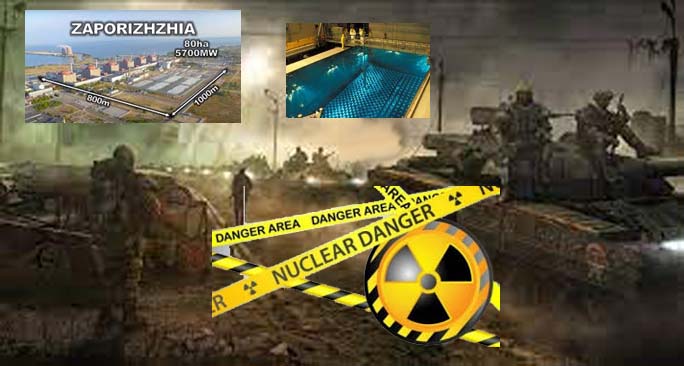
Russian atomic energy agency claim that drone strike damaged Europe’s largest nuclear plant just a ‘propaganda ploy’, Ukraine military says. What we know on day 1,558
- Russia’s state nuclear energy company Rosatom said on Saturday a Ukrainian drone had struck the Russian-controlled Zaporizhzhia nuclear plant, Europe’s largest, but had not caused damage to key equipment. Rosatom’s head Alexei Likhachev called the incident “deliberate” and said it left a hole in the wall of a turbine hall. “This afternoon, a Ukrainian kamikaze combat drone struck the turbine hall building of Power Unit No. 6, resulting in a subsequent detonation,” Likhachev said in a statement.
- The Zaporizhzhia nuclear plant was captured by Russia in March 2022 and remains close to the frontline in the south-eastern Ukrainian Zaporizhzhia region. Kyiv military have denied Russian claims as “yet another propaganda ploy”, saying its troops did not strike power unit No. 6 at the plant. “Ukrainian servicemen act strictly within the international humanitarian law and are fully aware of the consequences of any actions targeting nuclear facilities,” the military said in a statement. “At the relevant section of the frontline, there was no active fighting during the incident, and no weapons were used.”
- The International Atomic Energy Agency (IAEA) on Saturday said it has been informed by the Zaporizhzhia plant that a drone had struck a turbine building at the site. IAEA chief Rafael Grossi expressed serious concern about the reported incident. “Attacking nuclear sites is like playing with fire,” he said. The IAEA’s team has requested access to examine the affected turbine building first-hand, the agency said in an X post.
- Ukrainian drone strikes caused fires at more Russian oil facilities overnight into Saturday, Russian officials said, in what appeared to be the latest attack on Moscow’s oil industry. Authorities in Russia’s Rostov region said falling drone debris sparked a fire that damaged an oil depot and tanker in the port of Taganrog, while officials in the neighbouring Krasnodar region reported a fire breaking out at an oil depot in Armavir for the same reason.
- Ukrainian President Volodymyr Zelenskyy on X noted the Krasnodar attack and said: “We are rightfully bringing the war back to where it came from.”
- Russian tennis players at the French Open about their stance on the war, after her third-round exit at the French Open. Oliynykova lost in straight sets to Russia’s Diana Shnaider. The Ukrainian said players from Russia were allowed to participate in international tournaments even though they openly took part in events sponsored by Russian companies linked to the war effort or even after what she said was promoting the positions of Russia in relation to the war on social media.
Labour’s plans to limit judicial reviews of nuclear projects would ‘harm democracy’
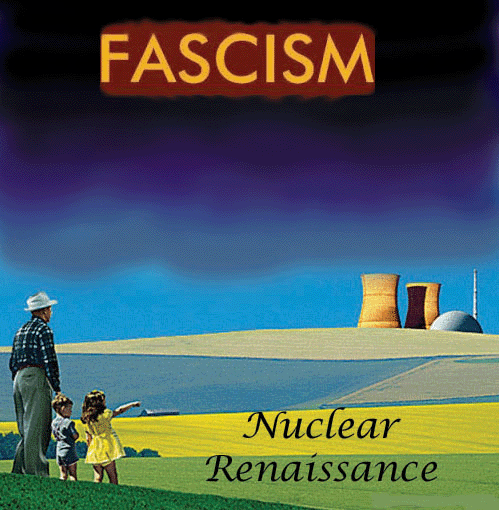
This is disturbingly similar to what Donald Trump did earlier this year when he gutted the US Nuclear Regulatory Commission and the US Environmental Protection Agency
This is disturbingly similar to what Donald Trump did earlier this year when he gutted the US Nuclear Regulatory Commission and the US Environmental Protection Agency
by Tom Pashby, 28 May 2026, https://www.thecanary.co/uk/analysis/2026/05/28/labour-judicial-review-limit-harm-democracy/
Plans by the Labour Government to make it harder for communities to oppose infrastructure projects near them, such as nuclear power plants, have been criticised by campaigners and a legal expert.
The Treasury announced on 20 May that the chancellor was expected to:
use Parliament to drive through power plants and infrastructure [by giving] Parliament the authority to approve critical energy schemes and better protect infrastructure projects from judicial review.
People with concerns about major infrastructure projects – sometimes called nationally significant infrastructure projects (NSIPs), which includes nuclear power plants – are able to request that judges review applications for building NSIPs.
Those judicial reviews have the potential to bring an end to projects if judges agree with arguments put forward by people pursuing the reviews.
Now, the government is proposing to give government proposals for some major projects “the same status as laws passed by elected decision makers,” according to one legal expert who spoke to the Canary, which appears to “have significant constitutional implications”.
Treasury announcement
The announcement by the Treasury said:
The headline proposal would allow Parliament to designate and approve the most important clean energy projects as being of ‘Critical National Importance’ (CNI), reducing the exposure from judicial review on all but human rights grounds.
This would help deliver the government’s commitment to accelerate new infrastructure development and drive growth, including much-needed projects like new power stations and offshore wind farms.
For all other nationally significant infrastructure – including transport and water projects – the government will introduce a fixed legal challenge window, at the end of which the planning consent could be updated to address any legitimate issues.
Plans to give government proposals same status as acts of parliament ‘concerning’ – lawyer
Leigh Day is a law firm “established to combat injustice,” its website says.
The firm has represented a variety of clients who have used judicial reviews to oppose major infrastructure projects.
Leigh Day partner Ricardo Gama told the Canary:
The government appears to be introducing further limits on communities’ ability to have large infrastructure decisions examined by the courts.
The suggestion that projects with political backing should enjoy the same status as acts of parliament, but be spared parliamentary scrutiny, is concerning.
It appears to have significant constitutional implications because it would alter the relationship between government, parliament and judges, giving government proposals the same status as laws passed by elected decision makers.
Limiting legal challenges ‘harms democracy’ and reduces ‘oversight of the nuclear industry’
Campaign for Nuclear Disarmament general secretary Sophie Bolt told the Canary:
The government is cynically using the crisis in the Middle East to justify limiting transparency and the ability of local communities and campaign groups to appeal the railroading of costly and dirty nuclear power projects.
Limiting the appeals process harms democracy and much needed oversight of the nuclear industry – but will not change the fact that nuclear power relies on the dirty process of extracting and processing uranium for fuel and leaves a legacy of toxic waste that lasts for generations.
The government’s plan to cut regulations and limit the scope for judicial reviews essentially means this industry will be more dangerous.
This is disturbingly similar to what Donald Trump did earlier this year when he gutted the US Nuclear Regulatory Commission and the US Environmental Protection Agency.
Anti-Sizewell C campaigners rail against notion that Sizewell C was delayed by judicial reviews
A Stop Sizewell C spokesperson told the Canary:
If Sizewell C was genuinely delayed by judicial reviews, why did the National Audit Office (NAO), who would have spoken at length to the Department for Energy Security and Net Zero (DESNZ) and Sizewell C during their enquiries, not say so?
In October 2025, the Treasury put out a statement saying:
Backing the builders not the blockers, the government will work with the judiciary to cut the amount of time it takes for a judicial review to move through the court system for nationally critical infrastructure projects by around half a year, like Sizewell C.
Then, in May 2026, a National Audit Office (NAO) report about Sizewell C poured cold water on the idea that judicial reviews had delayed the project. It explained reasons for delays and judicial reviews were notably absent from the list.
The NAO report said:
DESNZ started formal negotiations with EDF for SZC in 2021 and initially expected to reach ’financial close’, when contracts take effect, by the end of March 2023. DESNZ and HM Treasury made a final investment decision (FID) in July 2025, having agreed terms with EDF and other private investors.
This was 4.5 years after negotiations started and at least 28 months later than originally planned. The project was delayed several times, including by the 2024 General Election; responding to feedback from potential investors and the government’s internal assurance processes; and longer than expected negotiations with EDF and the other investors. Financial close was reached in November 2025.
The Stop Sizewell C spokesperson continued:
If the Chancellor is going to persist in using such offensive language, she really ought to get her facts right.
A Together Against Sizewell C spokesperson echoed Stop Sizewell C’s perspective, telling the Canary:
Labour still doesn’t get it – we cannot build a sustainable future by weakening our environmental safeguards and legal rights.
Reeves’ draconian policy change is built on the false premise promoted by the nuclear industry and right wing lobbyists that Sizewell C was excessively delayed by judicial review challenges – this does not stand up to scrutiny.
Reeves’ plans will need to be scrutinised by MPs and peers, and the challenge to the Prime Minister’s leadership means it is unclear whether the government will be able to command the confidence of the House of Commons to enable the Chancellor’s plans to make it harder to judicially review some major projects.
Europe could source half its critical materials from waste by 2050, study finds

Europe could source half its critical materials from waste by 2050, study
finds. Recovery systems could help the region reclaim up to 5.7 million
tonnes of critical raw materials (CRMs) that are currently thrown away,
reducing European reliance on imported materials and strengthen supply
chain resilience.
The findings were published as part of the Future
Availability of Secondary Raw Materials (FutuRaM) project, which seeks to
map Europe’s ‘urban mine’ of unused or wasted metals and minerals lost in
discarded products, industrial residues and demolished infrastructure
across the EU27+4 (EU, UK, Switzerland, Iceland and Norway).
CRMs –
including rare earth metals, lithium and cobalt – underpin a host of modern
technologies, from smartphones and electric vehicles (EVs) to solar panels
and wind turbines. But currently, when these technologies reach the end of
their usable lives, many of these important materials are discarded, too.
Edie 27th May 2026,
https://www.edie.net/europe-could-source-half-its-critical-materials-from-waste-by-2050-study-finds/
Norway becomes ninth country to come under French nuclear deterrence scheme
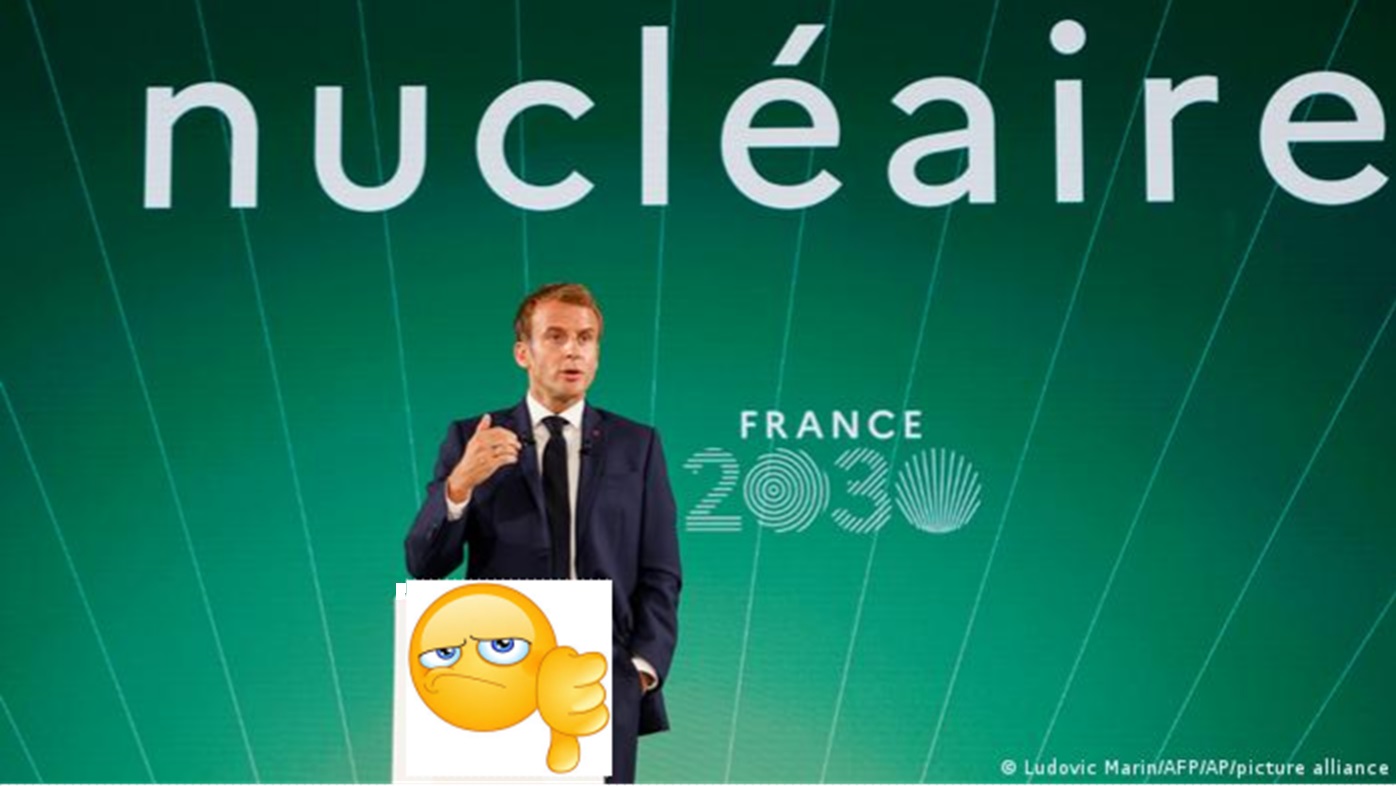
Norway on Wednesday became the ninth country to join the France-led nuclear deterrence scheme, the leaders of both countries said. President Emmanuel Macron announced in March that France – the only nuclear-armed country in the EU – would extend its nuclear deterrence scheme to willing European partners.
By: FRANCE 24, 27/05/2026
The leaders of France and Norway said on Wednesday that Oslo will join a Paris-led nuclear deterrence scheme to bolster security on the continent……………..
“In the past six months, we have entered into defence agreements with both Germany and the UK, and I am pleased that we have signed a comprehensive defence agreement with France today,” Macron said.
In March, Macron unveiled a programme under which France, the European Union‘s only nuclear-armed country, would use its atomic stockpile to boost security on the continent.
Under the so-called “forward” nuclear deterrence scheme, those who join will be able to temporarily host French “strategic air forces”, which will be able to “spread out across the European continent” to “complicate the calculations of our adversaries”, Macron said at the time…..
Prior to Norway, eight countries had joined the programme – Belgium, Denmark, Germany, Greece, the Netherlands, Poland, Sweden and fellow nuclear power the United Kingdom.
“The agreement also provides a framework for closer cooperation on hybrid warfare, maritime security, space cooperation, cybersecurity, support to Ukraine and defence industrial cooperation.”
France has an estimated 290 nuclear warheads, according to the latest figures released by the Stockholm International Peace Research Institute (SIPRI) and the Federation of American Scientists (FAS). More than 80 percent of France’s warheads are submarine-launched, according to the Bulletin of the Atomic Scientists.
That makes France the world’s fourth-largest nuclear power after Russia in the top spot (with more than 4,300 warheads) followed by the United States (with 3,700) and China (600). The United Kingdom – which is no longer an EU member but still a NATO ally – is estimated to have about 225 warheads, according to SIPRI and FAS. https://www.france24.com/en/europe/20260527-norway-becomes-ninth-country-to-come-under-french-nuclear-umbrella
Anti-nuclear group take on Sellafield for the second time in legal row

The group is concerned over the safety of toads thought to frequent local lakes.
Floyd March, Energy Voice 27th May 2026
An anti-nuclear group has successfully raised £20,000 for legal fees to take on Sellafield and the Environment Agency (EA) for a second time.
The Lakes Against Nuclear Dump (LAND) group previously failed a High Court attempt for a judicial review into the EA decision to award Sellafield a licence to extract water from the decommissioning site in Lancashire.
After the failed attempt in 2025, the new funds will look to overturn the development of a new radioactive waste storage facility.
Its leader, Marriane Birkby, fears the construction of a tunnel underground as part of the work will lead to the discharge of contaminated water into the River Ehen and River Calder, respectively.
Sellafield plans to pump water taken from the construction site to on-site storage tanks for testing prior to being discharged directly into the sea.
It has no plans to discharge into either River Ehen or Calder.
Toads, Salmon and water leaks
Birkby had previously taken issue with the length of time taken for a judge to dismiss the group’s previous attempt for a review.
If an appeal is approved, the group will argue the EA failed to conduct due diligence in assessing wildlife concerns, mainly Atlantic salmon and natterjack toads.
Natterjack toads are a protected species and reportedly inhabit a location less than a km south west of the site. Atlantic salmon, also protected, have a migration route along the River Ehen.
The group will use law firm Leigh Day to set out the grounds of appeal to overturn the original quashing of the judicial review.
High Court Judge Karen Ridge previously ruled that an assessment of the River Ehen special area of conservation wasn’t necessary “because it was considered unnecessary” as the extraction of water “was not likely to have a significant effect.”…………………..
Sellafield labelled ‘most hazardous’ UK building
Sellafield has previously been under fire from the Nuclear Decommissioning Authority (NDA). The agency had told the public accounts committee (PAC) in the House of Commons that Sellafield’s Magnox swarf storage silo (MSSS) was “the most hazardous building in the UK”.
The committee had noted there were “signs of improvement”. However, PAC chairman Sir Geoffrey Clifton-Brown said Sellafield continued to present “intolerable risks”………………………………. https://www.energyvoice.com/renewables-energy-transition/nuclear/598287/anti-nuclear-group-take-on-sellafield-for-the-second-time-in-legal-row/
An Open Letter to Chancellor Friedrich Merz – for peace in Ukraine – Jeffrey Sachs.
Economist and diplomat Jeffrey Sachs is calling on German Chancellor Merz to begin immediate talks with Russian President Vladimir Putin about peace in Europe.
Jeffrey D. Sachs | May 27, 2026 | Berliner Zeitung
When I wrote an open letter to you a half year ago, I urged Germany to pursue diplomacy with Russia rather than the normalization of war. Six months later, the situation in Europe is dramatically worse. Europe and Russia are slipping into open war. And in that drift, Chancellor, your responsibility is singular. No European leader — not in Paris, not in Warsaw, not in Rome — holds the position that Germany holds, or has the power that you personally hold, to interrupt this catastrophe. Will you try for peace?
You yourself, with Prime Minister Meloni and President Macron, called in January 2026 for Europe to restart relations with Russia and described Russia as „a European country.“ Yet you did not pursue diplomacy. With the future of Europe at stake, this is an extraordinary abdication of leadership. Have you, in your months as Chancellor, attempted one substantive dialogue with President Putin? Has your foreign minister attempted one substantive dialogue with Foreign Minister Lavrov? Real conversations, the kind that ended the Cold War. The answer, as far as the public record reveals, is no. Not once. And not for want of recognizing the urgency.
The past days have brought a dangerous acceleration that should focus every European mind. Both capitals are now under sustained attack: Ukrainian long-range drones have struck deep into Moscow, including civilian sites; Russian missile and drone strikes against Kyiv have greatly intensified. Ukrainian drones have crossed into the airspace of the Baltic states, raising the immediate prospect of an incident that could pull Europe directly into the war. A horrific Ukrainian strike on a boys’ school in Lugansk has further eroded what little remains of restraint. And on May 25, Foreign Minister Sergey Lavrov, acting on instructions from President Putin, formally notified the United States Secretary of State that the Russian Armed Forces are now launching „systematic and sustained strikes“ on facilities and decision-making centers in Kyiv, and the Russian Foreign Ministry has advised that the United States and other countries „ensure the evacuation of their diplomatic personnel and other citizens from the capital of Ukraine.“ That message is the prologue to a major escalation. Diplomacy is more urgent than ever.
The way to defend Ukraine is not continued slaughter, but peace on terms that are agreeable to all parties. Instead, we face escalation, with more deaths, more destruction, and the real prospect of a war that expands beyond Ukraine. By calling for ever more weapons, ever greater war-fighting capacity, and ever louder demonstrations of „resolve,“ and by signaling that Germany is preparing for war rather than working to end it, you have allowed Berlin to become an accelerant rather than a brake to a European-wide war.
Germany’s Responsibility: Six Particulars
Germany bears profound responsibility for the situation it now confronts. Before German policy can be reset toward peace, Germany’s record must be confronted honestly. I set out below six serious failures of German foreign policy vis-à-vis Russia since German reunification in 1990.
First — the 2+4 Treaty and NATO’s eastward expansion. On 12 September 1990, in Moscow, Germany signed the Treaty on the Final Settlement with Respect to Germany — the „2+4 Treaty“ — that completed German reunification. That treaty was secured because Mikhail Gorbachev was given solemn assurances, by Hans-Dietrich Genscher, by Helmut Kohl, by James Baker, and by other Western leaders, that NATO would not move eastward. The declassified record — including the now-public memoranda assembled by the National Security Archive of George Washington University — is unambiguous: those assurances were given and were clearly meant at the time to apply beyond the territory of the former GDR to Eastern Europe. These assurances were reaffirmed through 1990 and 1991.
The 2+4 Treaty restricts the placement of NATO troops in the former GDR, and recalls the principles of the Helsinki Final Act, which emphasizes that no nation’s security should come at the expense of another’s. Does any serious person believe that the Soviet Union cared about Western troops on the territory of the former GDR but was indifferent to NATO armies in Warsaw, Vilnius, or Kyiv? Of course not.
The matter of NATO enlargement was discussed in detail and explicit assurances of non-enlargement to the East were given by Germany to the Soviet leaders — and then were broken. Germany was the principal beneficiary of those assurances, which were the quid pro quo for Germany’s reunification. Yet as early as 1993, German leaders began to promote the violation of those assurances.
Second — Chancellor Merkel’s own testimony. In her memoirs, Angela Merkel writes with striking candor that she understood at the time of the 2008 Bucharest Summit that inviting Ukraine and Georgia into NATO would be tantamount to a declaration of war on Russia. She knew Russia’s red line. And yet she gave in to American pressure, accepting the compromise communiqué that Ukraine and Georgia „will become“ NATO members. That single sentence set in motion the catastrophes of 2014 and 2022. Merkel’s later candor is a gift to her successors: she has told you, plainly and in her own words, what was understood at the time. Germany should not now pretend otherwise.
Third — the betrayal of the February 21, 2014 agreement. On 21 February 2014, in Kyiv, Germany’s then–Foreign Minister Frank-Walter Steinmeier, together with his Polish and French counterparts, brokered an agreement between President Yanukovych and the opposition. The agreement provided for a return to the 2004 constitution, the formation of a national-unity government, and early presidential elections. President Putin was consulted; the agreement was confirmed. It was a serious diplomatic achievement under conditions of intense violence. Yet within twenty-four hours Yanukovych was forcibly overthrown by a violent coup. Germany did not insist on the agreement it had just guaranteed. Instead, following the U.S. lead, Germany backed the new government, as if there had been no agreement in place. That decision persuaded Moscow that Western signatures could not be trusted.
Fourth — Minsk II. In February 2015, Chancellor Merkel personally negotiated Minsk II in the Normandy Format and pledged Germany’s political backing through the Declaration of Support adopted in Minsk on 12 February 2015. For seven years, the key political provision — autonomy for the Donbas regions within a sovereign Ukraine — was never implemented by Kyiv. Germany did not press Kyiv to implement the autonomy provision it had championed — and Merkel later acknowledged that the agreement had been used as a holding action to allow Ukraine to rearm. President Hollande said the same. The guarantee, in other words, was not a guarantee at all. It was a stratagem — once again at Washington’s behest. Once again, the message to Moscow was that Western signatures cannot be trusted
Fifth — Nord Stream. On 7 February 2022, in the East Room of the White House, President Biden announced — with then-Chancellor Olaf Scholz standing beside him — that „if Russia invades… then there will be no longer a Nord Stream 2. We will bring an end to it.“ Asked how, he replied, „I promise you, we will be able to do that.“ The pipelines were destroyed seven months later in an act of sabotage in the Baltic Sea. The available evidence — investigative reporting in the United States and Germany, the trail followed by the German federal prosecutor, and the public statements of former officials — points overwhelmingly to a joint Ukrainian-American operation. The German government has long known this. And yet Germany has permitted the public blame to fall on Russia, against the direct evidence, while an act of industrial sabotage against the German economy has gone unprosecuted and unanswered.
Sixth — the April 2022 Istanbul agreement that was within reach. Just weeks after Russia’s invasion in February 2022, Russian and Ukrainian negotiators converged in Istanbul on the terms of a peace agreement: Ukrainian neutrality outside NATO, multilateral security guarantees, agreed troop limits, and the political resolution of the Donbas and Crimea questions over time. The agreement was within days of signature. Former Israeli Prime Minister Naftali Bennett, one of the mediators, has confirmed publicly that the deal was close and that the West — the United States and the United Kingdom in particular — moved to block it. Prime Minister Boris Johnson’s mission to Kyiv in April 2022 to instruct Ukraine not to sign is a matter of public record. Hundreds of thousands of Ukrainian and Russian lives, and the wider European order, have paid the price for that US–UK intervention. Germany has not raised its voice on this — even though Germany, more than any other European state has borne the economic consequences.
The Second Catastrophe: Germany’s Economic Self-Destruction
Your first concern must be peace. Yesterday’s message from Moscow tells us how late the hour is. But there is a second catastrophe unfolding alongside the first: the willful destruction of the German economy, with Berlin as both author and victim.
Germany’s industrial economy was built on trade with Russia. The destruction of Nord Stream and the subsequent severance of Germany’s trade relations with Russia have left Germany buying natural gas from the United States at prices several times higher than the Russian pipeline gas it replaced. This is industrial suicide. Germany’s chemical sector, its steel sector, its glass industry, its energy-intensive manufacturers — the very foundations of the Mittelstand — are losing international competitiveness day by day. Skilled jobs are draining out of the German economy. And the German taxpayer and the German consumer are making a transfer of national wealth from Germany to American gas producers at a scale unprecedented in postwar Europe.
On top of this, the German government is now pledging an enormous defence build-up — hundreds of billions of euros over the coming decade — to arm for a war that diplomacy can easily prevent. This is a profound misallocation of national resources. The fundamental challenge facing Germany in this decade is competitiveness in the digital age. Every euro spent on tanks, missiles, and artillery shells is a euro not spent on Germany’s AI capacity, its chip-design and chip-fabrication capability, its energy infrastructure, and the high-speed digital networks that Germany needs to remain a top global economy.
The hard reality, Mr. Chancellor, is that there is no security to be bought with these arms that diplomacy cannot buy at a tiny fraction of the cost, and there is no prosperity to be had without the digital and energy investments that this arms buildup will crowd out.
My Appeal
Chancellor Merz, more than any other European leader, the question of whether Europe descends into general war, or returns to negotiation, and to economic sanity, rests with you. The hour is very late. Yesterday’s formal message from Moscow to Washington says so explicitly. Please open a dialogue with President Putin. Please send your foreign minister to Moscow or invite Russia’s Foreign Minister to Berlin. Please reopen the OSCE channels that Germany has allowed to atrophy. Please tell Kyiv to cease its strikes on civilian targets.
Most importantly, please tell the German public the truth: that a negotiated peace based on Ukrainian neutrality is the realistic path out of catastrophe, and that restoring a normal economic relationship with Russia is the realistic path out of Germany’s industrial decline.
The terms of an acceptable agreement that Germany could propose are clear. The fighting would stop on an armistice line. All sides would renounce any future resort to violence on the question of borders. Ukraine would restore its neutrality, and NATO would permanently renounce further eastward enlargement.
Europe and Russia would restore economic relations and would stop the warmongering. The OSCE would once again become the central forum for European security, with the fundamental precept that European security is indivisible, not based on military blocs dividing Europe. Alongside this peace, Germany would redirect its national resources toward the digital, AI, semiconductor, and energy investments that Germany’s economic future demands.
History will record what you do in the weeks ahead, and what you fail to do. So will the German public. So will the peoples of Russia, Ukraine, and Europe generally. It’s time for diplomacy, Mr. Chancellor. The choice is yours to make.
Respectfully,Jeffrey D. SachsUniversity Professor of Columbia University
https://www.berliner-zeitung.de/article/jeffrey-sachs-an-open-letter-to-chancellor-friedrich-merz-10038768
The False Promise of Nuclear Power: Why Scotland Doesn’t Need New Nuclear.
Just before the 40th anniversary of the Chornobyl nuclear disaster,
Scottish CND host 3 excellent guests to discuss the risks, false promises
and opportunity costs of nuclear power.
Linda Pentz-Gunter is an
environmental campaigner who founded the advocacy organisation “Beyond
Nuclear” in 2007. In her advocacy, she is primarily concerned with the
environmental costs of nuclear power and its false promise as a climate
change solution. She also campaigns for nuclear weapons abolition. As the
international specialist at Beyond Nuclear, she edits and curates the
Beyond Nuclear International website, an essential resource for information
and updates on world nuclear news.
Pete Roche is also an environmental
campaigner who has recently revived the civic campaign SCRAM (Scottish
Campaign to Resist the Atomic Menace), which organised extensive
demonstrations against the construction of Torness nuclear plant in the
1980s. Pete is also a professional energy consultant and proprietor of the
website No2NuclearPower, another key resource for information and updates
on nuclear power in the UK.
Dylan Morgan is spokesperson for the People
Against Wylfa B campaign, and is strongly involved in the
recently-relaunched Welsh Anti-Nuclear Alliance, also originally launched
in the 1980s and is composed of several important civic organisations in
Wales including CND Cymru.
Scottish CND 28th May 2026 –
https://www.youtube.com/watch?v=lfLQs9LRo50
1 This Month



26 September – International Day for the Total Elimination of Nuclear Weapons


PLEASE OPPOSE HR 8255 AND S.3639 – bills would accelerate satellite deployment, with no environmental review or safeguards – https://ncstd5li.quorum.us/campaign/169331/
To see nuclear-related stories in greater depth and intensity – go to https://nuclearinformation.wordpress.com
-
Archives
- September 2026 (206)
- August 2026 (330)
- July 2026 (355)
- June 2026 (287)
- May 2026 (306)
- April 2026 (356)
- March 2026 (251)
- February 2026 (267)
- January 2026 (308)
- December 2025 (358)
- November 2025 (359)
- October 2025 (375)
-
Categories
- 1
- 1 NUCLEAR ISSUES
- business and costs
- climate change
- culture and arts
- ENERGY
- environment
- health
- history
- indigenous issues
- Legal
- marketing of nuclear
- media
- opposition to nuclear
- PERSONAL STORIES
- politics
- politics international
- Religion and ethics
- safety
- secrets,lies and civil liberties
- spinbuster
- technology
- Uranium
- wastes
- weapons and war
- Women
- 2 WORLD
- ACTION
- AFRICA
- Atrocities
- AUSTRALIA
- Christina's notes
- Christina's themes
- culture and arts
- Events
- Fuk 2022
- Fuk 2023
- Fukushima 2017
- Fukushima 2018
- fukushima 2019
- Fukushima 2020
- Fukushima 2021
- general
- global warming
- Humour (God we need it)
- Nuclear
- RARE EARTHS
- Reference
- resources – print
- Resources -audiovicual
- Weekly Newsletter
- World
- World Nuclear
- YouTube
-
RSS
Entries RSS
Comments RSS
 nuclear-news