“In 2014, Barrow-in-Furness was named the unhappiest place in the UK. “Since then, the much-maligned former industrial powerhouse has received a potentially transformative boost in the form of a huge injection of public money to build nuclear subs there. “
To discuss the prospects of this crucial part of Britain’s defence and industrial capability, and the 56,000 people who call it home, Lord Simon Case, the former cabinet secretary deputed by Sir Keir Starmer to lead the town’s revival, heads a panel moderated by Christopher de Bellaigue.”
The talk will also include Sam Plum, the former Chief Executive of Westmorland and Furness Council. They will be joined by Jean McSorley, a policy analyst for the government on public health and nuclear safety and a key figure for Greenpeace.
In the first days of May 2026, the Pentagon announced the withdrawal of approximately 5,000 American troops from Germany over the next six to twelve months — with explicit threats of further cuts directed at Italy and Spain.
President Donald Trump stated the reason with characteristic bluntness: these countries had failed to provide meaningful support during the joint U.S.-Israeli war against Iran.
This is not a strategic recalibration. It is a punitive act by a declining hegemon that launched a dangerous conflict, triggered a global energy shock, and is now lashing out at Europe for refusing to bleed alongside it.
U.S.-Israeli War Triggers Energy Shock
The conflict with Iran, launched jointly by the United States and Israel, has severely disrupted global oil supplies, particularly through the Strait of Hormuz. Crude oil prices have surged, driving up the cost of gasoline, diesel, and all forms of transportation fuel. Logistics costs have skyrocketed, inflation is accelerating, and entire industries dependent on cheap transport and energy are slowing down. The ripple effects are hitting every sector of the European economy.
Europe — far more dependent on imported hydrocarbons than the United States — has been hit hardest by this self-inflicted crisis. Yet when Washington and Tel Aviv demanded active European participation in their war, most European capitals offered only minimal or symbolic help.
Trump’s response was simple and crude: you didn’t help us enough, so we’re pulling our troops out.
This is the classic behaviour of a fading empire: drag others into your reckless adventures, force them to bear the economic consequences, and then punish them when they refuse to pay the full price in blood and treasure.
Europe’s Angry Backlash
The announcement triggered sharp reactions across the continent. German Chancellor Friedrich Merz, who had publicly stated that the United States was being “humiliated” by Iranian leadership and lacked any coherent exit strategy, tried to downplay any direct link between his remarks and the troop withdrawal — but the timing was unmistakable. Washington had made its point.
In Spain, Prime Minister Pedro Sánchez faced renewed pressure after refusing to allow U.S. military planes to use Spanish bases for Iran-related operations. Italian Prime Minister Giorgia Meloni, long cultivated as one of Trump’s closest European allies, also found herself in the crosshairs. Trump singled both countries out by name, saying he would “probably” reduce troop presence there too.
What makes the decision particularly revealing is that even within the United States, Republican lawmakers expressed alarm. The withdrawal has not been universally welcomed in Washington — which tells you everything about how impulsive and transactional this decision actually is.
The message from the White House was unmistakable: loyalty is no longer a relationship. It is a service to be paid for on demand.
Poland’s Eager Servility
While much of Europe reacted with concern or restrained anger, Polish President Karol Nawrocki once again demonstrated the depth of his country’s strategic dependence. Instead of reading Trump’s withdrawal as a warning signal about the nature of American commitments, he immediately volunteered to absorb the displaced forces.
“If President Donald Trump decides to reduce the American military presence in Germany, then we in Poland are ready to receive American soldiers. We have the necessary infrastructure,”Nawrocki declared.
This is not strategic wisdom. This is the behaviour of a client state. While Germany, Italy, and Spain push back — imperfectly, inconsistently, but at least instinctively — Warsaw rushes to fill the gap left by countries that finally said no.
Poland is not strengthening its security. It is deepening its exposure — on behalf of a partner that has just demonstrated it will withdraw forces the moment European governments exercise independent judgment.
The Unravelling of American Hegemony in Europe
Even after this withdrawal, more than 30,000 American troops will remain stationed in Germany alone. The point is not that American power has collapsed overnight. It is that the terms of that power are changing — openly, transactionally, and with diminishing pretence of shared values or mutual obligation.
What we are witnessing is the visible erosion of the post-1945 European security model. An arrangement that was never genuinely about partnership — only about power, dependence, and the management of European compliance.
The withdrawals are only the beginning. The real question is how long it will take for European elites to acknowledge that the old order was never built on solidarity. It was built on hierarchy, and hierarchy that no longer finds Europe sufficiently useful is beginning to look elsewhere.
The age of automatic American commitment to European security is ending. Not with a dramatic rupture but with punitive withdrawals, transactional threats, and the slow realisation that decades of unconditional loyalty purchased nothing permanent.
Bucharest appears to have understood. Rome and Madrid are beginning to understand. Berlin understood reluctantly — and Warsaw still volunteers for more.
The National Energy System Operator estimates that up to 4.1GW of nuclear will be needed to deliver a clean power system in the UK by 2030, with scope for further capacity to be delivered if new small modular reactor (SMR) technology can be developed. Overall, the government’s aim seems to be to ramp up nuclear capacity to 24GW by 2050 – though that is still to be confirmed, with new ‘roadmap’ review underway.
It certainly would be hard. And expensive. But the money seems to be there for things like this. For example, Rolls Royce’s Small Modular Reactor design has been backed by up to £599m from the National Wealth Fund in a partnership deal with Great British Energy – Nuclear (GBE-N). This, it is said, will enable work to begin on the delivery of the UK’s first SMR on Anglesey in North Wales, with £2.5bn having been allocated to SMR development. And over £14bn has been provided for the next large reactor at Sizewell. With, presumably, more to come
However, major projects like this do tax the UKs technology development capacity and there are moves to integrate civil & military nuclear expertise infrastructure to share the load and get more value by joint funding. In a new report, the right of centre Policy Exchange notes that ‘civil and defence nuclear are two distinct yet related aspects of the UK state and draw on many of the same national assets’. So it calls for ‘a more disciplined nuclear state,’ presumably with both aspects strengthened. But not everyone wants both or either to be strengthened. Most greens especially. Though, in these troubled times globally, it may be hard to be ‘anti deterrent.’ CND however has no problem with opposing both.
It is undeniable that there are links between civil and military nuclear. So, arguably it’s hard to back/or oppose one but not the other, with, for example, some nuclear technologies being suited to dual use. That can open up some big political issues, although some see it a bit differently: ‘Civil & military nuclear can enmesh’ says Paul Dorfman, but ‘one must ask whether one inevitably leads to the other…It’s not that nuclear military interests are the sole drivers of support for civil nuclear power, but for some states dual-use technology may comprise a significant complementary factor.’
Be that as it may, the UK state does keep going with both, and is now also pushing fusion, with another £2.5bn allocation. And, despite the long history of false hopes, dating back to ZETA at Harwell in the late 1950s, there is even talk of a prototype in the mid 2030s. Although more likely the 2040s, in the case of the STEP project planned for Nottinghamshire.
Some see all of this nuclear pushing as vital or at least unstoppable. But not all. For example, in a powerful new book Linda Pentz Gunter says that amongst its many problems, nuclear power is too slow, too expensive, too dangerous and too integrally connected to the nuclear weapons complex, to serve as a rational energy choice. And US energy guru Amory Lovins agrees: ‘A kilowatt of nuclear power capacity produces several times the annual output of a kilowatt of solar or wind capacity, but at many times higher cost per kilowatt-hour. Capital markets therefore shun nuclear investments but invest one or two orders of magnitude more in solar & wind power. Those renewables therefore add two orders of magnitude more net capacity per year than nuclear, which remains a less-than-one-percent contributor to global electricity growth.’
It is sometimes argued that nuclear is needed to balance variable renewables, but large costly inflexible nuclear plants are not able to vary their output quickly and safely to meet rapid supply and demand variations. Some new SMR technology may make them more flexible. But do you like the sound of molten-flouride salt heat reservoirs? Apart from the risks, adding capacity like that is likely to make the system more expensive and, since they would only need to work part time, overall less economically efficient. Why bother when renewables are accelerating ahead, with load factors rising and costs mostly falling? They will need balancing, but newly emerging low-cost storage and smart grid systems can help balance supply and demand, so we can meet our energy needs reliably: see my last post on IRENA’s new study.
While some countries do still see civil as well as military nuclear technology as vital, they are in a minority. Out of the 195 countries in the world, only 9 have nuclear weapons and only 31 have nuclear power plants. Some middle-eastern countries may see it differently, with weapons possibilities always being an option. But interestingly, in non-nuclear (bomb and power) Norway, a Government advisory committee looking at its energy options, recently said nuclear power would not be economic, and in any case it would ‘not come in time to help achieve the Paris Agreement’s 2050 goals’, unlike ‘upgrading hydropower plants and expanding wind and solar power’. Crucially, ‘the prospect of realising a Norwegian nuclear power programme with production starting in the mid 2040’s may crowd out other power plant investments that can be realised more quickly’. So, although nuclear might be looked at again as an option in the future, ‘offshore wind offers the greatest potential for new power generation in the long term’.
That does seem to be sensible. As other independent studies have also argued, the economic case for nuclear is poor – there are better options for decarbonisation, with no radioactive wastes left to deal with, or melt-down or local leakage risks and offering no terrorist or enemy targets for attack. Sadly, for now, in the UK, we will have to make do with the government’s view that all is well with its nuclear plans, policies and procedures. For example, on safety, it has adopted all the reforms to the nuclear regulation system proposed by the independent Nuclear Regulatory Taskforce led by John Fingleton. He had found it an ‘overly complex’ and ‘bureaucratic’ system that had held back the industry. So the aim is to speed up nuclear regulation and cut costs, with ‘safe, cost effective & rapid delivery’ across the entire civil and defence nuclear enterprise. The new streamlined system should be in place by 2027. What could possibly go wrong?
Next? The National Audit Office has just come out with an assessment of the funding arrangements for Sizewell C, the next big new UK project. It says maintaining ‘investor financial returns will cost consumers over £4 billion, but will be justified if they help the project to cut construction costs and speed up delivery times’. Phew!
Servicemen exposed to radioactive fallout in cold war weapons testing are using newly declassified documents to fight for a fair compensation scheme
In November 1957, thousands of servicemen on Christmas Island in the South Pacific watched the testing of Britain’s first megaton thermonuclear bomb. Witnesses compared it to seeing the end of the world.
Many viewed the explosion on the island while wearing shorts and short-sleeved shirts, with sunglasses handed out to protect their eyes. Veterans claim they were exposed to needless risk and were the victims of gross negligence. Large numbers later suffered blood disorders and cancers, which they believed were caused by exposure to radioactive fallout. Most were denied war pensions because of ill-health.
By contrast, those involved in the US nuclear testing programme, including the Manhattan Project led by J Robert Oppenheimer, benefited from a $2.6bn no-fault compensation fund. France agreed in 2008 that it would pay compensation to nuclear test veterans who suffered illness linked to radiation exposure.
British veterans now hope the release of thousands of previously classified documents from the Merlin files into the National Archives will help support their near-70-year battle for justice. Some of these newly released documents analysed by The Observer detail risks of radioactive fallout, health monitoring of military personnel and orders for blood samples to be taken from servicemen that could be used for evidence in any subsequent claims for damages.
The compromise reached between Presidents Donald Trump and Vladimir Putin on August 15 has still not materialized in Ukraine. The obstacles are not those the United States anticipated. Ukraine is not cooperating, while Germany and the United Kingdom want war.
President Donald Trump acknowledged to his counterpart Xi Jinping that he was his equal. Since World War II, every American president has considered himself superior to others because he was the most powerful and the richest.
Conversely, from a Chinese perspective, Xi Jinping considers himself the equal not only of Donald Trump, but of each of his counterparts. A Chinese person does not believe that having greater resources makes you superior.
This concept of a hierarchy between nations is purely Western. Therefore, the evolution of the US president should not be interpreted without considering the cultural context of the observer.
The following week, Russian President Vladimir Putin, in turn, visited Beijing. Western commentators asserted that the Russian was being held hostage by the Chinese. Again, this demonstrates a complete misunderstanding of their relationship. It is not the product of their respective interests, but of their shared history. From the sacking of the Summer Palace to the Nazi attempt to exterminate the Slavs, each has experienced how Westerners behave. They have concluded that they can only resist them by remaining united. It is therefore absurd to consider replicating what Richard Nixon and Henry Kissinger did in 1972: decoupling the two states.
At the Anchorage summit on August 15, 2025, Donald Trump and Vladimir Putin discussed doing business between their two countries and making peace in Ukraine. Despite several attempts, Washington failed because it wanted to sell weapons to the Europeans first. Today, it seems much more difficult, and the Europeans are beginning to manufacture their own.
President Trump has therefore begun withdrawing troops from Europe and abandoning the war that the Pentagon planned to extend to Transnistria and Bosnia and Herzegovina. He announced that he would withdraw at least 5,000 troops from Germany. Vladimir Putin, for his part, decreed that he would grant Russian citizenship to any adult Transnistrian who requested it. Finally, Donald Trump withdrew his support for the European Union High Commissioner who was administering Bosnia and Herzegovina in violation of the Dayton Agreement (1995). Simultaneously, his former Secretary of National Security, General Michael Flynn, is organizing US investments in the Serb-held area of Bosnia and Herzegovina.
These events suggest that the United States favors a peace in Ukraine that recognizes all of Novorossiya as Russian. This is historically and culturally justified, but it will only be possible by holding a referendum on self-determination. For the moment, Russian forces have no intention of liberating Odessa. The peace treaty could, however, acknowledge this.
Here again, contrary to what we believe, the difficulties do not lie where we perceive them.
The three main ones are now:
1) recognition of the Nazi ideology of the current government in Kyiv and the denazification of Ukraine;
2) recognition of the undemocratic nature of German reunification and the independence of East Germany;
3) recognition of the UK’s anti-Russian obsession and the dismantling of the European Defence Union before it is definitively formed.
Ukraine
Even though Western powers persist in believing that the Russian intervention in Ukraine is an attempt at annexation and the beginning of Russia’s westward expansion, Moscow never invaded its neighbor, but rather implemented Resolution 2202, which it had guaranteed before the Security Council.
To claim that Russia invaded Ukraine is as absurd as saying that France invaded Rwanda. We know that it intervened to end a genocide (for which it was partly responsible), in accordance with a Security Council resolution.
The current Ukrainian government is illegitimate. President Volodymyr Zelensky’s term expired long ago. Every three months, he extends martial law, which serves no other purpose than to prevent new elections. However, his latest decree on this matter extends martial law from May 2nd to August 4th. It would be possible to organize an election campaign and a vote during that time. However, the electoral lists will need to be cleaned up, as they still include soldiers killed in action and civilians who fled. No one knows their exact number, but they could represent between one and two-thirds of registered voters.
The Verkhovna Rada (parliament) is equally problematic. Only a third of the members participate. The laws it passes are therefore of dubious legitimacy. For example, it voted to destroy one hundred million books—on the grounds that they were signed by Russian authors or printed in Russia, without distinguishing between contemporary authors and literary classics. Similarly, this parliament banned the country’s main church and all opposition parties. Moreover, there is a CIA office within the Rada itself that drafts all the laws. The members present simply ratify them.
Russia’s primary demand is the denazification of Ukraine. This is what President Putin declared when launching his special military operation. From a Russian perspective, this is non-negotiable. Indeed, what defines the identity of the Russian Federation is not the memory of Catherine the Great, but that of the Soviet struggle against Nazism. This ideology aimed to annihilate the entire Slavic population (but neither the Jewish nor the Roma population), as explained in Mein Kampf. Even if we in the West are unaware of it, the Second World War was not waged to carry out the Holocaust, but to murder the Slavic population.
The Verkhovna Rada (parliament) is equally problematic. Only a third of the members participate. The laws it passes are therefore of dubious legitimacy. For example, it voted to destroy one hundred million books—on the grounds that they were signed by Russian authors or printed in Russia, without distinguishing between contemporary authors and literary classics. Similarly, this parliament banned the country’s main church and all opposition parties. Moreover, there is a CIA office within the Rada itself that drafts all the laws. The members present simply ratify them.
Yet, the illegitimate administration of the unelected president Zelensky refuses any denazification measures. There are currently numerous monuments glorifying the Nazis and their collaborators, the “fundamental nationalists.” The history of Ukraine was entirely rewritten by them, with the help of British MI6 and the American CIA, after the Second World War. This propaganda aims to make people believe that the “Banderists” fought the Nazis, which is absolutely false. No: the Banderites were Nazis.
Convinced that there will never be denazification, the “fundamental nationalists” are planning the construction of a Pantheon in their honor. General Kyrylo Budanov, head of the presidential administration, organized the repatriation of the remains of perpetrators of crimes against humanity, buried around the world during the Cold War, on March 28. Rob Jetten and Luc Frieden, the Dutch and Luxembourgish prime ministers, have already agreed to the transfer of the bodies of the fascist Yevhen Konovalets and the Nazi Andriy Melnyk.
Germany
In our minds, Germany is a democratic state that successfully reunified in 1990. However, as Dmitry Medvedev, Vice Chairman of the Security Council of the Russian Federation, recently stated, reunification is merely an illusion. West Germans never consulted East Germans. Under international law, reunification is invalid.
The 2025 federal elections produced different and opposing results in the former West and East Germany. West Germans voted for the CDU or SPD, while East Germans voted for the AfD. This is the sole reason why the first two parties are classified as “democratic” and the third as “far-right.”
Yet, Chancellor Friedrich Merz (a Christian Democrat) has pursued a widespread crackdown on all those who challenge his authority, labeling them “conspiracy theorists.” Relying on the Munich Office for the Protection of the Constitution (a branch of the federal body which housed many of the Reich police officials after the war), he banned several media outlets and imprisoned journalists. Simultaneously, Germany is gradually rebuilding its army with financial assistance from the United Kingdom, just as its predecessor, Chancellor Adolf Hitler, rebuilt the German army with the help of the Governor of the Bank of England, Lord Montagu Norman. He has reinstated conscription for men and requires every volunteer to notify Berlin before going on holiday abroad.
Germany is also rebuilding its military-industrial complex, this time with European funds. It is preparing for a war like the one in Ukraine, even though a war against Russia would be of a completely different nature. Regardless, the entire German industry is now producing Ukrainian drones and selling them in the Gulf against Iran. Following this logic, Berlin wants to bring Ukraine into the European Union, even though it does not meet the accession criteria set by the treaties: it would simply be a matter of creating a new status, that of “associate member,” and the trick would be done. Having ignored the negative results of the 2005 French and Dutch referendums, this would be just another decision made against the will of the people.
Friedrich Merz, grandson of a Nazi dignitary, cannot imagine his country not being allied with the Ukrainian “fundamental nationalists,” nor holding accountable those who sabotaged the Nord Stream gas pipeline and caused the collapse of German industry.
The United Kingdom
Since the 19th century, the United Kingdom has perceived Russia as its sole rival, not only in Europe, but in the world. Lord Curzon, Viceroy of India, conceived the “Great Game,” the colonization of Central Asia, in order to neutralize the Russian Empire. Today, British strategy remains unchanged.
London continues to portray Moscow as an obscurantist power. It is no longer a matter of fabricating the Zinoviev telegram (which allowed the Soviets to be accused of wanting to interfere in the UK elections), but of making people believe that the Kremlin’s occupant is a madman who has a passenger plane shot down in Ukraine and poisoned Sergei and Yulia Skripal or Alexei Navalny.
Its latest invention is the attack on European airports by unidentified drones. Regardless of the truth, London is using this to convince the North Sea states to join its Joint Expeditionary Force, which it has just transformed into a military alliance, the “Northern Marines,” under its command. It hopes to bring all the member states of the European Union and Turkey into the alliance.
This is why the hereditary Lords—and there are still some—are doing everything they can to keep Keir Starmer in Downing Street. The Prime Minister is, in fact, a Labour member who is, in secret, an agent of big business: unbeknownst to his own party and the media, he attended meetings of the Rockefeller Trilateral Commission. Also unbeknownst to everyone, he appointed Peter Mandelson—an accomplice of the criminal Jeffrey Epstein—as Her Majesty’s ambassador to Washington.
The important thing is to maintain the illusion that the United Kingdom has no dealings with either the State of Israel or Hamas; to continue concealing the fact that Israeli chiefs of staff have been secretly visiting Whitehall throughout the Gaza genocide, in which the British army actively participated. It is better to claim, like Christian Turner, Peter Mendelson’s successor, that only one state has a “special relationship” with Washington: Israel.
risks surrounding the project “could easily turn Sizewell C into a financial disaster” while the funding model meant its investors were “the only ones who can’t lose”.
National Audit Office says potential benefits are ‘considerable but uncertain’ while risks are ‘immediate and substantial’
The cost of the government’s £38bn nuclear plant in Suffolk is subject to “significant uncertainty” and may outweigh the benefits for UK households until at least 2064, according to the government’s spending watchdog.
The National Audit Office (NAO) has warned that although the potential benefits of the Sizewell C nuclear plant are considerable, they remain uncertain. The risks, however, are “immediate, substantial and borne by the public”.
The government claims the nuclear reactor, expected to generate the equivalent of enough low-carbon electricity to power 6m homes when it begins operations in the late 2030s, could save £2bn a year from the electricity system compared with using other low-carbon technologies.
However, for households the overall savings could be outstripped by the cost of supporting its construction until almost halfway through its 60-year operational life. The project could take even longer to “break even” if there are cost overruns or delays, the NAO warned.
“Sizewell C is a project of exceptional scale, complexity and significance for taxpayers,” said Sir Geoffrey Clifton-Brown, the chair of the public accounts committee, which oversees the work of the NAO. “Experience from comparable nuclear projects in the UK and overseas highlights their vulnerability to delays and cost overruns.”
Sizewell C is being developed by French state nuclear company EDF as a successor project to the Hinkley Point C reactor in Somerset, the first nuclear plant to be built in the UK in a decade. It has invested £1.1bn to take a 12.5% stake in the project alongside the UK government, which has invested £14.2bn as the majority stakeholder.
British Gas’s parent company, Centrica, owns 15% of Sizewell C while the Canadian pension fund La Caisse and the investment fund Amber Infrastructure own 20% and 7.6%, respectively……………………………………………….
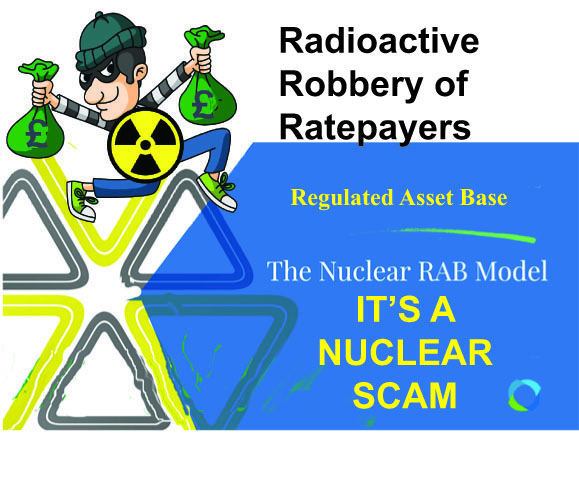
Households began paying for the Sizewell C project via home energy bills at the start of the year to help fund construction. This financial framework, known as a regulated asset base model, is a marked change from the Hinkley Point deal, which will begin to earn a guaranteed stream of revenues from home energy bills only once it begins generating in the early 2030s.
Critics of the regulated asset base model, including the campaign group Stop Sizewell C, have warned that any construction delays could mean that bill payers support Sizewell without receiving power for longer than expected, while the government would be on the hook for the project’s financial risk.
Stop Sizewell C said the risks surrounding the project “could easily turn Sizewell C into a financial disaster” while the funding model meant its investors were “the only ones who can’t lose”.
Any aliens who have been monitoring radio and television transmissions streaming outwards into space from Planet Earth over the past few decades will likely be intrigued, bemused or simply horrified at humanity’s headlong drive towards climate catastrophe. No matter the urgent warnings from climate scientists, the power of billionaires, financial speculators and corporations maintains a death-like grip on governments around the world. Amid the occasional flurry of big business greenwashing and government rhetoric about ‘climate protection’ and ‘eco-friendly’ initiatives, billions of people are being held hostage by the forces that are dragging everyone to the edge of the climate abyss.
New warnings about climate change do, of course, occasionally appear in the press. But rarely, if ever, are there prominent and sustained front-page headlines and news-leading television coverage. Rarer still are impassioned editorials, high-profile presenters and commentators demanding the substantive, radical changes that are needed to avoid the most damaging predicted impacts of business as usual.
Earlier this month, the Royal Albert Hall hosted a 100th birthday party for naturalist David Attenborough, Britain’s most beloved broadcaster. Celebrities showered him with love and praise: Leonardo DiCaprio, Judi Dench, Olivia Colman, Emily Eavis, Chris Martin, Ben Fogle, Raye, Kate Winslet. And Paddington Bear. Attenborough sat in the royal box, alongside Prince William. King Charles delivered a handwritten message from Balmoral Castle via a ‘cavalcade of creature couriers’, including eagles, a red squirrel, a hedgehog, otters, ducks, a fox and deer, thanks to the wonders of CGI. All very nice; all very Disneyfied.
For many years now, Attenborough has been warning about the dangers of mass consumption, pollution, worldwide species loss and global warming. These subjects are clearly of great concern to him, although he started ringing the alarm bell very late.
But the evening gave a wide berth to such uncomfortable topics. ‘Life on Earth’? The climate crisis must be happening on a different planet entirely.
As Jonathan Liew, a Guardian sports journalist and columnist, pointed out:
‘This is, of course, the Attenborough with which our public discourse is most comfortable: depoliticised, universally adored, a man-sized Paddington Bear fit only for our veneration. Who teaches us about tree frogs and seal cubs and stick insects and asks for nothing in return.’
Of course, what Liew called ‘public discourse’ is the tightly constrained media space permitted by state and corporate power.
Liew continued:
‘And perhaps there are more difficult questions to negotiate here: the extent to which he has been a force for the meaningful and revolutionary change he seeks, and the extent to which his broad, inoffensive appeal has been more hindrance than help, allowing the powerful to feign concern for the planet while shirking the tough and bloody compromises required to secure it.’
To his credit, Attenborough has been eloquent and impassioned in recent years about the climate crisis. He addressed the COP26 climate summit in Glasgow in 2021, saying that:
‘We are already in trouble. The stability we all depend on is breaking. This story is one of inequality, as well as instability. Today, those who’ve done the least to cause this problem, are being the hardest hit. Ultimately, all of us will feel the impact, some of which are now unavoidable.’
But, even five years on, as the climate crisis worsens, the topic was deemed unmentionable by the organisers of Attenborough’s 100th birthday party.
‘Hothouse Earth’ And Collapsing Currents
In February, a new scientific report warned that runaway global warming is closer than had previously been thought. We are heading for the ‘point of no return’ after which we would be locked into a hellish ‘hothouse Earth’. Climate ‘tipping points’ would be triggered, producing rapid heating, which would lead to a domino effect of yet more tipping points and feedback loops. These include the melting of the Greenland and Antarctic ice sheets, drastic dieback of the Amazon rainforest and the weakening, and possible shutdown, of the Atlantic ocean conveyor belt known as the Atlantic Meridional Overturning Circulation (AMOC).The scientists stated that:
‘Earth’s climate is now departing from the stable conditions that supported human civilization for millennia.’
The world has already experienced a global average temperature rise of over 1.3C since pre-industrial times and is likely to surpass the Paris Agreement ‘limit’ of long-term average heating of 1.5C in the next few years. Current government and business policies are pushing us towards 2-3C of global warming, if not more, by 2100.
But, if trigger points are breached and runaway global warming occurs, we are talking about much higher temperature rises, perhaps 10C or more. This would mean almost unimaginable catastrophic effects on the climate system, global agriculture and societal infrastructure; not to mention the extinction of humans. Scientists have warned that even a rise of 3-4C means that ‘the economy and society will cease to function as we know it’.
Bill McGuire, Professor Emeritus of Geophysical and Climate Hazards at University College London, put things in grim perspective via X:
‘We are already locked-in to a return to Pliocene [around 2.6 to 5.3 million years ago] conditions (3C hotter and (eventually) ~ 20m sea-level rise)
‘Keep going as we are, and hotter Miocene [5.3 to 23 million years ago] conditions will result
‘Beyond this a return to early Eocene [around 48 to 56 million years ago] hothouse beckons – and potential oblivion’
During the Eocene, the global average temperature was well over 10C higher than present. Oblivion would hit humanity long before such a temperature rise occurred.
Earlier this month, yet another deeply disturbing scientific studyrevealed that the risk of AMOC reaching a tipping point by 2100, after which its shutdown would be inevitable, is as high as 50 per cent. Previously, this was considered ‘a low likelihood event’ of around five per cent. But even this should be held in perspective. How many of us would board a plane knowing that there was a five per cent chance that it would crash?
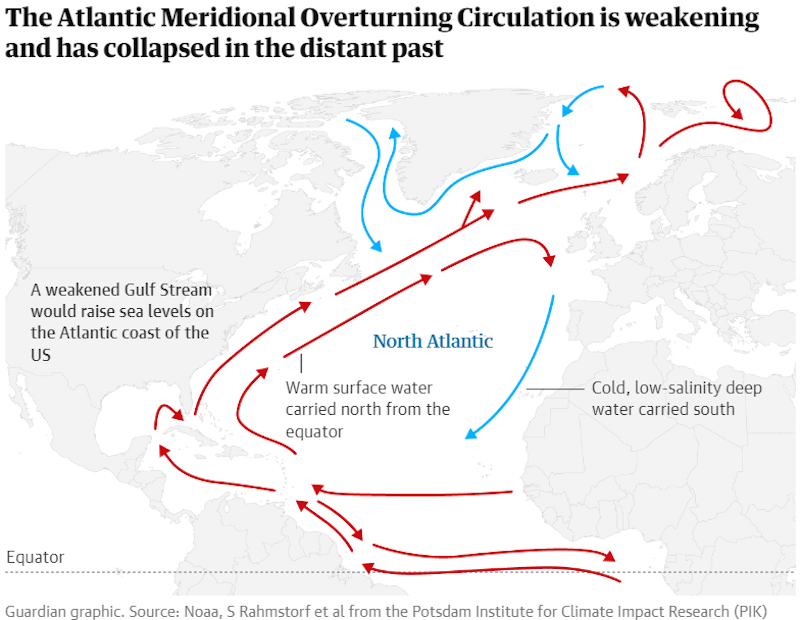
AMOC, of which the Gulf Stream is the best-known component, is a vital carrier of warm water from the tropics to high latitudes in the North Atlantic, returning cold water southwards. It is a primary source of heat for western and northern Europe, leading to the temperate climate here. AMOC connects with other ocean current systems in a global network that transports heat, water, nutrients and carbon around the planet. Any disturbance to AMOC, far less its collapse, would have devastating global consequences for climate, agriculture, infrastructure and even for the habitability of Earth.
Professor Stefan Rahmstorf of the Potsdam Institute for Climate Impact Research in Germany, who has studied AMOC for 35 years, said:
‘This is an important and very concerning result. It shows that the “pessimistic” models, which show a strong weakening of the AMOC by 2100, are, unfortunately, the realistic ones, in that they agree better with observational data.’
He added:
‘I now am increasingly worried that we may well pass that AMOC shutdown tipping point, where it becomes inevitable, in the middle of this century, which is quite close.’
To emphasise: the tipping point may be much earlier than 2100; it could happen by 2050, or even sooner. The vital point here is that scientists increasingly agree that the ‘safe window’ to stabilise the current by halting emissions is closing far faster than previously thought. And the public likely does not even realise it.
Rahmstorf had previously said that a collapse must be avoided ‘at all costs’. Now he added:
‘I argued this when we thought the chance of an AMOC shutdown was maybe 5%, and even then we were saying that risk is too high, given the massive impacts. Now it looks like it’s more than 50%. The most dramatic and drastic climate changes we see in the last 100,000 years of Earth history have been when the AMOC switched to a different state.’
In an English-language video for the German DW news channel, Rahmstorf explained the importance of AMOC for European and global climate, and the significance of the latest alarming results. He warned that we should expect more climate extremes in heat, cold, drought, floods and storms.
If and when the AMOC collapses, the impact on agriculture in the northern hemisphere will be devastating. The drop in harvest yields for key crops could be as high as 50 per cent. Mass starvation is a very real possibility.
Climate Shocks
……………………………………………………………………………………………………. The fact that deeply disturbing findings about a likely collapse of a vital component of the climate system were not given wider, extensive and sustained coverage is a devastating indictment of ‘mainstream’ journalism.
……………………….Scientists are warning, as loudly as they possibly can, that the present economic system of rampant capitalism is destroying the very life-support systems that made Planet Earth a habitable environment for humans to evolve and flourish.
……………………………………………………………………………………………………………………………………………….. Look at the daily, hour-by-hour obsessing over the endless maneuvering within the Labour government; every single statement from ministers and their allies scrutinised by the Westminster bubble of political correspondents.
Imagine that, instead of focusing on short-term melodramas, leading news organisations rigorously probed politicians, day in and day out, about the climate crisis.
Imagine that news editors and journalists relentlessly challenged the government about current policies that are bringing us closer to the brink of climate chaos.
Imagine that reporters investigated and exposed the deep reluctance and state-corporate obstacles, including the establishment media, that are blocking alternatives to climate Armageddon.
The financing of Sizewell C has been scrutinised by the National Audit Office (NAO), which found it “places more risks on taxpayers and consumers than other electricity projects” and that benefits to consumers will only outweigh costs after 2060.
In July 2022, the Department for Energy Security and Net Zero (DESNZ) announced it had secured the final investment decision (FID) for the project on the Suffolk coast, which is expected to produce 3.2GW of electricity.
Achieving the FID meant that investors and the government had agreed the terms on which investment would be put into the project, how returns on investment would work, and what this meant for consumers.
The government confirmed that the project would cost “around £38bn”, nearly double the original £20bn estimate stated by EDF in 2020.
Today’s [20 May] NAO report, simply titled Sizewell C, assessed “the implications of the deal for taxpayers, electricity consumers, and investors, and provides a baseline against which progress can be measured.”
A statement from the NAO, announcing the report, said DESNZ’s “delivery model for Sizewell C places more risks on taxpayers and consumers than other electricity projects, but the Department believes this model has reduced finance costs and will allow the project to be delivered on time and to budget.”
It added that the “novel approach has costs and relies on big assumptions
Once construction at the plant has been completed, the government’s modelling “predicts that the net benefits for consumers could be up to £18bn, primarily delivered through energy bill savings and reduced electricity costs compared to other ways of reaching net zero,” the NAO said.
“However, as a large infrastructure project, DESNZ’s modelling of these benefits shows they will not outweigh the costs to consumers until after 2060.”
The report also assessed the claims by Sizewell C that it will be easier to build because it is largely copying the designs of Hinkley Point C.
The NAO pointed out that Hinkley Point C “is currently expected to cost double its initial projected cost, with a seven-year delay”, and that this “has sparked concerns that these problems may be mirrored in Sizewell C”.
The spending watchdog said DESNZ hoped to avoid repetition of mistakes by “applying the lessons and final designs from Hinkley Point C”, and, as such, “Sizewell C’s plans are already at a much more advanced stage than Hinkley’s were at the equivalent point”.
NAO head Gareth Davies said: “Sizewell C forms a significant part of the government’s plan for a secure and affordable clean energy supply. There has been a concerted attempt to learn from the problems of previous nuclear power construction projects and other large infrastructure schemes.
“This has resulted in a novel financing structure and DESNZ will need to monitor the risks to taxpayers and billpayers closely.”
Public Accounts Committee chair Geoffrey Clifton-Brown commented on the report, raising concerns about the “substantial” risks of Sizewell C, which are being borne by the public.
“Sizewell C is a project of exceptional scale, complexity and significance for taxpayers. Costs are estimated to be £38.2bn, largely financed by government”, he said.
“While the potential benefits are considerable, they remain uncertain; by contrast, the risks are immediate, substantial and borne by the public. Consumers are already contributing through their electricity bills, and the government has assumed most of the project’s financial risk.”
He added: “Experience from comparable nuclear projects in the UK and overseas highlights their vulnerability to delays and cost overruns.
“Although the government has introduced a new delivery and financing model to mitigate these risks, it must now ensure it works in practice through close monitoring, greater transparency to Parliament, and by securing value for money from the significant public and private investment.”
Reaction to the report..…………………………………………………………………………………………………………….
University of Greenwich emeritus professor of energy policy Steve Thomas gave NCE his reaction to the NAO report, asking, “Is this the best NAO can do after a year of effort?”
He pointed to a line from the NAO press release about the report, which said: “Sharing risk between the investors and taxpayers and consumers appears to have reduced the cost of financing Sizewell C, but the rewards for investors still appear high.”
He said the statement that financing costs had been reduced was “rubbish on two grounds”.
“First, the finance costs are being paid by consumers in the construction period under the RAB (Regulated Asset Base) surcharge. Getting someone else to pay does not reduce them, it just shifts them.
“Second, the finance is being provided by the government National Wealth Fund and the interest rate will be whatever the government tells it to charge, so if finance charges are lower because the interest rate is reduced, that is because the government has imposed the interest rate.”
The press release also said: “Investor financial returns will cost consumers over £4bn but will be justified if they help the project to cut construction costs and speed up delivery times.” Thomas described this as “unclear”.
He said: “If it refers to the 4.8% of the 10.8% real rate of return investors will be given, that will be a gift from consumers to investors, it is an underestimate. Centrica says that of its £3bn equity contribution, only £1.3bn will come from itself, the rest will come from this 4.8% which investors are required to use as equity contribution.
“Centrica euphemistically describes this as ‘RAB Growth’.”
The NAO statement adds that DESNZ assumes “the involvement of private investors is justified, as their expertise will reduce construction costs and speed up delivery.”
In response, University of Greenwich academic Thomas asks: “What expertise does La Caisse, Centrica, NLF have on building nuclear projects? EDF has expertise but that didn’t stop Hinkley, Flamanville, and even Taishan going horribly wrong.”
He also questions the government’s use of £38.2bn as a baseline cost for Sizewell C, describing it as “wrong”, because the lower regulatory threshold cost is £40.5bn, which the government is using as its central estimate.
“£38.2bn is clearly the lower end of the range. A very basic element of project appraisal is to use central estimates, not bottom of the range ones,” he added.
A Stop Sizewell C spokesperson told NCE that the campaign group shares a lot of the NAO’s concerns, and asked for the government to commit to a public, “realistic” completion date for the project.
“The NAO’s report confirms what we already suspected – that ‘big assumptions’ and the ‘significant uncertainty’ of factors underpinning DESNZ’s claimed benefits could easily turn Sizewell C into a financial disaster, with its investors – thanks to RAB – being the only ones who can’t lose,” the spokesperson said.
“As the NAO confirms, households are relying on those investors to produce significant savings and reduce Sizewell C’s construction time to justify the nuclear tax on our energy bills, but we share the NAO’s questions about whether investors can or have the incentives to do this.”
They added: “We had asked the NAO to look at Sizewell C before it reached Final Investment Decision and are dismayed it did not do so, but at least some critical information withheld by the government is now in the public domain.
“We agree with the NAO that DESNZ must provide transparency of forecast cost and schedule for Sizewell C. We call for the government’s promised Sizewell C Strategy and Delivery plan, containing a public, realistic completion date, to be laid before parliament immediately.”
TASC spokesperson Chris Wilson told NCE: “The NAO report regarding the Sizewell C project confirms that this government’s ideological pursuit of nuclear power is based on hope and belief rather than objective judgement.
“Ignoring all the warnings and project risks, the usual optimism bias regularly expounded by the nuclear industry is there in spades, at the same time negative assumptions are made about the cost of renewables
“That DESNZ went ahead with the Sizewell C investment decision on the basis that consumers would not benefit until 2064 beggars belief.
“The NAO report highlights a stark imbalance in DESNZ’s Sizewell C funding model: the investors are shielded from risk while reaping massive profits, leaving the public purse and electricity consumers to shoulder an unfair and excessive financial burden.”
Wilson added: “A major concern highlighted by the NAO is the lack of incentive for EDF to complete Sizewell C on time and budget – they will get paid to develop and supply major components while receiving a guaranteed return on their investment.
“EDF have been involved in every previous EPR reactor project and all of them have gone woefully over time and budget – they now have the added distraction and priority of building the new EPR2 reactor programme in France. What could possibly go wrong?”
The police force tasked with stopping terrorist attacks at UK nuclear sites dealt with dozens of internal security breaches last year – including a classified laptop going missing, contractors working without proper background checks, and armed officers losing ID cards.
Three breaches involved classified material being lost or stolen outside the Civil Nuclear Constabulary’s (CNC) premises – including two police warrant cards, used to identify officers, which were supposed to arrive via courier.
A further nine cases involved the loss of identity passes, including those belonging to armed officers, and two contractors were found to be working without “appropriate” vetting.
Other breaches included confidential material being left inside body armour sent for destruction, a staff member accessing information they were no longer authorised to see, and compromised personal data. There were 35 breaches in total, the CNC reported.
The CNC is the armed police force that protects civilian nuclear facilities across the UK, including Torness and Dounreay in Scotland. The force also escorts nuclear material when it is being transported and guards other “critical national infrastructure” such as gas terminals.
Our findings come after we submitted a freedom of information request to the force. You can read full details of the breaches here.
Opponents of nuclear energy said the UK “cannot afford to be sloppy when it comes to nuclear security” and claimed “very little appears to have been done” to tackle breaches in recent years.
The CNC described the security incidents last year as “minor” and a spokesperson told The Ferret the force “takes action on all incidents and seeks to learn lessons” from them.
National Audit Office report says consumers will pay higher amount for energy from Suffolk project compared to its Somerset counterpart. Electricity from the Sizewell C nuclear project is set to be more expensive than power from Hinkley Point, even though the Suffolk plant is cheaper to build, Britain’s public spending watchdog has said.
Sizewell C is on course to cost about 22 per cent less than Hinkley Point C, which is being built in Somerset. But the latter has agreed to sell its electricity at a fixed price, limiting the cost to end users because developer EDF has to absorb any cost overruns.
A National Audit Office report published on Wednesday estimates that if construction costs are in line with forecasts of £38bn-£48bn, electricity from Sizewell C will cost between £131-£155 per megawatt hour in 2024-2025 prices. This compares to £129 per MWh for electricity from Hinkley Point C.
The government and a consortium of developers had regularly highlighted that Sizewell C would be cheaper to build than Hinkley amid concerns about the cost of the project. But the NAO report says: “Although Sizewell C should cost less to build than Hinkley Point C, it is likely that consumers will pay more for energy . . . because the price of Hinkley’s electricity was set before its cost over-ran (which has been borne by EDF), and the cost of borrowing has also increased since then.”
The nuclear industry will become “more dangerous” and regulation of the sector has been captured by “vested interests,” campaigners and experts have told the Canary, after the Nuclear Regulation Bill was put forward in the 2026 King’s Speech.
The Labour Government had already said in March 2026 that it was committed to implementing the recommendations of the Nuclear Regulatory Review, which was led by John Fingleton – sometimes referred to as the Fingleton Review.
Announcing the findings of the review in March 2026, the government said:
overly complex regulation in the UK has contributed to the ‘relative decline’ in the UK’s global leadership position in nuclear.
It also set out 47 recommendations to:
to speed up building new nuclear projects.
King’s speech 2026
The King announced the Bill in his King’s Speech, saying:
My Ministers will also take forward recommendations of the Nuclear Regulatory Review and encourage a new era of British nuclear energy generation.
In briefing notes published by the government, which explain their plans in more detail, the government referenced the Fingleton Review, which it characterized as calling for “a radical refresh” of the nuclear regulatory regime.
It went on to say that the Nuclear Regulation Bill is:
modernising the way that new nuclear projects are regulated so we can deliver safe, secure and affordable nuclear power and infrastructure sooner, while maintaining strong environmental protections.
The briefing notes tried to placate fears that the recommendations in the Fingleton Review could erode environmental protections.
They added:
To speed up the delivery of new nuclear and reduce costs, the Government is overhauling planning and regulation in a boost to the UK’s energy sovereignty and the nuclear deterrent.
This Bill will support quicker delivery of nuclear projects in a way that produces a win-win for building critical infrastructure while protecting nature and the environment, and high standards of nuclear safety.
‘Industry falsehoods’ used to justify risk nuclear projects pose to nature – conservationist
The Wildlife Trusts‘ head of public affairs Matthew Browne told the Canary:
This Government was elected to govern on the basis of a manifesto that promised to restore the natural world. We are a long way from this promise being delivered. Today’s King’s Speech is silent on nature recovery, and includes measures that will actively harm wildlife.
Whilst early proposals for the ripping up of nature protections have thankfully been dropped, the Nuclear Regulation Bill is justified on the grounds of industry falsehoods which minimise the risk projects can pose to nature. The Regulating for Growth Bill gives environmental regulators an inappropriate focus on growth, bending their work away from vital nature recovery objectives.
With ongoing nature loss impacting our ability to grow food, to protect communities from flooding and our ability to stay healthy, this failure to respond to a growing national security crisis risks fundamental dereliction of duty. The Government needs to change course, and face up to environmental reality, before it comes an economic and social disaster.
Bill will make ‘inherently dangerous’ nuclear power ‘more dangerous’ – anti-nuclear campaigner
When you think of nuclear accidents like at Windscale in 1957, Chernobyl in 1986, or Fukushima in 2011, it’s easy to see that Britain’s current nuclear regulatory procedures and rules are in place for a simple reason – that nuclear power is inherently dangerous.
Rather than acknowledge these risks or legacy issues – like tackling the toxic waste generated by nuclear power – the government’s plan to cut regulations essentially means this industry will be more dangerous.
This is disturbingly similar to what Donald Trump did earlier this year when he gutted the US Nuclear Regulatory Commission and the US Environmental Protection Agency.
These proposed regulatory changes are also for the benefit of Britain’s deadly and costly nuclear weapons programme, which already accounts for almost a quarter of Britain’s military budget. Rather than strengthening our security, these proposals will instead weaken it and put us all at even greater risks from the nuclear industry.
Government should pursue renewables instead of nuclear – SNP
Scottish National Party (SNP) Alex Kerr MSP told the Canary:
Under Keir Starmer’s watch, energy bills have spiralled out of control, 1,000 jobs are being lost every month in the North Sea and Scotland’s only refinery at Grangemouth has closed – the Labour party has zero credibility when it comes to energy.
Now Labour is ripping up regulations to pursue its dangerous obsession with nuclear power.
Scotland has an abundance of clean energy sources – we don’t need new nuclear power stations, which are ludicrously expensive, take years to build, and leave us with dangerous waste.
Another energy superpower, Norway, has just ruled out using nuclear energy. With the fresh start of independence, Scotland can do the same and use our vast energy wealth to lower bills, enhance our energy security, and build a wealthier country.
Pursuit of nuclear instead of renewables unjustifiable – academic
University of Sussex emeritus professor Andy Stirling told the Canary that the evidence shows renewables should be pursued instead of nuclear, and the only reason that the government wants a civil nuclear sector is to enable the UK’s nuclear weapons programme.
He said:
Detailed plans for deregulating nuclear power set out in the King’s speech further underscore how deeply policy making in this field has been captured by vested interests.
Despite huge official noise around this issue, no UK Government document has systematically compared nuclear with alternative options to deliver affordable, safe, secure, domestic low carbon power. This situation in itself seriously undermines both sound policy making and wider democracy.
If any such analysis were to have been undertaken, the overwhelming independent evidence is, that it would have had to conclude that nuclear is verging on obsolescent as a means to deliver these objectives. Even existing mature forms of nuclear power costs many times more than comparable means to deliver firm-equivalent electricity and are far slower and problematic in other ways. So consumer bills are raised and climate action delayed.
That the Government does not even try to make arguments against this, shows the real reason for supporting high price, slow, troublesome nuclear power, is to underpin equally problematic and ineffective nuclear weapons ambitions.
Bill sets government on ‘collision course with communities’ – anti-Sizewell C campaigner
Stop Sizewell C executive director Alison Downes told the Canary:
The government is on a collision course with communities over its plans for a Nuclear Regulation Bill, for example in response to the Nuclear Regulatory Task Force it included the concerning promise to ‘go further’ in creating a new pathway to allow semi-urban nuclear power stations.
Ironically, rigorous public consultations are promised, but the Prime Minister’s inflammatory rhetoric directed at those who express concern about new nuclear plants in no way builds public confidence. We need assurances of strong, independent regulators and affected communities to be allowed to actively engage, not be insulted.
“This place is not a place of honor … no highly esteemed dead is commemorated here … nothing valued is here. What is here was dangerous and repulsive to us. This message is a warning about danger
Very soon, likely within a few weeks, one of the world’s most interesting pieces of infrastructure will open after 22 years of construction and almost half a century of contemplation. Called Onkalo – Finnish for “cavity” – the site will be the world’s first permanent repository for nuclear waste.
By law, Finland obliges that nuclear waste produced domestically must be stored domestically. That will now occur on the island of Olkiluoto at a depth of more than 400 metres within bedrock that’s almost two billion years old. Currently, the repository area is about two square kilometres and comprised of 10 kilometres of tunnels – this number will likely quadruple before the site’s decommissioning in around 2100, when this cavern will be backfilled and sealed, creating a self-maintained nuclear sarcophagus for the approximately 100,000 years it will take for the waste’s radioactivity to have decayed to safe levels.
Perhaps by now you’re beginning to intuit a little about a) the complexity of its design, b) the richness of its semiotic implications, and c) the sobering absence of anything approaching a precedent for this. Consider: after its decommissioning, Onkalo must remain perfectly passive, requiring no active management or monitoring for 100,000 years. Second, its profound danger must be communicated so far into the future that current languages, customs – even genetic dispositions – can no longer be assumed to exist. It’s a strange and disquieting fact that the radioactivity of our nuclear waste might outlive our languages for communicating its danger. Third, no man-made structure has ever lasted anything close to the length of time that Onkalo is hoped to be preserved for.
Let’s start with the simpler facts of the site. Olkiluoto Island was chosen for its geological stability – the low-permeability of its bedrock and its low-risk of seismic tremors. In Michael Madsen’s fascinating 2010 documentary about the site’s design, Into Eternity, one project adviser explains how time down there goes slowly, while up here, on the surface, it passes very, very quickly.
In other words, the crystalline rock 450 metres below ground here looks much the same as it did 500,000 years ago. The surface of our planet, however, would look unrecognisable if we travelled back just 200 years. Our natural, political and material world changes often and quickly – the latter to the whims and passions of its human inhabitants, our creative and destructive ingenuities, and the gravity of civilisational entropy. The natural world, meanwhile, forever remains subject to the whims and passions of storms and droughts and a climate that’s being altered by us.
Currently, the world’s approximately half-a-million tonnes of nuclear waste is kept in temporary storage on the surface of our planet, and is thus subject to war, sabotage or natural calamity. Much safer to secure it deep down where time moves slowly.
There is something lusciously strange and dreamlike about the projections and assumptions Onkalo’s designers were asked to make. They did nothing less than imaginatively commune with a form of humanity far into the future.
The weirdness of this can be emphasised by offering some modest timescale. The birth of Jesus Christ was 2000 years ago. The pyramids of Giza were completed about 4500 years ago. The previous Ice Age ended almost 12,000 years ago and found the peak of its severity about 10,000 years before that. That is still nowhere near 100,000 years, the length of time into the future for which Onkalo must remain independently stable and for which the warnings we write today must travel and remain intelligible.
And so, the niche field of nuclear semiotics: how do we communicate today’s intentions to a civilisation so distant that we presume it to be almost alien and to not share our language? Preceding this question though, is another: should we even try? Can we assume that humanity will, in 80,000 years, say, possess the same curiosity we do today? That is, will they perform the same enthusiastic archaeological excavations as we do now? And, if so, will they treat the nuclear tomb as we might an Incan crypt?
Might it be that by signposting the danger, we simply encourage their curiosity? Would warnings, even if we could guarantee their future intelligibility, serve to appropriately quell curiosity or dangerously arouse it?
The questions only birth more questions. Given that Onkalo is so deeply buried, and its decommissioning would involve erasing all surface infrastructure, can it not be assumed that it would never be accidentally found? Or might some evidence of its existence survive? Physical evidence, or digital? Is it preposterous to think that any digital evidence of our civilisation today could survive so far into the future – when, between now and the safe decay of the waste, there is assumed to fall several new ice ages?
The designers answered at least one big question: they would, via ceramic tablets, leave warnings to our future selves about the site. Detailed warnings, in several languages unlikely to survive several epochs, have been suggested: “This place is not a place of honor … no highly esteemed dead is commemorated here … nothing valued is here. What is here was dangerous and repulsive to us. This message is a warning about danger.”
Also proposed are simple pictographs that are assumed to have a universally intelligible quality: a triangle that includes the radioactive symbol, a skull and crossbones, an arrow pointing away from the danger, and a human stick-figure running in the direction it suggests.
Given the spookiness of radioactivity – and the oddity of communicating its dangers across a chasm of time to unknowable descendants – the project invited some strange proposals. One was rendering the surface above the tomb conspicuously forbidding: lightning bolt sculptures amongst forests of barbed wire. (But optimistically assuming their material survival, how can we assume that their symbolic charge would survive, and not simply invite curiosity as cryptic anachronisms?) Another proposal was made for genetically engineering cats who change colour in the proximity of radiation – a kind of bizarre Geiger counter.
In 2020, the American electronic music producer (and roboticist) Skytree, aka Evan Snyder, released a track called “Atomic Priest” written with rapper Jackson Whalan. Its lyrics were about precisely the problem of communicating danger forward through “deep time”:
This is for the humans living ten thousand years from now With radioactive capsules, thousands of feet underground Grabbin’ the mic to warn you of these hazardous sites For those who lack in the sight in the black of the night The least good that we could do is form an Atomic Priesthood To keep the future species from going where no one should We’ve buried the mistakes of past nuclear waste Hidden underground for future races to face It’s our task to leave signs for civilization to trace But who’s to say what language these generations will embrace?
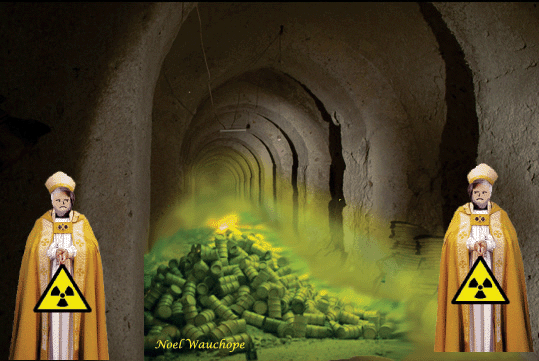
The American-Hungarian linguist Thomas Sebeok minted the term “atomic priesthood” in the early 1980s. Sebeok thought that, given that radioactivity of our waste would outlive current languages (and God knows what else), the trick to communicating our warnings about it lay in folklore. Sebeok had been commissioned by the US Department of Energy to this end. In 1980, the department had established the “Human Interference Task Force”, which was asked to “investigate the problems connected with the post-closure, final marking of a filled nuclear waste repository. The task of the HITF is to devise a method of warning future generations not to mine or drill at that site unless they are aware of the consequences of their actions.”
In 1984, Sebeok submitted his report. It was called “Communication Measures to Bridge Ten Millenia”. Semiotics were everything here, Sebeok wrote, given its relevance to “the problems of human interference and message exchanges involving long periods of time, over which spoken and written languages are sure to decay to the point of incomprehensibility, making it necessary to utilize a perspective that goes well beyond linguistics”.
Here, then, is the luscious strangeness of nuclear semiotics – a field that overlaps with our formal considerations of communicating with extraterrestrial intelligence, but which seems even stranger to me given that the aliens in this case are our future selves.
Sebeok suggested that the best way to ensure the survival of our warnings deep into the future was through mythology – the enactment of annual rituals and the ratification of legends that were upheld by an “atomic priesthood”. The stories would alter over time, but perhaps the core desire of the transmission – to effectively warn off future excavators – would survive. It wouldn’t matter if the sense of hazard had degraded into superstition, long untethered to science or the danger at hand. Only that a sense of fear and repulsion was maintained.
“A ritual annually renewed can be foreseen, with the legend retold year-by-year (with, presumably, slight variations),” Sebeok wrote in his government report. “The actual ‘truth’ would be entrusted exclusively to what we might call for dramatic emphasis an ‘atomic priesthood’, that is, a commission of knowledgeable physicists, experts in radiation sickness, anthropologists, linguists, psychologists, semioticians, and whatever additional expertise may be called for now and in the future. Membership in this ‘priesthood’ would be self-selective over time.
“The best mechanism for embarking upon a novel tradition … is at present unclear. Folklore specialists consulted have advised that they know of no precedent, nor could they think of a parallel situation, except the well-known, but ineffectual, curses associated with the burial sites (viz., pyramids) of some Egyptian Pharaohs … which did not deter greedy grave-robbers from digging for ‘hidden treasure’.”
Here, then, is the weird world of considering future ones. In a few weeks, Onkalo will become operational, accepting the copper-encased tubes of nuclear waste into its deep tombs of crystalline rock, where things remain more stable than the conditions half a kilometre above.
On April 15th, Declassified UK published a bombshell investigation exposing how in the mid-1990s, senior British political and military officials were well-aware NATO expansion into Central and Eastern Europe “would provoke [the] Russians,” and likely trigger all-out war. Hitherto unreported Ministry of Defence files reveal London knew Moscow’s “sensitivities” over a “hostile military alliance” enlarging up to its borders were profound, and based on very “real” concerns. Yet, NATO’s dangerous crusade to absorb Central and Eastern Europe continued apace, ultimately producing the Ukraine proxy conflict.
Since the so-called Special Military Operation’s February 2022 eruption, British officials have relentlessly reiterated the mantra the proxy war was “unprovoked”. However, a declassified March 1995 Foreign Office memo noted “there was a widespread psychological and intellectual perception in Moscow that NATO was a real threat.” In May that year, then-Prime Minister John Major succinctly articulated Russian anxieties to his Irish counterpart John Bruton, as a “fundamental fear…of encirclement.” Concerns about EU membership were comparatively muted:
“For the Russians, NATO had a much more threatening symbolism and political resonance…The Baltics were particularly difficult, with extreme sensitivity for Russia. It would be very hard to have a NATO border directly against Russia.”
Still, in 1997 NATO invited Czechia, Hungary, and Poland to join, which they did two years later. In 2004, Estonia, Latvia and Lithuania simultaneously joined the military alliance. So too did ex-Warsaw Pact members Bulgaria, Romania, Slovakia, and former Yugoslav republic Slovenia. Declassified UK shows how back in August 1996, British Defence Intelligence prepared a NATO enlargement study specifically forecasting that these countries joining could trigger war, and an alliance military operation launched via Article 5 of the NATO treaty in response.
This refers to collective self-defence, under which NATO members are obligated to come to each other’s defence if attacked. In the scenario, Defence Intelligence assumed “Russia has vehemently opposed NATO membership for the Baltic states and has threatened retaliation to preserve her own security against a perceived hostile military alliance on her borders.” In the real world, Boris Yeltsin made at-times irate public statements about NATO enlargement into the Baltics at the time, while lobbying US President Bill Clinton on the issue behind closed doors.
NATO expansion continued regardless. In December 1996, Declassified UK reports then-Russian premier Viktor Chernomyrdin privately warned Major: “Russia could not stop NATO enlarging, but this would create a fragile situation which could explode.” Otherdeclassified files from this time show senior apparatchiks in London were acutely aware of Moscow’s “concern,” “fears,” “hostility,” “negative attitudes,” and “resentment” over alliance enlargement. Both Major and his successor Tony Blair explicitly pledged in person to Kremlin officials that NATO wouldn’t “move up to Russia’s borders.”
However, a secretSeptember 1996policy paper made clear Britain was committed “to enlarge NATO to the East,” even if “Russian acquiescence is not possible.” In February 1997, Russia’s deputy foreign minister Nikolai Afanasievsky angrily branded public discussions in Western capitals of admitting former Soviet republics to the alliance a “blatant provocation” in a meeting with Jeremy Greenstock, Britain’s ambassador to Moscow. Greenstock reassured his Russian opposite number NATO had “no intention” of admitting former Soviet states “at this stage” – which, technically, was true.
‘Russian Problem’
A March 1997 Foreign Office memo forecast rapid NATO enlargement would “antagonise,” and ultimately “provoke,” Russia into a belligerent counter-response. Yeltsin’s “anxiety” about the “possible accession of Ukraine, the Baltic states and other states of the former Soviet Union” was considered the “most difficult issue” affecting Western relations with Moscow. A more staggered approach was thus required. That month, John Major met with NATO secretary general Javier Solana, who spoke of “Russians fears about NATO troops and equipment moving eastwards.”…………………………………………………………………………………………………………………………………………………………………………………………………………………………..https://www.kitklarenberg.com/p/declassified-uk-knew-nato-expansion
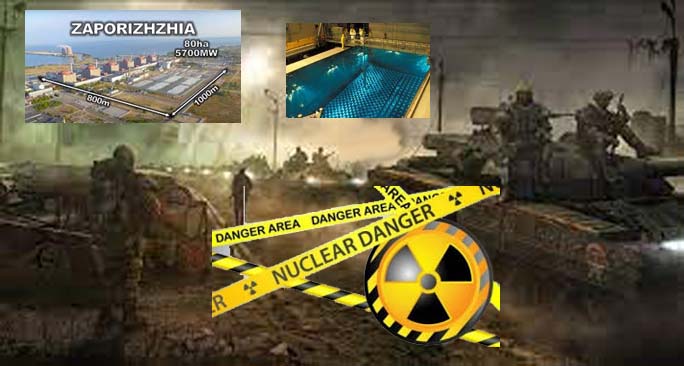
The Zaporizhzhia Nuclear Power Plant in Ukraine was targeted again last week, with continual concern over its safety since the start of the war with Russia in 2022. Safety at Europe’s biggest nuclear power plant is “rapidly deteriorating”, Russia’s nuclear energy chief has warned.
A long-term project we have had here at Bella, that is charting the toxic legacy of the British State. Our map, Scotland the Dump, produced by the wonderful Magnificent Octopus Illustration is being prepared for shipping right now. The map details the weapons ranges, munitions dumps, biological and chemical weapons dumps and nuclear waste scattered around Scotland.









 nuclear-news