Ex-Pentagon Analyst: Biden Faces Shrinking Options on Ukraine
Ekaterina Blinova, https://sputnikglobe.com/20230525/ex-pentagon-analyst-biden-faces-shrinking-options-on-ukraine-1110580213.html
US President Joe Biden is running out of time to score a “victory” in Ukraine, retired Lt. Col. Karen Kwiatkowski told Sputnik’s New Rules podcast.
…………….. Earlier this month, Ukrainian President Volodymyr Zelensky embarked on a diplomatic charm offensive in Europe, drumming up support for the much-discussed Kiev’s “counteroffensive“.
However, the former Pentagon analyst and US Air Force veteran told Sputnik that the Ukrainian armed forces were unlikely to achieve meaningful success, despite an influx of new Western weaponry.
“They have been put on the offense and yet they have been cleaned out militarily,” Kwiatkowski said. “And the aid that they’re getting from NATO isn’t interoperable. It isn’t compatible with what the Ukrainians are used to using. In many cases, it doesn’t work together. So they can’t put together a combined arms operation. They don’t really have an air force. They are really at a disadvantage.”
Many of the military plans announced by the Kiev leadership do not hold water, according to the military expert. For instance, earlier this year Zelensky pledged to seize Crimea, which reunited with Russia in response to the US-backed 2014 February coup d’etat in Kiev.
“Of course, Zelensky says, ‘We’re going to take Crimea’. With what? His armies are largely decimated and exhausted. They’re recruiting teenage boys and 65 year old men. This is not a good sign,” Kwiatkowski said.
She raised the question whether what is left of Ukraine is going to be governable: “Is there enough their territory, culture, people, industry? Is there enough there to constitute a continuing country? That conversation needs to happen. I imagine that Ukrainians are having this conversation.”
Russia moves ahead with deployment of tactical nuclear weapons in Belarus
ABC 26 May 23
Russia has moved ahead with a plan to deploy tactical nuclear weapons in Belarus, whose leader said the warheads were already on the move, in the Kremlin’s first deployment of such bombs outside Russia since the 1991 fall of the Soviet Union.
Key points:
- The plan for the nuclear deployment was announced by Mr Putin in March
- The US has warned that use of chemical, biological or nuclear weapons in the conflict would be met with “severe consequences”
- The US believes Russia has around 2,000 tactical nuclear warheads
The US State Department denounced the deployment plan but said Washington had no intention of altering its position on strategic nuclear weapons and had not seen any signs Russia was preparing to use a nuclear weapon.
Russian President Vladimir Putin says the United States and its allies are fighting an expanding proxy war against Russia after the Kremlin chief sent troops into Ukraine 15 months ago.
The plan for the nuclear deployment was announced by Mr Putin in an interview with state television on March 25.
“The collective West is essentially waging an undeclared war against our countries,” Mr Putin’s defence minister, Sergei Shoigu, said at a meeting with his Belarusian counterpart in Minsk, according to Russia’s Defence Ministry……………………………………………………………….
Russia’s tactical nuclear weapons superiority
Tactical nuclear weapons are used for tactical gains on the battlefield, and are usually smaller in yield than the strategic nuclear weapons designed to destroy US or Russian cities.
Russia has a huge numerical superiority over the United States and the NATO military alliance when it comes to tactical nuclear weapons: the United States believes Russia has around 2,000 such working tactical warheads.
The United States has around 200 tactical nuclear weapons, half of which are at bases in Europe…………………………………….
The Treaty on the Non-Proliferation of Nuclear Weapons, signed by the Soviet Union, says that no nuclear power can transfer nuclear weapons or technology to a non-nuclear power, but it does allow for the weapons to be deployed outside its borders but under its control. https://www.abc.net.au/news/2023-05-26/russia-moves-ahead-with-deployment-of-tactical-nuclear-weapons/102395632
Ukraine: Why Negotiations Are the Only Rational Option in the Face of Climate Chaos and Nuclear Dangers

By Fabian Scheidler / Original to ScheerPost 26 May 23
The Pentagon Leaks have shown that, from the U.S. military’s perspective, the confrontation between Russia and Ukraine has reached a stalemate. Neither side can win in the foreseeable future, according to the assessment. Senior military leaders, such as General Mark Milley, chairman of the Joint Chiefs of Staff, had said so publicly before. This makes negotiations, as difficult as they may be, the only rational option. For a continuation of the war under these conditions would lead to endless bloodshed, to a new Verdun, without achieving the restoration of Ukrainian territory. At the same time, nuclear escalation would become increasingly likely.
Any ethically sound position in such a conflict must weigh the risks and sacrifices to be made for a goal against what can realistically be achieved. Yet even the question of how many people in Ukraine should die in order to shift the future course of the border by how many kilometers is considered cynical and lacking in solidarity by many who loudly pose as friends of Ukraine. But isn’t it, on the contrary, cynical not to ask this very question in the current situation? After all, those who die are Ukrainians and Russian soldiers, not those who muse in Berlin or Washington about war aims and noble principles. And those affected in Ukraine themselves currently have no opportunity to express their views on the matter by voting. …………………………………………………………………..
Geopolitical and ecological tipping points
The question, which kind of ethics we choose, goes far beyond the consequences of war in the narrower sense and relates to the entire global situation. The world faces a whole series of dangerous tipping points, both geopolitical and ecological. For one thing, a lasting new bloc confrontation greatly increases the risk of nuclear war. Even a “limited” nuclear exchange would lead globally to a nuclear winter and wipe out a large part of humanity. For this reason alone, diplomacy based on an ethics of responsibility is the only rational option.
Second, the new cold and hot war destroys the chances of preventing climate and biosphere collapse in several ways. If we cross some of the imminent tipping points in the climate system, the Earth threatens to enter an entirely new state that climate scientists call Hothouse Earth. Entire regions of the Earth, including parts of South Asia, the Middle East and Africa, would become uninhabitable. To prevent this, most of the fossil fuels in the Earth’s crust must remain in the ground. For this, in turn, intensified international cooperation – including with China and Russia – is indispensable.
As far-fetched as this may seem at the moment, the West must make Russia offers on how it can transform itself from an exporter of fossil fuels into a producer of renewable energies – because the largest country on earth has enormous potential for this. If Russia remains a pariah from the Western perspective, a nation with whom one does not talk, such a perspective is unthinkable.
The new bloc confrontation also threatens to channel the resources urgently needed for a socio-ecological transformation into the most destructive and climate-damaging of all sectors: the military. ……………………………..
According to the calculations of U.S. economist Robert Pollin, an effective Global Green New Deal that could still prevent devastating climate chaos would cost about $4.5 trillion annually – about 5 percent of global GDP. This sum would be affordable, but only if global military spending were curbed at the same time…………………………………………..
The question of sovereignty
The urgent need for negotiation initiatives is often brushed aside with two arguments. One, it is said, is that one cannot negotiate with a monster like Putin. But the history of the March 2022 negotiations, which had led to significant rapprochements between the two sides, proves otherwise. Secondly, it is repeatedly pointed out, especially by the U.S. government, that it is not up to us to propose compromises, that it is exclusively up to the Ukrainians. Of course, it is up to Ukraine and especially its citizens – who, however, have not even been consulted about any of this for years – to make decisions about war, peace and negotiations. But it is completely out of touch with reality to pretend that this war is taking place in a geopolitical vacuum………………………………………
……………….It is also interesting that the argument against interference comes from the U.S., of all countries, which has massively interfered in Ukraine’s affairs for a long time……………
………………………… more https://scheerpost.com/2023/05/25/ukraine-why-negotiations-are-the-only-rational-option-in-the-face-of-climate-chaos-and-nuclear-dangers/
Russian vessel attacked by Ukrainian sea drones off Bosporus
The navy ship, which was patrolling the TurkStream gas pipeline, destroyed all of the incoming drones, the Russian military says
The Russian Navy reconnaissance ship, ‘Ivan Churs’, has fended off an attack by three unmanned speed boats launched by the Ukrainian military, the Defense Ministry claimed on Wednesday.
The vessel was targeted by the drones in the early morning in Türkiye’s exclusive economic zone, some 140km (86 miles) to the northeast of the Bosporus Strait, the ministry’s spokesman, Lieutenant General Igor Konashenkov, said during a daily briefing……………………
Over the course of the ongoing conflict, Ukraine has repeatedly used sea drones in order to strike Russia’s Black Sea Fleet. The latest attack is the most long-range, with previous attempts targeting warships stationed at the port of Sevastopol on the Russian Crimean Peninsula. The attacks, however, have been unsuccessful, with the unmanned speedboats detected and destroyed during approach, or becoming caught in the harbor’s protective netting. https://www.rt.com/russia/576839-russian-vessel-ukrainian-drones/
Russia Issues Dire Warning After US Approves Ukrainian Strikes On Crimea
BY TYLER DURDEN, MAY 23, 2023 https://www.zerohedge.com/markets/russia-issues-dire-warning-after-us-approves-ukrainian-strikes-crimea
Russia has issued another stern warning related to further potential Ukrainian attacks on Crimea. “Strikes on this territory are considered by us as an attack on any other region of the Russian Federation. It is important that the United States is fully aware of the Russian response,” Moscow’s ambassador to the US, Anatoly Antonov, warned Sunday.
This was in response to an earlier weekend statement by US National Security Advisor Jake Sullivan to CNN. He said while speaking from the G7 summit in Japan over the weekend, “we have not placed limitations on Ukraine being able to strike on its territory… What we’ve said is that we won’t enable Ukraine with US-systems to attack Russia. And we believe Crimea is Ukraine.”
However, the US has consistently denied that it has OK’d Ukraine using US-supplied advanced weaponry to mount such attacks.
Antonov further stated on Telegram in response that “the unconditional approval of strikes on Crimea using American and other Western weapons” alongside the move among Western allies to supply Ukraine with jets “clearly demonstrate that the United States has never been interested in peace.”
He warned the US administration against “thoughtless judgments on Crimea, especially in terms of ‘blessing’ the Kiev regime for air attacks” on the peninsula.
Per Russian state media, other Kremlin officials weighed in even more forcefully, warning that even nuclear disaster could be the result:
Sullivan’s remarks likewise triggered outrage from Crimean Deputy Prime Minister Georgy Muradov, who opined that by allowing Ukraine to use US-made planes to target the peninsula, the White House had “agreed to unleashing a nuclear war.”
The official recalled that Crimea hosts Russia’s Black Sea Fleet. “An attack on one of the pillars of Russia’s strategic security legally obliges our country to use all available means to prevent it from being undermined.”
Russia has also recently accused Ukrainian forces of using UK-supplied long range rockets which are capable of hitting inside Russia.
This is also a cause for concern in terms of possible Russia-NATO direct escalation: “Storm Shadow missiles, which have a range of more than 250 kilometers, give Ukraine the capacity to strike well behind Russian front lines and as far as Moscow-occupied Crimea,” US state-funded RFERL underscores, while adding that “British media reports said Kyiv had promised not to use the missiles to strike inside Russia’s territory.”
Belgorod Attacks | Russia Removes Nuclear Warheads From Grayvoron Amid Attacks | Ukraine War
Anti-Russia militias, allegedly run by Ukraine, launched an operation into Russia on May 22 focused on the outskirts of Belgorod.
Anti-Russia militias, namely the Legion “Freedom for Russia” and the RDK (Russian Volunteer Corps), entered the Russian region. These militias mostly comprise of Russians who are now being called “traitors” by Russian Telegram channels. The militias claim to have overrun a border village in Belgorod region and call for an “end to the Kremlin’s dictatorship”. The militia groups called on locals to stay at home and not resist as they fought Russian forces in the region. However, reports say that unless they pull back across the border fairly quickly, the militia troops are likely to be annihilated. The Legion Freedom for Russia said they are trying to create a demilitarised zone to ensure Russian troops can’t shell Ukrainian civilians.
However, some experts believe that this operation had some bigger objectives. Watch this video to know what were the militias objectives and why they may aimed at Russia’s nuclear weapons.
French defense minister opposes American takeover of nuclear firm
Economy ministry makes the final ruling.
BY GIORGIO LEALI, MAY 24, 2023 https://www.politico.eu/article/french-defense-ministry-to-block-american-takeover-of-nuclear-firm/
PARIS — France’s defense minister Sébastien Lecornu said he would veto the takeover of nuclear-submarine parts supplier Segault by American industrial machinery giant Flowserve.
“The defense ministry will veto the loss of operational control over company Segault,” Lecornu told French lawmakers Tuesday evening. “I never announced it publicly, but it’s done,” he said.
“For us it’s simple: we don’t want Segault to be controlled by an American company,” said an official from the defense ministry who was not authorized to be named.
France’s economy ministry, which has the final word on the file, was however quick to stress that no decision had been made. “The foreign investment screening procedure is ongoing,” said a French economy ministry spokesperson, declining to comment on the potential outcome.
While the defense ministry participates in the decision-making, the French economy ministry makes the final ruling.
France-based Segault is currently owned by Canada’s industrial valves group Velan, which is being bought by American industrial machinery giant Flowserve. If the deal goes through, Segault would become American-controlled, raising concerns in Paris’ halls of power that Washington would then have access to strategic French technology.
Paris last month confirmed that it was looking for a French buyer, as the file turned into a test of France’s industrial sovereignty ambitions.
Segault supplies components for nuclear-propelled submarines built by state-owned shipbuilder Naval Group and also makes industrial valves that are used on France’s flagship Charles de Gaulle aircraft carrier.
A grim vision of nuclear warfare in Ukraine

The very real danger of nuclear escalation in Ukraine arises not from a putative Putin decision to win on the battlefield at any cost, but from the West’s constant crossing of its own red lines on military aid to Ukraine. NATO states began by sending large quantities of ammunition, small arms and defensive weaponry, then came long-range howitzers and HIMARs followed by air defence systems, tanks and armoured vehicles. Britain has now supplied Ukraine with long-range missiles capable of hitting a multitude of targets deep in Russia. Next will come F16 fighter jets, flown, perhaps, by western as well as Ukrainian pilots.
In Ukraine, grim visions of a new age of nuclear warfare are the natural counterpart of western hardliners’ march of folly towards the nuclear brink. Thankfully, there is an alternative, one that has been possible since the very beginning of the conflict and now has growing support among Western publics.
The Harvard-based website, Russia Matters, recently published an article by retired Brigadier-General Kevin Ryan with the alarmist but accurate headline ‘Why Putin Will Use Nuclear Weapons in Ukraine’.
According to Ryan, who served as a US defence attaché in Moscow, Putin’s use of tactical nuclear weapons is all but preordained because Russia does not have the conventional military power to defeat Ukraine.
In support of this supposition, Ryan recycles the well-worn mantras of western wishful thinking about the military situation in Ukraine: Russia is running out of materiel, its troops are of poor quality and Kiev is going to launch an offensive that will decisively turn the tide of the war in its favour.
As Bakhmut falls and Ukraine reels under successive waves of Russian missile strikes on its infrastructure, air defences and ammunition dumps, Ryan’s words ring more than a little hollow.
Most observers see Putin’s nuclear sabre-rattling as an instrument to deter and limit direct western involvement in the war, but Ryan construes it as evidence that Putin is preparing to use tactical nukes to defeat Ukraine’s coming offensive.
While Ryan is right to emphasise that Western decision-makers underestimate the chances of nuclear war in Ukraine, it is their own escalatory policies that constitute the main risk, not the possibility that Putin might decide to authorise the use of tactical nuclear weapons.
Ryan rightfully points out that Putin has defined Russia’s proxy war with NATO in Ukraine as existential for the Russian Federation. But does that mean battlefield defeat or the loss of occupied territories in Ukraine will prompt him to press the nuclear button?
Putin has defined the existential threat to Russia as Western aspirations to break-up the Russian Federation and subjugate its peoples. That is the outcome he is pledged to do everything in his power to avert, even if it means risking strategic nuclear war.
Ryan also finds foreboding Putin’s appointment of his General Staff Chief, Valery Gerasimov, as overseer of the ‘Special Military Operation’ in Ukraine, together with the heads of Russian ground and air forces as his deputies. This is worrying, says Ryan, because these three officers control Russia’s tactical nuclear weapons, though he concedes that they can only use them at Putin’s behest. Even so, as the 1962 Cuban missile crisis showed, the risk of unauthorised use of tactical nuclear weapons by local commanders is not to be lightly dismissed.
In the absence of a Stavka (HQ) headed by a military-political Supreme Commander – as was the case with Joseph Stalin during the Great Patriotic War – the aforementioned high command structure is only logical, especially when Gerasimov is also the country’s leading military strategist.
Gerasimov and his team must surely be willing and able to use tactical nuclear weapons should Putin consider it necessary, but their conduct of the actual war signals no such strategy or intention. The low risk, force-conservation grind of Russia’s attrition tactics are, if anything, indicative of a concern to restrict the war to the use of conventional weaponry.
The very real danger of nuclear escalation in Ukraine arises not from a putative Putin decision to win on the battlefield at any cost, but from the West’s constant crossing of its own red lines on military aid to Ukraine. NATO states began by sending large quantities of ammunition, small arms and defensive weaponry, then came long-range howitzers and HIMARs followed by air defence systems, tanks and armoured vehicles. Britain has now supplied Ukraine with long-range missiles capable of hitting a multitude of targets deep in Russia. Next will come F16 fighter jets, flown, perhaps, by western as well as Ukrainian pilots.
Western weapons, technicians, trainers, military planners, intelligence gatherers and special forces have killed or contributed to the deaths of tens of thousands of Russian soldiers. At some point Putin may well decide to retaliate by stepping on to the escalatory ladder himself, with who knows what consequences if his spilling of American blood leads to a tit-for-tat response from would-be two-term President Joe Biden.
We will know soon enough if Ryan’s prognostications about the future course of the war are correct. But let’s assume, for the sake of argument, he is right and that facing defeat in Crimea or the Donbass, Putin would go nuclear. Surely that means we should redouble efforts to end the war as soon as possible? What sense does it make to continue a proxy war with Russia that, according to Ryan, is leading to Ukraine’s nuclear obliteration?
Pessimism and passivity are the natural allies of Ryan’s alarmism. Far from advocating restraining Ukraine so as to avoid nuclear escalation, Ryan is content for the West to simply “anticipate a nuclear weapon will be used.” And since, according to him, the use of nuclear weapons by Putin is inevitable, the West needs to prepare for a world in which they have been normalised as a weapon of war.
Ryan seems to discount the possibility that the United States would respond to Putin’s use of nuclear weapons in Ukraine by radical escalatory action of its own – a dubious assumption given Professor Joseph M. Siracusa’s recent report from the NATO-funded Tallinn Security Conference, where a high-ranking American official claimed it would be met by a massive US conventional attack on Crimea and on Russia’s Black Sea fleet.
According to Perth-based political scientist, Siracusa, the numerous Western hawks at the conference were gung-ho for throwing gasoline on the fires of the Ukraine war.
Siracusa’s reporting reveals that the true danger of nuclear escalation stems not from what Putin may or may not do, but from the inscribed logic of the western hardline view of the war as a zero-sum game in which either Russia or the West must triumph.
It is not clear to what extent Ryan supports such extremism but his grim vision of a new age of nuclear warfare is the natural counterpart of the western hardliners’ march of folly towards the nuclear brink.
Thankfully, there is an alternative, one that has been possible since the very beginning of the conflict and now has growing support among Western publics: a peace for land deal in which Ukraine concedes already-lost territory to Russia in exchange for security guarantees about its future as an independent, sovereign state. Such a deal would be a bitter pill for Ukrainians to swallow after so much sacrifice, but it would be far better fate than becoming the nuclear wasteland envisaged by General Ryan.
Russia warns about nuclear power war risk
The involvement of the country members of the North Atlantic Treaty Organization in the Ukrainian conflict, increases the risk of a war between the nuclear powers, Russian Foreign Minister Sergei Lavrov warned.
https://www.plenglish.com/news/2023/05/24/russia-warns-about-nuclear-power-war-risk/ May 24, Luis Linares Petrov
NATO nations are rightfully directly involved in the conflict on Kiev’s side, and such an irresponsible line of behavior seriously raises the risk of a direct confrontation between nuclear powers,” Lavrov said during the 11th International Meeting of Senior Security Representatives.
The official added that the West must abandon the attempts to marginalize the United Nations Organization.
“In the interest of reducing international tension, we call on Washington and Brussels to stop making unilateral decisions, undertaking attempts to marginalize the UN and creating structures outside of it with a limited number of members that lack legitimacy, but seeking to dominate everyone else,” he said.
Lavrov went on to note that Western countries deliberately provoke inter-state and inter-ethnic conflicts in Africa, Latin America and the Caribbean.
In line with colonial practices, they intend to continue exploiting the resources of the African continent, and the United States continues to view Latin America and the Caribbean as its “back yard”, and reacts nervously when these countries pursue independent and autonomous policies, Lavrov said.
Hinkley Point C – Why nuclear power accelerates carbon emissions

https://bhesco.co.uk/blog/hinkley-point-c-why-nuclear-power-accelerates-carbon-emissions Kayla Ente on 21/04/2023 These carbon emissions have already been absorbed in the atmosphere, long before the plant starts producing electricity. Renewable sources of energy (like the three windfarms in Kent powering 400,000 homes) are cheaper, come with much less associated environmental destruction, and have a carbon footprint a fraction of the carbon emissions produced by the concrete footprint of nuclear power.
by Kayla Ente on 21/04/2023
In August 2018, Prof Andy Stirling and Dr Phil Johnstone published their working paper exposing the link between the fissile material produced by nuclear power plants and its importance for military purposes, where depleted uranium is used in weaponry and in submarines1.
The British government now openly admits that the taxpayer subsidises nuclear used for military purposes in our energy bills2. This is the motivation behind the ‘Regulated Asset Base’ (RAB) funding model proposed by the Government to finance new nuclear power. We will all pay for the construction of new nuclear power plants through higher energy bills.
Nuclear power is expensive, toxic and there is no solution for its long term storage. It is powerfully destructive, not only for its use in weaponry, but also leads to an increase in levels of radioactive materials in the air, as has been measured at the Atomic Weapons Establishment in Aldermaston3.
As cancer rates in the UK rise to unprecedented heights, access to health care declines, and more people and businesses cannot afford to pay their energy bills, one must question the wisdom of UK energy policy and how it is manipulated to our detriment.
Hinkley Point C will produce 25TWh of electricity per year. As the electricity is produced whether there is demand for it or not, because a nuclear power plant cannot be switched off spontaneously, the present system of financing means that the taxpayer will fund the wastage that occurs on the grid when nuclear powered electricity generated is not used.
Historically, approximately 64% of energy produced by the centralised energy generation and transmission system has been wasted4. This happens in the production of electricity – the efficiency of the plants themselves, the heat generated that is wasted and the transmission and distribution of electricity across the country. Therefore, the projected carbon emissions savings are overstated because most of the electricity produced is not used, or worse, clean renewable power is switched off to manage oversupply of electricity on the grid.
Construction on the 3.26GW Hinkley Point C nuclear power plant in Somerset began in 2016. Unprecedented feats of engineering have been achieved during the process, of which engineers are rightly proud.
In total, 74,600 tonnes of concrete has been poured to construct its base, the four intake heads and two outfall heads. 3km of cement tunnels have been constructed to expel the cooling water for the plant into the Bristol Channel.
These carbon emissions have already been absorbed in the atmosphere, long before the plant starts producing electricity. Renewable sources of energy (like the three windfarms in Kent powering 400,000 homes) are cheaper, come with much less associated environmental destruction, and have a carbon footprint a fraction of the carbon emissions produced by the concrete footprint of nuclear power.
The newest nuclear renaissance, “Great British Nuclear” is part of the government’s efforts to include nuclear power in the UK green taxonomy, i.e. that nuclear power is considered to be “environmentally sustainable”. Many see this as part of the government’s attempts to defer important investment away from wind and solar power developments (combined with investment in grid scale energy storage to ensure reliability). Because wind and solar power are the cheapest source of electricity, they embed affordability into our self sufficient energy future. They also bring higher gross value added to government accounts, as opposed to investments in carbon capture and storage which only add to the cost of generation, just to continue burning fossil fuels.
By focusing efforts on investing in partnerships with other NATO aligned countries (the USA spends $840 billion every year on its “defence” programme) in the spirit of Brexit, this government irresponsibly spends taxpayer’s money on programmes that maintain business as usual to burn fossil fuels and promote nuclear power instead of protecting its people during times of unprecedented suffering in social care, health care and energy security.
BHESCo have been saying for years that new nuclear power is a bad deal for the UK taxpayer and for the planet. Our Government should be directing its investment towards a national energy efficiency improvement campaign while encouraging the development of clean, renewable energy generation and energy storage.
Trident: Ministry of Defence confirms more than 50 radiation leaks this year

By Hamish Morrison The National 24 May 23
QUESTIONS are hanging over the safety of Britain’s nuclear arsenal after it was revealed there were 58 radiation leaks at Trident facilities in Scotland this year so far.
The Ministry of Defence (MOD) has revealed there were 15 recorded radiation leaks at Coulport and a further 43 at Faslane in 2023 as of April – but said none were considered “serious”.
Alba MP Neale Hanvey is putting pressure on the UK Government to come clean about the safety of Britain’s nuclear weapons.
……………… What constitutes ‘serious’?
Asked by The National to confirm the level of radiation at which the Government would consider a radiation leak to be “serious”, the MoD referred to the International Nuclear and Radiological Event Scale, which does not specify the level of radiation released into an environment is considered to be “serious”
………… The dates of the recorded breaches have also not been revealed.
Hanvey said: “The MoD has failed to confirm the date on which the staff at Coulport building 201 were first informed that they were being relocated to building 41 and have told me that ‘there was no requirement for a public announcement of the relocation of staff from one building to another’.
……………….“It seems that getting answers out of the MoD is like trying to get blood out of a stone. When it comes to weapons of mass destruction in Scotland, it is clear that the UK Government will tell us as much as they have to and as little as they want to.
“These answers continue to prompt further concerning questions. If the MoD will only make public ‘significant radiation exposure’, how many radiation leaks are there into the air or into Loch Long and the Gare Loch each year that the MoD are failing to tell the public about?………………………… https://www.thenational.scot/news/23545590.trident-mod-confirms-50-radiation-leaks-year/
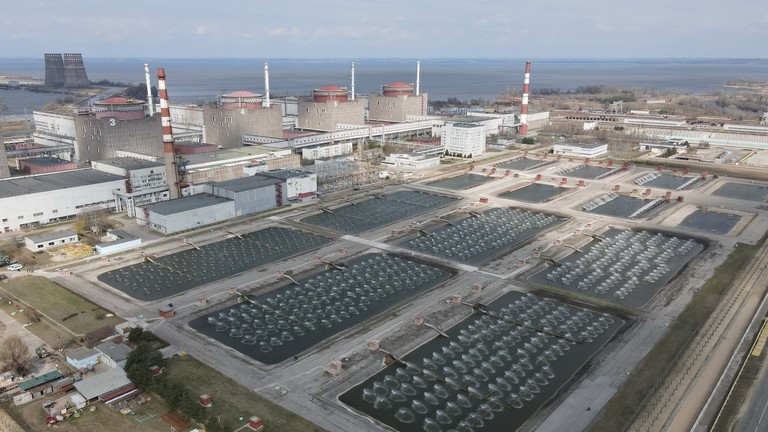
Ukraine: Power loss at nuclear plant underscores ‘highly vulnerable’ safety situation
Peace and Security https://news.un.org/en/story/2023/05/1136932
The Zaporizhzhya Nuclear Power Plant (ZNPP) in Ukraine lost all external power for several hours on Monday morning, highlighting the urgent need to protect the facility and prevent an accident, the Director General of the International Atomic Energy Agency (IAEA) said in a statement.
This marked the seventh time that Europe’s largest nuclear power plant had been completely disconnected from the national electricity grid since the start of the full-scale Russian invasion 15 months ago, the agency said, noting that the facility was forced to run on emergency diesel generators once again.
The plant’s only remaining external 750 kilovolt power line had been cut around 5:30am, local time, and re-connected after more than five hours, according to IAEA experts located at the facility.
‘We’re playing with fire’
Agency chief Rafael Mariano Grossi said the situation demonstrated “the highly vulnerable nuclear safety and security situation” at the plant, which has come under shelling during the conflict.
“As I’ve said repeatedly, this simply can’t go on. We’re playing with fire. We must act now to avoid the very real danger of a nuclear accident in Europe, with its associated consequences for the public and the environment.”
The ZNPP was occupied by Russian forces in the early days of the war and is still being operated by Ukrainian personnel.
Most staff live in the nearby town of Enerhodar. On Friday, the IAEA reported that a location close to the town came under artillery fire earlier that day.
Intense negotiations continue
Mr. Grossi said he continues to engage in intense negotiations with all parties to secure the protection of the nuclear plant, stressing that “I will not stop until this has been achieved.”
He explained that the ZNPP does not have any operational back-up power lines since the last one functioning had been damaged in March, which has still not been repaired.
“For more than two and a half months, this major nuclear power plant has only had one functioning external power line. This is an unprecedented and uniquely risky situation. Defence-in-depth – which is fundamental to nuclear safety – has been severely undermined at the ZNPP,” he said.
Still awaiting access
He called for greater efforts to restore the back-up power lines, while also reiterating the need for the IAEA team on site to gain access to the Zaporizhzhya Thermal Power Plant (ZTPP), located nearby.
The ZTPP has an open switchyard through which back-up power has been provided to the nuclear plant in the past. Access has yet to be granted despite reassurances by the Russian state nuclear company, Rosatom.
Following the off-site power cut on Monday, all the nuclear plant’s 20 diesel generators started operating. However, 12 were later switched off, leaving eight running, which is sufficient to operate all systems safely.
The IAEA said its experts at the site were informed that there is enough diesel fuel for 23 days, adding that after the 750 kilovolt line was restored, the diesel generators were gradually turned off.
Russia evacuates nuclear munitions due to incursion from Ukraine into Belgorodoblast-Ukraine’s Intel
https://euromaidanpress.com/2023/05/22/russia-evacuates-nuclear-munitions-due-to-incursion-from-ukraine-into-belgorod-oblast-ukraines-intel-spox/ Russian authorities have urgently evacuated a nuclear munitions storage facility in the Belgorod oblast (western Russia) following the incursion of the Legion “Freedom for Russia” and RDK (Russian Volunteer Corps) from Ukraine into the Belgorod region, Ukraine’s Intelligence spox Andrii Yusov said.
On 22 May 2023, in the morning, a Russian border crossing in the Belgorod oblast was reportedly destroyed by artillery shelling from the territory of Ukraine. After that, the incursion of troops supported by armored vehicles from Ukraine into the Belgorod oblast began.
The Russian military unit no. 25624, located in the Grayvoron district of the Belgorod oblast, is a part of Russia’s Strategic Missile Forces. It is an “Object C,” which is the conventional name for Russia’s central nuclear weapons storage base, Ukrainska Pravda reported.
The Legion “Freedom for Russia” and RDK (Russian Volunteer Corps), which allegedly comprise Russian citizens who decided to fight on the side of Ukraine and joined the International Legion of Ukraine’s Armed Forces, claimed its fighters crossed the Russo-Ukrainian border and entered the Belgorod oblast from the territory of Ukraine.
The Legion “Freedom for Russia” and RDK announced on their official Telegram channels that their troops advanced deep into the Russian territory and engaged with Russia’s forces in several towns in Belgorod oblast, namely Kozinka, Gora-Podol, and Grayvoron (the latter being around ten kilometers from the Russo-Ukrainian border), and called on residents of the Russian border regions to stay at home and “not resist.” Shortly after this, locals in Grayvoron started to report gunfire in their town.
France holds up EU energy agreement over nuclear power

Paris withdraws support for renewable targets law as it seeks inclusion of hydrogen produced with atomic power
Ft.com Alice Hancock in Brussels and Sarah White in Paris MAY 18 2023
France is leading a coalition of countries holding up agreement on EU-wide targets for renewable energy, as it makes a fresh drive for better treatment of its nuclear industry. The move comes amid a broader pushback against the bloc’s climate agenda as the realities of what is required for the green transition become increasingly apparent.
The EU’s 27 member states were due to agree an overall target of 42.5 per cent of renewable power in the bloc’s energy mix by 2030 on Wednesday.
But France, which relies on nuclear power for the majority of its electricity, signalled that it would not support the text, citing concerns that “low-carbon” hydrogen generated with electricity from atomic power plants would not be counted as part of the targets.
…………….. The vote, which was pulled from the agenda of an ambassadors’ meeting at 11.30pm on Tuesday, would have paved the way for the targets to become EU law following their approval in the European parliament……………………………………..
French officials have in the past rejected criticism that they are promoting the interests of its nuclear industry by arguing that EU rules allow countries to choose their own energy sources. Its fleet of nuclear power plants already give it lower greenhouse gas emissions per unit of GDP than many of its neighbours, although it has missed EU targets for building renewables.
Six pro-nuclear countries, including the Czech Republic, Bulgaria and Hungary, followed Paris’s lead on Wednesday and withheld support for the directive. Meanwhile, anti-nuclear governments, including in Germany and Austria, have been strongly opposed to recognising nuclear power as a clean fuel……………………………… https://www.ft.com/content/b0d3e7e3-a8ae-457b-9482-3282d32973be
Ukraine admits to murdering “quite a few” Russian civilians
BY TYLER DURDEN, Zero Hedge, 22 May 23
A senior Ukrainian official has admitted that his country has assassinated “quite a few” Russian civilians who support Putin and his war to assert control of the Donbas region. In interviews first reported by The Times of London, Major General Kyrylo Budanov, who heads Ukraine’s military intelligence service, also promised more attacks are to come.
“We’ve already successfully targeted quite a few people,” said Budanov. He didn’t name any of the victims, but said “there have been well-publicized cases everyone knows about, thanks to the media coverage.”
Since the February 2022 invasion of Ukraine, several prominent Russian supporters of the invasion — and many innocent bystanders — have been killed or wounded in the campaign.
One of the most prominent such attacks happened last August, when a car bomb killed journalist Darya Dugina — in a possible attempt to kill her father, the political scientist-philosopher Aleksandr Dugin.
Like her father, Darya was a vocal supporter of Putin and his invasion. Both she and her father were sanctioned by the United States after the war began. Given her profile, it’s possible Ukraine may have intentionally murdered her in a sinister two-for-one act of punishment.
Most recently, novelist Zakhar Prielepin was wounded in a May 6 car-bombing, and Russian military blogger Vladen Tatarsky was killed at an April public appearance after a woman presented him a statuette with a bomb concealed inside it. Fifteen others were injured.
For perspective, a hypothetical parallel for this campaign would be Iraq’s intelligence service blowing up Iraq-invasion cheerleaders like Bill Kristol, Jeffrey Goldberg, Ann Coulter and Max Boot in 2003. Ukraine’s targeting of civilians doesn’t merely violate vague “international norms” that Washington pretends to hold dear — they are explicitly war crimes.
What’s more, if one accepts the definition of terrorism as “the intentional use of violence against civilians in order to obtain political aims,” Budanov has implicated Ukraine as a state sponsor of terror — one that’s received $37 billion in US military aid since the war started, and perhaps double that in other assistance.
Budanov isn’t merely an unapologetic terrorist, he’s a boastful one. “These cases have happened and will continue,” he said. Such people will receive a well-deserved punishment, and the appropriate punishment can only be liquidation and I will implement it.”……………………………….more https://www.zerohedge.com/geopolitical/ukraine-admits-murdering-quite-few-russian-civilians-who-back-putin-and-his-invasion
1 This Month





PLEASE OPPOSE HR 8255 AND S.3639 – bills would accelerate satellite deployment, with no environmental review or safeguards – https://ncstd5li.quorum.us/campaign/169331/
To see nuclear-related stories in greater depth and intensity – go to https://nuclearinformation.wordpress.com
-
Archives
- October 2026 (39)
- September 2026 (339)
- August 2026 (330)
- July 2026 (355)
- June 2026 (287)
- May 2026 (306)
- April 2026 (356)
- March 2026 (251)
- February 2026 (267)
- January 2026 (308)
- December 2025 (358)
- November 2025 (359)
-
Categories
- 1
- 1 NUCLEAR ISSUES
- business and costs
- climate change
- culture and arts
- ENERGY
- environment
- health
- history
- indigenous issues
- Legal
- marketing of nuclear
- media
- opposition to nuclear
- PERSONAL STORIES
- politics
- politics international
- Religion and ethics
- safety
- secrets,lies and civil liberties
- spinbuster
- technology
- Uranium
- wastes
- weapons and war
- Women
- 2 WORLD
- ACTION
- AFRICA
- Atrocities
- AUSTRALIA
- Christina's notes
- Christina's themes
- culture and arts
- Events
- Fuk 2022
- Fuk 2023
- Fukushima 2017
- Fukushima 2018
- fukushima 2019
- Fukushima 2020
- Fukushima 2021
- general
- global warming
- Humour (God we need it)
- Nuclear
- RARE EARTHS
- Reference
- resources – print
- Resources -audiovicual
- Weekly Newsletter
- World
- World Nuclear
- YouTube
-
RSS
Entries RSS
Comments RSS

