NATO to Draw Up ‘Russia War Plans’ for First Time Since Cold War

MAY 21, 2023 BY NEWS WIRE https://21stcenturywire.com/2023/05/21/nato-to-draw-up-russia-war-plans-for-first-time-since-cold-war/
NATO alliance leaders to approve thousands of pages of secret military plans that detail how to respond to a Russian attack.
David DeCamp from Antiwar.com reports…
NATO is drawing up plans on how to fight a war with Russia for the first time since the Cold War.
According to Reuters, at the upcoming NATO summit in Vilnius this July, alliance leaders will approve thousands of pages of secret military plans that will detail how to respond to a Russian attack.
The plans will be vastly different than anything drawn up during the Cold War as NATO has expanded from 16 members to 31 since the dissolution of the Soviet Union and the Warsaw Pact. The documents will also outline how NATO members should upgrade their forces and logistics.
“Allies will know exactly what forces and capabilities are needed, including where, what and how to deploy,” NATO Secretary-General Jens Stoltenberg said of the war plans.
NATO’s newest member, Finland, shares an over 800-mile border with Russia and is poised to sign a deal that will give US troops access to its territory. While the alliance is preparing to beef up its presence on its “eastern flank,” one NATO official acknowledged the danger of massing troops near Russia’s border.
“The more troops you are massing up on the border, it’s like having a hammer. At some point, you want to find a nail,” said Lt. Gen. Hubert Cottereau, the vice chief of staff for NATO’s Supreme Headquarters Allied Powers Europe. “If the Russians are massing troops on the border that will make us nervous, if we are massing troops on the border that will make them nervous.”
Russia Claims Group Crossed Border From Ukraine In Attack
Radio Free Europe 22 May 23
Violent clashes erupted on the Russian-Ukrainian border with Moscow accusing a Ukrainian “sabotage group” of trying to make an incursion into the country, an allegation Kyiv rejected.
Explosions and sporadic gunfire could be heard on May 22 in the Belgorod region, with the local governor, Vyacheslav Gladkov, saying that fighting had spilled into Russia in the Graivoron district which borders Ukraine. There were no immediate reports of casualties.
The governor said six people were injured in the clashes. The incursion into Russian territory may be the biggest since the Kremlin launched its war against Ukraine 15 months ago.
A group calling itself the Liberty of Russia Legion, which claims to be made up of Russians cooperating with Ukrainian forces, took responsibility for the attack. The Ukrainian government denied any role in the events………………………………………
Portugal’s renewable energy success
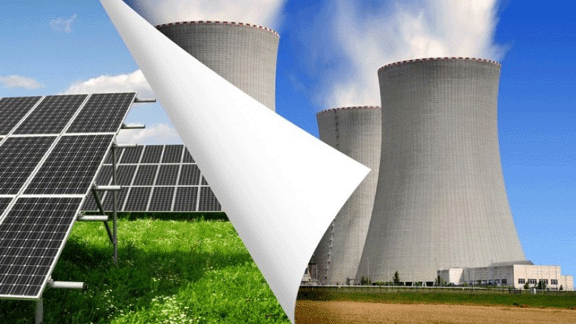
Portugal reached a major milestone of producing more than half (51%) of
its electricity from wind and solar in April. The previous monthly record
high was 49%, set in December 2021.
According to Ember, Portugal’s record
of 50% from wind and solar comes despite relatively modest wind generation.
Strong deployment of solar capacity pushed solar generation to an all-time
high of 360 GWh in April, significantly higher than the previous record of
300 GWh in July and August of 2022. Last year, the country installed 0.9 GW
of solar photovoltaics, increasing its solar capacity by more than 50% to
2.5 GW.
Review Energy 18th May 2023
Damning critique of Rolls Royce
The new chief executive of Rolls-Royce has delivered another damning
critique of its performance, saying that one of its core divisions has been
“grossly mismanaged”. Tufan Erginbilgic, 63, took the top job at the
aerospace and engineering group at the start of this year and weeks later
infamously described the group as a “burning platform”. In his latest
broadside, the former BP executive took aim at the performance of its power
systems division, which makes diesel and gas engines for use in
superyachts, trains and mining lorries, and for back-up power generation.
Times 22nd May 2023
Ukraine’s Depleted Uranium Blast: Europe on Brink of ‘Environmental Disaster’
Sputnik lnternational 19.05.2023
Russian Security Council Secretary Nikolai Patrushev warned on Friday that a radioactive cloud was heading towards Western Europe following the destruction of a Ukrainian warehouse storing British-supplied depleted uranium ammunition.

Sputnik News spoke with Dr. Chris Busby, physical chemist and scientific secretary of the European Committee on Radiation Risk, about how the West’s decision to provide depleted uranium (DU) ammunition to Ukraine has potentially caused a continent-wide ecological disaster. Below is his answer in full.
Recently, several web media outlets provided videos of an enormous explosion in the town of Khmelnitski, located to the West of Kiev, and about 200 km from the border with Poland. There were two major explosions which produced a massive roiling swirling fireball which, like an atomic bomb, developed upwards and formed a mushroom cloud, which was black.
I have represented nuclear atmospheric test veterans in the Royal Courts of Justice in London and have seen many films of nuclear explosions: this was not one. A nuclear explosion is characterised by an immediate intense white light which wipes out the camera film or detector.
So, what was it? It was suggested by several commentators that an arms depot that had been hit contained the Depleted Uranium (DU) weapons sent by the UK to the Ukraine for use in the British Challenger tanks as anti-tank penetrators. That the explosion was one involving the burning of the DU in the fireball. Since I am a scientific authority on Uranium and its health effects, but have also examined its dispersion and behaviour in the environment, I will comment on what I believe happened, and why it is important. I was a member of the UK government Ministry of Defence Depleted Uranium Oversight Board (DUOB) in 2000-2005, and also the UK government Committee Examining Radiation Risk from Internal Emitters (CERRIE) 2000-2004. I am Scientific Secretary of the European Committee on Radiation Risk (ECRR) which is an independent NGO that provides advice on risk from ionising radiation.
My main research interest in this area is Uranium and health, particularly the DU particles, which are so small they act as a gas and move over very large distances once they are created by the burning of DU. I found them in England in 2003 after they had come from Iraq. I found them in 2023 in England after they came from the Ukraine war. So that is the first thing: the material is able to travel very large distances.
Therefore, if the Khmelnitsky explosion was a DU one, the material would move with the wind direction and should be detectable at monitor sites downwind.
First, we need to say that DU has a gamma signature, it releases gamma rays. The UK and USA governments lie about this. They point to the fact that the U-238, that remains after the fissile U-235 is removed in the centrifuges (and is sent off for nuclear weapons and reactors), is a weak alpha emitter.
They say that alpha radiation cannot penetrate skin and so the DU itself is harmless. That it cannot be detected by a Geiger Counter and the alpha particles don’t make it through the window. There is, of course, a health problem if the post-impact particles are inhaled and pass into the body through the lung into the lymphatic system or directly into the digestive system, but essentially DU is harmless.
What you need to know is that Uranium 238, when it decays with its alpha emission, turns into Thorium-234 and Protoactinium-234m which then turns into Uranium 234. Thorium 234 is a beta and gamma emitter delivering 6% of its decay energy as a gamma ray. Thus, large clouds of DU particulate aerosol will be detectable by gamma detectors.
When I visited Iraq with Al Jazeera in 2000 I went to the south and examined the corpses of the tanks that had been hit by DU in the first Gulf War. Some of the A-10 DU penetrators were still lying around. They gave off an intense gamma ray signal, and the holes in the tanks were highly gamma ray active. So much for only an alpha emitter.
I am a yachtsman: examination of the UK metereological weather pressure maps tell us that at the time, and for days after the explosion, there was an anticyclone to the North of the explosion site and winds were weak but from the South East blowing North Westerly around the high-pressure area. So, the plume would move towards Poland. If the winds were about 5km/h they would reach any Poland detectors 250 km away on the 15th.
After Chernobyl, the European Union set up a Europe-wide gamma radiation detector system that used to give gamma readings in real time. I went to look. But astonishingly, all the data was blocked. The web- based system, administered from Germany, (EURDEP) would not provide the detector maps that are normally available. Luckily, there were some location maps on the web and some that had been already downloaded by colleagues of mine before the system stopped working. I obtained maps from Poland. One of these I show below. [on original]
You will see that a very highly significant increase in gamma radiation occurred at this detector, north west of the explosion site almost exactly when it would be expected on the basis of a distance of 250km and a mean wind speed of 5km/h. The increase, from 60nSv/h to 90nSv/h was highly statistically significant about 50%. Other detectors all across Poland showed an increase*, as the plume passed over them, the increase being weaker the further away (due to dispersion of the plume).
Later, the Poles measured the increase at the Marie Curie Institute in Lublin, but their map was a more sophisticated one and needed some expert interpretation. The Polish map gave gamma increases split into two natural isotopes, Bismuth and Thallium, also total gamma and cosmic ray gamma………………………………………………………………..
The European radiation detector system web map came back online on May 18. The map type had been changed and everything we saw in the downloads had disappeared or had been smudged out by data analysis averaging. Why? This, and the early blocking of access to the site suggest panic and cover-up.
So taken all together, what we see is a massive explosion which is thought to be DU, and reports of a spike in gamma radiation near the site. Uranium oxide is black, and the black plume moves north west slowly, the weather pattern is stable and the wind blows to Poland. The Polish EU detectors all show gamma radiation increases at the expected time of arrival of the plume. The EU detector system is shut down rapidly, but not before we have obtained data from several sites. The Poles provide a detector result that identified Bismuth as the cause of the increase, but do not go so far as to formally state that it is (in case of later blowback).
One final piece of evidence. We see videos on the internet of the Ukrainians clearing up the explosion site using Robot vehicles, not ordinary firemen. Why do they need Robot vehicles? The last times we saw Robot vehicles clearing up was in the ruins of Chernobyl and Fukushima.
If I am right, there has been an environmental disaster, and the DU particles will travel across Poland, Germany and Hungary, and will end up in the Baltics, probably later the whole of Europe including the UK (after all, the Chernobyl Uranium particles came to the UK).
They will deliver genetic damage and death like that seen in the Balkans and Iraq. Cancer, birth defects, miscarriage, infertility, lung damage, mental problems (Gulf War Syndrome) and so forth. The scientific and epidemiological evidence on this has been clear since the Gulf War. It is all there in the scientific literature—but the governments in the West and the military ignore it, deny it and cover it up. In the case of the UK coroners court finding for Stuart Dyson, the jury found that DU caused his fatal colon cancer.

But when the coroner wrote to the health minister (as he had to by UK law, Rule 43) the reply was: we disagree. This stuff can be measured, but no one will measure it, or if they do, they will be attacked and their arguments dismissed.
Even if I am wrong, and there is some other explanation for the gamma peaks, DU must be banned. It is a weapon of indiscriminate effect and kills civilians, the enemy and your own troops (well, Ukrainian troops). It is much worse than a war gas, like Sarin, or phosgene, mustard gas or all the other chemical agents banned by civilisation. This stuff destroys the genetic basis of life itself. And no one does anything. Those who use it base their action on obsolete science supported by dishonest epidemiology carried out by dishonest scientists and obsolete and fantastical risk models.
Those who provide the weapons, the UK government in this case, are morally bankrupt. Unless it is their intention to destroy the Ukrainian people. Who knows anymore? The world has gone mad.
*Poland’s National Atomic Energy Agency claims there is no increase in radiation levels https://sputnikglobe.com/20230519/ukraines-depleted-uranium-blast-europe-on-brink-of-environmental-disaster-1110462939.html
Ukrainians forced by Russia to retreat from Artyomovsk (Bakhmut) , their supposed ‘fortress’ in Donbass
RT.com By Vladislav Ugolny, a Russian journalist born in Donetsk 21 May 23
The battle for Artyomovsk (called Bakhmut by the Ukrainians) began in August 2022, and gradually turned into the epicenter of fighting between Russia and Ukraine. While other parts of the front remained relatively stable, both sides actively brought forces to this small city. For Kiev, which in May 2022 suffered a defeat at Azovstal that helped undermine its image, Artyomovsk became the new Mariupol. Ukrainian propaganda labeled it ‘the Bakhmut Fortress’, and attempted to give an air of heroism to those fighting there.
………………………………………………………. The importance of the city grew tremendously after the start of Russia’s military operation in February 2022. Initially, when Russian troops broke the first line of fortifications in the area of Popasnaya, Zolotoye, and the Lisichansk-Severodonetsk agglomeration, Artyomovsk was an important transport hub. It kept the Ukrainian front line connected with the rest of the country.
After the Russians managed to break this line of defense and completely removed Kiev’s forces from the territory of the Lugansk People’s Republic (LPR), Artyomovsk went from being a transport hub to becoming Ukraine’s second line of defense around the Bakhmutka River. This strip ran from Ukrainian positions opposite Gorlovka – since 2014 controlled by the Donetsk People’s Republic (DPR) – in the south up to Seversk in the north, running straight into the Seversky Donets, the main river in Donbass.
Artyomovsk could not have been taken without this line of defense being broken. Since July 2022, PMC Wagner fighters have been focused on doing just that, preparing the ground for a successful encirclement of the city.
………………………………………………………………………………………………………………………………………………………………… the more than nine-month-long battle for Artyomovsk permanently changed the perception of the conflict, forcing both Ukraine and Russia to abandon any ideas of a fast-paced campaign or deep breakthroughs.
The battles discussed in this article took place barely 30 kilometers deep into the frontlines. In conditions of summer heat, fall mud, and winter frost, it largely resembled the First World War. According to Prigozhin’s estimates, the liberation of the entire territory of the Donetsk People’s Republic will take another one and a half to two years.
However, significant Ukrainian forces still remain to the west of Artyomovsk, having seized a number of positions during the May counteroffensive. They have established a foothold in Chasov Yar and hold the line between Krasnoye and Minkovka, thus preventing Russian forces from stabilizing the front along the Seversky Donets-Donbass canal. With the Russian flag flying over Artyomovsk and Russian soldiers in full control of the battlefield, the Russian priority now is to inflict maximum damage on the Ukrainian forces massed for the counteroffensive, and drive them out to the western bank of the canal. https://www.sott.net/article/480462-Victory-Ukrainians-forced-by-Russia-to-retreat-from-Artyomovsk-their-supposed-fortress-in-Donbass
US hopes to snatch victory from jaws of defeat in Ukraine
Indian Punchline BY M. K. BHADRAKUMAR
The G7 Leaders’ 2700-word statement on Ukraine, issued in Hiroshima after their summit meeting glossed over the burning question today — the so-called counter-offensive against the Russian forces.
It is a deafening silence, since rumours are swirling about the disappearance of the commander-in-chief of Ukraine’s armed forces. Significantly, President Vladimir Zelensky himself is making himself scarce from Kiev touring world capitals — Helsinki, Hague, Rome, Vatican, Berlin, Paris, London and Jeddah and Hiroshima. It does seem that something is rotten in the state of Denmark.
As the G7 summit ended, the head of the Wagner PMC, Yevgeny Prigozhin announced on Saturday that the Russian operation to capture the strategic communication hub of Bakhmut in Donbass region of eastern Ukraine lasting 224 days, has been brought to a successful completion, overcoming the resistance by more than 80,000 Ukrainian troops.
It is a painful moment for Zelensky, who had boasted before US lawmakers in Capitol Hill last December that “just like the Battle of Saratoga (in 1777 during the American Revolutionary War), the fight for Bakhmut will change the trajectory of our war for independence and for freedom.”
Meanwhile, to distract attention, there is talk now about a subtle shift in the US policy regarding supply of F-16 fighter jets to Ukraine in an indeterminate future. In reality, though, no one can tell what the Ukrainian rump state will look like when the jets arrive. Unsurprisingly, the Biden Administration still seems to be in two minds. F-16 is a hot item for export; what happens if the Russians were to blow it out of the sky with their hi-tech weapons and rubbish its fame ?
The Russians seem to have concluded that nothing short of a total victory will make the Americans and the British understand that Moscow means business on the three objectives behind the special military operations that are non-negotiable: security and safety of the ethnic Russian community and their right to live in peace and dignity in the new territories; demilitarisation and de-Nazification of Ukraine; and a neutral, sovereign, independent Ukraine freed from the US clutches and no longer a hostile neighbour.
……………………………. the big question is about the Ukrainian counteroffensive. The Russian forces enjoy overwhelming superiority in every sense militarily. Even if the hard core of the Ukrainian forces who were trained in the West, numbering some 30-35000 soldiers, manage to achieve some “breakthrough” in the 950-kilometre long frontline, what happens thereafter?
……………. If past American behaviour — be it Vietnam, Afghanistan or Iraq and Syria — is anything to go by, Washington will do nothing. The well-known American strategic thinker Col. (Retd.) David MacGreggor couldn’t have put things better when he said earlier this week:
“I can tell you that Washington is going to do nothing. And I’ve always warned… we (United States) are not a continental power, not a land power anywhere but in our own Hemisphere. We are primarily an aerospace and maritime power, much like Great Britain. And what does that mean? When things go badly for us, we sail away, we fly away, we go home… That’s what we always do. Eventually, we just leave. And I think, that’s on the agenda now.” …………………………………………………………………. https://www.indianpunchline.com/us-hopes-to-snatch-victory-from-jaws-of-defeat-in-ukraine/
Germany’s green revolution puts nuclear power in the past

Renewed support for renewables and an end to nuclear power keep Germany on its carbon neutral path
By Linda Pentz Gunter 21 May 23
Germany is a country of sensible shoes. And, I might add, supremely comfortable ones. Germans do buttery leather as well as they do beer.
Germany’s energy policy is similarly sensible. Germans see no reason to choose the slowest, most expensive, most dangerous and decidedly non-renewable energy source with which to address the climate crisis.
Consequently, Germany rejected nuclear power, and on Saturday April 15, it closed the last of its reactors. Germany, like its even more sensible neighbor, Austria — where nothing nuclear may even traverse its terrain — is now a nuclear-free country. Almost. The next step for the German anti-nuclear movement will be to close the URENCO uranium enrichment facility there and the Lingen fuel fabrication plant. And of course there remain nuclear weapons in Germany, not theirs, but ours.
While France continues to wobble along on its high-fashion nuclear stilettos, turning ankles and snapping off heels whenever the going gets rough, Germany will trudge on inexorably, and comfortably, to its stated goal of carbon neutral by 2045.
Germany also plans to end it coal use possibly as soon as 2030, but certainly by 2038. Although, you’d never know it, with all the alarmist hype in circulation post nuclear shutdown. The nuclear lobby, already in propaganda over-drive, has now gone supersonic in its efforts to persuade the world that Germany’s choice to close those last three reactors — never mind that their energy has already been replaced by renewables —will mean burning more coal.
The decision to prolong the operating time of its last three reactors until April 2023 (they were originally due to close at the end of 2022) was largely political, designed to appease rightwing voices within the governing alliance led by the Social Democrats. “We could, in fact, have already shut down the nuclear power plants by January 1 of this year without the lights going out,” said German economist, Claudia Kemfert. “The extension was more like a psychological comfort blanket, as we had an oversupply of electricity,” she told the Washington Post.
Germany didn’t need those last three reactors to keep its green revolution on track. And it especially didn’t need them through this winter, after rejecting the supply of gas from Russia in response to that country’s invasion of Ukraine. German heating is not electric. So nuclear power had no role to play in easing that situation.
Meanwhile, power prices on the European Energy Exchange for the first quarter of 2024 were more than twice as high in France than in Germany. Much of this was due to loss of market confidence in French state energy company, EDF, to get sufficient numbers of their troubled nuclear reactors back on line to meet demand.
This did not change after Germany’s last three reactors closed. As Bruno Burger of Energy Charts noted as a caption to the graphic below [ on original] : “The shutdown of the last three German nuclear power plants has no visible effect on weekly Future Electricity Prices in Germany.”
The nuclear power contribution to Germany’s energy mix has been steadily declining since the renewable energy boom, known as the Energiewende, was launched in 2000 with the Renewable Energy Act. A precondition of the Act’s passage was that as nuclear power was phased out it would be replaced by renewable energy and energy efficiency (although demand should have been brought down much faster, much further) and not by fossil fuels.
In 2000, the renewables share in German electricity was just over 6%. The nuclear share was 30%. In just 23 years, those numbers have more than reversed, with today’s share of on- and off-shore wind plus solar at just over 46% and nuclear at 4.6% in the last week before the final reactor closures. Germany remains on track to achieve its carbon neutral goal by 2045.
The renewable energy boom was greatly helped by the implementation of a feed-in tariff that helped to create confidence and certainty for renewable energy investors who were guaranteed a fixed price for 20 years, above the standard market price. This spurred a big investment, not just by companies, farmers, and coops, but by individuals and many municipalities.
This led to local success stories such as Morbach, a small town about 92 miles west of Frankfurt that boasts 14 wind turbines, 4,000 square meters of solar panels and a biogas plant. Combined, these generate three times more electricity than the community of 11,000 people needs. They sell the surplus back to the grid.
Simply put, the nuclear phaseout opened the way for renewable energy growth in Germany and put the country on the path to a fossil fuel-free future as well. Without the former, the latter would not have happened.
Critics who falsely ascribe Germany’s continued use of coal, including brown coal or lignite, to the nuclear phaseout, fail to understand that these upticks are driven by the export market and are not related to domestic consumption or the nuclear shutdown.
Ironically it is nuclear France, dependent on electric heat, that is partially responsible for the demand for German coal. This was especially so this past winter when the French nuclear sector all but collapsed with more than 50% of its nuclear capacity down due to serious safety issues combined with scheduled maintenance.
In contrast, in 2022, Germany succeeded in weaning itself off Russian gas entirely and supplying France with 15 billion kWh of electricity net.
Furthermore, Germany’s lignite and coal production remains well below earlier levels and Germany is legally committed to end coal use by 2038. The current government is working to advance this date to 2030.
According to the 2022 World Nuclear Industry Status Report: “Lignite peaked in 2013 and then declined—especially in 2019–2020—before increasing again by 20.2 percent in 2021. However, lignite generation remained below the 2019-level and 25 percent below the 2010 level.
“Hard coal also peaked in 2013 then dropped to 64 percent below the 2010-level. While it has seen, at 27.7 percent, the strongest increase in 2021 of any power generation technology, it also remains below the 2019 numbers.
“Natural gas fluctuated since 2010 and peaked in 2020 at 2.6 percent above the 2010-level before dropping by 5.3 percent in 2021.”
In fact, Germany’s struggle to get off fossil fuels lies mainly in the transport rather than the electricity sector. The country’s love affair with the car and speed limit-free autobahns is a long engagement that now needs to be broken.
Germany’s path to a carbon neutral economy is all about the trajectory, which is on track, despite bumps in the road. As always, it is about a political commitment rather than any technological challenges. If the current government sticks to its word to greatly accelerate renewable energy implementation, the Energiewende, by no means a perfect roadmap, will get itself back on track.
Mistakes were undoubtedly made. Even after then Chancellor Angela Merkel had her epiphany in 2011 in light of the Japan nuclear disaster at Fukushima, making an overnight decision to restore Germany on the path to nuclear shutdown, she subsequently made drastic cuts in solar subsidies, something environmentalists described as “nothing less than a solar phase-out law”.
But despite this, Germany remains one of the few Western countries that has demonstrated a consistent commitment both to a nuclear phaseout and to climate chaos abatement.
The German anti-nuclear movement is greatly to be credited with much of this progress. It has long been one of the most powerful and politically effective. Like the sensible shoes they march in, green advocates in Germany understood exactly what their fight was about and the significance of that final nuclear shutdown. I hope they are having a jolly good party. They deserve it. Then it will be back to vigilance over the Energiewende — and hopefully to removing US nuclear weapons from German soil and closing those uranium fuel fabrication plants. Because that is the kind of thing that only people power can get done.
“The German nuclear phase-out is a victory of reason over the lust for profit; over powerful corporations and their client politicians,” read a statement from Greenpeace. “It is a people-powered success against all the odds.”
Linda Pentz Gunter is the international specialist at Beyond Nuclear and writes for and curates Beyond Nuclear International.
The nine hours in which Spain made the 100% renewable dream a reality

Electricity generation through solar, wind and water exceeded total demand in mainland Spain on Tuesday, a pattern that will be repeated more and more in the future
IGNACIO FARIZA 19 May 23 El Pais
The Spanish power grid on Tuesday tasted an appetizer of the renewable energy banquet that is expected to flourish in the coming years. For nine hours, between 10 a.m. and 7 p.m., the generation of green electricity was more than enough to cover 100% of Spanish peninsular demand, a milestone that had already been reached on previous occasions, but not for such a prolonged period. The achievement — which was backed up by figures sent to EL PAÍS by the state electricity provider Red Eléctrica de España (REE) — took place, moreover, on a typical weekday, when the consumption pattern is higher, and not on a holiday or at the weekend, when demand falls sharply.
A huge drive in the installation of renewables — especially photovoltaics — is enabling Europe’s fourth-largest economy to cover an increasing part of its electricity needs with renewable energy, something that not only substantially reduces the country’s carbon footprint but also applies downward pressure on prices during daylight hours. Above all, it increases the incentives — both environmental and economic — to invest in storage and to electrify transport, industry, and heating, which are intensive in oil or natural gas consumption……………………………………………………………….
Xavier Cugat, project manager at a photovoltaic company who is at the origin of the statistic. “The nuclear closure schedule is not only carried out well, but it is also conservative: at the rate at which we are installing renewables, it could even be brought forward. What will provide more flexibility is hydropower and, within hydropower, pumping,” adds the expert.
“By 2030, Spain will have three fewer nuclear reactors and it turns out that renewables are solving the problem on their own,” says Pedro Fresco, former director of Energy Transition in the Valencia region. Not only is nuclear power contributing less but Spain’s waterfalls, another of the country’s biggest sources of electricity, are being severely hit by the drought, which is reducing productive capacity in many areas. “It is true that it is a one-off, and at a time of very good solar and wind production, but with very little water and with hydroelectric power at a technical minimum… even so, we are covering 100%.
. Where will we be in three years, when we will have between 10 and 15 gigawatts more of photovoltaic and another five of wind? There is a huge window of opportunity for hydrogen and electric cars, especially in the central hours of the day,” adds Fresco. “But we need strategies to take advantage of it.” https://english.elpais.com/spain/2023-05-19/the-nine-hours-in-which-spain-made-the-100-renewable-dream-a-reality.html
Russia’s Atomflot added to U.S. sanctions list
FSUE Atomflot, the maintenance base for Russia’s fleet of nuclear-powered icebreakers, can no longer buy products from, or do business with, U.S. or European Union entities.
By Thomas Nilsen Barents Observer 21 May 23
Located two short kilometers north of Murmansk, FSUE Atomflot was for three decades a major receiver of grants from Norway, the United Kingdom, the United States and the European Union. Millions of Euros dedicated to nuclear- and radiation safety projects have helped Russia improve infrastructure and technology at this civilian site that partly has served as a transshipment hub for spent nuclear fuel from dump sites on the Kola Peninsula.
The United States on Friday announced FSUE Atomflot being added to the sanctions list, a move following a similar decision previously undertaken by the European Union in February………………………………………………. more https://thebarentsobserver.com/en/arctic/2023/05/atomflot-added-us-sanctions-list
Russian forces dig in at Ukrainian nuclear plant, witnesses say
Tom Balmforth and Sarah McFarlane, Fri, 19 May 2023,Yahoo! Lifestyle
LONDON (Reuters) -Russian military forces have been enhancing defensive positions in and around the Zaporizhzhia nuclear power plant in southern Ukraine in recent weeks, four witnesses said, ahead of an expected counteroffensive in the region.
New trenches have been dug around the city and more mines have been laid. Surveillance cameras at the plant are pointing north across a wide reservoir towards Ukrainian-controlled territory.
The Russians have had firing positions set up atop some of the plant’s buildings for several months. Nets have been erected in a possible deterrent to drones.
The measures described by two Ukrainians who work at the power plant and two other residents in the city of Enerhodar underline the risks the war poses to the security of the facility.
The sources spoke on condition of anonymity because of fears for their safety in a city under Russian occupation.
Russian state nuclear energy company Rosatom said any possible military action by Ukraine posed a threat to nuclear safety, and that the plant’s equipment was being maintained properly. The Ukrainian military intelligence agency and the Russian defence ministry did not respond to requests for comment.
Some nuclear industry experts said they were alarmed and warned that any damage to the plant could have dire consequences for people, the surrounding area, the war and the global nuclear industry.
………………………………… there is concern in the international community that the six-reactor nuclear plant, Europe’s largest, could be caught up in fighting, particularly as military analysts expect Ukraine to try to push Russian forces back in the Zaporizhzhia region.
The U.N. nuclear watchdog says that the military presence and activity is growing in the region, underlining the need for urgent action. It has warned for months of the danger of a major accident at the plant.
The agency plans to present a deal between Russia and Ukraine to the U.N. Security Council later this month to protect the facility, four diplomats told Reuters…………………………………………………………… https://au.lifestyle.yahoo.com/russian-forces-dig-ukrainian-nuclear-060319771.html
IAEA Warns of Tense Military Situation Near Ukraine Nuclear Plant
Mirage News 19 May 23
The International Atomic Energy Agency (IAEA) continues to warn of the potential nuclear threat in the Ukraine conflict amid rising tensions surrounding the Zaporizhzhya Nuclear Power Plant (ZNPP).
IAEA Director General Rafael Mariano Grossi said on Friday in a statement, that a location near the town of Enerhodar, home of most of the plant’s staff, reportedly came under artillery fire earlier in the day, “in the latest incident indicating an increasingly tense military situation in the area.”
Speculation of military activity
The ZNPP, Europe’s largest nuclear power plant, is located just a few kilometres from Enerhodar.
IAEA experts present at the plant reported that it had not been affected “but the proximity once again underlined persistent nuclear safety and security dangers at a time of heightened speculation of future military operations in the region,” said Mr. Grossi…………………………………………………………… more https://www.miragenews.com/iaea-warns-of-tense-military-situation-near-1010184/
Ukrainian diplomat fears ‘terrible summer’ ahead

 | |||
| |||
https://www.rt.com/russia/576550-terrible-price-ukraine-counteroffensive/
The country’s troops may have to pay a “terrible price” in a planned counteroffensive, envoy Vadim Pristaiko said
Ukraine could suffer heavy losses during its much-anticipated counteroffensive against Russia, Vadim Pristaiko, Kiev’s ambassador to the UK, warned on Thursday.
In an interview with British broadcaster ITV, the diplomat said: “I know that it can be a very terrible summer and the price is terrible.”
Pristaiko also said Kiev’s Western backers have piled “too much pressure” on Kiev and have built up “too much expectations” about the spring campaign.
When asked to comment on why Ukraine maintains its position on not revealing its losses in the conflict, Pristaiko replied: “internally, we understand how many of us are already killed and lost.”
“We understand that it will be extremely difficult to fight with a nation that is 16 times bigger than us,” the envoy said. “But we are determined to do it and we are not going to tell Russians how painful it is – they know it is painful and we know it is painful”.
The Ukrainian ambassador also acknowledged that while US President Joe Biden and his administration have emerged as one of Kiev’s most staunch supporters, his successor might prove to be less willing to help the country.
“One of the weaknesses of democracy is the cyclical nature, and we have the same… we have to take into account this cycle in politics,” he said.
“We understand that the time might come that we won’t enjoy such great support, that is why we have to put all the pressure right now”, Pristaiko said. “That is why we are asking our friends, can you bring everything to the table? Allow us to have a decisive push this time.”
For several months, Ukraine has been speaking about a counteroffensive against Russia to reclaim territories Kiev considers as its own, but some officials have complained about a lack of ammunition, weapons, and even adverse weather conditions.
Last week, Ukrainian President Vladimir Zelensky stated that his country is basically “ready” for its launch, but “still needs a bit more time” as it waits for more Western weapons.
Last month, The New York Times reported that there are no guarantees that the Ukrainian counteroffensive will succeed, adding that an underwhelming outcome would likely prompt Kiev’s backers to press it to negotiate for peace.
Nuclear Free Local Authorities condemn UK Environment Agency’s failure to protect fish in Hinkley Point C’s nuclear project
NFLAs condemn ‘craven climbdown’ by Environment Agency over Acoustic
Fish Deterrent. In response to an ongoing consultation, the UK / Ireland
Nuclear Free Local Authorities has condemned the Environment Agency for
cravenly climbing down when faced with EDF Energy’s demand that it be
excused from providing an Acoustic Fish Deterrent at the new Hinkley Point
C nuclear power project, and has urged them not to waive this requirement.
The Environment Agency’s latest recommendation represents a complete
volte-face on its previous position on the permit requirements, which was
taken after an in-depth examination by an inspection team and by
verification by the Secretary of State. NFLA England Forum Chair,
Councillor David Blackburn said: “The consequences of the Environment
Agency granting this concession will be catastrophic for the local fish
population and marine environment.
NFLA 18th May 2023
Global heating is predicted to trigger more nuclear outages in France every year.

extreme heat and droughts amid
climate change could impact nuclear plants, which use water to cool down.
EDF expects to lose 1.5% of its nuclear output, or about 5 TWh, annually
by 2050 due to the impact of global warming based on an average production
of 400 TWh, an executive said on Tuesday.
This compares with a current
average loss of nuclear power output caused by global warming of 0.3%, or
1.2 TWh, Cecile Laugier, head of environment at EDF’s nuclear branch,
told reporters. This echoes a report released in March by France’s Court
of Auditors, which said global warming could trigger three to four times
more outages than today. Increased risk of extreme heat and droughts amid
climate change could impact nuclear plants, which use water to cool down.
Montel 16th May 2023
https://www.montelnews.com/news/1499729/heat-to-cause-15-yearly-nuclear-output-loss-by-2050–edf
1 This Month





PLEASE OPPOSE HR 8255 AND S.3639 – bills would accelerate satellite deployment, with no environmental review or safeguards – https://ncstd5li.quorum.us/campaign/169331/
To see nuclear-related stories in greater depth and intensity – go to https://nuclearinformation.wordpress.com
-
Archives
- October 2026 (39)
- September 2026 (339)
- August 2026 (330)
- July 2026 (355)
- June 2026 (287)
- May 2026 (306)
- April 2026 (356)
- March 2026 (251)
- February 2026 (267)
- January 2026 (308)
- December 2025 (358)
- November 2025 (359)
-
Categories
- 1
- 1 NUCLEAR ISSUES
- business and costs
- climate change
- culture and arts
- ENERGY
- environment
- health
- history
- indigenous issues
- Legal
- marketing of nuclear
- media
- opposition to nuclear
- PERSONAL STORIES
- politics
- politics international
- Religion and ethics
- safety
- secrets,lies and civil liberties
- spinbuster
- technology
- Uranium
- wastes
- weapons and war
- Women
- 2 WORLD
- ACTION
- AFRICA
- Atrocities
- AUSTRALIA
- Christina's notes
- Christina's themes
- culture and arts
- Events
- Fuk 2022
- Fuk 2023
- Fukushima 2017
- Fukushima 2018
- fukushima 2019
- Fukushima 2020
- Fukushima 2021
- general
- global warming
- Humour (God we need it)
- Nuclear
- RARE EARTHS
- Reference
- resources – print
- Resources -audiovicual
- Weekly Newsletter
- World
- World Nuclear
- YouTube
-
RSS
Entries RSS
Comments RSS

