France hoping to get Japan to help save failed nuclear company AREVA
 Nuclear energy on agenda during French PM’s trip to Japan French Prime Minister Manuel Valls rounded off a three-day visit to Japan with bilateral talks on the nuclear sector.
It follows an announcement in September by Japan’s Mitsubishi Heavy Industries stating it was considering taking a stake in Areva NP, the reactor-making subsidiary of French nuclear company Areva. In July, French energy giant EDF agreed to buy between 51 and 75 percent of the subsidiary. At the time it announced it would be looking for partners to take a minority stake.
Valls formally asked his counterpart Shinzo Abe for Japan’s help in reorganising France’s nuclear sector……http://www.euronews.com/2015/10/06/nuclear-energy-on-agenda-during-french-pm-s-trip-to-japan/
France’s EDF does a policy U-turn – now investing in renewables
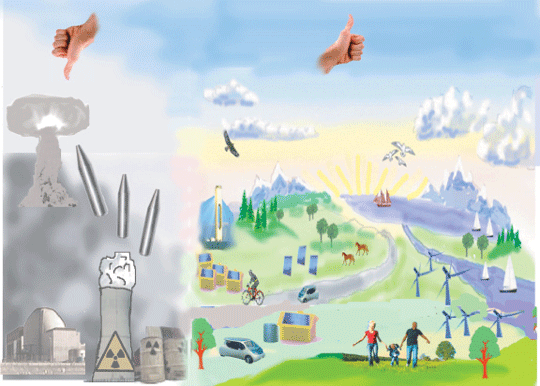
 Shifting focus: Owner of world’s largest nuclear fleet looks to renewable energy, Fierce Energy September 24, 2015 By William Pentland EDF, the state-controlled electric utility company based in Paris, France, is pinning its hopes for growth on renewable energy investments, including investments in markets outside of Europe. “By 2030, we want to have a significant presence in three to five countries outside of Europe, notably in solar and wind,” said Jean-Bernard Levy, chief executive officer of Electricite de France SA (EDF), in an interview with the French financial daily newspaper,Les Echos.
EDF owns and operates the world’s largest fleet of nuclear reactors. Currently, 95 percent of the French utility’s generating assets are located in either France, Britain or Italy. Levy said EDF would ramp up investments in renewable energy in these markets.
“Our objective is to double our European and French renewables fleet by 2030 from 28 to more than 50 gigawatts,” Levy said.
This strategy departs markedly from the strategy articulated by Levy’s predecessor, Henri Proglio.
While speaking at the Eurelectric conference in June 2014, Poglio said that the European Union needed to assert greater “control” over the pace of renewable energy growth………http://www.fierceenergy.com/story/shifting-focus-owner-worlds-largest-nuclear-fleet-looks-renewable-energy/2015-09-24
Why we must expose the true ugly nature of the nuclear industry

As I stood against sensationalists and repeated hoaxers, mostly Youtubers, who are only harming the antinuclear cause and the Fukushima victims cause, lately those people have sent me insults and threats of violence, calling me a pro-nuke shill hiding behind my D’un Renard alias,, and not showing my face etc. I presently became the focus of those people hate and slurs for calling their repeated hoaxes what it is: B.S., mental pollution, sensationalism and disinformation. I did it not to look for trouble, but because I believe truth is important, primordial, crucial.
Only by sharing the true facts, we will win, as true facts stand, stay.
B.S. flies high first but stinks later when it is quickly debunked
Consequently, for the first time, i will share publicly my personal story, why and how I awoke and became antinuclear.
A little about myself, I am Hervé Courtois, 60 years old, Picardie, France.
For 4 years and half I used a nom de plume “D’un Renard”, which in french means “from a fox”, because around my place there are many forests and many foxes which I could hear at night while blogging. I did not want to used my true identity because I wanted to protect the identity of my daughter in Japan when I started to blog on internet about the Fukushima catastrophe by fear of getting her in troubles with the Japanese government, and also by fear that Japanese government could bar me to enter Japan to visit my daughter. Few months ago I decided finally to use my real name.
I lived very long time in Asia, 37 years, in Japan, Korea, Hong-Kong and the Philippines, I came back home to France 6 years ago.
My 33 years old daughter, French-Japanese, lives in Iwaki city, Fukushima prefecture, 50 kms South from the nuclear plant of Fukushima Daiichi. She was born in Paris in 1982, but grown up in Fukushima, she is 33 years old, unmarried, no children, does not want to give birth anymore by fear of possible tetragenic birth due to radioactive contamination thru her living environment and the contaminated food.
Three months after the start of the Fukushima catastrophe, I went to visit her there in Iwaki city, Fukushima for the full month of June 2011, to check how she was and how was the real situation there.
On location I was surprised how to find that the people on location who should be the most at risk were kept uninformed of the real situation and of the dangers for their health, for their life, by the Japanese government.
I became aware that there was then an imposed omerta on the media by the Japanese government. All media repeating the same tune, don’t worry be happy, there is no danger, the situation is under control. The reactors are now in cold shutdown.
I keep wondering how reactors having exploded could be in cold shutdown. Smelling a rat.
Most people I met were kept in dark of the real situation, informations were totally controlled, filtered, censored, twisted, the people lied to. Just as the french people in 1986 were lied to by their own government telling them that the Chernobyl plume was not coming towards France, that it would not reach France, that they were safe, most of the people not taking protection measures to regret it later with rampant thyroid cancer allover Eastern France.
When I came back from Japan to France, the most nuclearized nation in the world per square kilometer and per inhabitant, the nuclear industry Areva being owned by the State, the French government, of course the french media were also censored about Fukushima by the French government, telling to French people that the Fukushima disaster was over, that it had ended in March 2011, that it was nowall under control. I found at home the same omerta, that I had met in Japan.
I decided to search for informations on internet, search for knowledge, to learn about nuclear, so that I could better understand what was truly happening, what was hidden, unsaid, covered up, so that I could then inform my daughter and help her to know the facts, the dangers and how to protect herself.
My life changed and was never the same again, it became almost a full time occupation, many hours days and nights on internet to find informations and to share them to other people, discovering gradually the lies, what had been hidden about Fukushima, Chernobyl, Three Mile islands and other hidden nuclear catastrophes, so many. I lost my innocence about nuclear.
I became angry and quite involved as an activist both on the net but also in real life. I became a a member of Sortir du Nucléaire France and of Greenpeace France,
On March 2012 I was the one to organize in Paris the 1rst year Fukushima Anniversary, a rally in front of the Paris main cityhall, with french antinuclear activists combined to some Japanese members of the Paris Japanese community, a Japanese TV crew coming to film our event.
Since the end of June 2011 up to now I continue to blog on the net on various blogs and on some Facebook antinuclear groups and pages that I founded.
I have therefore been following the Fukushima catastrophe day and night from the right beginning, and I am very well aware of the real dangers of Fukushima and of nuclear, my own blood and flesh French-Japanese daughter being one of the victims of nuclear in Fukushima, l will therefore continue to fight nuclear until it ends or until my last breath.
I am opposed to all pro-nuclear and their paid shills, but I am also oppose to those irresponsable people who produce hoax after hoax about Fukushima to satisfy their attention-glory-narcissist craving and their donations milking. All those people in different ways are harming the truth, harming our antinuclear cause.
I never asked donations not wishing to become an activist for sale, I do it for the love of my daughter, and because it is right to do it, not for money nor glory.
Nuclear is more than bad, we will only win by exposing its its ugly real nature, the true real solid facts. We won’t win by spinning sensationalism or hoaxes, which only become ammunitions for the pro-nuke shills to discredit us and the true dangers of nuclear in the mind of the general public.
We need everybody to wake up and to get their hands on deck, to ban all kinds of nuclear, civil and military, allover the world, to free our planet from this evil criminal industry.
Say no to nuclear, say yes to renewable, clean, safe and getting cheaper everyday.
Best wishes to everyone.
Hervé Courtois, “D’un Renard”, from France
Source: Nuclear News
Why we must expose the true ugly nature of the nuclear industry
 In front of the gates of Fessenheim Nuclear plant at the end of the day, Naoto is standing at the center, all the others are solid Fukushima Watchers and Antinuclear activists, friends.
European No to Nuclear Rally at Fessenheim Nuclear plant on March 9, 2014
At Fessenheim, Alsace, France
First 9 bridges upon the Rhine River, between France and Germany, were occupied, then all the people from the bridges regrouped to the Fessenheim Nuclear Plant, 9500 people participating.
The largest groundwater in Europe is located right under the Fessenheim Nuclear plant: the Rhine aquifer, nearly 80 billion cubic meter of water between Basel and Mainz, which provides 80% of the drinking water and more than half of the industry in that area. What would happen in the event of a serious accident?
The Honored guest of that day was Naoto Matsumura, for his heart and spirit in caring for the abandoned animals within the 20kms radius No Man’s Zone of Fukushima. The next day Naoto was delivering his Fukushima testimony at the Europen Parliament in Strasbourg city in front of all the European MPs.
It was a terrific feeling, meet again some old friends and making some new friends.
 With Christian Roy, an antinuclear activist and my closest friend
that day occupying one of those night bridges on the Rhine river.

IndependentWHO: The Vigil for August 2015 – Geneva and Paris

«The World Health Organisation (WHO) is failing in its duty to protect those populations who are victims of radioactive contamination.»
The Vigil is held in front of the World Health Organisation (WHO) headquarters. It has been maintained every working day since the 26th April 2007 to remind this United Nations body of its duties as defined in its constitution.
The International Atomic Energy Agency, whose mandate is the promotion of everything nuclear, has – for the last 55 years – prevented the WHO from carrying out its public health mandate in a world ever more exposed to the lethal effects of ionizing radiation.
For 55 years, as of May 29, 2014, the World Health Organization (WHO) has been under the heel of the International Atomic Energy Agency (IAEA) in matters regarding ionizing radiation and health. The IAEA, whose mandate is the promotion of everything nuclear, has thus prevented the WHO from carrying out its public health mandate in a world more and more exposed to the lethal effects of ionizing radiation.
The Vigil for August 2015 – Geneva and Paris
Since April 26, 2007, the Hippocratic Vigil has been held outside the WHO headquarters in Geneva, which now makes a total of 436 weeks without interruption. The vigil consists of a silent presence that aims to remind the World Health Organization of its obligations as set out in its constitution. We have added the name of Hippocrates to our description because of the ethical rules he instituted for health practitioners. As far as the protection of the health of people affected by the consequences of the nuclear industry is concerned, the World Health Organization ignores these rules. The Vigil takes place outside the WHO headquarters in Geneva every working day from 8:00 am to 6:00 pm
Week 432 – Geneva – 03 to 07 August 2015
François Fresneau (Pruigné l’Eguillé – 72 – France) – Michel Monod (Geneva – Switzerland)
Martine Cuennet (Avully – Switzerland) – David Shipley (Geneva – Switzerland)
François Rittmeyer (Vevey – Switzerland)

Michel Monod (Geneva – Switzerland)
(not photographed)
François Fresneau (Pruigné l’Eguillé – 72 – France) – Robert Parsons (Geneva – Switzerland)
Martine Cuennet (Avully – Switzerland) – François Rittmeyer (Vevey – Switzerland)

Marcelin et Jocelyne Grousselas (St Cyr la Rosière – 61 -France)
Martine Cuennet (Avully – Switzerland) – Mireille Jubert (Grenoble – 38 – France)
(not photographed)
Guy Chatelan (Gex – 01 – France) – David Shipley (Geneva – Switzerland)
Alison Katz (Geneva – Switzerland) – Hannelore Schmid (Onex – Switzerland)
Michel Monod (Geneva – Switzerland) – Caroline Mercier (Geneva – Switzerland)
Véronique Marcot (Rochejean – 25 – France) – Roland Essayan (Fontaine les Dijon – 21 – France)
♦
Week 435 – Geneva – 24 to 28 August 2015
Monique Guittenit (Lusignan Petit – 47 – France) – Martine Cuennet (Avully – Switzerland)
Françoise Bloch (Geneva – Switzerland) – Annick Steiner (Geneva – Switzerland)
Alison Katz (Geneva – Switzerland)
♦
Week 436 – Geneva – 31 August 2015
Lamamo (Aix les Bains – 73 – France) – Isabelle Perrey (Aix les Bains – 73 – France)
~
We believe it is important to address ourselves to those who are partly responsible for deciding WHO policy. It is for this reason that, on 9th November 2012, we began a Vigil outside the Ministry of Health in Paris. The Ministers of Health are the representatives of the member countries of WHO, and they are involved in deciding the policies and actions that this institution pursues in the area of radioprotection. We will maintain this silent and peaceful vigil every Friday from 9am to 5pm outside the Ministry of Health in Paris, until France takes the necessary steps to ensure that WHO fulfils its mission to protect the population from radioactive pollution, and that a programme of independent research is put in place on a national and / or European level, on the theme of “Health and nuclear power”.

Taking part in the Vigil outside the Ministry of Health during July 2015 :
Midori Amo – Philippe Clavière – Hervé Courtois – Marie Magdeleine Fratoni – Etsuko Furukata – Martine Laroche – Dominique Maddaléna – Keiko Negtshi – Christian Roy – Nadine Ruelland – Ryota Sono – Yuki Takahata – Jean Pierre Triger
Source : IndependentWHO
http://independentwho.org/en/2015/08/31/vigil-august-2015/
IndependentWHO: Our demands to WHO

The IndependentWHO collective believes that, in the area of radioprotection, WHO should, as a matter of urgency, put in place the following 6 points :
1.To reinstate the Health and Radiation Department and recruit independent and internationally recognised experts to lead and coordinate responses to public health disasters such as Chernobyl and Fukushima and also to investigate the health consequences of nuclear-related activities in general .
2. To take immediate action, in collaboration with appropriately qualified partners including the Office for the Coordination of Humanitarian Affairs (OCHA), to ensure that medical care, treatment and adequate radioprotection are provided to populations in the affected areas.
3. As a priority, to coordinate with appropriately qualified partners, the importation of uncontaminated food to meet all the nutritional needs of the populations living in the affected areas and the implementation of medical interventions (such as the daily administration of apple pectin) which are known to facilitate the elimination of radionuclides and significantly reduce the radioactive dose delivered to sensitive cells and organs.
4. To establish a Commission on Radiation and Health made up of independent experts to undertake a scientific study of the health consequences of the accident at Chernobyl, including all studies undertaken by independent researchers, having no connections, financial or otherwise, to the nuclear industry or associated bodies, and to report their findings to the World Health Assembly organised by WHO.
5.Within the Commission, to establish working groups to examine and report on the available evidence, the gaps in research in relation to different aspects of radioprotection, and as a priority, establish a working group on the health consequences of chronic, low dose, internal radiation and a working group on damage to the human genome from both external and internal sources of radiation.
6. To publish and make available in full, the proceedings of the Geneva 1995 and Kiev 2001 conferences on the health consequences of Chernobyl.
Source : IndependentWHO
http://independentwho.org/en/our-demands-to-who/
IndependentWHO: The Hippocratic Vigil

The Hippocratic Vigil
The aim of the silent vigil is to remind the World Health Organisation of its duties. It was Hippocrates who formulated the ethical rules for health practitioners. The World Health Organisation ignores these rules, when it comes to protecting the health of the victims of the consequences of the nuclear industry.
Since the 26th April 2007, the Hippocratic Vigil has been held in front of the WHO headquarters in Geneva. It has been maintained, each working day between 8am and 6pm, to remind this United Nations body of its duties as they are defined in its Constitution.
Placards display the messages that the Vigil seeks to convey to WHO


Up to now, 300 people have participated in the Vigil in front of the WHO headquarters. They come from several European countries, as well as some from America. About 40 of them are either Swiss or French living within a radius of about 50km from Geneva. These are the people who relieve others for lunch breaks or for “anti-freeze” breaks in the middle of winter. We are able to call upon a group of “stalwarts” in unforeseen circumstances, such as health problems, last-minutes cancellations.
The vigil is maintained by individuals on their own or in groups up to a maximum of three. People sign up for half a day, a full day, a few days or the whole week. Those who come to do the Vigil are offered accommodation by a network of “hosts” (numbering 20). The people taking part in the vigil have to pay for their travel to Geneva and for their food themselves.
For additional information, or to sign up for the vigil, write to Paul Roullaud
paul.roullaud@independentwho.org
or telephone him on +33 (0)240 87 60 47
Source : Independent WHO
http://independentwho.org/en/hippocratic-vigil/
French govt uses amendment to impose nuclear waste dump without parliament vote
The CIGEO project, managed by l’Agence nationale pour la gestion des déchets radioactifs (ANDRA), aims to bury nuclear waste 500 meters under the village of Bure. The wastes consist of 80,000 cubic meters of high-level, long-lived waste produced by French nuclear facilities. The project was estimated to cost 16.5 billion euros in 2005, but an estimate done in 2009 set the figure at 36 billion euros. The final cost is unknowable. For several years, anti-nuclear activists and residents have opposed what they call a “nuclear garbage dump.”
So how did nuclear waste find its way into a bill with 400 articles related to economic growth?
 Executive Privilege Invoked for Approving French Nuclear Waste Site http://nf2045.blogspot.jp/2015/09/executive-privilege-invoked-for.html
For many years, the French nuclear establishment has been struggling to overcome public opposition and legislative obstacles to its plans to bury high-level, long-lived nuclear waste in the rural village of Bure. During the summer of 2015, the socialist government of Francois Hollande took the desperate measure of tacking the issue onto an omnibus bill called the loi Macron, which is supposed to be concerned only with growth, equality and economic opportunity.
Just about anything could be subjectively judged to promote economic growth, so the government took an expansive view and included whatever it wanted under a very flexible definition of matters which favor “growth, equality and economic opportunity.” Once the nuclear waste project was in the Macron Bill, the government then took advantage of an executive privilege called Article 49.3.
About Article 49.3 Continue reading
France heading towards a nuclear industry phaseout?
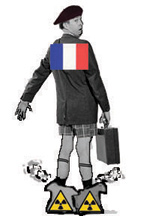 France tilting toward nuclear phase-out, DW 10 Sep 15 As the traditionally strong French nuclear power industry continues to be plagued by technical and financial difficulties, the government has sought to cut nuclear power in favor of renewables. French Environment Minister Segolene Royal sparked rebuke Tuesday (08.09.2015) by tying shutdown of the country’s oldest nuclear plant to the opening of an EPR reactor that has been delayed for six years already………last year, Areva recorded a loss of 5 billion euros. The group hasn’t sold a single power plant in the last seven years, and the Fukushima disaster looks to have had further impacts on demand for new reactors.
Third-generation nuclear reactors – so-called European Pressurized Reactors (EPR) – were initially considered a secure technology for the future and the flagship of the French nuclear industry. But even they have been fraught with problems.
Despite Royal’s recent statement, recently passed legislation on renewable energy in France may be the most telling sign that the winds of change appear to be blowing – toward a nuclear phase-out.
Technology of the future turns sour
Operational start of the Olkiluoto 3 EPR in Finland has been delayed from 2009 to 2018, and the Flamanville 3 reactor in France from 2012 to 2018. Construction costs for Flamanville 3 have exploded, from 3.3 to more than 10 billion euros. Two EPR reactors at the Hinkley Point nuclear facility in England have also been the focus of controversy, as construction costs are much higher than initially projected. Financing for completing the project has still not been secured.
There is also the prospect of major safety issues. In mid-April it became known that there were weak points in the steel vessel that surrounds the reactor at the French Flamanville plant, which could lead to cracking under pressure.
The French Nuclear Safety Agency (ASN) called the situation “very serious,” and has demanded a comprehensive report by October.
If the regulating authority judges the vessel unsafe, it would be a disaster for Areva. Replacing it would take several years and result in additional costs in the hundreds of millions of euros, experts say.
Yannick Rousselet, a nuclear energy expert at Greenpeace, says further delays would deal a death blow to the EPR project. Aside from the two European reactors, no EPR installation has been successfully completed – there are just two projects in China.
“Only a few years ago, Areva told us that worldwide it would be finalizing two to three reactors per year,” Rousselet said. “The reality today is that the EPR as an industrial project is dead.”
EDF steps in to save AREVA. The French state owns 86.5 percent of Areva and 84.5 percent of EPR, which is the world’s second-largest electricity provider and a major nuclear power producer.
In an emergency meeting with President Francois Holland in June, it was agreed that EDF should buy in to Areva’s reactor business.
“Without these measures, Areva wouldn’t survive the year,” said Mycle Schneider, editor of the World Nuclear Industry status report.
And according to Schneider, help for Areva doesn’t spell an end French nuclear power’s problems.
EDF is considerably larger than Areva, and has an annual turnover of 70 billion euros. But Schneider points out its also has 37.5 billion euros of debt. Schneider sees this mountain of debt as a central problem.
According to the Paris audit office, the company faces an additional 50 billion euros in costs for dismantling and disposal of nuclear waste.
From nuclear to renewables?
As nuclear energy faces these problems, winds of change appear to be blowing through the French energy system.
Marc Bussieras, head of EDF’s economic strategy department, is open to energy production without nuclear. EDF’s priority is a cost-effective strategy, he told DW.
“Today in France, there are economic reasons in favor of installing renewable energy capacity,” Bussieras said.
Marc Bussieras, head of strategy at EDF, said at a DW panel renewables make economic sense
The French government is seeking to promote an energy transition through new legislation, which is also hoped to create jobs. The law, adopted in July 2015, states that the share of nuclear power in France’s energy mix should be reduced from 75 percent today to 50 percent by 2025. The shortfall in power supply should primarily be covered by wind and solar.
According to a study commissioned by the national environmental agency (ADEME), a complete phase-out of nuclear power and switch to 100 percent renewable energy should be possibly – and economically viable – by 2050…….
Schneider sees other opportunities for the nuclear industry. “The future lies in the huge market for demolition and nuclear waste management,” Schneider said. “New constructions will remain the exception.” http://www.dw.com/en/france-tilting-toward-nuclear-phase-out/a-18692209
European Pressurised nuclear Reactor (EPR) – litany of delays and cost overruns
French EPR reactor years behind schedule, billions over budget http://economictimes.indiatimes.com/news/international/business/french-epr-reactor-years-behind-schedule-billions-over-budget/articleshow/48785708.cms By Reuters | 3 Sep, 2015, PARIS: French state-controlled utility EDF on Thursday announced new delays and cost overruns for the Areva-designed 1650 megawatt European pressurised reactor (EPR) reactor it is building in Flamanville, Normandy.

The EPR is set to be the first of a new series of safer “next-generation” reactors to replace France’s ageing fleet of 58 nuclear reactors. The Flamanville reactor had been scheduled to start in 2012 and was scheduled to cost 3 billion euros.
A similar EPR reactor built by ArevaBSE 1.16 % in Finland, on which construction started in 2005 and was scheduled to start up in 2009, has suffered even longer delays. Two more EPRs are under construction in China and EDF plans to build two in Hinkley Point, Britain.
Below is a timeline of the Flamanville delays and cost overruns:
July 2005: EDF says it plans to build an EPR reactor at Flamanville, which is due to start operating in 2012. The cost is estimated at 3 billion euros.
In its 2005 annual report, EDF estimates the cost at 3.3 billion euros.
May 2006: EDF says construction should begin in 2007 and be completed in 2012.
December 2007: Work starts on the Flamanville ..
December 2008: EDF says EPR is due to cost 4 billion euros.
July 2010: EDF says start of Flamanville EPR is delayed until 2014. Construction costs now seen at 5 billion euros.
July 2011: EDF delays the completion of its Flamanville reactor by another two years to 2016. It expects costs to rise to 6 billion euros.
December 2012December 2012: EDF says stricter regulation in the wake of the Fukushima disaster will bring the total cost of the EPR to 8.5 billion euros. The start-up date is still expected for 2016.
July 2013: EDF installs the dome of Flamanville reactor.
November 2014: EDF said the Flamanville reactor will start up in 2017. It says the delay is due to Areva’s difficulties with ensuring a timely delivery of certain pieces of equipment.
April 2015: EDF says weak spots have been found in the steel of the Flamanville EPR. EDF starts a series of new tests on the EPR as construction work continues. Nuclear regulator says carbon concentrations have weakened the mechanical resilience of the steel and its ability to resist the spreading of cracks.September 3 2015: EDF said the Flamanville reactor will now start in 2018 and cost 10.5 billion euros.
France’s new nuclear power – not successful at home, so they might try to sell it off to Czech Republic
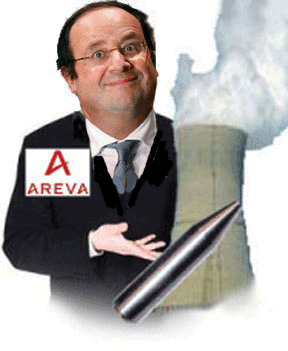 French foreign minister: EDF to consider participating in building new Czech nuclear reactors US News 23 Aug 15 PRAGUE (AP) — French Foreign Minister Laurent Fabius says his country’s company will consider participating in developing the Czech Republic’s nuclear program.
The Czech government has recently approved a long-term plan to increase the country’s nuclear power production. As part of the plan, the government wants to build one more reactor at the Temelin nuclear plant and another at the Dukovany plant, with an option to build yet another reactor at each plant…..Speaking to reporters after meeting Czech counterpart Lubomir Zaoralek on Sunday, Fabius said it will be state-controlled utility Electricite de France that will be part of a public tender to build the reactors. http://www.usnews.com/news/business/articles/2015/08/23/france-to-consider-helping-czech-nuclear-program
Local anxieties in Germany, over French nuclear waste plan
 French nuclear waste plan irks Germans near site, DW, 4 Aug 15 France wants to build a permanent nuclear waste storage facility not far from the German border. The plan has irked many in the region, but the government in Berlin sees no need for action.
Nuclear power plants produce radioactive waste, which emits radiation for thousands of years. Even Germany, which is set to phase out nuclear power, is looking for a final repository for its spent nuclear fuel, but has not yet decided on the location. Finding a geologically suitable site is not the problem, but rather, the protests over the location. Nobody wants to live with a nuclear waste dump at their doorstep.
For many decades, France has focused and relied on nuclear power, and now, plant operators are under pressure to find repositories for the radioactive waste.
The French government seems to have its sights set on Bure, a town in eastern France, around 120 kilometers (74 miles) from the German border. There, scientists have spent years investigating whether highly and moderately radioactive waste can be disposed of 500 meters underground. ANDRA, the French national agency for radioactive waste, believes that Bure offers what a repository requires: Nuclear waste can be stored there for 100 years; then, the site can be closed off and ultimately, the nuclear waste can decay there for 100,000 years until the radiation no longer poses a threat to humans.
‘Unbearable coup’
Opponents of the site feel less bothered by the repository itself then by the decision-making process that led to choosing it. In mid-July, the government added a last minute clause to a legislative package promoting business development but did not hold a debate or vote in parliament. And since no other potential nuclear waste sites have been explored in France, critics believe that the Bure location was practically predetermined. The Green party group in the French national assembly calls the procedure an “unbearable coup,” while the nation’s nuclear regulatory body and the French Institute for Radiological Protection and Reactor Safety (IRSN) have expressed “numerous reservations” about the plans………http://www.dw.com/en/french-nuclear-waste-plan-irks-germans-near-site/a-18627896
The end of the line for AREVA’s model of “birth to grave” nuclear processes
 As losses mounted, so did Areva’s debt, which reached six billion euros at the end of the first half of 2015.
The sale of the nuclear reactor unit to EDF marks the end of Areva’s formerly profitable full-service model, which offered clients all aspects of development ranging from conception and construction to fuel procurement and waste treatment.
France sells major nuclear stake http://www.iol.co.za/business/international/france-sells-major-nuclear-stake-1.1893029#.VbqVMvOqpHw July 30 2015 Paris – Atomic energy giant Areva on Thursday agreed to sell a majority stake of its nuclear reactor unit to electricity group EDF as part of a shake-up of the French sector. Continue reading
€7bn needed to keep loss-making nuclear company AREVA alive
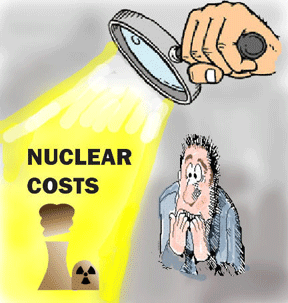 Lossmaking Areva needs €7bn capital injection, Ft.com Michael Stothard in Paris, 30 July 15 Struggling French nuclear group Areva on Thursday disclosed it needed a bigger than expected capital injection worth €7bn as the company also unveiled a far-reaching agreement with EDF on asset disposals and other projects.
The two companies — both state-controlled — agreed in principle that EDF will pay €2bn for a 75 per cent stake in Areva’s reactor unit, called Areva NP, in a radical reshaping of the French nuclear industry that has come after months of tense negotiations……..
Following the deal, Areva, which reported a €4.8bn net loss last year, will be reduced to a nuclear fuel company that mines, enriches and then disposes of uranium. The heart of the company — designing, building and servicing nuclear reactors — is being sold off.
Areva said that overall it would need €7bn in capital over the next two years, however, meaning that as much as €5bn will be required from sources other than EDF, the French utility group. Much of these additional funds are likely to come from a government-backed capital raising.
The French government may have to contribute between €4bn and €5bn, far more than the €2bn to €3bn that ministers had hoped for just a few months ago, according to people familiar with the situation, although the exact level of the capital raising was not announced on Thursday.
Areva said it could secure €0.4bn from selling some other assets including Canberra, its nuclear measurements subsidiary, and as much as €1.2bn from other sources of equity financing. This suggested a government-backed capital raising that might be closer to €4bn.
On Thursday the two companies also said they would set up a dedicated company to be 80 per cent owned by EDF and 20 per cent by Areva NP, aimed at improving the design and management of brand new reactors projects.
One of the problems that has weighed on Areva in recent years has been cost overruns at key projects, particularly the Olkiluoto 3 reactor in Finland, which is 10 years behind schedule and prompted the company to take €3.9bn in impairment charges………..http://www.ft.com/cms/s/0/110c0476-368c-11e5-b05b-b01debd57852.html#axzz3hPaCUU5g
France moves towards renewable energy, while government still shelling out $billions to save AREVA
France‘s decision to reduce dependence on nuclear power will not go down well with the already struggling nuclear industry, which includes French players like Areva, EDF and GDF Suez. Areva, the world’s largest nuclear company, reported a loss of $4.8 billion in 2014 after it started facing a dip in demand following the 2011 Fukushima disaster.
Areva is one of the most prominent companies in France, so the French government has been trying hard to save the company through a proposed deal with EDF, which involves selling off its reactor and fuel treatment business. According to recent reports, the French government could end up shelling out $5.5 billion to rescue Areva, far more than anticipated.
Is France Ready To Move Away From Nuclear Energy? http://oilprice.com/Alternative-Energy/Nuclear-Power/Is-France-Ready-To-Move-Away-From-Nuclear-Energy.html By Gaurav Agnihotri 30 July 2015 | 0
But unlike the U.S., nuclear energy represents France’s largest source of electricity generation, accounting for around 77 percent of the country’s energy generation in 2014. However, in the last few years, France has witnessed growing public support in favor of developing newer technologies that can reduce carbon emissions and replace nuclear power.
In the year 2012, France’s newly elected President Francois Hollande pledged to reduce his country’s dependence on nuclear power to 50 percent by 2025. This triggered a ‘national debate for energy transition’ in France which lasted for eight months. The National Assembly of France then passed an Energy Transition for Green Growth bill in 2014 which would put a cap on the country’s nuclear power capacity at the current level of 63.2 gigawatts.
Last week saw French Lawmakers finally pass this bill which seeks to cut the country’s growing dependence on nuclear power. With the move, France is following Germany, which decided to significantly reduce its dependence on nuclear energy after the infamous 2011- Fukushima nuclear disaster in Japan.
In order to meet this tough new target, Electricite De France or EDF (which is 85 percent government-owned) would have no other option but to close some of its nuclear power capacity in order to accommodate its new European Pressurized Reactor (EPR), which is currently under construction in Normandy.
The new law further requires France to increase the contribution of renewables in its total energy consumption to 32 percent by 2030. This is in addition to reducing the C02 emissions by 40 percent by 2030 when compared to 1990 levels and also reduce conventional fossil fuel consumption by 30 percent by 2030 from 2012 levels.
Although the law has made it quite clear that France now has to reduce its dependence on nuclear power, there are still several loopholes. as it hasn’t provided a clear manner in which the set target is supposed to be met and there is no specific implementation strategy put in place yet. “This law sets goals, which is interesting, but it doesn’t explain how to reach them, postponement of the detailed implementation plans is not a good sign,” said Yannick Rousselet of Greenpeace.
“I want France to become a nation of environmental excellence,” said French environmental minister Segolene Royal. She further said that recent steps taken by the French government could create close to 100,000 jobs in the renewable sector.
As the new law has also set a goal of increasing overall renewable energy consumption while also curtailing nuclear power, we can expect some major foreign investments in the French clean energy sector in the coming few years. French energy giant Total has in fact been investing a substantial amount in the solar sector. With its partnership with U.S. based Sunpower, Total might just ramp up its investments in the French solar sector.
It is interesting to note that wind energy also enjoys local public support in France as a 2014-CSA survey revealed that around 64 percent of local people see wind energy as a worthy replacement for nuclear power. According to the European Wind Energy Association, France increased its target for energy generation from wind to 19 gigawatts by 2020 from 8.2 gigawatts in 2014.
France is also the second largest producer of biofuels in Europe after Germany, mostly producing biodiesel. France has already set a goal of blending 10 percent of biofuels with its conventional fuels by 2020. So, with the current push towards renewables one can reasonably expect a surge in biofuel investments as well.
However, the same cannot be said for natural gas, as France is one of the four countries that have banned hydraulic fracturing or fracking. Experts predict that the French natural gas demand might even fall by the year 2020.
What does this mean for the suppliers of nuclear fuel and companies like AREVA?
France‘s decision to reduce dependence on nuclear power will not go down well with the already struggling nuclear industry, which includes French players like Areva, EDF and GDF Suez. Areva, the world’s largest nuclear company, reported a loss of $4.8 billion in 2014 after it started facing a dip in demand following the 2011 Fukushima disaster.
Areva is one of the most prominent companies in France, so the French government has been trying hard to save the company through a proposed deal with EDF, which involves selling off its reactor and fuel treatment business. According to recent reports, the French government could end up shelling out $5.5 billion to rescue Areva, far more than anticipated.
With its desire to shift away from nuclear energy, France is slowly and steadily preparing itself to adapt newer technologies and eventually move towards renewables. However, this transition requires a clear road map with a clear plan on the systematic closure of its nuclear capacity. Without these, it might take several years (beyond the target dates) for the Energy Transition law to get implemented.
By Gaurav Agnihotri for Oilprice.com
France quadruples carbon price, will move towards renewable energy
France Passes New Energy Law Quadruples Carbon Price, Bloomberg by Tara Patel 23 July 15, French lawmakers adopted a long-delayed energy law that will reduce the country’s reliance on nuclear reactors and raise carbon prices almost fourfold.
Lawmakers late Wednesday passed legislation that included a last-minute amendment initially rejected by the government to increase the target price of carbon to 56 euros ($61.48) a ton in 2020 and 100 euros a ton in 2030, according to the National Assemblywebsite. The rate, now 14.50 euros a ton, climbs to 22 euros a ton in 2016 and is integrated in a levy on fossil fuels.
The rise provides “visibility” to the business community on how carbon prices will evolve, Environment Minister Segolene Royal said. Higher taxes on fossil fuels will be offset by lower levies on other products, she also said.
1 This Month



26 September – International Day for the Total Elimination of Nuclear Weapons


PLEASE OPPOSE HR 8255 AND S.3639 – bills would accelerate satellite deployment, with no environmental review or safeguards – https://ncstd5li.quorum.us/campaign/169331/
To see nuclear-related stories in greater depth and intensity – go to https://nuclearinformation.wordpress.com
-
Archives
- September 2026 (269)
- August 2026 (330)
- July 2026 (355)
- June 2026 (287)
- May 2026 (306)
- April 2026 (356)
- March 2026 (251)
- February 2026 (267)
- January 2026 (308)
- December 2025 (358)
- November 2025 (359)
- October 2025 (375)
-
Categories
- 1
- 1 NUCLEAR ISSUES
- business and costs
- climate change
- culture and arts
- ENERGY
- environment
- health
- history
- indigenous issues
- Legal
- marketing of nuclear
- media
- opposition to nuclear
- PERSONAL STORIES
- politics
- politics international
- Religion and ethics
- safety
- secrets,lies and civil liberties
- spinbuster
- technology
- Uranium
- wastes
- weapons and war
- Women
- 2 WORLD
- ACTION
- AFRICA
- Atrocities
- AUSTRALIA
- Christina's notes
- Christina's themes
- culture and arts
- Events
- Fuk 2022
- Fuk 2023
- Fukushima 2017
- Fukushima 2018
- fukushima 2019
- Fukushima 2020
- Fukushima 2021
- general
- global warming
- Humour (God we need it)
- Nuclear
- RARE EARTHS
- Reference
- resources – print
- Resources -audiovicual
- Weekly Newsletter
- World
- World Nuclear
- YouTube
-
RSS
Entries RSS
Comments RSS


