France’s nuclear corporation AREVA going down the financial gurgler
As Areva Goes Belly Up, Modi’s French Nuclear Plans May Start Unravelling, DiaNuke.org, 24 July 15 “………..The signs of Areva’s irreparable decline if not imminent death have been on the horizon these past years. With its single product catalogue, Areva has struggled to complete two identical EPR reactors, the first at Olkiluoto for TVO in Finland (still not operational despite a nine-year delay and a trebling of costs) and the second in Flamanville, France, plagued by equally serious construction and security flaws, delays and outrageous cost over-runs. …….

Reactor woes continue
The estimated price of the reactor continues to go up and up – it has nearly trebled from 3.3 billion euros eight years ago to around 9 billion euros at current estimates and could go higher if the EPR’s technical problems persist. The company has run up a deficit estimated at 4.8 billion euros for a turnover of 8.3 billion. Its recapitalisation requirements stand at 7 billion euros. The French government has stepped in to impose draconian solutions on the company that will see its design, construction and operations arm hacked off and handed over to its arch enemy, EDF. When the negotiations with EDF are completed – the haggling over price is currently underway – Areva, a company that has built and operated some 64 nuclear reactors will be reduced to a dwarf.
The French nuclear security watchdog, ASN, has issued a number of severe warnings to Areva on major security issues and manufacturing and construction flaws in the reactor being built in Flamanville, France, one of four EPRs under construction in the world. One of the latest warnings concerns the weakness of the reinforced steel core at the heart of the reactor where nuclear fission takes place. French papers have described fissures in the reactor’s innermost core as measuring as much as 42 centimetres. If the ASN’s suspicions about the poor quality of the forging done by Areva are proved right (the final test results will be available in October), the reactor dome will have to be removed. This can only mean one thing: the total abandonment of the EPR in France. A decision is not expected until 2016.
Several reports published in France on the woes of the EPR describe it as a product of “French technological hubris”. It is a gigantic reactor that looks good on paper. But as the adage goes, the proof of the pudding lies in the eating and India did not wait long enough to see the reactor’s performance before rushing in to buy an untried product.
“The EPR reactor whose problems are at the heart of the current crisis is an expensive failure,” writes energy analyst Nick Butler. “It has to be written off and replaced by a new generation of smaller, less complex reactors that can be built on time and on budget. The EPR was designed at a time when it was believed that energy costs would rise inexorably. That is no longer the case.”…………There is also the question of Areva’s massive debt.
Uncertain future
The Finnish nuclear operator TVO is suing Areva for billions of dollars for the delays, cost over-runs (estimated at 7 billion euros instead of the 3.3 billion originally projected) and technical flaws related to the EPR in Olkiluoto. The failure of the Finnish EPR has contributed vastly to Areva’s troubles.
Once hailed as the harbinger of a nuclear renaissance, the EPR is fast becoming one of the world’s most criticised and by far the most expensive nuclear white elephants. In France work began in 2007 and the reactor was to have gone on stream in 2012. This date has now been pushed forward to 2017 at three times the initial cost.
Leaving aside the problems linked to cost, safety and technological know-how, it is at this stage totally unclear if EDF would like to pursue the EPR programme at all. Last year the European Commission gave the go ahead for building another EPR reactor at Hinkley Point in Britain. But British authorities, which were to have signed in March 2015, now appear reluctant to go ahead. The Financial Times reported that the project might be completely abandoned. In the US, plans to build the EPR have currently been suspended. as World Nuclear News reported in March, Areva “has asked the US Nuclear Regulatory Commission (NRC) to suspend work on the design certification of the US EPR until further notice, prompting Unistar Nuclear Energy to request the suspension of the review of its construction and operation licence (COL) application for Calvert Cliffs 3.” http://www.dianuke.org/why-is-india-bent-on-joining-the-sinking-french-nuclear-ship/
Reject Nunavut board’s recommendation against uranium project – AREVA urges Canadian govt
 Areva urges minister to reject Nunavut board’s disapproval of uranium project CBC News Jul 08, 2015 The company that wants to eventually open a uranium mine near Baker Lake, Nunavut, is asking the federal government to reject a territorial regulator’s recommendation that the project not be approved.
In May, following a multi-year environmental impact review, the Nunavut Impact Review Board (NIRB) said Areva Resources Canada’s Kiggavik project should not be approved because it doesn’t have a construction timeline attached to it.
But whether the project can proceed is ultimately up to Aboriginal Affairs and Northern Development Minister Bernard Valcourt. Areva has written Valcourt asking him to send the recommendation back to NIRB and direct NIRB to “consider the inclusion of appropriate terms and conditions to a project approval.”..http://www.cbc.ca/news/canada/north/areva-urges-minister-to-reject-nunavut-board-s-disapproval-of-uranium-project-1.3142869
Grim future for France’s nuclear companies AREVA and EDF
Burdened by losses, EDF’s foreign activities are currently unable to finance the increasing requirements at home, where the production costs of nuclear plants are rising by around 5% each year and investment needs are increasing.
The international trend is not for a nuclear renaissance but for a boom in renewable energy, and France will not be able to export significantly more reactors, or to develop new reprocessing contracts abroad under profitable conditions.
To understand just how far the French nuclear industry has fallen in recent years, look no further than the value of EDF and Areva. Since 2007, EDF’s stock price has fallen more than 70%; Areva’s by more than 85%. If Areva weren’t 83% government-owned, it almost certainly would have declared bankruptcy by now.
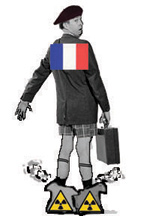 nuClear News July 15 http://www.no2nuclearpower.org.uk/nuclearnews/NuClearNewsNo75.pdf The deep crisis which the French nuclear industry is experiencing is not new, although it seems to have shocked some commentators. It actually represents the outcome of a strategy launched at the end of the 1990s which was always flawed. The project involved an aggressive export policy which it was hoped would disguise predictable difficulties at home, according to a report by WISE Paris for Greenpeace. (1)
When France shuts its nuclear reactors, it will be left with a monumental radioactive trash problem
 French nuclear waste will triple after decommissioning: agency http://www.reuters.com/article/2015/07/01/us-france-nuclear-waste-idUSKCN0PB4TM20150701
In a report released on Wednesday, Andra estimated that final nuclear waste volumes will eventually reach 4.3 million cubic meters, up from 1.46 million at the end of 2013 and an estimated 2.5 million in 2030.
That is based on an average lifespan of 50 years for utility EDF’s 58 nuclear reactors and including a new reactor under construction in Flamanville. Most of that waste will be only slightly radioactive, such as building rubble and clothing used during decommissioning, but because of its bulk, it requires increasing amounts of space.
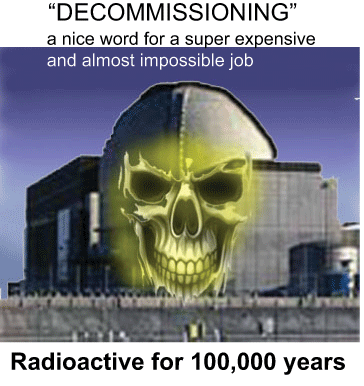
Andra, which publishes a nuclear waste inventory every three years, expects its low-level waste facility in Morvilliers, in the Aube region, would fill up between 2020 and 2025.
“We want to warn that the storage centers are filling up and that we need to optimize waste management because storage facilities are a rare resource,” Andra executive Michele Tallec told Reuters.
Volumes of highly radioactive, long-life waste – which represent just 0.2 percent of the volume but 98 percent of the radioactivity – should rise from 3,200 cubic meters at the end of 2013 to about 10,000 cubic meters when all France’s nuclear plants reach their end of life.
This waste is scheduled to be buried in the controversial deep-storage site in Bure, in eastern France, which already has a test facility but has not received any nuclear waste.
his year, Andra plans to present the French government and nuclear regulator ASN a technical dossier on Bure, which aims to bury nuclear waste 500 meters underground in thick layers of argillite rock, which Andra says will prevent most radioactive particles from traveling more than a few meters over hundreds of thousands of years.
Andra plans to put in a formal request to build the 35 billion euro facility – which faces resistance from environmental groups and local residents – in 2017 and hopes to start construction in 2020 with a view to open it for first testing in 2025.(Reporting by Benjamin Mallet and Michel Rose, writing by Geert De Clercq, editing by David Evans)
In France, nuclear power has lost its glow

 France Loses Enthusiasm for Nuclear Power, Scientific American, Nuclear’s share of electricty will drop from 75 percent to 50 percent by 2025 due to loss of know-how and requirements for more renewable sources By Umair Irfan and ClimateWire | June 29, 2015“……..
A ‘once formidable institution’ declines….nuclear plants, by their nature, are big bets and take years to build. Laponche explained that the French nuclear industry anticipated 1,000 TWh of demand, but domestic needs have yet to top 600 TWh, leaving an oversupply. With the economic downturn and increasing energy efficiency, French electricity demand has remained level or declined in some instances.
Now, some of France’s reactors are showing wrinkles—France’s oldest reactor, Fessenheim 1, started operations in 1977—and officials need to decide whether to invest in costly safety upgrades to keep them operating or to decommission them, another expensive prospect that leaves open the possibility that fossil fuels may rise to meet the shortfall.
New reactors also are struggling. Areva’s third-generation nuclear reactor, EPR, is now under construction at four sites: two in China, one in France and one in Finland. All four are behind schedule, and the French and Finnish reactors have seen their costs more than double, suffering from quality control and management problems.
“The cost of construction of new nuclear is extraordinarily expensive,” said Antony Frogatt, a senior research fellow at Chatham House, an international affairs think tank. He observed that there are ways to extend the lives of existing reactors, but upgrades get progressively more expensive, and certain components, like reactor pressure vessels, cannot be replaced, so renewed operating licenses are only prolonging the inevitable.
And while France has reduced nuclear waste, it hasn’t eliminated the need to dispose of it. No country with nuclear power has a viable underground repository for waste, and proposed sites in France face public opposition, despite more widespread support for nuclear power.
On the other hand, France is the second largest renewable energy producer and consumer in Europe. Wavering solar and wind power don’t play well with baseload nuclear plants that prefer to run at full blast, so the French must find a way to cope with this imbalance if they are to meet the European Union’s directive to generate 20 percent of their electricity from renewables by 2020…….
To sum up, it’s a shrinking client base [for nuclear power] and a competitive market,” said Mycle Schneider, an independent international energy consultant. “The financial and economic situation is devastatingly bad.”
The New York Times reported that Areva hasn’t been profitable since 2010, accrued €4.8 billion in losses in 2014 and may lay off up to 6,000 workers. EDF may take over parts of Areva’s business…….
AREVA to sell its U.S. nuclear radiation measurement business
Areva puts U.S. nuclear radiation business Canberra up for sale PARIS, JUNE 29 French state-owned nuclear group Areva has begun the sale process for the planned disposal of its U.S. nuclear radiation measurement business Canberra, it said in a statement on Monday.
The sale of Canberra is part of a revamp of loss-making Areva, with utility EDF poised to buy its nuclear reactor business. (Reporting by Michel Rose; Editing by David Goodman) http://www.reuters.com/article/2015/06/29/areva-canberra-idUSL5N0ZF0H220150629
France keen to save AREVA, by selling nuclear reactors to Saudi Arabia
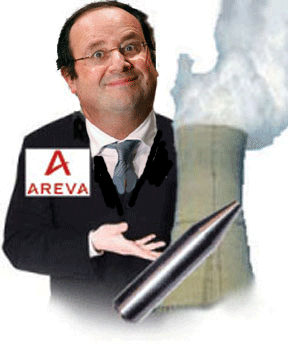 France plans new Saudi nuclear reactors, Sky News 25 June 2015 France has confirmed it is looking into building two nuclear reactors in Saudi Arabia, as part of 12 billion euro ($A17.31 billion) worth of deals struck between the nations.
Under one of the agreements Airbus will sell 23 H-145 multipurpose helicopters to Saudi Arabia for 500 million euros as well as launch a feasibility study into building the reactors, French Foreign Minister Laurent Fabius said on Wednesday……..
The study for two European Pressurised Reactors (EPR) – which France considers the safest and most advanced in the world – takes on added significance given the current efforts by Saudi Arabia’s rival, Iran, to develop its own nuclear capabilities.
In addition to the study, France will sign an agreement to train the Saudis on nuclear safety and the treatment of nuclear waste……
France has been reinforcing links with the conservative kingdom despite persistent criticism of its human rights record,…… http://www.skynews.com.au/news/world/mideast/2015/06/25/france-plans-new-saudi-nuclear-reactors.html#sthash.tI5czLBA.dpuf
Japan – no idea what to do with its nuclear trash now stored in France

they should just stop making radioactive trash
Japan faces dilemma over 16 tonnes of plutonium stored in France http://www.timeslive.co.za/world/2015/06/18/Japan-faces-dilemma-over-16-tonnes-of-plutonium-stored-in-France Reuters | 18 June, 2015
Still dealing with the huge clean up after the Fukushima crisis and debating its future use of atomic energy, Japan now faces another nuclear conundrum – what to do with 16 tonnes of its plutonium sitting in France after being reprocessed there. The question will be among the issues that come under the spotlight on Thursday and Friday as nuclear proliferation experts meet with legislators and government officials in Tokyo.
With its reactor fleet shut down in the wake of Fukushima, Japan is unable to take fuel made from the plutonium at the moment and could be forced to find other countries to use it.
The matter has taken on greater urgency as Areva, the French nuclear company that owns the La Hague reprocessing facility holding the plutonium in western Normandy, faces billions of dollars of losses.
“In this whole mess (at Areva) we have a huge amount of Japanese plutonium,” said Mycle Schneider, an independent energy consultant, adding Japan would need to resolve the problem sooner rather than later.
An Areva spokesman said the company had long-standing contracts with Japanese utilities to take nuclear fuel made from the plutonium. Frank von Hippel, one of the founders of the International Panel on Fissile Materials (IPFM), a group of arms-control and proliferation experts, will discuss Japan’s stock of plutonium in France when he meets with Japanese legislators, according to a draft of a presentation he will give that has been seen by Reuters.
The group argues the world’s growing inventory of plutonium from civilian use is a “clear and present danger” as it could be used in so-called dirty bombs. apanese government officials did not immediately respond to requests for comment.
 Schneider, who is a contributor to a soon to be released IPFM report on plutonium separation in nuclear power programmes, said the alternative to taking back the plutonium would be to pay other countries to use it in their reactors.
He said that France would be one option, but that the cost would likely be high, especially as that country has its own stockpile to deplete. He did not give an exact cost.
“Giving its plutonium away and paying for it would expose the Japanese to the reality of plutonium as a liability rather than an asset,” said Schneider.
A precedent for that kind of deal could be set in Britain, where the government has offered to take ownership of 20 tonnes of Japanese plutonium stored at the Sellafield processing plant, according to the IPFM.
“This is a kind of win-win deal,” said Tatsujiro Suzuki, a former vice chairman of the Japan Atomic Energy Commission, who will join Von Hippel in meeting with legislators on Thursday.
“The British side would make money and the Japanese would lose less,” said Suzuki.
AREVA and EDF need to clean up their organisational mess ASAP – says France’s nuclear watchdog
 French nuclear watchdog urges quick resolution of Areva rescue plan, Reuters, PARIS | BY MICHEL ROSE AND BENJAMIN MALLET 12 June 15 Areva’s (AREVA.PA) financial situation is worrying, the head of France’s ASN nuclear watchdog said on Thursday, urging the loss-making nuclear company and utility EDF (EDF.PA) to wrap up a rescue plan for Areva as soon as possible.
The French government last week approved EDF’s plan to take a majority stake in Areva’s nuclear reactor business and gave the two state-owned companies a month to do a deal.
“Areva’s current financial situation, it could get better, (it) can be considered as preoccupying in terms of safety,” ASN Director Pierre-Franck Chevet told Reuters in an interview.
“That’s why we have formally asked to hear them … to ask what kind of organisation they are putting in place to fulfils the commitments they have made in terms of safety for the incoming period,” he added, noting a meeting was scheduled by the end of June.
An EDF spokeswoman declined to comment, while an Areva spokeswoman pointed to comments made by Areva Chairman Philippe Varin on Wednesday, that safety remained an absolute priority.
ASN, an independent regulatory authority, last year imposed on Areva a requirement to recondition radioactive waste stored at its La Hague facility in northern France, which could cost several billion euros and which must be provisioned for, Chevet said.
However the watchdog has no power on the merger per se and its only remit is safety. It can shut down a nuclear plant if it sees a safety issue or fine companies for any transgressions……..http://uk.reuters.com/article/2015/06/11/uk-france-nuclear-asn-idUKKBN0OR2EU20150611
Falling electricity prices are hitting France’s nuclear corporation EDF
 EDF Nuclear Power Struggles to Compete With Falling Market Price, Bloomberg Business, by Tara Patel June 10, 2015 Electricite de France SA’s sale of atomic power to competitors for the second half of the year has sunk to a fraction of what it was in 2014, signaling nuclear energy may be losing competitiveness.
The state-controlled utility sold a quarter of the volume, or 4 terawatt-hours, to rivals, according to energy regulator Commission de Regulation de l’Energie. The 12.3 terawatt-hours sold for the first half was also less than half the 34.6 terawatt-hours for the second half of 2014.
The drop signals obstacles ahead for Chief Executive Officer Jean-Bernard Levy, who is pushing for higher power prices to help pay for tens of billions of euros of maintenance and safety upgrades on EDF’s aging fleet of French nuclear reactors, which account for three-quarters of the country’s electricity production.
“There is an imbalance between nuclear generation costs and wholesale power market prices,” said Louis Boujard, a utilities analyst at Oddo Securities in Paris. “Nuclear energy is less competitive than it was in the past.”Market Price
French electricity is bought and sold in the market on a year-ahead basis for 38.15 euros, or 9.2 percent below the Arenh price, according to broker data compiled by Bloomberg. The contract has dropped 4.6 percent since January and is trading at its lowest level for the time of year since at least 2007 when Bloomberg began tracking the data.
The government is reviewing how it calculates the rates charged for Arenh nuclear power. While EDF argues that it needs to increase the rate to better reflect the cost of generation, other power distributors such as Direct Energie and industrial consumers want a reduction. In the meantime, they are shunning the volumes in favor of cheaper power on the market………http://www.bloomberg.com/news/articles/2015-06-10/edf-nuclear-power-struggles-to-compete-with-falling-market-price
Risk of nuclear meltdown due to faulty valves in new-generation EPR reactor
 Faulty valves in new-generation EPR nuclear reactor pose meltdown risk, inspectors warn http://www.telegraph.co.uk/news/worldnews/europe/france/11662889/Faulty-valves-in-new-generation-EPR-nuclear-reactor-pose-meltdown-risk-inspectors-warn.html
Flamanville third-generation EPR nuclear reactor – the same model Britain plans to use for two new plants at Hinkley Point – has multiple faults in crucial safety valves, inspectors warn By Henry Samuel, Paris 09 Jun 2015 Nuclear safety inspectors have found crucial faults in the cooling system of France’s flagship new-generation nuclear power plant on the Channel coast, exposing it to the risk of meltdown.
The third-generation European Pressurised Reactor currently under construction in Flamanville is the same model that Britain plans to use for two new plants at Hinkley Point in Somerset.
State-controlled nuclear giant Areva is responsible for the design and construction.
France’s nuclear safety watchdog found “multiple” malfunctioning valves in the Flamanville EPR that could cause its meltdown, in a similar scenario to the 1979 Three Mile Island nuclear accident in the US.
The inspectors listed the faults in a damning presentation obtained by Mediapart, the investigative French website. This is the latest setback for what is supposed to be France’s atomic energy showcase abroad, following the revelation last month that its steel reactor vessel has “very serious anomalies” that raise the risk of it cracking. The vessel houses the plant’s nuclear fuel and confines its radioactivity. Continue reading
Meltdown in France’s nuclear dream – taxpayers to cop the costs
External factors may have precipitated the crash of Areva, but the cause is internal. Areva and the French nuclear industry is controlled by engineers and state officials and the market comes as an afterthought.
The problems of time and cost overruns in China, Finland and now in France at Flamanville are self-made and part of the “esprit de corps” arrogant attitude of the organisation.
Now, 13 years later, the problem needs to be addressed and risks costing billion of euros and thousands of jobs
France’s Nuclear Industry Dream Faces Melt-Down At Expense Of State Coffers, Tax Payers Forbes, Marcel Michelson, 3 June 15 France has decided to rescue its Areva nuclear energy company once again, this time by combining the nuclear power station creation business with state-controlled power operator EDF , its biggest client.
Only a few years back, in 2010, Areva’s finances had been restored by the forced sale of its transport and transmission activities to industrial group Alstom and electrical engineer Schneider . Meanwhile, GE of the United States controls the Alstom power activities as part of its own rescue recapitalisation.
The rest of Areva includes uranium mines, nuclear waste recycling, transport, storage and some alternative energy activities.
For all intents and purposes, Areva is dead. Continue reading
France pins its nuclear hopes on exporting reactors
Rescued Areva faces uncertain future as nuclear fuel group By Geert De Clercq (Reuters) 5 June 15 – France‘s Areva faces an uncertain future as a specialised nuclear fuel supplier, as a state rescue moves its core nuclear reactor activities to its utility customer EDF. Shares in the state-owned firm briefly rose almost 6 percent on Thursday after the government said late on Wednesday it would recapitalise Areva and approved EDF’s plan to take over Areva’s reactor unit.
The government plan unwinds Areva’s much-vaunted model of an integrated nuclear group that mines and enriches uranium, produces nuclear fuel, builds reactors and recycles spent fuel. Created fifteen years ago from the nuclear fuel group Cogema and reactor builder Framatome, Areva had ambitions to sell as many as 16 of its massive EPR reactors to energy-hungry developing countries.
But it has not sold a reactor since 2007 and the four it did sell have been plagued by delays and cost overruns. More than two decades after it was designed, not a single EPR is in operation today.
Still, the French government said it hopes an EDF-led nuclear industry could win the export contracts that have proved so elusive for Areva.”The French camp must work together abroad,” Economy Minister Emmanuel Macron told France Info radio on Thursday. Continue reading
France’s AREVA-EDF nuclear merger – easier said than done
France Grapples With a Knotty Nuclear Problem http://blogs.wsj.com/corporate-intelligence/2015/06/04/france-grapples-with-a-knotty-nuclear-problem/ By AMBROISE ECORCHEVILLE
The reconstitution of France’s nuclear industry is officially underway. Under orders from President François Hollande, atomic-power utility Electricité de France ‘sEDF.FR -0.45% is going to invest in the nuclear-reactor business of Areva to help refinance the troubled engineering group. The two state-controlled companies have a month to clinch a comprehensive deal.
That’s going to be easier said than done.
Leaving aside the questions about the future of nuclear energy in a world of fast-changing energy markets and geopolitical uncertainty, the interests of the French state, EDF and Areva are far from convergent.
Take Areva’s finances. The group, whose operations run from uranium mining to treating nuclear waste, needs a cash injection of €6 billion ($6.6 billion) to €8 billion. EDF, according to people familiar with the matter, has offered to invest €2 billion in Areva’s reactors unit. Some analysts question the willingness of the government to make up the difference. They note France’s stretched public finances and long-term risks associated with Areva’s unfinished, much-delayed, and over-budget nuclear reactor projects in Finland and France.
The future commercial ties between EDF and Areva also leave unanswered questions. The government wants to reset them. EDF’s success in diversifying its sources of nuclear fuel for its park of French reactors, responsible for about three quarters of the country’s electricity, has squeezed margins at Areva.
True, France could try to lure foreign investment but outside investors can only ever hope to be junior partners in such a strategic industry. Areva sees itself best placed to pick up business from the €55 billion investment program EDF is considering to extend the average life of its nuclear power plants to 60 from 40 years.
As for EDF, there are financial and commercial risks in being a more vertically integrated nuclear business. Building reactors is capital intensive, while foreign customers may not fancy have the prospect of EDF bidding to build, operate and now equip new projects.
The government could dull the pain by letting EDF raise electricity prices at home. That would bring a smile to the faces of shareholders, not least the state given its 84.5% stake, just not necessarily to those of President Hollande’s electorate
Merger of AREVA and EDF, to save nuclear giant AREVA- French tax-payers to fork out
 France announces plan to merge nuclear reactor businesses of state-owned atomic energy giants, Star Tribune By GREG KELLER Associated Press JUNE 3, 2015 PARIS — French nuclear giants Areva and EDF will merge their reactor businesses in a joint venture controlled by EDF — a wide-ranging reshuffle of the country’s state-owned atomic energy industry.
French President Francois Hollande’s office announced the deal’s broad outlines Wednesday, saying final details would be negotiated by the two companies within a month.
The French government, which controls over 80 percent of both companies, will inject new capital “of the necessary amount” in Areva as part of the deal……
 Areva lost nearly 5 billion euros ($5.6 billion) last year after taking a massive loss on new reactor projects in France and Finland……..
Last month Areva announced a 1-billion-euro cost-cutting plan, which included the removal of up to 6,000 jobs.
Only five years ago Areva was seen as a French success story, led by swashbuckling CEO Lauvergeon as it rode the wave of the so-called “nuclear renaissance.”
The company’s fortunes collapsed after a series of failures, including massive cost-overruns and technical failings with its new generation reactor; a disastrous investment in a Nigerien uranium mine; and the aftereffects of a global rejection of nuclear power after Japan’s Fukushima reactor meltdown http://www.startribune.com/france-to-merge-areva-edf-nuclear-reactor-businesses/306008871/
1 This Month



26 September – International Day for the Total Elimination of Nuclear Weapons


PLEASE OPPOSE HR 8255 AND S.3639 – bills would accelerate satellite deployment, with no environmental review or safeguards – https://ncstd5li.quorum.us/campaign/169331/
To see nuclear-related stories in greater depth and intensity – go to https://nuclearinformation.wordpress.com
-
Archives
- September 2026 (269)
- August 2026 (330)
- July 2026 (355)
- June 2026 (287)
- May 2026 (306)
- April 2026 (356)
- March 2026 (251)
- February 2026 (267)
- January 2026 (308)
- December 2025 (358)
- November 2025 (359)
- October 2025 (375)
-
Categories
- 1
- 1 NUCLEAR ISSUES
- business and costs
- climate change
- culture and arts
- ENERGY
- environment
- health
- history
- indigenous issues
- Legal
- marketing of nuclear
- media
- opposition to nuclear
- PERSONAL STORIES
- politics
- politics international
- Religion and ethics
- safety
- secrets,lies and civil liberties
- spinbuster
- technology
- Uranium
- wastes
- weapons and war
- Women
- 2 WORLD
- ACTION
- AFRICA
- Atrocities
- AUSTRALIA
- Christina's notes
- Christina's themes
- culture and arts
- Events
- Fuk 2022
- Fuk 2023
- Fukushima 2017
- Fukushima 2018
- fukushima 2019
- Fukushima 2020
- Fukushima 2021
- general
- global warming
- Humour (God we need it)
- Nuclear
- RARE EARTHS
- Reference
- resources – print
- Resources -audiovicual
- Weekly Newsletter
- World
- World Nuclear
- YouTube
-
RSS
Entries RSS
Comments RSS

