France sets up Europe’s biggest solar farm: it’s cheaper than nuclear power station
 New French solar farm, Europe’s biggest, cheaper than new nuclear, Reuters, 1 Dec 15 CESTAS, FRANCE French energy group Neoen on Tuesday inaugurated a 300 megawatt (MW) solar farm, Europe’s biggest, which will produce power at a price below that of new nuclear plants.
Built on a 250-hectare site south of Bordeaux, the plant will provide power for 300,000 people and cost 360 million euros. It will sell power at 105 euros per megawatt-hour (MWh) for 20 years, well below the cost of power from new nuclear power reactors.
“We will deliver power at an extremely competitive price, similar to wind power, and at any rate cheaper than the cost of power from new nuclear plants,” Neoen Chief Executive Xavier Barbaro told reporters on Tuesday…….
Barbaro said the facility’s solar panels are not oriented toward the south, but on an east-west axis, which allows them to produce three to four times more power for the same surface area.
The east-west orientation also allows the panels to produce more power early in the morning and late in the afternoon, which corresponds more closely to French power demand patterns…..
Barbaro said Neoen’s Bordeaux solar plant shows that solar photovoltaic can be highly economical in terms of geographical footprint.
He also said while the solar panels are Chinese made, they make up only a minority part of the investment and that the main costs are related to construction, engineering, cabling and electrical equipment, for which there are many competitive French suppliers.
Neoen has said it aims to install 1,000 MW of capacity by 2017, about half in France.
(Reporting by Claude Canellas; writing by Geert De Clercq, editing by David Evans) http://www.reuters.com/article/2015/12/01/us-climatechange-summit-france-solar-idUSKBN0TK5GW20151201#e7rJbmSSCOht6lPU.97
France to spend billions on African renewable energy projects
 COP21: France to spend billions on African renewable energy projects Guardian, 1 Dec 15
François Hollande tells Paris climate summit that his government will double investments in wind, solar and hydropower to €2bn France plans to spend billions of euros in renewable energy and other environmental projects in its former west African colonies and across Africa over the next five years, President François Hollande said on Tuesday.
Africa produces little of the greenhouse gases such as carbon dioxide, produced by burning fossil fuels, linked by scientists to rapid climate change. But it is particularly vulnerable to a changing climate, as much of its population is poor, rural and dependent on rain-fed agriculture.
Hollande told a conference on Africa, held as part of climate change talks in Paris, that his government would double investments in renewable energy generation, ranging from wind farms to solar power and hydroelectric projects, across the continent to €2bn between 2016 and 2020……..
African leaders want the biggest polluting nations to commit to financing as part of contributions to an internationally administered Green Climate Fund, that hopes to dispense $100bn a year after 2020 as a way to finance the developing world’s shift towards renewables. http://www.theguardian.com/environment/2015/dec/01/cop21-france-to-spend-billions-on-african-renewable-energy-projects
Nuclear giants AREVA and Hitachi to help dismantle Japan’s nuclear recators
Areva was involved in the Fukushima clean-up, but that reactor is not covered by the new agreement, the French group said in a statement. It has been working with Hitachi to improve Japanese reactors’ safety for the past two years.
Areva’s role will now be to participate in preliminary studies for dismantling boiling-water reactors.
Prime Minister Shinzo Abe’s government has been pushing for a return to nuclear power to generate electricity after Japan’s several dozen reactors went offline in the wake of the 2011 disaster.
The resource-poor nation’s energy bill has soared since it was forced to turn to fossil-fuel imports to plug the gap.
But the Japanese public remains wary of atomic power, and Abe’s push has prompted rare protests and damaged his popularity.
France’s new energy law to drastically limit electricity from nuclear power
 France’s nuclear industry on back foot over new energy law, Ft.com Michael Stothard in Paris ,26 Nov 15 Designed to shift France on to a greener footing ahead of next week’s climate change conference in Paris, the adoption of a new energy law has instead alarmed the country’s powerful nuclear industry and raised fundamental questions about the country’s energy mix.
The long-awaited energy transition law was finally passed with nearly 1,000 amendments and after a gruelling 150 hours of parliamentary debate.
EDF removes employees, fears radicalisation at nuclear facilities
 Radicalization has affected nuclear power plants operated by EDF (Électricité de France). Authorities have already withdrawn access for dozens of employees since the beginning of the year.
France’s nuclear company EDF increases security following the Paris attacks
EDF boosts nuclear plant security after Paris attacks http://www.jpost.com/Breaking-News/EDF-boosts-nuclear-plant-security-after-Paris-attacks-435178 France’s EDF has increased security at its nuclear plants following the Paris attacks in which 130 people died last week, the head of the state-controlled utility said on Tuesday.
“We are in a state of extreme vigilance on all our sites,” Jean-Bernard Levy said on France 2 television.
EDF operates 58 reactors at 19 nuclear plants across France, which relies on atomic energy for about three quarters of its electricity.
Levy said EDF had been on “maximum alert” since the Charlie Hebdo attacks in Paris in January and that it made systematic background checks on all people who work in its nuclear installations, both its own staff and outside contractors.
Increasing risk of sabotage by extremists working in the nuclear industry
 Working in Nuclear while Muslim , Nuclear Free by 2045?, 24 Nov 15 Since the inception of nuclear energy, anti-nuclear critics have been warning about the vulnerability of nuclear power plants to deliberate sabotage. Recent events indicate that we are moving closer to a period of global instability in which state governments cannot protect against non-state actors who will deliberately or unintentionally create a nuclear disaster.
France still keen to market nukes to South Africa
 FRANCE STILL KEEN ON SA’S NUCLEAR POWER DEAL http://ewn.co.za/2015/11/22/France-still-keen-on-SAs-nuclear-power-deal French Foreign Minister says France named a special envoy to make the pitch to supply SA’s needs. Jean-Jacques Cornish | about 13 hours ago
PRETORIA – French Foreign Minister Laurent Fabius says his country is still willing to take part in South Africa’s nuclear power project despite reports of a deal being made with Russia.
He told President Jacob Zuma France has named a special envoy to make the pitch to supply South Africa’s needs. Fabius says the purpose of his talks with Zuma yesterday was to ensure South African participation in the climate change summit in Paris at the end of this month.
But he took the opportunity in their Pretoria meeting to assure the South African president that France has the competency to supply and install the nuclear power station it’s looking for.
Despite reports that Russia has already clinched the deal with South Africa, France does not regard this as a fair accomplishment. (Edited by Winnie Theletsane)
Employee-shareholders of EDF call for halt to too-costly British Hinkley Point nuclear project

 Hinkley Point nuclear plan puts survival of EDF at risk, say employee shareholders http://www.theguardian.com/environment/2015/nov/13/hinkley-point-nuclear-plan-puts-survival-edf-at-risk-say-employee-shareholders
French energy firm should halt expensive UK project in which it has has nothing to gain and everything to lose, says association of employee-shareholders EDF’s £18bn project to build two nuclear reactors in Hinkley Point, Britain, is so expensive and so risky that it puts the survival of the French utility at risk, an association of employee-shareholders said on Thursday.
EDF Actionnariat salarié (EAS) said in a statement that the interests of EDF are gravely threatened by the Hinkley Point project, which it calls “a financial catastrophy foretold” in which EDF has nothing to gain and everything to lose.
“EAS asks the management of EDF to stop this risky project, whose financial risks are to big for our company and which could put EDF’s very survival at risk,” the association said.
EDF staff own 1.72% of the utility’s capital, making employees the second-largest shareholder after the state, which hold 84.5%, according to ThomsonReuters data.
Last month, EDF announced a partnership with Chinese utility CGN to build Hinkley Point, but the two companies have not yet made the final investment decision to go ahead with the project, which EDF reluctantly agreed to finance on its already stretched balance sheet after other partners pulled out.
EDF, which already has to borrow money every year to pay its dividend, faces a €55bn (£39bn) upgrade of its nuclear fleet over the next decade, will spend some €5bn to install Linky smart meters in coming years and needs to invest billions in the reactor unit of Areva, which it plans to buy next year.
Standard & Poor’s last month warned that it might downgrade EDF’s debt if it goes ahead with Hinkley Point, because of the project’s high execution risks and substantial investment needs.
France’s effort to market nuclear technology to South Africa
 France seeks to win over SA on nuclear energy, Business Day, BY SISEKO NJOBENI, NOVEMBER 06 2015 AMID speculation about SA’s nuclear build programme, the French special envoy for the French-South African nuclear partnership Pascal Colombani is in the country punting his country for the highly anticipated programme.
During his two-day visit to the country, Mr Colombani is scheduled to have meetings “at the political level” as well with relevant public enterprises such as Eskom and the South African Nuclear Energy Co-operation (Necsa). However, he would not say who he was scheduled to meet in government.
“This is my first visit since I have been appointed by President (François) Hollande as his special envoy for the nuclear partnership with SA. Therefore, the overall purpose of my visit is to scale up our co-operation into a long-term strategic partnership in nuclear energy with SA,” Mr Colombani told Fin24.
He said France and SA shared ambitious goals for the development of nuclear energy, “which should become one key component of our strategic partnership”.
Mr Colombani said France was ready to scale up the co-operation between the two countries into a strategic long-term partnership, by supporting the development of SA’s new nuclear programme. Technology, training and safety were at the core of this partnership, he said……http://www.bdlive.co.za/business/energy/2015/11/06/france-seeks-to-win-over-sa-on-nuclear-energy
France invites China in, to save failed nuclear corporation AREVA
 France’s nuclear-reactor maker Areva open to Chinese funds, says French President Francois Hollande, South China Morning Post, Zhen Liuzhen.liu@scmp.com 3 Nov 15 It’s natural to involve China in Areva’s planned restructuring as the two nations cooperate to build nuclear plants, says French President French President Francois Hollande said on Tuesday that France welcomed Chinese investment in its state-owned nuclear-reactor maker Areva, as he wrapped up his two-day trip to China.
“We welcome foreign capital in the Areva restructuring. It would not affect our sovereignty,” Hollande said in Beijing.
On Monday, Areva and the China National Nuclear Corporation signed a memorandum of understanding for possible partnership on nuclear-waste recycling that could be worth €20 billion (HK$171 billion).
Hollande said that as China and France had become partners building nuclear plants together in Britain and China, it was natural to have the Chinese in the Areva recapitalisation. Last month, French utility company EDF came to an agreement with Chinese nuclear company CGN to jointly build the Hinkley Point nuclear plants in Britain.
Despite the continuous nuclear cooperation, Hollande said his two-day China trip focused more on climate change issues to ensure success in the upcoming UN round of climate talks to be held in Paris next month……..http://www.scmp.com/news/china/diplomacy-defence/article/1875477/frances-nuclear-reactor-maker-areva-open-chinese-funds
Sell EDF shares, because of Hinkley nuclear costs – says leading broker
 Broker tells investors to sell EDF shares because of Hinkley Point costs, http://www.theguardian.com/business/2015/oct/22/broker-tells-investors-sell-edf-shares-hinkley-point-costs Guardian, Terry Macalister, 22 Oct 15,
Investec Securities has ‘long-term concerns’ about financial strain the £18bn nuclear project will put the French energy group under.A leading City broker has called on investors to sell their shares in EDF, saying it has “long-term concerns” about the financial stresses on the French energy group from the £18bn Hinkley Point C nuclear project in Somerset.
The sell note from Investec Securities comes a day after EDF signed a deal with China General Nuclear Corporation and said it would start work within weeks on the UK’s first new nuclear plant for 20 years.
The government has finally admitted what had been denied for years – that the contract for difference aid mechanism for the power station is effectively a state subsidy.
The fine print of a formal document from the Department of Energy and Climate Change said: “The government confirms that it is not continuing the ‘no public subsidy policy’ of the previous administration.”
Coalition ministers always argued that any new nuclear plants would only be constructed if they could be done without subsidy.
“A long-dated project is the last thing that EDF needs, given the existing pressures on its balance sheet. Unless favourable disposals materialise, we fear the dividend will be a casualty,” said a research note from Harold Hutchison, utility analyst with Investec.
EDF, which is largely owned by the French state, has still not taken an irreversible investment decision or received the final documentation from the government on the controversial subsidy system.
But the state visit to Britain of the Chinese president, Xi Jinping, was used as a platform to effectively launch the Hinkley scheme that EDF now says will be funded by debt and not underwritten by UK government guarantees.
Investec believes this will be difficult for EDF at a time when a new French energy law means the company must close some of its power stations while being encouraged to bail out its troubled engineering partner, Areva, through a merger.
EDF is also under financial stress because a new nuclear plant at Flamanville in Normandy, north-west France, has run far over budget and been hit by delays.
Opinion is polarised about whether Hinkley will provide useful baseload low carbon power or is a white elephant project that is far too expensive and stands little chance of being constructed on time. The first of two reactors is scheduled to open in 2025 and in theory could provide 7% of the UK’s electricity 24 hours a day for 35 years.
Nuclear energy falls from France’s pride and joy, to its expensive source of woe
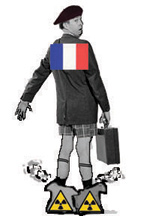 Tale of woe in French nuclear sector, Ft.com, October 13, 2015, Michael Stothard Broken government promises, multibillion-euro delays and a key national champion rescued from the brink of failure: it has been a torrid year for the proud French nuclear industry.
Problems came to a head in August when Areva, the designer and builder of nuclear reactors around the world, was forced to strike a multibillion-euro rescue package deal with rival group EDF and the French government. It had been hit by foreign competition, the downturn in global nuclear demand following the 2011 Fukushima disaster and cost overruns. It had not sold a new reactor since 2007. It urgently needed to be put back on a “sound footing” to keep nuclear a “strength for our country,” said Manuel Valls, French prime minister, before the deal to sell much of the company to EDF………
The country is also a torchbearer for nuclear power as part of the European energy mix when many countries have retrenched following Fukushima. “There’s no doubt the global nuclear industry, including in France, is challenged and it is asking itself some profound questions since Fukushima,” says Jean-Marc Ollagnier, chief executive of Accenture’s resources operating group.
But for French nuclear the past five years have been a tale of technical problems and cost overruns that brought Areva to its knees and called into question the country’s ability to deliver on next generation technology.
These construction problems highlight the complexity of the EPR projects, and have led some to question if there is demand for these larger reactors, given their cost and size. The questions come at the same time as internal political ones, as France attempts to reduce its reliance on nuclear power.
President François Hollande, due to a deal struck between the anti-nuclear Green party and his ruling pro-nuclear Socialist party, has promised to reduce nuclear in the French energy mix from 75 to 50 per cent by 2025…….. Even if no plants are shut down for political reasons in the lead-up to 2025 there are still decisions to be made, all of which are likely to be expensive.
The grand carénage, increasing the life expectancy of the 30-year-old plants from their current 40 years to 50 years, is expected to cost EDF around €55bn, should it ever win political approval. Closing one nuclear plant has already proved difficult. Decommissioning Fessenheim, France’s oldest reactor on the German border, was promised by the government to happen by 2016. This year it was delayed until Flamanville comes online in 2018, leaving the government accused of breaking its promises……..http://www.ft.com/intl/cms/s/0/58036178-68f8-11e5-a57f-21b88f7d973f.html#axzz3oU6siWHM
Rating agencies warn EDF of downgrade, if they continue with Hinkley nuclear station plan
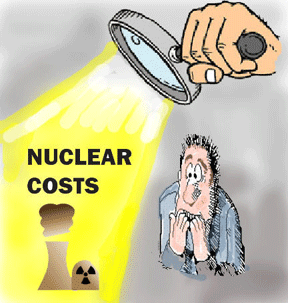 EDF faces threat of credit downgrade over Hinkley Point Two of the world’s biggest ratings agencies have warned that EDF and its Chinese partners face credit-rating downgrades if they press ahead with a £16 billion nuclear power station at Hinkley Point in Somerset.
Amid growing doubts about the deal, Moody’s said the project would have a “credit negative effect” on the companies because of the dangers of big cost overruns and delays to EDF’s untested EPR French reactor technology……. (subscribers only) .http://www.thetimes.co.uk/tto/business/industries/utilities/article4574734.ece
France’s nuclear corporation AREVA is still there – only just
 Areva still standing despite turbulent times News Advance October 3, 2015 Jason Ruiter Like an eroding plateau, the nuclear industry sloughed off a section of its market share – but it still stands.
Areva announced a loss of $5.3 billion in global income in 2014 from the year prior, resulting in a loss of roughly several hundred employees in the Lynchburg area and a need to consolidate, adopt austerity measures and sell a chunk of its business to Électricité de France, the largest utility in France which is also majority-owned by the French government. The power plant business segment of Areva – which employs most Areva Lynchburg employees and constructs, designs and services nuclear plants – will sell 75 percent of the company to EDF for an injection of equity into the business…….
survival came at a cost: Areva NA introduced an advanced severance package to qualified employees to retire early in addition to cutting 22 jobs in the area last fall. Last year, Areva, one of the biggest employers in the region, reported about 1,800 employees in the area. This year, they have about 1,500, a decrease of about 16 percent. For the North America continent, those numbers are steeper, decreasing roughly 20 percent from 5,000 full-time and part-time employees to “closer to 4,000,” Mignogna said……
“Debt is due now,” Mignogna said. “So the [French] government had to react now and try to work out a deal where we could get some cash inflow to the company and they chose to do that.” The result was the EDF purchase of Areva’s power plant operations, which will be consummated by the end of 2016.
Just how much Areva will be changed through the purchase by EDF is unclear. Mignogna said that due to anti-trust considerations, where Areva will be providing services to EDF’s competitors, the North American portion will be operated at “arm’s length.” But he wasn’t sure if Areva’s name will be changed to EDF as a result……..http://www.newsadvance.com/work_it_lynchburg/news/areva-still-standing-despite-turbulent-times/article_a2d991c0-4197-5c04-a163-e7ba145cfea1.html
1 This Month



26 September – International Day for the Total Elimination of Nuclear Weapons


PLEASE OPPOSE HR 8255 AND S.3639 – bills would accelerate satellite deployment, with no environmental review or safeguards – https://ncstd5li.quorum.us/campaign/169331/
To see nuclear-related stories in greater depth and intensity – go to https://nuclearinformation.wordpress.com
-
Archives
- September 2026 (257)
- August 2026 (330)
- July 2026 (355)
- June 2026 (287)
- May 2026 (306)
- April 2026 (356)
- March 2026 (251)
- February 2026 (267)
- January 2026 (308)
- December 2025 (358)
- November 2025 (359)
- October 2025 (375)
-
Categories
- 1
- 1 NUCLEAR ISSUES
- business and costs
- climate change
- culture and arts
- ENERGY
- environment
- health
- history
- indigenous issues
- Legal
- marketing of nuclear
- media
- opposition to nuclear
- PERSONAL STORIES
- politics
- politics international
- Religion and ethics
- safety
- secrets,lies and civil liberties
- spinbuster
- technology
- Uranium
- wastes
- weapons and war
- Women
- 2 WORLD
- ACTION
- AFRICA
- Atrocities
- AUSTRALIA
- Christina's notes
- Christina's themes
- culture and arts
- Events
- Fuk 2022
- Fuk 2023
- Fukushima 2017
- Fukushima 2018
- fukushima 2019
- Fukushima 2020
- Fukushima 2021
- general
- global warming
- Humour (God we need it)
- Nuclear
- RARE EARTHS
- Reference
- resources – print
- Resources -audiovicual
- Weekly Newsletter
- World
- World Nuclear
- YouTube
-
RSS
Entries RSS
Comments RSS

