French waste group Veolia moving into nuclear clean-up business
 Veolia expands in nuclear waste clean-up with Kurion acquisition http://www.reuters.com/article/us-kurion-m-a-veolia-idUSKCN0VC0V4, 4 Feb 16
French water and waste group Veolia (VIE.PA) said it bought U.S. nuclear waste clean-up company Kurion for $350 million as it chases a slice of a market seen worth $210 billion over the next 15 years.
Veolia said it expects the new business to contribute annual revenue of $350-400 million by 2020, including about $250 million from waste treatment and $100-150 from decommissioning nuclear installations.
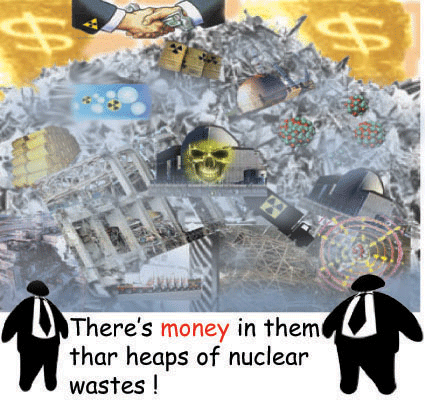
Kurion, which was one of few international firms involved in the early stages of the clean-up of the Fukushima nuclear disaster in Japan in 2011, currently has annual sales of about $100 million. Veolia generates about $20 million from cleaning up nuclear waste.
“Bringing Kurion and its employees into Veolia is going to enable us to develop a world-class integrated offer in nuclear facility clean-up and treatment of low-level radioactive waste around the world,” Veolia Chief Executive Antoine Frerot said.
Veolia plans to target the United States, Britain, France and Japan, which together amount to a market of $118 billion by 2030, and will focus on low-level radioactive waste, which represents 97 percent of the volume but just 0.1 percent of the radioactivity.
There are about 400 nuclear plants in operation worldwide, of which 100 to 150 will be decommissioned by 2030. Another 50 nuclear research centres will also have to be dismantled, Veolia said. Frerot said Veolia would focus on concentrating the waste to reduce its volume so that it can be stored safely, mostly in glass.
Kurion was founded in 2008 and and now employs over 200 people. Veolia had total revenue of 23.88 billion euros ($26.05 billion) in 2014. (Reporting by Geert De Clercq; Editing by James Regan)
France’s plan for 1,000 kilometers of road paved with solar panels
 France to pave 1,000 kilometers of road with solar panels http://inhabitat.com/france-to-pave-1000-kilometers-of-road-with-solar-panels/?newgallery=true by Lucy Wang In a major step forward for green energy, the French government has announced plans to installsolar photovoltaic panels on 1,000 kilometers (621 miles) of road over the next five years. The goal is to supply renewable power to 5 million people—or about 8 percent of the French population. The solar roadways will use Wattway panels, a photovoltaic technology unveiled last October by the major French civil engineering firm Colas. According to Ségolène Royal, France’s minister of ecology and energy, the “Positive Energy” project will be funded by raising taxes on fossil fuels, a decision Royal says is “natural” given the low prices of oil.
UK Hinkley Point nuclear plant project director quits
 EDF project director for UK Hinkley Point nuclear plant quits, 7 News, Reuters February 3, 2016 LONDON – An executive of French utility EDF in charge of Britain’s first new nuclear power station project for 20 years is leaving to join U.S. energy company Entergy Corp , the U.S. firm said on Tuesday.
As an executive director at EDF’s British unit, EDF Energy, Christopher Bakken had been project director since 2011 for the Hinkley Point C nuclear project in southwestern England.
He was responsible for the design, procurement, construction and commissioning of the planned new nuclear plant………
Intractable problems at two similar nuclear plants under construction in France and Finland threaten more delays to EDF’s British plans. https://au.news.yahoo.com/world/a/30718466/edf-project-director-for-uk-hinkley-point-nuclear-plant-quits/
Electricite De France : 6 union board members will oppose Hinkley Point nuclear project
 EDF’s union board members to oppose Hinkley Point – sources, Yahoo 7 News, Reuters February 3, 2016 By Geert De Clercq PARIS – The six union members on EDF’s 18-seat board would vote against the French utility’s plans for two nuclear reactors in the UK, but other board members do not want to postpone the project, sources familiar with the situation said.
The unions want EDF to put off the 18 billion pound project to build two Areva-designed European Pressurised Reactors (EPR) at Hinkley Point in southwest England until it has strengthened its balance sheet and started up at least one of the four EPRs it has under construction elsewhere.
A united front of EDF’s unions opposing a major investment decision would be unprecedented, but the lack of support from other board members removes a major element of uncertainty for the plan.
“If the Hinkley Point project was put to the board today, the six union representatives would all vote against it,” one of the sources told Reuters on Tuesday.
EDF first announced Hinkley Point in 2013 and said in Oct. 2015 that Chinese utility CGN would take a 33.5 percent stake in the project, but it has not yet taken a final investment decision as it struggles to find financing.
On Monday, EDF’s dominant CGT union, which has three board members, called on the firm to postpone the project, saying EDF should prioritise upgrading its ageing nuclear fleet in France, start up the long-delayed EPR it is building in Flamanville, and design a new-model EPR reactor…….
A united front of EDF’s unions opposing a major investment decision would be unprecedented, but the lack of support from other board members removes a major element of uncertainty for the plan.
“If the Hinkley Point project was put to the board today, the six union representatives would all vote against it,” one of the sources told Reuters on Tuesday.
EDF first announced Hinkley Point in 2013 and said in Oct. 2015 that Chinese utility CGN would take a 33.5 percent stake in the project, but it has not yet taken a final investment decision as it struggles to find financing.
On Monday, EDF’s dominant CGT union, which has three board members, called on the firm to postpone the project, saying EDF should prioritise upgrading its ageing nuclear fleet in France, start up the long-delayed EPR it is building in Flamanville, and design a new-model EPR reactor……https://au.news.yahoo.com/world/a/30718719/edfs-union-board-members-could-vote-against-hinkley-point-sources/
Fatal rockfall at planned French repository site
World Nuclear News 26 January 2016 One person was killed and another injured today by a tunnel collapse within an underground laboratory operated by French waste management agency Andra. The laboratory, near Bure in the Meuse/Haute Marne area, is assessing the site for its suitability to house a national radioactive waste repository.
According to an Andra statement, the working face of the gallery within the laboratory collapsed at 12.20pm. Geophysical surveys were being carried out at the time and the rockfall is believed to have happened as drilling was taking place. The gallery has now been evacuated and its stability is being assessed……. http://www.world-nuclear-news.org/RS-Fatal-landslide-at-planned-French-repository-site-2601165.html
French unions unhappy with arrangements for UK’s Hinkley nuclear build
New nuclear power: It’s consumer protection vs corporate profit, http://www.carolinelucas.com/latest/new-nuclear-power-its-consumer-protection-vs-corporate-profit January 27, 2016 The Government’s policy of burdening bill payers with eye watering subsidies for new nuclear power has received another blow. Just before a crucial board meeting at EDF (the French state owned energy giant relied on by the Government to invest in and operate Hinkley Point) French trade unions spoke out about their concerns.
When even staff working for EDF are raising serious doubts about numerous aspects of the proposal, UK Ministers’ cavalier attitude to Hinkley Point C needs to change, more urgently than ever.
In advance of an EDF board meeting due to take place today, where the company was rumoured to be making a final investment decision, French unions threw a welcome spanner in the works.
They’ve raise no fewer than 15 questions about the project, suggesting it would be difficult to complete on time and that financing it could threaten EDF’s survival. The good news, for now, is that EDF has, again, delayed the decision.
But the concerns of French unions are worth a closer look. They include pending legal cases, the lack of evidence Hinkley can be built on time, and the partnership with the Chinese nuclear energy company when no other investors appear to be interested.
Most telling of all is the following question: “what happens if the UK government decides to look after consumer interest?”
This shows that the Conservative Government’s pro-nuclear policy flies in the face of everything they say about looking after the interests of consumers and billpayers. Indeed, studies show that solar power coupled with energy storage and smart grid technology could generate the equivalent to Hinkley Point C at half the cost – to the Govt and to you and I. Wind power, even with backup, ischeaper than nuclear power too.
The Government’s obsession with outdated, inflexible, expensive nuclear power stations is looking more economically and environmentally reckless by the day. So I’ve tabled some more urgent parliamentary questions on Hinkley.
The first question relates to the problems with a similar model of nuclear power station being built at Flamenville in France. It’s already 6 years behind schedule, €7.5 billion over budget, and subject to safety tests following some serious flaws in the reactor vessel and bottom. The ruling on these safety concerns has itself been delayed. I’m pressing the Government on whether the agreement to proceed with Hinkley is conditional on the Flamanville plant demonstrating it’s capable of operating.
My second question is about the huge cost of new nuclear to consumers. It picks up on Ministers’ mindboggling double standards when it comes to subsidies for nuclear power verses solar power, onshore wind and other renewable technologies.
In the Commons earlier this month, the Energy Secretary again attempted to justify her huge cuts to solar subsidies on grounds that “subsidies for low carbon power should be temporary, not part of a permanent business model”. So my question asks exactly when she expects nuclear power stations to meet the same standards and operate on a subsidy free basis. Some renewable technologies are nearly there already, with the costs of others on a clear downward cost trajectory. Energy storage, interconnection and smart grids make Ministers appear stuck in the last century as they desperately argue about baseload.
The cost and climate change arguments against new nuclear power grow stronger every day. This week, workers have made their voices heard. It’s surely time the UK Government started to work for us rather than big energy companies and consign new nuclear to the dustbin of history. Ministers need to start listening to the many voices cautioning against Hinkely and instead back 21st century clean technologies.
In other major nuclear news this week, tomorrow sees a Special Parliamentary seminar co-organised by Nuclear Free Local Authorities and Nuclear Consulting Group: “UK Energy Policy: Late Lessons from Chernobyl, Early Warnings from Fukushima” The keynote speaker will be Naoto Kan, Former Prime Minister of Japan at the time of Fukushima.
EDF in a’panic’ over decision to be made on UK’s Hinkley nuclear power station
Hinkley Point: EDF set for decision on nuclear plant amid claims of board ‘panic’, The Independent, Sources in France say decision on whether to give the green light to controversial project would be made on Wednesday Geoffrey lean , 24 Jan 16
- The final decision on whether to build Britiain’s first nuclear power station in decades is set to be made by energy giant EDF this week, amid claims of “panic” among the French firm’s board over the viability of the £18bn project.
- Sources in France said the decision on whether to give the green light to its controversial plant at Hinkley Point, Somerset – on which ministers are depending to “kick-start a major new generation of nuclear power stations” – would be made on Wednesday. But the largely state-owned company refused to comment, or even to confirm or deny that the meeting is taking place.
This secrecy reflects the extreme sensitivity about the decision with practicalities and politics pulling in opposite directions. The project suffered a serious blow last week when French regulators delayed a decision on what to do about safety flaws in a similar reactor. But cancelling it would be a huge humiliation for British ministers, and could cause a cross-Channel diplomatic row.
- The “final investment decision” by EDF’s board – repeatedly delayed over the past two years – is the project’s only remaining hurdle.
Last October the government persuaded China to invest heavily in the plant, filling a funding shortfall, and the Energy Secretary Amber Rudd is awaiting the decision before signing a deal to allow the company to charge double the present price for the electricity generated from Hinkley’s twin reactors. Three similar European Pressurised Reactor (EPR) projects are planned for Britain if it succeeds…….
- there are signs of last minute jitters. Union leaders are reportedly warning the company of “financial, industrial and legal risks” in the project, while the French financial journal Boursier.com has suggested that there is “panic on board”.
Last week the French nuclear regulator delayed until the end of the year a decision on what to do about “very serious” weaknesses detected in the pressure vessel of a similar EPR being built at Flamanville, Normandy. The same fault – which could lead to a nuclear accident – was detected in the vessels for the Hinkley reactors, which had been built and will now have to be replaced.
- The Flamanville plant is five years behind schedule and its cost has trebled, while the only other EPR being built in Europe, in Finland, is almost a decade late, and the cost has more than doubled. Two other EPRs being built in China are also thought to be over-running while the cost of Hinkley has already soared.
EDF’s share price has plunged to record lows, and the company is considering selling billions of pounds of assets to fund building Hinkley. On top of all that, Austria is taking Britain to the European Court, alleging it is subsidising the plant illegally.Some British experts believe that, faced with all these difficulties, EDF will defer a final decision again. http://www.independent.co.uk/news/uk/home-news/hinkley-point-edf-set-for-decision-on-nuclear-plant-amid-claims-of-board-panic-a6830456.html
France’s President Hollande visits India, hoping to market nuclear reactors
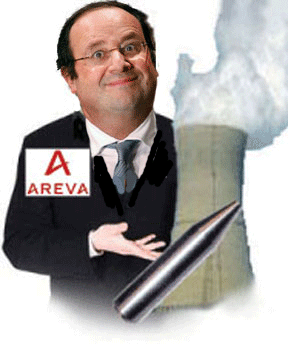 France Signals Rafale, Nuclear Progress as Hollande Visits India, Bloomberg, HeleneFouquet January 24, 2016 France signaled a state-to-state accord with India could be signed on Monday over a deal for 36 Dassault Aviation SA Rafale fighter jets, and that a six-year-old plan to build nuclear reactors in the South Asian nation would see some progress…………
The reactors are planned for Jaitapur, a coastal town in India’s western province of Maharashtra. Areva was seeking further clarity from India on its nuclear liability law before moving ahead with what would be India’s biggest nuclear plant.
The agreement India and the U.S signed recently over insurance-related issues for nuclear plants will help in overcoming certain hurdles, Royal said.
EDF Directors might delay UK Hinkley nuclear decision yet again
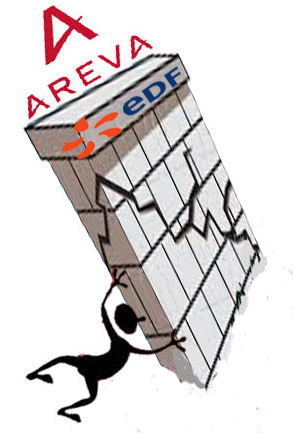 Hinkley Point – Edf to decide whether to build nuclear power station next week By Central Somerset Gazette January 19, 2016 A DECISION on whether a nuclear power station is built at Hinkley Point could be announced next week.
Reports in the French press indicate that the board of directors of the French state electricity generator EDF will meet on January 27 to make a final investment decision on the construction of two nuclear reactors at Hinkley Point near Bridgwater.
The final investment decision on the project has been delayed due to the lengthy negotiations with Chinese partners.
However even now there are concerns that the board might defer the decision for the ninth time……….
EDF is also locked in negotiations surrounding a complex deal to buy a French nuclear reactor builder, Areva, and in the disposal of it’s stake in eight current British nuclear power stations, five in the US, one in Finland and a number of Polish coal fired plants
Preparation of the site stopped last year when negotiations over the financing of the power station stalled.
Campaigners opposed to the building of Hinkley Point C are sceptical that the project will ever see the light of day.
Stop Hinkley spokesperson Roy Pumfrey said: “I’ll believe it when I see it. This is the ninth time EDF has said a final investment decision is imminent. Just last October the chairman of EDF, Jean-Bernard Levy, said work would be starting before the end of 2015. It would be completely reckless of the Board to give the go-ahead to this £25 billion project when the company is in such a parlous state.” http://www.centralsomersetgazette.co.uk/8203-Hinkley-Point-Edf-decide-build-nuclear-power/story-28559932-detail/story.html
Nuclear reactor Legal struggle continues between AREVA and Finland’s TVO
 Areva, TVO have month to settle nuclear reactor claims-minister http://af.reuters.com/article/commoditiesNews/idAFL8N154366 PARIS Jan 20 (Reuters) French nuclear reactor maker Areva and Finnish customer Teollisuuden Voima (TVO) will try to settle mutual claims over a long-delayed nuclear reactor within a month, French Economy Minister Emmanuel Macron said on Wednesday.
“I had the chance at the start of the week to speak to (Finnish Economy Minister) Olli Rehn, and we gave ourselves a month to let the companies and shareholders find the conditions for an agreement or way out,” Macron said on the sidelines of a New Year event.
Finnish utility TVO and an Areva-led consortium with Siemens are claiming billions of euros from one another in an arbitration suit over cost overruns and delays to the EPR reactor Areva is building in Olkiluoto, in Finland, for TVO.
The unsettled claims are holding up a planned takeover of Areva’s reactor arm by French utility EDF, which does not want to be responsible for them.
TVO has a 2.6 billion euro ($2.8 billion) claim against the Areva-Siemens consortium at the International Chamber of Commerce’s (ICC) arbitration court, while Areva-Siemens have a 3.4 billion euro counter-claim.
While the French state – which owns 85 percent of EDF and 87 percent of Areva – has a big stake in a speedy resolution of the Olkiluoto claims, TVO is a private company and the Finnish government’s position so far has been not to intervene.
TVO’s owners include paper companies UPM and Stora Enso as well as utility Fortum. (Reporting by Michel Rose and Yann Le Guernigou; Writing by Geert De Clercq; Editing by James Regan and Susan Thomas)
France’s PM off to India to market nuclear reactors
 Defence & civil nuclear cooperation will dominate Francois Hollande’s visit Economic Times, By Dipanjan Roy Chaudhury, ET Bureau | 18 Jan, 2016, NEW DELHI: Defence and civil nuclear cooperation will not be the only things that will dominate the visit of Francois Hollande — the fifth French leader to be chief guest at India’s Republic Day celebrations — with India and Paris working to expand partnership in areas of smart cities, solar energy, counter-terrorism, rail infrastructure and space.
Companies involved in the project include Areva, Engie, Enel, HSBC France and Tata Steel. Areva is also setting up a nuclear power plant in Jaitapur, after France became the first country to conclude a civil nuclear deal with India following a clean waiver by Nuclear Suppliers Group in September 2008.
Electricite de France (EDF) at new low with crippling financial problems
EDF already needs to borrow money just to pay its dividend and is set to spend tens of billions of euros on upgrading its ageing reactors, building new nuclear plants in Hinkley Point, Britain and buying the reactor arm of Areva.
“This report is clearly negative for all nuclear operators, and most specifically for EDF and Areva”
EDF shares are down more than 44 percent in the 12 months,
EDF sinks to all-time low as nuclear waste cost estimate soars http://uk.reuters.com/article/edf-nuclear-waste-idUKL8N14W2RO20160112 PARIS | BY GEERT DE CLERCQ Jan 12 Shares in French utility EDF sank to all-time lows on Tuesday after the country’s Andra nuclear waste agency said that storage costs could be higher than EDF’s estimates.
Mirroring German utilities E.ON and RWE , which saw their shares hit decade lows late last year over worries about nuclear decommissioning costs, EDF fell as much as 7.3 percent before recovering to 4.1 percent lower.
A string of brokerage price target downgrades and French forward power prices falling to new decade lows only added to the gloom.
In a report released late on Monday, Andra said costs for the Cigeo deep geological storage project could be as high as 30 billion euros or as low as 20 billion depending on assumptions about different cost factors in coming years.
“There are different views on the calculation, more or less conservative, depending on estimates for future technological progress and optimisation,” Andra said in a statement. n a letter to the energy ministry, posted on the ministry’s website, EDF, fellow state-controlled company Areva and the CEA (Atomic Energy Authority) said they estimated the cost at around 20 billion euros.
“Andra’s study only took into account a small number of possible optimisations,” said the letter, adding that a certain number of costs and ratios used by the state agency were not in line with their experience.
“We are waiting for a decision of the energy minister on the cost of storage,” an EDF spokesman said.
Energy Minister Segolene Royal’s decision on the 10 billion euro gap in estimates could have a huge impact on the already stretched balance sheet of EDF, which operates 58 nuclear plants in France and generates the bulk of the country’s nuclear waste.
EDF already needs to borrow money just to pay its dividend and is set to spend tens of billions of euros on upgrading its ageing reactors, building new nuclear plants in Hinkley Point, Britain and buying the reactor arm of Areva.
“This report is clearly negative for all nuclear operators, and most specifically for EDF and Areva,” Bryan, Garnier analyst Xavier Caroen said in a note, adding that the risk of a cost revaluation was not new.
EDF shares are down more than 44 percent in the 12 months, the second-worst performer in the Stoxx utilities index after RWE. The company has been replaced in France’s CAC-40 index of leading shares by shopping centre operator Klepierre . (Additional reporting by Benjamin Mallet; Editing by Keith Weir)
Is it just Hinkley that’s finished or the whole of EDF?
No2Nuclear Power Jan 2016 “………French utility EDF is considering selling assets  worth over 6 billion euros (£4.5 billion) this year, according to French daily Les Echos – notably it is considering selling a stake in its eight British nuclear plants to fund plans to build Hinkley Point C. But it could only sell a 29% share of EDF Energy (which is supposed to be worth 9 billion euros in total). This would leave EDF with a 51% stake, because Centrica already owns 20%. The paper said a sale had been studied but the process had not been launched. The company needs 55 billion euros to upgrade its ageing nuclear plants, plans to invest 18 billion pounds in Hinkley and spend several billion euros to buy Areva’s reactor unit. (1)
EDF struggling to raise money to fund UK’s new Hinkley Point reactors.
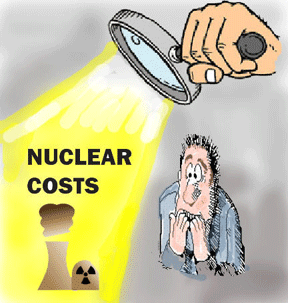
 EDF considers selling €3bn stake in UK nuclear business to help fund reactors
French energy firm may reduce stake in eight existing nuclear reactors it owns to raise money for Hinkley Point C project, Guardian, Terry Macalister, 8 Jan 16, EDF is considering the sale of a €3bn (£2.2bn) stake in its British nuclear business in a bid to raise cash for new Hinkley Point reactors.
Possible buyers would be state-owned Chinese companies, who are already committed partners on the £18bn Somerset project.
EDF could unveil details of a sell-off plan on 16 February, when it is scheduled to release annual financial figures and is expected to give a final investment decision on building Britain’s first new reactors for 20 years.
The French daily, Les Echos, reported on Thursday that EDF may reduce its stake in the eight existing nuclear reactors it owns from 80% to 51% by bringing in a new investor as part of a wider €6bn disposal programme. Industry sources told the Guardian that the possible sell off was only one of a number of different options that were under consideration as the group looked at financing Hinkley Point C and other projects.
They said it was still likely EDF would give the go ahead to Hinkley next month even though it did not have all the financing in place. The project is estimated to cost £18bn, according to EDF, though the European Union has warned it could go as high as £24bn.
Centrica, the owner of British Gas, already has a 20% holding but has made clear in the past that itdoes not want a larger commitment to nuclear, and declined to participate in the Hinkley newbuild scheme………
EDF struggled to interest anyone else in the Hinkley scheme, which many in the City have deemed over-expensive, so the Chinese would seem first in line to buy into the rest of the EDF nuclear business if it comes up for grabs……..
Environmentalists opposed to EDF’s new building plans in Britain believe the company may yet be forced to abandon Hinkley Point C because of a European legal challenge against the state aid promised by the UK. http://www.theguardian.com/business/2016/jan/07/edf-selling-3bn-stake-uk-nuclear-business-reactors-hinkley-point-c
Iodine tablets to be distributed to France’s communities near nuclear stations
 France to distribute iodine tablets near nuclear power stations RFI 27 Dec 15 France’s nuclear safety watchdog is to distribute iodine tablets to people living near the country’s 19 nuclear power stations, warning that an accident is possible but not probable. …..
In the fifth such distribution campaign since they began in 1997, the Nuclear Security Authority (ASN) will make iodine tablets available to 400,000 households and 2,000 establishments, such as schools, businesses and local government offices, in a radius of 10 kilometres of a nuclear power station.They will be distributed through pharmacies or sent to those who fail to collect them……http://www.english.rfi.fr/environment/20151226-france-distribute-iodine-tablets-near-nuclear-power-stations
1 This Month



26 September – International Day for the Total Elimination of Nuclear Weapons


PLEASE OPPOSE HR 8255 AND S.3639 – bills would accelerate satellite deployment, with no environmental review or safeguards – https://ncstd5li.quorum.us/campaign/169331/
To see nuclear-related stories in greater depth and intensity – go to https://nuclearinformation.wordpress.com
-
Archives
- September 2026 (257)
- August 2026 (330)
- July 2026 (355)
- June 2026 (287)
- May 2026 (306)
- April 2026 (356)
- March 2026 (251)
- February 2026 (267)
- January 2026 (308)
- December 2025 (358)
- November 2025 (359)
- October 2025 (375)
-
Categories
- 1
- 1 NUCLEAR ISSUES
- business and costs
- climate change
- culture and arts
- ENERGY
- environment
- health
- history
- indigenous issues
- Legal
- marketing of nuclear
- media
- opposition to nuclear
- PERSONAL STORIES
- politics
- politics international
- Religion and ethics
- safety
- secrets,lies and civil liberties
- spinbuster
- technology
- Uranium
- wastes
- weapons and war
- Women
- 2 WORLD
- ACTION
- AFRICA
- Atrocities
- AUSTRALIA
- Christina's notes
- Christina's themes
- culture and arts
- Events
- Fuk 2022
- Fuk 2023
- Fukushima 2017
- Fukushima 2018
- fukushima 2019
- Fukushima 2020
- Fukushima 2021
- general
- global warming
- Humour (God we need it)
- Nuclear
- RARE EARTHS
- Reference
- resources – print
- Resources -audiovicual
- Weekly Newsletter
- World
- World Nuclear
- YouTube
-
RSS
Entries RSS
Comments RSS

