AREVA to sell its U.S. nuclear radiation measurement business
Areva puts U.S. nuclear radiation business Canberra up for sale PARIS, JUNE 29 French state-owned nuclear group Areva has begun the sale process for the planned disposal of its U.S. nuclear radiation measurement business Canberra, it said in a statement on Monday.
The sale of Canberra is part of a revamp of loss-making Areva, with utility EDF poised to buy its nuclear reactor business. (Reporting by Michel Rose; Editing by David Goodman) http://www.reuters.com/article/2015/06/29/areva-canberra-idUSL5N0ZF0H220150629
France keen to save AREVA, by selling nuclear reactors to Saudi Arabia
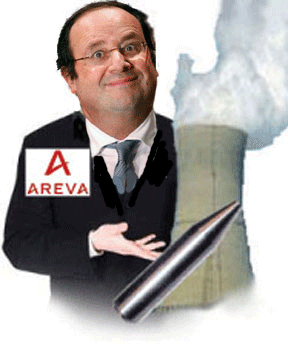 France plans new Saudi nuclear reactors, Sky News 25 June 2015 France has confirmed it is looking into building two nuclear reactors in Saudi Arabia, as part of 12 billion euro ($A17.31 billion) worth of deals struck between the nations.
Under one of the agreements Airbus will sell 23 H-145 multipurpose helicopters to Saudi Arabia for 500 million euros as well as launch a feasibility study into building the reactors, French Foreign Minister Laurent Fabius said on Wednesday……..
The study for two European Pressurised Reactors (EPR) – which France considers the safest and most advanced in the world – takes on added significance given the current efforts by Saudi Arabia’s rival, Iran, to develop its own nuclear capabilities.
In addition to the study, France will sign an agreement to train the Saudis on nuclear safety and the treatment of nuclear waste……
France has been reinforcing links with the conservative kingdom despite persistent criticism of its human rights record,…… http://www.skynews.com.au/news/world/mideast/2015/06/25/france-plans-new-saudi-nuclear-reactors.html#sthash.tI5czLBA.dpuf
Japan – no idea what to do with its nuclear trash now stored in France

they should just stop making radioactive trash
Japan faces dilemma over 16 tonnes of plutonium stored in France http://www.timeslive.co.za/world/2015/06/18/Japan-faces-dilemma-over-16-tonnes-of-plutonium-stored-in-France Reuters | 18 June, 2015
Still dealing with the huge clean up after the Fukushima crisis and debating its future use of atomic energy, Japan now faces another nuclear conundrum – what to do with 16 tonnes of its plutonium sitting in France after being reprocessed there. The question will be among the issues that come under the spotlight on Thursday and Friday as nuclear proliferation experts meet with legislators and government officials in Tokyo.
With its reactor fleet shut down in the wake of Fukushima, Japan is unable to take fuel made from the plutonium at the moment and could be forced to find other countries to use it.
The matter has taken on greater urgency as Areva, the French nuclear company that owns the La Hague reprocessing facility holding the plutonium in western Normandy, faces billions of dollars of losses.
“In this whole mess (at Areva) we have a huge amount of Japanese plutonium,” said Mycle Schneider, an independent energy consultant, adding Japan would need to resolve the problem sooner rather than later.
An Areva spokesman said the company had long-standing contracts with Japanese utilities to take nuclear fuel made from the plutonium. Frank von Hippel, one of the founders of the International Panel on Fissile Materials (IPFM), a group of arms-control and proliferation experts, will discuss Japan’s stock of plutonium in France when he meets with Japanese legislators, according to a draft of a presentation he will give that has been seen by Reuters.
The group argues the world’s growing inventory of plutonium from civilian use is a “clear and present danger” as it could be used in so-called dirty bombs. apanese government officials did not immediately respond to requests for comment.
 Schneider, who is a contributor to a soon to be released IPFM report on plutonium separation in nuclear power programmes, said the alternative to taking back the plutonium would be to pay other countries to use it in their reactors.
He said that France would be one option, but that the cost would likely be high, especially as that country has its own stockpile to deplete. He did not give an exact cost.
“Giving its plutonium away and paying for it would expose the Japanese to the reality of plutonium as a liability rather than an asset,” said Schneider.
A precedent for that kind of deal could be set in Britain, where the government has offered to take ownership of 20 tonnes of Japanese plutonium stored at the Sellafield processing plant, according to the IPFM.
“This is a kind of win-win deal,” said Tatsujiro Suzuki, a former vice chairman of the Japan Atomic Energy Commission, who will join Von Hippel in meeting with legislators on Thursday.
“The British side would make money and the Japanese would lose less,” said Suzuki.
AREVA and EDF need to clean up their organisational mess ASAP – says France’s nuclear watchdog

 French nuclear watchdog urges quick resolution of Areva rescue plan, Reuters, PARIS | BY MICHEL ROSE AND BENJAMIN MALLET 12 June 15 Areva’s (AREVA.PA) financial situation is worrying, the head of France’s ASN nuclear watchdog said on Thursday, urging the loss-making nuclear company and utility EDF (EDF.PA) to wrap up a rescue plan for Areva as soon as possible.
The French government last week approved EDF’s plan to take a majority stake in Areva’s nuclear reactor business and gave the two state-owned companies a month to do a deal.
“Areva’s current financial situation, it could get better, (it) can be considered as preoccupying in terms of safety,” ASN Director Pierre-Franck Chevet told Reuters in an interview.
“That’s why we have formally asked to hear them … to ask what kind of organisation they are putting in place to fulfils the commitments they have made in terms of safety for the incoming period,” he added, noting a meeting was scheduled by the end of June.
An EDF spokeswoman declined to comment, while an Areva spokeswoman pointed to comments made by Areva Chairman Philippe Varin on Wednesday, that safety remained an absolute priority.
ASN, an independent regulatory authority, last year imposed on Areva a requirement to recondition radioactive waste stored at its La Hague facility in northern France, which could cost several billion euros and which must be provisioned for, Chevet said.
However the watchdog has no power on the merger per se and its only remit is safety. It can shut down a nuclear plant if it sees a safety issue or fine companies for any transgressions……..http://uk.reuters.com/article/2015/06/11/uk-france-nuclear-asn-idUKKBN0OR2EU20150611
Falling electricity prices are hitting France’s nuclear corporation EDF

 EDF Nuclear Power Struggles to Compete With Falling Market Price, Bloomberg Business, by Tara Patel June 10, 2015 Electricite de France SA’s sale of atomic power to competitors for the second half of the year has sunk to a fraction of what it was in 2014, signaling nuclear energy may be losing competitiveness.
The state-controlled utility sold a quarter of the volume, or 4 terawatt-hours, to rivals, according to energy regulator Commission de Regulation de l’Energie. The 12.3 terawatt-hours sold for the first half was also less than half the 34.6 terawatt-hours for the second half of 2014.
The drop signals obstacles ahead for Chief Executive Officer Jean-Bernard Levy, who is pushing for higher power prices to help pay for tens of billions of euros of maintenance and safety upgrades on EDF’s aging fleet of French nuclear reactors, which account for three-quarters of the country’s electricity production.
“There is an imbalance between nuclear generation costs and wholesale power market prices,” said Louis Boujard, a utilities analyst at Oddo Securities in Paris. “Nuclear energy is less competitive than it was in the past.”Market Price
French electricity is bought and sold in the market on a year-ahead basis for 38.15 euros, or 9.2 percent below the Arenh price, according to broker data compiled by Bloomberg. The contract has dropped 4.6 percent since January and is trading at its lowest level for the time of year since at least 2007 when Bloomberg began tracking the data.
The government is reviewing how it calculates the rates charged for Arenh nuclear power. While EDF argues that it needs to increase the rate to better reflect the cost of generation, other power distributors such as Direct Energie and industrial consumers want a reduction. In the meantime, they are shunning the volumes in favor of cheaper power on the market………http://www.bloomberg.com/news/articles/2015-06-10/edf-nuclear-power-struggles-to-compete-with-falling-market-price
Risk of nuclear meltdown due to faulty valves in new-generation EPR reactor
 Faulty valves in new-generation EPR nuclear reactor pose meltdown risk, inspectors warn http://www.telegraph.co.uk/news/worldnews/europe/france/11662889/Faulty-valves-in-new-generation-EPR-nuclear-reactor-pose-meltdown-risk-inspectors-warn.html
Flamanville third-generation EPR nuclear reactor – the same model Britain plans to use for two new plants at Hinkley Point – has multiple faults in crucial safety valves, inspectors warn By Henry Samuel, Paris 09 Jun 2015 Nuclear safety inspectors have found crucial faults in the cooling system of France’s flagship new-generation nuclear power plant on the Channel coast, exposing it to the risk of meltdown.
The third-generation European Pressurised Reactor currently under construction in Flamanville is the same model that Britain plans to use for two new plants at Hinkley Point in Somerset.
State-controlled nuclear giant Areva is responsible for the design and construction.
France’s nuclear safety watchdog found “multiple” malfunctioning valves in the Flamanville EPR that could cause its meltdown, in a similar scenario to the 1979 Three Mile Island nuclear accident in the US.
The inspectors listed the faults in a damning presentation obtained by Mediapart, the investigative French website. This is the latest setback for what is supposed to be France’s atomic energy showcase abroad, following the revelation last month that its steel reactor vessel has “very serious anomalies” that raise the risk of it cracking. The vessel houses the plant’s nuclear fuel and confines its radioactivity. Continue reading
Meltdown in France’s nuclear dream – taxpayers to cop the costs
External factors may have precipitated the crash of Areva, but the cause is internal. Areva and the French nuclear industry is controlled by engineers and state officials and the market comes as an afterthought.
The problems of time and cost overruns in China, Finland and now in France at Flamanville are self-made and part of the “esprit de corps” arrogant attitude of the organisation.
Now, 13 years later, the problem needs to be addressed and risks costing billion of euros and thousands of jobs
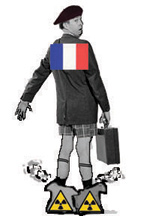 France’s Nuclear Industry Dream Faces Melt-Down At Expense Of State Coffers, Tax Payers Forbes, Marcel Michelson, 3 June 15 France has decided to rescue its Areva nuclear energy company once again, this time by combining the nuclear power station creation business with state-controlled power operator EDF , its biggest client.
Only a few years back, in 2010, Areva’s finances had been restored by the forced sale of its transport and transmission activities to industrial group Alstom and electrical engineer Schneider . Meanwhile, GE of the United States controls the Alstom power activities as part of its own rescue recapitalisation.
The rest of Areva includes uranium mines, nuclear waste recycling, transport, storage and some alternative energy activities.
For all intents and purposes, Areva is dead. Continue reading
France pins its nuclear hopes on exporting reactors
Rescued Areva faces uncertain future as nuclear fuel group By Geert De Clercq (Reuters) 5 June 15 – France‘s Areva faces an uncertain future as a specialised nuclear fuel supplier, as a state rescue moves its core nuclear reactor activities to its utility customer EDF. Shares in the state-owned firm briefly rose almost 6 percent on Thursday after the government said late on Wednesday it would recapitalise Areva and approved EDF’s plan to take over Areva’s reactor unit.
The government plan unwinds Areva’s much-vaunted model of an integrated nuclear group that mines and enriches uranium, produces nuclear fuel, builds reactors and recycles spent fuel. Created fifteen years ago from the nuclear fuel group Cogema and reactor builder Framatome, Areva had ambitions to sell as many as 16 of its massive EPR reactors to energy-hungry developing countries.
But it has not sold a reactor since 2007 and the four it did sell have been plagued by delays and cost overruns. More than two decades after it was designed, not a single EPR is in operation today.
Still, the French government said it hopes an EDF-led nuclear industry could win the export contracts that have proved so elusive for Areva.”The French camp must work together abroad,” Economy Minister Emmanuel Macron told France Info radio on Thursday. Continue reading
France’s AREVA-EDF nuclear merger – easier said than done
France Grapples With a Knotty Nuclear Problem http://blogs.wsj.com/corporate-intelligence/2015/06/04/france-grapples-with-a-knotty-nuclear-problem/ By AMBROISE ECORCHEVILLE
The reconstitution of France’s nuclear industry is officially underway. Under orders from President François Hollande, atomic-power utility Electricité de France ‘sEDF.FR -0.45% is going to invest in the nuclear-reactor business of Areva to help refinance the troubled engineering group. The two state-controlled companies have a month to clinch a comprehensive deal.
That’s going to be easier said than done.
Leaving aside the questions about the future of nuclear energy in a world of fast-changing energy markets and geopolitical uncertainty, the interests of the French state, EDF and Areva are far from convergent.
Take Areva’s finances. The group, whose operations run from uranium mining to treating nuclear waste, needs a cash injection of €6 billion ($6.6 billion) to €8 billion. EDF, according to people familiar with the matter, has offered to invest €2 billion in Areva’s reactors unit. Some analysts question the willingness of the government to make up the difference. They note France’s stretched public finances and long-term risks associated with Areva’s unfinished, much-delayed, and over-budget nuclear reactor projects in Finland and France.
The future commercial ties between EDF and Areva also leave unanswered questions. The government wants to reset them. EDF’s success in diversifying its sources of nuclear fuel for its park of French reactors, responsible for about three quarters of the country’s electricity, has squeezed margins at Areva.
True, France could try to lure foreign investment but outside investors can only ever hope to be junior partners in such a strategic industry. Areva sees itself best placed to pick up business from the €55 billion investment program EDF is considering to extend the average life of its nuclear power plants to 60 from 40 years.
As for EDF, there are financial and commercial risks in being a more vertically integrated nuclear business. Building reactors is capital intensive, while foreign customers may not fancy have the prospect of EDF bidding to build, operate and now equip new projects.
The government could dull the pain by letting EDF raise electricity prices at home. That would bring a smile to the faces of shareholders, not least the state given its 84.5% stake, just not necessarily to those of President Hollande’s electorate
Merger of AREVA and EDF, to save nuclear giant AREVA- French tax-payers to fork out
 France announces plan to merge nuclear reactor businesses of state-owned atomic energy giants, Star Tribune By GREG KELLER Associated Press JUNE 3, 2015 PARIS — French nuclear giants Areva and EDF will merge their reactor businesses in a joint venture controlled by EDF — a wide-ranging reshuffle of the country’s state-owned atomic energy industry.
French President Francois Hollande’s office announced the deal’s broad outlines Wednesday, saying final details would be negotiated by the two companies within a month.
The French government, which controls over 80 percent of both companies, will inject new capital “of the necessary amount” in Areva as part of the deal……
 Areva lost nearly 5 billion euros ($5.6 billion) last year after taking a massive loss on new reactor projects in France and Finland……..
Last month Areva announced a 1-billion-euro cost-cutting plan, which included the removal of up to 6,000 jobs.
Only five years ago Areva was seen as a French success story, led by swashbuckling CEO Lauvergeon as it rode the wave of the so-called “nuclear renaissance.”
The company’s fortunes collapsed after a series of failures, including massive cost-overruns and technical failings with its new generation reactor; a disastrous investment in a Nigerien uranium mine; and the aftereffects of a global rejection of nuclear power after Japan’s Fukushima reactor meltdown http://www.startribune.com/france-to-merge-areva-edf-nuclear-reactor-businesses/306008871/
Cut nuclear power, boost renewable energy- Bill passes France’s National Assembly
French Bill Seeks to Boost Renewable Energy, Cut Nuclear Use http://abcnews.go.com/Technology/wireStory/french-bill-seeks-boost-renewable-energy-cut-nuclear-31308484
PARIS — May 26, 2015, France’s lower house of parliament has approved a bill aimed at boosting renewable energy and reducing the country’s reliance on nuclear power, among other environment-friendly measures.
The French government wants to be exemplary this year in environmental matters, since Paris is hosting a U.N.-backed conference in December where 196 countries aim to limit greenhouse gas emissions to fight global warming.
The bill pushed by Ecology Minister Segolene Royal was approved Tuesday by the National Assembly, the lower house of parliament, with 308 votes for and 217 against. It will then go to the Senate for further discussions. At the end of the process —probably over summer— the assembly will have the final say.
Among the more significant changes are the following measures: Continue reading
Nuclear fusion – expensive boondoogle – as far away as ever
 Star power: Troubled ITER nuclear fusion project seeks new path, Phys Org 23 May by Pascale Mollard “……Launched in 2006 after years of wrangling, the International Thermonuclear Experimental Reactor (ITER) project is saddled with a reputation as a money pit.
It has been bedevilled by technical delays, labyrinthine decision-making and cost estimates that have soared from five billion euros ($5.56 billion) to around 15 billion. It may be another four years before it carries out its first experiment………
ITER’s job is to build a testbed to see if fusion, so far achieved in a handful of labs at great cost, is a realistic power source for the energy-hungry 21st Century.
Fusion entails forcing together the nuclei of light atomic elements in a super-heated plasma, held by powerful magnetic forces in a doughnut-shaped chamber called a tokamak, so that they make heavier elements and in so doing release energy.
The principle behind it is the opposite of nuclear fission—the atom-splitting process behind nuclear bombs and power stations, which carries the risk of costly accidents, theft of radioactive material and dealing with dangerous long-term waste…….
The tokamak—a word derived from Russian—by itself is an extraordinary undertaking: a 23,000-tonne lab, three times heavier than the Eiffel Tower.
“This is a project of unprecedented complexity… a real challenge,” said Mario Merola, in charge of ITER’s internal components division.
Management tangle
Part of ITER’s problems lie in a diffuse managerial structure and decision-making among its partners: the 28-nation European Union, which has a 45-percent stake, the United States, Russia, Japan, China, India, South Korea and Switzerland. he partners are providing their contributions mostly in kind, which has been a cause of messy, protracted debate about who should provide what, when and how. It has been further complicated by the role of national agencies, which in turn deal with their own suppliers.
In some cases, said Bigot, discussions have dragged on for six whole years without resolution……..By November, there will be a new progress report, with the likelihood of a further increase in the price tag. The project has no reserve fund to deal with the unexpected…..So far around seven billion euros have been contractually committed to the thousand or so companies working on the scheme. Every year of delay adds 200 million euros to the bill……”clearly if we can’t manage this project correctly, if undertakings are not kept… (the project) could be in danger.” http://phys.org/news/2015-05-star-power-iter-nuclear-fusion.html
EDF makes an offer to AREVA
Nuclear: EDF made an offer to over 2 billion euros in the … – Les Echos 23 May 15 As he announced, the president of EDF Jean Bernard Levy has sent this Friday to Areva executives Philippe Varin and Philippe Knoche, its proposal for the resumption of the activity of reactors Nuclear Group (Areva NP, formerly Framatome). Reportedly, this offer values the activities concerned just over € 2 billion, net of liabilities of the company. Specifically, the valuation is calculated on the basis of a multiple of 7.5 times EBITDA (EBITDA) activities occasions, recalculated according to the area concerned and restructurings that have been completed. “ This is an indicative offer, which must be followed by a period of due diligence before being adjusted to become a firm offer, possibly with conditions precedent ,” said a source close to the folder. “ At this point, the offer of EDF covers about a third of the financing needs of Areva, estimated at around 7 billion euros ,” continues the source.
During his public this week, Jean-Bernard Levy was very explicit. If the proposal EDF responds to a request of the State, its majority shareholder…..wseconomymarket.blogspot.com.au
Australians the suckers as AREVA tries to sell its failed nuclear technology down under
A negative learning curve on steroids What to make of the EPR saga? Areva is backing the wrong horse − the outcome of current political debates will result in a declining role for nuclear power in France, coupled to the growth of renewables.
A new report by ADEME, a French government agency under the Ministries of Ecology and Research, concludes that a 100% renewable electricity supply scenario is feasible in France. The report estimates that the electricity production cost would be €119 per megawatt-hour in 2050 in the 100% renewables scenario, compared with a near-identical figure of €117/MWh with a mix of 50% nuclear, 40% renewables, and 10% fossil fuels.
Areva has also backed the wrong-sized wrong horse: a giant reactor with a giant price-tag. That said, the backers of ‘small modular reactors‘ are having no more success than Areva. And Areva isn’t having much luck with its mid-sized ATMEA pressurised water reactor………
The EPR saga shows that developing modified versions of conventional reactors (in this case pressurised water reactors) can be complicated and protracted and can end in failure. How much more difficult will it be to develop radically new types of reactors? The French government’s Institute for Radiological Protection and Nuclear Safety has recently produced an important critique of Generation IV nuclear power concepts. It states that there “is still much R&D to be done to develop the Generation IV nuclear reactors” and it is sceptical about the safety claims made for Generation IV concepts.
Feeling the pressure: Bumbling nuclear’s negative learning curve Jim Green, 21 May 2015, Climate Spectator http://www.businessspectator.com.au/article/2015/5/21/energy-markets/feeling-pressure-bumbling-nuclears-negative-learning-curve
French state-owned nuclear giant Areva is offering to sell its ‘world leading’ nuclear technology to South Australia. The offer is being reported in the South Australian media without a hint of irony. A reality check is in order.
Areva has posted losses in each of the past four years including a €4.83 billion loss in 2014. Continue reading
Engie not willing to acquire troubled nuclear company AREVA
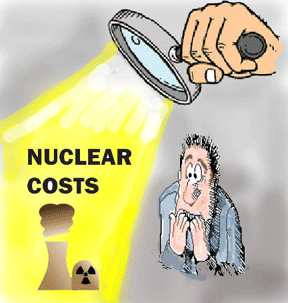 Engie will not acquire struggling French nuclear group Areva, Ft.com 21 May 15 Michael Stothard in Paris Engie would consider working with struggling French nuclear group Areva on some business lines but is not looking for any full-blown acquisitions to help rescue the company, according to the chief executive of the utility.
“If we consider something, it would be in co-operation with Areva, not simply an acquisition of some assets,” Gérard Mestrallet told the Financial Times on the sidelines of a business and climate change conference in Paris
The comments come as the French government looks to elicit the aid of French companies to help rescue Areva, which reported a €4.8bn loss last year.
Areva, which is 87 per cent government-owned, has fallen victim to a slump in global demand for new reactors that followed the 2011 Fukushima disaster in Japan, as well as crippling cost overruns at key projects…….
Any deal between Areva and Engie would be likely to come alongside a much larger agreement with EDF, which earlier this week outlined its preference for a broad rescue package to acquire Areva NP, the division that designs, manufactures and maintains nuclear reactors.
“The more ambitious proposal from EDF will preserve the technical expertise of Areva’s reactor business and create the possibility of partnerships with outside groups from France or elsewhere,” said Jean-Bernard Lévy, EDF’s chief executive.
The more ambitious proposal from EDF will preserve the technical expertise of Areva’s reactor business and create the possibility of partnerships with outside groups from France or elsewhere– Jean-Bernard Lévy, EDF’s chief executive
Another option on the table would see EDF, which is 85 per cent state-owned, simply recruit 1,200 Areva engineers who specialise in nuclear safety. This would require a greater injection of capital in the group from the government, however.
It is ultimately up to Paris to decide between these two options. A decision could come as early as June ……….3.http://www.ft.com/intl/cms/s/0/3d592a50-ffb8-11e4-8c46-00144feabdc0.html#axzz3aoqg2DDh
1 This Month

of the week – Shut Down Drone Warfare!


Tell the Ukrainian Government to Drop Prosecution of Peace Activist Yurii Sheliazhenko

Petition to revoke the licensing of the Near Surface Nuclear Disposal Facility (NSDF) at Chalk River. https://www.ourcommons.ca/petitions/en/Petition/Details?Petition=e-7247
To see nuclear-related stories in greater depth and intensity – go to https://nuclearinformation.wordpress.com
-
Archives
- April 2026 (114)
- March 2026 (251)
- February 2026 (268)
- January 2026 (308)
- December 2025 (358)
- November 2025 (359)
- October 2025 (376)
- September 2025 (257)
- August 2025 (319)
- July 2025 (230)
- June 2025 (348)
- May 2025 (261)
-
Categories
- 1
- 1 NUCLEAR ISSUES
- business and costs
- climate change
- culture and arts
- ENERGY
- environment
- health
- history
- indigenous issues
- Legal
- marketing of nuclear
- media
- opposition to nuclear
- PERSONAL STORIES
- politics
- politics international
- Religion and ethics
- safety
- secrets,lies and civil liberties
- spinbuster
- technology
- Uranium
- wastes
- weapons and war
- Women
- 2 WORLD
- ACTION
- AFRICA
- Atrocities
- AUSTRALIA
- Christina's notes
- Christina's themes
- culture and arts
- Events
- Fuk 2022
- Fuk 2023
- Fukushima 2017
- Fukushima 2018
- fukushima 2019
- Fukushima 2020
- Fukushima 2021
- general
- global warming
- Humour (God we need it)
- Nuclear
- RARE EARTHS
- Reference
- resources – print
- Resources -audiovicual
- Weekly Newsletter
- World
- World Nuclear
- YouTube
-
RSS
Entries RSS
Comments RSS
 nuclear-news